Okay, kids, let's talk 'bout that Krakow, aka Cracow, which is wierd if you know that 'C's in Polish are pronounced like 'ts' in English. So this city has two vastly different names. Cracow is prefered by graffiti artists, which caused me to think for a sec that it was an alternate, Anglicized spelling used by the youth to distinguish them from the ugly old. Turns out it's just the spelling used by the soccer team o' the city. Ugh.Someday, mon kinder, I'll teach you why soccer sucks so bad, but that's beside the point just right now, so back to Krakow:Come in Nov 1, the Catholic's All Saints' Day, which, since almost all Poles is Catholic (ever since, oh, 1943 or so) is a national holiday. Cemetaries are replete all the way with candles, and fairly glow, and are stuffed long after dark (sunset: 4:13 pm) with people who've obviously never heard of Zombies or Halloween. They don't have Halloween here.Let me explain.All Saints' or, The Day o' the Dead is the Catholic interpolation on the Pagan end of the year, when cold made the world die, especially in Ireland, and all the ancient dead were allowed to walk the quick earth with impunity. When Christianity came to these vile bastards, it was infinitely easier to give new names to the the things they did than try to change them (see my long disertation on the Inquisition, coming soon) and so Druid New Year's became All Hallows' and its eve All Hallows' Eve.More to the point, it's not surprising that multiculti USA, Protestant, Buddhist, Muslim USA, don't really get universally into All Saints'.It's Halloween that's notable. The more easily secularized elements. No shock, but let's think for a sec, eh.
Children dress as immortal characters to intimidate the older generation into giving them free candy, an older generation to whom they are, for all intents and purposes, immortal. (I mean the old will be dead long before the young die, here) It's a celebration of youth and instant gratification in an atmosphere of immortality. For all the invocations of cemeteries around Halloween, they remain empty, the fearful amongst us afraid of them, because the entire air of the holiday is one in which death is a nonentity, and these houses of it seem apt at any time to break into resurrected evidence that these children, and all the ones before them, will in fact never die. Not really. Not forever.
This is a contrast with the nations where All Hallows itself is celebrated, where citizens flock to cemeteries, light candles, acknowledge the dead and acknowledge that they themselves will die. They seem to adore the older generation here, not the younger. It's a solemn day wherein our debts to those who came before are treasured, and our entrance into their realm is prepared. For all the ghoulishness of Halloween, it is the denial of death that abounds. It is the eternal present of mountains of free candy, taken with and eaten with impunity, a gift from a generation who will not live to see them die, a token of relative immortality they'll have to pass along some day, though only in theory. For now.
Some time walking around Krakow, too, I think of this conciet: "The Atheist's Bible" just a title. No grasp of how to present it as a fictive thing in a fictional thing. I think for a second of the Bible sans the name o' god, and amidst this train o' thought I imagine this verse: Thou shalt not take a name in vain, and this seems much more profound all of a sudden than simply saying "god" when you're not praying, which is what that actually means. That you might owe something to your father and his father and the tons of other dudes who wore your name before you, this is interesting to me, when a whole country or two flocks to light candles above the scentless corpses of thier ascendents. When American kids sleep off the sleepless giddy night of a sugar high that celebrates them as the newest, the unobliged. The wearers of the masks of immortality.
I say this maybe because Krakow sort of wierd in Poland, in that there are parts of it that ain't less than say 60 years old. Way south it dodged Nazis and Russkies both, and has an old castle that still stands, and a Jewish cemetary with no candles that takes up a few city blocks. It's an old, history riddled city, I mean, you can see a Da Vinci and some other stuff, there's an architecture museum here despite the fact that a real architecture museum would have to be like, a city. More interesting, I think, is the city, run down a bit and poor and full of tourists and polyglot beggars, beautiful old buildings, a refreshing dearth of post-Soviet gaudy blue-purple-orange colored apartment complexes.
It's nice for sure.
British assholes come here to bachelor party becuase pounds v zloties is like 5-1 and it's actually cheaper to come here and do anything than to spend a night out in Londontown. This sucks especially on national holidays when all the natives are inside contemplating death, surrending the streets to grown-men children. All trick, no treat. Trust me.
The shining fact at the end, though, really, is Krakow, heart, I think, of this most maligned of European countries, the one place where the future is brighter than the past (almost like Halloween), is ascendant, and like the zombies we all dread, that's pretty cool.
Thursday, December 27, 2007


Sunday, December 23, 2007
Photoblogging: Ruru
A saluki friend in New Zealand, Graham Bond, often sends us bird of prey photos. Most recently, he captured these images of "Rurus" (Ninox novaeseelandiae, also known as "Morepork"), agile little insect- eating owls, catching moths in his porch lights.
He writes:
"These are a couple of poor quality photos that I managed to get of the Ruru. As you can see it is quite a small owl – the fence rail is 100mm deep – and large moths would provide a fair meal. However they are a true raptor as I have also seen them catch sparrows that often roost around the house and also starlings."
He is right about the raptorial character of Ninox owls. The largest, the powerful owl of Australia, eats flying foxes and large possums. They are also called hawk owls (not to be confused with the arctic hawk owl, Surnia ulula, sole member of a single- species genus) because of "their long tail, narrow wings, and poorly developed facial disk.." (Handbook of Birds of the World).
I think they are delightful pocket raptors.


He writes:
"These are a couple of poor quality photos that I managed to get of the Ruru. As you can see it is quite a small owl – the fence rail is 100mm deep – and large moths would provide a fair meal. However they are a true raptor as I have also seen them catch sparrows that often roost around the house and also starlings."
He is right about the raptorial character of Ninox owls. The largest, the powerful owl of Australia, eats flying foxes and large possums. They are also called hawk owls (not to be confused with the arctic hawk owl, Surnia ulula, sole member of a single- species genus) because of "their long tail, narrow wings, and poorly developed facial disk.." (Handbook of Birds of the World).
I think they are delightful pocket raptors.


Photoblogging: Winter
It is really winter. COLD,and snow coming every few days, though not much is sticking yet at our "low" 6500 feet.


We took the hounds out running west of town where we hadn't been in a long time. The fields hadn't gotten much rain and were devoid of hare but we had fun anyway.

Ataika is attentive.


Ataika is attentive.

Larissa still sometimes needs restraint

Smiling at run's end: Steve and Lashyn:

PS: It can be colder elsewhere:

Montana sharptail (courtesy Bruce Haak).

Smiling at run's end: Steve and Lashyn:

PS: It can be colder elsewhere:

Montana sharptail (courtesy Bruce Haak).
Photoblogging: Bloggish cards
I was looking idly at the cards pinned up on the door and realized how bloggish they are becoming. This corner has David (Never Yet Melted)Zincavage, Rebecca with hawk & dog; Odious-- the Victorian Christmas tree at right; and frequent commentor "Johnny UK"-- the yellow Lab. And more have come in since...


Photoblogging: Eagle Nest
Readers who know
Edge of the Wild may recall the eagle essay, where I visit the nearest golden eagle eyrie, on "Mount Titty" north of town. Ataika and I went out looking for quail there the other day. No luck, but I got a couple of photos of the old nest, still active. (It is the tiny white mark halfway up the rounded mound to the right of the "nipple").

We crossed La Jencia Creek, dry exept in summer rains, heading right in the photo, to climb onto the bench below the nest. Tazis track very straight.
 Here is a closer look. Can you see the nest now, nearly dead center? When they are on eggs I won't go any closer than this.

Edge of the Wild may recall the eagle essay, where I visit the nearest golden eagle eyrie, on "Mount Titty" north of town. Ataika and I went out looking for quail there the other day. No luck, but I got a couple of photos of the old nest, still active. (It is the tiny white mark halfway up the rounded mound to the right of the "nipple").

We crossed La Jencia Creek, dry exept in summer rains, heading right in the photo, to climb onto the bench below the nest. Tazis track very straight.
 Here is a closer look. Can you see the nest now, nearly dead center? When they are on eggs I won't go any closer than this.
Wednesday, December 19, 2007
Frosting
 A storm last Friday left us with a couple more inches of snow and some sparkling frost-covered trees.
 This didn't last too long after the sun hit it.
 You could see where the cottontails had been out early looking for breakfast.
 Someone's been chewing on my little aspen. I didn't see any deer tracks around this, though there are plenty of deer around. At dawn this morning I was out with the dogs and saw five does tip-toeing through the backyard. The dogs were so intent on sniffing rabbit and mouse trails that they never saw them. The sight of this chewed tree made me look up at the mature aspens behind it, all of which bore similar scars.
One More Pic
For the bird people: one of Jacob Sewell's new pigeons, a black- winged gold Archangel. They are among the most colorful of domestic pigeons, irridescent as can hardly be shown in a photo, and their name probably derives from the French 'arc- en- ciel': rainbow.


Pictureblogging 2: Partnerships
Blog- friend Cat Urbigkit is a rancher, sheepherder, and dog breeder who runs stock in southwestern Wyoming and writes wonderful children's books.
She recently told me a tale of the rivalry between a young stock- protection dog and a burro with the same job over who would control the sheep, especially five sheep the young Anatolian thought she "owned". Look at these photos.


An earlier generation of animal behaviorists breaks everything down into simple units. The herd- protection dog thinks it's a sheep (funny, they prefer dogs as mates); dogs' relation to sheep is subdued prey drive. (Yes, I do mean Ray Coppinger, who pioneered well but has become dogma personified). Perhaps the donkey thinks it is an Alpha.
I am more in the Vicki Hearne mode. Dogs and other intelligent animals have honor and ideas and very individual personalities and ways. And they do love and think they own "their" sheep.
She recently told me a tale of the rivalry between a young stock- protection dog and a burro with the same job over who would control the sheep, especially five sheep the young Anatolian thought she "owned". Look at these photos.


An earlier generation of animal behaviorists breaks everything down into simple units. The herd- protection dog thinks it's a sheep (funny, they prefer dogs as mates); dogs' relation to sheep is subdued prey drive. (Yes, I do mean Ray Coppinger, who pioneered well but has become dogma personified). Perhaps the donkey thinks it is an Alpha.
I am more in the Vicki Hearne mode. Dogs and other intelligent animals have honor and ideas and very individual personalities and ways. And they do love and think they own "their" sheep.
Pictureblogging 1: Dogs
Some tazi shots: Vladimir's enormous five- month old Urtak in Virginia, closely related to ours:


And the very different year- old Russian "Semirichenski" male Timur-- a bit like our Lashyn-- playing with him. Good new genes.


Lash and Kyran's gorgeous daughter Nemrah at Monica's in the East mountains.


I hear someone offered John Burchard an almost- new Suburban for her sister Tigger. He declined of course. But it is ovious I do not know how to make a living.
Surrender Ye Swords
Last month my friend Buddy completed his master's degree in art history, presenting a thesis on sword making and the weapon's eventual supplanting by firearms. As these things happen now, a morning radio announcer from Ireland found Buddy's thesis online and asked him to comment on the recent banning of samurai swords by the UK. Buddy is requested to comment on whether a sword can mean more to its owner than weaponry, or something along those lines. Why would anyone want a sword, is, I suppose, the idea. I'm not sure Buddy owns a sword, but it's an interesting question.
On the topic of banning swords in the UK (to be fair, they are banning only those swords inexpensive enough for everyone to own and use---collectors are exempt), I guess knives are next. Pointy things, bad for you.
Carrying a sword in public, evidently, is already illegal in the UK and punishable by four years in prison.
So what did they knight Elton John with?
On the topic of banning swords in the UK (to be fair, they are banning only those swords inexpensive enough for everyone to own and use---collectors are exempt), I guess knives are next. Pointy things, bad for you.
Carrying a sword in public, evidently, is already illegal in the UK and punishable by four years in prison.
So what did they knight Elton John with?
Tuesday, December 18, 2007
Homo erectus and Vitamin D
 Another very interesting article from John Noble Wilford of the NY Times. Researchers in Turkey have found evidence of tuberculosis in the cranium of a 500,000 year-old Homo erectus fossil. This sets a record by several hundred thousand years for the oldest known evidence for TB - the previous examples were only a few thousand years old from Egyptian and Peruvian mummies. But researchers are pushing their interpretations of the find's significance to another level:
"But the discovery’s importance, scientists say, is the support it gives to the theory that dark-skinned people who migrate out of tropical climates tend to have lower levels of vitamin D, a condition that can adversely affect the immune system as well as the skeleton.
While the presumably dark skin of human ancestors protected them from the intense ultraviolet radiation from the African sun, the adaptation became a liability when they moved into the temperate latitudes of Eurasia, as the pigment melanin blocked much of the attenuated sunlight. The reduction of absorbed vitamin D from sunlight compromised their immune systems."
(snip)
"In Africa, Dr. Jablonski noted, sunlight is so strong that even with dark skins as protection against its deleterious effects, enough light is absorbed to provide high levels of vitamin D. The risk of vitamin D deprivation increased as dark-skinned people moved to temperate zones, then as now. In the ancestral migrations, she said, it probably took hundreds of generations for immigrants to evolve lighter skins for absorbing more sunlight."
This is the first and earliest physical data point that may support the theory that the lower levels of melanin in the skin of high-latitude humans is an adaptation to increase vitamin D absorption.
Thumbs Up
Bumpersticker observed last night:
"Two Opposable Thumbs Up for Evolution!"
Wish I'd had my camera!
"Two Opposable Thumbs Up for Evolution!"
Wish I'd had my camera!
Two Quick Links
Via Margory: Bill Buford's excellent New Yorker review of the continuing dilemma we omnivores face is now on line. I have two of the cookbooks and recommend both, especially the Fearnley- Whittingstall. But why on earth does the third cost $130+??
A good Buford quote:
"For all the disarray, there is a coherent ideology. It is evident in the opening pages, an eleven-photograph sequence that shows the author taking two cows to slaughter. The pictures are not sensational, but they are unflinching. The first is of the animals boarding a trailer, the floor covered with hay, backed up against a corral (a dirt road, a wooden gate, early-summer foliage, a green-diffused light, Fearnley-Whittingstall, in his familiar Wellies, coaxing them along). Then: a captive bolt gun pressed against the top of an animal’s head. Then: the animal on its side on a concrete floor, collapsed, blood starting to pool. It is raised by its hind legs and hung upside down to drain blood. It is skinned, a thick white fat being peeled off the body in a single rug piece. This is followed by a tug-of-war removal of the unwieldy, instantly expanding intestines, like a white plastic trash bag filled to bursting, and the sawing of the carcass in half, the moment when conventional butchering begins. There is little accompanying text, apart from a rhetorical aside:Why is it considered entertainment when a predator kills another animal in a wild-life film, Fearnley-Whittingstall wonders, “whereas the final moments of human predation of our farmed livestock are considered too disturbing and shameful to be made available even for information.” The reader understands the point. Meat comes from an animal—a banal connection that has been obscured by the way supermarkets prepare and present our food—and the animal has to be killed. If you fear the sight of a carcass, you shouldn’t be eating from it."
And: the BBC has censored one of the most poignant if raunchy of all Christmas ballads, the Pogues' immortal "Fairy Tale of New York". ("It was Christmas... in the drunk tank"; in the photo, Shane McGowan appears to be simultaneously drinking a pint AND a bottle.) For my Christmas it is as essential as Handel's Messiah. HT Andrew Stuttaford, who calls it the "greatest Christmas song of them all"--!
A good Buford quote:
"For all the disarray, there is a coherent ideology. It is evident in the opening pages, an eleven-photograph sequence that shows the author taking two cows to slaughter. The pictures are not sensational, but they are unflinching. The first is of the animals boarding a trailer, the floor covered with hay, backed up against a corral (a dirt road, a wooden gate, early-summer foliage, a green-diffused light, Fearnley-Whittingstall, in his familiar Wellies, coaxing them along). Then: a captive bolt gun pressed against the top of an animal’s head. Then: the animal on its side on a concrete floor, collapsed, blood starting to pool. It is raised by its hind legs and hung upside down to drain blood. It is skinned, a thick white fat being peeled off the body in a single rug piece. This is followed by a tug-of-war removal of the unwieldy, instantly expanding intestines, like a white plastic trash bag filled to bursting, and the sawing of the carcass in half, the moment when conventional butchering begins. There is little accompanying text, apart from a rhetorical aside:Why is it considered entertainment when a predator kills another animal in a wild-life film, Fearnley-Whittingstall wonders, “whereas the final moments of human predation of our farmed livestock are considered too disturbing and shameful to be made available even for information.” The reader understands the point. Meat comes from an animal—a banal connection that has been obscured by the way supermarkets prepare and present our food—and the animal has to be killed. If you fear the sight of a carcass, you shouldn’t be eating from it."
And: the BBC has censored one of the most poignant if raunchy of all Christmas ballads, the Pogues' immortal "Fairy Tale of New York". ("It was Christmas... in the drunk tank"; in the photo, Shane McGowan appears to be simultaneously drinking a pint AND a bottle.) For my Christmas it is as essential as Handel's Messiah. HT Andrew Stuttaford, who calls it the "greatest Christmas song of them all"--!
Dog Novels for Kids
A curious phenomenon of the thirties, forties, and fifties was the proliferation of dog novels for kids or rather what would be called "young adults" these days. They may just have been a product of a more "country" time-- they were utterly un- pc, generally very good in natural history, and dealt forthrightly with issues of life and death. I read every one I could get my hands on.
I hadn't thought of them in years when Patrick Porter, flower grower, dog and pigeon man, and too- infrequent writer, asked our small pigeon group about a particular childhood volume. We couldn't quite find that one but (much younger but with a rural Maine background) climatologist Jacob Sewell and I both suddenly began to remember an amazing variety.
Patrick began:
"Does anyone remember a book from the early seventies [late for this "genre"--SB]about a large dog dumped from a family vehicle and then fends for itself somewhere in the northern states (Minnesota or something)? I think it was titled "The Big Dog". Dog gets dumped, dog gets blamed for sheep kills, boy finds and befriends dog and both are redeemed. It was a pleasure to read, and as my children struggle with literary interest, I thought I'd shove it at them. They are interested in the subject matter.
"In this book, wolves are referred to as "Manitoba Cruisers".
Jake replied:
"I have to admit I don't. I don't know what age/reading demographic your children are in but if dog/animal stories are up their alley you could always push the Jim Kjelgaard books (Big Red, Outlaw Red, Stormy, Lion Hound etc.). All about dogs. The main core about Irish Setters and bird hunting, but others on a lion hunting hound, trapping a fox, a sled dog, a stray retriever, others I may be missing. All good books. As you are a setter (English) man there are two older books one title "Wild Hunter" about an English Setter spotted hunting pheasant wild in a farm field. Boy buys her from farmer (who used her to herd cows), trains her into gun dog, she is shot by a buffoon and becomes gun shy. Saves boy from some mishap and in process overcomes her fear of guns. Another book titled "Raff" and maybe with the subtitle of "Story of an English Setter" that is also about bird hunting with, obviously, English Setters. On bird hunting there is also "Prince Champion Cocker" about a runt, golden cocker purchased as a pet, turns out to have great hunting drive and becomes a field trial champion.
"I was also (still am) a fan of any of Louis L'Amour's books as a kid. Max Brand also wrote some good books, not as big a fan of his traditional westerns which tend to be very cookie cutter dime novel, but he also salted things through with books on, or related more to animals that I recall really liking. One titled "Sled Dog Man" or something about a guy who lives in AK and is obsessed with creating the perfect sled dog via breed crossing. The protagonist gets roped in as his employee on a bet/dare and finds that he has produced the perfect sled dog, but they are untractable killers. Protagonist tames dogs and creates finest sled team ever. I think he also wrote one about an orphan kid who grows up as a mountain man with a "pet" bear. There are also several books, names escape me, about sight hounds (wolf/deer hounds usually) in the west.
"Hope that helps. I'm ready to go hide out in a sunny corner with a stack of childhood nostalgia."
Then me:
"Those are all ones I was thinking of but written in the thirties, forties,
fifties (last is when I read them). Also many herding collie ones, mostly
set in Scotland-- Bob, Son of Battle; Beth, a Sheep Dog by Ernest Lewis--
this also has falconry and lurchers!--I actually still have a copy.) Awol,
about a Doberman who was in the Pacific war-- I think this was a series. A
book with Lady in the title about a basenji who was also a bird dog--!"
Finally Jake again:
"You are right, I read the Basenji one too -- I believe they lived in the swamp? Also the herding collies, though I wasn't as fond of those books as they tended to be longish and the plot lines run together. But I recall Bob, Son of Battle. And one about "Lad". I forgot in the "hound" genre -- The obvious classic, "Where the Red Fern Grows". Also 'Bristleface" about a stray fox hound with a bristly face who turned out to be a rare breed of fox hound, and a good one. Another book, maybe with the word Ghost in the title, that was about fox hounds. A farm with a history of good fox hounds. Couple of kids train up a young dog and set him out with the dogs the old timers run (every night, just sit by the fire and let the dogs run). The dog has a beautiful voice but the kids keep it all under wraps. They sneak out there on the train and in the end the dog gets killed by the train, but a great book."
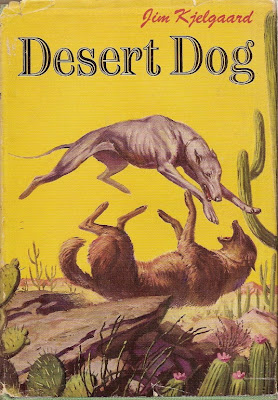
Stirred up by all this I searched the Intarwebz for an example and ended up buying this splendid copy, complete with dj, of Jim Kjelgaard's 1956 Desert Dog, about an escaped racing greyhound in Arizona.
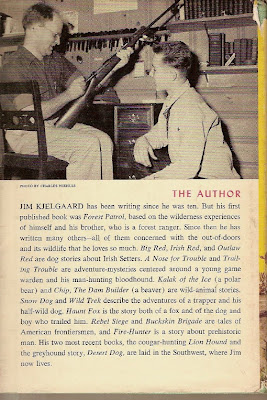
 REMARKABLY impossible dj photos for today: author showing child a rifle!
Nothing like them around today but Donald McCaig's well- written adult dog novels, though their success suggests that urban publishers may be missing a market.
I hadn't thought of them in years when Patrick Porter, flower grower, dog and pigeon man, and too- infrequent writer, asked our small pigeon group about a particular childhood volume. We couldn't quite find that one but (much younger but with a rural Maine background) climatologist Jacob Sewell and I both suddenly began to remember an amazing variety.
Patrick began:
"Does anyone remember a book from the early seventies [late for this "genre"--SB]about a large dog dumped from a family vehicle and then fends for itself somewhere in the northern states (Minnesota or something)? I think it was titled "The Big Dog". Dog gets dumped, dog gets blamed for sheep kills, boy finds and befriends dog and both are redeemed. It was a pleasure to read, and as my children struggle with literary interest, I thought I'd shove it at them. They are interested in the subject matter.
"In this book, wolves are referred to as "Manitoba Cruisers".
Jake replied:
"I have to admit I don't. I don't know what age/reading demographic your children are in but if dog/animal stories are up their alley you could always push the Jim Kjelgaard books (Big Red, Outlaw Red, Stormy, Lion Hound etc.). All about dogs. The main core about Irish Setters and bird hunting, but others on a lion hunting hound, trapping a fox, a sled dog, a stray retriever, others I may be missing. All good books. As you are a setter (English) man there are two older books one title "Wild Hunter" about an English Setter spotted hunting pheasant wild in a farm field. Boy buys her from farmer (who used her to herd cows), trains her into gun dog, she is shot by a buffoon and becomes gun shy. Saves boy from some mishap and in process overcomes her fear of guns. Another book titled "Raff" and maybe with the subtitle of "Story of an English Setter" that is also about bird hunting with, obviously, English Setters. On bird hunting there is also "Prince Champion Cocker" about a runt, golden cocker purchased as a pet, turns out to have great hunting drive and becomes a field trial champion.
"I was also (still am) a fan of any of Louis L'Amour's books as a kid. Max Brand also wrote some good books, not as big a fan of his traditional westerns which tend to be very cookie cutter dime novel, but he also salted things through with books on, or related more to animals that I recall really liking. One titled "Sled Dog Man" or something about a guy who lives in AK and is obsessed with creating the perfect sled dog via breed crossing. The protagonist gets roped in as his employee on a bet/dare and finds that he has produced the perfect sled dog, but they are untractable killers. Protagonist tames dogs and creates finest sled team ever. I think he also wrote one about an orphan kid who grows up as a mountain man with a "pet" bear. There are also several books, names escape me, about sight hounds (wolf/deer hounds usually) in the west.
"Hope that helps. I'm ready to go hide out in a sunny corner with a stack of childhood nostalgia."
Then me:
"Those are all ones I was thinking of but written in the thirties, forties,
fifties (last is when I read them). Also many herding collie ones, mostly
set in Scotland-- Bob, Son of Battle; Beth, a Sheep Dog by Ernest Lewis--
this also has falconry and lurchers!--I actually still have a copy.) Awol,
about a Doberman who was in the Pacific war-- I think this was a series. A
book with Lady in the title about a basenji who was also a bird dog--!"
Finally Jake again:
"You are right, I read the Basenji one too -- I believe they lived in the swamp? Also the herding collies, though I wasn't as fond of those books as they tended to be longish and the plot lines run together. But I recall Bob, Son of Battle. And one about "Lad". I forgot in the "hound" genre -- The obvious classic, "Where the Red Fern Grows". Also 'Bristleface" about a stray fox hound with a bristly face who turned out to be a rare breed of fox hound, and a good one. Another book, maybe with the word Ghost in the title, that was about fox hounds. A farm with a history of good fox hounds. Couple of kids train up a young dog and set him out with the dogs the old timers run (every night, just sit by the fire and let the dogs run). The dog has a beautiful voice but the kids keep it all under wraps. They sneak out there on the train and in the end the dog gets killed by the train, but a great book."
Stirred up by all this I searched the Intarwebz for an example and ended up buying this splendid copy, complete with dj, of Jim Kjelgaard's 1956 Desert Dog, about an escaped racing greyhound in Arizona.
 REMARKABLY impossible dj photos for today: author showing child a rifle!
Nothing like them around today but Donald McCaig's well- written adult dog novels, though their success suggests that urban publishers may be missing a market.
Real Influences: Travel Writing
While reading Douglas Botting's 2000 bio of Gerald Durrell I came upon these lines: "Young men woke up to find that the world was once again their oyster, and not just a place you went on a troopship. At almost the same time that the Durrell brothers' two books werepublished [1953] a galaxy of talened travel writers, including Laurens van der Post, Gavin Maxwell, Patrick Leigh Fermor, and Norman Lewis*, were also bringing out new books, while one- off new accounts of new worlds conquered or explored, such as Jacques Cousteau's The Silent World, Heinrich Harrer's Seven Years in Tibet and John Hunt's The Conquest of Everest-- all published in this same annus mirabilis of 1953-- were in large demand."
These were my stars. Childhood influences were Kipling, and the American naturalists like William Beebe; the only nominal kids' books I read were White's The Sword and the Stone and "dog novels", about which I will post later. "Adult" influences that I read much later and still admire include Hemingway and near- contemporaries like Tom McGuane.
But those guys were my gold standard, as I suspect they were and are for, again, contemporaries like the late Bruce Chatwin and Redmond O'Hanlon (he is often dismissed as a "mere" humorist-- go read that five- star book and tell me that is so).
I still admire them; even wrote the intro for this re- issue. And while I would hesitate to compare myself to the masters of travel, one perceptive critic, John Derbyshire, has at least noted the debt correctly. From the Washington Times, on Eagle Dreams:
"This is a very striking and unusual book, sufficiently so that I imagine the people responsible for awarding it a Dewey Decimal number, in order to properly shelve it in libraries, must have engaged in some head-scratching.
"Is Eagle Dreams_sport, travel, or zoology? You will have to make up your
own mind. I have put it among my travel books, along with Paul Theroux, Eric Newby and Robert Byron; and I believe that those distinguished persons would welcome Stephen Bodio into their company as an equal. He writes as they did, of strange things in remote places, described in a plain, unaffected style, spiced with humor, recondite knowledge, and the fatalism of the seasoned traveler. Towards the peoples he encounters the author is sympathetic without ever being sentimental, and there is a hint of melancholy as he shows us, inching upwards in the distance, the waters of
modernity that will eventually engulf a way of life that has persisted for millennia."
I should add that this is the best or at least most perceptive review I have ever had, and it was from before I corresponded with John; in fact it lead to our correspondence.
Of course, though he called it "Aquila Non Capit Muscas", the editors retitled it "A Kazakh Sport's Lasting Allure". Sigh.
All of those writers are gone now but Leigh- Fermor, in his nineties, dreaming away on his isle off the coast of Greece, still working on his third volume of his "walk" trilogy like some combination of old Odysseus and Circe...
(By the way, in his Amazon review of the Durrell bio that started this thread, old friend Greg McNamee seems to think that "his work is not widely read today". As his work brings up 416 results on Amazon, many in print, and there was just a new adaptation of "My Family and Other Animals", I respectfully disagree.)
*I link to only one Norman Lewis because unlike other writers here there seems to be more than one writer of that name.
These were my stars. Childhood influences were Kipling, and the American naturalists like William Beebe; the only nominal kids' books I read were White's The Sword and the Stone and "dog novels", about which I will post later. "Adult" influences that I read much later and still admire include Hemingway and near- contemporaries like Tom McGuane.
But those guys were my gold standard, as I suspect they were and are for, again, contemporaries like the late Bruce Chatwin and Redmond O'Hanlon (he is often dismissed as a "mere" humorist-- go read that five- star book and tell me that is so).
I still admire them; even wrote the intro for this re- issue. And while I would hesitate to compare myself to the masters of travel, one perceptive critic, John Derbyshire, has at least noted the debt correctly. From the Washington Times, on Eagle Dreams:
"This is a very striking and unusual book, sufficiently so that I imagine the people responsible for awarding it a Dewey Decimal number, in order to properly shelve it in libraries, must have engaged in some head-scratching.
"Is Eagle Dreams_sport, travel, or zoology? You will have to make up your
own mind. I have put it among my travel books, along with Paul Theroux, Eric Newby and Robert Byron; and I believe that those distinguished persons would welcome Stephen Bodio into their company as an equal. He writes as they did, of strange things in remote places, described in a plain, unaffected style, spiced with humor, recondite knowledge, and the fatalism of the seasoned traveler. Towards the peoples he encounters the author is sympathetic without ever being sentimental, and there is a hint of melancholy as he shows us, inching upwards in the distance, the waters of
modernity that will eventually engulf a way of life that has persisted for millennia."
I should add that this is the best or at least most perceptive review I have ever had, and it was from before I corresponded with John; in fact it lead to our correspondence.
Of course, though he called it "Aquila Non Capit Muscas", the editors retitled it "A Kazakh Sport's Lasting Allure". Sigh.
All of those writers are gone now but Leigh- Fermor, in his nineties, dreaming away on his isle off the coast of Greece, still working on his third volume of his "walk" trilogy like some combination of old Odysseus and Circe...
(By the way, in his Amazon review of the Durrell bio that started this thread, old friend Greg McNamee seems to think that "his work is not widely read today". As his work brings up 416 results on Amazon, many in print, and there was just a new adaptation of "My Family and Other Animals", I respectfully disagree.)
*I link to only one Norman Lewis because unlike other writers here there seems to be more than one writer of that name.
Monday, December 17, 2007
Links
A wonderful ancient sculpture.
All- female lizard clone species. Several of these are common in the Magdalena area.
Terrierman talks about veterinarian bill- padding, kickbacks etc. Luckily ours is an old- fashioned ranch woman-- but I have seen both the demand for pre- op bloodwork and the referral kickback.
Did a comet contribute to the Pleistocene extinctions? It looks more complicated all the time. HT Chas.
The Swedish army castrates its heraldic lion. So why does it leave the mane on?
Could the founders have been any more explicit about the Second amendment?
Stuffed roadkill toys are almost too weird. HT Laura Niven.
Dog armor. Chas again. He suggests chain mail for tazis.
A book about how to build toy guns and projectile launchers out of Legos has become a surprise best- seller.
A new organization to fight for sporting dog owners. HT Michael Spies.
Pluvialis has a good review of the not- very- good Golden Compass here. Saved me a few bucks-- it was the best of the books, with its cold Oxford and colder North, but if they can't give me good daemons I'm not going! She also links to a surprisingly affable discussion between Pullman and a Christian film critic-- surprising because I thought he would be more like the irritating "smug" Dawkins ("smug" as counterpart to the Dawkins- Dennet "bright".)
(And yes, Dawkins is a great writer on biology. I just wish he would follow the advice of his predecessor Huxley (in his debate with Ussher) when venturing out of comfortable territory.)
All- female lizard clone species. Several of these are common in the Magdalena area.
Terrierman talks about veterinarian bill- padding, kickbacks etc. Luckily ours is an old- fashioned ranch woman-- but I have seen both the demand for pre- op bloodwork and the referral kickback.
Did a comet contribute to the Pleistocene extinctions? It looks more complicated all the time. HT Chas.
The Swedish army castrates its heraldic lion. So why does it leave the mane on?
Could the founders have been any more explicit about the Second amendment?
Stuffed roadkill toys are almost too weird. HT Laura Niven.
Dog armor. Chas again. He suggests chain mail for tazis.
A book about how to build toy guns and projectile launchers out of Legos has become a surprise best- seller.
A new organization to fight for sporting dog owners. HT Michael Spies.
Pluvialis has a good review of the not- very- good Golden Compass here. Saved me a few bucks-- it was the best of the books, with its cold Oxford and colder North, but if they can't give me good daemons I'm not going! She also links to a surprisingly affable discussion between Pullman and a Christian film critic-- surprising because I thought he would be more like the irritating "smug" Dawkins ("smug" as counterpart to the Dawkins- Dennet "bright".)
(And yes, Dawkins is a great writer on biology. I just wish he would follow the advice of his predecessor Huxley (in his debate with Ussher) when venturing out of comfortable territory.)

Friday, December 14, 2007
A Few More Thoughts on Cranes
I have eaten crane (not mine) and it was wonderful. They are grain eaters and don't taste fishy as most of those others that Julie mentions, such as herons, are alleged to-- more like fine roast beef. They are also wary and difficult. Actually few hunt them, and those that do know they are good eating. They have a large population and are a serious agricultural pest in the Rio Grande Valley-- if they were not moved around by hunting farmers would be demanding (as they sometimes do anyway) that the refuge managers "bump" them down to Chihuahua by knocking down corn, where they are also a pest and are preyed on by humans in a much less controlled manner.
Also, Bosque del Apache, like most NWRs was established by hunter money-- and is now facing budget cuts.
For an interesting take on "hunters as locivores"-- something any regular reader knows we endorse-- see this NYT op- ed by Steven Rinella, author of The Scavenger's Guide to Haute Cuisine.
Also, Bosque del Apache, like most NWRs was established by hunter money-- and is now facing budget cuts.
For an interesting take on "hunters as locivores"-- something any regular reader knows we endorse-- see this NYT op- ed by Steven Rinella, author of The Scavenger's Guide to Haute Cuisine.
Hunting Cranes
A link at Home Range sent me to the blog of writer and NPR commentator Julie Zikefoose, who recently posted on the topic of Sandhill cranes and her consternation at the thought of hunting them. Zikefoose's good writing piqued Henry Chappell's interest some time ago when she admitted sometimes not releasing the house sparrows she traps on behalf of her bluebirds...
Her tone here, as Henry notes, is a little bit grouchy. But the range of replies from her regular readers takes grouchiness to new vistas. It's fair to say that most found the thought of hunting cranes repugnant. Much of the bile centered around the phrase "sport hunting," (a pet peeve of mine, too!) and disbelief that anyone would kill cranes for fun.
Zikefoose writes: "The thought of bringing these long-lived, monogamous, family-oriented and highly intelligent birds down for sport or roasting makes me physically ill. But then a lot of what's done in the name of sport hunting makes me ill. I know I'm getting crankier as I get older, and more conservative about speaking out because it might just be crankiness at work. But there's something about sport hunting of sandhill cranes that strikes me as fundamentally, indefensibly, sickeningly wrong."
After reading the list of comments and Julie's lively (and less grouchy) replies, I screwed up my courage and jumped into the pool. Given the interesting exchange that followed, I'm pleased I did!
Carefully, I wrote to Julie:
Her tone here, as Henry notes, is a little bit grouchy. But the range of replies from her regular readers takes grouchiness to new vistas. It's fair to say that most found the thought of hunting cranes repugnant. Much of the bile centered around the phrase "sport hunting," (a pet peeve of mine, too!) and disbelief that anyone would kill cranes for fun.
Zikefoose writes: "The thought of bringing these long-lived, monogamous, family-oriented and highly intelligent birds down for sport or roasting makes me physically ill. But then a lot of what's done in the name of sport hunting makes me ill. I know I'm getting crankier as I get older, and more conservative about speaking out because it might just be crankiness at work. But there's something about sport hunting of sandhill cranes that strikes me as fundamentally, indefensibly, sickeningly wrong."
After reading the list of comments and Julie's lively (and less grouchy) replies, I screwed up my courage and jumped into the pool. Given the interesting exchange that followed, I'm pleased I did!
Carefully, I wrote to Julie:
I enjoyed your sincere piece on the Sandhills and the prospect (or the horror) of hunting them. I am a hunter---not of cranes, but of other birds I'm sure we both would agree are beautiful and wonderful and worth protecting.
It's a conundrum, the hunter's worldview, and an old one. Michael Pollan called it "The Omnivore’s Dilemma," which expands the implication to all of us---even those who choose not to hunt or eat meat.
My aim here is not a defense of hunting. But I would like to comment on the use of the term "sport hunting," which, like you, I also find offensive and difficult to reconcile.
A few years ago, the USF&WS proposed a review on the "sport hunting of migratory birds," which included an opportunity for public comment. My comment (as a hunter of migratory birds) was obviously in support of continuing the Service's hugely successful wildfowl conservation programs, which are funded in large part by hunting permit fees.
But I took objection to the casual use of the term "sport hunting," which I view as implying that the activity has no practical purpose or intrinsic value and is thus merely an exercise in cruelty.
From the comments posted here, I think a lot of folks feel the
same way.
It may be that some hunters kill only for sport, meaning they
have no intention of eating the animal, and that, moreover, they view killing it only a test and proof of their skill. Large white men in safari hats standing over dead lions come to mind.
But believe it or not, such people are rare. Whether they should properly be called “hunters” or “shooters” is a point of some debate in hunting circles; the fact is, most people who hunt wild animals eat them. Securing food is a necessary component of hunting for most
Americans, even in this “time of plenty,” when plastic wrapped meat can be purchased from Wal-Mart.
I said this was no defense of hunting, but I suppose it is a defense of eating animals, generally. If you choose to eat animals, then you must choose either to kill them yourself or pay someone else to do it for you.
On a small scale, paying someone else to do the killing is a practical and long-held practice among people in small communities everywhere. It is no cruelty or moral cop-out to let a small local farmer provide your meat.
But to buy meat from huge corporate supermarkets is to buy meat from animals almost certainly raised in horrifying squalor and
crushing density and killed with indifference to every value except profit.
Yet I do this, and most Americans do too. It is not particularly pleasurable to think about.
In high contrast (to me at least), is my seasonal hunting for meat. An animal still dies to feed me and my family, but it is not one raised in a pile of manure, penned tight against a thousand others and pumped full of drugs so that it can die young in a factory rather than even
sooner from stress and disease.
Avoiding the support of such horror to do, instead, only what the cats and hawks and coyotes do for a living is a pleasure and an honor.
As long as I choose to eat meat, I will choose to hunt (clean, and cook) as much of it myself as I can.
Julie sent back a welcome, very friendly reply, restating her central question in a way a hunter might be able to address it:
{snip}...I hope you appreciate that, as a carnivore, I can't and won't criticize hunting for food. I admire people who can kill, clean and prepare their own food. I've been inside hundreds of dead birds and animals in preparing specimens, eaten lots of venison given to me by hunter friends. I buy local, humanely raised meat as well as the Styro-packaged stuff. I completely agree with you on those points (and have a series of sustainable farming posts now) No problem there. The point I'm trying to make is that I don't understand why sandhill cranes should be subjected to hunting, when herons and egrets aren't.
Why not shoot roseate spoonbills? Why not wood storks? They're coming back. There are probably enough of them to support shooting a few every year. That's my point....
Mike from (Sometimes Far Afield) and I both replied, making our cases for the hunting of cranes, he with some actual experience to share and me with none (but plenty of hot air to fuel us both). If you're interested to follow along and perhaps weigh in, click here.
Wednesday, December 12, 2007
The New Bird
Believe it or not, he's relaxing.

But anything with eyes like these never looks relaxed.

"God may fly a Peregrine, but the devil flies a Goshawk".
But anything with eyes like these never looks relaxed.
"God may fly a Peregrine, but the devil flies a Goshawk".
Tuesday, December 11, 2007
Human Evolution is Accelerating
Back when I was in graduate school the general consensus was that human evolution had generally halted or at least slowed in the early Holocene. It was believed that the strong evolutionary pressures that had operated on early hunter - gatherer populations had eased with the transition to agricultural economies and settled life.
Estimable University of Wisconsin professor and anthropology blogger John Hawks is a member of a team who's research has stood this former consensus on its head. In a just published paper Hawks and his colleagues show that the rate of change in the human genome has been increasing:
"By examining more than 3 million variants of DNA in 269 people, researchers identified about 1,800 genes that have been widely adopted in relatively recent times because they offer some evolutionary benefit.
Until recently, anthropologists believed that evolutionary pressures on humans eased after the transition to a more stable agrarian lifestyle. But in the past few years, they realized the opposite was true — diseases swept through societies in which large groups lived in close quarters for a long period.
Altogether, the recent genetic changes account for 7 percent of the human genome, according to the study, published in the Proceedings of the National Academy of Sciences.
The advantage of all but about 100 of these genes remains a mystery, said University of Wisconsin at Madison anthropologist John Hawks, who led the study. But the research team was able to conclude that infectious diseases and the introduction of new foods were the primary reasons that some genes swept through populations with such speed."
RTWT as they say. Hawks has more on the paper posted at his blog.
I was also intrigued by this fact that Hawks throws out, related to the mystery of the adaptive advantage of most of these genetic changes:
"Nobody 10,000 years ago had blue eyes," Hawks said. "Why is it that blue-eyed people had a 5 percent advantage in reproducing compared to non-blue-eyed people? I have no idea."
Estimable University of Wisconsin professor and anthropology blogger John Hawks is a member of a team who's research has stood this former consensus on its head. In a just published paper Hawks and his colleagues show that the rate of change in the human genome has been increasing:
"By examining more than 3 million variants of DNA in 269 people, researchers identified about 1,800 genes that have been widely adopted in relatively recent times because they offer some evolutionary benefit.
Until recently, anthropologists believed that evolutionary pressures on humans eased after the transition to a more stable agrarian lifestyle. But in the past few years, they realized the opposite was true — diseases swept through societies in which large groups lived in close quarters for a long period.
Altogether, the recent genetic changes account for 7 percent of the human genome, according to the study, published in the Proceedings of the National Academy of Sciences.
The advantage of all but about 100 of these genes remains a mystery, said University of Wisconsin at Madison anthropologist John Hawks, who led the study. But the research team was able to conclude that infectious diseases and the introduction of new foods were the primary reasons that some genes swept through populations with such speed."
RTWT as they say. Hawks has more on the paper posted at his blog.
I was also intrigued by this fact that Hawks throws out, related to the mystery of the adaptive advantage of most of these genetic changes:
"Nobody 10,000 years ago had blue eyes," Hawks said. "Why is it that blue-eyed people had a 5 percent advantage in reproducing compared to non-blue-eyed people? I have no idea."
Friday, December 07, 2007

Thursday, December 06, 2007
Last word on Mailer, plus..
Phillip posted below on Mailer, and I agree. A last word, from an email I sent:
Betsy once wrote, for the MIT paper, an announcement on him-- something like "the overrated self- regarding egotist Norman Mailer will appear..."
She assumed it would be caught in rewrite but it wasn't.
His Gary Gilmore book was a good Western book but maybe twice as long as it should have been.
Remember Tallulah Bankhead's remark to him after being introduced to him at a party shortly after The Naked and the Dead was published: "Oh-- you're the young man who can't spell 'fuck'."
A lot of attention is being paid to that just- past generation of (mostly male) novelists-- in the blogosphere*; in the New Yorker (Styron; not online yet.) They were all so ..northeastern, even the ones born elsewhere, unlike the stars of the previous one like Hemingway and Faulkner.
And I wonder if novelists will ever loom so large in the culture again.
*Unique and wonderful blog-- must post on it later.
Betsy once wrote, for the MIT paper, an announcement on him-- something like "the overrated self- regarding egotist Norman Mailer will appear..."
She assumed it would be caught in rewrite but it wasn't.
His Gary Gilmore book was a good Western book but maybe twice as long as it should have been.
Remember Tallulah Bankhead's remark to him after being introduced to him at a party shortly after The Naked and the Dead was published: "Oh-- you're the young man who can't spell 'fuck'."
A lot of attention is being paid to that just- past generation of (mostly male) novelists-- in the blogosphere*; in the New Yorker (Styron; not online yet.) They were all so ..northeastern, even the ones born elsewhere, unlike the stars of the previous one like Hemingway and Faulkner.
And I wonder if novelists will ever loom so large in the culture again.
*Unique and wonderful blog-- must post on it later.
More Pygmies
We discussed before here the interesting phenomenon that often occurs when species of large fauna get trapped on islands. Natural selection in the restricted habitat favors smaller individuals and you end up with a dwarf or pygmy subspecies.
Previously we talked about pygmy mammoths in the California Channel Islands and dwarf water buffalo in the Philippines. Yesterday I saw this piece on dwarf hippopotamuses found on Cyprus. Intriguing to think of hippos that were two and a half feet tall and four feet long.
Previously we talked about pygmy mammoths in the California Channel Islands and dwarf water buffalo in the Philippines. Yesterday I saw this piece on dwarf hippopotamuses found on Cyprus. Intriguing to think of hippos that were two and a half feet tall and four feet long.
"Arboricide"
Joe Brown
Chas has a link to an excellent piece on the fine and neglected western writer JPS (Joseph Paul Summers) Brown.
I met Joe Brown when we were both signing books at a sadly defunct bookstore in Tucson. I had brought a copy of his Forests of the Night, which could give Cormac McCarthy a run for his money, for him to sign.

Here is what he wrote:
 And what he looked like when he wrote the book:

I met Joe Brown when we were both signing books at a sadly defunct bookstore in Tucson. I had brought a copy of his Forests of the Night, which could give Cormac McCarthy a run for his money, for him to sign.

Here is what he wrote:
 And what he looked like when he wrote the book:
He regaled us with tales that could have come out of the old west but for the fact that they took place in the Sixties, of border cattle smuggling and Mexican bordellos (including one about a prominent local rancher we knew).
I am delighted that UNM Press has published an autobiography of his childhood, and will soon be releasing a new novel. Among other things, he just plain deserves it. And it gives me hope.
I am delighted that UNM Press has published an autobiography of his childhood, and will soon be releasing a new novel. Among other things, he just plain deserves it. And it gives me hope.
Goshawk
For the first time in nearly a decade we have a Gos in the dining room- kitchen alcove at Casa Q:
 He is a bit of a rehab case-- he is utterly terrified of dogs, though Ataika is trying to teach him, and when he is at a lower weight he is alleged to scream and attack feet. But he is a big handsome Wyoming tiercel and I think we can do something for, and with, him.
He is a bit of a rehab case-- he is utterly terrified of dogs, though Ataika is trying to teach him, and when he is at a lower weight he is alleged to scream and attack feet. But he is a big handsome Wyoming tiercel and I think we can do something for, and with, him.
Dog pix of the week
Looking northwest on the ranch from the northeast corner:

'Rissa runs:

Lashyn:

"Want a bath, 'Taik?"

"I don't think so."

'Rissa runs:
Lashyn:
"Want a bath, 'Taik?"
"I don't think so."
Projectiles
In days past, black powder and especially bow hunters were the most careful of all. Most were "naturalist" hunters, and had the ability to stalk close as well as the discipline not to take a shot that was less than perfect.
Now, with a lot more time open for bowhunters and the availability of modern- type black powder guns that LOOK like they could be accurate over long distances, I wonder if this is as true.
Consider these three projectiles:

Above, obviously, is a broadhead. Below left is a fragment of what appears to be a .50 caliber ball. Both were found encysted, for lack of a better word, in a beautiful bull elk confiscated from a road hunter (we were lucky enough to get the meat!) The third is the muzzle loader bullet, ironically fired at a more sensible range, that killed him. I hate to think of the pain that the arrowhead in particular must have caused.
I am not saying not to hunt with bows, though I do not think I am good enough. I am not saying not to hunt with modern muzzleloaders-- though most are in .50 caliber, one I consider marginal at best for elk. What I am saying is that bow and black powder hunters should learn the limits of their chosen tools.
Now, with a lot more time open for bowhunters and the availability of modern- type black powder guns that LOOK like they could be accurate over long distances, I wonder if this is as true.
Consider these three projectiles:
Above, obviously, is a broadhead. Below left is a fragment of what appears to be a .50 caliber ball. Both were found encysted, for lack of a better word, in a beautiful bull elk confiscated from a road hunter (we were lucky enough to get the meat!) The third is the muzzle loader bullet, ironically fired at a more sensible range, that killed him. I hate to think of the pain that the arrowhead in particular must have caused.
I am not saying not to hunt with bows, though I do not think I am good enough. I am not saying not to hunt with modern muzzleloaders-- though most are in .50 caliber, one I consider marginal at best for elk. What I am saying is that bow and black powder hunters should learn the limits of their chosen tools.
Wednesday, December 05, 2007
Ex Nihilo, X-Factor
Pluvialis continues to spellbind in reports on her goshawk adventures. If you haven't been following along, you're missing the show. A recent update included a remarkable observation about the kind of out-of-body experience common to many who love the countryside but live in the city.
I hope Pluvi won't mind a lengthy borrowing. Thinking of the hills to which she and her gos escape, she writes:
What a beautiful way to express this feeling I know so well! Steve and Rebecca can attest to how uniquely falconry can sew one into the landscape, but I bet the same feeling is common to other hunters, to farmers and to many who cannot be satisfied except to walk off the pavement.
Lament enters whenever we pause to consider we live mostly removed from the places we know and love best. Clearly, it is not impossible to love a town or a city. But my sense is that we are equipped as animals and (more importantly) as living things, to perceive a greater depth of detail and richness in our surroundings than we are given in views of artificial planes and angles. We need the full package of sensory input we're designed to accept; only a living environment can provide this.
As Pluvi said, it is not just biophilia that draws her to the hills, but that must be part of it.
How do we reconcile this disconnect? For falconers, our hawks and dogs provide part of the answer. Trained animals serve as conduits---that's how I see them, anyway---between the built environments we work and sleep in and the relative wildernesses we recreate in. Our animals at home, preening on perches and curled on couches, come alive in the field in a way we recognize immediately and can share almost as fully. A place for us is made as participant observers and passive directors of a team hunt. It's an old place we've grown into.
To travel around Baton Rouge is to cross, by necessity, a lot of hard concrete and to pass parking lots for newish, square-fronted buildings. Certain destinations are pleasant and walkable and worth seeing, but the journeys are mostly stark and unappealing.
And I LIKE Baton Rouge! It's home. It is actually an old city with a long human history spanning several cultures and more than two centuries. But it's getting newer by the day. It's turning itself upside down and re-facing its surfaces with more of the hard planes and angles that leave a guy like me desperate for sensory input. I get desperate for complication and richness and the kind of "difficulty" Pluvi finds in her Cambridge hillsides.
Trying to be generous to older cities and understand why they endure, I mentioned to her of a day in New Orleans---our city of respectable endurance if a questionable future.
Walking along the French Quarter, I once spotted through a crack in the asphalt a stratified history of the street’s pavements. The oldest seemed to be of raw cypress planks, set into the mud on end to make a kind of wooden cobblestone effect. I don’t know when it might have been laid down.
I tried to imagine the entire street paved in milled posts. A neighborhood of stone and cypress-walled houses painted Creole pastels and roofed in wood shingles. Mules pulling carts, stray dogs mingling with horses and people in the streets. Wading birds passing in formation twice a day. Windows and doors open, cooking fires going, the French Market rough and alive.
There was then in the city of New Orleans malaria and yellow fever and cholera but probably no sensory deprivation!
What else can we say about the difference between the built and more natural (not necessarily wilderness) environments we may prefer? Can anyone help define the x-factor?
I hope Pluvi won't mind a lengthy borrowing. Thinking of the hills to which she and her gos escape, she writes:
"These days, when I go into town, I’m increasingly finding excuses to park my car in the Grand Arcade car park, because I know that if I reverse the car into the open-air section of the fourth floor, I can lock the car, lean out over the rail and stare at these very fields. They run like a backbone across the horizon, scratched with copse-lines and damped with cloud-shadow.
"From the carpark, there’s no sense that the hills and the town are conjoined. A strange complication arises. Something of a doubling. Leaning out over the rail, I can feel myself standing up on the hill, miles away. There’s a terrible yearning to this intuition. It's almost as if my soul really is up there, several miles distant sitting on the hill in a den of salad burnet and dried thistles, watching my soul-less self standing in the car-park, with diesel and concrete in its nose and anti-skid asphalt underfoot. With the car-park self thinking if she looks very, very hard, perhaps through binoculars, she might see herself up there.
"Is this because I know that land intimately, every hedgerow, every thin track through dried grass where the hares cut across field-boundaries, every rusted bit of agricultural machinery, every warren and tree? Certainly the high spires and towers aren't graspable in that familiar way. They're no-one's habitat. You can't walk them. Nothing lives on them. They're designed to command, not engender the small-scale familiarity and love common to field-margins, ditches and hedgerows full of herbage and birds."
What a beautiful way to express this feeling I know so well! Steve and Rebecca can attest to how uniquely falconry can sew one into the landscape, but I bet the same feeling is common to other hunters, to farmers and to many who cannot be satisfied except to walk off the pavement.
Lament enters whenever we pause to consider we live mostly removed from the places we know and love best. Clearly, it is not impossible to love a town or a city. But my sense is that we are equipped as animals and (more importantly) as living things, to perceive a greater depth of detail and richness in our surroundings than we are given in views of artificial planes and angles. We need the full package of sensory input we're designed to accept; only a living environment can provide this.
As Pluvi said, it is not just biophilia that draws her to the hills, but that must be part of it.
"It's not biophilia per se that makes it better up on the hill. Not just that there are animals up there. But that there are many animals up there who see the land in different ways and live on it in different ways, and I think this just makes the land richer, thicker, more interesting and loveable..."
How do we reconcile this disconnect? For falconers, our hawks and dogs provide part of the answer. Trained animals serve as conduits---that's how I see them, anyway---between the built environments we work and sleep in and the relative wildernesses we recreate in. Our animals at home, preening on perches and curled on couches, come alive in the field in a way we recognize immediately and can share almost as fully. A place for us is made as participant observers and passive directors of a team hunt. It's an old place we've grown into.
To travel around Baton Rouge is to cross, by necessity, a lot of hard concrete and to pass parking lots for newish, square-fronted buildings. Certain destinations are pleasant and walkable and worth seeing, but the journeys are mostly stark and unappealing.
And I LIKE Baton Rouge! It's home. It is actually an old city with a long human history spanning several cultures and more than two centuries. But it's getting newer by the day. It's turning itself upside down and re-facing its surfaces with more of the hard planes and angles that leave a guy like me desperate for sensory input. I get desperate for complication and richness and the kind of "difficulty" Pluvi finds in her Cambridge hillsides.
Trying to be generous to older cities and understand why they endure, I mentioned to her of a day in New Orleans---our city of respectable endurance if a questionable future.
Walking along the French Quarter, I once spotted through a crack in the asphalt a stratified history of the street’s pavements. The oldest seemed to be of raw cypress planks, set into the mud on end to make a kind of wooden cobblestone effect. I don’t know when it might have been laid down.
I tried to imagine the entire street paved in milled posts. A neighborhood of stone and cypress-walled houses painted Creole pastels and roofed in wood shingles. Mules pulling carts, stray dogs mingling with horses and people in the streets. Wading birds passing in formation twice a day. Windows and doors open, cooking fires going, the French Market rough and alive.
There was then in the city of New Orleans malaria and yellow fever and cholera but probably no sensory deprivation!
What else can we say about the difference between the built and more natural (not necessarily wilderness) environments we may prefer? Can anyone help define the x-factor?
Tuesday, December 04, 2007
Done & Back! (With links)
I shipped off the remaining part of the book project last week-- illos, captions, credits-- and have my life back, though my brain doesn't believe it yet. I have a HUGE backlog of links plus some photo posts and essays planned, but I don't intend to do them all today, so bear with me. This boy needs to get out more.
Links first.
Patrick makes a fierce liberal case for the Second Amendment.
Alex Massie imagines a Distressed Writers' Agency:
"What's needed, then, is a new kind of literary agency. Rather than the established model of matching authors with publishers, we need an agency that specialises in pairing the people plagued by a surfeit of ideas and deficit of willpower with those afflicted with precisely the opposite condition.
"Take Client A, for instance. He swims in ideas every morning. The poor fellow can scarcely read the newspaper without an idea for a short story or play or film or, in exceptionally hideous moments, a poem popping into his head. Why, he says to himself, that's capital material for a writer. Time, surely, that someone made something of it. Alas, Client A has so many notions that no sooner does he sit down to crack on with his latest wheeze than he is socked by another, shinier, better (or at least newer) idea that is, he is sure, this time, the one that will make his bloody name once and for all. Client A, it may not surprise you to learn, is an expert at writing acceptance speeches for prizes given to films and books that remain, alas, unwritten."
RTWT of course.
A lawyer and a judge steal somebody else's property, and want to be paid for it. Isn't this cause for disbarment??
"A leading children's author was told to drop a fire-breathing dragon shown in a new book - because the publishers feared they could be sued under health and safety regulations."
I posted below on a New York Times piece on urbanites who fear the country. Sippican Cottage had more to say on the subject.
"Some armed local? Oh brother. In Sharon, Connecticut? People -- in Sharon Connecticut you lock your doors so your friends will know you're not home if they come over unexpectedly and you're out. They know where your key is anyway. William F. Buckley was born in Sharon Connecticut. Do you really think he's coming in the window at night with a dagger in his teeth and darkness in his heart for you because you're so Vegan you only eat things that don't cast a shadow? Get a grip."
A while back Mary referred to some of us as disciples of Rousseau becuause we argued for fewer rules. I at least was taken aback because my view of human nature is rather dark-- more Hobbes than Rousseau. Recently I found this quote from C S Lewis That rather sums up my view, if more religiously than I would state it:
"I am a democrat because I believe in the Fall of Man. I think most people are democrats for the opposite reason. A great deal of democratic enthusiasm descends from the ideas of people like Rousseau, who believed in democracy because they thought mankind so wise and good that every one deserved a share in the government. The danger of defending democracy on those grounds is that they’re not true. . . . I find that they’re not true without looking further than myself. I don’t deserve a share in governing a hen-roost. Much less a nation. . . . The real reason for democracy is just the reverse. Mankind is so fallen that no man can be trusted with unchecked power over his fellows. Aristotle said that some people were only fit to be slaves. I do not contradict him. But I reject slavery because I see no men fit to be masters."
Related: in a very funny post, Dr Hypercube quotes Kung Fu Monkey re "Robot overlords".
Tyrone: They bring world peace, universal health care –
John: At the cost of our freedoms!
Tyrone: MY POINT EXACTLY. We’re already giving up our freedoms — our right to privacy, gone.
It so happens that Lewis had something to day to that, too:
"Of all tyrannies, a tyranny exercised for the good of its victims may be the most oppressive. It may be better to live under robber barons than under omnipotent moral busybodies. The robber baron's cruelty may sometimes sleep, his cupidity may at some point be satiated; but those who torment us for our own good will torment us without end, for they do so with the approval of their own conscience."
Natural (?) history: a strange stuffed "cryptocanid" that was killed in Montana many years ago has been rediscovered in Idaho. Some of the suggestions (it is a dire wolf-- ONE??) are ridiculous but it would be interesting to do DNA studies. Darren?
Links first.
Patrick makes a fierce liberal case for the Second Amendment.
Alex Massie imagines a Distressed Writers' Agency:
"What's needed, then, is a new kind of literary agency. Rather than the established model of matching authors with publishers, we need an agency that specialises in pairing the people plagued by a surfeit of ideas and deficit of willpower with those afflicted with precisely the opposite condition.
"Take Client A, for instance. He swims in ideas every morning. The poor fellow can scarcely read the newspaper without an idea for a short story or play or film or, in exceptionally hideous moments, a poem popping into his head. Why, he says to himself, that's capital material for a writer. Time, surely, that someone made something of it. Alas, Client A has so many notions that no sooner does he sit down to crack on with his latest wheeze than he is socked by another, shinier, better (or at least newer) idea that is, he is sure, this time, the one that will make his bloody name once and for all. Client A, it may not surprise you to learn, is an expert at writing acceptance speeches for prizes given to films and books that remain, alas, unwritten."
RTWT of course.
A lawyer and a judge steal somebody else's property, and want to be paid for it. Isn't this cause for disbarment??
"A leading children's author was told to drop a fire-breathing dragon shown in a new book - because the publishers feared they could be sued under health and safety regulations."
I posted below on a New York Times piece on urbanites who fear the country. Sippican Cottage had more to say on the subject.
"Some armed local? Oh brother. In Sharon, Connecticut? People -- in Sharon Connecticut you lock your doors so your friends will know you're not home if they come over unexpectedly and you're out. They know where your key is anyway. William F. Buckley was born in Sharon Connecticut. Do you really think he's coming in the window at night with a dagger in his teeth and darkness in his heart for you because you're so Vegan you only eat things that don't cast a shadow? Get a grip."
A while back Mary referred to some of us as disciples of Rousseau becuause we argued for fewer rules. I at least was taken aback because my view of human nature is rather dark-- more Hobbes than Rousseau. Recently I found this quote from C S Lewis That rather sums up my view, if more religiously than I would state it:
"I am a democrat because I believe in the Fall of Man. I think most people are democrats for the opposite reason. A great deal of democratic enthusiasm descends from the ideas of people like Rousseau, who believed in democracy because they thought mankind so wise and good that every one deserved a share in the government. The danger of defending democracy on those grounds is that they’re not true. . . . I find that they’re not true without looking further than myself. I don’t deserve a share in governing a hen-roost. Much less a nation. . . . The real reason for democracy is just the reverse. Mankind is so fallen that no man can be trusted with unchecked power over his fellows. Aristotle said that some people were only fit to be slaves. I do not contradict him. But I reject slavery because I see no men fit to be masters."
Related: in a very funny post, Dr Hypercube quotes Kung Fu Monkey re "Robot overlords".
Tyrone: They bring world peace, universal health care –
John: At the cost of our freedoms!
Tyrone: MY POINT EXACTLY. We’re already giving up our freedoms — our right to privacy, gone.
It so happens that Lewis had something to day to that, too:
"Of all tyrannies, a tyranny exercised for the good of its victims may be the most oppressive. It may be better to live under robber barons than under omnipotent moral busybodies. The robber baron's cruelty may sometimes sleep, his cupidity may at some point be satiated; but those who torment us for our own good will torment us without end, for they do so with the approval of their own conscience."
Natural (?) history: a strange stuffed "cryptocanid" that was killed in Montana many years ago has been rediscovered in Idaho. Some of the suggestions (it is a dire wolf-- ONE??) are ridiculous but it would be interesting to do DNA studies. Darren?
Monday, December 03, 2007
Dinosaur Mummy
I saw several places this morning information on a dinosaur "mummy" found in North Dakota in 1999. "Mummy" really isn't the proper term - the fossil cast is unusual in that the soft tissues are very apparent:
"Unlike the collections of bones found in museums, this hadrosaur came complete with skin, ligaments, tendons and possibly some internal organs, according to researchers.
The study is not yet complete, but scientists have concluded that hadrosaurs were bigger -- 3 1/2 tons and up to 40 feet long -- and stronger than had been known, were quick and flexible and had skin with scales that may have been striped."
The interpretation of stripes is based on the observation of bands of different sized scales on the skin. It's been very frustrating that pictures of this haven't been posted that I can find.
This reminded me of a Douglas Preston adventure novel I read last year, Tyrannosaur Canyon, where the plot revolves around the discovery of of a T-rex preserved in a similar manner, but the mineral grain size is so small you can see features down to the cellular level.
"Unlike the collections of bones found in museums, this hadrosaur came complete with skin, ligaments, tendons and possibly some internal organs, according to researchers.
The study is not yet complete, but scientists have concluded that hadrosaurs were bigger -- 3 1/2 tons and up to 40 feet long -- and stronger than had been known, were quick and flexible and had skin with scales that may have been striped."
The interpretation of stripes is based on the observation of bands of different sized scales on the skin. It's been very frustrating that pictures of this haven't been posted that I can find.
This reminded me of a Douglas Preston adventure novel I read last year, Tyrannosaur Canyon, where the plot revolves around the discovery of of a T-rex preserved in a similar manner, but the mineral grain size is so small you can see features down to the cellular level.
More on Native American DNA
Matt and Chas both sent me this piece last week on another DNA study that shows Native Americans are most closely related to peoples in Siberia, indicating that is their point of origin. This isn't exactly news, but is another corroborating study apparently done on a larger scale than most in the past.
On a related topic, some of you may recall this post I did early last year that discussed the problems the Mormon Church was having reconciling the DNA evidence of Siberian origins with their church doctrine that Native Americans are descended from a Jewish tribe that emigrated here about 600 BC. Well this article I saw this morning says they have given up. The Book of Mormon has been revised:
"The old introduction read that, after thousands of years, all the Israelites were destroyed except one branch, known as the Lamanites, and these survivors were 'the principal ancestors of the American Indians.'
The new version reads that the Lamanites 'are among the ancestors of American Indians.'"
As I said last year, I don't think this will really mean much to the faith of the average LDS member, but I find it an interesting concession.
On a related topic, some of you may recall this post I did early last year that discussed the problems the Mormon Church was having reconciling the DNA evidence of Siberian origins with their church doctrine that Native Americans are descended from a Jewish tribe that emigrated here about 600 BC. Well this article I saw this morning says they have given up. The Book of Mormon has been revised:
"The old introduction read that, after thousands of years, all the Israelites were destroyed except one branch, known as the Lamanites, and these survivors were 'the principal ancestors of the American Indians.'
The new version reads that the Lamanites 'are among the ancestors of American Indians.'"
As I said last year, I don't think this will really mean much to the faith of the average LDS member, but I find it an interesting concession.
Saturday, December 01, 2007
I've just finished a month sans internet and tv. No saintly action, just a broken hardrive and an incomprehensible language, respectively.
So I read every book I brought. Ran out fast.
One of the books I brought was this monstrosity of a thing called The Executioners Song. I'd seen the film adaptation (loose use of 'adaptation'), Cremaster 2, and I was baffled and anxious to read the book.
Of course the ridiculous, hypnotic film didn't lend much to my expectations, but I've been trying of late to catch up on the things I'm embarrassed I haven't read. The most difficult of these gaps-to-fill is the generation I guess about 2 back, Roth, the aforementioned Updike, Vidal, Mailer, et c, the so-called Great Male Narcissists.
Mailer to me seems the best, but this is a highly uninformed opinion.
So, lacking recourse to anything else at all, I looked at the twelve inches of English language books available in Radom, Poland. There was a short book by Murikami, and Mailer's latest, soon to prove last, book, The Castle in the Forest. Short books are the enemy of the bored man, so despite loving Murikami and being highly ambiguous toward Mailer, I went with the longer, cheaper book.
Lord, it was awful. Unknown to me the author died as I was reading this book, probably thinking bad thoughts about him and it both.
So here's just a small word for the man, the great novelist of his generation without a great novel. Apollo astronauts, genius double-murderers, Hitler, Mailer, the man took on the big things, wrote some really long books, and I would say none of the biggest ones are really great, but they fail because he tries too hard, too much, his great books stop just short of great because he takes off from that near-great point to leap toward an impossible height.
To read this man is to see a great writer fail time and time again to write a great book because he cannot help but try to write a book beyond greatness.
Hats off to that.
So I read every book I brought. Ran out fast.
One of the books I brought was this monstrosity of a thing called The Executioners Song. I'd seen the film adaptation (loose use of 'adaptation'), Cremaster 2, and I was baffled and anxious to read the book.
Of course the ridiculous, hypnotic film didn't lend much to my expectations, but I've been trying of late to catch up on the things I'm embarrassed I haven't read. The most difficult of these gaps-to-fill is the generation I guess about 2 back, Roth, the aforementioned Updike, Vidal, Mailer, et c, the so-called Great Male Narcissists.
Mailer to me seems the best, but this is a highly uninformed opinion.
So, lacking recourse to anything else at all, I looked at the twelve inches of English language books available in Radom, Poland. There was a short book by Murikami, and Mailer's latest, soon to prove last, book, The Castle in the Forest. Short books are the enemy of the bored man, so despite loving Murikami and being highly ambiguous toward Mailer, I went with the longer, cheaper book.
Lord, it was awful. Unknown to me the author died as I was reading this book, probably thinking bad thoughts about him and it both.
So here's just a small word for the man, the great novelist of his generation without a great novel. Apollo astronauts, genius double-murderers, Hitler, Mailer, the man took on the big things, wrote some really long books, and I would say none of the biggest ones are really great, but they fail because he tries too hard, too much, his great books stop just short of great because he takes off from that near-great point to leap toward an impossible height.
To read this man is to see a great writer fail time and time again to write a great book because he cannot help but try to write a book beyond greatness.
Hats off to that.
Subscribe to:
Posts (Atom)