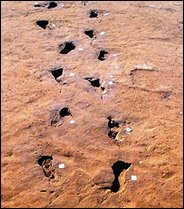
The NY Times and the Denver Post both have articles today on a significant archaeological discovery at a prehistoric Mayan site in El Salvador. Dr. Payson Sheets of the University of Colorado has been excavating at the Ceren site since the late 1970s, a 1,400 year-old site with miraculous preservation due to its burial by a volcanic eruption. I mentioned it in a post last year as a "New World Pompeii" that amazingly has received little popular notice. The picture above shows the reddish-colored walls and floor of a Mayan house at Ceren, buried by gray volcanic ash.
The discovery announced today helps answer questions about Mayan subsistence that have deviled archaeologists since the 1960s. It has been well documented that the Maya grew the classic triumvirate (maize, beans, and squash) of prehistoric North American agriculture, but it's been obvious for some time that nutrient weak jungle soils could not have supported the intensive farming of these crops required to support the dense Maya populations. There must have been other crops supporting the Maya that didn't deplete the soil as quickly as maize.
When I was in graduate school at CU, I took several courses from Dr. Sheets (he was on my thesis committee) where this topic was under discussion. One of the prime candidates for one of the other crops was manioc, a woody shrub with a carbohydrate-rich tuberous root, that had been domesticated by Indians in South and Central America. Manioc is usually processed into flour, has very high yields in poor soils, and is not a nutrient depleter like maize. The problem was with the poor preservation of material in Mayan sites in Central American jungles, no one could find direct evidence of its use. Maize appears in the iconography of Mayan glyphs, sculptures, and vase painting, but no one was able to identify anything that looked like manioc.
We had lots of discussions about indirect means of identifying the presence or use of manioc. Apparently its pollen is not preserved or identifiable. Manioc contains toxins that prevent it from being eaten raw. It must be shredded, pulped and processed to remove the poison. An early step in the processing is to peel the root and shred it on a grater.
For a project in a lithic technology seminar, I did a survey of the ethnographic literature on manioc graters and built a replica grater by embedding stone flakes I manufactured into a board. As I had no manioc, I used it to grate potatoes (used them for hash browns!) and then examined the flakes under a microscope to document the wear patterns left by the grating. The idea was even if the board had rotted away, if you found flakes in an archaeological site with that wear pattern, you could posit manioc processing. I'm not aware that any archaeologists working in Mayan sites followed up on this.
This was all put to rest however, by the latest discovery. From the Denver Post:
"Two months ago, Sheets and his team found strange cavities a few inches in diameter in what looked like a 1,400-year-old agricultural field, with raised beds surrounded by paths.
The archaeologists poured in dental plaster, waited for it to harden, and pulled out perfect replicas of manioc tubers - a carbohydrate-rich staple in much of the tropical world today.
With further excavation work, Sheets said, it became clear that the fields were worked just hours before a massive volcano covered the little village of Ceren with ash. Ceren lies about 15 miles west of San Salvador."
 The lower of the two plaster casts in this picture is of one of the manioc tubers. That is a cast of a tree limb above it. The Denver Post "dead tree" edition had a great picture of one of the raised beds.
So the question is answered after all these years. You can learn more about other discoveries at the Ceren site at this web site.