Showing posts sorted by date for query ice cream. Sort by relevance Show all posts
Showing posts sorted by date for query ice cream. Sort by relevance Show all posts
Sunday, December 07, 2014
What Happens When A Breeding Wolf Is Killed
“Lethal Control of Wolves Provides No Benefit to Livestock”
“Why A Ravening Wolf is a Sheep’s Best Friend”
Those were the headlines yesterday, as media outlets continue to hype a flawed Washington State University research paper that I panned over on Wolf Watch. The WSU researchers noted that through a certain time period:
1) the wolf population increased;
2) livestock depredations by wolves increased; and
3) control (killing) actions wolves to limit livestock depredations increased.
The WSU paper concluded that it was the increase in wolf control that caused the increase in livestock depredations (rather than the very large increase in the number of wolves).
Reminds me of the Ice Cream Murders which found that large cities have increased murder and violent crimes during hot months. During the same time period, sales of ice cream skyrocket. Does this mean ice cream turns people to murder?
Looking for a diversion, I checked my social media feed and found numerous posts about how killing wolves only increases the population when one of a pack’s lead wolves is killed, disrupting the pack’s social structure and making way for more members of the pack to breed. So, you silly ranchers, if you want to save your sheep, don’t kill wolves. Argh!
That someone would believe this stuff makes me crazed. If you’ve got wolves killing your sheep, often the only way you are going to stop it is to kill the wolf/wolves doing the damage – or remove your livestock. The wolves won’t have some Kumbaya moment by the light of the moon that turns them into vegetarians instead of meat eaters.
It’s time to review what is actually known about the effects of the loss of a breeding wolf from a wolf pack – not theory, not modeling, but what has been documented. This issue was addressed in a paper in the Journal of Wildlife Management in 2008: “The Effects of Breeder Loss on Wolves,” written by Scott Brainerd and 18 contributors. The Brainerd paper summarized nearly 150 records of breeder loss in wolf populations around the globe from 1970-2003 and found:
• Wolves reproduced within territories the season after breeder loss in about 47% of cases. (Less than half.)
• Breeders were more likely to be replaced within 12 months where breeders of one sex remained (60%) than where breeding pairs were absent.
• After a breeder loss, if the pack doesn’t reproduce the next season, the pack size is smaller than if the pack does reproduce. (Yes, this is a duh).
• The ability of wolves to reproduce the season after breeder loss was greater in cases where one breeder had to be replaced, than in cases where both breeders had to be replaced.
• The average time it takes for breeder replacement differs with the size of the wolf population. Recolonizing populations with less than 75 animals take an average of 19 months for breeder replacement, while populations with more than 75 wolves take just over 9 months. Average times to next reproduction were 22 months in small wolf populations, and 12 months for larger recolonizing populations.
• In 38% of cases, wolf packs dissolved and abandoned their territories after breeder loss, leaving territories vacant or occupied by solitary wolves. Of these dissolved groups, 53% became reestablished when occupied by new wolves, or when the remaining solitary wolves found new mates. In 21% of cases, neighboring wolves usurped vacant territories. When the cases in which neighboring packs usurped territories were excluded after breeder loss, wolves became reestablished in territories after an average time of 2.72 years.
Montana State University researchers Scott Creel and Jay Rotella co-authored a 2005 paper on human-caused mortality and wolf population dynamics (entitled “Meta-Analysis of Relationships between Human Offtake, Total Mortality and Population Dynamics of Gray Wolves”) that examined 21 North American wolf populations and the relation between total annual mortality and population growth to annual human offtake. The paper noted that the Northern Rocky Mountain wolf population increased 15-fold over the preceding 15-year period. The paper’s findings “reinforce the expectation that harvesting is not likely to increase reproduction or decrease natural mortality by reducing competition for resources.”
The complexity of breeder loss on social structure was also revealed in “Impacts of Breeder Loss on Social Structure, Reproduction and Population Growth in a Social Canid,” by Bridget Borge and three co-authors (including Brainerd), published in July 2014 in the Journal of Animal Ecology. These researchers examined a 26-year dataset of 387 radiocollared wolves in Denali National Park and Preserve, Alaska. Borge, et. al, concluded: “The importance of individuals to the dynamics of populations may depend on reproductive status, especially for species with complex social structure. Loss of reproductive individuals in socially complex species could disproportionately affect population dynamics by destabilizing social structure and reducing population growth. Alternatively, compensatory mechanisms such as rapid replacement of breeders may result in little disruption. The impact of breeder loss on the population dynamics of social species remains poorly understood."


Thursday, March 22, 2012
Boston Speak
After thirty- some years in New Mexico I must confess I find "Burqueno" more natural than Bostonian. But during George's visit, both accents provided a lot of amusement for all involved. Annie D, who spent many years there (we met at the fabled Childrens' Zoo-- use search bar for "Real Zoo" tales)-- sent a long email forward of hilarious Bostonese pronunciation and usage. I have been unable to find a link, but a few examples and reactions from former and present Bostonians are irresistible.
"How to say these Massachusetts city names correctly (Say it wrong and be shunned).
Worcester : Wuhsta (or Wistah)
Gloucester : Glawsta
Leicester : Lesta
Woburn : Woobun
Dedham : Dead-um
Revere : Re -vee-ah
Medford: Meffud (or Meffit- see below)
"Definitions:
Frappes are made with ice cream; milkshakes are not.
If it is carbonated and flavored, it is tonic.
Soda means CLUB SODA.
Pop refers to DAD.
When we want Tonic WATER, we will ask for TONIC WATER. [SB: Hell no: "WATTA"]
The smallest beer is a pint.
Scrod is whatever they tell you it is, usually fish.
If you paid more than $7/pound, you got scrod.
It is not a water fountain; it is a bubblah.
It is not a trashcan; it is a barrel.
It is not a spucky, a hero, or a grinder; it is a sub.
It is not a shopping caht; it is a carriage.
It is not a purse; it is a pockabook.
They are not franks; they are haht dahgs; franks are money used Switzahland.
Police do not drive patrol units or black and whites; they drive a crewza. If you take the bus, you're on the looza crooza. It is not a rubber band; it is an elastic. It is not a traffic circle, it is a rotary."
Reactions: Paul Dinolo, who has known me since I was 13:
"Geeze Steve & Libby, that Anne is wicked smaht. It's so friggin' pissah that she knows this stuff."
Paul McCormack, no Bostonian but another old Zooey, with maybe the best:
"I remember Richard [from Medford] imitating a Medford cheerleader: “M – E – D – F – O – AH – D- Meffit!... Meffit!... Meffit!"
Dr Hypercube, who is from nearby Portsmouth:
"What? No definition of packie?"
Me: "You mean a likka stoa?"
"How to say these Massachusetts city names correctly (Say it wrong and be shunned).
Worcester : Wuhsta (or Wistah)
Gloucester : Glawsta
Leicester : Lesta
Woburn : Woobun
Dedham : Dead-um
Revere : Re -vee-ah
Medford: Meffud (or Meffit- see below)
"Definitions:
Frappes are made with ice cream; milkshakes are not.
If it is carbonated and flavored, it is tonic.
Soda means CLUB SODA.
Pop refers to DAD.
When we want Tonic WATER, we will ask for TONIC WATER. [SB: Hell no: "WATTA"]
The smallest beer is a pint.
Scrod is whatever they tell you it is, usually fish.
If you paid more than $7/pound, you got scrod.
It is not a water fountain; it is a bubblah.
It is not a trashcan; it is a barrel.
It is not a spucky, a hero, or a grinder; it is a sub.
It is not a shopping caht; it is a carriage.
It is not a purse; it is a pockabook.
They are not franks; they are haht dahgs; franks are money used Switzahland.
Police do not drive patrol units or black and whites; they drive a crewza. If you take the bus, you're on the looza crooza. It is not a rubber band; it is an elastic. It is not a traffic circle, it is a rotary."
Reactions: Paul Dinolo, who has known me since I was 13:
"Geeze Steve & Libby, that Anne is wicked smaht. It's so friggin' pissah that she knows this stuff."
Paul McCormack, no Bostonian but another old Zooey, with maybe the best:
"I remember Richard [from Medford] imitating a Medford cheerleader: “M – E – D – F – O – AH – D- Meffit!... Meffit!... Meffit!"
Dr Hypercube, who is from nearby Portsmouth:
"What? No definition of packie?"
Me: "You mean a likka stoa?"
Tuesday, December 13, 2011
One Good Hound
Not all New Mexico hounds are tazi types; more are longdogs (locally more often called "staghounds"), deliberate and intelligently- bred crosses of various sighthound breeds. I have been hoping, and still am, that Clint Chisler would elaborate on the voluntary partnership between Lucy and a free falcon, but meanwhile here is his celebration of a fine dog.

"In the fall of 2007 a good friend of mine and fellow sight hound hunting enthusiast, Bill Bates, and I took a trip to the Estancia Valley. I bought a pup for $45 that day. She was 7 weeks old and one of a dozen very similar looking siblings. I figured I’d get the smallest female since I’m more of a rabbit hunter than a coyote killer. The ranch hand I bought her from asked me, “do ya think that’s too much money?” I quickly replied, “No I’d say someday she’ll be prove to be worth it.” That statement was soon become an understatement. Lucy was a squirrelly little hazel-eyed light brindle staghound. To look at her you might think she was just another greyhound, but her ancestry traces back to indigenous staghound blood lines from the southwestern United States with a little Argentinean Dogo, Pit bull, and who knows what else mixed in.
"Over the years Lucy has been an outstanding hound. From about 6 months of age she could keep up with my older stag/saluki, and improved the older she got. Lucy has taken about a half dozen coyotes to date and I can’t count how many jacks. Ten of those jacks were taken as a team effort with a wild (previously inter-mewed) prairie falcon I had released on the mesa where I did most of my hunting in Los Lunas, NM. The prairie falcon is a story in itself that I hope to write soon. Not many dogs could match her perfect combination of speed and endurance.
"Lucy has endured many injuries that are all too common in the coursing world; broken toe, fence-torn tail that had to be amputated, a concussion from running full speed into a pickup, coyote bites, and too many sutures/staples to be listed. These strong yet delicate dogs age fast, but Lucy has stood the test of time and the rough miles of running across the New Mexico countryside. Her hardened feet have come to accept the sand, rocks, mud, and snow they have been exposed to and punished by. To this day Lucy is still an integral part of my pack.
"A couple of mornings ago I let the dogs out for the day and after I broke a thin layer of ice in the water tub I stood and soaked up a beautiful cream orange and blue sunrise. In the foreground a murder of crows were flying across the landscape. I’m guessing they were going from their nightly roost to a nearby dairy to eat for the day. I looked down and Lucy was right beside me watching the same grand display of nature, and then she looked up at me with those hazel eyes."


"In the fall of 2007 a good friend of mine and fellow sight hound hunting enthusiast, Bill Bates, and I took a trip to the Estancia Valley. I bought a pup for $45 that day. She was 7 weeks old and one of a dozen very similar looking siblings. I figured I’d get the smallest female since I’m more of a rabbit hunter than a coyote killer. The ranch hand I bought her from asked me, “do ya think that’s too much money?” I quickly replied, “No I’d say someday she’ll be prove to be worth it.” That statement was soon become an understatement. Lucy was a squirrelly little hazel-eyed light brindle staghound. To look at her you might think she was just another greyhound, but her ancestry traces back to indigenous staghound blood lines from the southwestern United States with a little Argentinean Dogo, Pit bull, and who knows what else mixed in.
"Over the years Lucy has been an outstanding hound. From about 6 months of age she could keep up with my older stag/saluki, and improved the older she got. Lucy has taken about a half dozen coyotes to date and I can’t count how many jacks. Ten of those jacks were taken as a team effort with a wild (previously inter-mewed) prairie falcon I had released on the mesa where I did most of my hunting in Los Lunas, NM. The prairie falcon is a story in itself that I hope to write soon. Not many dogs could match her perfect combination of speed and endurance.
"Lucy has endured many injuries that are all too common in the coursing world; broken toe, fence-torn tail that had to be amputated, a concussion from running full speed into a pickup, coyote bites, and too many sutures/staples to be listed. These strong yet delicate dogs age fast, but Lucy has stood the test of time and the rough miles of running across the New Mexico countryside. Her hardened feet have come to accept the sand, rocks, mud, and snow they have been exposed to and punished by. To this day Lucy is still an integral part of my pack.
"A couple of mornings ago I let the dogs out for the day and after I broke a thin layer of ice in the water tub I stood and soaked up a beautiful cream orange and blue sunrise. In the foreground a murder of crows were flying across the landscape. I’m guessing they were going from their nightly roost to a nearby dairy to eat for the day. I looked down and Lucy was right beside me watching the same grand display of nature, and then she looked up at me with those hazel eyes."

Thursday, October 01, 2009
Subversive Youth
At Steve's request I'll start October off with a cranky "gloom and doom" post. After all, I haven't done one since I detailed the horrors of ice cream.
Hard as it may be to believe (or not), a school district in New York state has a policy that doesn't allow students to walk or ride their bicycles to school. Some middle school students have started a campaign of civil disobedience and say this policy will not stand. No wonder there's an epidemic of childhood obesity.
Hard as it may be to believe (or not), a school district in New York state has a policy that doesn't allow students to walk or ride their bicycles to school. Some middle school students have started a campaign of civil disobedience and say this policy will not stand. No wonder there's an epidemic of childhood obesity.
Thursday, August 27, 2009
The Horror of Ice Cream
I found this recent NY Times article twisted even by the standards of the Times. Entitled "When Parents Scream Against Ice Cream", it details the efforts of parents in a number of cities to ban summertime ice cream vendors from parks or even entire neighborhoods. The basic premises are that ice cream is a sugary treat that is bad for kids and that ice cream vendors are "dirty" and "dangerous". But the real bottom line is that all too many parents just don't want to say no to their children when they're asked to buy treats.
Ice cream is an innocent sweet delight, one of life's simple pleasures and here come the scolds to try to take it away. I was going to turn this into a short essay on weenie parents afraid to tell their children no, but figured I would just sound old and cranky. So I have decided to take the more positive path of ice cream proliferation.

We make a lot of ice cream at our house using this new style machine that I got for Father's Day a few years ago. It's easy and works great with no ice or rock salt mess. In the warm months I'd say we average a batch a week. I'm putting in this recipe for dead simple no-cook vanilla ice cream that came with the manual (thank you, Cuisinart!). It's so simple even I haven't been able to screw it up yet.
Simple Vanilla Ice Cream
Ingredients
1-1/2 cups whole milk
1-1/8 cups granulated sugar
3 cups heavy cream
1-1/2 tablespoons pure vanilla extract
Instructions
In a medium mixing bowl, use a hand mixer on low speed to combine the milk and granulated sugar until the sugar is dissolved, about 1 to 2 minutes.Stir in the heavy cream and vanilla. Turn the machine on; pour the mixture into freezer bowl, and let mix until thickened, about 20 to 25 minutes. The ice cream will have a soft, creamy texture. If a firmer consistency is desired, transfer the ice cream to an airtight container and place in freezer for about 2 hours. Remove from freezer about 15 minutes before serving.
We've used half buttermilk/half whole milk for a richer taste. Go make some and give it to your kids! Give it to your neighbors' kids!
Take that, ice cream haters!
Friday, June 05, 2009
Suburban Wildlife
 At lunchtime today when I was walking over to the burger place, I saw these goose families on a play date in the neutral ground between the hotel parking lot and the ice-cream place.
 Soon after I got there, the gardener came though with his noisy aeration machine and sort of broke things up. Time to cut across the parking lot to more congenial surroundings.
Friday, January 06, 2006
Big Surf
Over the last three weeks or so, we have had a number of storms and attendant swell here in Southern California that's resulted in bigger than normal surf. There have been many days in this stretch that we have had waves in the 8-12 foot range. That has made these people very happy.
 My daughter was upset with herself for not bringing her board when she came up from Long Beach for Christmas.
Here in the Santa Barbara Channel there are extensive forests of giant kelp (Macrocystis pyrifera) offshore. All this wave action has uprooted kelp and piled it up on the beach.
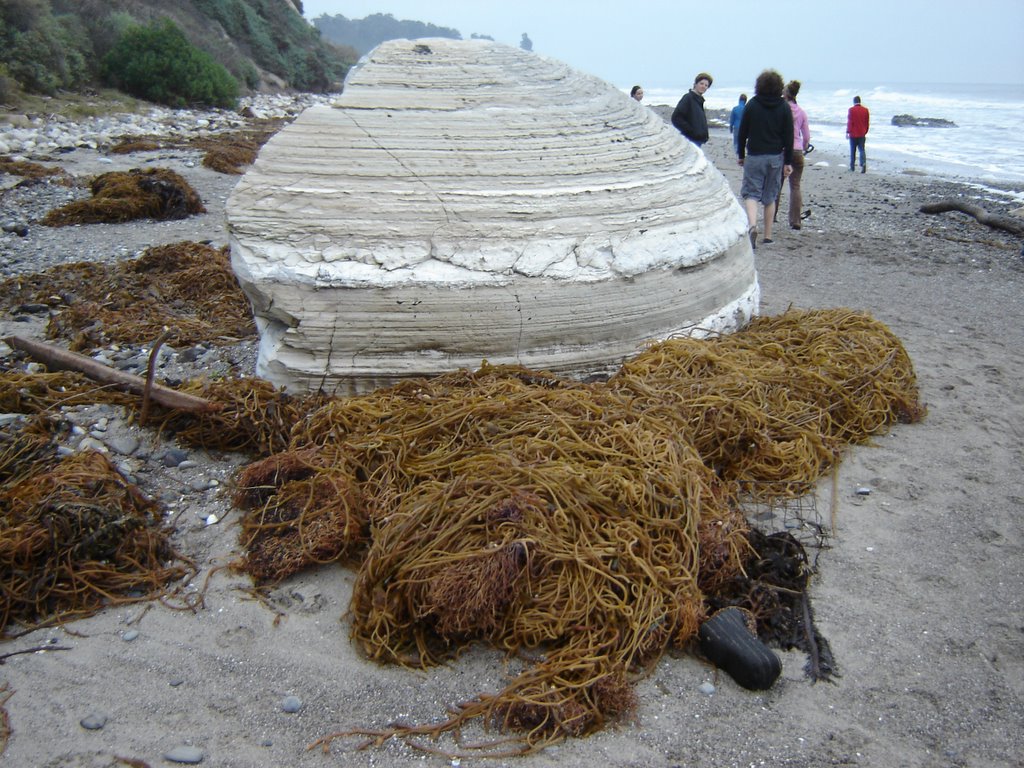 Kelp has always looked very strange to me, so rubbery and full of those knobby gas bladders that keep it suspended in the water. It seems otherworldly and looks hardly like a plant at all. It is an essential part of the near shore ecosystem providing food and shelter to a wide variety of fish and other sea critters.
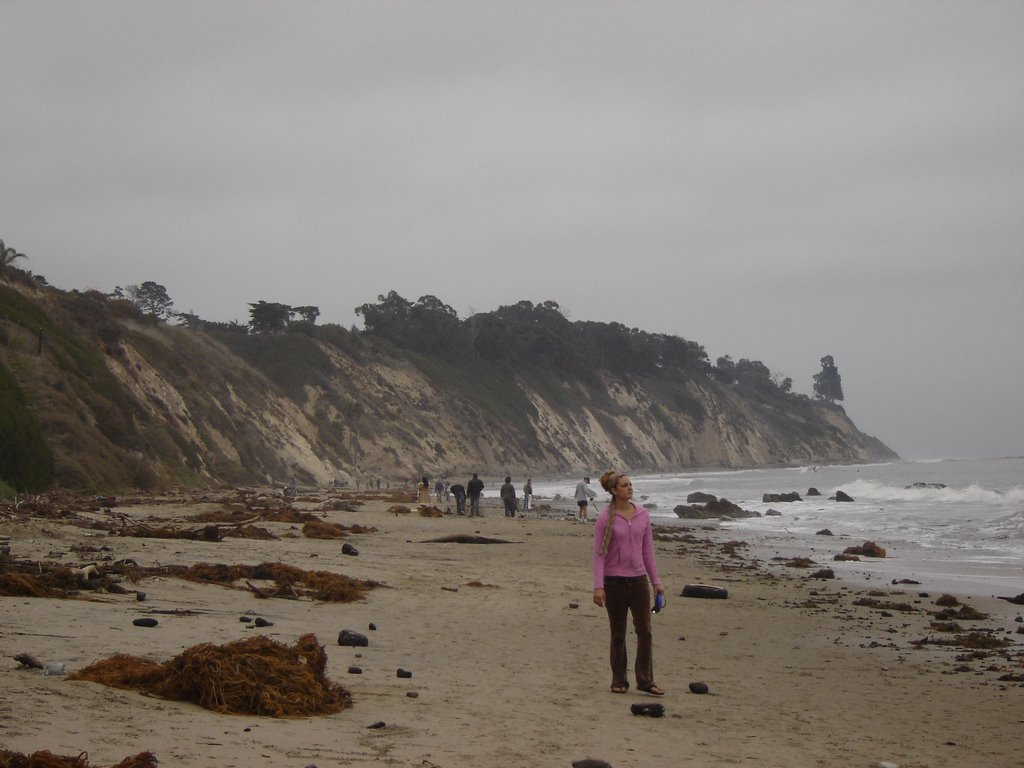 In this view you can see wads of it strewn all along the beach. This is Hendry's Beach looking east toward Arroyo Burro.
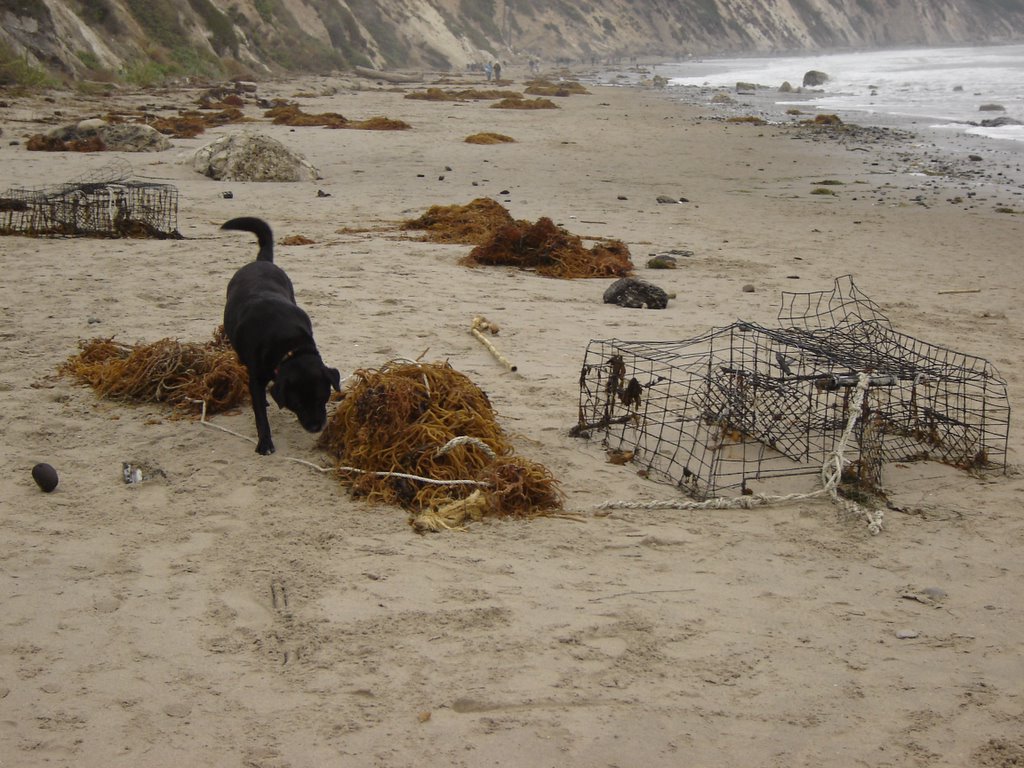 It is still lobster season here, and many unfortunate fishermen have had their traps yanked up and thrown on the beach as well. Here's our lab Maggie checking out a couple of them. You can see the mooring line attached to the one on the right. We saw probably a dozen or so in a quarter-mile stretch and the floats of many more just off the beach where they had been pushed into shallow water. I'm told these traps cost about $75 apiece.
The kelp forests here are commerically harvested. Large boats clip the top few feet off the plants and pull them on board. This harvest is heavily regulated and the total annual take in California is about 50,000 tons (wet weight). Some is processed and sold as dietary supplements but the majority is used by chemical companies to make compounds used as thickening agents in the commerical food industry. So think about that the next time you have Jell-o or ice cream.
Subscribe to:
Posts (Atom)