Lauren's amazing ink:
"Stuff is eaten by dogs, broken by family and friends, sanded down by the wind, frozen by the mountains, lost by the prairie, burnt off by the sun, washed away by the rain. So you are left with dogs, family, friends, sun, rain, wind, prairie and mountains. What more do you want?" Federico Calboli
Showing posts with label Central Asia. Show all posts
Wednesday, January 24, 2018
Thursday, February 09, 2017
Central Asian Arrivals
A week ago Jim and I made a late-night run to the Salt Lake airport to pick up the newest members of our ranch operation: two Central Asian Ovcharka pups, arriving from Tajikistan. We’ve had a few CAOs in the past and found them to be effective guardians, and were glad for the opportunity to obtain pups from the region where the breed originated. We made quick introductions of the pups to our adult guardian dogs, which readily accepted the pups since they were presented by us.
But these pups are a little different than any of the livestock guardian dogs we’ve had in the past. We’ve used multiple breeds, and had dogs that were white, tan, red, and brown, but never black and white. The only black and white dogs our sheep have ever experienced are herding dogs.
The job of a herding dog is to move the sheep around, so the sheep move away from herding dogs. But the job of a guardian dog is to stay with the sheep and keep them protected.
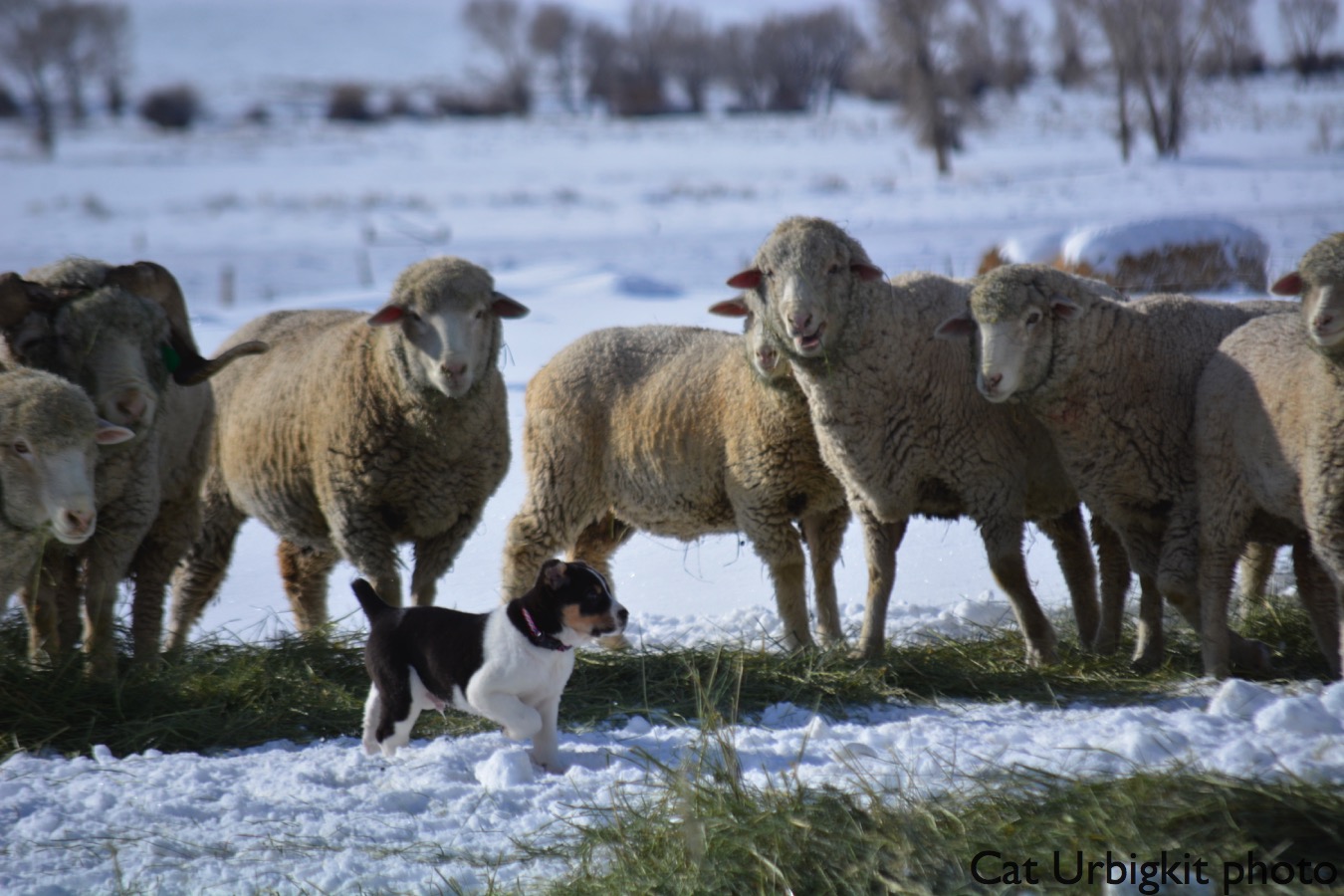
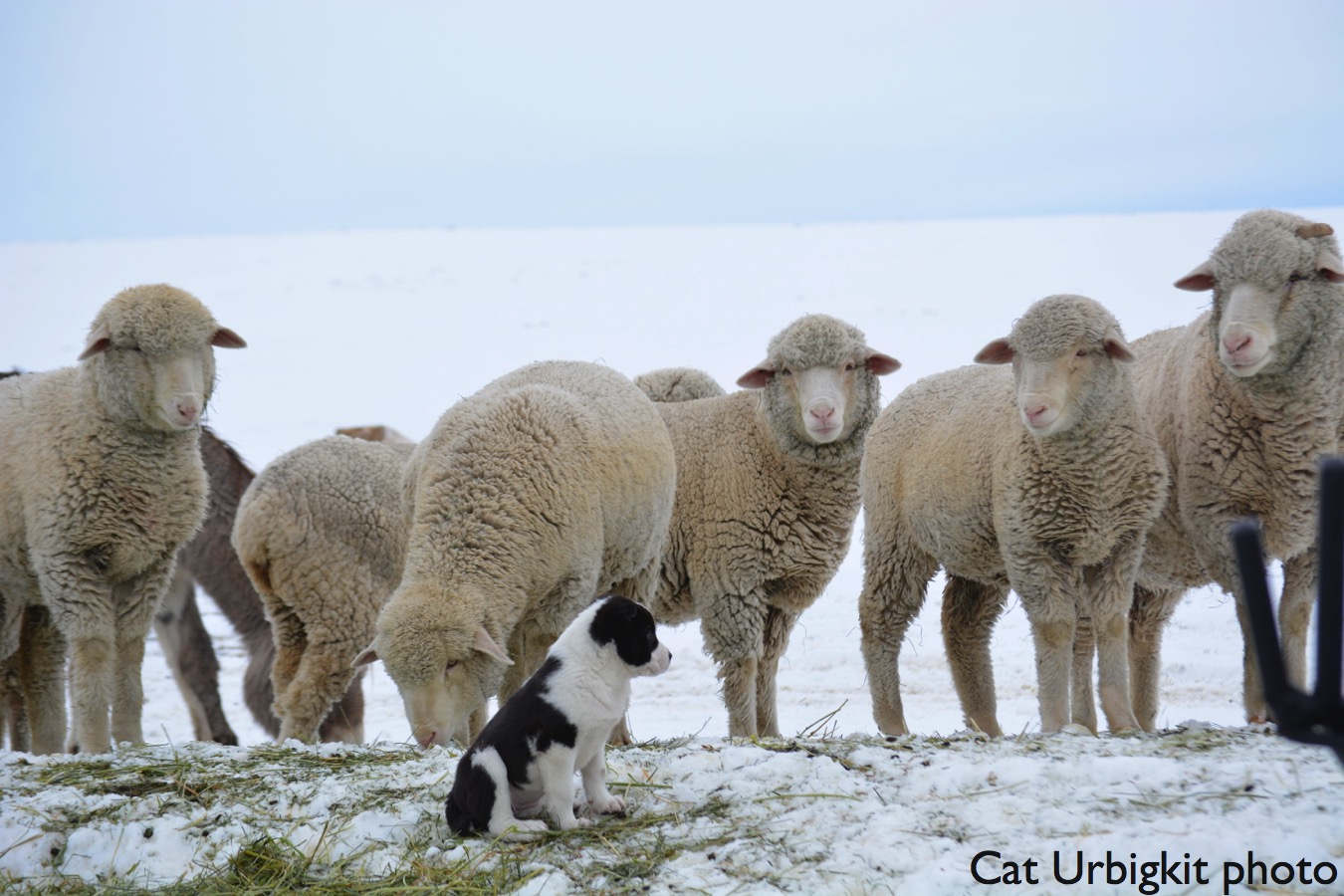
When our sheep flock met the CAO pups, they immediately moved away from them as they would in response to a herding dog. It wasn’t just the color, but the size of the pups – the same size as herding dogs.
The pups are siblings, a tri-colored male named Omar and a female named Taji. Even at only a few months old, it is apparent that they both have strong but different guardian traits.
Taji is a communicator, able to “read” how others are responding. She looked at the sheep from a distance, then put her nose to the ground as if investigating something interesting, and moseyed her way closer to the sheep. Her careful approach ensured the sheep didn’t flee, and when the sheep started to back away, Taji sat down on the ground looking away from them. It was a clever ploy, and it worked. Several of the sheep gradually made their way closer to investigate as she maintained her submissive posture.
Omar, on the other hand, has the soul of a warrior, and when he detects any change in his world, he boldly charges forward to investigate. His posture is always head-up, tail-up. That’s how he tried to introduce himself to the sheep, which of course didn’t work. He used the same attitude with the burros, and after investigation, the burros decided to let him live, although one burro was tempted to take him out. (These introductions were all supervised by humans and other guardians, so it wasn’t as though a strange dog had simply appeared among the flock.) But settling the sheep to these two arrivals has been more challenging than it has been with any other guardian dog pups we’ve raised, and it’s my view that it’s primarily because of the color difference. The sheep will eventually learn that the pups are guardians, and subsequent generations of sheep will also learn that guardians come in this color pattern as well. But the sheep are currently naïve, so we’re altering our management to give the sheep additional time to adjust.
While the pups are given supervised time out with the flock every day (despite a winter of record snowfall), most of their time is spent in the yard or large outdoor kennel. We feed hay along the fences so that the pups and sheep spend plenty of time face-to-face time, with the fences separating them. That way, the sheep can watch the pups, and do nose-to-nose exploration from their safe locations.
The pups don’t bark at the sheep, but cry for them and lick them through the fence. The pups have the desire to be with the sheep (as guardians should) so it’s just a matter of allowing the sheep to adjust to the new constants in their lives. We've got two other pups from another litter coming in a few months, so the socializing will begin anew.
But these pups are a little different than any of the livestock guardian dogs we’ve had in the past. We’ve used multiple breeds, and had dogs that were white, tan, red, and brown, but never black and white. The only black and white dogs our sheep have ever experienced are herding dogs.
The job of a herding dog is to move the sheep around, so the sheep move away from herding dogs. But the job of a guardian dog is to stay with the sheep and keep them protected.
When our sheep flock met the CAO pups, they immediately moved away from them as they would in response to a herding dog. It wasn’t just the color, but the size of the pups – the same size as herding dogs.
The pups are siblings, a tri-colored male named Omar and a female named Taji. Even at only a few months old, it is apparent that they both have strong but different guardian traits.
Taji is a communicator, able to “read” how others are responding. She looked at the sheep from a distance, then put her nose to the ground as if investigating something interesting, and moseyed her way closer to the sheep. Her careful approach ensured the sheep didn’t flee, and when the sheep started to back away, Taji sat down on the ground looking away from them. It was a clever ploy, and it worked. Several of the sheep gradually made their way closer to investigate as she maintained her submissive posture.
Omar, on the other hand, has the soul of a warrior, and when he detects any change in his world, he boldly charges forward to investigate. His posture is always head-up, tail-up. That’s how he tried to introduce himself to the sheep, which of course didn’t work. He used the same attitude with the burros, and after investigation, the burros decided to let him live, although one burro was tempted to take him out. (These introductions were all supervised by humans and other guardians, so it wasn’t as though a strange dog had simply appeared among the flock.) But settling the sheep to these two arrivals has been more challenging than it has been with any other guardian dog pups we’ve raised, and it’s my view that it’s primarily because of the color difference. The sheep will eventually learn that the pups are guardians, and subsequent generations of sheep will also learn that guardians come in this color pattern as well. But the sheep are currently naïve, so we’re altering our management to give the sheep additional time to adjust.
While the pups are given supervised time out with the flock every day (despite a winter of record snowfall), most of their time is spent in the yard or large outdoor kennel. We feed hay along the fences so that the pups and sheep spend plenty of time face-to-face time, with the fences separating them. That way, the sheep can watch the pups, and do nose-to-nose exploration from their safe locations.
The pups don’t bark at the sheep, but cry for them and lick them through the fence. The pups have the desire to be with the sheep (as guardians should) so it’s just a matter of allowing the sheep to adjust to the new constants in their lives. We've got two other pups from another litter coming in a few months, so the socializing will begin anew.
Friday, December 09, 2016
The First Eagle Huntress?
However admirable Ashiolpan seems (and she is), and however fine the movie the Eagle Huntress is (and I suspect it is, and I want to see it), SHE IS NOT THE FIRST EAGLE HUNTRESS. This mistaken belief is particularly promulgated by American reviewers and I know I shouldn't expect much of them; I should only be happy they're saying a form of hunting is good.
But for the record, with leaving out dubious semi-contenders like Princess Nirgigma in the 20s, who I very much doubt trained her own eagles, or Frances Flint Hamerstrom, who as far as I know never hunted with her eagle or participated in Asian culture, the FIRST eagle huntress is Lauren McGough, originally of Oklahoma City, Oklahoma, who I originally helped achieve her dreams when she was 16, when she went over and hunted with the late Aralbai. She was so taken with this that she won a Fulbright Scholarship and spent a year in remotest Bayaan Olgii Aimag in the westernmost point of Mongolia learning both the Kazakh and Mongol languages while training her first eagle, Alema ("Milky Way") which she trapped herself. She subsequently caught 30-odd foxes with her, plus other game. She has not yet written up her experiences, but everyone who knows her knows that she is the real thing. She's hunting right now with her eagle...
![]() | |
| Lauren at 16 with Aralbai |
| With Alema soon after capture |
Saturday, July 11, 2015
Thursday, January 01, 2015
Ataika and her mother in Almaty; Almaty life
Could it be ten years ago? More?
Ataika at 6 weeks, in Almaty, Kazakhstan, in Konstantin and Anna Plakhov's back yard, the day we met her, with mother Oska.
A month in our apartment, with days riding around in Askar Raybaev's (Mitsubishi!) stretch limo; visiting museums and supermarkets and restaurants and archaeologists; then to New Mexico on KLM. What a strange postmodern dog's life! Scenes of that month following...
Ataika at 6 weeks, in Almaty, Kazakhstan, in Konstantin and Anna Plakhov's back yard, the day we met her, with mother Oska.
A month in our apartment, with days riding around in Askar Raybaev's (Mitsubishi!) stretch limo; visiting museums and supermarkets and restaurants and archaeologists; then to New Mexico on KLM. What a strange postmodern dog's life! Scenes of that month following...
Saturday, October 25, 2014
Image
Leon Gaspard was a Taos painter of the early 20th century, with an eccentric style that makes him marginally less popular than some of his straightforwardly impressionist colleagues.
He was a Russian who traveled in the the Soviet Union in the 20's. Like his predecessor , the poet and novelist Lermontov (grandfather Scot "Learmont"), his was a transformed western name-- his grandfather was a Huguenot refugee fleeing persecution in France.*
For now, a simple image, very real despite romanticism... photo'd from Frank Water's book. I would be interested in seeing any better version, or any of the other falconry images that exist...
* Or the great 20th century ornithologist Vladimir Flint, whose "Flint's Rules" for toasting with Vodka have brought many to their knees...
He was a Russian who traveled in the the Soviet Union in the 20's. Like his predecessor , the poet and novelist Lermontov (grandfather Scot "Learmont"), his was a transformed western name-- his grandfather was a Huguenot refugee fleeing persecution in France.*
For now, a simple image, very real despite romanticism... photo'd from Frank Water's book. I would be interested in seeing any better version, or any of the other falconry images that exist...
* Or the great 20th century ornithologist Vladimir Flint, whose "Flint's Rules" for toasting with Vodka have brought many to their knees...
Monday, October 20, 2014
Snaphance Locks
The first, made by a Mongolian blacksmith, is younger than I am. No date on the ornate Italian one, from a Twitter photo recycled by David Zincavage. But remember, the invention of the flintlock , in this form, dates back to almost 1600, and Cherkassov who published the drawing, called them "Primitive" in 1865...
Visual Free Association
David Zincavage sent me this striking image of a Kazakh girl and eagle. The rather formal gold- braided pattern on her coat is common among all the Turkic peoples of Central Asia, from Uzbekistan through Kyrgizstan to the (Kazakh) western "Aimag" of Mongolia. Jack and Niki wore Uzbek versions for their wedding in Santa Fe.
Update: The first photo is from Blog friend and Central Asian scholar and Blogger Dennis Keen; more in comments below.
Monday, May 19, 2014
Old Photo
From Tim Gallagher.
Caption from Lane Batot: "Upon opening an insurance office in Kyrghistan, agent Smith visited a local village in hopes of raising payment rates in regard to the residents keeping exotic and dangerous animals on the premises. Agent Smith has not been heard from since...."
Friday, May 16, 2014
Central Asian Dogs and Falconry
First, a wonderful film from Kyrgizstan-- in English!
Next, an amazing album of photos by our friend Jutta, who traveled there this spring. I have already posted a few of her photos.
Another film, from Turkmenistan. Notice the smaller Sakers there, more like Prairie falcons than Gyrs. The style of hunting is much like ours, only they use camels (and wear rather different hats).
The next video is on Vimeo and I don't know how to imbed it so will just give a link. It is Soviet- era and not the best quality, but has some glimpses of local falconry I have not seen anywhere else.
Next, an amazing album of photos by our friend Jutta, who traveled there this spring. I have already posted a few of her photos.
Another film, from Turkmenistan. Notice the smaller Sakers there, more like Prairie falcons than Gyrs. The style of hunting is much like ours, only they use camels (and wear rather different hats).
The next video is on Vimeo and I don't know how to imbed it so will just give a link. It is Soviet- era and not the best quality, but has some glimpses of local falconry I have not seen anywhere else.
Wednesday, April 23, 2014
Taigans!
Jutta Rubesam lives in Germany and has been a constant presence here through her Nhubia and Taalai, the two talented canine dancers who often grace our Weekend Doggage. In times past she visited New Mexico and took some of my favorite photos of my own dogs.
Now she has been to Kyrgizstan and the shores of lake Issyk- Kul, where she shot this portfolio of the Kyrgiz herders and their hounds. I am delighted to see that they have not standardized and still retain their physical diversity, from near- tazis to "aboriginal Afghans".
Wednesday, April 16, 2014
Eagle Dreamers
I must assume that ALL my readers have seen some version of this:
I have gotten over 100 emails, and they are still coming in. The one most saw was a BBC article (see David Zincavage's blog), but I like the photographer's, and his background info. It seems that the wild men of central Asia, as pragmatic as can be, have not opposed the few brave young women who have decided to take up this difficult but thrilling way of life (not exactly a"sport" by the way, as some call it, unless at the games at the annual fall "fiestas" there and in the 'Stans).
I was delighted by the photos, and the whole phenomenon. But I thought the real pioneer was being ignored-- Lauren McGough, who contacted us when she was 16, went out to hunt for a month with the late Aralbai, "The Coolest Man in the World" (Google it up), then returned on a Fulbright to spend a year there as an apprentice, then another year back and forth to the 'Stans and Mongolia. She is now in Scotland writing her doctoral thesis, and has continued flying eagles on the plains here and in Scotland.
Lauren is not worried, though she has a sensible distrust of the accuracy of the press: "The photos are just brilliant of course - I recognize in that smile the pure joy of flying an eagle! I always have mixed feelings about media articles of Mongolian eagle culture, though. Its hard not to be possessive of "my" subject!... If I can find the funds, perhaps visiting the girl myself would be a compelling epilogue. It in a way, it is like coming full-circle, from my own 14-year old self that used to daydream her red-tail was an eagle. Or something!"
After I got her notes I wondered: Olgii Aimag is not too big; could the young Kazakh girl have heard about the strange American berkutchi? Could it have swayed her father? Could she have seen this not- very tall American with the huge eagle named after the Milky Way?
There is going to be a book, and it will have insights I never dreamed of. Meanwhile, back in the USA, the government is considering shutting down the (at most) 6 eagle annual falconry take, while wind farms and eagle- killing natives are given a pass. Sometimes I think I should go off to live and die in Asia, where eagle dreamers get some respect.
I have gotten over 100 emails, and they are still coming in. The one most saw was a BBC article (see David Zincavage's blog), but I like the photographer's, and his background info. It seems that the wild men of central Asia, as pragmatic as can be, have not opposed the few brave young women who have decided to take up this difficult but thrilling way of life (not exactly a"sport" by the way, as some call it, unless at the games at the annual fall "fiestas" there and in the 'Stans).
I was delighted by the photos, and the whole phenomenon. But I thought the real pioneer was being ignored-- Lauren McGough, who contacted us when she was 16, went out to hunt for a month with the late Aralbai, "The Coolest Man in the World" (Google it up), then returned on a Fulbright to spend a year there as an apprentice, then another year back and forth to the 'Stans and Mongolia. She is now in Scotland writing her doctoral thesis, and has continued flying eagles on the plains here and in Scotland.
After I got her notes I wondered: Olgii Aimag is not too big; could the young Kazakh girl have heard about the strange American berkutchi? Could it have swayed her father? Could she have seen this not- very tall American with the huge eagle named after the Milky Way?
There is going to be a book, and it will have insights I never dreamed of. Meanwhile, back in the USA, the government is considering shutting down the (at most) 6 eagle annual falconry take, while wind farms and eagle- killing natives are given a pass. Sometimes I think I should go off to live and die in Asia, where eagle dreamers get some respect.
Subscribe to:
Posts (Atom)