Showing posts with label livestock guardian dogs. Show all posts

Wednesday, August 29, 2018

Spiked collars


{Intro from Cat: Last week, a wolf tried to get into a flock of yearling sheep on the mountain, and ended up in a brawl with six guardian dogs. Although the wolf was injured, it escaped without succeeding in killing any sheep. If it lives, I'm hoping it learned a valuable lesson. A couple of the dogs were injured but are fine.
Another flock moved several miles downriver from our house, getting out onto the desert and further away from the Wind River Mountains here in western Wyoming. This is the flock we've had here all summer, with no depredation even though the wolves kept checking in on them and testing the dogs. We assumed things would be safer for that flock, but apparently at least one wolf decided to follow their movement downriver.

Bear-Bear, the biggest and toughest livestock guardian dog I've ever known (a Central Asian Ovcharka/Akbash cross), was badly injured. Since then, I’ve been getting lots of comments that we need to put spiked collars on our dogs. It’s an easy suggestion, but a lot harder to implement on a naïve dog population that most people realize. If you’ve got a stable dog pack on a set acreage it’s easier, but when you are managing a dog population involving four groups of dogs in a fluid system across large expanses of landscape, it’s much more complicated.}

A spiked collar is a tool, an added defense for a livestock guardian dog. But just like any tool, there are appropriate times and places for their use, and some dogs are more suited to using them than others. Placing spiked collars in a dog pack is something that has to be closely supervised.

We have spiked collars, and have used them in the past with a group of mature dogs with one dominant male leading the bunch (Rant). But we are not currently using spiked collars, for numerous reasons. There are four groups of dogs out with different sheep flocks, and the members of each group change on a fairly regular basis at this time of year (for a variety of reasons) when the sheep are on the move. That means that pack dynamics change as well.

In addition, since we’ve brought in our first outside dogs in about 10 years, we’ve bumped up pup production to get these dogs into the working gene pool. So we’ve got all age groups present, from pups just a few months old that are interacting with yearling dogs, dogs with a few years experience, dogs in their prime, and older dogs.

Adding sharp objects to dog collars in this scenario would lay the groundwork for a disaster. Dogs may get their teeth knocked out from inter-pack brawls involving spiked collars. Dogs are smart and know to use the spikes as a weapon. That is great when dealing with wolves, not so great when you’re hormonal and mad at another dog for stealing a bone or growling at your offspring.

In their countries of origin, there are some areas where the collars are often used; in other areas, not so much; and in some areas, not at all. Even where they are used, rarely are all members of a pack collared – only those lead or more aggressive dogs most likely to be first on the scene to challenge a wolf wear spiked collars. In some areas we visited in Turkey, the dogs only wear the collars in certain grazing areas, and by law the collars must be removed before the flocks return to the village.

Juvenile dogs that are still growing and wrestling and figuring out their place in the pack generally shouldn’t wear spiked collars, and we don’t have any collars that small anyway (as in nothing that would fit Boo, who survived a wolf attack in May).

Last week, four dogs from the river flock went on a walkabout and visited a neighboring ranch that does not use dogs of any kind. The presence of four large dogs was startling enough, but we’ve got dogs from Tajikistan with cropped ears – and for some reason, that seems to scare the hell out of people. Fortunately, these kind people got word to us so we could quickly rid them of their unwelcome visitors.

Perhaps when we’ve got a more consistent dog population (which is during the winter when we’ll be feeding hay to the sheep and the flocks are further apart) we can put collars on some of our dominant dogs. We would have more time to supervise the process at that point. But until then, it’s not a good option.

Tuesday, November 21, 2017

Retiring Old Mama


The last few years, we’ve been working Old Mama into retirement. She’s a fine old dog that has traveled many, many miles accompanying her flocks from the low desert to the high mountains each year. We gradually placed her with flocks following shorter trails, and finally stopped allowing her to trail to winter range a few years ago. She’s adapted beautifully to every change; so long as she’s with sheep, she’s content.

Every day she cheerfully sticks her tail straight up into the air and trots off to lead the flock in the day’s grazing. Her face and body carry many scars of war, proof of her unwillingness to back down from a fight with any predator.

Yesterday was the start of a new stage of retirement, as we placed Old Mama into a large pen with orphan lambs that were born this spring. She’s healed up from her most recent battle with wolves, and is in great physical condition, but her teeth are worn with age so she can no longer defend herself. It’s something that she doesn’t understand, as she regularly sounds the alarm and charges out with the other guardians to face danger.

The last few months we’ve had our hands full with wolf problems, so we’ve been night-penning the sheep, and Old Mama is usually the last to enter the pen, following her flock into safety. But when she entered the pen last night, I slipped a leash over her head and diverted her into an adjacent pen, where she could be with smaller lambs. Old Mama was happy to spend time with these youngsters, but when she watched me let her flock out of the neighboring pen at daylight this morning, she stood expectantly at the gate, waiting for me to let her out. But I didn’t. She would no longer be their leader.

With wolves frequently coming so close to the house, I’m afraid we may be on the verge of a major canid brawl. Predictably, Old Mama would rise to the challenge, and would give her life in the process. We’re trying to lessen the risk of that happening.

We had hoped to stop night-penning the sheep as soon as we start winter feeding, probably around the first of December. Instead of ranging out to graze, our providing lines of alfalfa-grass hay near the house will keep the flock close by. But our discovery of wolf tracks within a quarter-mile of the house has cancelled that plan. We’ll be night penning until we can get these particular problem wolves eliminated.

Perhaps during the day Old Mama and her lambs can rejoin the flock as it feeds on hay near the house, and accompany the flock back into the pens at night. Perhaps my indulging in the desires of an old dog will lead to her demise. While I fear for her, far be it for me to deny an old dog her last wish.

Sunday, October 01, 2017

The Predation Crisis

It was still dark, but I heard the ruckus of the dogs outside and flipped on the outside light to see eight livestock guardian dogs and three guardian burros headed for the house. All were agitated and upset as they escorted guardian dog Old Mama straight for the front door. Even in the dim light, I could see her hind end was soaked with blood.

The wolf pack had hit the flock on its bedground to the west of the house. The sheep had fled around the corner of the fence to the spot where I would find them shortly before dawn. We would spend all the rest of that day finding dead sheep, gathering the walking wounded, and moving the flock to the holding pens at the house. Our death toll that day included one ewe and nine lambs that had been slated to go to market at 80 pounds a few weeks later. In addition, there were nearly a dozen walking wounded sheep (both ewes and lambs), and three injured guardian dogs (one severely wounded).

We live in Wyoming’s predator zone­, the area where wolves can be legally killed at any time without a tag. It appeared that the attack on our place involved a pack with pups that were learning how to kill.

USDA Wildlife Services arrived the next morning to try to locate the pack. They eventually found tracks here and there (including the tracks of two wolves just a quarter-mile from our house) but the wolves were covering a large range and managed to stay both out of sight and out of the traps that were set for them. The federal agency has now spent two weeks trying to trap and radio-collar one wolf from the pack so we can find out how many wolves we’re dealing with. But the wolves have remained elusive, leaving just their most recent cattle kills behind.

Yesterday was the last day that federal funding was used for wolf control. If wolf control is to proceed, it will be through funding from our local predator board.

Meanwhile, our walking wounded sheep are dying one by one, but we’re hopeful Old Mama may recover. The sheep flock has remained penned and has been fed $150-per-ton hay we’ve trucked in since the attack. We can’t turn the flock out to graze without guardian dogs, and the dogs can’t go out while the wolf traps are set on their range.

A portion of the Farm Bill provides for partial compensation for livestock death loss above normal mortality “due to attacks by animals reintroduced into the wild by the Federal Government or protected by federal law, including wolves and avian predators.” It’s our understanding that our claim will be the first such claim under the program for attacks by reintroduced animals.

There is no compensation program to pay for our walking wounded sheep, our vet bills, or the cost of bringing in hay during this time that our flock should be grazing. And now there is no federal funding for control of problem wolves. We know the wolves will be back.

This is the privilege of living in Wyoming’s predator zone. Neighbors located 20 miles north of us are in the trophy game zone so they are eligible for both state-funded damage compensation and control of wolves, but those of us in the predator zone are presumed to be able to “take” wolves at any time, so we’re supposed to be satisfied with this compromise. Unfortunately when it comes to wolves, it’s never a simple matter of just shooting problem animals because they arrive, do their damage, and leave under the cover of darkness.

What more can we do? What more can we be expected to do? I think we’ve done our share to minimize conflicts with large carnivores. Dependent on the season and location, we utilize a total of 14 nonlethal techniques to deter predators from our flock (fencing, pasture rotation, carrion removal, guardian dogs, guardian burros, taking weak animals out of the herd/culling, frequent human presence/herding, employing noise-makers, employing cameras/flash devices, shooting at/harassing predators that approach, removing attractants from pastures, using multi-species grazing, changing bedding sites, and night penning). But nothing is perfect, and all nonlethal control techniques will fail at some point.

Our use of these varied nonlethal control techniques delays the inevitable: the need for lethal control of problem predators. Now is the time for lethal control of our problem wolves, if only we can find them before they return to strike our flock and its guardians again.

Despite all our efforts, we still rely on the professionals at USDA Wildlife Services. We have found that skilled animal damage specialists are able to identify and track individual problem predators and eliminate those animals that are causing our problems. This targeted removal is an important part of keeping our losses to a minimum.

But the predator load in Wyoming continues to increase, while funding and support for management and damage control decreases. Our story is just that: our story. Talk to our neighbors in the Upper Green River region, who have lost at least 60 head of cattle this summer to grizzly bears. Or our friends in the Black Hills who have lost a major portion of their goat crop to mountain lions this year, despite the presence of herders and guardian animals.

We have no interest in the eradication of predator populations, but the public needs to begin to understand the reality of what it’s like to live alongside large predators, and the hardship and heartaches these animals cause to the people who share the same range, despite our best efforts.

Wildlife advocates oppose the killing of every bear, wolf, or mountain lion, even though the removal of these animals has no negative impact on their overall populations. It’s easy to oppose the killing of a beautiful, iconic animal when you are removed from the reality of the animal’s basic nature – a mode of life that involves killing to make a living. Yet state wildlife management agencies manage these species with conservative harvests because of an underlying fear of litigation by wildlife advocates.

Something’s got to give, because the current system is not sustainable. I think we’ve given enough.

Thursday, February 09, 2017

Central Asian Arrivals

  A week ago Jim and I made a late-night run to the Salt Lake airport to pick up the newest members of our ranch operation: two Central Asian Ovcharka pups, arriving from Tajikistan. We’ve had a few CAOs in the past and found them to be effective guardians, and were glad for the opportunity to obtain pups from the region where the breed originated. We made quick introductions of the pups to our adult guardian dogs, which readily accepted the pups since they were presented by us.

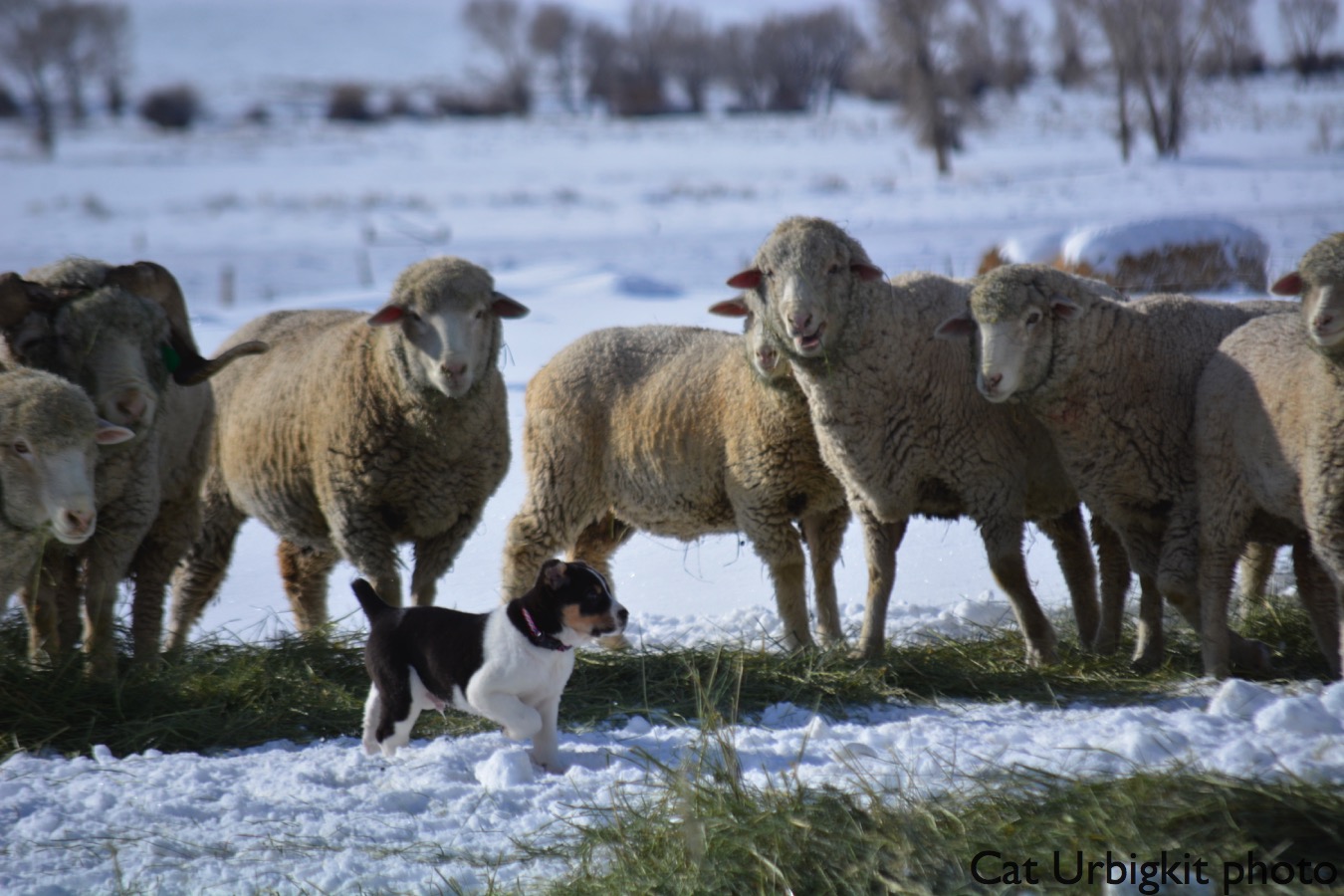
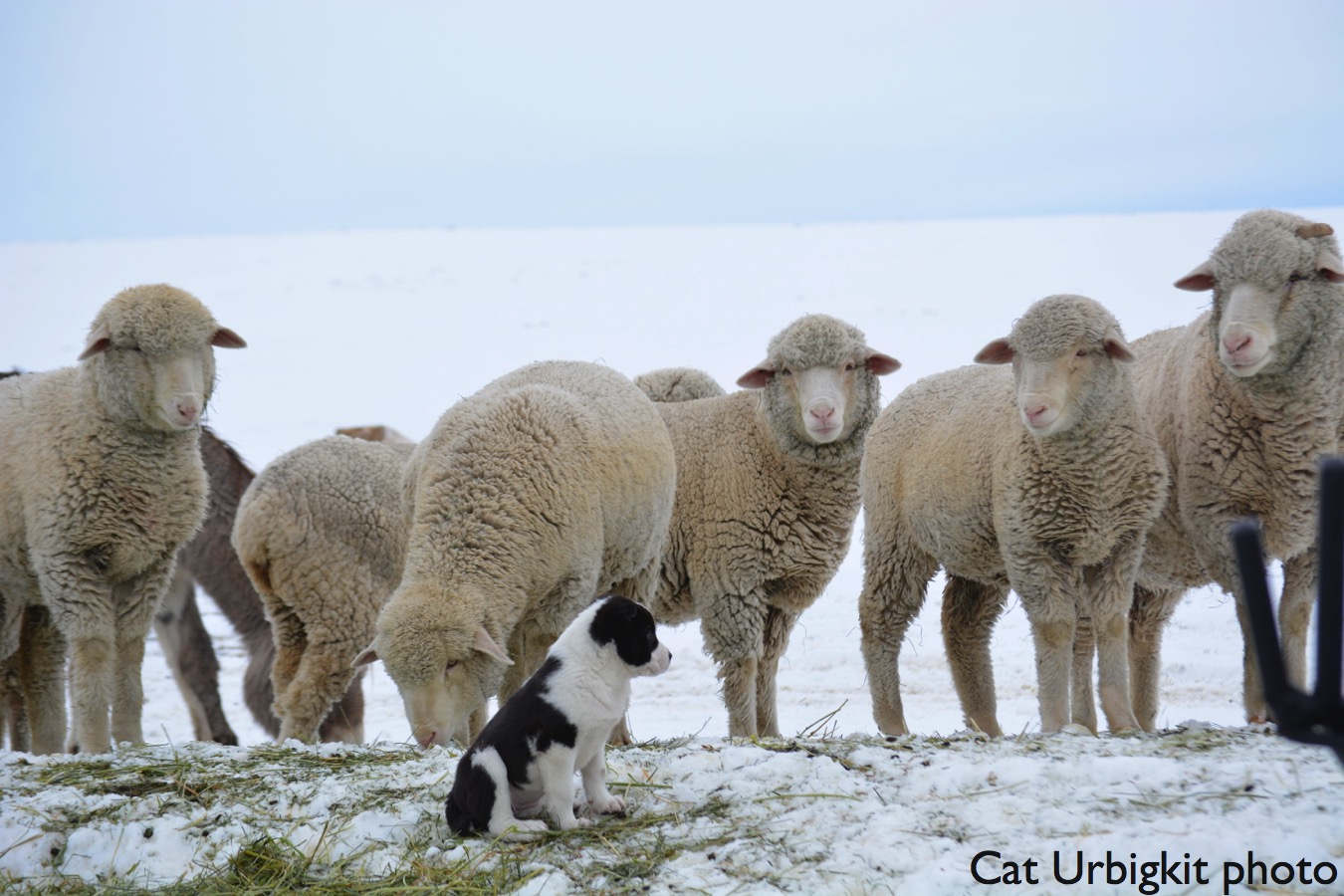
But these pups are a little different than any of the livestock guardian dogs we’ve had in the past. We’ve used multiple breeds, and had dogs that were white, tan, red, and brown, but never black and white. The only black and white dogs our sheep have ever experienced are herding dogs.

The job of a herding dog is to move the sheep around, so the sheep move away from herding dogs. But the job of a guardian dog is to stay with the sheep and keep them protected.

When our sheep flock met the CAO pups, they immediately moved away from them as they would in response to a herding dog. It wasn’t just the color, but the size of the pups – the same size as herding dogs.

The pups are siblings, a tri-colored male named Omar and a female named Taji. Even at only a few months old, it is apparent that they both have strong but different guardian traits.

Taji is a communicator, able to “read” how others are responding. She looked at the sheep from a distance, then put her nose to the ground as if investigating something interesting, and moseyed her way closer to the sheep. Her careful approach ensured the sheep didn’t flee, and when the sheep started to back away, Taji sat down on the ground looking away from them. It was a clever ploy, and it worked. Several of the sheep gradually made their way closer to investigate as she maintained her submissive posture.

Omar, on the other hand, has the soul of a warrior, and when he detects any change in his world, he boldly charges forward to investigate. His posture is always head-up, tail-up. That’s how he tried to introduce himself to the sheep, which of course didn’t work. He used the same attitude with the burros, and after investigation, the burros decided to let him live, although one burro was tempted to take him out. (These introductions were all supervised by humans and other guardians, so it wasn’t as though a strange dog had simply appeared among the flock.)
But settling the sheep to these two arrivals has been more challenging than it has been with any other guardian dog pups we’ve raised, and it’s my view that it’s primarily because of the color difference. The sheep will eventually learn that the pups are guardians, and subsequent generations of sheep will also learn that guardians come in this color pattern as well. But the sheep are currently naïve, so we’re altering our management to give the sheep additional time to adjust.

While the pups are given supervised time out with the flock every day (despite a winter of record snowfall), most of their time is spent in the yard or large outdoor kennel. We feed hay along the fences so that the pups and sheep spend plenty of time face-to-face time, with the fences separating them. That way, the sheep can watch the pups, and do nose-to-nose exploration from their safe locations.
The pups don’t bark at the sheep, but cry for them and lick them through the fence. The pups have the desire to be with the sheep (as guardians should) so it’s just a matter of allowing the sheep to adjust to the new constants in their lives. We've got two other pups from another litter coming in a few months, so the socializing will begin anew.

Thursday, November 17, 2016

Guardian/herding dog differences

 
I’ve written extensively about our relationship with our working livestock guardian dogs and have written very little about life with our herding dogs. The difference between the two types of dogs is remarkable.

None of our guardian dogs over the age of about two months old has ever been willing to play with a store-bought toy. Sure, they will fling a dead prairie dog through the air repeatedly, but never an actual dog toy.

Our guardian dogs do not retrieve anything you throw for them in attempt to get them to play. Instead, they tend to look at you like you’re an idiot, and watch while you retrieve it yourself.

We had the exciting experience of teaching a few of our guardian dogs to do funny tricks. But they only did the tricks once (as if to prove it could be done), and reverted back to the typical “this-human-is-a-complete-idiot” look of contempt.

Unlike any herding dog I know, our guardian dogs are nearly incapable of catching treats that are tossed directly at them. It’s a rare event that one of our guardians will open its mouth to catch a piece of meat that is gently launched at them. The meat will hit the dog on the nose, or in the middle of the forehead, before bouncing off and landing on the ground from where it is retrieved and consumed.

With the exception of the “go to the sheep” command, our guardian dogs fail to take more than the most rudimentary instructions from us. Even if they are fully aware of what we want them to do, they will comply only if it was their idea in the first place.

Try pointing something out in the distance, and the guardian dog will look at your hand, unlike our herding dogs, which use both verbal requests and hand signals. I can point out a specific lamb to Hud the herding dog, and tell him to “Get that lamb.” Hud will them chase the lamb through the flock, knocking it down with his chest and holding it to the ground until I get there. (Hud's the dark dog in the photos, while the guardians are the all-white dogs.)

These behavioral differences are easily explained by the differences in the type of work the dogs specialize in. Guardian dogs are by their very nature independent decision-makers. They assess threats to their herds, and react accordingly. They do not wait for human guidance.

The only exception to this is exhibited by Rena, a guardian dog now suffering from arthritis as the result of a battle with wolves. There is a pesky coyote that she can’t catch, so when it comes around teasing her, Rena will bark and wait until Jim or I follow her out with a gun. All she wants is that coyote dead, so she’s willing to cooperate with us to make that happen.

In contrast, herding dogs are human companions, bred to be pliable in taking instruction, and seem to have a desire to please their humans. Guardian dogs generally don’t care about what humans think, but herding dogs do.

Since most of our dogs were raised together, the guardian dogs are all amazingly tolerant of the much smaller herding dogs. The guard dogs don’t like to have their sheep messed with, but allow the herding dogs to do their jobs so long as no sheep are injured in the process. Shearing day is fun for herding dogs, which enjoy the excitement and the work of keeping the sheep bunched and moving forward, while the guardian dogs sulk around outside the corral, fuming about the disturbance to their flock.

Our adult guardian dogs tend to weigh between 90 and 130 pounds, and our smallest adult herding dog was Abe, weighing in about 25 pounds when soaking wet. Yet honest old Abe was treated as top dog, with a pack of guardian dogs patiently waiting for him to walk away from the food bowl before the ravenous pack would move in.

Abe was a bearded collie/border collie cross, while Hud is a bearded collie/Aussie cross. Both dogs had the soft-mouth characteristic that we shepherds find so endearing. Both dogs prefer to simply poke the sheep with their noses rather than bite. Content just to be in the presence of their sheep, both dogs could be left alone with the sheep without feeling the need to “work” them.

All the dogs tend to be well aware of their surroundings, and often it’s a herding dog that detects the presence of a coyote. The herding dog will raise the alarm and start running in the direction of the problem, but will always glance behind to make sure the guardian dogs will arrive at the point of danger long before the herding dog. The herding dogs then happily return to their leisure while the big dogs do the work.

One of Hud’s jobs is to “guard” four goat guardian dogs every morning while they eat. Hud keeps the goats from getting to the dogs and competing with them for their food. Yesterday his job got a little more complicated when a baby goat decided she liked the looks of Hud and came to him. Hud adores baby animals and got excited by the tiny goat since this was only the second time he’d been able to thoroughly investigate a member of this species. Hud towered over the kid, running his nose over her back and putting his nose to her tail. The kid decided that was too close for comfort and raced for me to save her. I told Hud, “Easy, easy,” and tried to convince him to move her back to her herd. But every time she tried to go back to her bunch, Hud cut off her exit by licking her nose and turning her back to me. It was pretty funny, but I eventually told Hud to knock it off, so he let her go, following her back to her herd before returning to the work he was supposed to be doing. The guardian dogs didn’t even look up from their food.

Hud is a prime example of the concept that like their human companions, dogs are creatures of habit. Hud has a few store-bought toys to play with, but there is one special toy that is our bedtime entertainment. When I make the bed each morning, I place the decorative pillows on the bed and place his stuffed Lambchop toy on top. Every evening while Jim and I are on computers or watching television in the living room, Hud quietly goes back to our bedroom to retrieve Lambchop, and then slowly walks into the living room to present it to us, gently pushing it into a lap. The suggestion is clear: It’s bedtime. We usually agree, jumping up to shut off the lights, and following him down the hall to bed. Hud and Lambchop wait patiently in the middle of the bed while his humans brush their teeth and crawl under the covers.

But sometimes Hud tries to put us to bed far too early, and we have to convince him that no, going to bed at 5 p.m. is not a good idea.

This nighttime routine is such a staple of our lives that when I’m away from home, Hud sulks. He refuses to retrieve Lambchop to put Jim to bed, and usually sleeps outside on those nights. His sulking starts the minute he sees me get out my luggage. That’s why I usually try to pack my bag while its deep in the dark recess of my closet.

While Hud would prefer to spend nearly every minute in my presence, our guardian dogs aren’t nearly so devoted. The guardians act happy to see me every day, but usually grow bored with me within a few minutes, dismissing me and returning to their flock. Their devotion lies elsewhere.

Friday, August 05, 2016

Quote: a Preview of Cat's New Book

"I have been in many countries and there is not a Kangal anywhere. That is why the world will be at war soon. If everyone had my father’s dogs, things would already be settled. In my home . . . the wolves will come for something that is not theirs. The Kangal finishes it all and sends them away. We are herders, and we like it. The Kangal keeps us safe in our land. We cut off his ears when he is little, so the wolf cannot bite. The wolf is always killed by the time we get to the dogs. My sister, she has two sons now. The wolves came for her and were destroyed . . . now she has two sons... Sir, the Kangal is good for the world. Not just families. They are the color of sand and rock, they have the heart of those before them, the wild animals that have become our friends. It is that way with our dogs. Every- one should have a Kangal.”

An old Turkish herder in Cat Urbigkit's Brave and Loyal: An Illustrated Celebration of Livestock Guardian Dogs

Tuesday, August 02, 2016

Escort


It’s fairly predictable that within a matter of minutes of meeting me you’ll learn how important livestock guardian dogs are to our western Wyoming sheep outfit. This morning provides an example.

After lambing season ended, we ended up with five bum (orphan) lambs. The lambs spend their nights locked in prime real estate (our yard), but during the day the front gate is open and they are free to roam. This morning, I fed the lambs before daylight, swung the front gate open, and proceeded with other morning chores. Once the sun was up, I returned from checking our main flock and noticed I didn’t see the lambs out grazing anywhere near the house. A quick search confirmed that they weren’t where they should be.

I noticed a few spots of white in the distant sagebrush, and pulled out a set of binoculars for a closer look. Three of our guardian dogs were sitting down along our back fenceline, surrounding the bum lambs and stopping their wild venture away from the safety of the ranch yard. I laughed as guardian dog Rena turned to begin the trail for home, the five lambs lining out behind her, with another guardian bringing up the rear. The third guardian cut back through the sagebrush to return to the main flock as the bum flock received what amounted to a police escort back to the safety of the ranch yard. (Click on photo for larger view.)

Even though we’ve lived with guardian dogs for decades, my respect for the work these animals do grows by day.

Friday, March 18, 2016

Old Mama

She’s not much to look at, some cross between livestock guardian dog breeds. Born on the range to working guardians, she’s lived all her 10+ years of life there, migrating with the flocks from the sagebrush-covered low country in winter, to the high country of the Wind River Mountains as the flocks move for summer grazing. Her hard pawpads carried her over more than 200 miles of trail each year, moving slowly with the seasons.

She’s a typical range dog, gentle and attentive to her ewes and lambs, while fiercely protective of canine intruders to her range. I’d crossed paths with her for years, as we sorted the range herds for shipping the lambs to market each fall, and as I visited the herds along the trail throughout the seasons.

Reserved with strangers, Old Mama slowly approaches her shepherds, standing quietly for attention for a few minutes before departing back to the job. The scars on her face reveal her persistent character – she’s not one to back down from a fight with a predator.

About four years ago, after lambing season, the flocks were on the move north, preparing to enter the wilderness, but Old Mama was swollen in pregnancy. One of the herders took her to the ranch where she had a selection of places to den to give birth to her pups. Our family’s flock was about seven miles north of the ranch, still within Old Mama’s home range. Old Mama stayed at the ranch a few days, but there were plenty of other guardian dogs already attending to the small flocks of sheep there, so she moved across the range, seeking that perfect isolated spot to give birth to her pups. She selected a rock outcrop high above a rugged canyon, five miles north of the ranch, but only two miles from our flock.
She appeared one morning near my flock, greeted by our guardians as one of their own. We could see she’d recently given birth, so Jim and I put out food for her, watched while she ate and then departed, headed back to the south. We’d had bears trying to get into our sheep flock nearly every night, but our guardians were persistent, keeping the bears at bay. One night, a bear moved to the cattle herd in the adjacent pasture, and the bawling of the cattle drew the attention of two of our guardians, which rushed to the rescue. I sat in the dark listening to the voices of our dogs as they were joined by a third, as Old Mama arrived on the scene. The three dogs worked as a team as they set to harassing the bear. The sounds of the night told the story: the cattle bawling, the bear roaring and bawling, with sharp barks of the dogs as they moved the bear away from the cattle and back into the forest. The night grew quiet, and my dogs returned, bouncing with excitement and adrenalin. Her work done for the night, Old Mama returned to her pups.

She made regular visits to my camp for food, and we eventually followed her back to her den, much to her outrage. We dug her growling pups from their rocky hiding place, and moved them to my camp, sticking the pups in a stock trailer with softened food and water. When Jim went to check the pups before daylight, he found Old Mama waiting to tend her litter.

We sheep producers often disagree with our guardian dogs about where they should have their pups, but we usually let the bitches have their way during that time they seek seclusion to give birth, waiting a few days before we retrieve the new families for closer supervision. This is nothing new to traditional shepherd cultures – guardian dogs give birth in primitive dens on the range across the world. Some shepherds put bells on the collars of pregnant females so they can follow the sounds of the bells to find the natal den.

I was glad Old Mama’s den hadn’t been found by anyone else. Someone might have thought this dog family needed “rescued” and taken them to a vet clinic or animal rescue in town, far from their rangeland home and away from livestock.

We and our rangeland neighbors have had various guardian dogs “rescued” on numerous occasions over the years – even within a half-mile of our house when the dogs were in the pasture with their flock, as well as a four-month old pup taken from its mother’s side while with its flock.

I used to be somewhat sympathetic to the good-hearted souls who thought they were doing the right thing. But I’ve grown weary of it. Just because a dog is not within sight distance of a house or herd doesn’t mean it’s been left behind or abandoned. Others see range dogs they feel are too skinny, expecting these athletic and hard-working dogs to be as fat as the dogs that live in their houses.

Granted, sometimes the predator situation gets so intense on our range that we have to rotate the dogs to force each dog to get some rest because the dogs will work themselves into the ground. When predators won’t flee, the dogs engage in fights, and getting their ears torn or bites on their front legs is rather common. The dogs will limp around for a few days – as would a human with a temporary but not serious injury. A few tablespoons of blood scattered down the legs of a bright white dog is a shocking sight to those who are not familiar with the lives of working dogs. Most of the injuries to the dogs are minor, and if they do require treatment, we can take care of it ourselves. Livestock producers routinely practice vet care on all our animals, and we have the medicine and the equipment to do so. Many times we administer care in the field, but sometimes the animals are moved back to ranch headquarters. More severe injuries, like those inflicted on our guardian Rena when she fought with wolves, are rare, and do require emergency vet care.

Old Mama rejoined us on the range last year as our flock grazed the sagebrush steppe along the foothills of the western front of the Wind River Range. When we gathered our animals to leave that range in late fall, we brought Old Mama with us to spend the winter months with our flock on a much smaller range. Cool as ever, she’s adjusted to the new experience, relaxing with the reduced workload that comes with the winter season, and leading her flock from their hilltop bedground to the haystack to wait for the sheep to be fed every morning.


Thursday, August 28, 2014

Fearing What We Don't Understand


A recent Denver Post article featured a woman who fears the Akbash livestock guardian dogs that have trailed with domestic sheep herds into the San Juan Mountains for the last three or four decades. The woman is now carrying a loaded Glock because of her fear the “aggressive dogs” will attack.

Any legitimate concern about hikers encountering livestock guardian dogs was ruined by the article’s closing statement: “ ‘I don’t want to be the Diane Whipple of the San Juans,’said Graham, referring to a woman fatally mauled in San Francisco in 2001 by two large herd guard dogs of another breed.”

Diane Whipple was killed by two vicious Presa Canario dogs in a California apartment complex. These were not livestock guardian dogs. This breed is not used to guard livestock herds in America. Sometimes called Canary Island mastiffs, this breed was developed as a livestock “catch” dog (used to catch and hold cattle!) and eventually bred to be fighting dogs. The New York Times reported that the owners of the dogs that killed Whipple had adopted the dogs – they came from a member of the Aryan Brotherhood who was breeding and fighting the dogs for guarding meth labs for the Mexican Mafia. The reference to Whipple’s tragic death “by two large herd guard dogs of another breed” in the Denver Post showed grossly irresponsible journalism.

Livestock producers using public lands do not want hikers being frightened by livestock guardian dogs. The best reaction is education.

For Dog Owners
For livestock producers, that means discarding those old traditions of not petting your guardian dogs. Instead, raise your dogs in a way that ensures they are well-socialized to humans. The dogs should be petted and fed by the dog owner, family members, and herders. No one outside the family and ranch workers should ever be allowed to feed the dogs. After receiving affection for a few minutes, the dogs should be directed to “Go to the sheep.” The dogs should be exposed to kids on bicycles, teenagers on motorcycles, etc. The dogs soon learn that humans are not a threat to the sheep.

Most livestock guardian dogs used in the American West do not perceive humans as a threat to the herd – that is, unless a strange human is approaching the herd. We’ve had people drive into the middle of our herd on our lambing ground and exit their vehicle with the family dog. Fortunately, I was there to intervene to prevent an intense encounter.

For Public Land Users
In most cases, when a strange human is encountered on the range, the guardian’s reaction is going to be an attempt to intimidate the intruder. That means raised hackles and tail, and loud barking as the dog rushes toward the intrusion. I’ve encountered dozens (if not hundreds) of working guardian dogs in my travels here and in many countries abroad, and I’ve always stood quietly, talking to the dogs until they realize I’m not a threat and go back to their sheep. I would never attempt to hike through the middle of a sheep herd I randomly encountered on the range. Skirting around the herd is appropriate.

Generally, if you are on foot, horseback, or an all-terrain vehicle and come close to sheep, a livestock protection dog should have time to see and/or hear you approach and recognize that you are not a threat to the livestock. But a rapidly approaching mountain biker, suddenly surprising the livestock protection dog, may appear to be a threat. Stop, get off the bike while keeping it between the dog and your body, and talk to the dog so it can recognize you are a human.

Hikers with domestic dogs may be perceived as a greater threat. An unleashed dog encountering sheep likely will be perceived as a predator, which could cause an aggressive confrontation with the livestock protection dog. Uncontrolled domestic dogs are the top killer of livestock in America, and a guardian dog's job is to keep these animals from harming the herd.

People hiking and biking on western rangelands are encouraged to carry pepper spray and be knowledgeable about how to use it. Pepper spray works on many animals that can be perceived as threatening – from bears and mountain lions, to dogs.

The Colorado Wool Growers Association provides the following recommendations for hikers and bikers:

DO:
• Keep your dog on a leash and never allow your dog to harass the sheep

• Watch for livestock protection dogs near sheep (usually large white or tan dogs)

• Remain calm if a livestock protection dog approaches

• Stop and get off of your bike, put your bike between you and the dog

• Tell the dog to “go back to the sheep”

• Walk your bike until well past the sheep

• Keep your distance from the sheep

• Choose the least disruptive route around the sheep

• If the sheep are trailing, wait for them to pass

DO NOT:
• Chase or harass the sheep or dogs

• Try to outrun the dogs

• Throw things at the dogs

• Make quick movements

• Feed the dogs

• Take a dog with you

• Attempt to befriend or pet the dog

Shared Range
I wish I could meet the frightened woman in Colorado and take her out to meet some working livestock protection dogs so she could have a little different perspective on the dogs and how they work. These Western rangelands are big enough for a multitude of uses, and with a little common sense and understanding to other land users, we can happily continue to share this landscape.

A NOTE ON STEVE: Steve is still doing battle with trying to receive email. We'll keep you posted about a resolution – Cat.

Friday, August 15, 2014

Summer Guardians


We moved our sheep flock to grazing range along the foothills of the Wind River Mountains in early July. We've had a refreshingly moist summer, bringing this arid rangeland to life. The ewes are fat, the lambs are growing, and we share the same piece of earth with abundant sage grouse, as well as nesting long-billed curlews. Nine-month old Beyza (an Akbash) has claimed the range as her own, and is a fantastic guardian – as are the others in her lineage, including her mother Luv's Girl, and sister Rena.


When we moved onto the range, my friend Pete asked if I would take care of an extra female livestock guardian dog. She had just given birth to five pups, and the pups were too small to travel with the herd as they moved into the mountains. I tended to the small family for a few weeks, but one of the 7-week old pups started trying to follow my herd as it grazed during the day. After retrieving the pup from more than a mile away from its siblings, we sent the female to the mountain, and brought the pups to our home, where we have a scattering of orphan lambs and adult sheep.

When people talk about getting livestock guardian dogs off to a good start, much emphasis rests on getting pups introduced to the species it will guard at a young age. That's important - bonding is best if if starts early. The introductions to the lambs went well.


But what doesn't get much discussion is how much easier it is to bond pups to a sheep herd that has had a long association with guardian dogs. It's nearly a cultural thing – this relationship is so close, continuing from one generation to the next. When new pups arrive on our ranch, the adult sheep come to investigate. When the pups walk underneath the ewes, and sniff the underbelly of the rams, the sheep are not panicked or upset. They don't stomp the pups, and show an amazing amount of patience as pups chew on the big curls of a ram's horn, or investigate a milk bag on a ewe.


The new pups were soon crawling under the yard gate to hang out with the adult sheep, especially a big range ram. We select and cull sheep based on not just performance and appearance, but behavior. Calm and attentive behavior is ideal. This ram is an ideal babysitter for the pups, and gently disciplines bad behavior.


Sunday, July 20, 2014

Weekend Doggage

For once not a salukoid, but Tina Garfield's Anatolian puppy, who is not quite at full growth yet, at the PO.


Monday, June 16, 2014

Guardian Dogs & Wolves in the Alps

Wolf damage to livestock herds in the southern French Alps continues to be a chronic problem, with more than 2,400 head of livestock killed by wolves in 2013. Researchers have indicated that the region is facing the limit on the efficacy of the use of Livestock Guardian Dogs (LGDs) in that region.

Researchers
Preliminary results of the most recent detailed research project were published in the Spring 2014 Carnivore Damage Prevention News. The paper, “The CanOvis Project: Studying Internal and External Factors that May Influence Livestock Guardian Dogs’ Efficiency Against Wolf Predation,” was written by Jean-Marc Landry, Gerard Millischer, Jean-Luc Borelli, and Gus Lyon of the Institute for the Promotion and Research on Guarding Animals in Switzerland, and Parc National du Mercantour of France.

Methods
Researchers were equipped with a long-range infrared binocular with recording capabilities. They were able to record night-time interactions between wolves and LGDs in the Maritime Alps. Research involved three flocks of sheep, two of which had high wolf pressure, including one grazing in an area where no wolf shooting permits are issued – not even to livestock producers experiencing wolf attacks on their herds. Flock sizes ranged from 1,750 to 2,500 sheep. One area had two flocks at the start of the grazing season, but these were combined at the end of the summer due to frequent wolf predation on one herd. All three flocks were protected by LGDs, mainly by Great Pyrenees dogs, or Great Pyrenees/Maremma crossbreds. One flock had 11 LGDs, while the other two herds had four LGDs each. The LGDs were fitted with GPS collars each evening, and their movements were tracked until sunrise.

How did the LGDs react?
LGD reactions ranged from no reaction, to barking, social or close contacts (33% of the events), and chasing. Using the infrared binoculars, researchers were able to document wolves passing by the flock, feeding on freshly killed sheep, and attempting to attack sheep – despite the presence of LGDs. The researchers noted: “Wolves were apparently unafraid of LGDs. Although wolves were chased by LGDs or had agnostic encounters, these experiences did not prevent them from returning the same or following nights. Moreover, we recorded several occurrences in which a single LGD faced a wolf and exaggerated its behaviors instead of attacking, allowing enough time for the wolf to escape. Thus, the LGDs observed (either naïve or experienced with wolf encounters) seemed to be very cautious around wolves.”
The researchers suggest that LGDs should be considered a primary repellent by disrupting a predator’s behavior, but they do not permanently modify that behavior. Wolves become habituated to the presence of LGDs, according to the researchers. They found that both LGDs and wolves seem to evaluate the risk of escalating confrontation.

Aggression
Great Pyrenees LGDs are often selected for use in areas with a high degree of tourism, because they are known to be less aggressive to humans and other dogs. In fact, they are now bred and promoted for their docility. But LGDs that are expected to be effective guardians in wolf territory must have a higher level of aggression to predators. They must have a willingness to confront and fight the predator, as certain LGD breeds are known to do. Researchers pointed to the Karakachan from Bulgaria as a breed known its aggression to intruders.

Stepping away from the research paper for a moment, I would note that our family started with Great Pyrenees LGDs but found they were not aggressive enough for the predator challenges they faced. Thus we moved to Akbash, which have a higher level of aggression to predators while not posing a threat to humans; and to Central Asian Shepherds, which have a high level of canine-aggression. We have found them to be very effective in wolf-inhabited areas of western Wyoming.


Yearling females: tri-colored is a Central Asian Ovcharka, while the white dog is Rena, an Akbash.

Barking
The researchers found that LGD barks do not modify wolves’ ongoing behaviors, but these vocalizations do seem to transmit information. “Because barking is easy to pinpoint, they might give valuable information to the wolves about the LGDs’ location, the number of individuals, their distance and maybe even temperament. Nevertheless, LGDs’ barks can attract other LGDs, even if they are not able to observe the scene.”

Marking
The LGDs in the study were often seen leaving the flock in the early mornings to defecate and urinate before returning. Some LGDs and wolves defecated on the same spot, so these “scent markings” did not serve to deter wolf presence.

Age & Courtship
Just as wolves become more sedentary and their predatory performance declines with age, the same appears to be true with LGDs, especially as it pertains to a weakening physical condition that comes with age. Thus, the age structure of the LGD pack is a key factor in protecting skills.

The researchers also noted that female LGDs in heat poses a separate problem that needs managed by the herder or flock owner. “The energy to protect the flock is wasted on courting females and fighting males,” the researchers noted. “In our case, a strange male LGD managed to reach a female in heat in the middle of the flock despite the presence of three males, probably because they were wounded during a fight at the beginning of the evening.”

Young Wolves
Particular wolves were seen staying near the flocks, attempting (and failing) to attack, and interacting with LGDs. Researchers believe these were young wolves learning to hunt and testing the LGDs. “Consequently, if these first encounters are not associated with negative consequences, we hypothesize they will learn that LGDs and shepherds are not a danger and will perceive sheep as an available resource. This knowledge may then be passed to the next generation through associative learning. Thus, more aggressive LGDs may be necessary to teach young wolves that encounters with LGDs have severe consequences.”

Shepherds aren’t a threat either
The researchers found that shepherds aren’t viewed as much of a threat to the wolves either. Since their only option is yelling and throwing rocks, the effect on wolves is negligible. The researchers found that the wolf flight distance when confronted by the shepherds was sometimes as short as 100 feet.
Recent wolf attacks on sheep herds are happening more often in daylight (52% of all attacks) and a shepherd reported being challenged by a wolf while trying to retrieve a wounded lamb.

Future
The CanOvis project research project will continue, with researchers continuing to observe how LGDs react to wolves and how wolves counter-respond. To read the full paper, click here.

Saturday, April 19, 2014

Wolf Miscellany

I think there is an unstated human obsession with wolves, perhaps because they contain in essence both the genes of our species' best animal friend, and the age -old simultaneous rep as humankind's most visible enemy. Here are a few recent instances.

I have always heard the some of the big Central Asian flock protection dogs are interbred with wolves. As wolves are among their chief adversaries, and the phenotype is so different, I never took the myth too seriously. I was wrong-- apparently there is a surprising amount of fraternizing. One of the scientists involved puts it just that way: ""The shepherd dogs are free-ranging, largely outside the tight control of their human masters. They guard the herds from wolves, which are common in the areas where they are used, but it appears that they are also consorting with the enemy."

The implications of this, in such areas as nature vs nurture, are enormous. Obviously genes aren't all, or the offspring would not be useful. Training and loyalty must come in somewhere.


John Wilson participated in a "round- up" of some of the breeding Mexican wolves held at the Sevilleta, where they needed to capture a pair to send to Mexico. I was happy to see they are really being kept in isolation these days, having seen evidence of the contrary a few years back-- letting in television news helicopter crews for a shoot is not isolation! Also interesting was how passive and shy the wolves are, offering no resistance. The workers formed a line and swept down the hill to where the den boxes are; the wolves retreated to the boxes; the volunteers then opened the den, pinned the wolves, trussed them, drugged them and carried them out. No one, human or wolf, was injured.


Some notes from John (odd format is from his notes):
Far up a canyon, many pens are separated by many gates and fences. This is where the captive Mexican Gray Wolves live and breed.  It is not an area that visitors get to see.  Only staff and volunteers who are working on specific projects enter this area.  The large deep canyon in which the facility rests is filled with large pens enclosed with high chain link fences.  There are half a dozen of these pens, each about a couple of acres.  The pens are reached by passing through anterooms and doors are closed to ensure no escapes...


--> We all created a line with various tools to make us appear larger. Then we slowly walked toward the wolves wooden box den.  The wolves are immediately panicked by human presence.  They are very afraid of us because their contacts with humans have been kept to an absolute minimum. ...  We caught glimpse of the wolves as they ran back and forth and away from us.  
--> The wolves fear humans and try to get away as they would in the wild. Their only option is to get in their den. With serious coaching from the staff the line advanced toward the plywood box den and very quickly the wolves went inside.  A staff member ran to the den and closed the only door.  In both enclosures the wolf pair quickly took shelter in the den.

--> From the first moment access is possible the wolves (a mated pair) are monitored to ensure their safety.   The dens have hinged roofs and side panels.  The staff check on the wolves constantly through the exercise and are alert to signs of stress and overheating.  Long forked control sticks keep the wolves immobile until they are ready to be moved onto the ground cloths where the work will be done

--> With surprising speed, blood sampling, stool sampling, palpation to determine pregnancy, inoculation, and other procedures take place. A radio tracking collar is put on. Cooling ice packs and alcohol for the feet keep the animal from overheating.   

--> In a few minutes the wolf is lifted gently into the travel kennel.  When lifted from the work area to be placed in the kennel the wolf’s tail was curled under its body and no struggle was made.  Hind end first, the wolf was placed in the kennel.  When the animal was safely inside, the muzzle was removed by pulling on a rope and the door was closed.

--> This pair of wolves with the female pregnant will be driven to Laredo and transferred to the Mexican staff who will release the animal in to reserves on that side of the border.  The other pair will cross the border at El Paso and be a part of the endangered species work there.
And then there is what we might call the decadent-- an L.A.  chef's new avant- garde signature dish, "Wolves in the Snow": venison in the image of a wolf kill .


"To pull of the dish, Thornton uses venison to replicate the sort of meat a wolf might eat; the blood is a beet and blackberry gastrique; and the snow is a creamy cauliflower purée. Something, perhaps, to be made for your next date night?"

Here is the recipe:
Wolves in the Snow
From: Craig Thornton of Wolvesden
Serves: 4-6
Venison:
2 lbs. venison tenderloin, trimmed of silver skin and brought to room temperature
salt to taste
pepper (crack a good amount of pepper onto the venison after cooking)
grape seed or canola oil
basting kit: 2 tablespoons butter; thyme; and 2 garlic cloves crushed with the skin left on
1. Heat oven to 300°F
2. Add a decent amount of oil to a large, hot pan.
3. Season venison with salt and a small amount of black pepper. Add venison to the pan and brown on all sides. Then place the pan in the oven for 7-9 minutes, until rare to medium rare (any more and the meat will taste overly gamey and iron-y).
4. Remove pan from oven, and add basting kit into the pan. Once the butter is melted, spoon it over the meat. Baste for about two minutes.
5. Take venison out of the pan and let rest for 8-10 minutes. Season with black pepper.
Cauliflower purée
1 head cauliflower (with a few pieces reserved and left raw)
salt to taste
milk (to cover)
1 tablespoons lemon juice
small pinch of sugar
1. Cut the head into florets, about 2-inch pieces.
2. Place in a pan, cover with milk, and season with salt and sugar. Cook until soft enough to blend.
3. Remove cauliflower from pan, add to blender, and blend. Add cooking liquid as needed, until you have a slightly thick purée. Adjust seasoning to taste, then set aside along with lemon juice (which will be used for final plating).
Raw cauliflower
reserved raw cauliflower
salt to taste
2 tbs olive oil
1 tbs lemon juice
small pinch of sugar
1. Chop the cauliflower roughly.
2. Combine remaining ingredients, then use them to dress the raw cauliflower. Set aside.
Blackberry beet "gastrique"
1 cup beet juice (preferably from freshly juiced beets)
1 pint blackberries
Banyuls vinegar to taste
salt to taste
sugar to taste
1 sheet gelatin, or ¼ packet powdered gelatin
1. Place beet juice in small pan and reduce over low heat (a higher heat will give you a bitter flavor).
2. Take your blackberries and put them through a food mill, or crush them and force them through a fine strainer. Do not blend the blackberries, as you do not want the flavor of crushed blackberry seeds.
3. Once the beet juice is reduced by half, add the blackberry purée. Season to taste, adjusting the vinegar and sugar for a sweet-and-sour flavor, adding a little salt to sharpen the flavors.
4. Once seasoned, bloom your gelatin sheet, or powdered gelatin, in water.
5. Lightly heat your sauce, keeping below 120°F (you want it just barely heated enough for the gelatin to dissolve, but also to not kill the raw blackberry flavor).
6. Mix in your gelatin. Once dispersed, adjust seasoning again, then store and set aside.
Douglas fir
2 packets of Douglas fir pine needle tea
1 cup water
sugar to taste
1 sheet gelatin or ¼ pkt powdered gelatin
1. Make Douglas fir tea.
2. Strain, then season with sugar.
3. Bloom your gelatin.
4. Mix in gelatin, let cool, then set mixture aside.
Hen of the woods mushroom
2 package hen of the woods mushroom
grape seed or canola oil
salt to taste
butter to taste
1 tablespoons chopped shallot
1. Heat large sauté pan with oil.
2. Add mushrooms, but do not move the pan or touch the mushrooms. Let them sit, and gain color on one side (by seasoning later, the mushrooms will retain more liquid).
3. Add a spoonful of butter and the shallots, then let cook for a few minutes. Season, and set aside until plating.
Final plating
1. Warm the cauliflower purée, add lemon juice, then adjust seasoning.
2. Take Douglas fir sauce, and put about ½ tbs on the plate.
3. Rip venison apart with two forks, which will act as sharp teeth.
4. Place cauliflower purée on the plate.
5. Lay mushrooms, scattered, on the plate.
6. Lay down the venison, then sprinkle the raw cauliflower, letting it fall wherever.
7. Attack the plate with your blackberry beet "blood." If you don't get "agro," then your plate will reflect that, and who will believe that you, or a wolf, killed this thing?

 Actually it sounds pretty good, but it looks more than a little grim. Cat suggests: "... it would be more authentic if the chef would have slid a rumen sac replica onto the plate." Chas adds "No marzipan intestines?" But Jack, who found and sent it, has the final snark: "Of course, if he weren't a complete pussy he'd be opening joints in Pinedale, Salmon and Reserve instead of L.A., where the local critics could offer meaningful feedback on wolf attack verisimilitude." Ouch!