Tuesday, January 10, 2006

Steve's Flint Cores - The How and Why

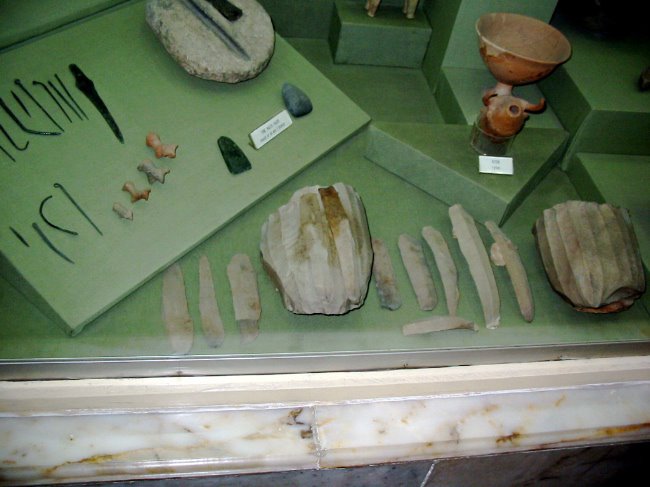
Knowing how much I like messing around with these things, Steve took this picture of two prehistoric flint cores in a museum in Turkey and sent it on to me. These are both very nice specimens and you can see the parallel flake scars down the sides and examples of the blades that have been driven off of them. A core is a piece of homogenous lithic material that has had flakes removed from it. It's primary purpose is to provide flakes that can be used to make tools. In this case I am calling the flakes "blades" simply because of their long thin shape.
Cores can come in lots of different types described by the pattern and types of flakes that have been struck from them. Above are: a) single platform pyramidal, b) opposed platform cylindrical, and c) radial. These are by no means all the types and frankly most that you find are expedient, where a few flakes have been struck off wherever the flintknapper could get them. But the cores in Steve's picture are the type a) above - and the platform refers to the surface that was struck with a hammerstone or antler billet to drive the flakes. The arrows show the direction of force.

After the blades are produced, they can be used for lots of things. First they can be used as cutting tools as they are - they look like straight-razors, don't they. Quite often one side will be intentionally dulled to make it easier to hold and then it is called a "backed" blade. Here's one where one of the lateral margins has been chipped to dull it. The fresh edges are much sharper.
They can be further chipped to the form of a formal tool such as this projectile point.

This is an obsidian point from Catal Huyuk, a site we talked about yesterday. There are of course a wide variety of tools that can be made this way such as scrapers, drills, burins, knives, etc.

A common use of these blades in the Middle Eastern neolithic (whence Steve examples come) is as cutting edges in sickles.
This is a reconstructed example where you can see the blade segments set into a sickle that can be of wood, antler or bone. The stone pieces are almost never recovered still in their setting. Their interpreted use is usually based on a silica polish on the cutting edge called "corn gloss". This comes from silica fragments imbedded in plant stems cut by the sickle.

The manufacture of blades as shown by Steve's picture is only one of a wide variety of techniques for making chipped stone tools that have been used in human history. The blade technology does appear at different times all over the world. The Maya were particularly adept at it, using obsidian as their preferred material. I am more familiar with a local example.
These examples are Late Prehistoric Chumash blades (A-L) and cores (M-V) from the Channel Islands. But check the scale in the drawing - these are much smaller than the cores and blades in Steve's picture. These are actually "microblades" specifically produced and used for the manufacture of shell beads. You can see that the tips of some of the blades above have been modified for use as drills or borers.

Shell beads were a staple of Chumash art and trade. Beads were made of a variety of shell types but the most common were Olivella shell.
You can go to any beach around here at low tide and see lots of them. Here's a few that I have picked up. Their name comes from their resemblance in shape and size to olives. These were sometimes simply drilled and strung whole or could be cut down into a wide variety of shapes and styles. These styles often changed and can be chronologically sensitive "type fossils." Styles correlated with radiocarbon dates can be used to help date sites.
This image shows Olivella beads recovered from the Channel Islands. The top row shows bead "blanks" cut from the shell, the middle row shows in-process beads, and the bottom row shows finished beads of several sizes and styles.

These beads were traded all over prehistoric California and further into the Western United States.
This shot is of some beautiful Anasazi (Ancestral Pueblo) jewelry from Northeastern Arizona, a good 700 miles from here. Whole Olivella shell beads are plainly visible in the left side of the picture. Beads like this have been found as far away as in sites in Eastern Oklahoma. Anasazi painted ceramics have been found in the Chumash area in caves in the Santa Monica Mountains, showing trade going the other way. One of the things I find interesting about that is it is almost certain that the Chumash were quite familiar with agriculture and with ceramics and wanted nothing to do with either. But I'll save that for another post.

Some of the images used above came from George Odell's Lithic Analysis, William Andrefsky's Lithics, Jeanne Arnold's (ed.) The Origins of a Pacific Coast Chiefdom, and Wesley Jernigan's Jewelry of the Prehistoric Southwest

Icons in Space!


For Mr. and Mrs. Peculiar: icons in space, and at the Baikonur cosmodrome. Whatever its faults, this ain't your father's Soviet Union. Courtesy John Debyshire.

More Flu

Here is a good LAT overview of the state of the H5N1 Avian Flu virus, concentrating on its inevitable spread along wild bird flyways. (Personally I worry a lot more about domestic chickens and ducks in the Asian "bird factories").

And here is a dark view of what could happen, and why "ring vaccination", though perhaps ideal. will likely not work in the countries of origin: "...when a fourteen year old boy became Turkey’s first avian flu mortality last week (followed soon by two siblings), a government spokesman criticized doctors for mentioning the disease because they were “damaging Turkey’s reputation.” This is ominously reminiscent of China’s initial response to SARS in 2003."

Russia says it will ban travel to Turkey this spring if the (not transmissible from human to human) cases there do not go away. Yeah, THAT'll work....

Hawk Breeding Regs

This is a long post with contributions by both Matt and me. It is taken from a letter written to the USFWS responding to their request for input on proposed new regulations for falcon breeders. Feel free to skip if it seems too "inside"-- but I think tht it (especially Matt's part) will be of interest to anyone concerned about the endless push by government to regulate the way in which we keep our animals:

(Me first): I have been a falconer for well over thirty years,. I have reviewed the proposed rule to change the regulations governing raptor propagation and while I agree that the regulations need to be easier to understand, I feel that the proposed rules need some serious changes.

First: the FWS proposes breeding success as a criterion for renewal of breeding permits and continued possession of raptors under breeding permits. This is an impossible standard which would discourage rather than encourage innovations and improvements in breeding techniques. Breeding is as much an art as a science, and breeders artists. Some hawks take years to breed; others need changes of mates; artificial insemination birds “click” with some sperm and not others. Some hawks succeed some years and not in others. And what will happen to non- breeding birds if falconry permits are filled? This may be the most important provision of all.

Second: it only seems common sense to allow non- authorized persons--family, friends, employees-- to care for raptors, as long as they are being kept on- premise. Some may well be better qualified in the judgment of the permittee than some falconers he knows!

The time- frame for imprinting hybrids should be extended. Birds can hardly be prohibited from seeing other birds for the rest of their lives.

Finally, the private property issue. Raptors are becoming domestic animals. Some Game Departments actually have expressed resentment to falconers of my acquaintance that said falconers are allowed access to “their” birds. [ Ed. note not in original: this happened in California--SB] This is absurd, considering the relative amounts of time and money spent and the biological reality. My friend Matthew Mullenix says it better than I can, truthfully and forcefully:

“The property status of captive-bred raptors is of monumental import to modern falconry. We legally purchase our captive-bred birds; we pay for their medical treatment, we trade them; we give them away; we sue for damages when they are maliciously injured or stolen; and we take pains to choose the best of them for making the next generation. In fact, we consider them valued private properties, and we act accordingly. Our choices, methods and aims are identical to those of conscientious breeders of livestock the world over: We seek the improvement and perpetuation of animals we love; and we seek independence.

“U.S. law supports our claims to private ownership in various precedents. I believe common sense supports our claims, also, and that these two facts are related. Consider a citizen jury, non-experts in wildlife law, deciding whether a fifth-generation captive-bred Harris hawk belongs to the falconer who legally paid for it. Such a bird would be chosen with care for its known lineage, the reputation of its breeders, and the personal aesthetic judgment of the one who buys it. When taken home, the bird is named, trained, cared for, and improved over time; its daily life the sole responsibility of its owner. This process differs little from the purchase of springer spaniel, a quarter horse, or a Siamese cat.

“For all intents and purposes, we own these birds. The "common sense standard" will ultimately decide this in our favor.

“I presume the Service disagrees on that point. The proposed regulations read in part that these birds are "always under the stewardship of the U.S. Fish and Wildlife Service" and are "not private property."

“I don't believe this set of regulations should include such a claim. I do understand that should captive-bred raptors belong to us, their Federal regulation becomes difficult if not impossible. I also understand that some good has come and may yet come from Federal permitting. Nonetheless, this cat has long since left the bag.

“The Service's "stewardship" of captive bred raptors is effectively moot. Can the Service even say with certainty how many captive bred raptors have been produced or are now alive? Can it determine their origins; or their relations to one another; or whatever becomes of them? Perhaps in theory it could, with proper funding and a larger staff. But why should it? Does the Service have any interest in the improvement of captive-bred birds for the betterment of falconry?

“How long can the Service justify the expense of monitoring a population of animals with no relation to any wild stock? In short, I don't believe the Service can demonstrate its stewardship of captive-bred raptors.

“On the other hand, falconers and breeders themselves can easily demonstrate good stewardship of their own stock. For one example, the University of Washington geneticist (and raptor breeder) Toby Bradshaw has compiled an expanding database and pedigree of hundreds of captive bred Harris hawks. More mundane examples of the daily (hourly) attention to individual captive-bred birds are innumerable and multiplied by the current number of their breeders and owners.

“Again: Captive bred raptors belong to their legal caretakers. We are their rightful stewards, accepting of all the peril and seeking all the reward that this status affords us. I appreciate your consideration of my comments as you continue to draft these regulations”.

The "End of Hunting"?

Both Reid and Anne Hocker noticed this article in the left- of - center Washington Monthly lamenting the decline of hunting opportunities fror the average man and suggesting ways thet "progressives" have a natural affinity with the issue. While nobody would call me a progressive I think that author Christina Larsen hits the nail on the head.

"Tony Dean, a sort of Walter Cronkite of Midwestern sportsmen, who mixes walleye recipes with political commentary on the popular "Tony Dean Outdoors" show, says he fears a day when hunting and outdoor recreation become pastimes of the elite, something only the well-to-do can afford to enjoy. "Our forefathers left a European system in which wildlife and land belonged only to landowners," Dean told me. "We don't want to go back to being like the Europeans.""

Which would be neither conservative of our traditions, which include public land and access, or conservationist. Ideologues make a mistake if they think that turning hunting into a rich man''s privilege will attract the votes of rural Americans.

Larsen also writes of some interesting contrasts between Kansas and Iowa in policy, favoring Kansas. Despite a dumb anti- evolution stance and (on the other side) a popular book by a leftish academic, in this case at least there's nothing "the matter with Kansas".

PS: Reid writes that at since the piece was posted at Alternet : "...You should see the comments - mostly "how dare they put something like this on a progressive site!!!"

I'd think that breaking the current polarization might be a good thing... sigh.

Monday, January 09, 2006

Hasan Dag and Catal Huyuk

Steve's post last week on Turkish Landscapes had a photo of a volcano named Hasan Dag that he traveled past on his trip. The following is a guest post on Hasan Dag and a nearby archaeological site from Janet Jones, an archaeologist and classics professor, who was on the trip with Steve:

Everytime I see the mountain I can't help but think of this extraordinary wall painting from Catal Hoyuk, the famous Neolithic farming village in the Konya plain not far from Hasan Dag. The painting which dates to ca. 6000 BCE was uncovered in 1963 by James Mellaart. Some would call this the earliest map. According to Mellaart it shows a plan of Catal Hoyuk with an erupting Hasan Dag (which could be seen from Catal Hoyuk) behind. Such local volcanic mountains were an important source of obsidian, an important trade material used for tools, weapons, jewelry, etc.

This illustration is taken from the the catalogue of the Museum of Anatolian Civilizations in Ankara:


Here's a view taken from the internet showing the distinctive double peak.
It's hard to miss the likeness:


Update from Steve: Reid found this site with material on Catal Hoyuk, but I found this comment amusing:

"The contours of the volcano are breast-like and the overall shape of the volcano closely matches schematized "bison-woman" paleolithic designs and other goddess representations; it looks distinctly like a body, much more so than like a mountain".

Uuhh-- maybe. But don't you get the idea that the writer has never actually seen this particular mountain?

Parvo in Yellowstone?

Here is an article on whether Parvovirus could be responsible for a sudden decline in the Yellowstone wolf population. I wsn't sure how this might be spread, so asked sometime contributor Dr. John Burchard, zoologist and polymath, for his opinion. His answers were, as always, fascinating.

I had said to Reid, who had sent the item:

"Distemper made some awful inroads in lions in East Africa a few years back, definitely from dogs, so spreading zoonoses are possible. The only doubt I had is that I thought Parvovirus (generally written that way AFAIK, not as two words) was spread through infected soil etc. rather than animal- to- animal. So how are the wolves coming in contact?"

" I’ll ask John Burchard--- he knows more than most vets ".

John replied:

"Distemper caught from local dogs is, I believe, also a major, perhaps decisive factor in the decline of Cape hunting dogs (Lycaon pictus) in East Africa, and in the survival problems of the last remnants of the Ethiopian wolf in the Bale
Mountains. Canine distemper virus can infect a very wide range of species - I think it's not even limited to Carnivora. Something very like it was responsible for mass mortality of Harbor Seals in European waters, several years
back.

"Canine parvovirus was a species jump, probably from cats, in 1978 or very shortly before. A panzootic in dogs went round the world in that year; no antibodies to parvovirus have been found in any dog sera collected before 1976.

"The canine parvovirus is VERY resistant in the environment - it can survive for months or perhaps even years outside the host, which is unusual for a virus. That durability is largely responsible for its importance as a pathogen. You can bring it home on your shoes, your clothing, your hands, whatever.

'Given the level of hatred for wolves in the ranching community, it would not altogether astonish me if someone deliberately spread parvovirus among the Yellowstone wolves. Because the virus is so resistant, it would be very easy to do".

I'd hate to believe it, but especially up north, where emotions seem to run higher, I couldn't in honesty rule it out. Not much way to detect it, either. One can only hope the wolves build up antibodies. I'll leave the last word to our friend Vladimir Beregovoy, another scientist and fellow hunter, whose specialty is primitive dog breeds:

"Yes, wolves should be with us, but they should respect people and dogs. Hunt them with staghounds, Tobets, Borzois, etc., but do not exterminate them completely, please! To me, without a wolf wilderness is not real, even woods and fields are not real."

Engrish

On a (much) lighter note, Peculiar showed us this irresistible T- Shirt. I have seen ones as strange in Kazakhstan and Mongolia but (all together now ) THEY ARE IN THE OTHER COMPUTER!

Kill the Guns!

This New York Times story seems, well, barking mad to me. The police in Maine now destroy the guns used in murders in front of the victims' families. One poor woman was quoted as saying "It was just a very important day for my husband and I," she said. "This was a weapon that changed our lives."

No, it was a PERSON that did that.

Saturday, January 07, 2006

"Rejected by the Publishers"

Roseann sent us this interesting Times clip on two Booker - prize- winning novelists of the Seventies who had those same manuscripts rejected by twenty modern publishers. I'm not sure exactly what it means-- I have not read Middleton, and a lot of Booker prize winners have seemed like trendy lightweights to me. But NAIPAUL?? Surely any editor should be able to recognize writing of that quality!

Pigeon Culture in Turkey..

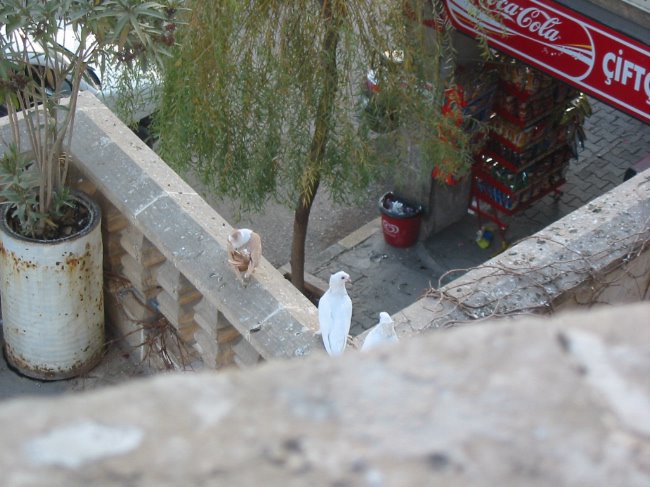
.. could be a book, and IS an excellent website, which I urge anyone interested to consult before, during, and after reading this post-- it contains breeds, photos, sport, advice, origins, and more. I have had it bookmarked for years, never thinking I might get a glimpse of eastern pigeons "on the ground".

Turkey is especially important to the pigeon fancier interested in the history and biology of domestication, because, as in the case of dogs, it is either an important way station out of Asia (as I and the Turkish fanciers think) or a point of origin. As I have written in my book Aloft-- see left-- all the most ancient breeds of pigeon, most used for flight competition or admired for beauty or voice, rather than "practical" breeds for food, come from an area around the Mediterranean stretching from Egypt through Arabia all the way through Turkey. As the West becomes more aware of Asian culture it seems that such birds are also found all the way up into the "Stans", and perhaps always have been. There are mentions of "Middle Eastern"- sounding breeds in 19th Century and early 20th Century British books on Central Asia, which I collect. The old way of thinking was that they were first kept in the Middle East, the "Cradle of Civilization", ,and brought east by Islam. But that's where Europeans looked. New evidence, much of it biological, keeps pushing most domestications east and north, following what has come to be known as the Silk Road (this is perhaps my most serious semi- scholarly preoccupation). Of course such early domestication would have to have been done by nomads or even hunters, who used to get no respect. When I found the Turkish pigeon website a few years ago, I was amazed that they took it for granted that their nomadic Asian ancestors brought their pigeons down from the northeast,and that they even associated some breeds with Shamanism! (See their entries on Trumpeters).

I will not go on too long with this "Pigeon Wonkery", but I should add a few more things before the photos. One is that I have never seen such a pigeon culture, both urban and rural. In Sanliurfa, when I had a chance, i would go out on my hotel balcony at dawn (easy when awakened by the call to prayer at 5:30!) and dusk to watch easily fifty competing flocks in the sky above. I also saw pigeons, high- quality ones, in the bazaar and even in a restaurant! (See below). The countryside was the same-- birds of a quality that could bring hundreds of dollars in the US evading Pergrines on the village outskirts.

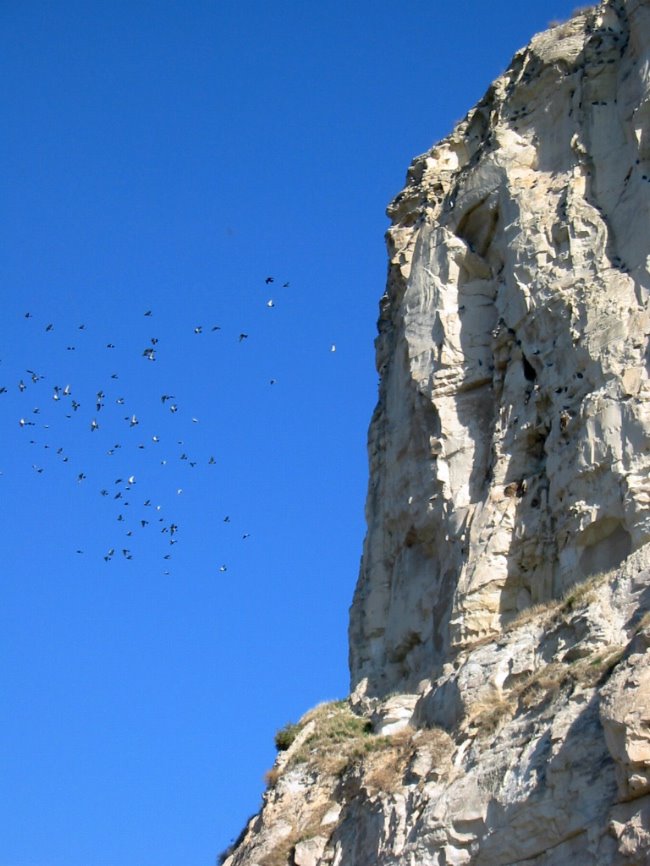
To begin: Rock Doves-- real ones, not feral mutts-- over the Euphrates. Even if the domestic birds originate further east, this, as Darwin first demonstrated, was the original bird (yes, it's found through Asia too, but these are the first real wild ones I ever saw).


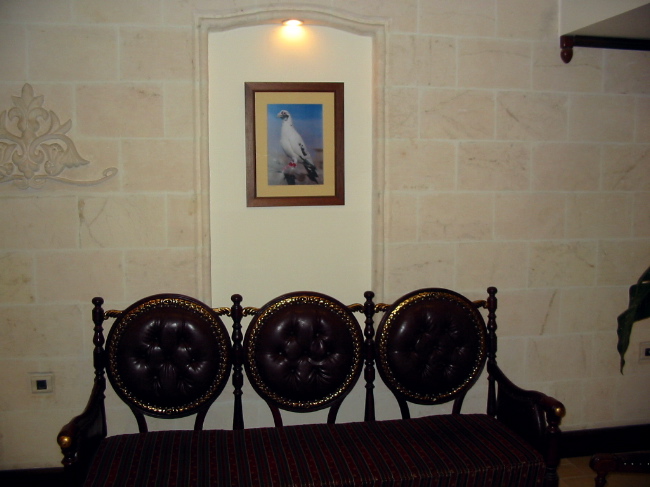
The importance of pigeons in Turkey might be symbolized by this artful signed photo of an "Urfa Guvercin" (Urfa pigeon, actually a diving dewlap-- see the website), complete with jewelry bands, in the lobby of Urfa's finest hotel.


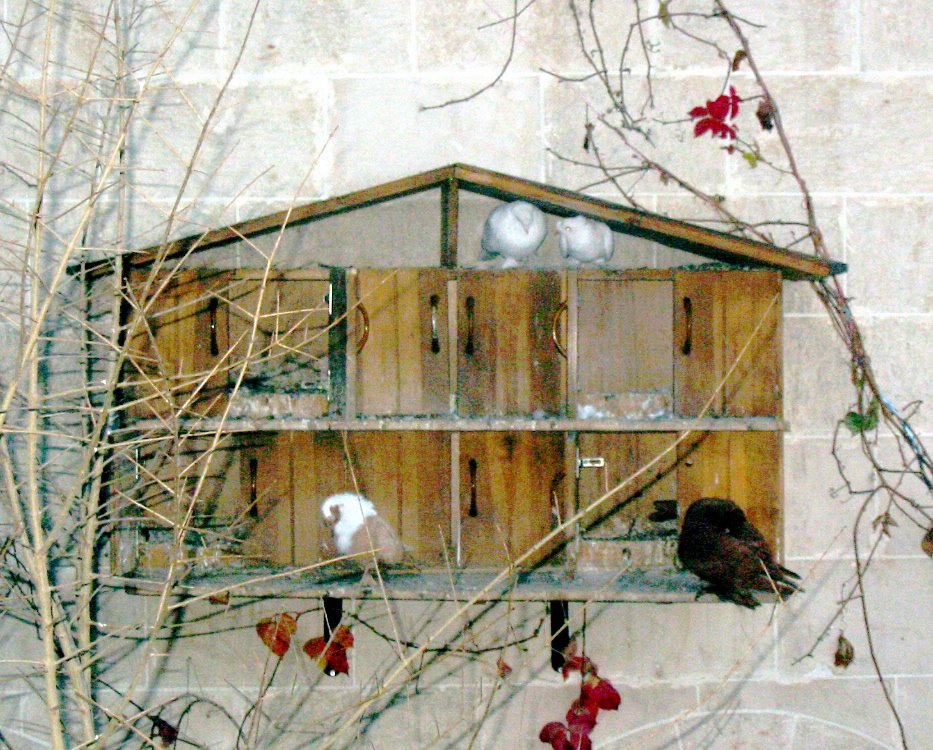
Many of the breeds in Turkey are kept in cupboard lofts. This was in the lobby of a semi- outdoors restaurant, as you will be able to see in the next two photos.


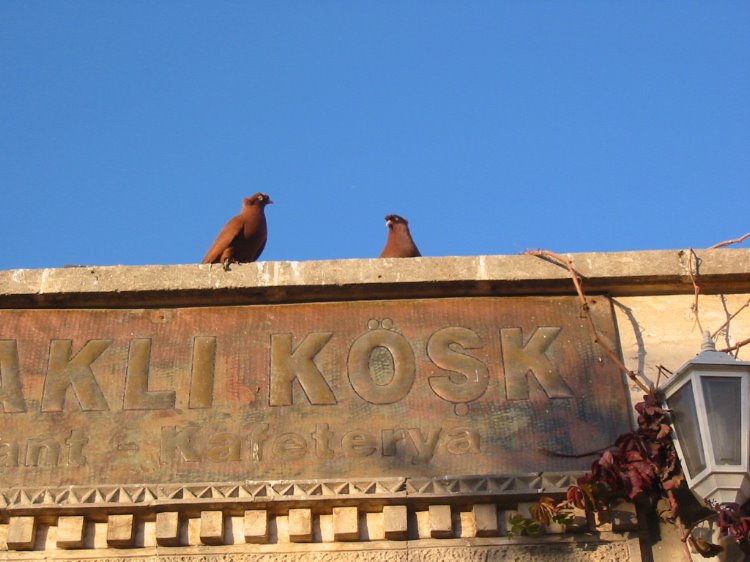
Two beautiful red trumpeters on the restaurant sign:


White trumpeters and a Shirazi or Shaksharli tumbler below the balcony where I am eating.


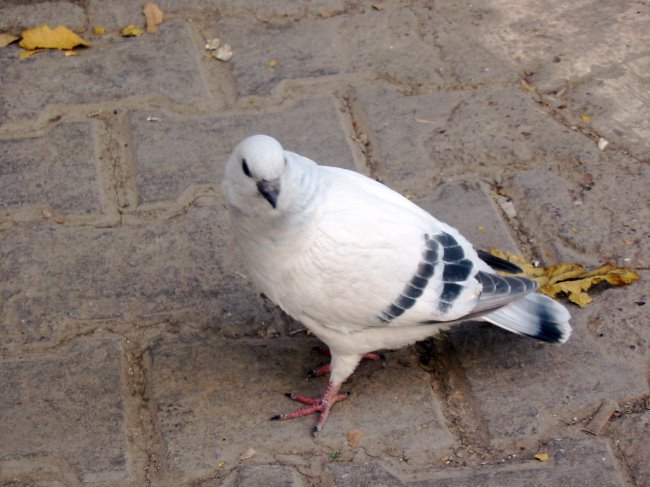
A young "Damascene" (our culture tends to use Arabic- rooted names for the eastern breeds, as they have come mostly from Lebanon or Syria to the States) in the bazaar. The color is called "ice"


In the villages. These "Lebanons" are big enough to eat, though also beautifully colored.


I apologize for the photo quality, but these Swifts were not going to let me close in with my little digital. The one in the foreground had just almost contemptuosly evaded a passing Peregrine, which to be fair didn't try too hard-- experience? Thet were flocked up with some nondescript but athletic tumblers. One kept leaping into the wind from his perch on a wire, hovering in place, and doing a backflip.


All these traditional pigeon cultures seem secure, but I wonder. They are under seige from Islamists, who see them as frivolous (see "Talibanning Pigeons", left) and from the modern fear of germs and dirt, the need to control (see the post on Chicago and pigeons, below, plus many posts on animal control, microchipping, etc.). Janet just sent me this item on Bird Flu in fowl near Urfa. Pigeons are less susceptible than fowl, hawks than pigeons-- but will anyone care? Already a neighbor-- tellingly, one of the rich "nouveau Magdalenians" rather than the natives-- has enquired suspiciously of me: "what are you going to do about your birds?" if Bird Flu comes (uuhhh-- lock them up until it passes?)

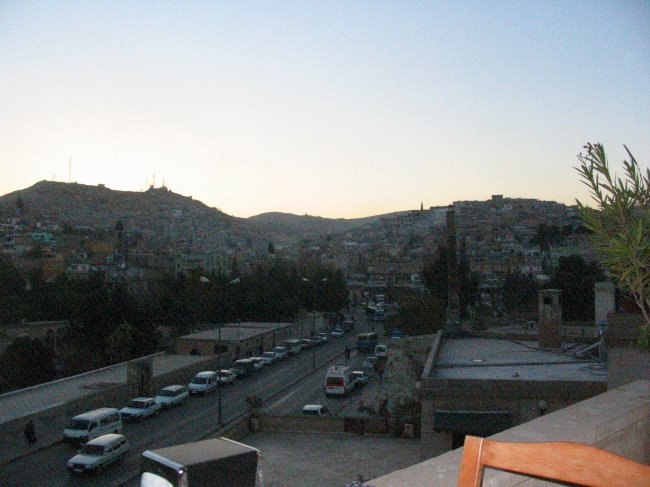
So: long may they fly. I wish you could actually see the flocks in this shot of Urfa at dusk, but the resolution is I fear too small. But they are still there-- so far.


"And in the isolation of the sky

At evening, casual flocks of pigeons make

Ambiguous undulations as they sink

Downward to darkness, on extended wings."

-Wallace Stevens

Update: here is another fine Turkish pigeon site in English, with good photos, showing even more breeds.

Friday, January 06, 2006

More Sporting Notes/ Doom & Gloom

More from Sir Terence. Our mutual friend John Burchard, who has apppeared here, asked what had happened to Fallujah, which once apparently was a hotbed of salukis and falcons rather than 'insurgents". He replied:

"I suppose there were two main causes [of the change]: the first which goes back to the '60s was the deliberate breakup of the traditional tribal feudal system by the Socialist Ba'ath. The shaikhs lost their land rights and with it their power of patronage. The tribes were forcibly settled and living in cramped little villages was not conducive to the old way of life with hawk and hound. Then came the war with Iran in 1980 which took away all the able-bodied males to fight and apart from the few  greybeards of the kind that I knew people simply didn't have the opportunity to hunt any more. As you know, they do not keep unproductive animals and people stopped having Salukis. I searched that area fairly thoroughly but though I had an excellent entree through one of the shaikhs who still kept falcons and had once had Salukis I did not find a single hound. Even the shaikhs of the 'Anizah had none, though they remembered the good old days. The exception was Rutbah on the border with Jordan, Syria and Saudi Arabia where there were lots of Salukis and falcons. The old 'uns could still hunt - even gazelle - in the largely empty deserts all around there and importantly could sell their hounds and falcons to the wealthy Saudis."

When I wrote him for permission to quote this he added:

"...the war was rather specific to Iraq. In other more peaceful countries the decline is more due to the absence of game, often through shooting or disturbance of habitat, and the greater interest of the young men in computer games and the good life!"

Good life indeed! O tempora!
 

Big Surf

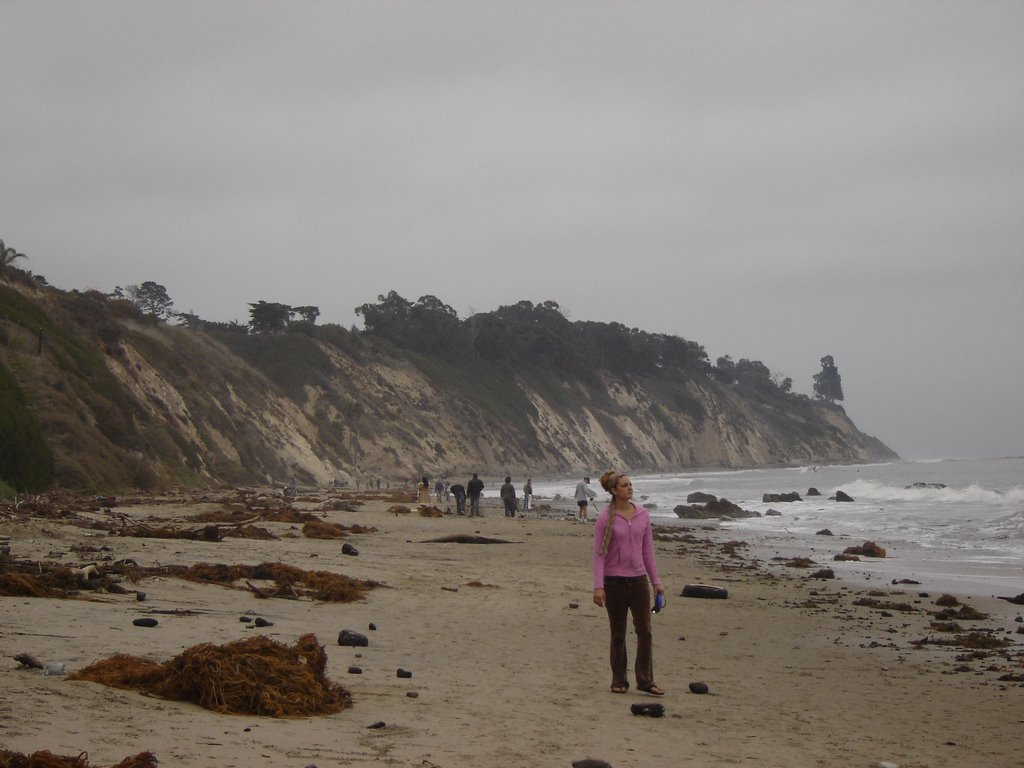
Over the last three weeks or so, we have had a number of storms and attendant swell here in Southern California that's resulted in bigger than normal surf. There have been many days in this stretch that we have had waves in the 8-12 foot range. That has made these people very happy.

My daughter was upset with herself for not bringing her board when she came up from Long Beach for Christmas.

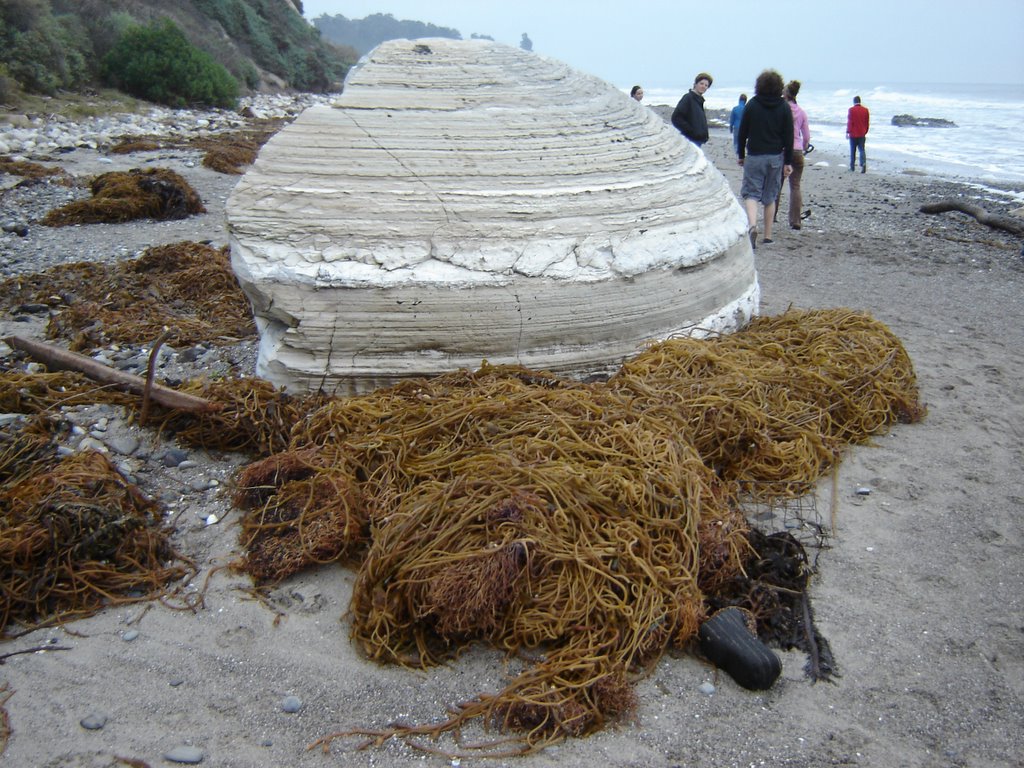
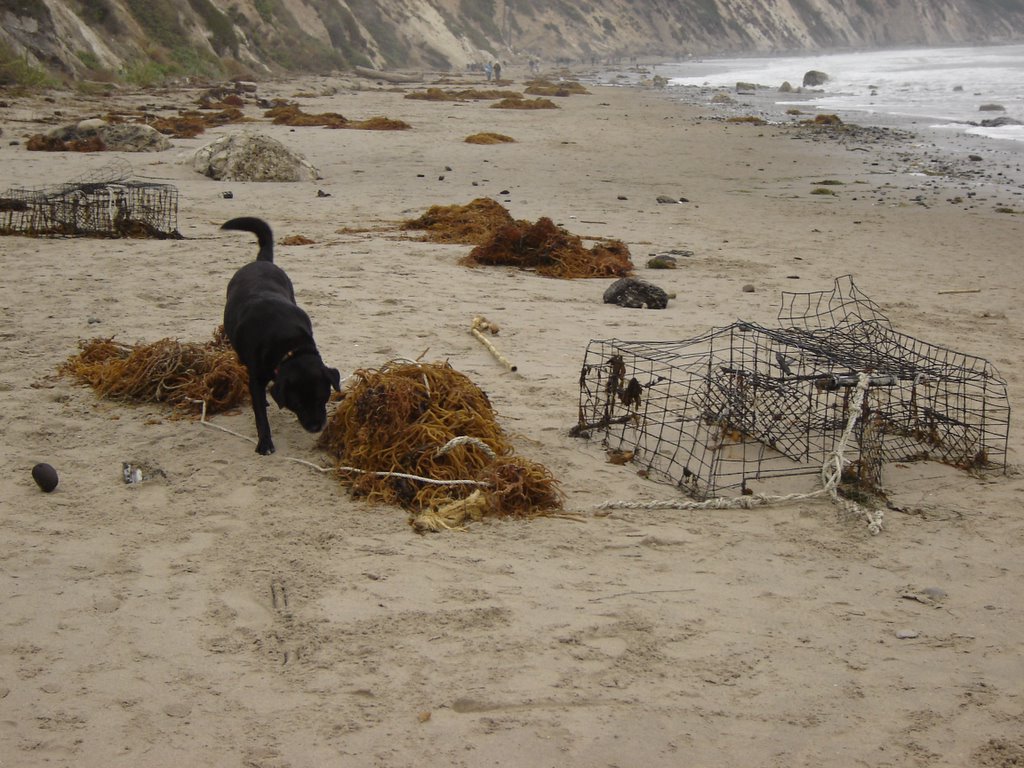
Here in the Santa Barbara Channel there are extensive forests of giant kelp (Macrocystis pyrifera) offshore. All this wave action has uprooted kelp and piled it up on the beach.


Kelp has always looked very strange to me, so rubbery and full of those knobby gas bladders that keep it suspended in the water. It seems otherworldly and looks hardly like a plant at all. It is an essential part of the near shore ecosystem providing food and shelter to a wide variety of fish and other sea critters.

In this view you can see wads of it strewn all along the beach. This is Hendry's Beach looking east toward Arroyo Burro.

It is still lobster season here, and many unfortunate fishermen have had their traps yanked up and thrown on the beach as well. Here's our lab Maggie checking out a couple of them. You can see the mooring line attached to the one on the right. We saw probably a dozen or so in a quarter-mile stretch and the floats of many more just off the beach where they had been pushed into shallow water. I'm told these traps cost about $75 apiece.

The kelp forests here are commerically harvested. Large boats clip the top few feet off the plants and pull them on board. This harvest is heavily regulated and the total annual take in California is about 50,000 tons (wet weight). Some is processed and sold as dietary supplements but the majority is used by chemical companies to make compounds used as thickening agents in the commerical food industry. So think about that the next time you have Jell-o or ice cream.

Thursday, January 05, 2006

(Sad) Sporting Notes from All Over

Queensland, Australia, has permanently ended bird hunting through a regulatory ruling, joining New South Wales,the Australian Capital Territory,and Western Australia.

From the January/ February issue of Shooting Sportsman (not on line):

" 'This is not an appropriate activity in contemporary life in the Smart State" [sic], announced Premier Peter Beattie. The number of citizens who wrote letters opposing recreational hunting was nearly twice that of the number of licensed hunters, and when the matter went before an Animal Welfare Advisory Committee, it "advised that the likely rate of wounding was unnacceptable and consequently the level of pain and suffering through wounding would be unreasonably high.' "

Lessons?

Ask not for whom the bell tolls...

Democracy is NOT a panacea...

Australia, beloved of the sort of neocons and liberals who believe in a mythical "Anglosphere", is one of the ultimate nanny states... ask any Aussie of libertarian sentiments. We won't even mention Canada.

Meanwhile in England, where despite the government freedom- minded people seem to be more active then in the Antipodes, innovative sportsmen continue to improvise. Sir Terence Clark tells me that muzzled greyhounds are being run in what are being called "trials". Hares are driven out of a wood onto a field, and two greyhounds are slipped to "flush" them. They pursue the hares across the field to another field, where two guns await them. Since the hounds don't do the catching, he adds, "All of this is legal within the Hunting Act". !! Similarly, other English friends with salukis that formerly coursed have added saker falcons to the team as the ultimate catchers.

...and of Almaty

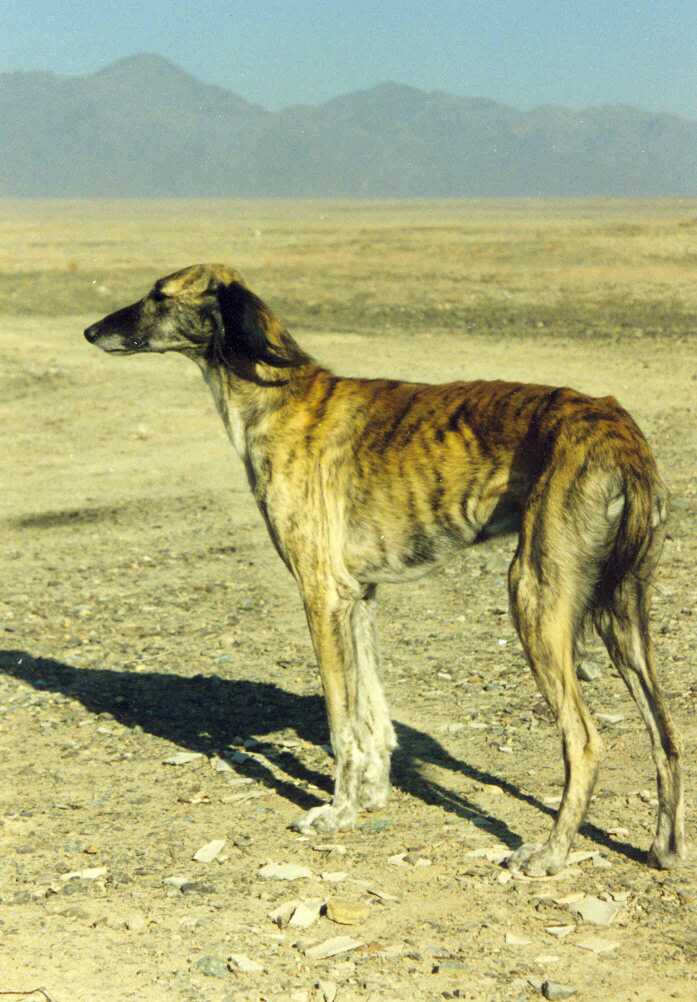
My ornithologist friend Andrey Kovalenko in Almaty, Kazakhstan, who bred my Kiran, sent me this picture of brindle Lashyn's grandfather Sherkhan standing on the steppes with the Tian Shan behind, by our friend (and pro photographer) Oleg Belyalov.


I wish I had the "real" computer working so I could show you the drawing from the Russian magazine "Oxota"-- by Vadim Gorbatov of course-- which shows Oleg being mauled by a leopard in Turkmenistan. Later, perhaps...

Lashyn is a "Semirichenski" or Seven Rivers tazi and a taller, more rawboned type than the Almaty and Turkmeni strains, as was her grandfather. She was born in Kiev, but all her ancestors were Kazakh.

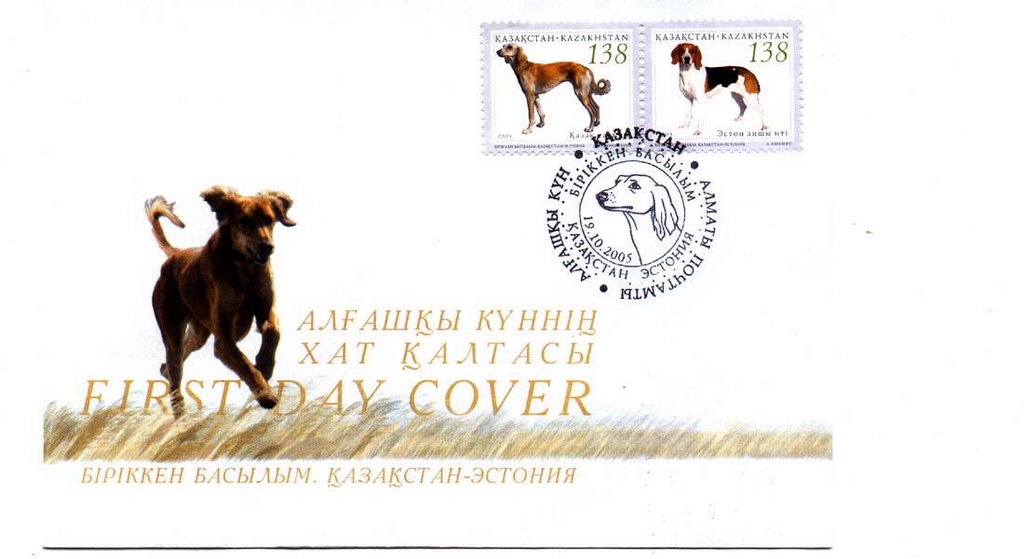
And Kiran's father has had a great honor-- he was chosen to portray the Kazakh tazi on a first- day cover and stamp.


The boy looks just like his dad.

Dogs (and Mountains) of Home...

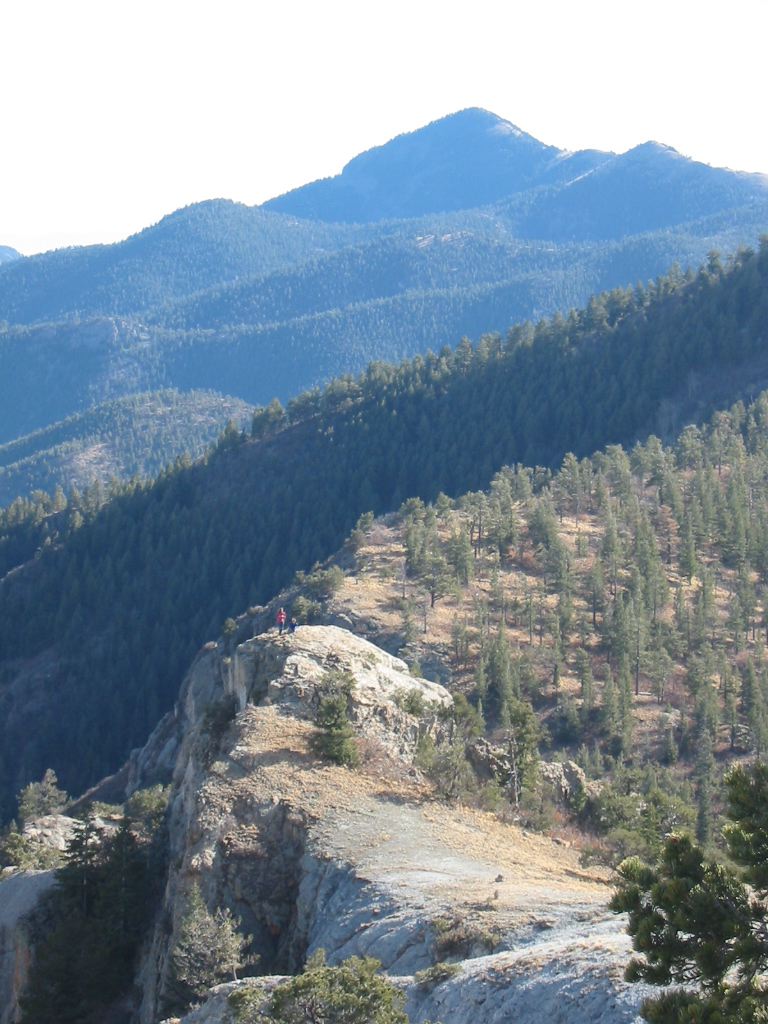
We celebrated the New Year's, Jackson's birthday, my return, and my recovery from flu, by hiking to the 10,000 foot ridge atop the Magdalenas nearby-- only a 6- mile hike, but over 3500 feet vertically. It occurs that it also shows some differences in our Asian dogs, both between their two types and (greater) to the Turco- Persian dogs...

Me with''the girls":


Libby ditto:


Picnic on the ridge--- notice Lashyn:


...and a view south with Jack and Nikki just visible, looking toward 10, 780 foot South Baldy a few miles away.

Some Turkish Dogs

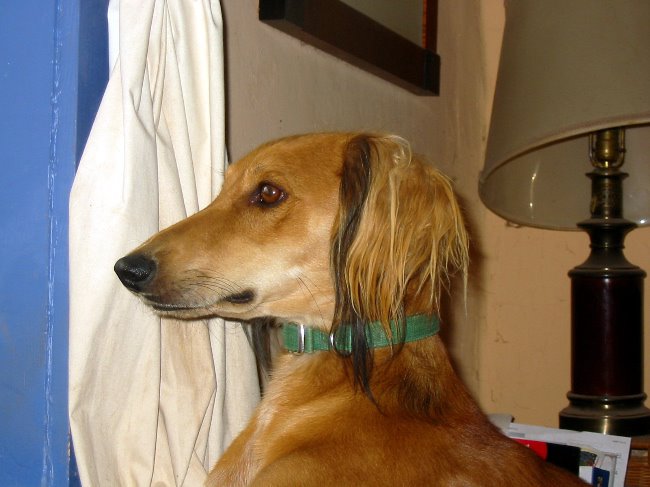
The hounds of Turkish Kurdistan are tall, strong, and long- legged. They are run on gazelles, at least in the south, as well as hares, which would certainly select for size. All we saw were also smooth coated. To me they resemble the salukis of Arabia or (most) Iran, more than those of Central Asia, like mine, though all tazi- saluki variation seems clinal and influenced by climate and terrain, as in wild animals, rather than by faddish breeding. It SHOULD be so, though more and more it isn't. They are called "tazhee'-- zh as in the French name "Jeanne"-- not "saluki" (properly "saluqi"), an Arabian word.

All are kept and treated well, not like dogs in some Islamic cultures, though I am not as sure as one of my companions that all sleep indoors-- this one seemed to have a doghouse.


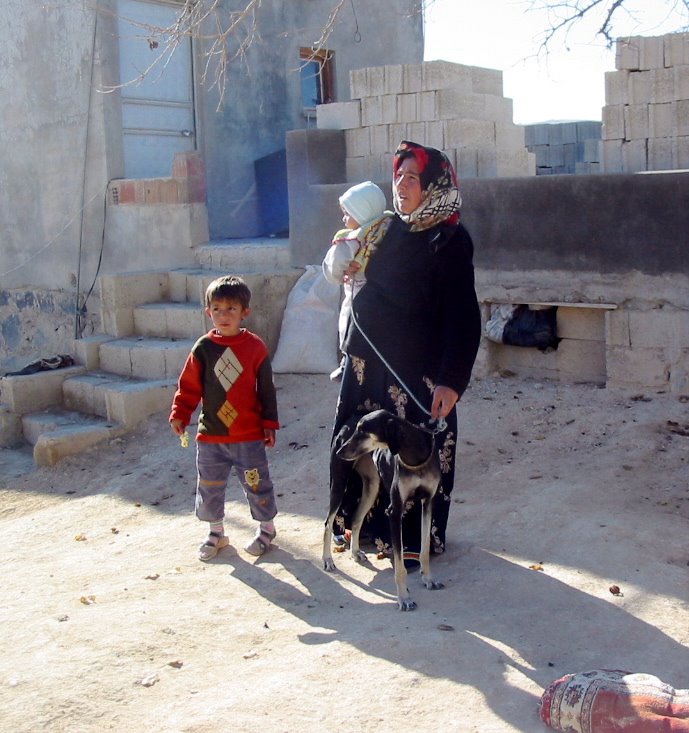
But some of my dogs sleep out most nights too. What is certain was that all liked humans and did not cringe, and that all were well- fed and bold. (Diet is like the human's, more or less-- meat scraps, vegetables, flat bread-- plus bones). Each village seemed to have 2- 5 dogs, though it was hard to tell since most don't run free-- some males are an exception. All wear coats for warmth. This is a typical male in his clothes, against a typical village background.


Putting on a female's coat, as sheep look on:


The male flirts with a female. Notice cropped ears-- universal for males, common on females.


This dog wanted to go hunting and kept climbing into our van.

This one was my favorite, because of her attitude. When a kite (hawk ) landed a quarter mile away she RAN to see what was happening. I prize initative over anything! Just a primitive hunter I guess...


Next Turkey posts will be on the incredible pigeons and on tame partridge, followed in turn (over a few days I suspect) by culture, the wonderful food, and even shotguns. But first, more domestic and Asian stuff. For more perspective on Turkish tazis, including in other areas like the northeast, go to this site .

Update: some comments from Janet Jones, who was also on the trip. Janet is an archaeologist and classicist who has been living and digging in Turkey for over twenty years, a professor at Bucknell, and a saluki breeder, so I think you can take her opinions and facts as correct.

"Just a couple of editorial comments (academic that I am). I think the
tazi is leaning against a storage structure, not a dog house. The
shepherd dogs had smaller shelters near them. I am pretty sure the
tazi sleep inside -- they are so careful about the coats and all.
Plus they are very rare and valuable.

"It's Hasan Dag (with an s and a funny thing over the g meaning a soft
g that lengthens the vowel preceding).

"In all these cultures there is a separate word for dog and hound. In
Turkish its kopek and tazi. Folks get very upset with you over there
(and here sometimes) if you refer to them in Turkish as kopek (which
is a dog and hence unclean). Tazi means, basically, hound -- and
therefore a different life form which can be petted, touched with the
hand, allowed indoors".

Thanks, Janet, The same division exists, if not quite as sharply perhaps, in Central Asia-- "it"-- dog-- and tazi.

Turkish Landscape

We started in Ankara, headed south, and crossed the Taurus range. I think the landscape, though long- inhabited and bearing traces of human presence since the Neolithic, would seem more familiar to an inhabitant of the Amercan West than an Easterner or European. The strangest thing for me was the abundant groves of nut trees and the omnipresent flocks of sheep, each accompanied by an Anatolian shepherd or two, often wearing spiked collars.


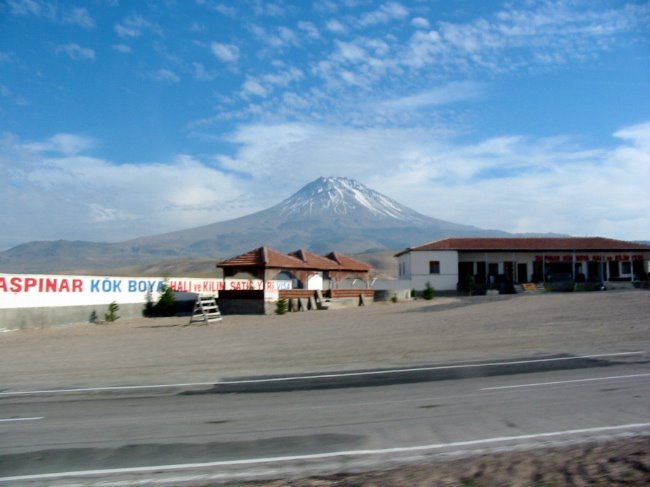
We passed the volcano of Hasan Dag ...


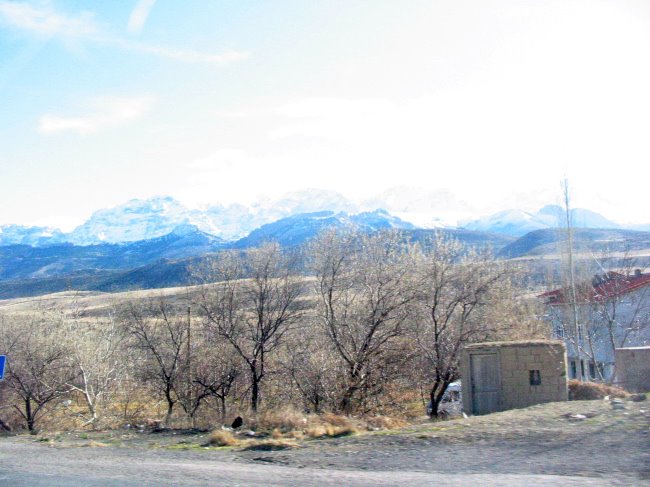
...and crossed the Taurus range, still forested...


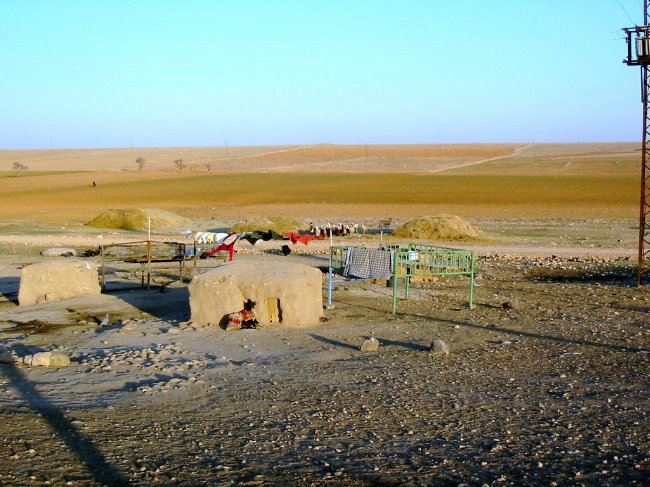
..to eventually end up in the southeast near Syria: desert with irrigation:


That's a shepherd in the background-- you don't get too close.

All landscapes remind me a bit (or more) of home-- I seem to gravitate to such places.

We're Still Standing

While I was in Turkey, Libby got a crew (thank you Simon Armijo and Charley Wagner among others) to build two concrete --or "SEE- ment" as we say here-- buttresses to hold up the crumbling east wall of our 120- plus year- old stone house, which regular readers may recall was dumping fist- sized lumps of mortar on our heads as we slept before I left. One problem down!

Back to the Blog!

Despite the fact that I am still on the "Model T " iMac and its incredibly slow speed, I thought I had best jump back in before the world passes me by! I have a bunch of purely bloggish referrals i have collected in the past week, even a few which have gotten past the sharp eyes of Reid, Matt, O & P-- and some that haven't but that I think I should call more attention to.

Plus there is all the material and photos from my Turkish trip-- dogs, PIGEONS, culture, food, more. Because photos send so slowly on this computer I will be trickling these through over several days or more, through Reid.

Bloggish referrals, first. Here is a New York Times story on the "resurrection" of the quagga, a zebra- like equine from South Africa. Much is made of whether it is a "real" quagga or not, but according to Jonathan Kingdon, in Volume 3 B of his magisterial 7- volume East African Mammals, the quagga is a mere race, conspecific with the common zebra. So why should it not be possible to breed back to the lost "morph" by selecting quagga- like individuals, as taxidermist Reinhold Rau has done?

But it is a good article, barring some oddly sad PC observations about how taxidermy was evidence of white South Africa's attitudes of "dominion", as opposed to present day museums' emphasis on African culture and videos. Such very liberal scientists and cultural commentators as Kingdon, Oliver Sachs, and the late Stephen Gould, all of whom have written essays in favor of old- fashioned "Cabinet Museums", might disagree.

Re Anne Hocker and the Washington Times: pigeon keeping is now illegal in Chicago. A federal court found that keeping pigeons is not a fundamental right. Probably not, but the question might be framed better. Don't people have a fundamental right not to have ancient and harmless pastimes suddenly criminalized?

Notoriously, handguns are also banned in Chicago,which has not affected the crime rate at all.

A new carnivore has been found-- photographed!-- in Borneo. What is it?---- looks like some kind of civet to me. Though Borneo has been well studied, this discovery reminds us of how much is just... out there, if we don't destroy the habitat. In Borneo, we are still doing that...

Odious and Peculiar link to this Scotsman story on how Stalin planned to breed human- ape hybrids as invincible worker and soldiers, and incidentally to "destroy religion". Yeah, that always works. Stalin still holds my title as "Worst 20th Century Tyrant", though I realize that Hitler and Mao will always be contenders. Related more detailed story here.

Reid found me this NYT science article on the "Cute Factor". I remain suspicious of "cute" , perhaps because we are all so susceptible to it, and I am not alone. "....said Denis Dutton, a philosopher of art at the University of Canterbury in New Zealand, the rapidity and promiscuity of the cute response makes the impulse suspect, readily overridden by the angry sense that one is being exploited or deceived. "

And speaking of Hitler: "The new Beetle looks like a smiley face," said Miles Orvell, professor of American studies at Temple University in Philadelphia. "By this point its origins in Hitler's regime, and its intended resemblance to a German helmet, is totally forgotten."

Another piece from the invaluable NYT Science pages-- did you know that if you eat meat with shot in it , the lead may end up in your appendix? Remarkable X- ray!

Only: IT IS NOT BUCKSHOT! Buckshot is used for, well, bucks. BIRD shot is used for birds.

Of course, I'm sure the writer has opinions on guns...

More to come...

Wednesday, January 04, 2006

Ancient Irrigation in Peru

This news release describes archaeologist Tom Dillehay's discovery of irrigation canals in coastal Peru that may date as early as 6700 years ago. Recent research keeps pushing the inception of agriculture and urban life in Peru back in time. The pace of research in this important region has increased due to the more stable political situation in recent years.

On the Peruvian coast examples of settled towns and large scale communal architecture have been found as early as 5200 years ago in the Norte Chico, which could make them as early as Sumerian civilization in Mesopotamia. Charles Mann has an accessible summary of recent research there in his book 1491. According to Mann and as alluded to in the description of Dillehay's work, the principal crop grown in these earliest sites was cotton. A case is made by some that the earliest domesticated plant in the area may be cotton rather than any food plants. This upsets the assumptions that we have had about the development of advanced societies - that agriculture supplied the stable food source that allowed settled life. On the Peruvian coast, the marine fisheries may have provided that stable food source rather than agriculture. Cotton was more important than food plants as it was used to make twine for fishing nets, increasing the fishing yield.

Interesting stuff and possibly another paradigm overturned.

Tuesday, January 03, 2006

For Sale on eBay


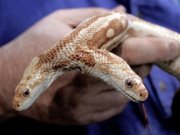
You can have your very own two-headed snake, for sale on eBay. Minimum bid is $150,000.

Breakfast on the Trail with Frank Hamilton Cushing

A while back Steve said we should do more food-blogging, doubtless inspired by the good things our blog-sister Roseann Hanson puts up at Three Martini Lunch. So I wanted to pull my weight in that regard, though not to short myself, a few weeks ago I did post a coot recipe that Rebecca O'Connor told me she almost had to use.

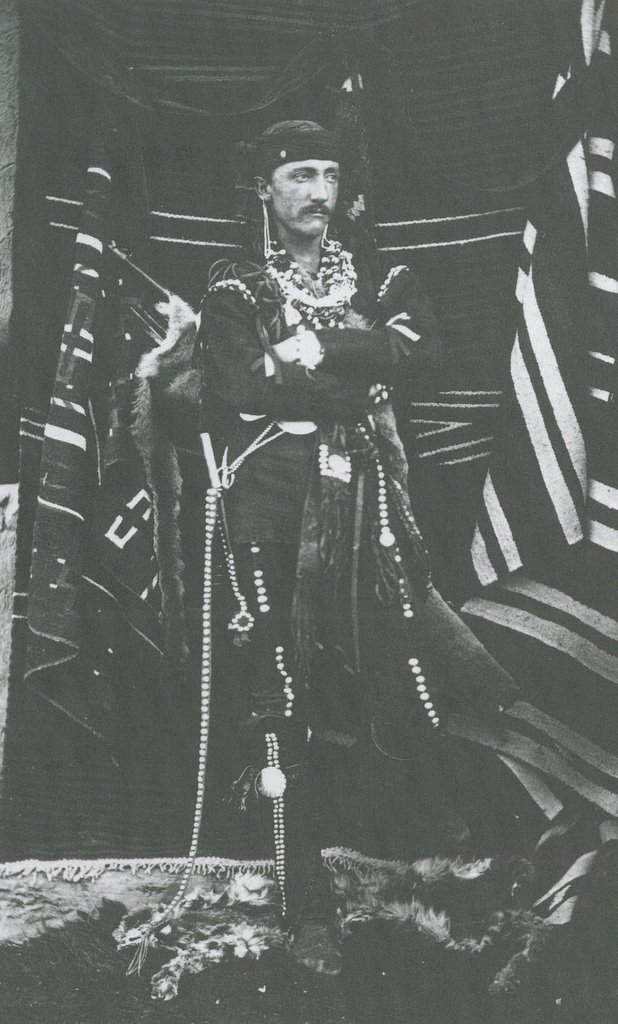
So the inspiration for this food post comes from Frank Hamilton Cushing, an ethnologist from the Smithsonian Institution who lived and studied the Indians at Zuni pueblo in western New Mexico from 1879 - 1884. This book is a collection of his writings from which the photo above of Cushing in full Zuni regalia and the account below is taken.

This comes from the story of a road-trip Cushing took with two of his Zuni compadres, Pa-lo-wah-ti-wa and Kesh-pa-he. They were going on a journey of several days on horse-back and Cushing was taken aback that they were taking essentially no supplies: a couple of small bags of cornmeal, some corn-bread, salt, pepper and their cooking utensils. Cushing was told that they would show him how to live off the land.

On their stop for the first night, Cushing's friends quickly caught a couple of rabbits that they roasted on sticks before their campfire. They also made what we called "stick bread" in Boy Scouts, a rolled-out coil of dough, draped around a stick and toasted before the fire.

The next morning, Cushing (his friends called him "Little Brother") and the Zunis get ready for breakfast. I'll let him tell the story:


…Kesh-pa-he appeared, leading the horses.

"There’s a nest just outside of camp!” said he.

“Where?” exclaimed Pa-lo-wah-ti-wa, catching up his hunting knife and cutting a twig like the one with which the rabbits had been captured the evening before. “I’ve been telling Little Brother how hunters make 'rat-brine,'” said he, with a grin, and a stirring motion of the knife he was whittling with. “He is so hungry for some that his breath is hot and his eyes moist with anxiety! – look at him!"

Thereupon both rushed to find the nest in question. It was composed of sticks, stalks, and abundant cactus spines – with which the Southwestern wood-rats cleverly protect the approaches to their houses – all piled compactly about the roots of a large juniper tree. With a prod all this was soon demolished, and the holes in one of the roots examined.

“They’re in!” called out Kesh-pa-he excitedly, and forthwith the flexible sapling probe was introduced, twirled a few times and withdrawn, two squirming, staring-eyed rats well twisted to its end, and another prodding brought out one more. The rats were choked en route to our camp, and perhaps a little too soon for their own comfort, thrown into a bed of embers, where, after roasting a few moments, they bloated up into oblong balls, became divested of their tails, legs, ears, winkers, and all other irregularities, and when pulled from the fire, looked like roasted potatoes overdone. They were “shucked” in a twinkling – came out clean and white except for a greenish tendency of what were once their under-sides – and were forthwith mashed into a pulp between two stones – meat, bones, visceral contents and all, and stirred into about a pint of salt and water. Thus concocted was the “rat-brine;” green in color, semi-fluid, and meaty in taste – for they made me eat some of it, I do not regret to say – and very aromatic in flavor; a quality which the rats derive from the trees in which they live and on the berries and leaves of which they feed. Disgusting indeed would this delicacy of the hunter be, were the wood-rat of the Southwest anything like his various Eastern representatives and cogeners; but he is not. He lives on but one or two kinds of food all his life, and the peculiar flavor of the sauce made from him is due to the way in which – visceral contents and all – he is worked up into “rat-brine.”


Bon apetit!

Archaeologist in New Orleans
This article in today's New York Times about an archaeologist working with FEMA on Hurricane Katrina reconstruction is interesting as far as it goes, but leaves a lot out concerning the role that cultural resources (archaeology and history) play in those Federally-funded efforts. Much of the work that FEMA sponsors is considered Federal undertakings, and as such is subject to review under the National Environmental Policy Act (NEPA) which means that studies of historic and archaeological properties affected by them have to be done and significant resources protected.
There are many archaeologists, historic architects and historic preservationists (far beyond the woman mentioned in the article) working in Louisiana and Mississippi right now on this mission. My employer has support contracts with FEMA for this type of activity and I and my wife have been repeatedly asked to go for 30 to 90 day stints. Were our schedules with current clients not so onerous we would. Connie spent the month of October, 2004 in Florida, working for FEMA and the Corps of Engineers doing just that after the three hurricanes that hit there that year.

With all the historic buildings and resources in New Orleans and the Gulf Coast that is a big job. Just wanted to fill you in on that.

It was also interesting to see in this article that some of Dr. Dawdy's previous excavations in the city may have uncovered a bordello.

Monday, January 02, 2006

The New Middle Ages

I don't agree with everything Eric Jager says in his LA Times op-ed piece, but I will second his strike at "presentism" or our predisposition to view contemporary times as the summit of knowledge and enlightenment looming above the ignorance and intolerance of past ages. I find this particularly irritating when public figures in past ages are judged by contemporary standards, but that's not really where Jager is going.

Jager believes that we have no right to refer to the emerging 21st century as the "Information Age" as he sees major elements in our behavior as a species that haven't changed since Medieval times: "...legalized torture, rampant religious fanaticism, widespread poverty and illiteracy, the threat of mysterious plagues, fascination with magic and the occult and suspicion of science, what else would you call it?" but the New Middle Ages. I have a feeling he picks the Middle Ages as he is a professor of Medieval Literature. But why stop there, you could go back as far as you want in human history and find all of these things. It's evident to me that will all the advances we've made, there are still many things about us that have not changed since the Pleistocene, and we should never forget it.

But I do concur with him that we should keep a rein on our self-esteem as "modern" people. As an exercise, imagine yourself in Europe or North America in AD 1800, just knowing that you are at the summit of modern science just as we do today, then consider the knowledge and technology gap between then and AD 2000. Now turn around and imagine what ignorant, benighted clucks the people of AD 2200 will consider us to be.

And they will!

Photos from Turkey

Steve continues to experience computer problems that make it impractical to load posts into Blogger, but he does have e-mail. He was able to send me these dog and bird photos from his trip that I have loaded below.


The dog photos were taken in rural Kurdish areas and the pictures of birds are from larger towns. Just to whet your appetite. More to come soon.