By now at least half the town knows that Lib fell off a ladder tending to the pigeons in the "trap" on top of the pigeon loft. I use "trap" in quotes, because normally it is a pigeon racer's term for sort of double entrance chamber used in racing pigeon competitions to control access. But in this case we have been trying to catch and remove two first year's "Urban Coopers" who have set up on my loft and, so far this late summer and fall, have killed over twenty pigeons from the flight loft.
A writer to the Magdalena E- Board says the following: "If that's not a joke about the hawk and the pigeon, let me give you the ornithological point of view. Let nature take its course. Hawks are predators and need to kill smaller birds to feed themselves and their offspring. A certain group of hawks called Accipiters prey almost exclusively on other birds. Let them do it. It's nature's way."
I don't know quite where to start. As anyone knows,I am more than familiar with Accips, having flown two subspecies of Goshawks in four states and having seen` them flown in five countries.
But "Nature's Way"? The Urban Accipiter is a brand new, human- influenced phenomenon. In Asia and eastern Europe, as documented ably by England's Conor Jameson in his book Looking for the Goshawk; Gosses, a near- wilderness species in western North America (you can find pairs in The San Mateos near Grassy Lookout, and in the Magdalenas up the canyon from the Water Canyon Peregrine nest in wet years), are now common inhabitants of urban parks, even in Moscow and East Germany. The great Russian wildlife artist Vadim Gorbatov,who has painted quail on Lee Henderson's ranch, done Water Canyon as a backdrop for a children's book on Peregrine reintroduction,
and who drank that"good Mexicanski vodka" (tequila) at the Spur, lives in a Moscow high- rise, and painted his resident Gos catching a hooded crow in front of his apartment for my book,At the Edge of the Wild
We don't know why Goshawks are invading the cities, but we do know something about Coopers. The phenomenon was first noticed in the early 90's in Tucson, when a University of Arizona study of the Coopers hawk there revealed the then-astounding number of 160 pairs within metropolitan Tucson's boundaries. The population then was unhealthy, though large. The hawks were living entirely on urban feral pigeon and the unnaturally large population of white- winged, Aztec,and ground doves which the city, with its water and plantings, attracted. These birds had endemic Trichomonas gallinae, a disease which did not harm the pigeons much but killed the predators. Only the resistant hawks survived, and once the population became resistant, it nearly tripled, to a density unknown in any wild situation. The species received a second winnowing from West Nile disease, which killed as many as 7/8 of the raptors (not just Coops)that got it. The resulting urban populations have doubtless been genetically changed to one with the disease resistant genes. They have also changed their habits-- I'd bet that they don't interbreed with their mountain cousins much. This kind of "voluntary" isolating mechanism is just how Menno Schilthuizen suggested that sympatric speciation, far rarer than allopatric, could take place (in Frogs, Flies, and Dandelions-- he even convinced scary old Ernst Mayr, in his nineties at the time!)
This is all for bio- wonks. Practical point is, there are probably a THOUSAND pairs in the Rio Grande Bosque, nesting in people's backyards and making pests of themselves dive- bombing runners (both my female doctors have been attacked by them in Albuquerque-- luckily even a big western female doesn't weigh more than a male homing pigeon, though their long tails can make them look as big as Goshawks. They are utterly without fear. Even the wilderness ones are bold; I once watched a female in Copper canyon roll a skulking raven twice her size that had been searching for nests three times, like a leopard attacking a bear. These ones are ridiculous; Lib poked the male with a stick and he just SAT there, and as she was doing this, the female cut in and carried off a pigeon! If they were the size of Crowned eagles, we'd all be carrying ten- bore shotguns or howdah pistols. They have also moved uphill (not down I think) to live in Magdalena. Until five years ago or so Coopers lived only in the the mountains, nesting in deciduous trees in the canyon bottoms, and rarely attacked my pigeons (I have been here 36 years). In the last couple of years they have become a problem. This particular young unmated "pair", birds born this spring, learned to hunt on (mostly my) domestic pigeons and the infernal exotic Eurasian Collared doves, which in the last decade have replaced the "natural" southern invasive White wings (up from Texas and Arizona naturally, not coming from the east in an invasive wave). The pair have killed so many of my flying pigeon flock is threatened. As a falconer, I can legally trap raptors, and I see no difficulty in catching them and releasing them in Socorro, where they can eat feral pigeons to their content and not both my highly bred, expensive fliers.
So LIbby was up on a ladder putting water in to the birds in the trap, when the ladder broke and she fell between the halves. (I had been up there the day before and had warned her it was shaky). Luckily our friend Kim, who has been helping us with animals the past couple of weeks, was there, because I was inside working. At the Emergency Room, they found that she had lost two teeth, broken a rib, and needed several stitches on her face. She remains in a good mood with the help of Nurse Ataika, but it turns out we we were lucky to have missed getting our pup last week as it would have been a pretty hairy situation...
"... nature is portrayed poorly whenever harmony is implied." _ Aussie ornithologist Tim Low.
UPDATE on hawks courtesy of Paul Domski: "Brian [Milsap, USFWS biologist] said that if you are standing at a Coop nest, there are 4 others within a 1/2 mile, or something close to that. "
"Stuff is eaten by dogs, broken by family and friends, sanded down by the wind, frozen by the mountains, lost by the prairie, burnt off by the sun, washed away by the rain. So you are left with dogs, family, friends, sun, rain, wind, prairie and mountains. What more do you want?" Federico Calboli
Showing posts with label Evolution. Show all posts
Sunday, October 30, 2016
Saturday, November 07, 2015
Update on "Beebesaurus"
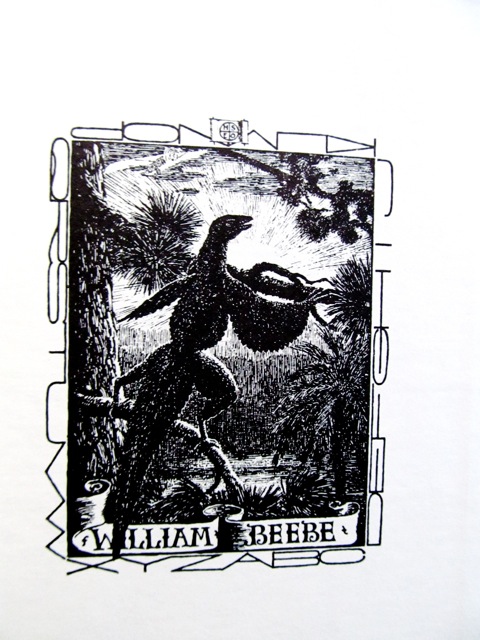
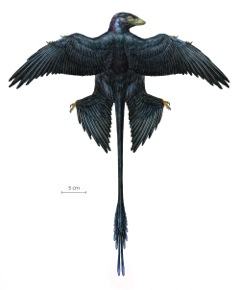
... also known as Microraptor gui. I painted it a sort of irridescent black, to conform with what is known about its feathers. Can't believe how much it looks like Beebe's bookplate in his pre- WW I (1910) book Our Search for a Wilderness. Microraptor was dug up in China in 2003.
Tuesday, October 27, 2015
Beebesaurus
I finally got my copy, Beebe's copy, of his book Our Search for a Wilderness, with his bookplate. The seller thought it was an iguana, but I knew it was a sketch of a possible "pre-Archaeopteryx" avian ancestor he had imagined. In 1910.
I think it was 2003 when they dug up Microraptor gui. The model is light- colored, but it has been discovered to be irridescent black. Mira!

I am painting my model black, and displaying it with the book...
I think it was 2003 when they dug up Microraptor gui. The model is light- colored, but it has been discovered to be irridescent black. Mira!

I am painting my model black, and displaying it with the book...
Sunday, April 12, 2015
#feathersdammit#FEATHERS
Pluvi Tweets about this fantastic photo of Cassowaries, and once again damns the lizards of Jurassic Park. Early adapters can risk looking weird, but those who cling to the old paradigm too long can come to look like Flat - Earthers...
Wednesday, March 25, 2015
Convergence
No one has ever explained this close evolutionary convergence to me; even Jonathan Kingdon thought they looked less alike than they do.
Nearctic Meadow "lark": an icterid ((New Word blackbird), common here and a lovely singer; and African Longclaw, also a bird of savannahs. But HOW? I am sure we will someday figure it out, but I don't have a clue...
The images alternate, starting with a longclaw. And no, they are NOT related- cats and dogs...
Tuesday, June 10, 2014
New Toy
Supposedly Archaeopteryx-- but except for the lack of the inner "killer claw" more of a typical feathered Theropod like Deinonychus.
Also see A Field Guide to Mesozoic Birds.
Sunday, December 01, 2013
Cryptic Cats
I always like finding new species, and am fascinated by "cryptic" ones that look just like others but have different DNA. (Are there really SEVEN Red Crossbills?) Not every species is really one, and if you obsess on the subject it will drive you mad. I like to argue and define, but my not quite tongue- in- cheek assertion that Northern Goshawks are not one circumpolar but two species, while the Gyr and Saker are one, is an example of a debatable case I know something about.
I know nothing about cats, but as a curious naturalist I was interested in this account of a new species of Leopardus found in Brazil, not least because last time I looked at cats the only one close to it was the Margay, Leopardus (then Felis) weidi.
The pictures made L. tigrinus and L. guttulus look like color phases, but the evidence of long separation seemed clear. More than that was nagging at me. In the 60's and early 70's, before I knew her, Betsy Huntington had achieved the rare feat of breeding margays in her house in Cambridge, where they mostly roamed free. (She demonstrated her methods to a horrified Roger Caras on live TV--"I just waited until the female was in heat and stuck them together like this. It wasn't hard-- they liked each other!")
But her two cats looked less alike than the new species and the "tigrina" Remember, these are old photos, but...
And here are a couple of the stripier one leaping and perched up where they did, and of an indubitable margay. The one with the more striking markings also has a rather different head (and I do not think he is an ocelot, as there are also photos of an ocelot-- bigger, bulkier, and different-- in her album to compare-- last pic).
I don't know if we can ever do other than speculate-- I think everyone involved in the project is long dead, and the only two who remember its existence are me and Annie Davidson. Annie?
Saturday, November 30, 2013
Teaser
Would you consider these cats the same species?
Thoughts on this and much more starting tomorrow. Returning soon to full service-- the books go slowly, but too many good things to share...
(And Annie D-- recognize these creatures?)
Wednesday, April 24, 2013
Why Quammen's Spillover is worth Your Time
David Quammen's new book Spillover, on emergent diseases; or more specifically, on emergent zoonoses, came out a few months ago to a series of middling good but somehow lukewarm reviews. I vehemently disagree, but it takes a bit of unfolding. Why do some readers find such a book fascinating while others find it dull?
First: I think any literate biologist will find it fascinating, a journalistic War and Peace with many adventurous protagonists, viruses as antagonists, mysterious hosts (you will learn why so many turn out to be bats, and why the source of the legendary Ebola--- which should scare you a lot less than bird flu-- probably is).
But you must understand evolution as an organizing principle of all nature to follow it. What is more, Quammen travels round the world, from northern Australia, where a disease you have likely never heard of jumps from fruit bat to horse to veterinarian, to the familiar (to his readers) rain forests of equatorial Africa, home of gorilla and chimp and bonobo, of war and bushmeat, Ebola and Marburg and AIDS. He looks at Lyme disease (not a virus by the way). He visits Bengladesh (who else bothers?) to trap flying foxes while wearing a biohazard suit, and sees a scary combination of a dense population inhabiting a semi- submerged land with poor sanitation as well as a sweet bucolic tropical nation. He goes to southern China, home of the briefly appearing SARS, which I was checked for once on a Mongolian flight from China, and where the proximity of humans, ducks, and pigs may make for the next human pandemic in the form of an unstoppable flu.
You must be patient, because none of this has a normal narrative line. Quammen is delightfully anecdotal, but unlike in Richard Preston's entertaining and Stephen King- terrifying The Hot Zone, he is not penning a novelistic thriller that happens to be non- fiction. His aim is to have the reader understand all the origins of the diseases he writes about, that is, their evolutionary roots. He wants you to know what a virus is, and how the main kinds of virus differ, and how they evolve without being "alive". He wants you to know how and why some kind of outbreak is mathematically virtually inevitable. But nobody "explodes"; in fact, I thought that given his gentle reprimand to Preston over his using that verb re Ebola, the Saturday Wall Street Journal's giving the assignment to review the book to him was at least tactless. Preston acquitted himself as a gentleman, giving the book a mostly favorable review, but that unmentioned paragraph hung uncomfortably in the air.
Quammen ends the book by writing vividly about what a unique situation our human biosphere is, merely in its sheer mass and number of ubiquitous large mammals and their congener species. It is a subject I have only seen in science fiction. And then he closes with a description of a plague of tent caterpillars in Bozeman Montana, and what happened to them. If you read that far, and I think even non- science nerds may be captivated by then, you may finally feel your flesh creep.
Wednesday, April 10, 2013
Two rather biological quotes
From William Hamilton, the eccentric genius whose new biography is on the way, and from our old neighbor David Quammen, who chronicled Bill's demise from the complications of malaria meds in his Spillover, review on deck at last...
Hamilton, from volume 3 of his collected works:
"For me it seems that the universe only needs to be beautiful, my 'science' no more consistent or less tragic than Antigone's story or her sculpted head."
And David's rejoinder, to a scientist collecting bat samples in Uganda in hopes of finding Marburg and Ebola:
"Wait a minute, lemme get this straight: You're in a cave in Uganda, surrounded by Marburg and rabies and black forest cobras, wading through a slurry of dead bats, getting hit in the face by live ones like Tippi Hedren in The Birds, and the walls are alive with thirsty ticks, and you can hardly breathe, and you can hardly see, and...you've got time to be claustrophic?"
More from both these sources coming.
Thursday, March 21, 2013
Say it again, John
Dr John Burchard on "Oriental sighthounds" (and breeds in general):
"I think we have to remember that the breed subdivisions within the "oriental
sighthound" group are to some considerable extent a Western artifact which does
not accurately reflect the reality on the ground. On the ground there are
several regional populations, each with a considerable range of phenotypic
variation, grading more or less insensibly into one another. The extent of gene
exchange among them is probably considerable but thanks to "breed politics"
(also a Western invention) I fear we are unlikely ever to get honest and
accurate sampling that would permit DNA analysis of the situation. Almost
everyone involved has some kind of agenda and most of those agendas are either
Western-inspired or based on a desire to have a "national" breed. Most of these
dogs are called "saluqi" in regions of Arabic speech and some variant of "tazi"
elsewhere. To me it appears that the phenotypic "fault lines" - to the extent
that such actually exist, which is far from obvious - do not particularly
coincide with the linguistic ones - nor, alas, with the "breed political" ones.
Introducing the Western "purebred" model, derived from 19th century notions of
human racial "purity", into this situation has IMHO not been beneficial.
"In other words, when we speak of "different breeds" here, it is probably a good
idea to use quotation marks ."
Tuesday, January 01, 2013
Nomenclature
Annie Davidson sent our tiny aging, nostalgic, and usually goofy Zoo group (we have known each other since, what, 1970?) a provocative essay contra the Linnaean binomial system. I think she was poking a stick in an anthill, but I am afraid it pushed a few buttons! I was provoked to editorialize...
"The author's criticisms are valid, her conclusion unjustified. Linnaean terminology is bad but everything else is WAAY worse. I espouse and defend, here and elsewhere, a small c conservatism-- what works (and with many patches it has & does); rules known, universally accepted against chaos and a million competing schemes & memes. Think how losing the Latin Mass for idealistic reasons shattered the Catholic church-- I was there-- but she argues for tearing down a system that, I'm sorry, represents something even more universal.
"She is a bit historically uninformed, and naive besides. For the first, she states (always beware any use of 'obviously'!): "What is obviously needed is a naming system where the name, once assigned, does not change, even when scientific understanding of the organism's relationships changes. We would not have to worry whether a rose by any other name would smell as sweet.' But no SPECIFIC name can change without reassignment to another species-- only generic. Nomenclatural priority. It even allows stupidity-- Buteo jamaicensis for the redtail because it was first collected there, Canis niger, "BLACK dog or canid", for the red wolf, now an endangered "taxon" because it may be a natural hybrid but still nominally black... one stable name. WE ALREADY HAVE THIS, bound about by formal rules. She goes on: 'The irony is that there already is an informal system with that property. It is the much-maligned common name. The objection to a common name like "strawberry geranium" is that the plant is neither a strawberry nor a geranium. Why is that a problem? French toast is neither French nor toast, but the world survives.'
"Because who cares about toast, as long as you get it? Every language has many common names but there is only one formal name and even Russians (ie, those with a Cyrillic alphabet) and Chinese acknowledge it.
"The only schemes seriously offered to challenge Linnaeus are cladistic and 'correct' but are not NAMING systems which I expect are hardwired in our brains evolutionarily-- "Rational monsters" that would take a PhD to explain. I have heard it seriously offered that an organism's proper-- what, term?-- is a printout of a tree of however many pages showing its descent. I would find this an excellent adjunct of great interest- but what do you CALL it?? 'Cladistic tree # 545,353'? Instead, we are naming animals, doing what the late Vicki Hearne metaphorically called "Adam's task", calling the animals by name to know something about what they are, to be able to talk about them- inadequate but a start. To name is not to know but is there any knowing without naming in a speaking species?
"Systems like the author's, using pop names, are worse-- breathtakingly ignorant of history-- one popular book in favor, understanding the nature of whales, wants to "popularly" reclassify them as FISH. NO, NO, NO, NO! NO!
"Last thought: high in the Kazakh Tian Shan nearly a decade ago, a friendship formed when ornithologist Andrey Kovalenko, whose English is as awkward as my Russian, lifted his eyes above the peaks and breathed "Gypaetus barbatus!" I knew to look to the sky because I knew he wasn't seeing a snowcock on the ground, an accentor in the bush-- he was looking above the skyline to show me my first Lammergeier."
Sunday, November 11, 2012
Art, Science, Insect Hunting, and Nabokov
John Wilson's butterfly photos remind me of one of the great neglected stories of 20th century intellectual life; that Vladimir Nabokov was not just a writer and teacher but a great taxonomist, this despite being denigrated as a dilettante in his time.
Joseph Conrad is legitimately revered for becoming a great English novelist in his second language but the prickly and egotistical Nabokov is not always grated the same status. Yet he wrote as well in English as he did in Russian (and French) and will be remembered for everything from Lolita (one of the three great fifties "Road" books-- search earlier posts) to, at a minimum, the poignantly funny Pnin, the pioneeringly PoMo but accessible Pale Fire, The Gift (first written in Russian, with butterflies, unlike the others) and the autobiographical Speak, Memory. His sometimes perverse but minutely analytical lectures on writers Russian and not are IMAO priceless for other writers and students of literature. Not bad for a repeatedly exiled refugee...
He also collected and studied butterflies all his life. His studies of the widespread little "Blues", which he carried on at Harvard, were often dismissed during his lifetime. Using traditional taxonomic methods of close observation and measurement (he was particularly fascinated by the "lock and key" variations in butterfly genitalia*), he developed a theory suggesting that the Blues came over the Bering Straits to Alaska from Asia and spread south to the Andes, branching and diversifying as they went.
He was right, as recent DNA studies have shown. And here is a more "literary" treatment.
Two good books cover the whole background, though both came out before his vindication: Nabokov's Blues, which tells of his years of study, and the omnibus Nabokov's Butterflies.
And here are a couple of local blues from John Wilson, who started the ball rolling... the western pygmy blue, Brephidium exile, and the Acmon blue, Plebejus acmon
*This is not as unusual as one might think. A few summers ago I had a contract to collect hundreds of micro bees at the Sevilleta refuge and mount each one with extracted but attached genitalia displayed. I think it is safe to add this was BEFORE Parkinson's! Got many geek points for discussing such at parties with my boss, the lovely Karen (Wetherill) Wright, below in two guises after sample bee box and me as bee wrangler....
Saturday, October 20, 2012
Birds of Paradise
Some marketers seemed to think that a fitting description of my last book's subject, eagles, was "the most beautiful bird in the world". To use a more polite word than I usually would, nonsense! There are many contenders; this pheasant has always been a favorite:
Even more so when displaying
But there are even better candidates, nearly xenobiological fantasies, but real:
HT Karen Graham!
Even more so when displaying
But there are even better candidates, nearly xenobiological fantasies, but real:
HT Karen Graham!
Monday, August 13, 2012
Sunday, August 12, 2012
For Annie D
Are Geladas different from true baboons?
UPDATE: She replies "Too different. That's why I broke up with him." (The Kapcha wouldn't let her in). She also made a point about aposematic coloration, convergent evolution, geladas, and black widow spiders--! Later, maybe...
Monday, July 30, 2012
More Visitors
Who but Arthur Wilderson would visit and bring obscure, beautifully- made Czech battle rifles, other military goodies, a bottle of cherry dessert wine from a Colorado winery, and friends, Nate and (female) Evan, with interests in everything from fossil cat cladistics and Darren Naish's blog to Asian falconry and cartridges I had never heard of? (They brought me two examples!) At one point, the whole living room was covered with feathered dinosaur books and papers, followed by historic John McLoughlin articles, science fiction novels, and "modern" dino descriptions from the seventies; next, disassembled rifle parts; finally, material on dog evolution and photos of petroglyphs ...
I realized we had achieved terminal geek velocity on the second day, when I started drawing them a flow chart of my major biological fascinations, with the Burgess Shale at the top, such things as Neanderthals and bird origins somewhere in the middle, criss- crossing lines of connection everywhere, names including Jonathan Kingdon, Val Geist, and Darwin stuck in like raisins in the batter, and in the lower right, to the right of "Wallace's Line" and "Predator Ecology", a list: Canids, Columbidae, Falconidae, Afrotheria, Heloderma and Varanidae; VENOM EVO; Aussie species; Vampire bats; DODO.
And they understood it.
Subscribe to:
Posts (Atom)


.jpg)