Showing posts with label Travel. Show all posts

Thursday, October 30, 2014

Sanliurfa

The Kurdish Peshmerga from Iraqi Kurdistan are gathering in the southern Turkish province of Sanliurfa, south of the ancient city once known simply as Urfa, less than forty miles north of the border, looking south, and southeast, where a Kurdish Syrian town is besieged by an ancient enemy with a new face, one seen on social media everywhere these days. Nothing between Urfa and the border but irrigated wheat fields and a barbed wire fence... and south of that border, the black flags, black masks and headcloths of our latest fast- moving plague of wanderers and nomads, happy to exterminate anything that does not have its cultural DNA. Kurds who have retaken their towns report that the wandering "State" killed all their livestock and even birds....

Cat sent me a touching video of refugees with a  segment of a kid who had saved his pigeons, against the will of his father--who finally relented-- and probably wisely. After all, the Taliban made killing domestic pigeons one of its sixteen commandments, along with banning shaving, music, sorcery, kites, and uncovered women. A week after they took over, they purged every rooftop pigeon loft in Kabul, virtually destroying the ancient local highflyer breed. Isis apparently thinks Al Qaeda and the Taliban are too moderate and compromising.

The video of the Kurdish refugees is here, and the kid comes in about at 1:40.

Urfa may be the most ancient city I have ever stayed in, allegedly 9000 years old, with three real Neolithic sites in it. You cannot dig for construction without finding a structure or artifact of interest to archaeologists. Among the legends is that it is the Biblical Ur of the Chaldees and the birthplace of Abraham (probably neither), and that it is the birthplace of Job. It apparently was where the Armenian alphabet was invented, though the Turks purged all the Armenians in the first two decades of the twentieth century; mentioning that genocide is still a  criminal offense there. Perhaps one reason for the Turkish unease with the Kurds, today's dominant population locally,  is that they are honestly if horrifyingly uninhibited on that question; one quite civilized Kurd I know said he hated the Turks for not being grateful enough for the Kurds' help in killing the Armenians! Though they are pretty rough on each other-- Achmed would get in long shouting matches with his relatives, then turn to me with a smile and say "I am sorry-- the Kurdish problem is not yet solved!"

 But it is a magical city, built on steep hills, with its skyline of churches repurposed as mosques (some have switched back and forth three times); its minarets, its hundreds of contending pigeon flocks every dawn and dusk, its pagan remnants. The sacred carp pool belongs to Jewish, Christian, and Moslem tradition; in all three, Nimrod tried to immolate Abraham in a gigantic pyre there, and God turned the fire into water, the burning coals into fish. But it is an open secret that infertile women still take water and fish from it to change their luck. Urfa is a palimpsest of buried and not- so- buried civilizations.


Artsy effect unintentional, light rain on my lens


 I don't know whether these photos will be sharp enough to show the pigeon flocks...


But it is a city of pigeons. There may be  sixty flocks in the evening sky above, all competing. They even had a cupboard loft in the entry of my favorite rooftop restaurant, to entertain me when I ate.


A city of birds and ruins, some even inhabited...

A city with bazaars that were built before Columbus, still bustling...
  Where you can buy anything from a rug to a hammer to an iron collar...
To a pigeon of course...
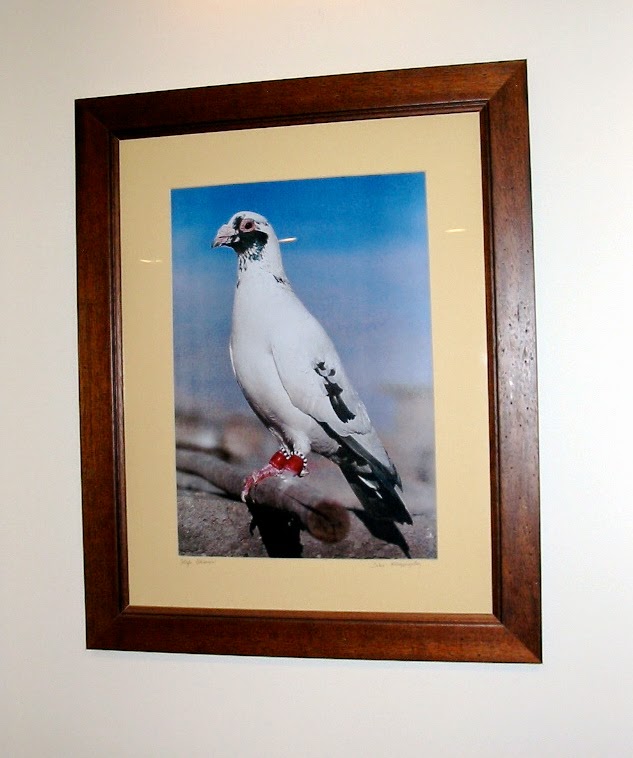
 It is worth re- visiting my hotel, to see that art photo of the Ur Pigeon of Urfa, wearing the pigeon jewelry that pigeons have in the Middle East for centuries..

Another, a Mssawad , a breed which I saw in Urfa, with jewelry, though this was taken by Sir Terence Clark in a village in Syria. I wonder if it still exists...


Because somewhere south of Urfa is a whirling void, the kind that has come like a storm out of the desert before, and  flattened many other "old civilizations put to the sword" ...


Friday, October 17, 2014

A Familiar Place...

The road runs straight south from the ancient city of Sanliurfa in Turkey (actually "Urfa"-- the title is a post- Ataturk designation) to a border, or, in our fraught times, perhaps, a BORDER, like our southern one.

 The land is almost flat, dry, but productive since the dam on the Euphrates, which drowned may old villages, allowed irrigated winter wheat to be grown. The drowned villages have been rebuilt. The people of the countryside are Kurds rather than Anatolians, with a leavening of Arabs near the border.

They are contentious, argumentative, overwhelmingly hospitable (one thing they do is continually roll you cigarettes; once I had one behind each ear I HAD to smoke, but sweet Turkish tobacco is not that bad). They drink endless coffee and not very hidden "raki", the anise- flavored local vodka. One reason they do not have all that much visible alcohol is not Islamic; booze in Turkey is a state project, which means the Kurds would have to  buy it from a government they do not love, but I ordered and drank it every night in our hotel.

That road runs into Syria about thirty miles south of the city. On the other side... well, go west 40 more miles or so, turn left, and you can watch the seige of Kobani.

The people in Urfa fly pigeons; Turkey is the most pigeon- fancying nation in the world. Urfa is the only city I have stayed in that has large art- photo portraits of pigeons, signed by the photographer, in the lobby of its most prestigious luxury hotel. This one is a Reehani dewlap, with the inked label saying "Urfa Guvercin"-- simply "Urfa Pigeon".


In the countryside, people hunt, with gun and tazi and hawk.


They have flock guardian dogs too, though it is best to get back in the car if they get too close. This one was already starting towards me.
It can be a lot like here. I have often teased people with this next one, asking what part of New Mexico it was taken in. Most think maybe Taos though some go for Rio Arriba county.
There will be more. Strange how knowing a place just a bit makes your perspective so vivid...

Sunday, February 03, 2013

Train not in vain

The next posts will be on the last few fascinating if tiring days-- Amtrak sleeper, a civilized way to ride; Kansas City, a good friend, some med workups, unique museums, BARBECUE; back to the Spur and water battle...

Here is my snug little sleeping box, just big enough for my stuff. Pretty good for sleeping but frustratingly one sided for viewing my beloved Great Plains, which of all wild or empty landscapes seem to provoke my dreams. Do you know James McMurtry's "No More Buffalo"? Luckily the skylighted Lounge cars had big windows, comfortable chairs disposed variously, and a good selection of beer and spirits-- a civilized way to ride.

My sleeping box-- about what I needed and not an inch more. I think of certain Japanese hotels that hold their clients packed in like sardines; these travelling cells are nicer:


Wednesday, December 12, 2012

Understandable Error, Matt!

I don't know about a banana (see Matt's comments below) but most Americans would see a double rifle from England, with its barrels arranged side by side, as a shotgun. We have not quite NEVER built a double rifle here but I would be surprised if we had built over 100 in the last century. Everything from our hunting habits (long, open country shots) to the expense of "regulating" doubles, which like everything about them is done by hand, works against this. (The English and European demographic for hunters, restricted to expensive private land for the most part, skews much higher than ours; no US mag, however pretentious, could call, as a review in The Field recently did, an 18,000 pound gun "modestly priced". And The Field isn't even pretentious-- just comfortably what it is.

Here is a "typical" VERY Best London side by side shotgun, perhaps my favorite, a Boss in 20 bore. As it could go for over $100,000 used I will never own one unless like one lucky writer I know I am given one as a present by an older man who is retiring it.
Another shotgun, a Churchill, rather stouter...

The next two are rifles but without seeing the iron sights how would you tell? The first is a classic Rigby with its distinctive "dipped" lock plates, in .470 Nitro (rather like the small shotgun but BIG rifle bore of .410, and just one actual caliber lower than Bond's .500); the second, also by Rigby but made in California I think-- very long story-- is what is known in my circles as the Lion Porn gun, proving that money does not convey taste though it may buy craftsmanship...

Incidentally Ian Fleming's brother Peter, who wrote books that are among the 25 I would take to the proverbial desert island, especially News From Tartary (you should also read his travel companion Ella Maillart's Forbidden Journey; when have two such writers written two such delightfully different books about the same trip?)* shot a pair of Purdeys, rather like the Boss above, and a ".275 Rigby" bolt rifle like my friend Jonathan below. We are entering the realm of "affordable with effort" here, but I doubt I will ever own a double rifle that costs more than my house, truck,and last trip to Asia combined.


*Links still slow but both available on Amazon and other places.

Thursday, October 25, 2012

Rifle quiz


Pure fun for scholars of guns and readers of travel and adventure tales: how many things can you find in common on these little carbines? Oh, I will add one invisible addition for the bolt:


The first question is for tecchies; the second for readers and travelers: how many books and writers and scientists and... whatever-- can you list that mention or who used either?

Tuesday, November 29, 2011

Links, Pix, & Assorted Phenomena...

Lauren's Aquiling is up and running again and, at least until her book on her year among the Kazakhs is out, the best place for exotic falconry and adventure tales...


There is some pretty funny and often grotesque animal photography up at Nature Wants to Eat You. HT Annie Davidson, who also sent this video of a walking octopus.

Tim Gallagher, who recently completed a book on his harrowing expedition to the heart of the Narcotraficante strongholds of the Sierra Madre in search of the (almost?) extinct Imperial woodpecker, wrote the short version here, and added a link to the only videos of this largest of all woodpeckers...

Dr Joseph Rock explored the remotest parts of central Asia and southwestern China for the National Geographic in the twenties and thirties. Teddy Roosevelt's big- game hunting sons thought Minya Konka in "his" territory near the border of Szechuan and Tibet-- he wrote about in in 1930-- was higher than Everest. A couple more Americans laid siege to it in 1935 (they were also hunters, armed with a Springfield .30- 06 and two "heavy" SMLE's) and found it was formidable but not quite that high. Yvon Chouinard, Al Read, Kim Schmitz, Rick Ridgeway, and Harry Frishman (Peculiar's biological dad) made another attempt on it in 1980, not long before Harry was killed in a climb in his "backyard" Tetons, but they ran into disaster. Bruce Chatwin allegedly caught the legendary "bat fungus" that did in his AIDS- compromised body in a cave in the vicinity, which is also home to the Naxi people and their still- living goshawk falconry. (Chatwin also put Rock's book, and Emperor Frederic II's falconry text de Arte Venandi cum Avibus, into his posthumous story "The Estate of Maximilian Tod").

Obviously there is a book there, and eventually I hope to go, with Lib and Peculiar. Meanwhile I suspect the greatest single source of useful material is at the Arnold Arboretum near Boston, where Rock's archives reside, full of treasures like this photo:

("Horned Rifles" too!)

Friday, August 19, 2011

"Endemics"

Writer Tom McIntyre has been in Argentina, not just shooting doves but hunting birds behind pointing dogs and fishing. What caught my attention (and what he, an informed naturalist- hunter, knows well) was the unique identity of some of his quarry.

Europeans often name local species after familiar things, but folk taxonomy is unreliable. South Americans think of this fish, called a"dorado"* for its golden color, as a trout:

As a careful perusal of everything from its fins to the shape of its jaws suggests, it is not! It is a characin, an entirely New- World family. Other members include piranhas, the vegetarian fish of the Amazon basin, and the neon tetras in your tropical aquarium. And Tom caught his on live eels, a bait hat might intimidate the cannibal taimen of Mongolia (Tom's is not huge for the species).

An even more interesting misnomer is the Argentinian name for this bird:"perdiz"; partridge.

Ecologically it does rather resemble a partridge, but evolutionarily it is ancient, more like a little flying rhea or ostrich! Tinamous-- there are several species-- are small, flying ratites (the ONLY flying ratites), part of the old southern "Gondwanaland" radiation that includes all of the above plus cassowaries, emus, extinct moas, and kiwis. Like the last they lay enormous eggs, but tinamou eggs resemble porcelain art objects in polished greens and blues.

They don't act like ostriches though. Tom:

"Kick in the ass to hunt. Used a very good German shorthair who literally snaked through the grass as they ran a mile before flushing. Limit is eight and we filled two one day, in about three miles of jogging. Great fun. FYI, perdiz run like chukar (on flat ground), fly harder, faster, and lower than quail, and are the best game bird I have ever eaten." (Tom may have eaten more species of game bird than anyone I know).

For now I will postpone the subject of the amazing pestiferous parakeets...

Look for an update on Tom's upcoming article on his Argentine experience.

*The word dorado is apparently now also the preferred (PC?) term for the tropical salt water game fish known in my youth as the dolphin, apparently to distinguish it from the mammal.

Monday, June 13, 2011

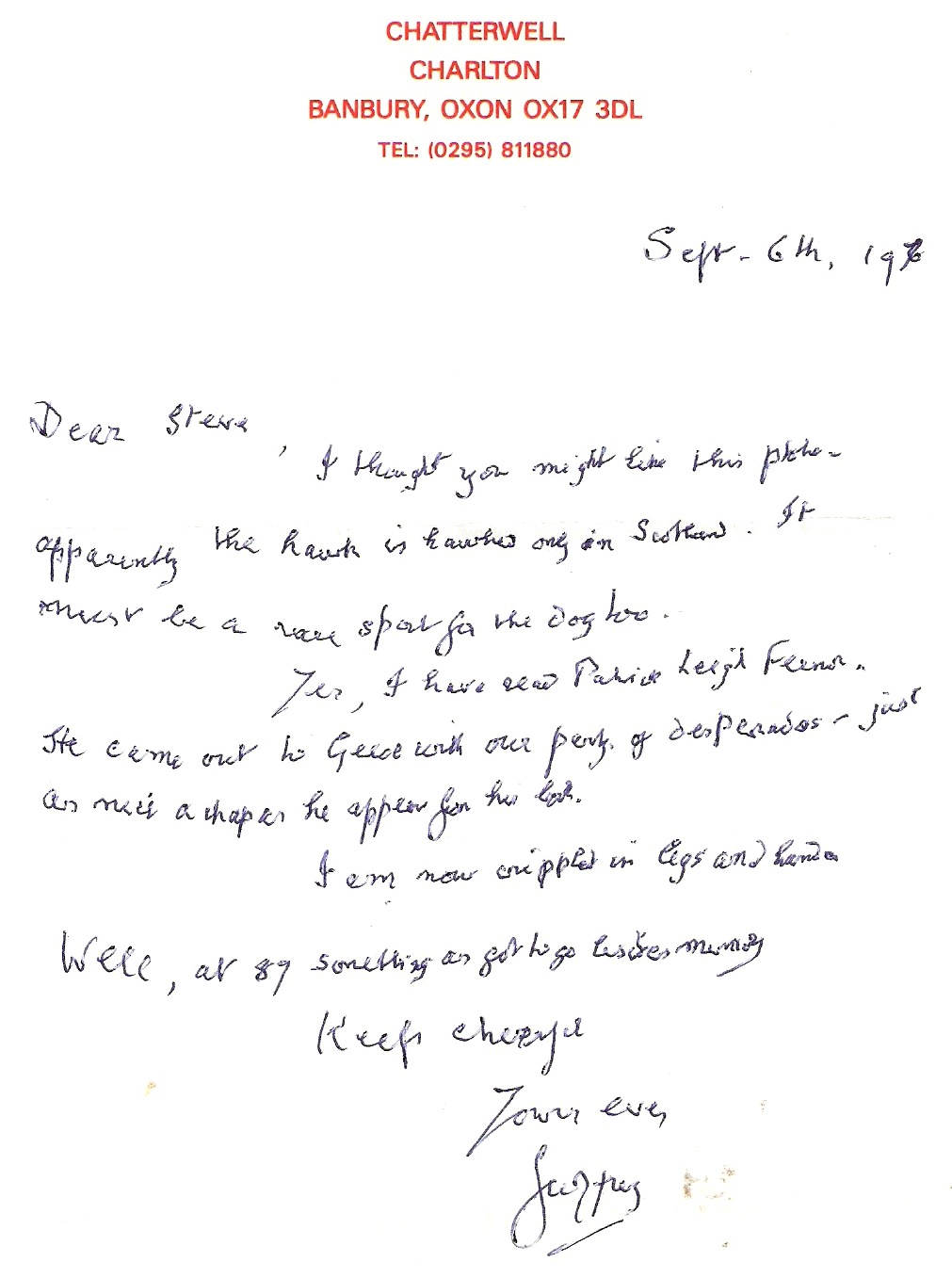
PLF 2: Letters from Geoffrey Household

Sadly, I never corresponded with Patrick Leigh Fermor, but I did for many years with the adventurous old "suspense" story writer Geoffrey Household (as so many perceptive critics wrote, he was so much more than that, including a naturalist, a regionalist, and a chronicler of the same old lost Europe that Leigh Fermor also celebrated). Some of his best works are still or at least recently in print, though they were written from the thirties into the eighties: Rogue Male, in which an English big game hunter with a secret stalks a Hitler figure until he becomes the prey; 1965's Dance of the Dwarfs, a cryptozoological novel with several twists; and the one I read first, 1960's Watcher in the Shadows, still another tale of being stalked. Household's knowledge of nature and animals gave him an intuition and sympathy for prey that many writers of such novels lacked.*

I will write about Geoffrey's own work, but that must wait. Suffice to say that in the winter of 86-87, having been recently widowed, I wrote to him asking if he had known PLF, whose Woods & Water I had just finished. I figured with his background-- among other things, he had lived in Bucharest and Greece for many years before the war, and been in British Intelligence-- he might have. I just wanted to do something new-- walk across Europe, perhaps?

Geoffrey wrote back with enthusiasm; we had written to each other for some time, and I think he was worried for me. Of course, he HAD known "Paddy" during the war.

(I'll follow each letter with a blown- up text of the relevant part, as the handwriting of an 87- year- old- man can be as bad as that of a 61- year old with Parkinson's-- click twice and they are more legible than the originals!)


He apparently thought the matter over, then, perhaps forgetting his previous note, wrote what may have been his last letter to me in the fall before his death the next year at 88. His handwriting had deteriorated, but he could still command a phrase.


Desperados indeed. As David Pryce- Jones said this morning: "Could there be men like that again? In these thin days I doubt it..."

*Geoffrey's short story collections are not "suspense" and are much harder to find but worth the effort. Start with Sabres on the Sand or The Europe that Was.

UPDATE: In the introductory essay to the NYTBR ed of Rogue Male, linked above (click on "See Inside"), Virginia Nelson writes "...One can't help but wondering if his path crossed that of the notable English picaro Patrick Leigh Fermor..."

UPDATE 2: The wonderful Patrick Leigh Fermor blog is now on our blogroll (right). More to come I'm sure...

Friday, June 10, 2011

Patrick Leigh Fermor 1915- 2011 RIP

Too burnt on obit- writing to write a proper tribute to one of my (and Betsy Huntington's; she left me all my early first editions; and Q's) favorite writers and examples of a life well- lived. But readers and nomads everywhere should observe a silent moment: Patrick Leigh Fermor has died at 96 in England. He had recently returned from the island off Crete he had called home for many years, perhaps to be reunited at last with his late wife Joan. We must all hope that he finally completed his third book about his youthful walk, between the wars, from the Hook of Holland to "Constantinople"; the second volume,Between the Woods and the Water, may be my favorite travel book ever. I eagerly await Artemis Cooper's biography next year...

Good obits in the Telegraph, at England's Channel 4, and at The Guardian. More to come I'm sure...

Will attempt something later; for now here is an older post by me and here is one by Reid.


UPDATE: more good obits and memories: Max Hastings in the Daily mail; his biographer-to- be, Artemis Cooper, with a photo of his first love, Romanian princess Balasha Cantacuzene-- be still my heart!

Let's lift a glass to one who never hesitated-- see Cooper's opening tale-- to do so himself.

And a last note from another Guardian article, for those who are holding their breath about the existence or fate of the "Third Volume":

"Readers are still awaiting the promised third leg of Leigh Fermor's trip, despite the author's repeated promises to "pull my socks up and get on with it" and his 2007 declaration that he was learning to type so that he could complete it more quickly.

"Cooper, who visited him at his Greek home earlier this year, said that the writer had been working on corrections to a finished text. "A early draft of the third volume has existed for some time, and will be published in due course," she said.'

Saturday, January 22, 2011

Far Away and Long Ago: Family with Megafauna

Just for fun: a shelf in the library has accumulated a bunch of photos with this theme, dating from the thirties (Betsy Huntington) to just eleven years ago (me). Here are a few.

First, Betsy, at four, with her mother, at the Pyramids:


Second, Libby on an elephant, in the early seventies, at TIGERtops (see below) in Nepal; looking for tigers, of course.


Me in Zimbabwe in '97, just before it all went to hell, with an orphaned rhino. God, I look like Redmond O'Hanlon-- Anglos in the tropics, fat and sweat and curly hair, oh my. (The head ranger there, when I asked him why he was successful, answered with great gusto and a big grin "because I kill so many poachers". Tough neighborhood).


Finally (horses are technically megafauna) a more familiar strange road: Bayaan Olgii 2000, second Mongolian "expedition", chasin' eagles near Ulaan Hus with Bolatbek's relatives.

Tuesday, December 18, 2007

Real Influences: Travel Writing

While reading Douglas Botting's 2000 bio of Gerald Durrell I came upon these lines: "Young men woke up to find that the world was once again their oyster, and not just a place you went on a troopship. At almost the same time that the Durrell brothers' two books werepublished [1953] a galaxy of talened travel writers, including Laurens van der Post, Gavin Maxwell, Patrick Leigh Fermor, and Norman Lewis*, were also bringing out new books, while one- off new accounts of new worlds conquered or explored, such as Jacques Cousteau's The Silent World, Heinrich Harrer's Seven Years in Tibet and John Hunt's The Conquest of Everest-- all published in this same annus mirabilis of 1953-- were in large demand."

These were my stars. Childhood influences were Kipling, and the American naturalists like William Beebe; the only nominal kids' books I read were White's The Sword and the Stone and "dog novels", about which I will post later. "Adult" influences that I read much later and still admire include Hemingway and near- contemporaries like Tom McGuane.

But those guys were my gold standard, as I suspect they were and are for, again, contemporaries like the late Bruce Chatwin and Redmond O'Hanlon (he is often dismissed as a "mere" humorist-- go read that five- star book and tell me that is so).

I still admire them; even wrote the intro for this re- issue. And while I would hesitate to compare myself to the masters of travel, one perceptive critic, John Derbyshire, has at least noted the debt correctly. From the Washington Times, on Eagle Dreams:

"This is a very striking and unusual book, sufficiently so that I imagine the people responsible for awarding it a Dewey Decimal number, in order to properly shelve it in libraries, must have engaged in some head-scratching.

"Is Eagle Dreams_sport, travel, or zoology? You will have to make up your
own mind. I have put it among my travel books, along with Paul Theroux, Eric Newby and Robert Byron; and I believe that those distinguished persons would welcome Stephen Bodio into their company as an equal. He writes as they did, of strange things in remote places, described in a plain, unaffected style, spiced with humor, recondite knowledge, and the fatalism of the seasoned traveler. Towards the peoples he encounters the author is sympathetic without ever being sentimental, and there is a hint of melancholy as he shows us, inching upwards in the distance, the waters of
modernity that will eventually engulf a way of life that has persisted for millennia."

I should add that this is the best or at least most perceptive review I have ever had, and it was from before I corresponded with John; in fact it lead to our correspondence.

Of course, though he called it "Aquila Non Capit Muscas", the editors retitled it "A Kazakh Sport's Lasting Allure". Sigh.

All of those writers are gone now but Leigh- Fermor, in his nineties, dreaming away on his isle off the coast of Greece, still working on his third volume of his "walk" trilogy like some combination of old Odysseus and Circe...

(By the way, in his Amazon review of the Durrell bio that started this thread, old friend Greg McNamee seems to think that "his work is not widely read today". As his work brings up 416 results on Amazon, many in print, and there was just a new adaptation of "My Family and Other Animals", I respectfully disagree.)

*I link to only one Norman Lewis because unlike other writers here there seems to be more than one writer of that name.

Thursday, September 20, 2007

Another Travel Essay..

... from Phillip Grayson, who will soon be reporting from Poland.

The Number 1 Most Secret Best Part of Istanbul

The first thing one should do on arriving in Istanbul is hop in a cab and head to your hotel in Taksim, the downtown heart of cosmopolitan Istanbul. There are cheaper hotels in the center of the tourist district, and you’ll probably want to stay there the bulk of your trip, but on this first night in town you need to go all the way into the belly of the beast.
Taksim itself is nice enough, crawling with shops and well-stocked with an endless supply of basically-pretty-similar bars and restaurants, but that’s all beside the point. Before you even arrive there, the best part of your visit may well have already taken place.
The airport is on the outskirts of the European side of the city, and the road that winds from it to your overpriced hotel will take you along the seaside for several miles, giving you plenty of time to take in the manicured parks that line the shore and the warships, freighters and cruise ships that commiserate in the harbor, as well as schizophrenic piecemeal architecture that defines the majority of the city, houses cobbled together and repaired as they required it, and not a bit more. An apartment building, for example, may date back to the mid-70s for the first two or three floors, and then have a few more above them about a decade younger, with a single wall that came in after the earthquake and a brand spankin’ new roof. You’ll also get a chance to see a few of the “historical” wooden houses of Istanbul, dilapidated and slowly collapsing, these cannot be torn down, so even later, as you cruise down the Bosphorus toward the Black Sea, you’ll see a couple stuck in amidst the modern mansions in a sort of scaled-up version of these cut-and-paste apartments in the suburbs.
You’ll turn away from the seaside just before you begin approaching the Bosphorus, which separates Europe from Asia Minor, guarded over by Topkapı palace and a few thousand tourists. Instead you move straight toward the Golden Horn, the inlet that runs into the European side of the city, and which, as you cross it, will be lined with Mosques, filled with jellyfish and a few fountains, and crossed over by two long bridges full of fishermen. Before you even get there though, with an almost alarming suddenness and grandeur, as you emerge from an underpass, an Ancient Roman aqueduct reminds you that, for all the natural beauty you’ve seen and will see, this is a human city, fought over and fortified and overpopulated and restructured in sometimes amazing ways to perfect it away from whatever nature’s original intent might have been.
On the other side of the Golden Horn you ascend one of the seven hills the city was built on (and what is it with building cities on seven hill?) and get the best possible view of Istanbul, looking over the sprawling, undulating city, either decked out in a million lights of surprisingly varied colors, or scorched by the sun to something so perfectly exotic and massive as to make reality seem just a little less stable.
Immediately after this world-class tableau, on the right, is a street and runs away from you and is filled, completely, top to bottom, end to end, with nothing but chandeliers, small chandeliers, big chandeliers, gigantic chandeliers, cheap chandeliers, expensive chandeliers, a chandelier to suit any mood, budget and home, believe you me, all lit and undeniable and designed, it would seem, to shatter your newly enfragiled sense of reality. It could well be the most bizarre thing I’ve ever seen (and I’ve seen the Grand Bazaar).
With that pesky sense of equilibrium out of the way, you’re now in Taksim, whose main road, ostensibly pedestrian despite the dozens of cars and motorcycles honking their way through the thronged crowds, is said to see almost a million sets of feet every day. There are McDonalds and Pizza Huts and Burger Kings aplenty, but you’ll want to try some authentic Turkish cuisine, but beware, because Turkish food is Greek food without pork or sauces, and your already repeatedly affronted, oh so delicate sense of reality might not be able to fight of the sense that there is much better Turkish food in America than there is in Turkey. Try not to think about it too much. Keep your wits about you and step back out into flood of humanity that is I_tiklal Sokak remembering these last few things: the men arm in arm are not gay, it is not rude to walk (or drive) directly into someone without apology or hesitation, you don’t want to buy perfume off the street, and once your luggage has been successfully lost, the best part of your trip is over, you will never be this disoriented again, so you might as well take a nap.

Friday, August 24, 2007

Our Roving Correspondent

Phil Grayson is stopping through Magdalena en route to Poland from his last job in Istanbul. I am hoping he will be posting himself soon from Poland, with his own password, but he has given me several travel essays to entertain you meanwhile. Here is the first.

It’s Vrahati Time!

A ways west of Athens is Corinth, and a ways west of Corinth is Vrahati. A little Peloponnesian village on the coast of the Gulf of Corinth, Vrahati has everything you could want in a vacation spot, beautiful vistas, perfect, warm, crystal clear water, loud nightclubs, and umbrellas and lounge chairs set up all along the beach, free for anyone to use, built on the assumption that if you swim and sit out in the boiling Greek summer long enough you’ll pop in to get a soda or beer or something from the café behind you. It has Greek girls, tall and dark and having smoked themselves into a beach-ready thinness, it has cheap wine, great food, and friendly people. Everything, with the exception of hotels.
As far as I could discern, there is one four-star hotel somewhere in Vrahati unseen by me, nothing at all below that, and with beach-camping forbidden by Greek law, it puts the frugal yet law-abiding traveler in a bit of a bind.
As a result, Vrahati is mainly a destination for Greeks, who keep their summerhouses there. This makes it a nice refuge from the tourist traps and conmen of Athens, an escape from post-Olympics inflation, and generally a nice, laid-back way to take in the ease and love of life that you came to Greece for.
One glorious manifestation of this is the siesta. Wake up at dawn, eat breakfast for a few hours, sit around having coffee, shooting the breeze, maybe go for a dip to beat the midday heat, have lunch for a few hours, then crawl into a cool dark room and sleep through the prohibitive heat of the afternoon. The siesta chases off the heat stroke, digests the pig or two you’ve eaten at lunch, and, when everything in town closes down until 4 or 5 in the afternoon, enforces leisure and patience, at least until your body falls (as it will easily fall) into the proper rhythm. The best thing about the siesta, though, is the nighttime. Rolling out of bed around Quittin’ Time, USA has a way of making a man willing and able to stay out all night, wreaking all manner of havoc on the good people of Vrahati, his own body, and the laws of both god and man. And that, my friend, is what vacation is all about. Just ask the bars that open, open!, at 1 am.
All of which brings us back to our original problem, the terrible dearth of hotels. One can nap the afternoon away on the beach, somehow as long as you’re running the risk of skin cancer it doesn’t count as camping, but sooner or later a man has to sleep. Really sleep. On a bed.
Of course, you could bus it back to Corinth and environs, plenty of reasonable accommodations there. Otherwise you could head on further down the coast to any of the other perfect beaches that fill the peninsula, some even with sand in place of the smooth stones that make the beach in Vrahati and most of the rest of Peloponnesia. But those both sound an awful lot like giving up, letting this cold world get the best of you once again, surrendering this little slice of heaven to a bunch of rich foreigners (at least they would be foreigners in America), admitting defeat. And there’s no reason for that when you’re one of the only foreigners in town and the Greek habit of being incredibly hospitable fits together so well with the American habit of abusing the hospitality of others. I discovered this on accident one night, trying desperately, Greek-English dictionary furiously churning, to convince a group of Greek girls to let me sleep with them. Something must have been lost in translation, but I spent the rest of the week napping on the beach and sleeping on their couch. So I implore you, good reader, pack your sunscreen and your puppy dog eyes, and hit up the unsuspecting little town of Vrahati, Greece.