Wednesday, October 26, 2005

Cupules and Geophagy

A common form of prehistoric rock-art here in California is the cupule. These are shallow round depressions ground into a rock face, usually in no particular pattern. Here is a picture of my colleague Bryon Bass next to a rock covered with cupules.


This location is in Kern County in the foothills of the Tehachapi Mountains – the extreme southern boundary of the Central Valley. Historically this was a boundary area between tribes, shared by the Southern Valley Yokuts, the Castac Chumash, and the Kitanemuk. Here is another example from the same general area.


Cupules should not be confused with another extremely common archaeological feature found here, the bedrock mortar. A picture of some typical BRMs is here.


Mortars are functional – they served as facilities to crush acorns and other seeds for food processing. As such they are usually found on horizontal surfaces and are quite large and deep. Cupules have been interpreted as non-functional – they are shallow and usually found on vertical or slanted surfaces and there is no evidence that anything was ground in them. You can see this in the pictures above.

They are somewhat enigmatic. It’s hard to think of them as “art” as they don’t seem to represent anything and usually are placed randomly. Ethnographic accounts of the Yokuts describe these as markers commemorating the completion of a “coming of age” ceremony for young women. Each girl ground a cupule at the completion of the rite and families had their own special rock faces where this was done. Data from other tribes here links cupules to other fertility rites.

Kevin Callahan, an archaeologist from Minnesota, presented a paper at the Society for American Archaeology meetings a few years ago that tied California cupules to a world-wide phenomenon that apparently has great time depth. That is geophagy – the eating of earth.

In this view some cupules were “functional” in the sense that they were made to grind and obtain rock powder. This powder was eaten as part of ceremonies to ensure fertility. Callahan cites ethnographic data to back this up.

Geophagy, however, is a much wider phenomenon than the example above, linked to dietary deficiencies and medicinal uses. Every time you take Kaopectate, you are swallowing an elixir of water and kaolinite clay. While searching in vain for a link to Callahan’s paper, I did find this interesting article by Suzanne Ubick in California Wild that discusses his work and has lots of other fun facts about eating dirt.

.. and Wolf Eagles

Here is Manai, with his eagle....


...and a wolf pelt, taken by this eagle, hanging on his winter house.


Eagles do not take wolves in the wild as a rule, though a biologist friend has seen one kill a coyote here, and they regularly take pronghorn here (see American Pronghorn : Social Adaptations and the Ghosts of Predators Past and Survival By Hunting: Prehistoric Human Predators and Animal Prey ) and saiga there. Wise Manai has a dictum he does not always follow: "If you want to keep your eagle ten years (the length of time Kazakhs keep their birds before releasing them back to the wild to breed) do not hunt wolves!"

A Ghost of Evolution

A fascinating book that Steve introduced me to is Connie Barlow’s Ghosts of Evolution. The essential biological truth that forms the book's basis is that many plant species evolve in concert with “partner” animal species that serve as agents to disperse the plants’ seeds. The evolutionary strategy is that the plants evolve fruits that appeal to specific animals, who eat the fruit and drop the seeds in their feces in areas away from the parent plant.

Barlow uses the pathfinding work of Dan Janzen and Paul Martin (cited multiple times on this blog!) who have pointed out that there are a number of plants here in the Americas (and elsewhere) that no longer have animals that eat their fruit. The breakthrough concept here by Janzen and Martin was that the animal “partners” for these plants are extinct and that most of them were Pleistocene megafauna. Their term for these plants is "ecological anachronisms". They are the “ghosts of evolution” of Barlow’s title.

While back in Arkansas recently, I saw one of these “ghosts”, the osage orange (Maclura pomifera) shown in the picture below.


The tree’s range at European contact was the Red River Region where Arkansas, Oklahoma, and Texas come together. The tree was prized for its wood by Native Americans, who used it to make bows. This is reflected in the name that French explorers gave the tree, bois d’arc, that survives in the name of a river in the area.

You can see the tree’s fruit at the base of the tree in the picture above and in the close-up below.

It is green, rock-hard, and orange-sized. The inside oozes a nasty sticky latex. No native animals eat them. They don’t taste very good to humans – Barlow tells of her experiments in that arena, “…more like air freshener than food.” As you can see the fruit falls to the base of the tree, sits there, and rots. No dispersal agent – that fruit isn’t going anywhere.

Actually, its dispersal agent in the last 200 years has been humans. Farmers in the eastern US planted the tree in thickets to make hedgerows before barbed-wire was invented and thereby expanded its range. Also, come to think of it, when I was a little boy growing up in that area my friends and I would run around the neighborhood throwing the “oranges” at each other. So I guess little boys are an important dispersal agent these days.

Barlow reaches the conclusion that the fruit evolved to be eaten whole by mammoths or mastodons and that these are the missing “partners”. Some experiments she made feeding the fruit to zoo elephants were inconclusive. She does give some anecdotal evidence that horses eat them. Actually, the common name for them I remember in Arkansas was “horse apples”.

Of course, if this is true you have to remember that the horse is also an extinct Pleistocene megafauna, missing from North America from 14,000 years ago until the arrival of the Spanish.

Eagle Huggers

You've all heard of tree huggers. But some of my best friends have been eagle huggers.

Golden eagles are long- lived, life- bonded, top- of- the- food- chain predators. This can make them very hard to train, but if they are bonded they are REALLY bonded. They are intelligent and playful-- I know Konrad Lorenz, usually smart about such things, thought not, but he tried to fly a poor zoo veteran in Vienna.

They can also be jealous, and dangerous over food. As I once said to an American photographer in Mongolia who wanted to tie a rabbit to his head and have a Kazakh throw his eagle at him: don't mess with anything that can kill wolves, and flies.

But they have a softer side. Here, courtesy of PrairieMary, her late ex- husband, sculptor Robert Scriver, and his "Eegie".


And here, my friend Manai, who lives near Bayaan Olgii in western Mongolia. One of the eagles he is hugging does catch wolves.

Tuesday, October 25, 2005

Iola Reid, RIP

My maternal grandmother, Iola Wilkinson Reid, died on October 1, in Jonesboro, Arkansas. She was 97 and had been in a nursing home, mentally lost and physically declining for the last five years. She really had been miserable and suffering in the home and though I was very close to her and miss her, I am glad that her suffering is over. I spent the first couple of weeks of the month back there for the funeral and to handle details of her will.

My grandfather died in 1979. My mother was an only child and died in 1984. Iola's older sister, Doreen died twelve years ago, so my Dad (her son-in-law) and my sister Carol and I were really all she had left for family. Luckily my Dad and sister were there in Jonesboro to help her. She was able to be independent staying in her home, playing bridge twice a week, and doing gardening for exercise until she was 92.

We should all be so lucky. Iola lived virtually her entire life in Jonesboro, which is in northeast Arkansas about 60 miles from Memphis. She really had a good long run and a full life, and though she had some hard times when young, she was able to see and do much more than was typical of her time, class and region. As L.P. Hartley said, “The past is another country” and my grandmother was a window into that country for me. Lots and lots of stories were passed on to me. It occurred to me after her death that Theodore Roosevelt was president when she was born in 1908. What a different world that was, what great events she witnessed and lived through.


This picture was taken at a camp meeting in Ravenden Springs, Arkansas in 1912. My grandmother is the blond moppet sitting on the ground on the right side of the photo. Her sister Doreen is the little girl in the middle with her hands crossed over her knee, and my great-grandmother Maude Sullins Wilkinson is the woman immediately to the left of Doreen facing the camera. Camp meetings were a Southern cultural thing - religious revival meetings where extended families and friends would camp out and listen to sermons without the distractions of work-a-day life. It’s striking how 19th century everything in this view appears. The image of Iola is blurred because she moved while the picture was being taken. It's interesting to know that she couldn't keep still at age 4 any more than she could when I knew her!

Some subtle things can tell you a lot about that “other country” of the past. For example Sullins wasn’t really Maude’s maiden name. Sullins was an anglicized form of O’Sullivan – an attempt to evade the anti-Irish prejudice of the day.

My great-grandfather Alvah Wilkinson was a telegrapher for the Cotton Belt Railroad – one of those obsolete jobs like buggy-whip manufacturing. But the telegraph was the information superhighway of the day and in November, 1918, via the telegraph he was the first person in Jonesboro to learn that WW I had ended. He left the depot and went running up and down Main Street, telling everyone the good news. But he almost lost his job for leaving his post. I mean trains could have collided!

My great-grandfather died of cancer in 1922 and shortly after that Maude was diagnosed with tuberculosis. It was the killer disease of the period that we rarely think about any more, that eventually took her and another of my great-grandparents, Augustus Reid. Doreen and Iola took their mother on the train to Colorado and placed her in a sanatorium in Aurora. Though still teens, they lived in a boarding house in Denver, got jobs and went to night school to try to finish high school. They took the trolley out to Aurora on the week-ends to see their mother. They were orphaned in 1925 when Maude succumbed to the disease. In Denver, Doreen had met a Wyoming rancher, Bob Bryant. She married him and stayed out west. Iola took their mother back to Arkansas for burial.

When Iola returned to Jonesboro alone, she wanted to finish high school and found a family that would take her in for the year that she needed to graduate. I have been struck at the improvisational nature of such arrangements that government functions would do today. Today Child Protective Services would have placed her in a foster home. Back then she and Doreen had to figure out on their own how to take care of their mother and how to finish school.


This picture of Iola was taken in 1927, about the time she won the Miss Jonesboro Beauty Contest. The big prize was a trip to Hollywood and a screen test at one of the studios. She never used it as she decided to marry my grandfather Travis Reid that year and help him run his drug store. For their honeymoon, they drove to New Orleans in their Model-T. It took them nearly three days - what today is about a 7 hour drive on I-55. They were nearly arrested in New Orleans for driving the wrong way on a one-way street. They were so "country" they had never heard of a one-way street.

1927 was also the year of the great Mississippi Flood – the greatest natural disaster to hit the South between the New Madrid Earthquake of 1811 and this year’s hurricanes. She told me stories of the flood and we had home movies of evacuees in tent cities on Crowley’s Ridge near Jonesboro.

So many stories of their life. They shook hands with Franklin Roosevelt at a political rally in Little Rock in 1932, and he did his campaign baby-kissing routine on my infant mother. They worked in the political campaigns of a family friend, Hattie Caraway, the first woman elected to the US Senate, that same year and in 1936. They met Huey Long, who came up from Louisiana to help Caraway campaign. They struggled through the Depression with the rest of the country. My grandfather carried people on his drug store account books for years. As he said, “I couldn’t tell sick people they couldn’t have medicine even if they were broke.” Local farmers dropped by hams and chickens to help carry their accounts and they got by.
I’ll close with this picture taken in 1988 of Iola with my wife Connie and our children at Mammoth Spring, Missouri. I’m glad that Lauren and Travis got to know their great-grandmother and learn from her as I did. We all miss her.

Monday, October 24, 2005

Landscape blogging

Just for fun. We had our (late) first hard frost last night. Usually we have gotten our first snow by about now. Here are a morning and evening shot of our town on a snowy day, looking south from near our house on our (still dirt except for its bottom end) main street, for those who think that the Southwest is all saguaro and blazing heat.


[Morning]


[Evening]

In which two of my interests meet

That is, the evolution of disease organisms and the new drive to control all animals.

I have been watching the progress of bird flu with attention if not exactly alarm. Being I hope a prudent sort, and one who believes in self- sufficiency, I have laid in a supply of Tamiflu and have Relenza on order. But this story is becoming the hysteria of the week, replacing even hurricanes. Does anyone even remember West Nile hysteria? SARS?

The worst aspect may be that it strengthens the hands of the ever- eager and rather strange new coalition of animal rights activists, big ag, and ambitious congressmen (see here for a gushing article on Rick Santorum, the "conservative" presidential hopeful in bed with PETA) who want the iron hand of government to clamp down on pet keepers, breeders of small creatures, hunting dog owners, and practicioners of small- scale sustainable farming.

First, go here for a good biological and above all evolutionary perspective on why H5N1 flu is unlikely to be another 1918 pandemic. The author knows what she is talking about.

Dog Politics has good coverage of the Santorum and PAWS business.

I belong to a discussion group of ten people who talk about pigeons (originally) but also dogs, hunting, art, and science. Some of the best thinking I have heard recently on these issues has come from them. (Most of us are scientists or artists). I will keep them anonymous unless or until they ask otherwise.

From a Canadian member:

"Yes if things keep ramping up on the bird flu issue we may well have to hide some birds.There is talk in this country of making all outdoor poultry flocks illegal. Pigeons it is being said are suspect because they free fly thus making it more likely that they can contact infected wild birds and then spread the disease far and wide.

"What the hell is next I don't know exterminate all wild waterfowl to keep the dam factory farm chickens safe.

"Evidence from Asia suggests humans mostly get the virus from contact with the excretions of infected birds. And those, of course, include blood. Several countries have acted on the assumption that hunters run an increased risk: Saudi Arabia has halted falconry, and Turkey, Moldova, Serbia and Montenegro have all suspended shooting."

From another artist AND scientist, in the US:

"Good article. I was just about to point out a quote from AberdeenUniversity microbiologist and bird flu expert Professor Hugh Pennington"

" "The bird flu has being doing the rounds of the Far East for about 10 yearsand it hasn't mutated yet into the form that we really fear - the form that could infect people on any scale at all - and it may never do that."

"The problem is that people love drama and the media will tend to feed into this. The factory poultry farms WILL use this to their advantage. This is what will lead to birds becoming illegal. I'm not too worried. There is plenty of land with thick as hell laurel understory here where no humans will ever find a bird. Hopefully this whole thing will go away at some point when the media finds something else to hype (how often do you
hear about SARS? It's still around, yet no one cares because the media isno longer hyping it.)"

Another zoologist (and falconer and saluki breeder):

"That would suit the factory farmers very well. It would rid them ofcompetition from "sustainable" folks like Joel Salatin's operation, wherethe chickens are confined outdoors in rolling pens and moved daily to fresh
ground .."

Another:

"That is what I understand as well. I think most of the hype, in this country at least, is that the government got caught with their pants down on Katrina and suddenly decided to look "active" on any potential (even if that potential is minor) threat to "security". Of course this plays neatly into the whole tracking of all animals bit. What a bizarre situation and could be a real blow the the sustainable etc. movement just as it gets going ...

"Mass media is *NOT* designed to keep people informed, it's designed to keep them coming back for more and being sensational (bus load of nuns flattens sports car carrying disabled children after high speed chase) or fear- mongering works like a charm.

" Of course if one were enterprising, you could take this info (packed, crowded conditions spawn intense strains of bird flu) and argue that factory farms are a threat to "national security" and small, healthy,
sustainable farms are much safer. Even add in the fact that most factory farms, because they are so
unhealthy, require mass use of antibiotics and, therefore, are responsible for creating resistant bacterial strains and you're really rolling -- what a health threat they are -- too bad no one can stand up with that one."

For a GREAT Joel Salatin essay go here.

For more on the subject of animal control on this blog go here.

Cascade effects in Yellowstone

This fascinating NYT article on the cascade effect of the Yellowstone wolf introduction may prepare our imaginations in just a small way for the effects if "ReWilding" starts. The change in the plant ecology and species composition of the Plains and Southwest alone is going to be amazing.

"Where willows and cottonwoods have returned, they stabilize the banks of streams and provide shade, which lowers the water temperature and makes the habitat better for trout, resulting in more and bigger fish. Songbirds like the yellow warbler and Lincoln sparrow have increased where new vegetation stands are thriving.

"Willow and aspen, food for beaver, have brought them back to the streams and rivers on the northern range. In 1996, there was one beaver dam on the northern range; now there are 10.

"The number of wolves has also greatly increased the amount of meat on the ground to the benefit of other species.

Grizzlies and coyotes rarely kill adult elk, but each pack of wolves kills an elk every two or three days. After they eat their fill, other carnivores take over the carcass. Opportunistic scavengers like magpies and ravens make a living on the carcasses.

"The number of coyotes, on the other hand, has fallen by half. Numbers of their prey - voles, mice and other rodents - have grown. And that, in turn bolsters the populations of red foxes and the raptors."

I have ordered Paul Martin's new book Twilight of the Mammoths, on the ReWilding project, and will review it here soon.

Jackson's Wedding Pics

As promised. This isn't exactly a "diary" blog, but these people aren't just family-- they are fellow bloggers. Besides, what could possibly look more magnificent than an Eastern Orthodox ceremony?


The linked flower crowns in the Orthodox ceremony will be hung on the wall above the couple's bed.


Mr. and Mrs. Andrew Jackson Frishman-- or to the blog world, Mr. and Mrs. Peculiar.

Here are Odious and Peculiar in the flesh, looking a bit exhausted as they contemplate cleaning up the rehearsal cookout.


The groom's parents-- Mr. and Mrs. Querencia?


And Larissa of Writhing in Apathy vamping for the bride at the cookout.


Church photos by Jonathan and Roseann Hanson. Outdoor ones by me.

Doom and Gloom

Another in the continuing series.

"Of course, the end of the world has been promised by Jews, Christians, Muslims and assorted crazies with sandwich boards for as long as there has been a human world to end. But those doomsdays were the product of faith; reason always used to say the world will continue. The point about the new apocalypse is that this situation has reversed. Now faith tells us we will be able to solve our problems; reason says we have no answers now and none are likely in the future. Perhaps we can't cure cancer because the problem is simply beyond our intellects. Perhaps we haven't flown to the stars because our biology and God's physics mean we never can. Perhaps we are close to the limit and the time of plenty is over."

No Ray Kurzweil, he.

More on modern writers, editors...

...and fact checkers. Reid had seen an article on Mongolia in which the reporter referred to a statue of Jengiz as being of "Khan". He snapped: " I love how the idiot reporter refers to the statue of "Khan" as if it's Genghis Khan's last name. Where do they hire these people?"

I commiserated-- and remembered something that happened to me a few years ago. I responded to my co- bloggers:

"That's what you get today-- and if you correct them, they'll think YOU are wrong.

"True story: a few years ago I was asked by the National Geographic to fact- check a short photo story by Dave Edwards on the eagle hunters-- I had been recommended by both Dave and the archivist at the World Center for Birds of Prey. They had two questions: did Mongolia have a modern road system (Dave and I said no-- only 400 km of pavement in a country 1800 miles wide, and that in such bad repair that most drivers prefer the dirt tracks or open steppe) and did eagles scream for food (both of us said yes--- mostly they are imprints, and call constantly for food and attention.)

"They then looked at an atlas, saw the Soviet era network of "roads-- ie, dirt camel tracks passing for highways; asked a birder about eagles---

"And rejected the statements of the two people who had been there."

I should add that a few magazines still retain their standards. When I wrote for The Atlantic I had to be ready with a stack of books and an hour or more free when it was time for the fact- checker to call.

Shadow from the Fourth Dimension

This one is for Odious and Peculiar, because they like this kind of thing: a three dimensional metal sculpture representing the "shadow" of a four- dimensional object.


The Golden Hoard

Here is an incredible story of an archaeological find far better than one by any Indiana Jones; its concealment by heroes under the Taliban; and its restoration, with the original Russian archaeologist in attendance.

See also this page for some photos.

Thanks to Debbie on our Tazilist.

Why we need more publishers in the West-- and why real writers are better editors

Chas sent me this observation that Prairiemary made to a discussion group on the ethics of "Creative Nonfiction" (I guess that's what I write, mostly). It is so good that I will reproduce it whole (though I have put a particular sore point in bold- face).

"Another factor to consider in this discussion is editors, particularly when one is writing about the West. At the recent Montana Festival of the Book, an author recounted bitterly how he had had events actually
changed by his back east female editor. He was NOT a romantic type guy putting in airs and graces. He had reported that he and his buddies had had a good day hunting and then sat around the campfire to
eat coq au vin and wild rice they had brought along. The editor INSISTED that he had to change that because no real "macho" men would eat that way. She wanted them to put grouse -- that they had killed
while hunting -- on a spit and roast them over the fire. In vain did the author, a very literal minded engineer, say, "But we ARE macho and that's what we really DID eat!"

"Her reply was, "Look, you signed a contract and this is OUR writing now."

"Others reported similar incidents. We seem to have a lot of editors out there who are frustrated writers. When they don't even know the subject matter, it's a disaster. Which is why we need Western presses."

I might also mention that some of the best editors I have had, like Jim Babb at the "new" Gray's, Ed Gray at the old one, Nick Lyons, and Tom McIntyre, have been real writers with no frustrations to make them rewrite my copy-- only interesting suggestions.

Prairiemary and I have also been having an interesting conversation on keeping wild animals. When it develops it too may lead to a post.

Friday, October 21, 2005

Lost Airman - Modern Iceman

The LA Times carried pieces yesterday and today telling the intriguing story of a body found last Sunday in a glacier in Kings Canyon National Park here in California. The location is on the slopes of Mt. Mendel, a 13,710 foot peak located southwest of Bishop.

It is believed to be the body of a World War II airman, killed in a training flight that crashed in the area in 1942. The body has an unopened parachute strapped to its back, and the cover is stenciled with the word "Army". In 1947 in this area, a hiker found wreckage from an Army Air Forces AT-7 training aircraft and four other bodies. It was established that the plane crashed five years earlier and this body may represent another body associated with that crash.


The AT-7 was an aircraft seating five that was used to train navigators during the war.

The body was removed by helicopter in a 400 pound block of ice and taken to the Fresno County Coroner's Office for processing and identification. This effort will be supported by the Pentagon's POW/Missing Personnel Office. According to this office there were many such training crashes in California during WWII as there were many military airfields located in the Central Valley. It is rare to find bodies associated with them here these days, though some from WWII are still being found in such places as New Guinea, Greenland, and China.

After seeing this article, Steve's wife Libby, who grew up in California, wrote, "When I was a kid we went on long trips into the Sierras -- when small we had a mule packer take us in and we set up a basecamp -- one of the most memorable was in Colby Meadows in Evolution Valley which is near were this plane was located. I remember coming across plane wrecks several times, and one was most definitely a military one. They always creeped me out a bit, especially the one by which we found a snake which had half-swallowed a frog whose legs were still kicking. The things that stick in your mind from childhood!"

I checked a map, and Colby Meadows is 1.5-2 miles west of the glacier where the body was found. I had the map because my son Travis and I had gone on a back-packing trip in an area just east of the glacier in 1999. We didn't see any plane wrecks, but that is very wild and rugged country, and I can tell you it is not surprising that this could have stayed lost for 63 years.

"Aircraft archaeology" is a thriving activity, in the US, the UK, and in Europe, with lots of amateur enthusiasts. With the thousands of aircraft downed in Europe and the UK during WWII, there are still plenty of them to find in lesser traveled areas.

This week's find reminded me of the last most famous body preserved in a glacier, Otzi the Iceman, who died (was murdered, actually!) 5300 years ago in the Alps.

Ramen - Now and Then

This article in the LA Times discusses the booming sales of instant ramen noodles in Mexico. Traditionalists are horrified that ramen is displacing the consumption of beans and rice, the historic food of the poor in Mexico. I have always been fascinated by cultural change as shown in food consumption "tipping points" such as the one years ago when coffee consumption passed tea consumption in Great Britain or when salsa sales passed ketchup sales in this country. My guess is that it will be a while before ramen passes arroz y frijoles, but I would certainly back the effort mentioned in the piece to have Mexican food recognized as "a patrimony of humanity!"

Interesting synchronicity in this story as it appears just after archaeologists in China announce that they have found the oldest oriental noodles ever, 4000 years old, in a neolithic site in Northwestern China. It's hard to think of them being preserved after all that time, but they were trapped under an overturned bowl.
Dry caves are well-known for preserving perishable items, but it is astonishing sometimes, as in this case, what can be preserved even in open archaeological sites. In Anasazi sites in southwestern Colorado, we would commonly find pieces of turkey eggshell and feathers that were a thousand years old or more.

Monday, October 17, 2005

Anasazi Kiva Abandonment

Steve and Chas Clifton at nature blog posted here and here about a fascinating article in the High Country News that discussed a snake skeleton found on the floor of a kiva in the Mesa Verde area, apparently part of a ritual performed at the time the structure was abandoned. It was really a very well-done article and I would suggest you link back and read it if you didn't catch it the first time around.

That article and subject took me back to an aspect of my master's thesis that I hadn't thought about for years. My thesis at the University of Colorado dealt with the excavation of four Anasazi sites in Mancos Canyon, Colorado within 30 miles or so of the site mentioned in High Country News. We found patterns of animal sacrifice which we assumed were associated with kiva abandonment - as in the case of the snake. To give some context to the descriptions, I will show you a diagram of a "typical" kiva here


courtesy of the National Park Service. Kivas were subterranean ceremonial chambers that were covered with a roof of cribbed logs. To keep a fire burning and the smoke moving, a ventilator shaft was excavated outside of the kiva walls that connected to an opening near the floor of the kiva.

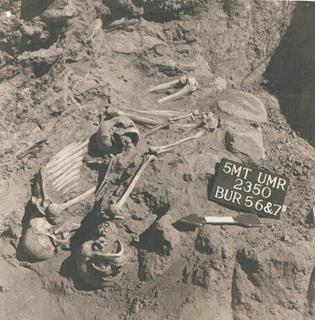
Most of the kivas I excavated had dogs and/or turkeys purposely sacrificed and placed on the floor, in the firepit or in the ventilator opening. None of these appeared to be circumstances where the animals could have accidently fallen in and died. The skeletons were all placed on the living surface and were articulated. This picture shows a dog burial from the ventilator opening at a kiva at site 5MTUMR2559.

This kiva also had a dog placed in the firepit with a large slab placed on top of it. One of my colleagues, Bill Gillespie, excavated a site nearby (5MTUMR2347) that had a kiva containing five dogs and eleven turkeys! All of the kivas at these sites dated from the mid AD 900s into the early AD 1000s. The Anasazi were apparently sacrificing the only domesticated animals they had, dogs and turkeys.

But never any wild animals and definitely never any snakes. That is different and interesting.

The HCN article alludes to the issues of warfare and cannibalism among the Anasazi that I discussed in this earlier post. None of my thesis sites had evidence of cannibalism, but one did have a somewhat spooky example of treatment of human dead, as seen in this photograph.


These three bodies were dumped into the ventilator shaft outside of a kiva. A 45-50 year-old male and a 15-17 year-old female were dropped head-first into the shaft and a 5-7 year-old of indeterminable sex was dropped feet-first. All at the same time. Realize that Anasazi burials of this time period were careful affairs with bodies flexed just so and many grave goods. These three people were not so much buried as disposed of. Christine Robinson analyzed these burials as part of her master's thesis and could find no probable cause of death from the skeletal evidence. Were these ritual executions? We'll never know.

I have a couple of friends, Mike and Kathy Gear , who are archaeologists turned novelists. As I mentioned to Steve, this is the sort of thing they could use in one of their "prehistorical" novels. They have set some of their novels in Anasazi prehistory, in fact their latest, People of the Moon, is placed at a Chacoan outlier site, Chimney Rock, located east of Durango, Colorado. Their books are novels, but Mike and Kathy work very hard at researching the time periods and areas they use as settings, so they can represent the current state of archaeological knowledge in their work.

Saturday, October 15, 2005

Robot Camel Jockeys

Not a joke: Qatar has developed a lightweight robot jockey for camel racing, to replace the children who were preferred before.

Unfortunately this version does not have the photo from the original dead- tree WSJ version of October 3.

Karma Light?

One used to go to the BBC and such papers as The Herald Tribune for information. But according to this hilarious item by Canadian columnist Michael Higgins, you might best avoid it. Maybe it's my age or upbringing, but even moderately educated non- Catholics used to know that "Carmelites" were nuns, and that LATIN was the "foreign language" of certain Church rituals.

"British journalist Libby Purves got it quite right when she observed recently and humourously in her column in The Tablet:

"'On 4 April an old convent school friend speechlessly thrust a copy of the International Herald Tribune into my hand and pointed to the paragraph about the catafalque:

"The 84-year-old [Pope] Jean Paul [sic] was laid out in Clementine Hall, dressed in white and red vestments... tucked under his left arm was the silver staff, called the crow's ear, that he had carried in public.

"So the crozier has become the crow's ear. But it doesn't stop here. Purves continues:

"'The BBC subtitle service was quite rich in moments of epic religious illiteracy, providing a troop of Karma Light nuns [Carmelite]. It also gave up entirely on the 'Oremus' by subtitling it 'Chanting in a foreign language.' "

Hat tip to Kathy Shaidle at Relapsed Catholic.

Friday, October 14, 2005

Zuni Rock Art Blogging 2

For your enjoyment, I'm back with some more prehistoric petroglyphs from Zuni Pueblo in west central New Mexico. As I mentioned in this post there are some beautiful examples of rock art from an area near the northern edge of the reservation. I have always liked this cliff face


which has a variety of geometrics, anthropomorphs, some deer, and you can even see one of the classic humpback flute players (Kokopelli) on the right side of the panel. The desert varnish has left a fine dark field for the artists to peck through and show the lighter sandstone beneath.

A detail of one section shows this fairly realistic deer

which incorporates aspects of the rock in defining the animal's stomach. He is emphatically male and his antlers are rendered more realistically than in most other prehistoric deer petroglyphs in the region.

Another favorite of mine from this panel is this horned frog

who has a nice symmetry, though the artist didn't think it necessary to do much on representing the head. Perhaps the wide, spiny body and squat legs were the essence of the horned frog for him.

Islamic Indians??!!

At the wedding last Sunday, my brother- in- law, an anthropologist who has worked for more than 30 years with the Chamula Mayas of Chiapas, told me bemusedly that the latest fad for these VERY religiously syncretic people-- they have incorporated their own Paganism, Catholicism, Presbyterianism, some sort of Evangelicism, and alchoholism with little effort. They have a complicated cosmology and incredible art-- I'll try to photograph some when I am up in Santa Fe again.

I was a bit taken aback. I am by no means as convinced of the incompatibility of (some kinds of) Islam and the West as my friends at Gates of Vienna. I have seen the layered- over- Animism, Sufi- saints- and- shrines, women- on- horseback- drinking- vodka version in Central Asia. My friends in Kazakhstan tell me of ancient warrior queens who hunted. My Mongolian Kazakh friend Canat, former Soviet commando, then dissident, then eco- entrepreneur (go with him if you want to ride with the eagle hunters) once told me "I love Allah, but I do not love mullahs. After the Change, they came and tried to build us a mosque. They wanted us not to drink, and to cover our women. We sent them back to Arabia".

But a Moslem presence in an already anti- American part of Mexico? (Commandante Marcos ground). South of our ever- permeable border? Just what kind of Moslems were they?

I Googled around and found this Houston Chronicle article via Freerepublic. It is a fair and complex piece. Good-- they are more or less Sufi- based sect, and so NOT Wahabbi, which hold Sufism to be just another heresy. Bad-- they are allegedly anti- Semitic.

Of course, if they act like the Chamula always have -- or the Central Asians-- they will incorporate drink into their rituals, and mellow out.

Two more thoughts: there are serious IslamIST-- no joke-- groups throughout Central and South America, especially in Paraguay -- not native but imported, and actively encouraged by such as Hugo Chavez (who has just blamed the Pakistan earthquake on international capitalism-- you can't make this stuff up.)

Last, another quote from Canat, dated September 12, 2001; I keep it on the wall next to my desk:

"Hello, my friends,

"I present my condolences to your family and all your friends. I can't believe now what is happened in USA. Of course, this is big lost of World. This is not just American's, it is all world tragedy.

"Take care yourself, my friends. My family and my Kazakh people are with you."

They don't, by any means, all hate us.

Microchip everything!

Eveyone interested in keeping domestic animals should read this post on animal control and the "PAWS" bill. The odd alliance of the AKC, the HSUS, and the worst of all, PETA, are lining up with the support of "conservative" presidential hopeful Rick Santorum in a bid to control all domestic cat and dog breeding and eventually, apparently, microchip EVERYTHING. If you have any interest in backyard breeding, closeness to animals, limited government, the preservation of small old non- commercial gene lines, or just plain freedom, write your congresscritter NOW. The link was sent to me by the ultra- respectable SAOVA (Sportsmen's and Animal Owners' Voting Alliance) and is the best treatment yet I have seen of this proposed law.

"Dog Politics" says:

"Do you think the AKC and PETA and the HSUS  have now found a common cause - are they now sharing the love?   Do they love Rick Santorum.  Does he love them back?

"I'll tell you what kind of love they'll be sharing - the green kind. It's called money. 

"Fuggetaboutit - there's ONLY ONE question that truly matters:

"Will the PAWS bill further endanger our freedom, our privacy, our constitutional rights?"

...and he goes on to show us how it will. I confess I can be dubious about money ALWAYS being the cause of political alliances, but he makes quite a case.

For more of my posts on animal control go here and here (microchipping livestock) and here.

Beluga Caviar

The US Fish and Wildlife Service has banned importation of Beluga Caviar from the Caspian.

Something had to be done. My only concern with a total ban is that, as always (and as in ivory before it) it equally penalizes those countries with real conservation, and those where poaching and corruption are rampant.

Ironically, Iran seems to have a better conservation program than other Caspian nations. But then, It Is A Well Known Fact (see G. L. Herter, below) that Mussolini made the trains run on time.

History's Ironies 2

In Nigeria, white farmers driven from their land in Zimbabwe, and their modern methods, are being welcomed with open arms. One can only hope it will stay that way.

History's Ironies 1

Chinese colonists in Xinjiang, patriotic Communists when young, are being dispossed by the new Chinese capitalist economy, and have nowhere to go. It is sad, but probably neither Uyghurs or Tibetans are shedding any tears.

Moving Photo

This photo of Condoleeza Rice and a Kyrgiz eagle falconer is amazing, and should move anyone but the most hardened ideologue. When I was born, her family was living under Jim Crow, and he was a Soviet "minority" forbiden to roam with his herds, as his ancestors had always done, or even fly eagles, by direct order of Stalin.

She is now one of the most powerful women in the world, a multilingual PhD who studied the Soviet system before its fall.

And the old practices of Central Asia are legal again-- eaglers and houndsmen hunt in the field, eagles fly on flags, and appear on national stamps.

I am no great believer in progress, but sometimes...


And of old things new again...

Extremely Cool Beetles..

...at this Cornell site. The carbon dust illustrations here are particularly nice.

Thanks to Will Brown of Blue Ridge Biological.

I could be wrong...

Any reader of this blog knows I am wary about China. So when I read an essay called "The Chinese are our Friends" in the November Esquire (not available online) I had to read it.

It was not as weak a case as I supposed, and the author, Thomas P. M. Barnett, was neither a Wall Street Pollyanna nor a leftist, though he failed to mention such things as a Chinese general's threatening to nuke all our cities if we defended Taiwan on the grounds, startlingly Maoist, that they could afford to lose the population. And he, as I do, likes India and (though it is often difficult) Russia.

So, in the spirit of Derb's "can we predict ANYTHING?" (see below) I give you a link to Barnett's new book, Blueprint for Action, which I have not read, will probably read and disagree with, but will probably be stimulated by, as I was by his essay.

The 1918 Flu Pandemic...

...was a bird flu that jumped, just like H5N1.

Author Gina Kolata also wrote Flu, THE book on the pandemic. Get your Tamiflu-- its coming, sooner or later.

Carnival of Derbs

John Derbyshire has written many quotable and irascible things lately. In this essay he suggests a rough but possibly realistic exit strategy in Iraq-- arm the Kurds, our only friends; give guarantees to the Turks; screw the rest. (Sorry, John, for a rather blunt but I think accurate summary). Who knows but that, with the struggle continuing and support eroding and nobody agreeing on what is happening, we could do worse.

Or maybe we could. In THIS one, he opines, brilliantly, that no pundit or commentator on world affairs, including him-- even on China-- really has any idea what is likely to happen.

The past, seen even through nostalgia, is at least a bit more reliable. Here, in an obituary note on a good friend in Hong Kong, he also reminds us that it is also a different country. "Chan grew up in the 1930s in the household of a grandee in the Foshan distict of Guangdong Province. It was a wild and woolly time, with warlords, bandits, the Japanese, and rapacious government agents stomping around. Noticing that Chan seemed to know a lot about handguns, I once asked him: "Did your father have guns?" Chan: "My father had his own private army." "

George Leonard Herter

In this post at his NatureBlog, Chas evokes the eccentric ghost of George Leonard Herter, pioneer in outdoor catalogs, inspiration to our youth, author of both The Bull Cook and George the Housewife, and holder of ... odd opinions. Those quoted in NatureBlog are relatively conventional.

George the Housewife can be described as a male Heloise for the barking mad-- and Im not sure that Heloise doesn't approach that point herself. But Bull Cook and Historical Recipes is worth owning both to read aloud at any table where the wine flows, and because some of the recipes-- Chas and I both make "Doves Wyatt Earp", for instance-- are pretty good..

But the history is why you buy the book. My favorite line in all the Herter ouvre is "The Virgin Mary was very fond of spinach", closely followed by "It is a well known fact [ a favorite Herter locution ] that Beethoven was fond of Spam." Other quotes from a good Amazon review, which save me a trip to my library, are: "Sauerbraten was invented by Charlemagne...Henry the VIII actually never amounted to anything and would not have made a good ditchdigger...In 1212 St. Francis went to the Holy Land. When he came back he taught his followers a simple way to poach eggs...Pate De Foie Gras was first made for Joan of Arc by one of her army cooks ..."

His African book The Truth About Hunting in Today's Africa (1963), which features photos of dead birds being thrown upside down to recreate the author's shots, also has at least one immortal line: "Most people don't realize that being eaten by a hyena doesn't hurt very much".

It is well worth getting any of the above, and reading them aloud to friends and family. I hope it didn't warp all those young bloggers mentioned below...

Alternate Histories

I have been having some interesting conversations with Chas on novels of alternate history-- you know, the ones where a slight change in events results in, eventually, a very different world. He sent me this link to an interesting but ultimately unsatisfying discussion (do read it, perhaps skipping the Hegel, Walter Benjamin, Freud et al-- it IS a bunch of academics-- for some interesting book leads). But I think they find alternate history "right wing" because it is not progressive.

I replied to Chas:

"[The post] Started good, but degenerated-- Walter Benjamin, Hegel, academicism generally, and this priceless line: "Ugh - this is degenerating the same way things always do around here." I probably still will blog it. It has some good notes of books that are forgotten but wonderful, like Keith Roberts' Pavane (gee, I always thought that was rather Catholic [ and can't believe it's still in print!]) and some I haven't heard of but want to see, like the one with the Stooges and Zero Mostel and Peter Lorre working for Brecht...

"Does one consider Steve Stirling "right wing"? He is AFAIK a moderate Democrat, but in the Draka trilogy (easiest to get as The Domination and its sequel) he imagined a society of fascist posthumans so well that a writer who appears to be a Nietzchean neo- fascist insists Stirling is an advocate! Milton & Satan? Stirling ... tempts... those of us with discomforts with industrial civilization. He also shows the possible costs of building a post- human one, in slavery and waste. I don't think I'd like his "fan", though he gives a perversely intelligent analysis..."

Chas replied:

"I thought he reminded me of Heinlein, the one book I read (Conquistador), and Heinlein definitely had romantic-fascist tendencies, if not the full economic policy... I don't think Heinlein is Mussolini, but he likes uniforms (Aphrodite likes Mars) and exults a romantic individualism that some lefties read as quasi-fascist".

Granting that I am more conservative than Chas, at least nominally, I think Stirling tries on different faces. I think Conquistador is a conscious tribute to Heinlein and people like Poul Anderson (he says either in or somewhere about the book how different the attitudes and values of those who fought WW II were from those of us who came after). His semi- fantasy- catastrophist last two novels ( Dies the Fire (excellent) and its sequel that I haven't read yet) show more how the post- WW II generations would react to the loss of our civilization.

The way to approach the Draka stuff is to read the inexpensive pb Drakon first, in which a magnificent female of the master race falls through an artificial wormhole into our world (or one close enough-- Stirling is tricky) and decides to take it over and bring her kind through. ("Something wicked this way comes", as a reviewer said). He really makes anybody with an ecological conscience think "maybe this wouldn't be so bad", despite the overtones. And it is actually funny in places.

Then read the big HB Domination (link above) that collects Marching through Georgia, Under the Yoke, and The Stone Dogs, to see just how hideous the process that resulted in the re- greening of Earth was-- and why it is necessary to oppose-- I don't know, "hard transhumanism"? (For a good treatment of the same meme from the nominal left, try Ken MacLeod's The Cassini Division). "Order the guns and kill!", as Kipling said.

One of the heroes of the second volume of Domination is a martyred Catholic nun.

Also re Stirling-- if , as I am, you are a sucker for anything to do with the Raj and the Great Game, try Stirling's The Peshawar Lancers, a rousing one- off set in still ANOTHER timeline with many knowing winks to fans of the literature of that time and place...

Talibanning pigeons, 1996

In my continuing series on banning various animals, we come to one of the most notorious (though if our high- tech society decides to do it the results may be even worse). In December of 1996, under the presidency of Amir Bin Maluf, the Taliban issued 16 edicts. Most were the usual ones that made headlines in the West: "To prevent sedition and female uncovers" (yes, that's ONE edict); "To prevent music"; "To prevent beard shaving and its cutting"; "To prevent kite flying" (I cite this because it is often mentioned); "To prevent idolatry" (ie, all pictures of anything)"; "To prevent sorcery". But one is particularly interesting, Edict number 4: "To prevent keeping pigeons and playing with birds. Within ten days this should be monitored and the pigeons and any other playing birds [Afghanis also kept falcons and fighting partridges] should be killed".

I have asked around. Some thought the reason for the ban was because pigeon flyers and partridge fighters gambled on birds ( but what of falconers?); others said that the Taliban considered playing with birds "un- Islamic" because it was frivolous and took away time from important things like prayer, beating women, and harassing others' innocent amusements. I should add that MOST Moslem societies love pigeons, and they keep some of the oldest breeds , especially in hard- drinking, Sufi, all- the- women-can- ride north- Central Asia, where "we love Allah, we do not love mullahs" (more on that later).

I am not the one who said that persecuting pigeons is of equal importance to persecuting women, artists, and musicians-- they were.

They did better at that particular crusade than at any but the one against the Bamiyan Buddhas. There are now more Afghan highflyers in the US than in Afghanistan. I'll try to find a pic.

The above edicts from Ahmed Rashid's excellent Taliban.

Tynan

I forgot two odd things about Tynan below. Though a noted libertine, he was a student of C. S. Lewis at Oxford, and appreciated him all his life-- words from Lewis were read over his grave.

And he wrote one of the best books on bullfighting ever written on the practice for the non- aficionado, Bull Fever. I'd give it the edge on even Hemingway's fine book, perhaps because he deeply understood the theatrical nature of the spectacle.

Writhing in Apathy?

I tease Larissa (another attendant of the wedding below) about whether anyone her age has yet earned the right to use a phrase coined in his diaries by the brilliant English theater critic and writer Kenneth Tynan when he was dying of emphysema in his fifties-- but no matter. "Writhing" is a brilliantly funny ongoing (I hope) account of a young actress's life in New York. But it is also about food, accidental meetings, cockroaches-- let me qoute a bit on the last subject:

"July 8th: Yesterday, in a moment of incomprehensible forgetfulness, I breezed right into my bedroom with nary a thought as to the danger that lay in wait for me there. In my obliviousness, I turned to my wall mirror and picked my mascara out of the tin cup on the shelf beneath it. Just as I was lifting the wand to my lashes, I caught sight of something else in the mirror, to the bottom right of my face. I spun around. There, in full view, smugly eyeing me from atop my nightstand, was the cockroach. It made no attempt to scurry away, hide, or even take flight; it just sat there like a sphinx, unmoving except for its antennae, inches long and all a-twirl. I half expected to see a lonely tumbleweed drift past us and hear plaintive whistling in the distance. I reached down with my left hand, picked the plastic bag from Gristedes up off the floor, and slowly walked to the shelf. With wrath swift and god-like I swung the bag forward over the stand while with my mascara wand I knocked the beast into it, immediately tying the handles together in triple knots. Crunch, crunch,…..crunchcrunchcrunch it went, imprisoned and frustrated. This Gristedes bag was the kind made of unusually thick, crinkly plastic, so every step the leviathan took crackled like hellfire, which I interpret as heavily symbolic. I was about to take the bag outside and throw it into a waste bin when I realized that, as I was now safe, my molester all imprisoned, I could just leave it where it was and let it think on what it had done for a while. I turned the nightstand lamp on next to it, so it might contemplate its sins in the harsh glare of righteousness. I slept that night in the living room.


"July 10th, 2005: Crunch, crunch, crunch….The prisoner, whom I now call Gregor, shows no signs of wilting. Three days with no food or water has had little discernable effect on his vitality. I examine his bag every few hours and watch the almost beautiful play of light and shadow he makes as he crawls this way and that, his body silhouetted against the wrinkled plastic walls, now sharper as he bears down close to the wall, now blurrier as he ruffles his wings and stretches his insect legs. The scene is Chekhovian in its sadness: the seagull has wandered far from his home and rightful place and thus must die, unnaturally, and in a strange land. Crunch, crunch, crunch…I wonder how it all will end. I remember my mother telling me as a child that a cockroach can live for three months on a crumb of food too small for the human eye to see. Perhaps Gregor will enjoy such longevity, crunching away on my nightstand as summer ripens and fades into fall and the leaves start to change, as people marry and divorce, grandparents die and babies are born. He will wander till he expires in his crinkly white limbo, with only the memory of the bustling outer world, its sewers and basements, dropped icecream cones and spilt soda, sleeping females and closets filled with silks, to sustain him in his final hours. Flights of angels sing thee to thy rest, my Gregor."

Tuesday, October 11, 2005

Back to Reality

I'm back from a long and wonderful weekend attending and celebrating the wedding of my stepson, Jackson Frishman, to his sweetheart Nikki Mazzia. The crew was a unique mix of Eastern Orthodox, St. John's College (Santa Fe campus), river rats, Magdalenians, and... more. Not just a few bloggers either; Odious AND Peculiar, usually separated by geography except in the world of blogs; Writhing in Apathy, about whom I will write in more detail later: the Alpha Environmentalist (I was able to utter a sentence that I truly enjoyed: "Odious, meet the Alpha Environmentalist! "): Kate of The Little Bookroom; Pen and Paper, The Pumpkin King,Nine Scorpions, and I think more...

I have a large backlog of subject matter ranging from Zimbabwe to Kurdistan (and always China), from sharks to sturgeons, from George Leonard Herter to more animal laws to the flu. Still busy for the next few days but will begin to get them up.

And as for the wedding, most visually splendid I have ever been to, there will be pics.

Monday, October 03, 2005

Seeing Is Believing

My first impression of New Orleans, circa summer of 1986: This is a dirty city.

I was sixteen, traveling with my friend Ricky, who was half a generation my senior and my falconry mentor. He warned me about the place.

"No good looking women, either."

We were still half an hour's drive from our destination, a friend's home in the outlying neighborhood of Arabi, not exactly a suburb of New Orleans, in St. Bernard Parish. Flashing past the window of Ricky's 280ZX were chunks of Styrofoam afloat in flooded marsh. White egrets stood on one foot in the median and perched in low salt scrub along the highway. Whirling flocks of blackbirds mimicked smoke from the cooling stacks along the Industrial Canal.

What one could see then of New Orleans East was dirty, and anyone could be excused for finding other parts of the city in similar disrepair. But in fact there was nothing dirty about Arabi. It was a place merely lived in, a neighborhood like an extension of your living room, with the diner plates still on the TV tray in the morning. Here a population of working class people, roughly equal parts rural and urban stock, somehow found more in common with each other than with anyone else. That was how New Orleans looked and how it worked: one neighborhood at a time.

That New Orleans looks (and works?) different now hardly bears saying. Most of Arabi is destroyed and much of New Orleans East beyond recognition. The chief concern before rebuilding can be discussed is what to do with the wreckage. That story is told by Peter H. King of the LA Times (in You've Got to See It to Really Believe It):

"...Then they fell to talking casually about the scale of destruction. Sharafkhani said it looked to him like nine out of 10 houses in the flood zones would have to come down.

It was, he said, unbelievable.

The foreman nodded.

"It's like someone came through and dropped bombs every couple of blocks. Boom. Boom. Boom. Boom. Boom.

"It's a bulldoze job," the hard hat concluded, "that's for sure."

"Back on the road, Sharafkhani started to work out a math problem aloud. He figured, conservatively, that 100,000 houses would have to come down in Orleans Parish. This number left out St. Bernard and other parishes in greater New Orleans, and also all the cars and boats and commercial structures that would require disposal somewhere.

"Each house, he said, would produce two or three truckloads of debris, for a total of as many as 300,000 truckloads— and the major landfills he'd visited earlier were straining to accommodate 400 or so trucks daily. He did not bother to divide the number of truckloads by the number of days, or weeks, or months it would take to handle them all. He reduced the calculation to a single word: "Years."

"We are talking years."

Saturday, October 01, 2005

CommonCensus...

..is proposing an interesting new way to redraw the map, highlighting real regions as opposed to top- down constructions. Check it out here.

Quantum Catfish..

...is a hilarious new illustrated blog, featuring the philosophical dialog of several fishermen in a boat. Think Day by Day, only with fish, and southern.

Thanks to Dymphna of Gates of Vienna.

It might not be a good idea...

..to buy Chinese beauty products. They are using executed prisoners and probably aborted fetuses to extract collagen. From The Guardian:

"Agents for the firm have told would-be customers it is developing collagen for lip and wrinkle treatments from skin taken from prisoners after they have been shot. The agents say some of the company's products have been exported to the UK, and that the use of skin from condemned convicts is "traditional" and nothing to "make such a big fuss about".

(Snip) "...An agent told customers it had also exported to the US and European countries, and that it was trying to develop fillers using tissue from aborted foetuses.."

"In June 2001, Wang Guoqi, a Chinese former military physician, told US congressmen he had worked at execution grounds helping surgeons to harvest the organs of more than 100 executed prisoners, without prior consent. The surgeons used converted vans parked near the execution grounds to begin dissecting the bodies, he told the house international relations committee's human rights panel.

"Skin was said to be highly valued for the treatment of burn victims, and Dr Wang said that in 1995 he skinned a shot convict's body while the man's heart was still beating. Dr Wang, who was seeking asylum in the US, also alleged that corneas and other body tissue were removed for transplant, and said his hospital, the Tianjin paramilitary police general brigade hospital, sold body parts for profit."

Read the whole thing.

Incidentally, the traveling German "art "exhibit featuring flayed and preserved bodies, now in Toronto, has also been tied to executed prisoners.

"Bells & Smells"

I don't post too much about religion or politics here, mostly because they are not my area of expertise and because others so often say it better. But this defense of old fashioned Catholic rituals and customs from Dappled things strikes me as exactly right.

"But it's a false dichotomy to say one must choose between the external trappings of religion and the interior stuff that has eternal significance. There's no reason in the world why one can't have both, and Catholicism has traditionally kept them both together. To be unimpressed by a triple tiara certainly does not make one a bad Catholic, but I wonder whether zealously opposing all these little grace notes in the religious score might not. To my mind, at any rate, all these things speak of the magnanimity and exuberance of a religious spirit that spills out into the world in all sorts of unlikely and delightful ways. They knock us out of the prosaic and linear existence of everyday life and remind us that old-fashioned religion, in addition to being good, saving, and true, is also charming, merry, and even whimsical. A woman in white veils and orange blossoms would be ludicrous walking down the aisle of Wal-Mart, but there is something right about her walking so attired down the aisle of the church in a wedding. Perhaps not every bride will choose to exercise that option, but only a grinch would want to deprive her of that choice.

"And this is what I think drives the progressive hacking away at all that is quaint and definitely non-prosaic in our religious customs: not just plodding utilitarianism, but a spirit of grinchiness. The Calvinists and their Catholic cousins, the Jansenists, pioneered that spirit in Christianity, and the sober rationalists of the Englightenment did the same for secular society. Purge away everything but the non-essential and you may indeed retain Christian truth, but you will have made the practice of it into something much grimmer than it has to be. Chesterton's Rolling English Road [ "the rolling English drunkard made the rolling English road"] illustrates that insight wonderfully, and Hopkins' Pied Beauty does the same.

"So, take the tiara or leave it, bring your cocker spaniel to be blessed or leave it at home, but think twice before you write it all off as distraction and poofery."

Pig Follies again

A judge has upheld the ruling to kill exotic opigs on Santa Cruz Island, and Animal Rightists are upset, of course. I think Reid Farmer has the right idea: "It's a scary thought if one of these suits wins. I mean, in principle, I'm all for pig condoms. But I think the plaintiff and his attorneys should be stationed at the island to help the pigs put them on."

Supernova

An interesting new- ish theory on mammoth extinction can be seen here. A supernova caused what are carefully being called "comet- like" events about 13,000 years ago, may have wiped out most of the mammoths, leaving traces in their tusks.

This would be a rather local, that is, North American, event, not resposible (probably) for all Pleistocene extinctions. It also might have had an impact on early American humans:

"In addition to the tusk evidence, the scientists said arrowheads from North America's prehistoric Clovis culture, which went extinct around 13,500-13,000 years ago, Icelandic marine sediment, as well as sediment from nine 13,000-year-old sites in North America, contain higher-than-normal amounts of radiation in the form of potassium-40 levels."

I have a notion that a similar theory was proposed a few years ago, but cannot find a thing. Reader info would be welcome!

Anasazi revisited

Remember this?

Well, it appears that snakes with sinister connotations are not unknown in Anasazi sites.

"A couple of years back, Ryan was digging out the bottom of another kiva here when she unearthed the 800- year old skeleton of a snake. It had been stretched out on the kiva floor, andits skull was conspicuously missing. Usually, a dead snake would be found coiled in rocks, its vertebrae scattered like dice, but this one was straight as a ruler, cleanly intact but for its head. just before the chamber had been intentionally buried in refuse and rubble, before its ceiling beams had been pulled out, a headless snake had ben laid across the hardpan floor".

It was not a sign of anything good. "Shortly after finding the snake, Ryan brought a group of American Indians to the site, asking their opinions...When she approached this exposed kiva, she mentioned her curious find, One woman from a western pueblo suddenly stiffened. Without explanation, she turned and walked away, keeping her distance from the entire site from then on.Ryan understood that the woman was carrying a private piece of knowledge, something that told her what it meant to find a headlees snake on the floor of a kiva."

It is an excellent piece, by the good writer Craig Childs-- Read The Whole Thing, as they say.

Giant Squid seen at last!

If you haven't seen this yet, you should. Apparently it is a lot more active than was suspected.

Don't eat bats...

The animal reservoir of SARS has just been discovered by two medical teams: the Chinese horseshoe bat (not the civet cat or raccoon dog, which had previously been suspected). Apparently the Chinese penchant for eating ANYTHING, however weird or endangered, has bitten them back. It may make for an interesting cuisine, but is not always the smartest thing to do...

I think the precautions advised indicate they are not falling back on, say, Macdonald's. Since the bat can transmit the disease to palm civets, they should ensure a quarantine: "Most civets that are sold in China as a delicacy are farmed, Dr. Wang said, and the government should ensure civet farms are distant from bat colonies, monitor farmed civets for SARS-like viruses and allow just noninfected animals to go to market."

Good idea, as the old Indian in Never Cry Wolf used to say.

Another thing struck me. Years ago, I read Richard Preston's terrifying and fascinating account of the Ebola and Marburg viruses, The Hot Zone. In it, he goes to the Kitum caves in Kenya, which may be the source of Marburg, and sees bats, which may be the reservoir. He says: "The rocks below the bats were slubbered with wet, greasy guano, a spinach- green paste speckled with green blobs, which reminded me of Oysters Rockefeller. Momentarily and unaccountably, I wondered what the bat guano would taste like. I thrust away this thought. It was the mind's mischeif. You should avoid eating shit when you are in Level 4 [the deadliest level of biological contamination]."

My stepson and I thought this hilarious, and made it into one of our "Simple Rules for Life" : "Don't eat bat shit in a Level 4 Hot Zone". Ha, Ha.

Well, here is another bit from the NYT story: "...in Asia, many people eat bats or use bat feces in traditional medicine for asthma, kidney ailments and general malaise."

Hmm...

Animals and Government

I am always amazed how, as society becomes more complex, it inevitably seems to want to control not only your life but your animals. Various reasons may be given-- animal welfare, neighbors complaints, disease ("Mad Cow", SARS, Avian Flu). But the end result is virtually always to confiscate, prohibit, even kill "uncontrolled" and unpopular animals,. (The late Vicki Hearne, poet, animal trainer, and philosopher, used to say sourly of seeing roadkill dogs in the South that at least they hadn't gotten around to eliminating them all for humane reasons-- yet. She also said that animal rights people saw animals only as "cute" or victims, which may or may not be another point.)

Paranoid? You bet! In my own experience: when Libby was living in Bozeman-- Montana!-- we had three dogs. The ordinance said you could only have more than two if all the neighbors didn't object. One neighbor hated dogs. A town cop came and told us just to have one put down! We eventually took it to court. Luckily, lawyer friends took us on for free, because the case, which we won, cost $27,000, which the city had to pay.

They came to me that day and said, "OK, you beat us on the dogs. Next, we'll go after your pigeons. And if that doesn't work, your hawks". Luckily, we were already Magdalena bound. Now, both bird species are SPECIFICALLY banned in Bozeman.

The feed store guy said to us sadly, "This used to be Montana".

Then, in Magdalena, a newcomer on the City Council introduced an ordinance that would have banned all "exotic and farm" animals and birds (the town is full of chickens, goats, sheep, and horses, being in rural New Mexico), plus as in Bozeman limit us to two dogs. She also wanted to have anyone pay $150 for any animal born, INCLUDING EVERY EGG LAID. Absurd? Keep reading! At least in Magdalena she was voted down, for the time being.

Recently Will Brown of Blue Ridge Biological, a scientist, artist, and keeper of pigeons, sent me an article that was originally published in The Poultry Press.. By Mary Zanoni, a Yale and Cornell PhD who heads up a new organization called Farm for Life (no link yet, but a PDF of the paper, which contains addresses and a place to sign up for a newsletter, can be downloaded here) "Why You Should Oppose the USDA’s Mandatory Property and Animal Surveillance Program" is nothing less than frightening. And remember, nobody has voted on this-- it is entirely administrative, within the USDA.

She begins: "For several years, the USDA has been working with the largest-scale animal industry organizations (for example, the National Pork Producers, Monsanto Company, and Cargill Meat) to develop a mandatory “National Animal Identification System” (“NAIS”).
(Snip)

"By January 1, 2008, the NAIS will be mandatory. Every person who owns even one horse, cow, pig, chicken, sheep, pigeon, or virtually any livestock animal, will be forced to register their home, including owner’s name, address, and telephone number, and keyed to Global Positioning System coordinates for satellite monitoring, in a giant federal database under a 7-digit “premises ID number.”

''Every animal will have to be assigned a 15-digit ID number, also to be kept in a giant federal database. The form of ID will most likely be a tag or microchip containing a Radio Frequency Identification Device, designed to be read from a distance. The plan may also include collecting the DNA of every animal and/or a retinal scan of every animal.

"The owner will be required to report: the birthdate of an animal, the application of every animal’s ID tag, every time an animal leaves or enters the property, every time an animal loses a tag, every time a tag is replaced, the slaughter or death of an animal, or if any animal is missing. Such events must be reported within 24 hours.

"Third parties, such as veterinarians, will be required to report “sightings” of animals. In other words, if you call a vet to your property to treat your horse, cow, or any other animal, and the vet finds any animal without the mandatory 15-digit computer-readable ID, the vet may be required to report you.
(Snip)

"If you think the description [above] sounds too bizarre to be true, please go to usda.gov/nais, read the Standards and Plan, and check the citations."

I think her conclusion below is realistic, not paranoid, as it would be virtually impossible for most small breeders to comply with, never mind the civil liberties implications. And such simple pleasures as pigeon racing and State Fair animal shows would become illegal.

"The NAIS will drive small producers out of the market, will make people abandon raising animals for their own food, will invade Americans’ personal privacy to a degree never before tolerated, will violate the religious freedom of Americans whose beliefs make it impossible for them to comply, and will erase the last vestiges of animal welfare from the production of animal foods."

Weird historical note: such things have happened. I am a great fan of the ancient and grotesque "Thief Pouter" pigeon breeds of Spain (I wrote about them in Aloft-- see books to the left). They flew fom their home lofts to "seduce" your competitors' birds to your home.


The dicator Franco, from a combination of dislike of the rebellious southern countrymen and a fear that they could use the birds to communicate, simply banned their flying, and in some cases just banned whole breeds (from the Thirties until his death). I quote from the "Clandestino" pouter site "Franco only sanctioned the Suelta sport [ a modern sport with no homing involved] and the "Modern" Spanish thief pouters used therein, and banned all other thief pouter breeds from ever flying. The breeders of the various traditional, working type Spanish thief pouter breeds were forced to make a decision: give up their birds to the Suelta sport or organize a club to promote their once working birds as show birds only, so that they would no longer be persecuted by the dictator and the many avid followers of the Suelta sport. Most thief pouter breeders caved in to the pressure and began breeding their birds to fit the newly created show standards for each breed; but a handful of people refused to put their working birds into the show pen and continued to secretly breed and fly their birds as thieves (the original purpose of all Spanish thief pouters)."

One more thing: the USDA program is getting a lot of support from those who fear Mad Cow. The way to stop that is to stop feeding animals to cows, period. Wouldn't that be a better rule? Similarly, on Avian Flu: easy: don't allow your birds access to other birds when it is about. SARS? It's a Chinese bat-- more on that coming, next post....

Update: Matt Mullenix has sent these sites where you can go to check the government's own info/ propaganda: http://www.usaip.info/ -- and : http://animalid.aphis.usda.gov/nais/index.shtml

Monday, September 26, 2005

Zuni Rock Art Blogging


Steve and Matt love birds (as do I!) and I have been wanting to share one of my favorite petroglyphs - the owl seen above - with them for some time. This petroglyph is located near Zuni Pueblo in west-central New Mexico and is in a cluster of panels of prehistoric petroglyphs and very striking historic pictographs. I took photographs of many of them years ago and recently had them digitally scanned so I can share them in future posts.

A more detailed run-down of Zuni rock art can be obtained in this book by M. Jane Young.

According to Zuni informants, a common folk-tale describes the owl as a friend of the Zuni, who would fly at night to spy for them. The zig-zag line seen to the right of the owl above is said to represent the path of his flight as he flies over the enemy Navajo and returns to tell the Zuni of their numbers and location.

Another image on the same panel located a couple of feet below the owl is this corn plant with


the single ear standing up. I have always thought that this semi-stylized portrayal was elegant and charming.

As I said earlier, now that I have some of these images scanned, I will drop more in from time to time.

Sunday, September 25, 2005

Indian Whaling

Reid asked me what I thought about this NYT story about the Makah and their attempt to return to their whaling tradition. Did I think it comparable to tribal use-- and sometimes abuse-- of eagles in the southwest?

I replied:

"Hmmm-- I think I have a rather different take on the Makah. There is an excellent book by Robert Sullivan called A Whale Hunt covering their whole attempt to revive the hunt, and I think it can be justified. They use the whole whale, it( the gray) is far from endangered, nobody else wants them-- they just think whales are holy and that nobody should touch them. It is significant that the major opponent is the HSUS, now a die- hard fanatical animal rights group. There is no commercial market, the way there is for eagle feathers...

"The "anti" groups come off very badly in Sullivan's book, and I think he started as an ordinary reporter with no brief for hunting".

Incidentally: some of the Amazon commentary on Sullivan's book is priceless-- not reviewing the book but savaging it from every point of view from that of "Gandhi's grandson"-- yeah, there's an authority on Indian whaling (no comments on that please)-- to Indian activism to alleged (I didn't notice, and I do) bad editing. Makes me ever less hopeful of our bridging our divides. Can't we ever leave anyone alone?

Only a bureaucracy..

... could come up with a situation this convoluted.

I sympathize with the sheepherders, and with-- maybe-- the lower- level feds. But when you start shooting endangered species to save them--?? Earth to bureaucrats: THIS DOESN'T MAKE SENSE!

Biologists, not politicians, should sort this one out pronto.