Showing posts with label Birds. Show all posts

Tuesday, October 27, 2015

Beebesaurus

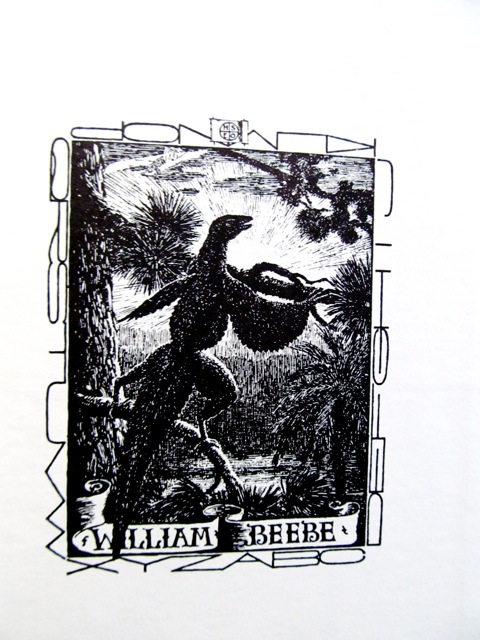
I finally got my copy, Beebe's copy, of his book Our Search  for a Wilderness, with his bookplate. The seller thought it was an iguana, but I knew it was a sketch of a possible "pre-Archaeopteryx" avian ancestor he had imagined. In 1910.


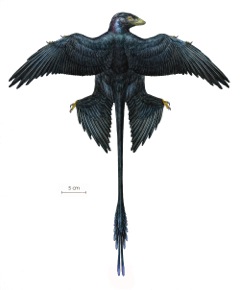
I think it was 2003 when they dug up Microraptor gui. The model is light- colored, but it has been discovered to be irridescent black. Mira!


I am painting my model black, and displaying it with the book...

Sunday, April 12, 2015

#feathersdammit#FEATHERS

Pluvi Tweets about this fantastic photo of Cassowaries, and once again damns the lizards of Jurassic Park. Early adapters  can risk looking weird, but those who cling to the old paradigm too long can come to look like Flat - Earthers...

Friday, March 27, 2015

Paradigm Shift!

It's happening  NOW. Tim Gallagher just sent me this image from a comics website: feathered tyrannosaurid attacking Roman legionnaires!

Wednesday, March 25, 2015

Convergence

No one has ever explained this close evolutionary convergence to me; even Jonathan Kingdon thought they looked less alike than they do.

Nearctic Meadow "lark": an icterid ((New Word blackbird), common here and a lovely singer; and African Longclaw, also a bird of savannahs. But HOW? I am sure we will someday figure it out, but I don't have a clue...

The images alternate, starting with a longclaw. And no, they are NOT related- cats and dogs...


Wednesday, February 25, 2015

Another Image: Crook

I dug this up recently for a gun scholar and to refresh my memory. General Crook, famed in the Indian wars in the southwest, and a fair man, was also an amateur but serious ornithologist, and poses here with a "lifter" Parker, so combining at LEAST three blog themes.

Thursday, October 16, 2014

Links, Big Birds, and all the news that fits...

When you have been dealing with meds and other unavoidable and  annoying facts of aging, everything piles up. You don't think Lucas Machias or Lane B stops mailing or that Annie D doesn't send me a mix of the surreal and the biological, or JP stops writing his serious essays, do you? The world goes "whirling still"*, and all the news is not Ebola or Isis (though they are as close to where I spent time in Kurdish Turkey as I am to Socorro-- thirty miles!)

News per se is boring. Once the too- difficult new meds were done away with, and my schedule tweaked, I still have mornings and late afternoons when I can do physical stuff, and if I get to the bar in the evening I can sit there until they throw me out. The next of my reprints, On the Edge of the Wild, with a new intro by Paula Young Lee and a cover by Vadim Gorbatov, is out soon-- see more a few posts past. After that is Eagle Dreams with a splendid black and white profile of the late Aralbai by Cat. And more to come.

Fall continues absent. My essentially northern soul (my Italian ancestors were in the Alps warring with Otzi after the Ice Age; most of the rest were mad melancholic Celts, mercenaries  fighting others of the same lineage in Scotland and later Ireland) is irritated by this golden weather everyone else loves. We should have had a hard frost  four weeks past; instead we have hot days and FLIES. Enough! Quail will start soon but I can never quite get in the mood for bird hunting unless there is a touch of frost, and your breath is visible when you open the back door just as the sun makes a bright edge over the mountains to the southeast...

I was having trouble with Rio; no, I was having trouble with my legs. Tavo Cruz came to my rescue without my having to ask, and will get him going, with me pitching in as I am able. Tavo is a biologist, a dog - in- law, and has a Gyr Merlin, so we can all relax. It is a much better solution than either giving him up or leaving him bored; so far Rio is free of vices, but boredom makes Gyrs as crazy as it does humans...

Work- we don't talk details, but I have had a sudden inspiration on how to proceed in my latest project-- perhaps why my subconscious now suggests I get back to work here too.
So: LINKS.

Turkish and Tunisian falconry are virtually identical, and I am told by Vadim that Georgia's is too. All use Eurasian Sparrow hawks caught on first passage using a mole cricket and a shrike; all employ a method that looks insane to us, throwing hawks like baseballs; though they know the hood, the birds are so well- manned that it hardly seems necessary to use the hood except in emergencies. The birds are flown as the migrant Coturnix quail move through, and can take astonishing bags. Once the quail have passed through, the hawkers release their birds.

There was a four -part YouTube on Turkish traditional hawking available for a while that had the look of being made for the state's educational TV company. These next two works are not as exhaustive, but are still fun. The first is this Vimeo of the Festival de L'epervier in Tunisia. No real hunting is done, but you can see real bird handling (the competition consists of tossing a quail off the side of a steep hill, then bowling a Spar after it). Some of the  Spars appear to be trailing 3 or four feet of string,  which doesn't slow them down much. The remarkable thing about this film is that falconry is obviously just a part of life, not some  strange exotic revival. Teenaged kids, young toughs and older working men hold forth on the virtues of their birds (one does see that the universal redneck signifier is redneck camo EVERYTHING-- have seen it as far from Magdalena, or Tunisia, as Bayan Olgii, and in Nick Fox's films of Southwest China). It makes a strange contrast to the old men in linen suits and finely woven broad brimmed straw hats...

Oh and-- don't take the written notes too seriously-- most of the birds are NOT "Barbary Peregrines" whatever that means-- most, and all but one flown (that by a dolt who treats a still- living quail as an inert object), are Accipiters, Spars, Accipiter nisus, and the exceptions look like Mediterranean Peregrines rather than the similar but distinct Barbary. One little guy is so calm and well- manned that he sits unhooded on the floorboard of a motor scooter, unhooded and unruffled, as his owner starts up and rides away.

The other link is to the White Review and is titled "The Forgotten Sea: the Falconers of the Eastern Pontos". Its tone is between that of a travel piece and a scholarly article; though the writer was not a falconer he kept his eyes open; this may be the most comprehensive of the accounts of this falconry I have read by anyone. The author seems to think Turkish falconry is dying, albeit  slowly. He certainly documents signs of its decadence: birds being kept after the season as pets because of their color; obsession with color rather than hunting ability; not flying special birds for fear of losing them... I approve of getting birds pet- TAME, but Spars that are not flown are not really hawks. Rio would make a better "pet" than any Accipiter nisus, but he is now learning to be a bird, as Libby puts it, with the attendant dangers and possibilities.

Jackson and Niki ALMOST made it up to the Black Sea coast last trip; let us hope that they can see it before this sort of magical survival disappears. As a Turkish speaker familiar with falconry since his childhood, he may bring back nuances yet unknown here.

Very different bird. You may have seen this little video of a Redtail taking down a drone, filmed BY the drone on the banks of the Charles (River, between Boston and Cambridge Massachusetts), but it is irresistible. I flew my old Redtail Cinammon less than a mile from there forty years ago, but never caught anything that exciting.


Cambridge hawker, '72?

My other links are not for the most part about birds, and I will put them in the next or another post. But first; remember how Robert Bakker, back in the nineteen eighties, called T rex "The Roadrunner from Hell"? And how Peter Larson, whose conviction and (I would say) unjust jailing for fossil offenses I don't quite understand even after reading about them, called it "The biggest bird of all"? I think that an actual paradigm shift is upon us, even as the nerds debate the producers over whether the "Velociraptors" in the next Jurassic Park episode should finally be allowed their feathers or stand shivering like plucked chickens. Bigger and bigger Tyrannosaurs are being discovered with feathers, especially Eutyrannus, and some dino kids are saying "why is the Tyrant King naked?"

Eutyrannus AND "Velociraptors"** in the snow
 Sensible, mostly young scientists, pointing to the acceptance of likely feathers on young rexes, ask when any adult in any birdlike line had no feathers when the young did. And now our most innovative paleoartist, John Conway, gives us a calm, feathered, close- mouthed Tyrannosaurus that is about the scariest thing I ever saw. He doesn't want to roar  at you***-- he just wants a snack!
* Who am I quoting? (A poet from his first book- whole stanza will appear).

** They are not Velociraptors, which were only coyote size-- more like, oh, Utahraptors--  but the name is better. You know those aspirin ads where some weary oldster has to tell a young person that Aspirin is not just for heart attacks? Kids either think I am being inventive, metaphorically, or that I am wrong (and correct me) when I refer to birds of prey as "raptors".

*** John McLoughlin used to roar himself: "WHY do they always show predators with their MOUTHS open, ROARING? They would all STARVE!"
Tuesday, August 19, 2014

Dream Birds

The Green Junglefowl and the Nicobar pigeon resemble chickens and pigeons but pushed to fever- dream intensity. The mere existence of such creatures is at least a partial antidote to the blues.

Photos taken in Indonesia by Federico Calboli


Thursday, July 31, 2014

"...all Dinosaurs had feathers"

The report (HT John Wilson) begins: "The first ever example of a plant-eating dinosaur with feathers and scales has been discovered in Russia. Previously only flesh-eating dinosaurs were known to have had feathers so this new find indicates that all dinosaurs could have been feathered."

The big thing here is the "all" I have been waiting for. Conceptually, this is huge.

The other key term is "Ornithschian", one of the two large divisions of Dinosaurs-- the plant- eating ones that often walk on four legs rather than two, including the duckbills and the Triceratops and its relatives. Some of us have thought  since the eighties that the meat- eating two legged Dinos, up to and including T rex (as Robert Bakker called it, "the 12000 pound Roadrunner from Hell"), were all feathered, and they did give rise to birds. But though we knew that some had weird bristly structures, it was less clear that the other group were feathered. Now it seems that from the start, maybe even before the Dino family split on two, that they came out of the Triassic extinctions wearing feathers. (There was a greater extinction  event BEFORE the Dinos, (see Out of Thin Air by Peter Ward), and its low- oxygen conditions may have caused the Dino- bird line to develop the air sacs, hollow bones, and efficient breathing that allow birds to fly over the Himalayas and "Brontosaurs"  to be agile moving animals even though they were bigger than my house).

In honor of all this, my favorite over- the- top depiction of the new standard, a feathered T rex attacking a "hairy" young Triceratops, and a dead Velociraptor by John Conway.


Monday, June 30, 2014

We Need More Feathered Dinos

John McLoughlin was writing about them in the late SEVENTIES. Isn't it time yet to acknowlege, preferably before the next Jurassic Park, that dinos resemble eagles and turkeys and Roadrunners more than, oh, fence lizards?

Especially with all the good artists around...


These last would be so good if they weren't lizard- naked!

This guy has known it for a long time...
And this one; well, these ones holding their long - ago first books in front of my house some years back, but I learned at least partly from the guy with the beard.


Tuesday, December 24, 2013

Floyd Robbins

Reader and commenter Gil Tracy introduced me to the work of his friend, the wood carver Floyd Robbins of South Carolina. I didn't think carving was art until I saw these. You have seen the "dead dove" below; take a look at these extraordinary objects.


 Gil says: "The wisp of snipe has to be seen to be believed.  He engineered it to where the birds are balanced and connected via wingtips."


The .410 shells and box are also wood.  Gil : "A few years ago I visited him at his shop.  On an overturned boat that he was repairing, was a dead snipe.  Nothing unusual in his shop as he studies them for color, etc.  Two weeks later the bird was still there.  I poked it.  It was one of his carvings."

Tuesday, August 13, 2013

Paleo Art comes of age...

Which doesn't mean gets dull and predictable. On the contrary, the abundance of "new" fossils  has given birth to a generation of artistic and scientific iconoclasts whose bold new vision is far more rooted in the past than any older generation's was. The inimitable polymath and prodigiously productive blogger Darren Naish, a serious anatomist, was raised on the same romantic classical dinos as I was; it is hard not to admire the old lizard- tailed reptiles as art, and their artists as virtuoso painters. But, as he says in the intro to All Yesterdays, an entertaining mixture of paleontology and art that could be a manifesto for the clear- eyed new breed of artist- scientists, "Rudolph F. Zallinger's animals-- most famously depicted in the Zallinger mural at Yale's Peabody Museum-- were clearly done with only a superficial reference to the skeletons of the species concerned." The great Charles Knight knew better, but he "...gave dinosaurs small, slender muscles that did not match their bones (dinosaurs actually seem to have had enormous, more bird- like muscles) and frequently drew dinosaurs freehand- style, again with what looks like poor attention to the proportions and nuances of the actual skeletons."

The old paradigm was overthrown in the seventies, when I was younger than Darren is now, by Ostrom at Yale and the flamboyant Robert Bakker out in the Badlands, and by John McLoughlin's first brilliant attempts to illustrate the dinos as, well, birds. But neither Bakker's description of Tyrannosaurus as a "Roadrunner from Hell",  nor McLoughlin's deadly genetically reconstructed Imperial pets in his his 1983 novel The Helix and the Sword , the Deinonychids Moscow and Washington, penetrated pop consciousness; Jurassic Park's big "Velociraptors" (not really), sisters of the Emperor's killers, were as reptilian as lizards, which made as much sense as having naked chickens or eagles walking around. Raptor types actually had feathers more like a goshawk's than a kiwi's, never mind scales-- we have found the feather insertions for big asymmetrical quills in their arms.
Bakker with dinosaur

McLoughlin self- portrait with "social hybrid of man and wolf" (his phrase)
Researchers and artists like Greg Paul and Luis Rey have since blown the old paradigm to hell with their properly birdy angular anatomy; Rey in particular adds wild primary colors and patterns, not because he knows what color they were but because both birds and for that matter lizards tend to use pattern and color in their rituals; the few fossils that show Mesozoic feather patterns indicate he is leaning in the right direction.

There are three new books that exemplify the new tradition. All Yesterdays is at once the most explicitly theoretical and "in your face", but also the most whimsical; Pterosaurs , by Mark Witton (who also has an excellent blog) is a genuine monograph by a expert, using the same rigorous standards, showing us what is known to date about creatures most people would assume were from another planet than ours, contemporary with not only dinosaurs but perfectly recognizable birds; A Field Guide to Mesozoic Birds and other Winged Dinosaurs by Matthew Martiniuk is the first book I know that simply poses various theropods and other later animals as though they were birds as to body carriage, how they hold their arms or wings-- something I see with relief and consider overdue-- and puts them in "Bird Guide" format.

The one for all naturalists with a sense of humor is All Yesterdays; after Darren declares that "this book is firmly grounded in a skeptical, rigorous, evidence- led effort to study and depict anatomy: the approach promoted by Paul, Anton, and the like...",  he reminds us that things like fat and feathers and integument, "manes, ruffs, , thick furry coats..."; not to mention behavior, can all affect appearance. Then he hands over the reins to artists John Conway and C.N. Kosemen and lets them run.

Every one of these reconstructions is original; some look rather like dinosaurs, some like odd little mammals (see the fluffy little Leaellynasaura, with its lemur tail held upright in a snowstorm); some are fairly conventional but doing unfamiliar things; one is fat, two invisible, and the Elasmosauruses in neck-swinging contests look more like sea worms in a colony than the Loch Ness monster. Perhaps my favorite is their reconstruction of the Therizinosaurus, the first depiction of this ridiculous beast that has made any sense to me at all: an upright, long-tongued avian giant sloth with kiwi feathers*, browsing high branches with a prehensile tongue.

The last chapter is hilarious: reconstructions of present-day animals by future paleontologists. The cat resembles a carnivorous iguanoid with mammalian teeth and staring eyes; swans and hornbills are reptilian and slick like yesterday's dinosaurs; the elephant has immense tusks but no trunk, the python legs, and the baboon is venomous. The most ridiculous, though no more so than some of today's versions, is a manatee that looks like a vegetarian lion, imaginatively reconstituted from a single bone, standing in its mountain meadow.

Pterosaurs is a serious scientific monograph illustrated by the author, with a thing on the cover that looks like an alien aircraft racing through a Martian sky.

 I am not qualified to judge it, only to read it in awe; I have read all the modern books on these flying creatures, and this is far and away the best. I do believe these are the oddest vertebrates ever to live on earth. They ranged from the size of a tiny songbird to the span at least of a large aircraft, and were astonishingly successful. The science is rigorous, the speculation intelligent, and the illustrations, though Witton is not a great artist, are breath-taking. Either you like this kind of thing or you don't. But I'll most likely keep this book until I die. Look at the examples here for a clue.

The last book is is striking in part because it is so familiar; the main difference between it and any bird guide you use is that a lot of these birds are scaled with a human figure, because some of them are pretty big. I have been looking for bland, placid silhouettes of things like Deinonychus and Velociraptor ever since John McLaughlin asked me (almost a dinosaurian eon ago) why the hell every carnivore in prehistory is shown with mouth agape, roaring. And why don't artists see how bird-like the hand structure of raptorial dinosaurs is? I don't mean to use the word "bland" as a criticism; what I mean is normal, unexcited. I expect if you were watching these creatures through binoculars and they didn't know you were there, they would look just like this.
Second from the top is that notorious fowl, Deinonychus herself

*Here is an almost believable version that is more courting pigeon than sloth.

Monday, May 27, 2013

Thursday, February 28, 2013

A Few Birds

Coming back this weekend after work, sick days, and generally too much, and that dull. (Why is it so hard to pay writers dammit???) We will have links, pix, dog news, poetry. I will finally review David Quammen. I will announce others. There will be.... MORE. Tonight though, good photos... as always, right or double click and embiggen.

This extremely early bandtail showed up at Carolyn and John Wilson's in the Magdalenas two days past. Photo by Carolyn W:


Goshawks. This adept pigeon- killing young male was in Larry Day's backyard outside of Bozeman MT. I wonder if his meal descended from Spanish pouters I gave Larry 20 years past...


A relative but Melierax not Accipiter-- dark chanting goshawk photographed by Texas writer Dennis Sumrak while hunting in Namibia. Dennis is working on a piece on our water crisis and has been seen at the Spur...


Can anyone remember a Roy Campbell poem-- "Singing Hawk" perhaps-- about this bird? I seem to but can't find it...