Showing posts with label Paleontology. Show all posts

Sunday, March 27, 2016

A Mongolian Progression....

Most books by Roy Chapman Andrews are interesting, but inexpensive. In his day he was a popular writer, and even early titles like Whale Hunting with Gun and Camera (!) and Camps and Trails in China are not too hard to find.

Not so The New Conquest of Central Asia. As it is the record of ten years of American Museum of Natural History expeditions, a huge book with many contributors, its usual price tag of around $650 is easy to understand, but hard to pay!

So when I found a not too battered ex- lib with a library binding and only three of its more than 200 plates missing, for $200, I grabbed it, I have never been happier with a book! Despite the rough condition a (tape on maps, stamps,  and library binding), it is a battered, still- magnificent treasure trove of everything Mongolian,  scientific and, yes, Colonial, in  early Twentieth Century Asian history.


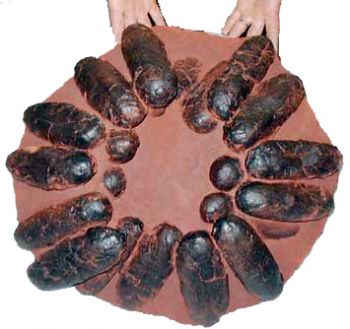
Our house name for it is The Big Book of Mongolia, and we keep it on the coffee table rather than the library, where we can dig into it randomly when we have a minute to spare, finding everything from buildings I have been in (Gandan Monastery) to landscapes we, like they, drove through,  despite the absence  of roads. One of our friends in Ulan bataar, Nyamdorj, always drovenhis Mercedes limo across the steppes, stopping for us to get out and push the car through what would be considered blue--ribbon trout streams in Montana. I must ask Jonathan Hanson if the first AMNH expedition is the first one that used cars extensively -- they even had camels plants stashes of gas ahead of them! And, of course, I've touched the  fossils in the actual dinosaur's nest in Ulaan Bataar's museum, some of the first ones ever found.

The book's typical condition:
Driving in he twenties; Wolf, Chapman's dog, riding high
The frontispiece is one of the few remaining color plates,  but there were only 5, while there were hundreds of black and white illos . And I have always liked this map showing the relative sizes of the US and Mongolia, and even used a version in Eagle Dreams, but this one looked like it was situated too far South.
I was right.Here is the correct one, from Andrews' On the Trail of Ancient Man:
 The title of the last book gives a hint of irony too.The expeditions found MANY fossils, including important mammals (Chapman was to write some of his best accounts of finding them in his children's book, All About Strange Beasts of the Past, in 1956 -- it was the first of his books that I read. He also found the most important dinosaur fossils of all time, in beds that are still giving up fascinating fossils; without them, we might not have found the affinities of dinosaurs to birds as fast as we have. But they were looking for human fossils, all the time, and they never found any! They were certain humans had originated in Asia.

Until I read The New Conquest, I never realized that they had a great human paleontologist on board: Pierre Teilhard de Chardin, SJ, the aristocratic, Jesuit paleontologist who indeed found one of the most important and iconic hominin fossils, the so-called Peking Man, on Dragon Bone hill near Beijing. It is now considered one of the first and most important fossils of Homo erectus. Or at least the castings made from it are. 

Pere Teilhard was an enigmatic man. His theology is abstruse and incomprehensible to me, though Father Bakewell respected it. My favorite of his books is Letters From a Traveler, accounts of his various diggings and wanderings. His life was novelistic, and two good novels have been written about him and the fate of  Peking Man. What is known is that the fossils were put on an America controlled train to be shipped out of the way of the invading Japanese, and they have never been seen again. The first, by Stephen Becker, is called The Blue-eyed Shan. It is a part of his Chinese trilogy, one of the oddest concepts for good books I've ever seen. In each, a newly decommissioned Marine who was, like Becker, born in China, engages in a series of adventures. In the first, The Chinese Bandit, adventure is the point. The book can be summed up as marine goes to China, marine is attacked by Chinese bandits, marine becomes The Chinese bandit. The second, The Last Mandarin, is a comedy, but a dark one; a caper book. The third, and I think the most profound, The Blue Eyed Shan,  is a tragedy; the bones end up in possession of a wild mountain tribe in Burma after they kill the protagonists. All three would make good movies, albeit with different directors.

The other novel is probably more realistic. Nicole Mones, author of Lost in Translation, is a Sinophile and scholar who lives in China; another of her good novels is about Chinese  food and cooking. She knows a lot about de Hardin's life in Beijing and his interesting relationships with intellectual women. 

All these books are worth reading. And you might be interested to know that Becker, a New Englander who used a wheelchair and lived on a sailboat (he was a friend of Bad Bob Jones) also wrote a very good novel about law and justice in early 20th century southern New Mexico called A Covenant with Death.

Saturday, November 07, 2015

Update on "Beebesaurus"

... also known as Microraptor gui. I painted it a sort of irridescent black, to conform with what is known about its feathers. Can't believe how much it looks like Beebe's bookplate in his pre- WW I (1910) book Our Search for a Wilderness. Microraptor was dug up in China in 2003.

Monday, June 30, 2014

We Need More Feathered Dinos

John McLoughlin was writing about them in the late SEVENTIES. Isn't it time yet to acknowlege, preferably before the next Jurassic Park, that dinos resemble eagles and turkeys and Roadrunners more than, oh, fence lizards?

Especially with all the good artists around...


These last would be so good if they weren't lizard- naked!

This guy has known it for a long time...
And this one; well, these ones holding their long - ago first books in front of my house some years back, but I learned at least partly from the guy with the beard.


Tuesday, March 25, 2014

Mahakala(s): Mongolian Free Association

I took a bunch of Mongolian artifacts to the Magdalena Library Saturday as visual aids to a talk by my friend Ian Jenness. He and his wife had taken the Trans- Siberian to Lake Baikal and Irkutsk, then dropped down to Ulan Bataar, spent a week or so in Mongolia in ger camps, then continued by rail through China.

I bought snuff boxes and 19th Century books and clothing and a muzzleloader and folk paintings, and several images of this guy:
Though he looks monstrous to Western eyes, he is in fact supposed to be a fierce protector; one of his "jobs" is Protector of Monasteries. This may well have special relevance to Mongolia in the past (and Tibet in the present?) Although Choibaltsan is sometimes called the Mongol Stalin, and ruled for about the same span of years, his reign was marked more by stultifying bureaucracy then terror-- except for monasteries and (as always with dictators?) minority tribes. I was once shown a cave where he had ordered 30 monks burned alive in the 50's, with soot still visible on the roof. It was refreshing to know that the family who showed me the cave were the proud parents of a novice monk, who took a day off to join us at our feast at their summer ger.

(From Wiki: " Choibalsan oversaw violent Soviet-ordered purges in the late 1930s that resulted in the deaths of an estimated 30,000 to 35,000 Mongolians; mostly Buddhist clergy, intelligentsia, political dissidents, ethnic Buryats and Khazaks, and other "enemies of the revolution." His intense persecution of Mongolia's Buddhists brought about their near complete extinction in the country.")

But wait-- there is more. Mahakala is also the genus of a small but taxonomically important feathered Mongolian Dino, a sort of roadrunner with a bony tail.

Brian Switek writes about his discovery here; and Carl Zimmer tell us how his lineage illuminates the bird- Dino lineage here.

Sunday, January 26, 2014

My Favorite Recent Hominin Reconstruction

I suspect "WE"-- call us Modern or in Europe Cro- Magnon-- thought that our recently extinct  fellow "hominins'",  to use the latest correct term--  looked odd, as we did to them,  even though we did mix genes.  Most reconstructions are so steeped in reflexive egalitarianism-- wrong word, but I'm looking for a synonym for sappy "everything is beautiful"- ism-- that all depictions look like that mythical Neandertal on the train mentioned so often in the fifties (TRAIN? Did we all live in New York or London??),  who just looked a bit uncomfortable in his Mad Men commuter suit. Which is why I do love these Denisovans, who would give any Modern kid proper nightmares; I suspect their (and our) western kin, the Neandertals, would have too...


Tuesday, October 08, 2013

Argentavis magnificens

The BIG bird. Moro correctly guessed -- no, knew- what the huge black cutout a few posts ago represented: the the biggest bird that ever flew, and one of the biggest flying creatures-- only Azdarchid pterosaurs were larger.

As far as I know (Therese? Darren?), its taxonomy seems a bit vague, and its habits disputed. The facts are that it lived in a hotter, dryer plains habitat in the late Miocene of southern South America, (6 million YA); that it had a hooked beak rather longer in proportion to its head than other raptors (as Darren said, a perfectly good word referring to a particular group BEFORE the unnaturally naked predators of Jurassic Park); and that it was HUGE. Its wingspread was more like a small plane's than a bird's: 23- 25 feet. It may have weighed only a little less than an ostrich, or even as much. It was too heavy for sustained flapping, but was built to soar in the perpetual winds blowing off the Andes. Its primary flight feathers were over a yard and a half long! (The points of attachment were preserved and indicated a shaft about an inch thick).


Many reconstructions show the bird as a giant vulture but that is dubious; it was as likely a predator as a scavenger, and there was plenty of food around. The logic for a vulturine appearance is something like "New World vultures include condors. Condors are rather like Teratorns. Argentavis may be related to Teratorns..."

I don't buy it. The bird has some stork affinities as do New  World vultures (unrelated to Old World ones or other birds of prey). But it is different, with its huge beak and strong legs and ridiculous size. I like more ambiguous ones, like this wonderful portrait by Wandering Albatross at Deviant Art... it looks like something unique that might have vultures as relatives.

There is a good informal account by paleontologist Bjorn Kurten in his 1991 Innocent Assassins.  Not Exactly Rocket Science discusses how it flew. I would love to hear more from anyone who is more up- to- date...

Monday, September 02, 2013

Linkage

Is the Honeyguide the most gruesome nest parasite alive? The video is not for the faint- hearted, but check out the little blind monster hanging fby its bill from the naturalist's finger in the still pics.


That it will grow into a pretty if nondescript bird that eats wax and guides humans  and honey badgers to beehives so it can feed on broken combs is only slightly less weird...
.
A plug for a good beer: when we were at Deep Springs Jack introduced me to "Icky Ale" with the dolphin- like reptile (so to speak) on the package. Many designer beers and ales seem to put more energy into their labels than their product, but this one is delicious .

The Ichthyosaurs are from the famous "arranged" site that was interpreted at least half- seriously as being "art" from a giant squid or Kraken.

This infuriated some paleontologists, but stimulated others to play with the idea. A LOT of scientists appear to be H P Lovecraft fans, and the word was never far away. Mark Witton's blog took time off from Pterosaurs to do a genuinely original Chthulhu, flickering interdimensionally rather than just sitting there like a winged man with a cephalopod's head.
The best, and the scariest, video I have ever seen of desert flash floods.


Over 20-- almost 30 years ago, at about this time of year, Floyd Mansell, his then teenaged son Phil, Betsy Huntington, and I were shooting doves north of town and were cut off by such a creek. Phil was amazed by my amazement. "Doesn't the water do that in Massatooshetts?" Nope, and you don't lose pickup trucks in it either, as you might if you attempted fording this one.
One more selected bit of eclectic weirdness from the world and the web: a functioning wooden model of a Desert Eagle autopistol.


Tuesday, August 13, 2013

Paleo Art comes of age...

Which doesn't mean gets dull and predictable. On the contrary, the abundance of "new" fossils  has given birth to a generation of artistic and scientific iconoclasts whose bold new vision is far more rooted in the past than any older generation's was. The inimitable polymath and prodigiously productive blogger Darren Naish, a serious anatomist, was raised on the same romantic classical dinos as I was; it is hard not to admire the old lizard- tailed reptiles as art, and their artists as virtuoso painters. But, as he says in the intro to All Yesterdays, an entertaining mixture of paleontology and art that could be a manifesto for the clear- eyed new breed of artist- scientists, "Rudolph F. Zallinger's animals-- most famously depicted in the Zallinger mural at Yale's Peabody Museum-- were clearly done with only a superficial reference to the skeletons of the species concerned." The great Charles Knight knew better, but he "...gave dinosaurs small, slender muscles that did not match their bones (dinosaurs actually seem to have had enormous, more bird- like muscles) and frequently drew dinosaurs freehand- style, again with what looks like poor attention to the proportions and nuances of the actual skeletons."

The old paradigm was overthrown in the seventies, when I was younger than Darren is now, by Ostrom at Yale and the flamboyant Robert Bakker out in the Badlands, and by John McLoughlin's first brilliant attempts to illustrate the dinos as, well, birds. But neither Bakker's description of Tyrannosaurus as a "Roadrunner from Hell",  nor McLoughlin's deadly genetically reconstructed Imperial pets in his his 1983 novel The Helix and the Sword , the Deinonychids Moscow and Washington, penetrated pop consciousness; Jurassic Park's big "Velociraptors" (not really), sisters of the Emperor's killers, were as reptilian as lizards, which made as much sense as having naked chickens or eagles walking around. Raptor types actually had feathers more like a goshawk's than a kiwi's, never mind scales-- we have found the feather insertions for big asymmetrical quills in their arms.
Bakker with dinosaur

McLoughlin self- portrait with "social hybrid of man and wolf" (his phrase)
Researchers and artists like Greg Paul and Luis Rey have since blown the old paradigm to hell with their properly birdy angular anatomy; Rey in particular adds wild primary colors and patterns, not because he knows what color they were but because both birds and for that matter lizards tend to use pattern and color in their rituals; the few fossils that show Mesozoic feather patterns indicate he is leaning in the right direction.

There are three new books that exemplify the new tradition. All Yesterdays is at once the most explicitly theoretical and "in your face", but also the most whimsical; Pterosaurs , by Mark Witton (who also has an excellent blog) is a genuine monograph by a expert, using the same rigorous standards, showing us what is known to date about creatures most people would assume were from another planet than ours, contemporary with not only dinosaurs but perfectly recognizable birds; A Field Guide to Mesozoic Birds and other Winged Dinosaurs by Matthew Martiniuk is the first book I know that simply poses various theropods and other later animals as though they were birds as to body carriage, how they hold their arms or wings-- something I see with relief and consider overdue-- and puts them in "Bird Guide" format.

The one for all naturalists with a sense of humor is All Yesterdays; after Darren declares that "this book is firmly grounded in a skeptical, rigorous, evidence- led effort to study and depict anatomy: the approach promoted by Paul, Anton, and the like...",  he reminds us that things like fat and feathers and integument, "manes, ruffs, , thick furry coats..."; not to mention behavior, can all affect appearance. Then he hands over the reins to artists John Conway and C.N. Kosemen and lets them run.

Every one of these reconstructions is original; some look rather like dinosaurs, some like odd little mammals (see the fluffy little Leaellynasaura, with its lemur tail held upright in a snowstorm); some are fairly conventional but doing unfamiliar things; one is fat, two invisible, and the Elasmosauruses in neck-swinging contests look more like sea worms in a colony than the Loch Ness monster. Perhaps my favorite is their reconstruction of the Therizinosaurus, the first depiction of this ridiculous beast that has made any sense to me at all: an upright, long-tongued avian giant sloth with kiwi feathers*, browsing high branches with a prehensile tongue.

The last chapter is hilarious: reconstructions of present-day animals by future paleontologists. The cat resembles a carnivorous iguanoid with mammalian teeth and staring eyes; swans and hornbills are reptilian and slick like yesterday's dinosaurs; the elephant has immense tusks but no trunk, the python legs, and the baboon is venomous. The most ridiculous, though no more so than some of today's versions, is a manatee that looks like a vegetarian lion, imaginatively reconstituted from a single bone, standing in its mountain meadow.

Pterosaurs is a serious scientific monograph illustrated by the author, with a thing on the cover that looks like an alien aircraft racing through a Martian sky.

 I am not qualified to judge it, only to read it in awe; I have read all the modern books on these flying creatures, and this is far and away the best. I do believe these are the oddest vertebrates ever to live on earth. They ranged from the size of a tiny songbird to the span at least of a large aircraft, and were astonishingly successful. The science is rigorous, the speculation intelligent, and the illustrations, though Witton is not a great artist, are breath-taking. Either you like this kind of thing or you don't. But I'll most likely keep this book until I die. Look at the examples here for a clue.

The last book is is striking in part because it is so familiar; the main difference between it and any bird guide you use is that a lot of these birds are scaled with a human figure, because some of them are pretty big. I have been looking for bland, placid silhouettes of things like Deinonychus and Velociraptor ever since John McLaughlin asked me (almost a dinosaurian eon ago) why the hell every carnivore in prehistory is shown with mouth agape, roaring. And why don't artists see how bird-like the hand structure of raptorial dinosaurs is? I don't mean to use the word "bland" as a criticism; what I mean is normal, unexcited. I expect if you were watching these creatures through binoculars and they didn't know you were there, they would look just like this.
Second from the top is that notorious fowl, Deinonychus herself

*Here is an almost believable version that is more courting pigeon than sloth.

Monday, May 27, 2013

Thursday, April 11, 2013

Passenger Pigeons # 1

Trying something new here. I have either three or four new possible books on deck, though how I will find energy to do them all is a... challenge. One is natural history and ornithology, one a novel, long set -aside,  and I am not sure I want to say more about either it or the other one/ two yet. But the natural history has a neat 3000 word intro/ outline/ essay and a real plan, and I thought I might put that much in here as two or three excerpts, as the whole thing is only 3000 words.

I have developed the idea a bit, though more conventionally, in Living Bird; it may be available online there, as it was published a few issues back. My actual thesis is rather more radical: the PP, at least as we "know" it, is an ecological phenomenon. Human culture (Paleoindian burning, starting as recently as 12,000 YA) created it; human culture (as in our, colonial version) killed it. Read and ponder and let me know if you want to hear more. Since "Martha" the last PP, died in 1914, it seems an appropriate date.


A Feathered Tempest:
The Improbable Life and Sudden Death of the Passenger Pigeon

“The pigeon was a biological storm. He was the lightning that played between two opposing potentials of intolerable intensity: the fat of the land and the oxygen of the air. Yearly the feathered tempest roared up, down, and across the continent, sucking up the laden fruits of forest and prairie, burning them in a traveling blast of life. Like any other chain reaction, the pigeon could survive no diminuition of his own furious intensity. When the pigeoners subtracted from his numbers, and the pioneers chopped gaps in the continuity of his fuel, his flame guttered out with hardly a sputter or even a wisp of smoke.”
-Aldo Leopold, 1947
Introduction
“Slowly the passenger pigeons increased, then suddenly their numbers
Became enormous, they would flatten ten miles of forest
When they flew down to roost, and the cloud of their rising
Eclipsed the dawn. They became too many, they are all dead.
Not one remains.”
Robinson Jeffers

The passenger pigeon was not just a bird. Calling it a “biological storm,” as Aldo Leopold did, was an understatement; it was more like a series of simultaneous biological hurricanes, blowing all the time. At its population’s peak, four to five billion pigeons roared over the forests and prairies of the east and midwest, a number equal to the entire population of overwintering birds in the U.S.. A single flock in motion could darken the sky over 180 square miles. One recorded breeding colony in Wisconsin in 1871 was 125 miles long and between six and eight miles wide. Such a flock could consume two and ten million liters of food a day.
The passenger pigeon is an icon, a symbol of the fertility of the pre-Columbian world and our ruining of Eden. We Europeans came to a world of abundance, cut down the trees, shot the pigeons, and hauled out barrels of salted pigeons in railroad cars to the markets of the east. By the 1870’s the birds were in retreat; in 1914, the last, cutely named “Martha” after George Washington’s wife, died in a zoo in Cincinnati. The pigeon’s extinction symbolizes the heedless exploitation of a continent’s riches at the hands of our culture.
All this is true, as far as it goes. But if you begin to consider the conventional narrative, to look at the tale through contemporary scientific eyes, it begins to look curiously thin.
Such a biological phenomenon could not have acted in a void. Modern ecological thinking shows us that if you subtract a species that once consisted of 40% of all the birds in North America, you lose or change more than just a bird. Passenger pigeons fed on enormous amounts of “mast,” the nuts produced by the dominant species of the eastern hardwood forest: white oak, beech, and chestnut. Of these, two are at least mildly in retreat today relative to other species, one seems to have fewer “crops,” and one is ecologically if not genetically extinct. Other species of plants also seem to be affected. Berries from no fewer than eleven families were dispersed by passenger pigeons, and some now rarely fall at any distance from their parent plant.
The pure physical effect of the flocks would have been like nothing that exists on the planet today. The weight of the pigeons and their nests damaged the forest like a hurricane, breaking limbs and even toppling trees. But no hurricane would also leave inches of nitrogen-rich droppings on the forest floor. Contemporary observers said the ground looked “snow-covered” after the pigeons passed. The droppings first killed grasses and understory vegetation, then promoted riotous growth a year or two down the line.
Other species could not help but be affected. The recently-rediscovered ivory- billed woodpecker prefers to feed in dead trees; could the loss of such abundant provisions have contributed to its near extinction? The pigeon’s demise may also have had an impact on such creatures as the Bachman’s, blue-winged, and golden-winged warbler, the Carolina parakeet, the eastern box turtle, and the American burying beetle. The term “keystone species” has become a part of our common understanding: a species so important that knocking it from its place in the ecological arch causes a tumbling cascade of change and destruction. The more one looks at the passenger pigeon, the more it looks like the “mother of all keystone species”.
I first began looking into the importance of this bird during an internet discussion among some friends, mostly naturalists and biologists, on rare and extinct birds. Someone asked a question about the pigeon. I had been reading about the Pleistocene extinctions, the coming of humans to the continent, and about the effect of fire on landscapes. Suddenly, all of these phenomena looked to be related. Some of the “facts” about the pigeon and about pre-Columbian America in general began to appear very strange. Things contrary to our simple myths began to emerge from the mist.
During the last glaciation, cold steppes existed as far south as the latitude of modern Delaware. South of this ecosystem was an extensive band of boreal forest, which also covered the Rockies, and much of the plains south of glacial-edge steppes were forested as well. PiƱon-juniper savannah, better-watered than today, covered much of the southwest. Tropical ecosystems in Mexico may have been drier than today, but were in much the same place. Deciduous forest occupied only a fraction of its later space on the continent.
So, where were the pigeons?

Saturday, January 26, 2013

The Real Indy


Paleoblog reminds us that it is Roy Chapman Andrews' birthday. (HT Walter Hingley, once again). Naturalist, intrepid explorer, bone digger, hunter (he shot a Mannlicher- Schonauer 1903 carbine like mine, Savage Model 99's, and Savage bolt actions in .250- 3000), writer, self- promoter, and sometime director of the American Museum of Natural History, he was the closest thing to Indiana Jones in the real world.


Father Bakewell knew him, and he was a childhood idol of mine.He may have rubbed more modest scientists the wrong way, but he had a genius for finding remarkable things even while looking for others; his expedition discovered dinosaur eggs in a nest, iconic fossils which I saw and touched in Ulan Bataar, while looking for human ancestors.


His many books are still readable. You can join the Roy Chapman Andrews Society here.


Never let it be said that he was not an inspiration...

Thursday, November 29, 2012

Roy's Rules

Roy Chapman Andrews' Rules for his 1920 Mongolian expedition, according to Alan Nichols of the Explorer's Club:

- No cussing the weather.

- No grouching against the gasoline in the water.

- No profanity (except the picturesque variety).

- All male members must take share in pumping tires and other work not requiring hot air.

- If male members cannot supply fresh meat on any one day, they will not be allowed to smoke after dinner.

The Expedition and each member is required to:

- Have a thoroughly good time.

- Camp early and start late on general principle.

- Stop and investigate or leave the road and explore whenever desired.

Monday, August 20, 2012

Tattoos, Griffins, Dinosaurs, and Indiana Jones

Our friend Sari in Finland sends this link to some tattooed mummies in the Siberian Altai. Here are a couple more from that tradition, from (I think) a bit further south.

These are mythical "Griffins", but are probably based on fossils like the Protoceratops, found in Mongolia in the 1920's by Roy Chapman Andrews, the real- life inspiration for Indiana Jones.

Some of his actual fossils are in the Museum in Ulan Bataar, where we have seen (and touched!) them.


The birth of the Griffin from the bones of a dinosaur is described well in Adrienne Mayor's The First Fossil Hunters .