Showing posts with label rural life. Show all posts

Wednesday, August 29, 2018

Spiked collars


{Intro from Cat: Last week, a wolf tried to get into a flock of yearling sheep on the mountain, and ended up in a brawl with six guardian dogs. Although the wolf was injured, it escaped without succeeding in killing any sheep. If it lives, I'm hoping it learned a valuable lesson. A couple of the dogs were injured but are fine.
Another flock moved several miles downriver from our house, getting out onto the desert and further away from the Wind River Mountains here in western Wyoming. This is the flock we've had here all summer, with no depredation even though the wolves kept checking in on them and testing the dogs. We assumed things would be safer for that flock, but apparently at least one wolf decided to follow their movement downriver.

Bear-Bear, the biggest and toughest livestock guardian dog I've ever known (a Central Asian Ovcharka/Akbash cross), was badly injured. Since then, I’ve been getting lots of comments that we need to put spiked collars on our dogs. It’s an easy suggestion, but a lot harder to implement on a naïve dog population that most people realize. If you’ve got a stable dog pack on a set acreage it’s easier, but when you are managing a dog population involving four groups of dogs in a fluid system across large expanses of landscape, it’s much more complicated.}

A spiked collar is a tool, an added defense for a livestock guardian dog. But just like any tool, there are appropriate times and places for their use, and some dogs are more suited to using them than others. Placing spiked collars in a dog pack is something that has to be closely supervised.

We have spiked collars, and have used them in the past with a group of mature dogs with one dominant male leading the bunch (Rant). But we are not currently using spiked collars, for numerous reasons. There are four groups of dogs out with different sheep flocks, and the members of each group change on a fairly regular basis at this time of year (for a variety of reasons) when the sheep are on the move. That means that pack dynamics change as well.

In addition, since we’ve brought in our first outside dogs in about 10 years, we’ve bumped up pup production to get these dogs into the working gene pool. So we’ve got all age groups present, from pups just a few months old that are interacting with yearling dogs, dogs with a few years experience, dogs in their prime, and older dogs.

Adding sharp objects to dog collars in this scenario would lay the groundwork for a disaster. Dogs may get their teeth knocked out from inter-pack brawls involving spiked collars. Dogs are smart and know to use the spikes as a weapon. That is great when dealing with wolves, not so great when you’re hormonal and mad at another dog for stealing a bone or growling at your offspring.

In their countries of origin, there are some areas where the collars are often used; in other areas, not so much; and in some areas, not at all. Even where they are used, rarely are all members of a pack collared – only those lead or more aggressive dogs most likely to be first on the scene to challenge a wolf wear spiked collars. In some areas we visited in Turkey, the dogs only wear the collars in certain grazing areas, and by law the collars must be removed before the flocks return to the village.

Juvenile dogs that are still growing and wrestling and figuring out their place in the pack generally shouldn’t wear spiked collars, and we don’t have any collars that small anyway (as in nothing that would fit Boo, who survived a wolf attack in May).

Last week, four dogs from the river flock went on a walkabout and visited a neighboring ranch that does not use dogs of any kind. The presence of four large dogs was startling enough, but we’ve got dogs from Tajikistan with cropped ears – and for some reason, that seems to scare the hell out of people. Fortunately, these kind people got word to us so we could quickly rid them of their unwelcome visitors.

Perhaps when we’ve got a more consistent dog population (which is during the winter when we’ll be feeding hay to the sheep and the flocks are further apart) we can put collars on some of our dominant dogs. We would have more time to supervise the process at that point. But until then, it’s not a good option.

Tuesday, November 21, 2017

Retiring Old Mama


The last few years, we’ve been working Old Mama into retirement. She’s a fine old dog that has traveled many, many miles accompanying her flocks from the low desert to the high mountains each year. We gradually placed her with flocks following shorter trails, and finally stopped allowing her to trail to winter range a few years ago. She’s adapted beautifully to every change; so long as she’s with sheep, she’s content.

Every day she cheerfully sticks her tail straight up into the air and trots off to lead the flock in the day’s grazing. Her face and body carry many scars of war, proof of her unwillingness to back down from a fight with any predator.

Yesterday was the start of a new stage of retirement, as we placed Old Mama into a large pen with orphan lambs that were born this spring. She’s healed up from her most recent battle with wolves, and is in great physical condition, but her teeth are worn with age so she can no longer defend herself. It’s something that she doesn’t understand, as she regularly sounds the alarm and charges out with the other guardians to face danger.

The last few months we’ve had our hands full with wolf problems, so we’ve been night-penning the sheep, and Old Mama is usually the last to enter the pen, following her flock into safety. But when she entered the pen last night, I slipped a leash over her head and diverted her into an adjacent pen, where she could be with smaller lambs. Old Mama was happy to spend time with these youngsters, but when she watched me let her flock out of the neighboring pen at daylight this morning, she stood expectantly at the gate, waiting for me to let her out. But I didn’t. She would no longer be their leader.

With wolves frequently coming so close to the house, I’m afraid we may be on the verge of a major canid brawl. Predictably, Old Mama would rise to the challenge, and would give her life in the process. We’re trying to lessen the risk of that happening.

We had hoped to stop night-penning the sheep as soon as we start winter feeding, probably around the first of December. Instead of ranging out to graze, our providing lines of alfalfa-grass hay near the house will keep the flock close by. But our discovery of wolf tracks within a quarter-mile of the house has cancelled that plan. We’ll be night penning until we can get these particular problem wolves eliminated.

Perhaps during the day Old Mama and her lambs can rejoin the flock as it feeds on hay near the house, and accompany the flock back into the pens at night. Perhaps my indulging in the desires of an old dog will lead to her demise. While I fear for her, far be it for me to deny an old dog her last wish.

Sunday, October 01, 2017

The Predation Crisis

It was still dark, but I heard the ruckus of the dogs outside and flipped on the outside light to see eight livestock guardian dogs and three guardian burros headed for the house. All were agitated and upset as they escorted guardian dog Old Mama straight for the front door. Even in the dim light, I could see her hind end was soaked with blood.

The wolf pack had hit the flock on its bedground to the west of the house. The sheep had fled around the corner of the fence to the spot where I would find them shortly before dawn. We would spend all the rest of that day finding dead sheep, gathering the walking wounded, and moving the flock to the holding pens at the house. Our death toll that day included one ewe and nine lambs that had been slated to go to market at 80 pounds a few weeks later. In addition, there were nearly a dozen walking wounded sheep (both ewes and lambs), and three injured guardian dogs (one severely wounded).

We live in Wyoming’s predator zone­, the area where wolves can be legally killed at any time without a tag. It appeared that the attack on our place involved a pack with pups that were learning how to kill.

USDA Wildlife Services arrived the next morning to try to locate the pack. They eventually found tracks here and there (including the tracks of two wolves just a quarter-mile from our house) but the wolves were covering a large range and managed to stay both out of sight and out of the traps that were set for them. The federal agency has now spent two weeks trying to trap and radio-collar one wolf from the pack so we can find out how many wolves we’re dealing with. But the wolves have remained elusive, leaving just their most recent cattle kills behind.

Yesterday was the last day that federal funding was used for wolf control. If wolf control is to proceed, it will be through funding from our local predator board.

Meanwhile, our walking wounded sheep are dying one by one, but we’re hopeful Old Mama may recover. The sheep flock has remained penned and has been fed $150-per-ton hay we’ve trucked in since the attack. We can’t turn the flock out to graze without guardian dogs, and the dogs can’t go out while the wolf traps are set on their range.

A portion of the Farm Bill provides for partial compensation for livestock death loss above normal mortality “due to attacks by animals reintroduced into the wild by the Federal Government or protected by federal law, including wolves and avian predators.” It’s our understanding that our claim will be the first such claim under the program for attacks by reintroduced animals.

There is no compensation program to pay for our walking wounded sheep, our vet bills, or the cost of bringing in hay during this time that our flock should be grazing. And now there is no federal funding for control of problem wolves. We know the wolves will be back.

This is the privilege of living in Wyoming’s predator zone. Neighbors located 20 miles north of us are in the trophy game zone so they are eligible for both state-funded damage compensation and control of wolves, but those of us in the predator zone are presumed to be able to “take” wolves at any time, so we’re supposed to be satisfied with this compromise. Unfortunately when it comes to wolves, it’s never a simple matter of just shooting problem animals because they arrive, do their damage, and leave under the cover of darkness.

What more can we do? What more can we be expected to do? I think we’ve done our share to minimize conflicts with large carnivores. Dependent on the season and location, we utilize a total of 14 nonlethal techniques to deter predators from our flock (fencing, pasture rotation, carrion removal, guardian dogs, guardian burros, taking weak animals out of the herd/culling, frequent human presence/herding, employing noise-makers, employing cameras/flash devices, shooting at/harassing predators that approach, removing attractants from pastures, using multi-species grazing, changing bedding sites, and night penning). But nothing is perfect, and all nonlethal control techniques will fail at some point.

Our use of these varied nonlethal control techniques delays the inevitable: the need for lethal control of problem predators. Now is the time for lethal control of our problem wolves, if only we can find them before they return to strike our flock and its guardians again.

Despite all our efforts, we still rely on the professionals at USDA Wildlife Services. We have found that skilled animal damage specialists are able to identify and track individual problem predators and eliminate those animals that are causing our problems. This targeted removal is an important part of keeping our losses to a minimum.

But the predator load in Wyoming continues to increase, while funding and support for management and damage control decreases. Our story is just that: our story. Talk to our neighbors in the Upper Green River region, who have lost at least 60 head of cattle this summer to grizzly bears. Or our friends in the Black Hills who have lost a major portion of their goat crop to mountain lions this year, despite the presence of herders and guardian animals.

We have no interest in the eradication of predator populations, but the public needs to begin to understand the reality of what it’s like to live alongside large predators, and the hardship and heartaches these animals cause to the people who share the same range, despite our best efforts.

Wildlife advocates oppose the killing of every bear, wolf, or mountain lion, even though the removal of these animals has no negative impact on their overall populations. It’s easy to oppose the killing of a beautiful, iconic animal when you are removed from the reality of the animal’s basic nature – a mode of life that involves killing to make a living. Yet state wildlife management agencies manage these species with conservative harvests because of an underlying fear of litigation by wildlife advocates.

Something’s got to give, because the current system is not sustainable. I think we’ve given enough.

Thursday, February 09, 2017

Central Asian Arrivals

  A week ago Jim and I made a late-night run to the Salt Lake airport to pick up the newest members of our ranch operation: two Central Asian Ovcharka pups, arriving from Tajikistan. We’ve had a few CAOs in the past and found them to be effective guardians, and were glad for the opportunity to obtain pups from the region where the breed originated. We made quick introductions of the pups to our adult guardian dogs, which readily accepted the pups since they were presented by us.

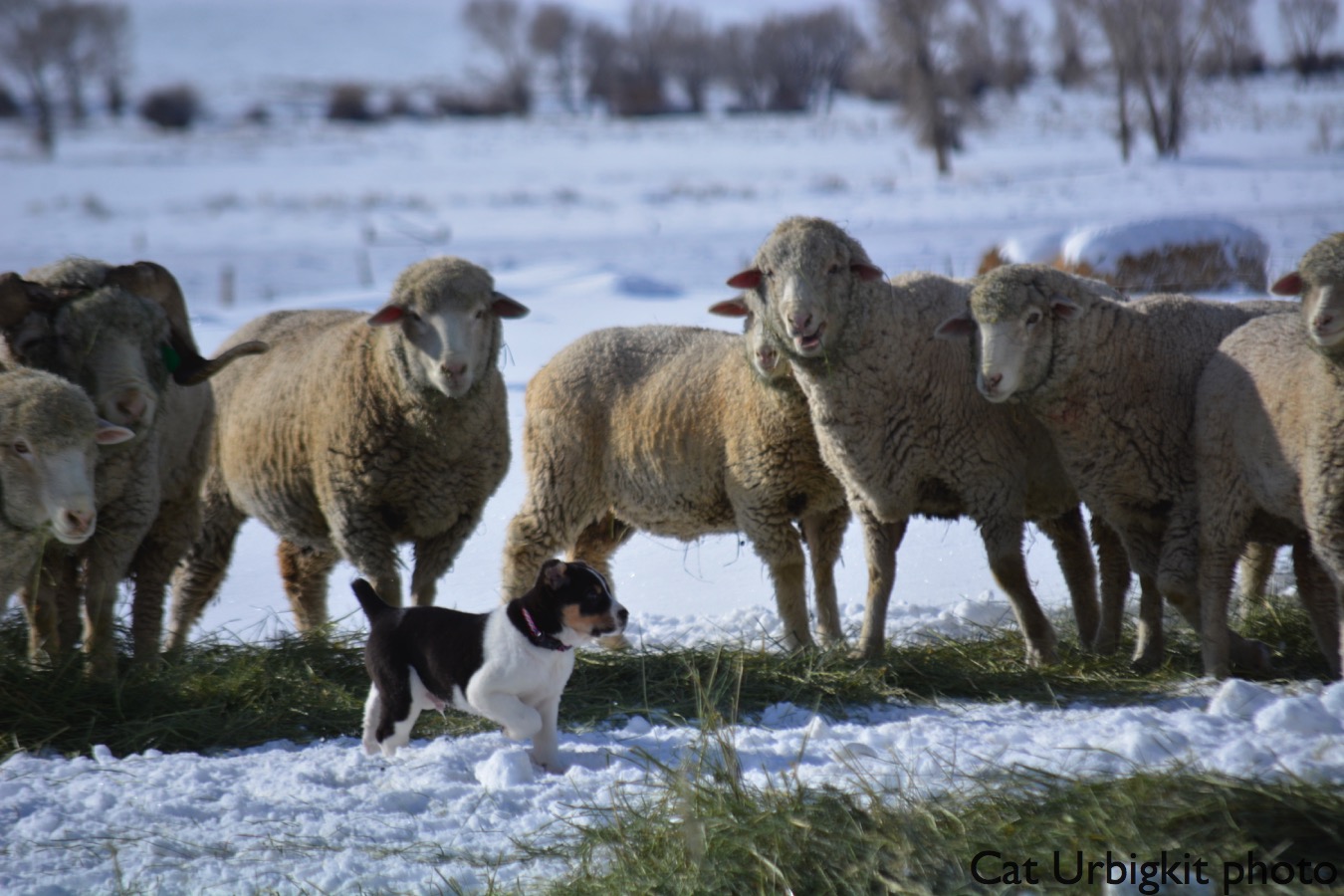
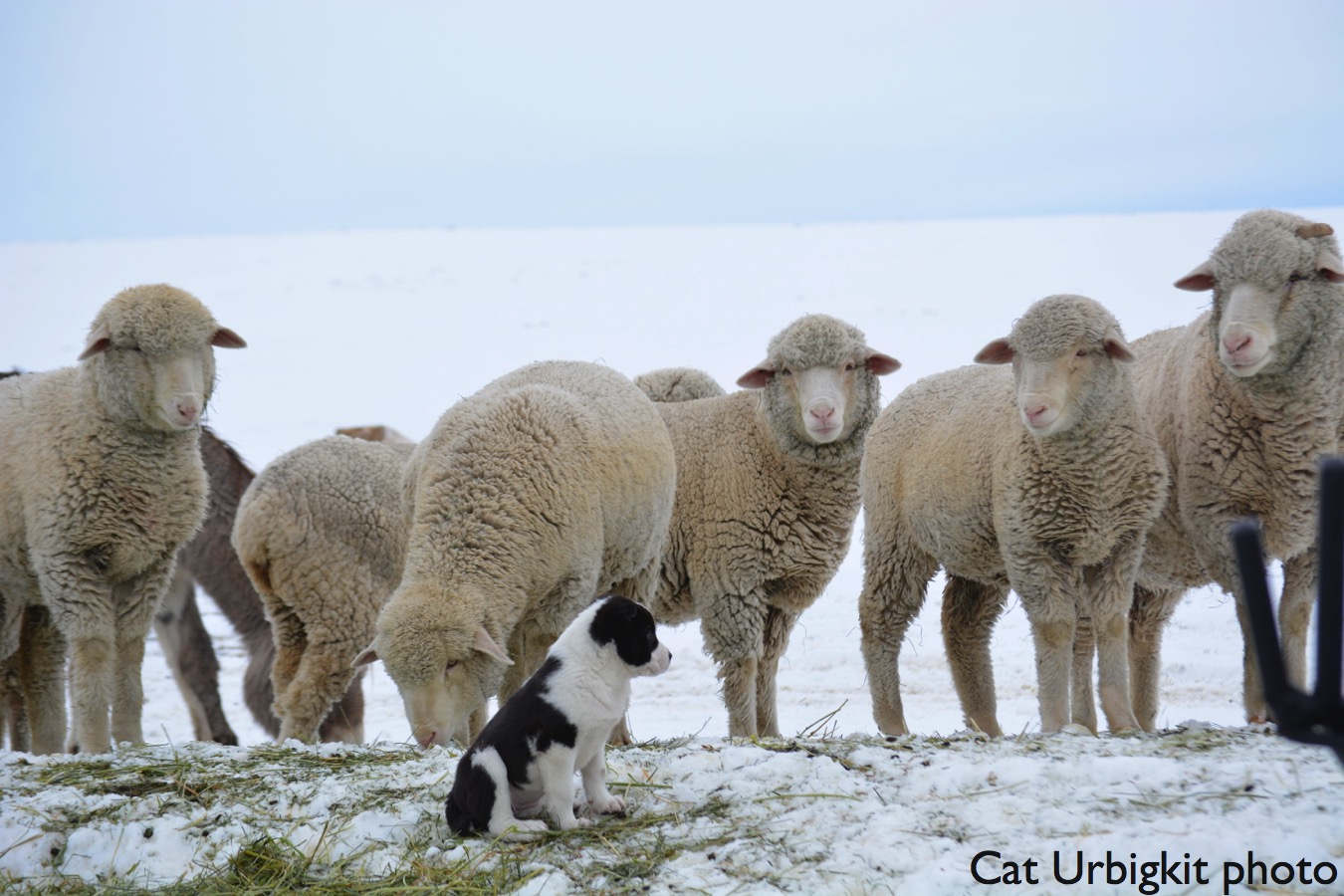
But these pups are a little different than any of the livestock guardian dogs we’ve had in the past. We’ve used multiple breeds, and had dogs that were white, tan, red, and brown, but never black and white. The only black and white dogs our sheep have ever experienced are herding dogs.

The job of a herding dog is to move the sheep around, so the sheep move away from herding dogs. But the job of a guardian dog is to stay with the sheep and keep them protected.

When our sheep flock met the CAO pups, they immediately moved away from them as they would in response to a herding dog. It wasn’t just the color, but the size of the pups – the same size as herding dogs.

The pups are siblings, a tri-colored male named Omar and a female named Taji. Even at only a few months old, it is apparent that they both have strong but different guardian traits.

Taji is a communicator, able to “read” how others are responding. She looked at the sheep from a distance, then put her nose to the ground as if investigating something interesting, and moseyed her way closer to the sheep. Her careful approach ensured the sheep didn’t flee, and when the sheep started to back away, Taji sat down on the ground looking away from them. It was a clever ploy, and it worked. Several of the sheep gradually made their way closer to investigate as she maintained her submissive posture.

Omar, on the other hand, has the soul of a warrior, and when he detects any change in his world, he boldly charges forward to investigate. His posture is always head-up, tail-up. That’s how he tried to introduce himself to the sheep, which of course didn’t work. He used the same attitude with the burros, and after investigation, the burros decided to let him live, although one burro was tempted to take him out. (These introductions were all supervised by humans and other guardians, so it wasn’t as though a strange dog had simply appeared among the flock.)
But settling the sheep to these two arrivals has been more challenging than it has been with any other guardian dog pups we’ve raised, and it’s my view that it’s primarily because of the color difference. The sheep will eventually learn that the pups are guardians, and subsequent generations of sheep will also learn that guardians come in this color pattern as well. But the sheep are currently naïve, so we’re altering our management to give the sheep additional time to adjust.

While the pups are given supervised time out with the flock every day (despite a winter of record snowfall), most of their time is spent in the yard or large outdoor kennel. We feed hay along the fences so that the pups and sheep spend plenty of time face-to-face time, with the fences separating them. That way, the sheep can watch the pups, and do nose-to-nose exploration from their safe locations.
The pups don’t bark at the sheep, but cry for them and lick them through the fence. The pups have the desire to be with the sheep (as guardians should) so it’s just a matter of allowing the sheep to adjust to the new constants in their lives. We've got two other pups from another litter coming in a few months, so the socializing will begin anew.

Thursday, November 17, 2016

Guardian/herding dog differences

 
I’ve written extensively about our relationship with our working livestock guardian dogs and have written very little about life with our herding dogs. The difference between the two types of dogs is remarkable.

None of our guardian dogs over the age of about two months old has ever been willing to play with a store-bought toy. Sure, they will fling a dead prairie dog through the air repeatedly, but never an actual dog toy.

Our guardian dogs do not retrieve anything you throw for them in attempt to get them to play. Instead, they tend to look at you like you’re an idiot, and watch while you retrieve it yourself.

We had the exciting experience of teaching a few of our guardian dogs to do funny tricks. But they only did the tricks once (as if to prove it could be done), and reverted back to the typical “this-human-is-a-complete-idiot” look of contempt.

Unlike any herding dog I know, our guardian dogs are nearly incapable of catching treats that are tossed directly at them. It’s a rare event that one of our guardians will open its mouth to catch a piece of meat that is gently launched at them. The meat will hit the dog on the nose, or in the middle of the forehead, before bouncing off and landing on the ground from where it is retrieved and consumed.

With the exception of the “go to the sheep” command, our guardian dogs fail to take more than the most rudimentary instructions from us. Even if they are fully aware of what we want them to do, they will comply only if it was their idea in the first place.

Try pointing something out in the distance, and the guardian dog will look at your hand, unlike our herding dogs, which use both verbal requests and hand signals. I can point out a specific lamb to Hud the herding dog, and tell him to “Get that lamb.” Hud will them chase the lamb through the flock, knocking it down with his chest and holding it to the ground until I get there. (Hud's the dark dog in the photos, while the guardians are the all-white dogs.)

These behavioral differences are easily explained by the differences in the type of work the dogs specialize in. Guardian dogs are by their very nature independent decision-makers. They assess threats to their herds, and react accordingly. They do not wait for human guidance.

The only exception to this is exhibited by Rena, a guardian dog now suffering from arthritis as the result of a battle with wolves. There is a pesky coyote that she can’t catch, so when it comes around teasing her, Rena will bark and wait until Jim or I follow her out with a gun. All she wants is that coyote dead, so she’s willing to cooperate with us to make that happen.

In contrast, herding dogs are human companions, bred to be pliable in taking instruction, and seem to have a desire to please their humans. Guardian dogs generally don’t care about what humans think, but herding dogs do.

Since most of our dogs were raised together, the guardian dogs are all amazingly tolerant of the much smaller herding dogs. The guard dogs don’t like to have their sheep messed with, but allow the herding dogs to do their jobs so long as no sheep are injured in the process. Shearing day is fun for herding dogs, which enjoy the excitement and the work of keeping the sheep bunched and moving forward, while the guardian dogs sulk around outside the corral, fuming about the disturbance to their flock.

Our adult guardian dogs tend to weigh between 90 and 130 pounds, and our smallest adult herding dog was Abe, weighing in about 25 pounds when soaking wet. Yet honest old Abe was treated as top dog, with a pack of guardian dogs patiently waiting for him to walk away from the food bowl before the ravenous pack would move in.

Abe was a bearded collie/border collie cross, while Hud is a bearded collie/Aussie cross. Both dogs had the soft-mouth characteristic that we shepherds find so endearing. Both dogs prefer to simply poke the sheep with their noses rather than bite. Content just to be in the presence of their sheep, both dogs could be left alone with the sheep without feeling the need to “work” them.

All the dogs tend to be well aware of their surroundings, and often it’s a herding dog that detects the presence of a coyote. The herding dog will raise the alarm and start running in the direction of the problem, but will always glance behind to make sure the guardian dogs will arrive at the point of danger long before the herding dog. The herding dogs then happily return to their leisure while the big dogs do the work.

One of Hud’s jobs is to “guard” four goat guardian dogs every morning while they eat. Hud keeps the goats from getting to the dogs and competing with them for their food. Yesterday his job got a little more complicated when a baby goat decided she liked the looks of Hud and came to him. Hud adores baby animals and got excited by the tiny goat since this was only the second time he’d been able to thoroughly investigate a member of this species. Hud towered over the kid, running his nose over her back and putting his nose to her tail. The kid decided that was too close for comfort and raced for me to save her. I told Hud, “Easy, easy,” and tried to convince him to move her back to her herd. But every time she tried to go back to her bunch, Hud cut off her exit by licking her nose and turning her back to me. It was pretty funny, but I eventually told Hud to knock it off, so he let her go, following her back to her herd before returning to the work he was supposed to be doing. The guardian dogs didn’t even look up from their food.

Hud is a prime example of the concept that like their human companions, dogs are creatures of habit. Hud has a few store-bought toys to play with, but there is one special toy that is our bedtime entertainment. When I make the bed each morning, I place the decorative pillows on the bed and place his stuffed Lambchop toy on top. Every evening while Jim and I are on computers or watching television in the living room, Hud quietly goes back to our bedroom to retrieve Lambchop, and then slowly walks into the living room to present it to us, gently pushing it into a lap. The suggestion is clear: It’s bedtime. We usually agree, jumping up to shut off the lights, and following him down the hall to bed. Hud and Lambchop wait patiently in the middle of the bed while his humans brush their teeth and crawl under the covers.

But sometimes Hud tries to put us to bed far too early, and we have to convince him that no, going to bed at 5 p.m. is not a good idea.

This nighttime routine is such a staple of our lives that when I’m away from home, Hud sulks. He refuses to retrieve Lambchop to put Jim to bed, and usually sleeps outside on those nights. His sulking starts the minute he sees me get out my luggage. That’s why I usually try to pack my bag while its deep in the dark recess of my closet.

While Hud would prefer to spend nearly every minute in my presence, our guardian dogs aren’t nearly so devoted. The guardians act happy to see me every day, but usually grow bored with me within a few minutes, dismissing me and returning to their flock. Their devotion lies elsewhere.

Tuesday, August 02, 2016

Escort


It’s fairly predictable that within a matter of minutes of meeting me you’ll learn how important livestock guardian dogs are to our western Wyoming sheep outfit. This morning provides an example.

After lambing season ended, we ended up with five bum (orphan) lambs. The lambs spend their nights locked in prime real estate (our yard), but during the day the front gate is open and they are free to roam. This morning, I fed the lambs before daylight, swung the front gate open, and proceeded with other morning chores. Once the sun was up, I returned from checking our main flock and noticed I didn’t see the lambs out grazing anywhere near the house. A quick search confirmed that they weren’t where they should be.

I noticed a few spots of white in the distant sagebrush, and pulled out a set of binoculars for a closer look. Three of our guardian dogs were sitting down along our back fenceline, surrounding the bum lambs and stopping their wild venture away from the safety of the ranch yard. I laughed as guardian dog Rena turned to begin the trail for home, the five lambs lining out behind her, with another guardian bringing up the rear. The third guardian cut back through the sagebrush to return to the main flock as the bum flock received what amounted to a police escort back to the safety of the ranch yard. (Click on photo for larger view.)

Even though we’ve lived with guardian dogs for decades, my respect for the work these animals do grows by day.

Friday, March 18, 2016

Old Mama

She’s not much to look at, some cross between livestock guardian dog breeds. Born on the range to working guardians, she’s lived all her 10+ years of life there, migrating with the flocks from the sagebrush-covered low country in winter, to the high country of the Wind River Mountains as the flocks move for summer grazing. Her hard pawpads carried her over more than 200 miles of trail each year, moving slowly with the seasons.

She’s a typical range dog, gentle and attentive to her ewes and lambs, while fiercely protective of canine intruders to her range. I’d crossed paths with her for years, as we sorted the range herds for shipping the lambs to market each fall, and as I visited the herds along the trail throughout the seasons.

Reserved with strangers, Old Mama slowly approaches her shepherds, standing quietly for attention for a few minutes before departing back to the job. The scars on her face reveal her persistent character – she’s not one to back down from a fight with a predator.

About four years ago, after lambing season, the flocks were on the move north, preparing to enter the wilderness, but Old Mama was swollen in pregnancy. One of the herders took her to the ranch where she had a selection of places to den to give birth to her pups. Our family’s flock was about seven miles north of the ranch, still within Old Mama’s home range. Old Mama stayed at the ranch a few days, but there were plenty of other guardian dogs already attending to the small flocks of sheep there, so she moved across the range, seeking that perfect isolated spot to give birth to her pups. She selected a rock outcrop high above a rugged canyon, five miles north of the ranch, but only two miles from our flock.
She appeared one morning near my flock, greeted by our guardians as one of their own. We could see she’d recently given birth, so Jim and I put out food for her, watched while she ate and then departed, headed back to the south. We’d had bears trying to get into our sheep flock nearly every night, but our guardians were persistent, keeping the bears at bay. One night, a bear moved to the cattle herd in the adjacent pasture, and the bawling of the cattle drew the attention of two of our guardians, which rushed to the rescue. I sat in the dark listening to the voices of our dogs as they were joined by a third, as Old Mama arrived on the scene. The three dogs worked as a team as they set to harassing the bear. The sounds of the night told the story: the cattle bawling, the bear roaring and bawling, with sharp barks of the dogs as they moved the bear away from the cattle and back into the forest. The night grew quiet, and my dogs returned, bouncing with excitement and adrenalin. Her work done for the night, Old Mama returned to her pups.

She made regular visits to my camp for food, and we eventually followed her back to her den, much to her outrage. We dug her growling pups from their rocky hiding place, and moved them to my camp, sticking the pups in a stock trailer with softened food and water. When Jim went to check the pups before daylight, he found Old Mama waiting to tend her litter.

We sheep producers often disagree with our guardian dogs about where they should have their pups, but we usually let the bitches have their way during that time they seek seclusion to give birth, waiting a few days before we retrieve the new families for closer supervision. This is nothing new to traditional shepherd cultures – guardian dogs give birth in primitive dens on the range across the world. Some shepherds put bells on the collars of pregnant females so they can follow the sounds of the bells to find the natal den.

I was glad Old Mama’s den hadn’t been found by anyone else. Someone might have thought this dog family needed “rescued” and taken them to a vet clinic or animal rescue in town, far from their rangeland home and away from livestock.

We and our rangeland neighbors have had various guardian dogs “rescued” on numerous occasions over the years – even within a half-mile of our house when the dogs were in the pasture with their flock, as well as a four-month old pup taken from its mother’s side while with its flock.

I used to be somewhat sympathetic to the good-hearted souls who thought they were doing the right thing. But I’ve grown weary of it. Just because a dog is not within sight distance of a house or herd doesn’t mean it’s been left behind or abandoned. Others see range dogs they feel are too skinny, expecting these athletic and hard-working dogs to be as fat as the dogs that live in their houses.

Granted, sometimes the predator situation gets so intense on our range that we have to rotate the dogs to force each dog to get some rest because the dogs will work themselves into the ground. When predators won’t flee, the dogs engage in fights, and getting their ears torn or bites on their front legs is rather common. The dogs will limp around for a few days – as would a human with a temporary but not serious injury. A few tablespoons of blood scattered down the legs of a bright white dog is a shocking sight to those who are not familiar with the lives of working dogs. Most of the injuries to the dogs are minor, and if they do require treatment, we can take care of it ourselves. Livestock producers routinely practice vet care on all our animals, and we have the medicine and the equipment to do so. Many times we administer care in the field, but sometimes the animals are moved back to ranch headquarters. More severe injuries, like those inflicted on our guardian Rena when she fought with wolves, are rare, and do require emergency vet care.

Old Mama rejoined us on the range last year as our flock grazed the sagebrush steppe along the foothills of the western front of the Wind River Range. When we gathered our animals to leave that range in late fall, we brought Old Mama with us to spend the winter months with our flock on a much smaller range. Cool as ever, she’s adjusted to the new experience, relaxing with the reduced workload that comes with the winter season, and leading her flock from their hilltop bedground to the haystack to wait for the sheep to be fed every morning.


Wednesday, December 09, 2015

Playing with Food


Because sometimes it's fun to play with your food - a coyote in western Wyoming this morning.

Wednesday, June 24, 2015

Curs On Coyotes


We parked the truck under the crest of the ridge and the two yellow female curs jumped from the cab to the ground, sniffing around unconcernedly for ground squirrels. Jeff quietly called the dogs back to the truck so he could snap electronic collars onto their necks. The girls remained quiet and seemed calm, but as I glanced at the seven-year old female, I could see the muscles of her back legs quivering in excitement. Although the collars can send electric shocks, for these seasoned pros, that would not be necessary. Instead, Jeff would use the collars to emit electronic beeps to communicate commands. There would be no voice commands in the field.

We spoke little, walking quietly with the dogs until we’d reached a rock outcrop perched at the end of the ridge overlooking a small pond, with sweeping views up several drainages along the face of the Wind River Mountains. We sat with our backs against the rocks, the dogs sitting patiently in front, as Jeff blew on a coyote call. We sat still, mosquitoes buzzing around us, sweat dripping down our backs, while the dogs slowly moved their heads from side to side as they scanned the hillsides for movement, occasionally adjusting their rumps for a more comfortable position. Plenty of birds, butterflies, and a few pronghorn antelope, but no coyotes, so we gathered ourselves back up for a hike to the next ridge, headed to check a location where a female coyote had denned the year prior.

The morning was long past and it was 80 degrees by the time we reached the rugged bluffs above the Big Sandy River, checking on one last den site before calling it a day. I could hear lambs calling to their mothers from the riverbed below as we began hiking toward the den, the curs trotting out in front of us. It was far too hot for anything to be happening, but the curs quickly jumped an adult male coyote that had been lounging on a ridgeline away from the pups. One yelp from the dogs and the chase was on, away from us and out of sight over the ridge.

Within seconds I saw a dog’s head pop up on the skyline, as one of the dogs took a look to locate her human partners. A few barks and yelps later, the two curs came charging back over the top of the ridge, with the male coyote a few paces behind.
The coyote was agitated at the intrusion into his range, barking aggressively, and trying to get close enough to grab a mouthful of dog. But the curs were fast and determined, swinging back around and coming to a full stop to urge the coyote forward when he faltered.
The temptation was too much, and the coyote again gave chase.
 The girls brought him in at a run directly across a small draw from our location, where Jeff was waiting with his .22-250 Remington. The dogs slowed and stopped, as did the coyote, giving Jeff a clean and close view. One quick shot and the coyote was down.
The dogs raced back to us for praise, then returned to rough up the carcass a little before leading us back along the ridgeline. After a quick water break, the dogs escaped the heat by climbing back into the cab for a well-deserved nap.

Sunday, June 07, 2015

Spring Reds

 This seems to be the spring for red fox in western Wyoming. It's not that we have more of them, but we've got a few litters that have been more visible than usual. Fortunately they aren't near our lambing grounds, so they aren't in areas where conflicts would be expected.


I spotted six kits at this den at the entrance to a cattle ranch along a county road.

Tuesday, March 31, 2015

Spring's Arrival

A pair of sandhill cranes arrive for breakfast every morning, slowly striding across the green sweep of ground where we've fed the sheep flock the day before. They appear in the early dawn, and I step out the back door to quietly call out my wishes for a good morning. The cranes respond with their trilling calls in this most calm time of day. I can't help but wonder if these are the cranes that I developed the same routine with last year, and the year before ... I like to think so. Greeting the morning with old friends is a wonderful way to start the day.

Saturday, December 20, 2014

Settling In For Winter

Our fenceline marks the border of the Mesa big game winter range. It's located south of Pinedale, Wyoming and is closed to motorized traffic from Jan. 1 through April 30 every year so that the mule deer and pronghorn antelope can spend winter days free from disturbance. This 76,000-acre range covers the broad expanse between the Green River to the west, and the New Fork River to the east.
The mule deer migrate from surrounding mountain ranges to concentrate on this lower elevation sagebrush country. Our place is at 7,200 feet in elevation, and we enjoy watching our winter neighbors.
We see a lot of gorgeous bucks, but the does are the ones I view as the most magnificent.

Friday, August 15, 2014

Summer Guardians


We moved our sheep flock to grazing range along the foothills of the Wind River Mountains in early July. We've had a refreshingly moist summer, bringing this arid rangeland to life. The ewes are fat, the lambs are growing, and we share the same piece of earth with abundant sage grouse, as well as nesting long-billed curlews. Nine-month old Beyza (an Akbash) has claimed the range as her own, and is a fantastic guardian – as are the others in her lineage, including her mother Luv's Girl, and sister Rena.


When we moved onto the range, my friend Pete asked if I would take care of an extra female livestock guardian dog. She had just given birth to five pups, and the pups were too small to travel with the herd as they moved into the mountains. I tended to the small family for a few weeks, but one of the 7-week old pups started trying to follow my herd as it grazed during the day. After retrieving the pup from more than a mile away from its siblings, we sent the female to the mountain, and brought the pups to our home, where we have a scattering of orphan lambs and adult sheep.

When people talk about getting livestock guardian dogs off to a good start, much emphasis rests on getting pups introduced to the species it will guard at a young age. That's important - bonding is best if if starts early. The introductions to the lambs went well.


But what doesn't get much discussion is how much easier it is to bond pups to a sheep herd that has had a long association with guardian dogs. It's nearly a cultural thing – this relationship is so close, continuing from one generation to the next. When new pups arrive on our ranch, the adult sheep come to investigate. When the pups walk underneath the ewes, and sniff the underbelly of the rams, the sheep are not panicked or upset. They don't stomp the pups, and show an amazing amount of patience as pups chew on the big curls of a ram's horn, or investigate a milk bag on a ewe.


The new pups were soon crawling under the yard gate to hang out with the adult sheep, especially a big range ram. We select and cull sheep based on not just performance and appearance, but behavior. Calm and attentive behavior is ideal. This ram is an ideal babysitter for the pups, and gently disciplines bad behavior.


Tuesday, March 18, 2014

Spring, and Shared Range

Spring has arrived to our western Wyoming rangelands. We’ve already had temperatures in the 40s and snowmelt, with the resulting visit from our old friend mud – which we haven’t experienced for the longest time in our decade or so of drought. It’s been a pleasure to have to throw the truck in four-wheel drive to get in the driveway. No belly-aching from this corner.

The sandhill cranes have begun to arrive, with their crane calls in morning meadows our true sign of a change of season. We’ll (hopefully) have a few more snowstorms through early May, and I’ll be doing a rain dance for a wet spring to bring this arid range fully out of its dormancy.

The sandhill cranes come close to the house, and follow the sheep flock, nourishing themselves on scattered grain from winter feedlines we fork onto the snow.

Pronghorn antelope herds share this range with the sheep, in larger numbers during the winter months, and less in the heat of summer when they migrate to other areas for grazing. The sheep and the guardian dogs are accustomed to their presence as a part of the landscape in which we live.
It’s this time of year when the wildlife migrations begin, as snowmelt allows big game herds to move from lower elevation desert country and begin to follow the receding snow to the high country. Migratory domestic sheep herds will soon follow, using many of the same trails. Millions of hooves have traveled these paths, for eons. Here’s a glimpse of small herds of pronghorn antelope and elk lining out as they trail back north, to the Wind River Mountains.

Spring has arrived indeed.

Monday, February 17, 2014

Wyoming Winter


We’ve enjoyed a fairly quiet winter in western Wyoming, and are thrilled with the recent series of snowstorms and blizzards hitting our area. We’ve been in a drought so long it was somewhat a pleasure when I buried the feed truck in deep snow this morning. Even though I was sure that the snow would eventually melt and I could retrieve the truck at that time (can’t be more than a few weeks, right?), husband Jim gave it a few tugs with another truck and freed me.

We had high prices last fall during shipping, so we reduced our sheep numbers, and now learn that feeding a small flock within the one-mile pasture around the house is an easy winter chore.


Our winter guardians, in addition to three burros, are three female Akbash guardian dogs, all of the same lineage. After her battle with wolves last fall, Rena healed up nicely. We wondered, and feared, how she might react to predator challenges after such an aggressive fight in which she nearly lost her life. Rather than having fear or aversion, her reaction has been the opposite – she’s a terror on four paws, and seems to have a chip on her shoulder when it comes to the coyotes in the neighborhood.


Rena is joined in guardian duty by her nine-year old mother Luv’s Girl, and her four-month old half-sister Beyza. Following the Tajik tradition of selecting the pup with the bold carriage, I selected Beyza from her littermates because of her swagger – her tail is often held high, curled over her back, and she has aggressive guardian tendencies, even at this young age. She now goes charging out with mother and sister when a threat is perceived.

Our jackrabbit population continues to be depressed, with a corresponding decrease in the number of golden eagles wintering here. Many more bald eagles are concentrated on road-killed animals.


With Jim home taking care of the critters, in between traveling to speak at conferences, I’m spending as much time as possible working on books, with one adult nonfiction title set for release this fall, and a second recently completed nonfiction manuscript under consideration at a publishing house. I’m hopeful that by the end of the year I can get back to the world of books for young readers, but the publishing world continues to undergo upheaval and finding my place in it is like walking blindfolded.

Wednesday, December 18, 2013

Why We Need Wildlife Services


USDA Wildlife Services – the federal animal damage control agency – has come under increased attack by those who want to shut this agency (which Defenders of Wildlife calls “the hit-man for hire arm of the USDA”), and I want to weigh in after two decades of working fairly closely with the agency in western Wyoming.

Wildlife Services plays a vital role in our livestock operation – whether we are grazing a cattle herd on public land, or our sheep herd on private ground. This agency has the professional expertize we need for lethal control involving problem animals.

But let me back up. Like other livestock producers, lethal control isn’t the only management tool we use with predators, but it is always the one that makes the headlines.

Our sheep herd consists of animals with a strong flocking instinct, making them less vulnerable to predation. Our rams are large and have horns, and when we ran cows, they had horns too, and these animals know how to use them in defense. Our frequent presence in our herds, as well as our frequent shooting to create disturbance, are other methods to discourage predator presence in our active pastures. Our pastures are kept clean of both birth material and animal carcasses. We use both livestock guardian dogs and guardian burros, and believe that these animals are what keep us in livestock production business because they are so effective. Because we use guardian animals, we don’t use traps, snares or poisons because of the threat they pose to the guardians.

We’ve had some success using a motion-detection camera with a flash targeting new den sites to harass predators enough that they’ve moved their dens from our lambing pasture.

Sometimes we use night pens for our sheep, but this option is available only in certain pastures, and is appropriate only under certain conditions. We are well aware that a predator that jumps inside a corral with a penned sheep herd creates a massacre. If your herd is night-penned in large carnivore country, you’d best be sleeping inside that pen unless your perimeter is a high electric fence.

We also allow and encourage sport hunting of predators around our herds, and do some direct shooting ourselves on occasion.

I serve on the county predator board, and the board has a contract with Wildlife Services to perform aerial gunning of coyotes during the winter months to reduce the presence of coyotes on lambing and calving areas on private land in the county. This is the only organized predator control program that takes place in our county. In the past, this program was funded through predator fees collected during livestock brand inspections (so that only livestock producers paid for it), but in recent years the program has been funded through annual budget allocations from our county commission – local tax dollars used for professional predator control. Our board only began contracting with Wildlife Services after the private company we had used for more than three decades was no longer available. Our meetings and our actions (including how much we pay for predator control, and how many animals are killed in the program) are all open and public.

The move to Wildlife Services was made with great hesitancy, but approved based on a real need. The county where I live (Sublette County) is 80% public land, with large portions designated big game winter range where motorized access in winter is prohibited. Our back fenceline is the southern border of the Mesa big game winter range, or as we call it, “the coyote refuge.” Any predator control that takes place in such a sensitive zone must be conducted professionally, and with the concurrence of the land manager – in this case, the Bureau of Land Management. The Wyoming Game and Fish Department provides the predator board with information on fawn:doe ratios in various wildlife herds when the data indicates that these herds are impacted to the extent that predator control is deemed warranted. We started receiving their predator-control wish lists just a few years ago, and the lists are not accompanied by funding to implement.

The most important reason for our ranch to use Wildlife Services is because when there are some conflicts, the agency is our family’s only option to resolve the conflict – the agency keeps us honest, and legal. For example, we’ve had problems with ravens killing newborn lambs. Ravens are federally protected birds, so we are not allowed to kill them, even when they are in the process of killing lambs. Ravens are intelligent, long-lived birds that learn from one another, and when one starts killing lambs, that action draws in others. We call Wildlife Services for rescue when these situations arise. Wildlife Services first must confirm that ravens are the problem, and then places poison bait (avian-specific) on site, and keeps visual observation of the bait to ensure that other protected birds (like hawks and eagles) do not access the bait. Our experience has been that the Wildlife Services effort targets the problem birds and resolves the situation within a matter of hours.

Wildlife Services has also enabled the taking of golden eagles for falconry purposes in Wyoming – the only state in the nation where this is permitted. A certain number of immature eagles (not nesting pairs) are taken from designated depredation zones (areas where eagles are confirmed to prey on lambs). I believe that up to six eagles annually have been live-captured from Wyoming for falconry in recent years, which is a preferred method to federal officials simply killing depredating eagles.

Wildlife Services has also just completed the first year of a new program that targets raven concentrations at Wyoming landfills in five counties that are known as Greater Sage Grouse strongholds. We fully expect that this effort will benefit the sage grouse population, which is under consideration for listing under the Endangered Species Act.

Since we live in an area with large predators that are protected by state or federal law (grizzly bears, black bears, and gray wolves), we need assistance to resolve conflicts with these species. Other options are extremely limited or non-existent, and we don’t want to be placed in the position of having to make the decision to break the law or save our animals.

Three years ago, the problem was a bear killing our sheep in a desert pasture on private ground along a major river. We needed an authorized wildlife agency to first determine whether the predator was a black bear (protected by state statute) or a grizzly bear (protected by federal statute). With a black bear, landowners are allowed to kill the animal if it’s caught in the act of killing livestock. This bear was wise, and killed a few sheep about once every week, never coming back to feed on a previous kill, and could not be lured into a baited bear trap. We had all our other predator deterrence methods in use, yet the bear kept returning to kill again. Wildlife Services made numerous attempts to capture the bear, but the bear evaded all efforts. We had to abandon the pasture to stop the killing because we couldn’t eliminate the bear. Since we could never actually see the bear in the act of killing (the closest I got was one day when one of the guardian dogs knocked me to the ground in an effort to keep me from going through the willows where the bear had just killed sheep), we weren’t able to shoot it. The most logical and efficient way to find the bear would be through the use of hounds, but that method was prohibited by state law. State regulations allowed the bear traps to be placed only three nights in a row, and the bear would return every seven days, making this impossible. At least by using Wildlife Services to confirm the bear damage, we were later able to receive some compensation for our losses by the state wildlife agency.

This year, wolves got into our sheep herd and killed nine animals. I called Wildlife Services to request their presence the next morning to examine the carcasses and walking wounded to determine what species was responsible for the problem while we worked to develop our plan of action. We had constant bear presence near our herd, with both grizzly and black bears, but the guardian dogs were doing a great job keeping the bears out of the sheep. Between the phone call and Wildlife Services’ arrival, wolves entered the pasture (where I was present, sleeping next to the herd) and tangled with one of our guardian dogs, which was badly mauled but held the wolves out of the herd. As one Wildlife Services specialist was confirming the sheep kills a few hours later, another shot two wolves as they fled from the pasture, ending the problem. Since there is no compensation for our losses to wolves in this part of the county (it’s part of the predator zone, while other parts of the county are in the trophy zone for wolves where losses are compensated) we didn’t need to have all of the sheep carcasses skinned out for confirmation. In this case, what we needed was an end to the problem, which Wildlife Services effectively provided.

In some cases, it is important to have Wildlife Services confirmation of livestock losses because there are some compensation programs available to producers. In our case, when trophy game animals (black bears) kill our sheep, confirmed losses are eligible for compensation. Our herd grazes in the predator zone for wolves, so our losses to wolves are not compensated, so confirmation of wolf kills is made only to initiate wolf control.

We have had some frustration that when we’ve had numerous bear-killed sheep, Wildlife Services is not able to confirm that all of the animals were bear kills. In these incidents, when a bear is repeatedly preying on our herd, if a 60-pound lamb goes missing, that’s not confirmation of a kill. If only the hide from the lamb is found, that’s not confirmation. If only the spattered blood, the rumen and a few tuffs of wool is found, that’s not confirmation. Some believe that ranchers are calling all the shots and automatically getting confirmation of damage, but we know that is simply not true. From our experience, there must be enough evidence for Wildlife Services to make the confirmation. You would think that if there is favoritism by Wildlife Services to certain clients, I might be one to benefit since I have a good working relationship with Wildlife Services and serve on the board that signs the contract and pays for their services in the county. It just doesn’t happen – this is an entirely professional relationship.

Our livestock losses to predators are minimal, and that is because of the combination of both lethal and non-lethal methods of predator control we use. But Wildlife Services is an important component of our success. It is same agency that both the U.S. Fish and Wildlife Service and the Wyoming Game and Fish Department utilize for control of large carnivores that come in conflict with livestock or humans. These programs are not indiscriminant killing of predators, but targeted control to resolve conflicts.

I have photos of our bear-killed sheep, wolf-killed sheep, sheep that are walking-wounded from predator attack, raven-killed lambs, and flocks of ravens harassing our ewes in labor or as they have just given birth, but am sparing the reader from having to see such graphic images. They may just be predator attacks on livestock to others, but these are the animals we live and work with every day. They are not just our livelihood, but a big part of our lives. Our job as shepherds is to ensure our animals have a good life from the time they enter the world to the time they leave it. We don’t seek elimination of predator populations, and are happy to share the range with a diversity of wildlife. When we can’t resolve wildlife conflicts, we are thankful to have USDA Wildlife Services to turn to.