Saturday, March 31, 2012

Snake Alphabet

Tom McIntyre's Ophidian Abecedarium (story below with "Gun Alphabet"). Pix, anecdotes, suggestions all encouraged. Right click photo to enlarge...

SNAKE ALPHABET–A to Z

Asp
Boomslang
Cottonmouth
Death Adder
Eastern Diamondback Rattler
Flying Snake
Garter Snake
Hognose Snake
Indigo Snake
Japanese Striped Snake
King Snake
Lyre Snake
Mamba (Jonathan Hanson's friend Neels with pet)

Night Snake
Olive Sea Snake
Python
Queen Snake
Rat Snake
Sidewinder
Taipan
Urutu
Vine Snake
Water Moccasin
X (Equis in Spanish, another name for the fer-de-lance)
Yellow Anaconda
Zebra Spitting Cobra

Friday, March 30, 2012

Hot Links


A looter has been convicted for stealing Civil War artifacts from the Petersburg battlefield in Virginia. The picture shows cans of minie balls he collected.

Reanalysis of a Pleistocene ground sloth bone from a museum in Ohio determined that it showed butcher marks. I believe this is the first evidence for ground sloth butchering in North America. There are many Paleoindian sites with evidence of bison and mammoth hunting, but not much evidence of hunting other megafauna. It's only been in recent years that we have found the first Paleoindian horse and camel kill sites. This specimen comes from a Jefferson's ground sloth (one of the big boys!) and is radiocarbon dated to between 13,435 and 13,738 BP. There's a reason we store these things in museums!

Chocolate Allergies Linked to Cockroach Parts. I just couldn't resist that headline.

A DNA study of modern cattle has come to the conclusion that all our current domesticated cattle are descended from a single herd of aurochs that lived about 10,500 years ago.

The shipwreck of the Titanic has been much in the news lately, with James Cameron's further exploration there and the coming reissuance of the popular movie in 3D. This article provides a very different perspective as it discusses the large amounts of trash that have been deposited in the wreck area since 1912.

Archaeologist Bill Kelso will receive a well-deserved honor: he is being made an Honorary Commander of the Order of the British Empire (CBE). In the 1990s, Kelso led the excavation team that relocated the original Jamestown fort in Virginia dating to 1607. It had long been thought that the fort had eroded into the James River and been lost, but Kelso proved that wasn't so. I recently bought a copy of Kelso's book on his quest, Jamestown, The Buried Truth.

I posted about the important Turkish archaeological site of Gobekli Tepe a few months ago. This study on source analysis of obsidian artifacts from the site shows that the raw material comes from a wide variety of sources from all over Anatolia. That's pretty much what you would expect to find at a site that was an important regional ceremonial center.

This report from a Grand Junction, Colorado TV station tells of some historic Spanish artifacts recently found in the Grand Valley near there. They got a little carried away: I believe they mean 16th and 17th centuries. I hadn't heard about this discovery and look forward to hearing more.

Findings

Harper's Magazine isn't on my regular reading list, but I ran across this and enjoyed it.

Findings

By Rafil Kroll-Zaidi

Entomologists re-created the chirping of the Jurassic bush cricket, and Russian soil cryologists cultivated a 31,800-year-old plant from a fossilized squirrel burrow in Siberia. It was determined that ancient Egyptians fed snails to dead ibises, and it was suggested that the guinea pigs of Elizabethan Europe were used primarily as pets rather than as food. In China, zookeepers married a ram and a doe. Chinese were found less likely than Britons to focus on the eyes when asked to evaluate the faces of sheep. In Portugal, Grupo Lobo was disbursing to goatherds such traditional dogs as cão de Castro Laboreiro, cão de gado transmontano, and cão da Serra da Estrela. Pygmy kids exhibit goat accents. Pygmies in Cameroon and Congo were being trained to track poachers using the program Blindate. Fish in the lakes of Switzerland were hybridizing themselves out of existence. Crew aboard the icebreaker Aurora Australis tricked Adélie penguins into grooming a plush-toy penguin chick. A U.S. District Court in San Diego threw out a slavery lawsuit filed against SeaWorld by orcas Corky, Kasatka, Katina, Tilikum, and Ulises. Stress-hormone levels in the feces of right whales were found to have dropped after 9/11.

An unidentified deep-sea quacking was attributed to species of fish with specialized structures likely used for vocalizing. Such fish, said an ichthyoneurologist not involved in the research, “aren’t going to have a frivolous organ that does nothing.” Scientists released photos of a brownbanded bamboo shark being swallowed whole by a tasseled wobbegong. The dwarf galaxy NGC 4449 was consuming a smaller dwarf galaxy. Stacks of solid buckyballs were observed around the binary star system XX Ophiuchi. Alan Turing was found to have correctly predicted the genetic mechanism whereby ridges form in the roof of a mouse’s mouth. Physicists succeeded in deriving the shape of any ponytail using the Ponytail Shape Equation and the Rapunzel Number. The cost-benefit calculations of a sea slug’s central nervous system were found to persist when it is removed from the slug, placed in a dish, and offered food. A seventeen-year-old English girl’s anemia was attributed to her having eaten primarily Chicken McNuggets, KFC chicken nuggets, and supermarket chicken nuggets since the age of two. Urologists at Wake Forest Baptist Medical Center found that children’s bedwetting is often due to constipation, but that the mild constipation often responsible is inadequately diagnosed under the guidelines of the International Children’s Continence Society.

Starlings can be fooled into making irrational choices, yawning is contagious among budgies, and ecologists observed a truce between jackdaws and lesser kestrels in Italy. Old male sparrows do not appear to feel threatened by the song of younger rivals. Australian ethologists confirmed that female great bowerbirds are fooled by the forced-perspective illusion whereby males construct their bowers to appear more impressively large. India’s government commissioned a study on the effect of cell phone radiation on birds. In Argentina, chalk-browed mockingbirds had stopped trying to rid their nests of shiny cowbirds’ parasitic eggs. Biologist Martin Burd suggested that the efficiency-dictated size limits observed in the colonies of Central American leaf-cutter ants may help predict the maximum size of human cities. The disproportionately large hippocampi of hummingbirds allow them to remember the location of every flower in their territory. The dense feathering of the wings of barn owls (who in Scotland were enjoying a glut of voles) enables the birds to fly silently. The discovery, suggested the lead researcher, may have aeronautical applications, but, he noted, “We are far away from that point…. Until then, we will conduct many more experiments on owl wings.”

Wednesday, March 28, 2012

Gun and Snake Alphabets Project

Tom McIntyre writes:

"Here's a school project, if you're game (might even work into a blog post).

"Enter my great-nephew, age 7. On a recent visit, unbidden, he asked me to create a "Snake Alphabet" (why an alphabet, I'm not sure) for him. So I did, as best as I, a non-herpetologist, could... His task is, eventually, to look up all these serpents and learn about them.

'On the phone today, my niece, Leila, tells me that Jack, the great-nephew, has the snake alphabet taped over his bed's headboard. And now, again without any prompting from me, he's requested a "Gun Alphabet."

"I have put together the following incomplete list, pasted below. I wanted to use iconic firearms, rather than simple brand names ("Mossberg" 12 gauge for M, for example, rather than Musket, which was my selection), unless the names themselves are iconic (Colt, Winchester, etc.)

"Anyway, I am sure you get the idea, here. So I am openly soliciting any firearms you graciously might think of to fill the blanks, or that you consider superior to ones already on the list. Again, maybe something you can open up to input on your blog...

"Do it for the children."

My response, a couple of blurry illo examples, and his incomplete list follow-- snakes to come, suggestions, including replacements encouraged. Anybody have an "X"?

(Me):
"O; If you don't want generics like "over and under" I would suggest Orgue de Bombardes, an "organ of cannons" or multiple cannon platform, horse drawn, used in the middle ages. The one I have a picture of has dragons on each side of the cannon mounts and shields for the gunners.

"Q: Queen Anne pistol. Geoffrey Boothroyd says these early 1700's flintlocks "had evolved into perhaps the most attractive type of pistol ever made in this country." Pics should be readily available -- I probably have more than one source myself.

"U: Greener UNIQUE, a famous and eccentric boxlock double gun design obviously different to anyone's eye and still occasionally used in their highest-end guns. I have a photo of a very ornate one.

"Z: I think the most interesting possibility is the rare Remington Elliot "Z" Derringer of 1861/2.

"I will cogitate some on X [Arthur?] and more vivid or specific substitutes for such as "side by side". For instance, if you used the weird Remington Derringer, you might use something like "Darne" for D instead of the generic Derringer."

Tom's list (snakes later, above):

Arquebus
"Brown Bess," Land Pattern .75 Caliber
Colt Paterson Revolver
Derringer
Evans Repeating Rifle
Flintlock Rifle
Gatling Gun
Howdah Pistol
Infanteriegewehr M.98 Rifle
Jäger Rifle
Krag-Jørgensen .30 Army Rifle
Lee-Enfield Mk I Rifle
Musket
Nitro Express Rifle
O
Punt Gun
Q
Ruger Blackhawk Single Six
Side-by-Side Shotgun
Thompson Submachine Gun
U
Volcanic Repeating Arms Pistol .41 Caliber, 1856
Winchester Model 70 .270 Winchester Centerfire, pre-'64
X
"Yellow Boy" Henry Rifle, .44 Henry Rimfire,
Z

Swimming Eagle of Baton Rouge

Everyone needs to see this YouTube video.

Chimney Rock

Prior to picking up the puppies last week, I drove down to Durango, Colorado for the annual meeting of the Colorado Council of Professional Archaeologists where I was presenting a paper. On the way down I took this picture of Chimney Rock, in Archuleta County.

There is an important prehistoric Puebloan site on top of this spectacular mesa and the area is set aside by the San Juan National Forest as the Chimney Rock Archaeological Area. This site is believed to be the northeastern-most outlier of the highly-developed Chacoan Culture. Apparently there are all sorts of astronomical observations that can be made using the twin spires as sighting posts. Our old friends Mike and Kathy Gear even set one of their prehistoric novels at this beautiful location.

Two Puppies and a Baby

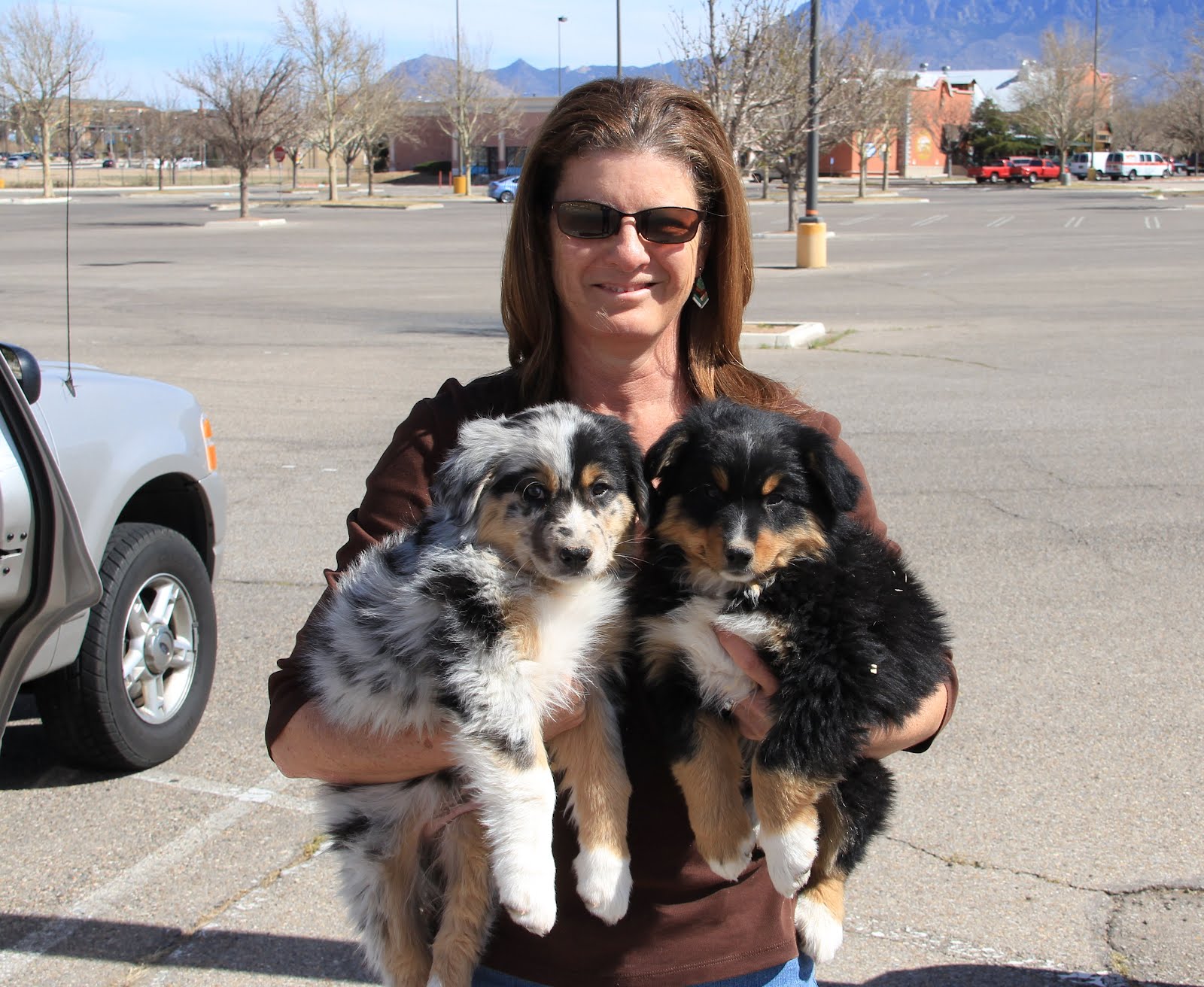
Puppy pick-up was last Sunday, when we met Curt and Susan Boyd in a shopping mall parking lot in Albuquerque. We couldn't get over how much they had grown.

They did fine in a crate behind the front seat of the Explorer. They slept most of the way back to Denver. We have decided on names. The blue merle is Buck and the black tri is Cash.


On the way back north we were able to stop in Santa Fe and have a (too) short visit with Mr and Mrs Peculiar and Baby Eli. Eli loved the pups and here he is trying to pet Cash. As Nikki said about babies and puppies together, "It's too much cuteness"!

When we got home, we introduced them to Sadie, who is still trying to figure out how all this is going to work. As they had been penned up all day, we tried to romp them around in the front hall to get them tired enough to go to sleep. Mission accomplished.

Sunday, March 25, 2012

Wyoming


Every spring I try to take one person who has never been to a grouse lek out to see the sage grouse strut. This morning I took Haley out to a lek not far from home. We were driving in about 20 minutes before sunrise, rolling through the lek (which is adjacent to a gravel road), admiring the grouse as they went about their business, when suddenly the entire lek erupted, with grouse bombing out in all directions to get away. A magnificent golden eagle had entered the scene, like a cruise missile gliding just a few feet from the ground. The eagle didn't succeed in taking a grouse (although a hen was in grave danger for several seconds). I expected the grouse to quickly return, but when I turned around to look again, the eagle had established a perch, so I knew the grouse would not return.

We drove about 15 minutes to another lek and enjoyed seeing a herd of pronghorn antelope standing atop a nearby hill, also watching the grouse activities below.

Saturday, March 24, 2012

Legal cock fighting


I've spent several sunrises this week on local sage grouse leks. It would be a shame to live in such great grouse habitat without going out to witness the activities taking place on these traditional grouse leks (breeding grounds) at this time of year. It's early in the breeding season, and the cocks are doing some intense fighting.


In corner one above, we have Handsome, an obviously superior stud grouse, looking to collect a harem of hens.


In corner two, we have Punk, a grouse that provides style inspiration to angry young people everywhere.


Handsome and Punk leave their corners and take to whaling on each other. The Greater Sage Grouse is the largest North American grouse. These are big birds, weighing in at around seven pounds.

The two birds in the photo above didn't fight for long, but we watched two evenly matched cocks repeatedly go up against each other in intense attacks.


They threw legs at each other (grouse don't have spurs but they have thick, stout legs). They slap the hell out of each other with their wings.


But what looked to be the most painful was when one of these two grabbed the other with its beak, and held on to a chunk of his chest while the fight continued. Ouch!


Jim and I kept our distance from these two fighters because they were so intense. They were still going at it when we left the lek after sunrise.

Ronald Stevens

This is not Bertie Wooster with a Gyr, but the great, innovative English falconer, naturalist, and writer Ronald Stevens, who lived for many years on an estate in Ireland and was the first falconer to understand Gyrs since the death of Colonel Thornton in the 1820's.

With then- young John Morris (my generation) he also bred the first hybrid falcons, from a pair made of a Saker from Colonel Kent Carnie and a local Peregrine. We corresponded for a couple of years shortly before his death at, I believe, 93.

Dog colleague Sir Terence Clark has been searching for info, and I have been able to give him a little and some contacts. I wrote:

"I corresponded with him extensively when he was old and still have five letters over several years, some long, I could scan. Unfortunately a lot of magazine material etc has gone by the way.

"He was an innovative falconer and the first after Thornton (who died in the 1820's!) and before the American grouse hawkers to make a success with Gyrfalcons-- outside of Asia anyway. He collected birds, knew Haile Selassie, and flew Peregrines at enemy pigeons during the war.

"Although English he settled on an estate in County Galway in Ireland with red grouse. He kept both a Gyr or two and a Lanner at virtual liberty (also a flock of parakeets!) One Gyr would fly home after the hunt.

"He was a mentor to many, among them sportsman- falconer-writer John Morris. He and Morris bred a clutch of very early hybrids, Saker X Peregrine if memory serves. He at least was acquainted with TH White-- I will look in my White- Mavrogordato letters. Youthful photos of him look like they come straight from PG Wodehouse. In old age he resembled a cross between Churchill, Buddha, and a benevolent toad, and wore Chinese coolie hats in the summer."

We would all appreciate any info not in the books. For instance who other than Stevens (right) and the King of Buganda are in this photo?

The Riss & Tavi show

She is hunting again now, with Tavi and neighbor/ cousin Mars, and playing more including with big shaggy "uncle" Gaddi...


Occasional obligatory pigeon post

A pair of Cuban pouters I bred, at Mark's in Iowa, tuning up for the season; a pair of old fashioned Scottish horsemen up a Tom's on the Canadian prairie, strong enough to evade goshawks. Both are flying pouters, professional "thieves" and seducers; this video shows why, a bit (from Spain whence the game came).


On the other hand

My yoga instructor is a (real not wannabe) cowgirl. Her bumper:

But this has to stop

Zombies. Zombie targets?

ZOMBIE FRICKIN' TEDDYBEARS?


Call me old- fashioned but I would rather my grandson did not play with the facsimile of a rotting bear corpse. I'd almost rather the real thing.

Oh and-- they have "cute" vampire teddys too.

With dreadlocks.

Front Page

The local (not bad) paper. It is probably A Good Thing that the biggest above- the- fold news is that a dog killed another. But that damn COLON....

I am getting old...

Thursday, March 22, 2012

A Few George Photos

Joel's (where he stayed), our ruin, the range, the bar, the library-- as James McMurtry sings "what else do you need?"


The library shot, also by George, is of me with another old friend on his first visit; Montana fine gunmaker and writer Steve (Steven Dodd) Hughes. Much good book and gun talk ensued, about which more soon...

Boston Speak

After thirty- some years in New Mexico I must confess I find "Burqueno" more natural than Bostonian. But during George's visit, both accents provided a lot of amusement for all involved. Annie D, who spent many years there (we met at the fabled Childrens' Zoo-- use search bar for "Real Zoo" tales)-- sent a long email forward of hilarious Bostonese pronunciation and usage. I have been unable to find a link, but a few examples and reactions from former and present Bostonians are irresistible.

"How to say these Massachusetts city names correctly (Say it wrong and be shunned).
Worcester : Wuhsta (or Wistah)
Gloucester : Glawsta
Leicester : Lesta
Woburn : Woobun
Dedham : Dead-um
Revere : Re -vee-ah
Medford: Meffud (or Meffit- see below)

"Definitions:
Frappes are made with ice cream; milkshakes are not.
If it is carbonated and flavored, it is tonic.
Soda means CLUB SODA.
Pop refers to DAD.
When we want Tonic WATER, we will ask for TONIC WATER. [SB: Hell no: "WATTA"]
The smallest beer is a pint.
Scrod is whatever they tell you it is, usually fish.
If you paid more than $7/pound, you got scrod.
It is not a water fountain; it is a bubblah.
It is not a trashcan; it is a barrel.
It is not a spucky, a hero, or a grinder; it is a sub.
It is not a shopping caht; it is a carriage.
It is not a purse; it is a pockabook.
They are not franks; they are haht dahgs; franks are money used Switzahland.
Police do not drive patrol units or black and whites; they drive a crewza. If you take the bus, you're on the looza crooza. It is not a rubber band; it is an elastic. It is not a traffic circle, it is a rotary."

Reactions: Paul Dinolo, who has known me since I was 13:

"Geeze Steve & Libby, that Anne is wicked smaht. It's so friggin' pissah that she knows this stuff."

Paul McCormack, no Bostonian but another old Zooey, with maybe the best:

"I remember Richard [from Medford] imitating a Medford cheerleader: “M – E – D – F – O – AH – D- Meffit!... Meffit!... Meffit!"

Dr Hypercube, who is from nearby Portsmouth:

"What? No definition of packie?"

Me: "You mean a likka stoa?"

Wednesday, March 21, 2012

Spring silliness


Warm temperatures have been welcome, but our snow cover is long gone, and the resulting mud has dried. The animals seem to be enjoying the spring weather. In the photo above, Rena greets Buck, a bum lamb raised by a little girl who recently moved to Oklahoma, so Buck returned to the herd.

Rena is very kind to young animals, and yesterday afternoon, flopped over on her side to let Hud the herding dog beat her up - he was thrilled. Notice the lambs and herd standing nearby.

Sunday, March 18, 2012

Links

Some smart atheists (and one brilliant one, John Gray, who really doesn't fit that or any easy definition) defend religion against "fundamentalist atheists". HT Vic Venters.

Local naturalist John Wilson, followed by many other friends, sent in a link about the ancient cultures of Central Asia. Makes me nostalgic.

Jonathan Hanson sends a link on little dinosaurs with shining feathers (NOT birds), and Neutrino Cannon one on bears using tools.

Karen Myers sends disturbing news on the Belyalov foxes. If I were rich I'd buy two.

Allen Jones sends in the news that Tom Russell's text for his art book Blue Horse, Red Desert is now available as an ebook.

Illustrations

The kind of things I might use in the book of 100. Covers are obvious, and will obviously be the majority, but here are a few other ideas.

From the top: a couple of "twofers"; a letter from Angus Cameron to Jack O'Connor, both in it, on Jack's New Yorker review (for the Rifle Book!), and Russ Chatham's portrait of a young Tom McGuane (both in also, several ways) for "Heart of the Game" in the first issue of Outside magazine.

Next, art and typography: salmon woodcut by Dalgleish for an arty edition of Walton's Angler; pages from a facsimile of same; kudu from a first edition of Green Hills. Finally, a cover and some author pics: the late Robert F Jones' first novel Blood Sport, by the guy who used to do Carlos Castenada; the jacket photo for that, when he was really BAD Bob; the mellower sporting sage that Libby knew, never quite knowing why he had such a nickname. As always click or double to enlarge.

There will be more...


St Patrick's at the Spur

Cowboy-Spanish St Paddy's at the bar, with Montana's excellent band "86'd Again"(thank God Linda at least did not have a green beard.)

From top: Montana Pettis and Luke Martin (hat); Mary Jean Zamora Rains and Catherine Aragon tend bar; Chelsea Armstrong takes video as Bobby (Bad Dog) Contreras, owner Darryl Pettis (Montana's father) and ranch manager and fellow rifle aficionado Jake Stamper look on; Monico Baca, Darryl, and Libby in various states of reaction to the photographer. Last, the inimitable Cody Henderson (who is "Spanish" -- see below) with his latest costume. The shot cups exhort the passerby to give him a drink, Irish or not.


It occurs to me that after some outside visitors amused by such localisms as "mira!" (look), and the recent fortuitous gift (by my doc, a homegirl from Peralta), of an interesting cultural link, that we talk a little funny down here. We speak English, but with Spanish inflections and vocabulary and Indian gestures. I never think twice about it, having spent over half my life so far here; one tends to shift gears back in the regular culture. But if you want to hear what we sound like at home, check out the YouTube below. "Eeee....!" (spelled in full "hijo" -- figure it out). NB: in use at least, despite Lynette, it's more "Oy vey" than "Ooh la la."

R & T, Latest Adventures of

Shiri writes: "A down pillow exploded on the puppy last night."