Ron Moody, a neighbor of Don's in Lewistown, has written on the subject of Public Lands and their loss before, notably in this article from the Bull Moose Gazette he sent me last week:
"So is this dispute an isolated event? Or do other NGOs (non-government
organizations) self-censor or suppress support for public access to obtain
backing of wealthy donors who want more wildlife but also want exclusive private access
to it? My observation is that such suppression is widespread, even
endemic, to the DU-type fundraising model employed by many habitat conservation groups.
"Thirteen years ago I wrote on this very subject in my old NIMROD'S TRACE
column once published in the Montana Wildlife Newspaper of the Montana Wildlife
Federation. That column was about the challenges for hunters in the 21st
Century as predictable at the end of the 20th Century.
"Judge for yourself whether the 20th Century has inflicted hard challenges on
conservationists of the 21st Century."
RTWT! As Randy Newberg, interviewing Don on a Hunt Talk Radio podcast last week said, (Don agreed): both parties are out of touch with sportsmen, the majority of whom want to keep their guns AND their Public lands; only the very rich don't care. (HT Lucas Machias for the podcast).
Tuesday, December 29, 2015


C J's latest project
C J Hadley came over as a young girl from Birmingham in England, and worked at Car and Driver magazine in its legendary years, when the late David E Davis ran a strong stable of writers and illustrators. It may be advancing age, but I think magazines were more colorful then, perhaps because they were a more important part of the market. These were also the days of the Pat Ryan Sports Illustrated, training ground for many of the writers that helped form me, howing me how broad a subject a sporting essay could be.
CJ met Tom Quinn there, when Tom did this legendary cover:

Both went on to other things, Quinn to become a wildlife painter, perhaps our best; CJ, however improbably, ended up in Nevada runing the outspoken rancher's voice, Range magazine, where the English girl has been nominated for Cowgirl Hall of Fame by Jameson Parker, Joan Chevalier, and John L Moore, two of whom make frequent appearances here.
I have one original Quinn, a watercolor sketch of a roadkill Bee eater that I snatched out of the fire kindling in his studio (really), any amount of prints, and have been privileged to write the text to a collection of his work, The Art of Thomas Quinn.
Tom's firestarter:
 Quinn and me, with his wife Jeri's oil of a horse in the background (plus wolves by his old friend Vadim Gorbatov, painted by Vadim before he visited NM for a Korean edition of Seton's Lobo, the story of a cattle- killing New Mexico wolf, with our aid for background material.

CJ, as Tom says, is not always controversial. She has just released what I believe is her second, broadest in scope, most ambitious and best collection of western art and poetry (in this and other images forgive some rather odd croppings; I photo'd it on my coffee table!)
 You say you don't like cowboy poetry and art? Well, there are plenty of those represented: Buckeye Blake, Waddie Mitchell, Wallace McRae, as well as traditional western writers like Will James. But so is the far less traditional cowboy Paul Zarzyski (he is a Democrat!); Ted Kooser; Linda Hasselstrom, and many many more. In artists Tom is well represented, but also the old master Maynard Dixon, Charlie Russell, and any number of writers and artists who may be new to you. Here is a broad if non- random selection:. A always, right or double click and you can blow it up big enough to read easily.


 Good job, CJ! It is $43, available at 1 800 RANGE-4-U.
Here is CJ with Montana novelist and friend of Q John L Moore.
 UPDATE : here is a pic she just sent of her with her dogs Belle Star, Strider, and Cache Drogan.

CJ met Tom Quinn there, when Tom did this legendary cover:

Both went on to other things, Quinn to become a wildlife painter, perhaps our best; CJ, however improbably, ended up in Nevada runing the outspoken rancher's voice, Range magazine, where the English girl has been nominated for Cowgirl Hall of Fame by Jameson Parker, Joan Chevalier, and John L Moore, two of whom make frequent appearances here.
I have one original Quinn, a watercolor sketch of a roadkill Bee eater that I snatched out of the fire kindling in his studio (really), any amount of prints, and have been privileged to write the text to a collection of his work, The Art of Thomas Quinn.
Tom's firestarter:


CJ, as Tom says, is not always controversial. She has just released what I believe is her second, broadest in scope, most ambitious and best collection of western art and poetry (in this and other images forgive some rather odd croppings; I photo'd it on my coffee table!)


Here is CJ with Montana novelist and friend of Q John L Moore.


Monday, December 28, 2015


RIP: Pearl the Merle

Nate Moody and Nan Morningstar's Pearl, the only merle pup from the late Semirichenia tazi from Kiev, brindle Lashyn, and the Hancock bred lurcher Plummer fom England, died of a bladder problem last week. She was our favorite of the litter, by far the most adventurous-- she could climb over the dog gate at five weeks-- and we intended to keep her until Nate fell for her. We have mostly puppy pics here-- perhaps Nate can supply some later ones. It is hard to believe she was not young. Nobody is any more, I'm afraid. Other than possibly Dutch Salmon's line, there are no more living descendants of that litter. And that makes me sad. She was a fine dog, as were her parents.
The lower photos are with her house mate, Maty, one of Ataika's girls.


Monday, December 21, 2015
George's Battle
My brother in law and great friend, George Graham of South Weymouth, Massachusetts, married to my sister Karen, faces the battle of a lifetime. Tomorrow he begins five weeks of targeted radiation and chemo, after that four more for recuperation. Then they cut. Esophageal cancer is a tough one, and it took down Hitch, but Hitch was a lifelong smoker and it was all through him. They never even gave him the option of surgery.
George, on the other hand, is a big healthy non- smoker, an outdoorsman and naturalist, who shares my interests in birds and guns among other things; but for their love of the ocean, I have privately hoped they might move here when they retired. He has the best attitude I can imagine, as does Karen: healthy skepticism, black humor, and a determination to avail themselves of all of the wonders of modern medicine, with which my family is amply connected, in a great medical town. All concerned will do their blessed damndest to fight this thing...
So, say a prayer or just light a candle to modern science, but let Karen and George, and their sons, know they have any support they need. I will.
He and Karen with Tom and Nadine Russell, Passim coffeehouse, Cambridge MA

 He and Karen at official Mass trapping class earlier his year, learning how to catch problem creatures dead or alive-- not a common suburban skill!


With me at the Magdalena shooting range, and with us at the Spur- his accent, without the consonantal "r", delighting the cowboys: "Say 'Jawj,' George!"
"Ahh, you guys..."


 Telling cancer what to do:

George, on the other hand, is a big healthy non- smoker, an outdoorsman and naturalist, who shares my interests in birds and guns among other things; but for their love of the ocean, I have privately hoped they might move here when they retired. He has the best attitude I can imagine, as does Karen: healthy skepticism, black humor, and a determination to avail themselves of all of the wonders of modern medicine, with which my family is amply connected, in a great medical town. All concerned will do their blessed damndest to fight this thing...
So, say a prayer or just light a candle to modern science, but let Karen and George, and their sons, know they have any support they need. I will.
He and Karen with Tom and Nadine Russell, Passim coffeehouse, Cambridge MA


With me at the Magdalena shooting range, and with us at the Spur- his accent, without the consonantal "r", delighting the cowboys: "Say 'Jawj,' George!"
"Ahh, you guys..."


Darren's Opinion of Feathered Dinos...
Darren's opinion on feathered dinos is at LEAST as strong as mine, and better informed-- but I didn't do a T- Shirt. I don't usually wear one, but I have ordered his, in a kind of dayglo golden orange at that...
 Darren's blog(s)-- his has had several versions and sponsors-- have been what I thought of as my siblings, though his have always seemed more specifically "naturalist" in subject than mine. We have both been writing blogs for about ten years-- he has theoretically fewer posts, though I would say far more substantial ones-- I do a lot of light stuff, not to mention Magdalena and NM rural views. But we started linking, and talking about those great predators, Golden eagles, in his first post. This led to his appearance in my Eternity of Eagles , and mine in his first Tet Zoo collection.
I think the common subjects extend far further than a non- scientist, or perhaps a non- artist, might assume-- ask my friend Carlos Martinez del Rio, who runs the Berry Center for Biodiversity at the University of Wyoming in Laramie (unfortunately, often confused in the popular mind with the godawful Southwest Biodiversity Center down here, which mostly sues ranchers and puts them out of business (it is an open secret in the Southwest that one of the biggest real estate developers down here is a big supporter, picking up the deeded private portions of the ranches when the Center gets them thrown off their public land leases). There is an unwritten book about one of the best arguments for public land ranching, AKA "welfare ranching" in certain circles. The deeded land is riparian and private; the leases are the dry uplands. Once the ranchers lose the leases, they must sell the home place, which usually has the springs and such, to developers, which as far as I can see DECREASES biodiversity. That it was founded by a failed graduate student in literature at Stony Brook, with a penchant for literary "theory", rather than a naturalist or conservation biologist, is adequately documented in this story in the New Yorker, where you get the distinct impression that the writer went in as a fan and changed his mind.
Whereas the Center at Laramie, founded by a wealthy heir to a Main Line Philadelphia fortune who was also one of the four founders of the Peregrine Fund, exists only to study, promote, and celebrate the earth's creatures in all their splendid diversity.
More soon-- lots more to unpack here. But read Darren!
Early update: I would say these nice little figures of a Velociraptor mongoliensis and an Oviraptorid are nice, but not "birdy" enough-- they are still "feathered lizards".


Watch for my swan song in the next Living Bird, my last scheduled assignment, called "They had FEATHERS!"

I think the common subjects extend far further than a non- scientist, or perhaps a non- artist, might assume-- ask my friend Carlos Martinez del Rio, who runs the Berry Center for Biodiversity at the University of Wyoming in Laramie (unfortunately, often confused in the popular mind with the godawful Southwest Biodiversity Center down here, which mostly sues ranchers and puts them out of business (it is an open secret in the Southwest that one of the biggest real estate developers down here is a big supporter, picking up the deeded private portions of the ranches when the Center gets them thrown off their public land leases). There is an unwritten book about one of the best arguments for public land ranching, AKA "welfare ranching" in certain circles. The deeded land is riparian and private; the leases are the dry uplands. Once the ranchers lose the leases, they must sell the home place, which usually has the springs and such, to developers, which as far as I can see DECREASES biodiversity. That it was founded by a failed graduate student in literature at Stony Brook, with a penchant for literary "theory", rather than a naturalist or conservation biologist, is adequately documented in this story in the New Yorker, where you get the distinct impression that the writer went in as a fan and changed his mind.
Whereas the Center at Laramie, founded by a wealthy heir to a Main Line Philadelphia fortune who was also one of the four founders of the Peregrine Fund, exists only to study, promote, and celebrate the earth's creatures in all their splendid diversity.
More soon-- lots more to unpack here. But read Darren!
Early update: I would say these nice little figures of a Velociraptor mongoliensis and an Oviraptorid are nice, but not "birdy" enough-- they are still "feathered lizards".

This might be more like it:

Watch for my swan song in the next Living Bird, my last scheduled assignment, called "They had FEATHERS!"
Thursday, December 17, 2015


When we were young

Saturday, December 12, 2015
Good essay
Barry Lopez in Granta. The first quote is so often the writer's dilemma.
"As much as I believed I was fully present in the physical worlds I was traveling through, I understood over time that I was not. More often I was only thinking about the place I was in. Initially awed by an event, the screech of a gray fox in the night woods, say, or the surfacing of a large whale, I too often moved straight to analysis. On occasion I would become so wedded to my thoughts, to some cascade of ideas, that I actually lost touch with the details that my body was still gathering from a place."
"Existential loneliness and a sense that one’s life is inconsequential, both of which are hallmarks of modern civilizations, seem to me to derive in part from our abandoning a belief in the therapeutic dimensions of a relationship with place. A continually refreshed sense of the unplumbable complexity of patterns in the natural world, patterns that are ever present and discernible, and which incorporate the observer, undermine the feeling that one is alone in the world, or meaningless in it."
(Courtesy of Carlos Martinez del Rio)
"As much as I believed I was fully present in the physical worlds I was traveling through, I understood over time that I was not. More often I was only thinking about the place I was in. Initially awed by an event, the screech of a gray fox in the night woods, say, or the surfacing of a large whale, I too often moved straight to analysis. On occasion I would become so wedded to my thoughts, to some cascade of ideas, that I actually lost touch with the details that my body was still gathering from a place."
"Existential loneliness and a sense that one’s life is inconsequential, both of which are hallmarks of modern civilizations, seem to me to derive in part from our abandoning a belief in the therapeutic dimensions of a relationship with place. A continually refreshed sense of the unplumbable complexity of patterns in the natural world, patterns that are ever present and discernible, and which incorporate the observer, undermine the feeling that one is alone in the world, or meaningless in it."
(Courtesy of Carlos Martinez del Rio)
Friday, December 11, 2015
New Bird
VERY nice new female Aplomado which came with brain installed, including her own ideas about where to sit. She is already flying to the T perch I am using with the Harris below. Stay tuned....


One more light one...
This amazing illo of a mammoth apparently walking out of a frozen bank is from a 19th c childrens' travel book. The text is sensible enough but the ilustration almost made me buy the book..


Wednesday, December 09, 2015
Playing with Food


Tuesday, December 08, 2015
A Little Place Marker
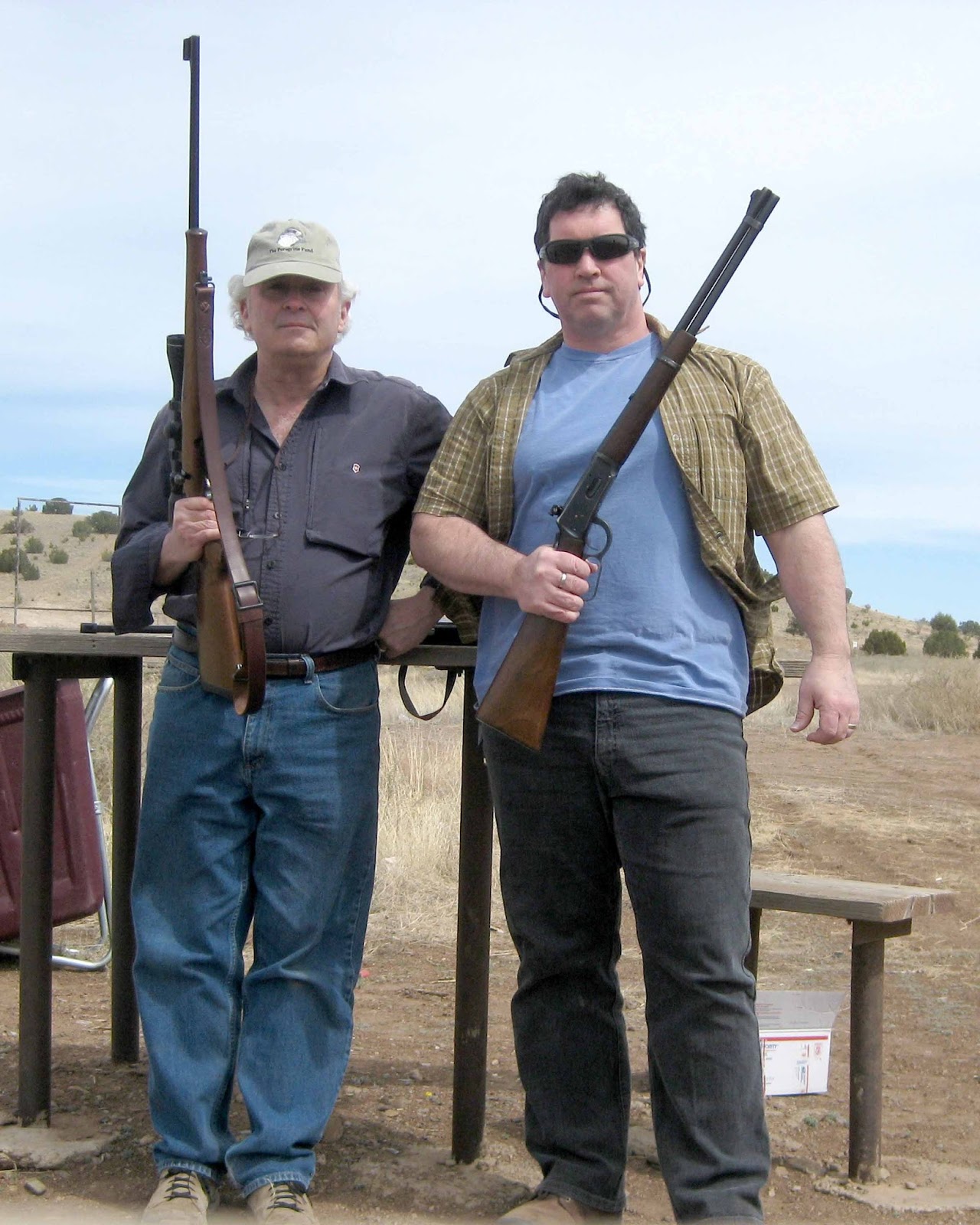
Plenty of material, madly busy, but this image, courtesy of John L Moore, will stand, as truth, as a testimonial to my old rifles, and to my vanity that my hair is growing back, if not quite here yet. At least I can go out now without a hat...


Tuesday, December 01, 2015
Winter tension

My cell phone rang just as I was stepping out the door to fork some hay to the sheep in the -10 degree nip of the morning. It was our local large carnivore biologist calling to give me a heads-up about a pack of wolves roaming just outside our sheep pasture. Apparently state wildlife officials had logged numerous sightings of a pack of three wolves, and our flock is the nearest livestock in the area where the wolves are roaming.
While the call was much appreciated, the presence of a pack of wolves in the neighborhood has been evident for the last month. Our livestock guardians have been on edge, with the dogs alternating between hyper-aggression and exhaustion. In early November, the sheep flock busted through a fence and fled their river bottom pasture, taking the dogs with them, but leaving the burros behind. When I arrived later that day, the burros were sweated up and nervous, huddled near the hole in the fence where the sheep had escaped. When I approached, all three burros were spooky, fleeing from me, jumping the fence and landing out on the county roadway (after one got tangled and fell, cutting herself on the wire in the process). I raced around on foot to catch up, and calmed them, convincing them to follow me through a small walk-in gate off the county road to get them into the same pasture where the sheep had fled.

We left the sheep flock and guardian dogs (reunited with their burros) in the larger pasture away from the river bottom, which we know serves as a corridor for predators. The pasture is huge, and the flock stayed out in the middle of the sagebrush-covered flat, away from the mountainside behind, and the river corridor along its eastern edge. When the flock was hesitant to go back to the river to water, we set up a portable tank and hauled water to them on the flat.

Wolves in our region reached biological recovery goals more than a decade ago, yet remain under full federal protection. There is little a livestock producer can do when a pack moves in. Only once there is dead livestock on the ground can control be initiated by federal officials – even when the killing occurs on private property. I’m resting easier now that I’ve had the luxury of moving my flock away from immediate danger, but sick at heart knowing that the problem will only migrate to my neighbor.
Subscribe to:
Posts (Atom)