Lauren's amazing ink:
"Stuff is eaten by dogs, broken by family and friends, sanded down by the wind, frozen by the mountains, lost by the prairie, burnt off by the sun, washed away by the rain. So you are left with dogs, family, friends, sun, rain, wind, prairie and mountains. What more do you want?" Federico Calboli
Showing posts with label golden eagles. Show all posts
Wednesday, January 24, 2018
Thursday, April 06, 2017
Golden Eagle Migrations
Researchers recently discovered the importance of Montana's Big Belt Mountains (near Bozeman) as a raptor migration flyway, and their first major monitoring effort for this flyway began in the fall of 2015, and was repeated in fall 2016. This route recorded the greatest number of migrating golden eagles of any site in North America, with 2,620 golden eagles recorded, with a peak of 24 goldens per hour!
The team also recorded another important behavior: Golden eagles continued to migrate at night under a full moon.
And if the golden eagle information wasn't enough, the researchers also documented all 17 raptor species known to migrate through the region - all on one day!
The Big Belts are a 75-mile long mountain range in west-central Montana, just north of the Bridger Mountains, which are well-known for raptor migrations. The raptor migration counts were conducted by Ronan Dugan and Jeff Grayum of the Golden Eagle Migration Survey and the report on the Fall 2016 counts can be found here.
Friday, December 09, 2016
The First Eagle Huntress?
However admirable Ashiolpan seems (and she is), and however fine the movie the Eagle Huntress is (and I suspect it is, and I want to see it), SHE IS NOT THE FIRST EAGLE HUNTRESS. This mistaken belief is particularly promulgated by American reviewers and I know I shouldn't expect much of them; I should only be happy they're saying a form of hunting is good.
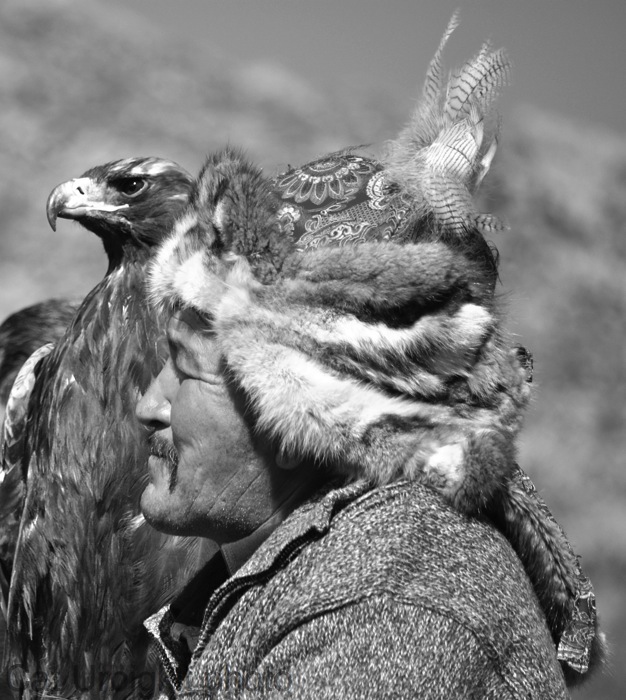
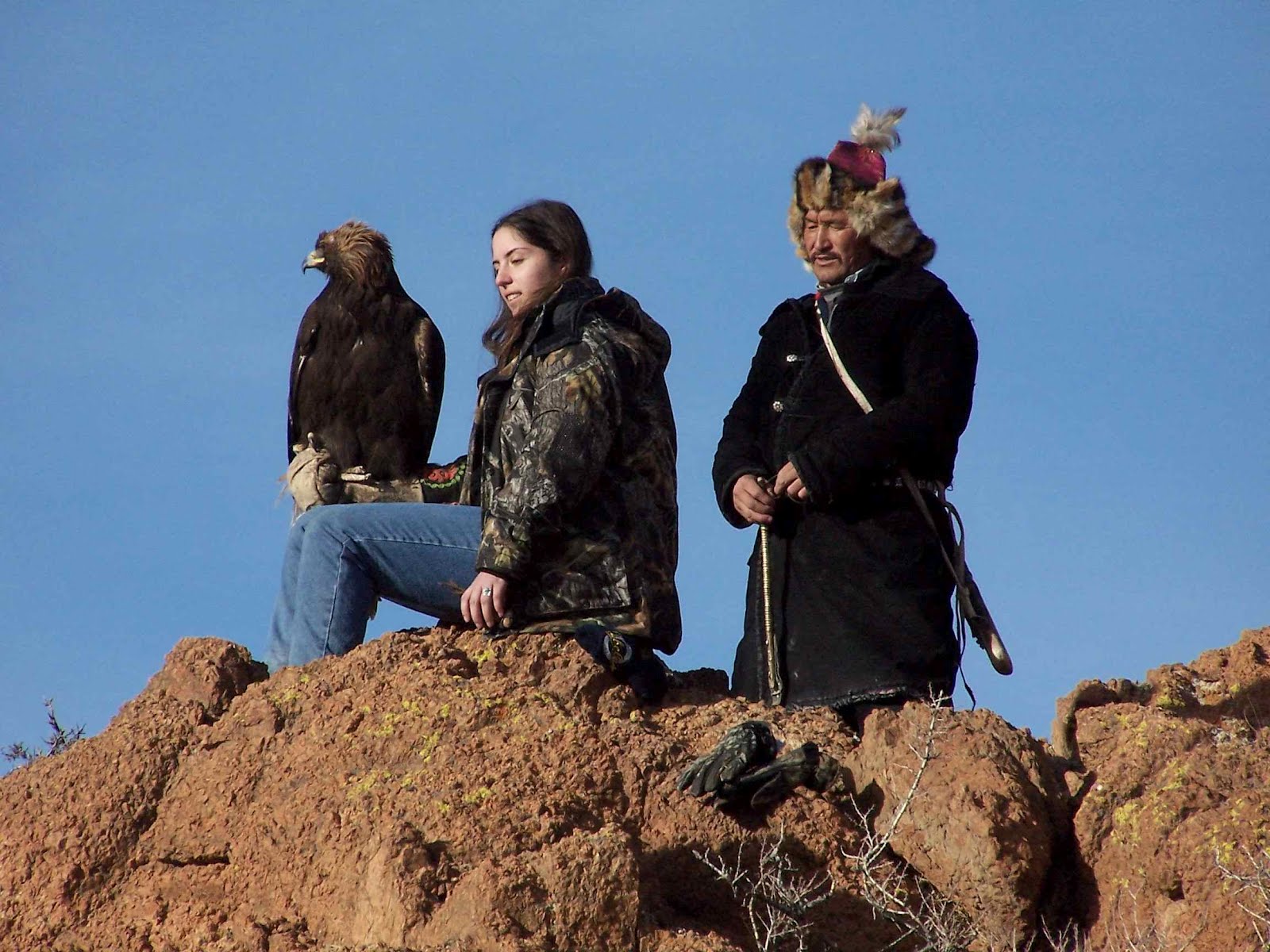
But for the record, with leaving out dubious semi-contenders like Princess Nirgigma in the 20s, who I very much doubt trained her own eagles, or Frances Flint Hamerstrom, who as far as I know never hunted with her eagle or participated in Asian culture, the FIRST eagle huntress is Lauren McGough, originally of Oklahoma City, Oklahoma, who I originally helped achieve her dreams when she was 16, when she went over and hunted with the late Aralbai. She was so taken with this that she won a Fulbright Scholarship and spent a year in remotest Bayaan Olgii Aimag in the westernmost point of Mongolia learning both the Kazakh and Mongol languages while training her first eagle, Alema ("Milky Way") which she trapped herself. She subsequently caught 30-odd foxes with her, plus other game. She has not yet written up her experiences, but everyone who knows her knows that she is the real thing. She's hunting right now with her eagle...
![]() | |
| Lauren at 16 with Aralbai |
| With Alema soon after capture |
Sunday, July 17, 2016
Interactive Olgii
Belatedly (because of TOO MUCH GOING ON the past few weeks), an unusual interactive video of eagle hunters in Olgii, courtesy of local reader James Cherry. If I were to guess,. I would say it is on the hill on the east side of valley, south of Olgii town, near where Manai used to live...
That scene of the meal makes me positively nostalgic.
Sunday, April 26, 2015
A contrarian view on eagle conservation
I had published this on Jameson Parker's blog in response to a question and it occurred that it would make an interesting little essay. But some have misunderstood it, so let me give you my conclusions before my reasoning:
I don't think (Golden) eagles are in any way endangered, but I support protection for them.
I don't think wind power companies and other utilities should get an automatic free pass on killing eagles.
I don't think any Indian tribes without a strong religious reason for taking eagles should be allowed to do so (I am encouraged that at least one pueblo now keeps live eagles, and attempts to breed them). I think that commercial exploitation of eagles and other birds of prey for their feathers by anyone is deplorable, and ideally should be ended. In today's world, I doubt that it will.
The legal take of no more than six eagles for falconry was something that put less pressure on the population than any other conceivable use, and even added to the Indians and wind farms, would have a negligible effect. In all likelihood allowing ANY falconer who qualified to take an eagle would not make any difference. If officials were really worried about this, they could mandate that trained eagles be released into the wild after ten years as the Kazakhs do.
In the ideal world, conservation decisions should be based on biology. In our real world, they can't be, not entirely anyway. Still, using a little information and pretending to a bit less hypocrisy would be welcome. And another thought: the educational value of trained eagles is not to be dismissed.
So, here it is:
I have a bit of a heretical stance about Golden eagles re wind farms. I dislike the amount of kills allowed for wind farms. But whether or not the population is harmed needs at least two questions answered. One is how many (Golden) eagles there are; the other is what else takes them out of (breeding) circulation.
The first is never discussed except among biologists– it is as though certain enviros do not want to ever say anything optimistic. The number of Bald eagles got brought low, partly by persistent pesticides, and now increases as it becomes ever more tolerant of human society. But the number of known Golden nests (or rather the reasonably accepted extrapolated number ) is AND MAY ALWAYS HAVE BEEN almost inconceivably high, so high I am not inclined to quote it without access to the actual data, except five figures of pairs in North America. (There are two nesting pairs I know of within ten miles of where I write these notes). This is never publicized, but you can track it down. The data is not from livestock or energy apologists, either. Remember, there is an untouched Arctic population, and ones in Labrador that seem to eat herons in breeding season. The golden is so adaptable that there is a Greek population that eats mostly tortoises. I doubt wind turbines will dent those numbers or scare them away.
The Texans used to shoot hundreds every year and it seems to have done little biological harm. Now wind farms are allowed to kill several hundred a year, and Navajos and other Native peoples are allowed not only unlimited hunting but utterly unlimited access to such species as Red- tailed hawks, not to train but to sell feathers. Which works out in practice that every delinquent kid on a troubled reservation sees a hawk on a pole and shoots it. Then probably sells it. While there are serious religious uses of eagles by the Pueblos, there is also an internal market, really illicit, in feathers for tribal dance outfits, competitive and lucrative- and some sympathetic judges have decided these commercial competitions are protected too. (Meanwhile one pueblo has modified its ceremonies to no longer kill eagles, and has hired a biologist to teach them how to keep them in a healthy way!)
Many activist types hate falconry as intolerable meddling with romantic symbols, but a falconer’s eagle is not even lost from the population– only “on loan” so to speak. The Kazakhs I rode with in Asia let them go to breed after ten years, and eagles commonly live to over 30. Until now falconers were a allowed a take of 6 wild-caught Golden eagles a year, only from areas in Wyoming and the Dakotas with proven sheep predation problems. Right now the government is inclined to end this benign “use”. I wish that moralists and humane activists would not go after the tiny portion of eagles allowed to falconers! If we allow a small kill harvest from the tribes, an unknown yet amount for wind farms, oil wells, roads and such, and want a healthy population… we HAVE to set fairly rigid quotas to be safe. But known numbers could easily allow a live take of up to six (or ten or whatever– except I don’t think that there will ever be that many eaglers), some of which would eventually even breed.
Meanwhile, in the warden- free lands of most reservations eagles still exist only because of apathy– there is no protection. Ranchers under 60 are more or less benign, and don’t shoot them (wolves are far more threatening in both reality and reputation), but some angry young rez kids kill every sitting bird they see, and sell the feathers no matter what, as a demonstration that they “own” them Some tribes have made clear falconers shouldn’t get any quota, because they are religious symbols! A bit of Googling would show us the old regs, under which we existed and complained for decades, while Texans shot hundreds or maybe even thousands (see Don Scheuler’s Incident at Eagle Ranch), were uninformed– they now seem almost as unimaginable as photos of the aerial dogfights with eagles when they were hunted from planes. But, counterintuitively, they were probably biologically harmless in that they didn’t– because they couldn’t– wipe out eagles. Morally though, making dead eagles a commodity for anyone looks worse to me than wind farms; commerce can drive extinction like stoking a fire.
(Photo above from Life Magazine in 1953, from an eagle shooter's view in Texas)
Why not reasonable quotas for falconers’ birds? Fewer privileges for Indians, at least ones with no religious stake, as those don’t have the built- in cultural reverence? And less posturing from anti- wind people at least about eagles aka Charismatic Megafauna (the turbines may actually be worse for bats, a group far more threatened than the Golden eagle!)
I don't think (Golden) eagles are in any way endangered, but I support protection for them.
I don't think wind power companies and other utilities should get an automatic free pass on killing eagles.
I don't think any Indian tribes without a strong religious reason for taking eagles should be allowed to do so (I am encouraged that at least one pueblo now keeps live eagles, and attempts to breed them). I think that commercial exploitation of eagles and other birds of prey for their feathers by anyone is deplorable, and ideally should be ended. In today's world, I doubt that it will.
The legal take of no more than six eagles for falconry was something that put less pressure on the population than any other conceivable use, and even added to the Indians and wind farms, would have a negligible effect. In all likelihood allowing ANY falconer who qualified to take an eagle would not make any difference. If officials were really worried about this, they could mandate that trained eagles be released into the wild after ten years as the Kazakhs do.
In the ideal world, conservation decisions should be based on biology. In our real world, they can't be, not entirely anyway. Still, using a little information and pretending to a bit less hypocrisy would be welcome. And another thought: the educational value of trained eagles is not to be dismissed.
So, here it is:
I have a bit of a heretical stance about Golden eagles re wind farms. I dislike the amount of kills allowed for wind farms. But whether or not the population is harmed needs at least two questions answered. One is how many (Golden) eagles there are; the other is what else takes them out of (breeding) circulation.
The first is never discussed except among biologists– it is as though certain enviros do not want to ever say anything optimistic. The number of Bald eagles got brought low, partly by persistent pesticides, and now increases as it becomes ever more tolerant of human society. But the number of known Golden nests (or rather the reasonably accepted extrapolated number ) is AND MAY ALWAYS HAVE BEEN almost inconceivably high, so high I am not inclined to quote it without access to the actual data, except five figures of pairs in North America. (There are two nesting pairs I know of within ten miles of where I write these notes). This is never publicized, but you can track it down. The data is not from livestock or energy apologists, either. Remember, there is an untouched Arctic population, and ones in Labrador that seem to eat herons in breeding season. The golden is so adaptable that there is a Greek population that eats mostly tortoises. I doubt wind turbines will dent those numbers or scare them away.
The Texans used to shoot hundreds every year and it seems to have done little biological harm. Now wind farms are allowed to kill several hundred a year, and Navajos and other Native peoples are allowed not only unlimited hunting but utterly unlimited access to such species as Red- tailed hawks, not to train but to sell feathers. Which works out in practice that every delinquent kid on a troubled reservation sees a hawk on a pole and shoots it. Then probably sells it. While there are serious religious uses of eagles by the Pueblos, there is also an internal market, really illicit, in feathers for tribal dance outfits, competitive and lucrative- and some sympathetic judges have decided these commercial competitions are protected too. (Meanwhile one pueblo has modified its ceremonies to no longer kill eagles, and has hired a biologist to teach them how to keep them in a healthy way!)
Many activist types hate falconry as intolerable meddling with romantic symbols, but a falconer’s eagle is not even lost from the population– only “on loan” so to speak. The Kazakhs I rode with in Asia let them go to breed after ten years, and eagles commonly live to over 30. Until now falconers were a allowed a take of 6 wild-caught Golden eagles a year, only from areas in Wyoming and the Dakotas with proven sheep predation problems. Right now the government is inclined to end this benign “use”. I wish that moralists and humane activists would not go after the tiny portion of eagles allowed to falconers! If we allow a small kill harvest from the tribes, an unknown yet amount for wind farms, oil wells, roads and such, and want a healthy population… we HAVE to set fairly rigid quotas to be safe. But known numbers could easily allow a live take of up to six (or ten or whatever– except I don’t think that there will ever be that many eaglers), some of which would eventually even breed.
Meanwhile, in the warden- free lands of most reservations eagles still exist only because of apathy– there is no protection. Ranchers under 60 are more or less benign, and don’t shoot them (wolves are far more threatening in both reality and reputation), but some angry young rez kids kill every sitting bird they see, and sell the feathers no matter what, as a demonstration that they “own” them Some tribes have made clear falconers shouldn’t get any quota, because they are religious symbols! A bit of Googling would show us the old regs, under which we existed and complained for decades, while Texans shot hundreds or maybe even thousands (see Don Scheuler’s Incident at Eagle Ranch), were uninformed– they now seem almost as unimaginable as photos of the aerial dogfights with eagles when they were hunted from planes. But, counterintuitively, they were probably biologically harmless in that they didn’t– because they couldn’t– wipe out eagles. Morally though, making dead eagles a commodity for anyone looks worse to me than wind farms; commerce can drive extinction like stoking a fire.
(Photo above from Life Magazine in 1953, from an eagle shooter's view in Texas)
Why not reasonable quotas for falconers’ birds? Fewer privileges for Indians, at least ones with no religious stake, as those don’t have the built- in cultural reverence? And less posturing from anti- wind people at least about eagles aka Charismatic Megafauna (the turbines may actually be worse for bats, a group far more threatened than the Golden eagle!)
Wednesday, April 16, 2014
Eagle Dreamers
I must assume that ALL my readers have seen some version of this:
I have gotten over 100 emails, and they are still coming in. The one most saw was a BBC article (see David Zincavage's blog), but I like the photographer's, and his background info. It seems that the wild men of central Asia, as pragmatic as can be, have not opposed the few brave young women who have decided to take up this difficult but thrilling way of life (not exactly a"sport" by the way, as some call it, unless at the games at the annual fall "fiestas" there and in the 'Stans).
I was delighted by the photos, and the whole phenomenon. But I thought the real pioneer was being ignored-- Lauren McGough, who contacted us when she was 16, went out to hunt for a month with the late Aralbai, "The Coolest Man in the World" (Google it up), then returned on a Fulbright to spend a year there as an apprentice, then another year back and forth to the 'Stans and Mongolia. She is now in Scotland writing her doctoral thesis, and has continued flying eagles on the plains here and in Scotland.
Lauren is not worried, though she has a sensible distrust of the accuracy of the press: "The photos are just brilliant of course - I recognize in that smile the pure joy of flying an eagle! I always have mixed feelings about media articles of Mongolian eagle culture, though. Its hard not to be possessive of "my" subject!... If I can find the funds, perhaps visiting the girl myself would be a compelling epilogue. It in a way, it is like coming full-circle, from my own 14-year old self that used to daydream her red-tail was an eagle. Or something!"
After I got her notes I wondered: Olgii Aimag is not too big; could the young Kazakh girl have heard about the strange American berkutchi? Could it have swayed her father? Could she have seen this not- very tall American with the huge eagle named after the Milky Way?
There is going to be a book, and it will have insights I never dreamed of. Meanwhile, back in the USA, the government is considering shutting down the (at most) 6 eagle annual falconry take, while wind farms and eagle- killing natives are given a pass. Sometimes I think I should go off to live and die in Asia, where eagle dreamers get some respect.
I have gotten over 100 emails, and they are still coming in. The one most saw was a BBC article (see David Zincavage's blog), but I like the photographer's, and his background info. It seems that the wild men of central Asia, as pragmatic as can be, have not opposed the few brave young women who have decided to take up this difficult but thrilling way of life (not exactly a"sport" by the way, as some call it, unless at the games at the annual fall "fiestas" there and in the 'Stans).
I was delighted by the photos, and the whole phenomenon. But I thought the real pioneer was being ignored-- Lauren McGough, who contacted us when she was 16, went out to hunt for a month with the late Aralbai, "The Coolest Man in the World" (Google it up), then returned on a Fulbright to spend a year there as an apprentice, then another year back and forth to the 'Stans and Mongolia. She is now in Scotland writing her doctoral thesis, and has continued flying eagles on the plains here and in Scotland.
After I got her notes I wondered: Olgii Aimag is not too big; could the young Kazakh girl have heard about the strange American berkutchi? Could it have swayed her father? Could she have seen this not- very tall American with the huge eagle named after the Milky Way?
There is going to be a book, and it will have insights I never dreamed of. Meanwhile, back in the USA, the government is considering shutting down the (at most) 6 eagle annual falconry take, while wind farms and eagle- killing natives are given a pass. Sometimes I think I should go off to live and die in Asia, where eagle dreamers get some respect.
Saturday, March 22, 2014
Traditional Sport in Kyrgizstan
Sent by Sir Terence Clark:
UPDATE: I was struck by the smooth gait of the horses and the comfortable seat of the riders in one sequence. I am no great horseman, so was gratified when old cowhand and world class photographer Jay Dusard wrote: "The most amazing segment in the film was the horses that were shown at extremely fast trotting. Very fast and smooth traveling, with riders staying nearly level. Posting the trot was practically indistinguishable, with some of the riders posting ever so slightly. At least one of the horses was pacing, rather than trotting."
Friday, December 20, 2013
It is official
You might have figured it out in comments below but it is official: because the Feds are allowing a three- decade exemption for wind farms to kill as many eagles as they "need" to, and because they exert no pressure on tribal use (right and understandable for religious practice, but ignoring the profitable if clandestine traffic in feathers for dance costumes), falconers will no longer be allowed to catch "up to six" eagles for falconry in areas of proven depredation, exactly reversing the win- win scenario Cat details below.
Nobody ever took six a year, an infinitesimal part of the breeding surplus; ranchers had proven predators removed; falconers got the companionship of one of the world's formidable predators, often for decades, and the chance to participate in one of if not THE oldest falconry tradition on earth, at least six thousand years old.
Presumably if we do not fight this it means "for three decades?" Or forever?
And why in hell not allow trapping in wind farms?
Nobody ever took six a year, an infinitesimal part of the breeding surplus; ranchers had proven predators removed; falconers got the companionship of one of the world's formidable predators, often for decades, and the chance to participate in one of if not THE oldest falconry tradition on earth, at least six thousand years old.
Presumably if we do not fight this it means "for three decades?" Or forever?
And why in hell not allow trapping in wind farms?
![]() |
| No more of this! |
Saturday, November 16, 2013
Monday, November 11, 2013
Digging
Andy was right about the photo of Libby a bit below, but didn't guess the place. The photo was taken in 1966, when she was digging on the important early American Hell Gap archaeological site in southeastern Wyoming, east of Guernsey, under the leadership of the legendary Cynthia Irwin- Williams.
Libby got her degree, and dug at some other early American sites, including one near Cabezon in New Mexico then called "Anasazi Origins". But eventually she left and pursued other careers, from Outward Bound instructor and Himalayan trekking guide to professional private chef and head of Patagonia mail order. She still has the best eye for human artifacts and tiny tools I have ever seen, but it is mostly just for fun, and we leave them in the field.
The enormous collection of tools and bones ended up at Harvard for a while, but when our friend Laura Niven was going for her advanced degrees in Wyoming , almost 20 years ago, she found that they had been "repatriated". We found out when she called us in excitement, having found Libby's name and that of her older sister, Elizabeth and Eleanor Adam, on many of the labels.
In recent years, what with hanging out with the Farmers (Reid and Connie are BOTH archaeologists) and working with the Forest Service as "site guardians", we have again gotten interested in such things, though as a biologist manque, I favor the end of the Pleistocene with its monsters and "first contacts", Paleoindian better than "Pueblan". So when we knew we were going up to Wyoming, we asked Carlos to set us up some time with theGeorge Frison Institute. Frison himself was someone who wrote one of my favorite American anthropology texts, Survival by Hunting.
One illustration in the book is of particular interest. Ranch- born, Frison knew that eagles were common and effective predators on pronghorn, though it is still hard to convince some people today. A rancher friend of his painted the scene, which closely resembles three wild kills I have had described to me.
The woman who was teasingly referred to as "The Mysterious Libby" was welcomed to the collection by Marcel Kornfeld, who also found that picture of Libby. By the time we left, she was considering returning to dig as a volunteer next summer. I hope to get her to tell a few tales of her digging days in a bit.
Libby got her degree, and dug at some other early American sites, including one near Cabezon in New Mexico then called "Anasazi Origins". But eventually she left and pursued other careers, from Outward Bound instructor and Himalayan trekking guide to professional private chef and head of Patagonia mail order. She still has the best eye for human artifacts and tiny tools I have ever seen, but it is mostly just for fun, and we leave them in the field.
The enormous collection of tools and bones ended up at Harvard for a while, but when our friend Laura Niven was going for her advanced degrees in Wyoming , almost 20 years ago, she found that they had been "repatriated". We found out when she called us in excitement, having found Libby's name and that of her older sister, Elizabeth and Eleanor Adam, on many of the labels.
In recent years, what with hanging out with the Farmers (Reid and Connie are BOTH archaeologists) and working with the Forest Service as "site guardians", we have again gotten interested in such things, though as a biologist manque, I favor the end of the Pleistocene with its monsters and "first contacts", Paleoindian better than "Pueblan". So when we knew we were going up to Wyoming, we asked Carlos to set us up some time with theGeorge Frison Institute. Frison himself was someone who wrote one of my favorite American anthropology texts, Survival by Hunting.
One illustration in the book is of particular interest. Ranch- born, Frison knew that eagles were common and effective predators on pronghorn, though it is still hard to convince some people today. A rancher friend of his painted the scene, which closely resembles three wild kills I have had described to me.
The woman who was teasingly referred to as "The Mysterious Libby" was welcomed to the collection by Marcel Kornfeld, who also found that picture of Libby. By the time we left, she was considering returning to dig as a volunteer next summer. I hope to get her to tell a few tales of her digging days in a bit.
Monday, September 23, 2013
Eagle versus Deer
This is pretty cool: a camera trap in Primorye, set to observe Amur ("Siberian") tigers, caught a golden eagle in the act of killing a sika deer. Knowing of my interest, Jonathan, Tim Gallagher, and Annie Hocker all sent notice.
But I am grumpy about the text, especially two statements, ""rabbits—their regular prey—"
Not really; more like rabbits, hares, great blue herons, demoiselle cranes, bar- headed geese, Greek tortoises, pronghorn antelope, coyotes, domestic stock on occasion... whatever is available at the right place and time. And:
"The scientists underscore that golden eagles do not regularly attack deer".
But they do. Also as I just stated, many other large and/ or hoofed animals.
John Byers' brilliant pronghorn monograph considers them a major predator.
George Frison, the old archaeologist who wrote Survival by Hunting, a sometime inspiration to both Reid and Lib, ditto, and features a painting of them in his book doing that.
Danny McCarron, personal observation of golden taking down running antelope (wild, both) "like they do it every week!"
Tigner ranch here, who had 40 calves taken by one pair and allowed the Audubon Society (in the seventies, a less PC time, granted) to film it, before they trapped and relocated them.
EVERY EASTERN EUROPEAN EAGLER takes roe every year, like a gos on a hare, both at home and at Opocno (below).
Golden eagles are top- of- the- chain carnivorous dinosaurs. If they were bigger they would hunt us...
UPDATE: I was reminded that Darren and I both covered this along time ago.
But I am grumpy about the text, especially two statements, ""rabbits—their regular prey—"
Not really; more like rabbits, hares, great blue herons, demoiselle cranes, bar- headed geese, Greek tortoises, pronghorn antelope, coyotes, domestic stock on occasion... whatever is available at the right place and time. And:
"The scientists underscore that golden eagles do not regularly attack deer".
But they do. Also as I just stated, many other large and/ or hoofed animals.
John Byers' brilliant pronghorn monograph considers them a major predator.
George Frison, the old archaeologist who wrote Survival by Hunting, a sometime inspiration to both Reid and Lib, ditto, and features a painting of them in his book doing that.
Danny McCarron, personal observation of golden taking down running antelope (wild, both) "like they do it every week!"
Tigner ranch here, who had 40 calves taken by one pair and allowed the Audubon Society (in the seventies, a less PC time, granted) to film it, before they trapped and relocated them.
EVERY EASTERN EUROPEAN EAGLER takes roe every year, like a gos on a hare, both at home and at Opocno (below).
Golden eagles are top- of- the- chain carnivorous dinosaurs. If they were bigger they would hunt us...
Monday, December 31, 2012
Red Kite?
I can't prove the bird morphed into an "eagle" in the hoax video below was a red kite (Milvus milvus) but I have seen a few in the wild and I think it was. A beautiful bird with remarkable buoyancy and power of flight, a common medieval street scavenger, a most challenging quarry hunted through the high clouds by Gyrs and Sakers (the Craigheads did some of the last of this in pre- Partition India in 1940 and documented it in film and writing), the bird became rare with modern sanitation and persecution, was reintroduced, and is now common again. I saw my first one from a train just north of Marseilles but they are everywhere now.
The other reason confirming my uneasiness with eagle ID (other than long the long narrow crooked wings with light patches and its quite forked but nevertheless kitelike tail (young are not forked)- is that the Francophone hoaxers said it was a "Royal Eagle". Ain't no such bird, but the filmmakers might have known that the kite in the film is known as the "Milan Royal".
Film:
Kite images from the Net:
The other reason confirming my uneasiness with eagle ID (other than long the long narrow crooked wings with light patches and its quite forked but nevertheless kitelike tail (young are not forked)- is that the Francophone hoaxers said it was a "Royal Eagle". Ain't no such bird, but the filmmakers might have known that the kite in the film is known as the "Milan Royal".
Film:
Kite images from the Net:
Sunday, May 20, 2012
Lauren checks in...
Adventuring on; she will be going out to Kazakhstan to learn serious Kazakh soon, then to several other Stans. The Explorers Club has provided some funds but I may just have to run a bleg here...
(Need I say more about my friend, protegee who long since surpassed her elder, first female berkutchi, first American ditto, eagler, writer, Fulbright fellow...?)
A short quote:
" On June 6th I am flying to Kazakhstan to spend two months intensively learning Kazakh. Amazingly, incredibly, this was fully funded! Then in September, I will run away again to that region to fly eagles, run dogs, and really learn how to manage horses and camels (for the sake of *ahem* cultural anthropology). I'm rearing to go - its one of those places that, once you been, all you can think of is how to get back (as you know), but I'm also fairly anxious and the harsh realities of it weigh on me. It will be very cold (I have some permanent damage from my frostbite) hard, and lonely. Also, finances will be difficult. The Explorer's Club gave me $2800 (!!) but no other money has come through as of yet. .. [re new pix] Some photos from the last little while. Man, there is so much to tell you. I included the lamb's eye one - as eating such things was old hat for me, but it was quite the "party trick" for all the visitors!"
Lauren with her eagle in Mongolia a couple of years ago: Recent pix: With our late friend and guide Aralbai:
(Need I say more about my friend, protegee who long since surpassed her elder, first female berkutchi, first American ditto, eagler, writer, Fulbright fellow...?)
A short quote:
" On June 6th I am flying to Kazakhstan to spend two months intensively learning Kazakh. Amazingly, incredibly, this was fully funded! Then in September, I will run away again to that region to fly eagles, run dogs, and really learn how to manage horses and camels (for the sake of *ahem* cultural anthropology). I'm rearing to go - its one of those places that, once you been, all you can think of is how to get back (as you know), but I'm also fairly anxious and the harsh realities of it weigh on me. It will be very cold (I have some permanent damage from my frostbite) hard, and lonely. Also, finances will be difficult. The Explorer's Club gave me $2800 (!!) but no other money has come through as of yet. .. [re new pix] Some photos from the last little while. Man, there is so much to tell you. I included the lamb's eye one - as eating such things was old hat for me, but it was quite the "party trick" for all the visitors!"
Lauren with her eagle in Mongolia a couple of years ago: Recent pix: With our late friend and guide Aralbai:
Friday, February 10, 2012
Sad Week
I just got word from Alan Gates that Aralbai has died at just 54.

(Photo by Cat)
He might have been "The Coolest Man in the World" and was a serious drinking companion, but many people from many countries from here to England to Japan (I may tell that tale later) appreciated him as a guide and mentor.
From the top: he and his son, '98, by me; with his wife and Alan; with Lauren when she was 17 and years later in her Fulbright year; by Cat again (hoping she will post too), and releasing his eagle back to the wild, also by Lauren.


He was one of three friends or friend's family members who died this week. More later.

(Photo by Cat)
He might have been "The Coolest Man in the World" and was a serious drinking companion, but many people from many countries from here to England to Japan (I may tell that tale later) appreciated him as a guide and mentor.
From the top: he and his son, '98, by me; with his wife and Alan; with Lauren when she was 17 and years later in her Fulbright year; by Cat again (hoping she will post too), and releasing his eagle back to the wild, also by Lauren.


He was one of three friends or friend's family members who died this week. More later.
Thursday, February 02, 2012
Kazakh portraits
Thursday, January 19, 2012
Sad News

Alan Gates writes:
"I have sad news that Aralbai has been diagnosed with throat cancer, he refused the laser treatment he was offered at the UB hospital because he believed that those that had had this type of treatment, die quicker.
"He has deteriorated a lot from the time I last hunted with him, and at the age of 54 it is far too young.
"I know you, like me have spent a lot of time with Aralbai, so I thought you should know."
I hunted (& ate sheep and drank vodka) with Aralbai the first time I went out to Mongolia in '97.

He has since taken out many of my friends, from Cat (who got in a horse race with his son, no longer a little kid!) to, particularly, Lauren, both on her first trip at 17 to her later Fulbright year.

He is also "The Coolest Man in the World".
I do not know if anything can be done for a brave friend but am asking Canat.
More photos by Cat below-- first is the boy in the upper, '97 one, all grown up... and here is Alan's link to him at the Festival of Falconry.


A last one by Lauren, letting his eagle go free after years of hunting, the Kazakh way:
Subscribe to:
Posts (Atom)