... and perennial sufferer of foot- in- mouth disease Ted Turner apparently only cares about environment that he owns. He was caught on tape by Wolf Blitzer making an unusual number of fatuous statements, even for him. Not only does he apparently think the North Koreans are good guys *; when told that they could reach Alaska with nukes, he said:
(Blitzer) " There are some estimates, by the way, that could reach Alaska."
(Turner): "Well, what, the Aleutian Islands? There's nothing up there but a few sea lions."
Please, environmentalist friends-- DO NOT give this man any more money!
*Blitzer: "But this is one of the most despotic regimes and Kim Jong Il is one of the worst men on Earth. Isn't that a fair assessment?"
Turner: "Well, I didn't get, I didn't get to meet him, but he didn't look, in the pictures that I've seen of him on CNN, he didn't look too much different than most other people."
Blitzer: "But look at the way, look at the way he's, look at the way he's treating his own people."
Turner: "Well, hey, listen. I saw a lot of people over there. They were thin and they were riding bicycles instead of driving in cars, but ah-"
Blitzer: "Lot of those people are starving."
Turner: "I didn't see, I didn't see any, I didn't see any brutality in the capital or out in the, on the DMZ".
Sunday, September 25, 2005


"Discovered, Described, and Eaten"...
.. was the heading Odious sent me referring to this New Scientist article about a new creature form the ever- surprising and fruitful mountains of Laos.
"It was for sale on a table next to some vegetables," says conservation biologist Robert Timmins, "and I knew immediately it was something I had never seen before." People in the Khammouan region of Laos know of the species, and prepare it by roasting it on a skewer..."
The most surprising thing about the new rodent is that it is not closely related to any living species, and may be close to the root of divergence of Old and New world species.
Now let's just hope the Chinese don't eat them all for medicine...
Thanks also to Cronaca.
Slow blogging
Matt is dealing with refugees and hawking; Reid finishing a report; and me? Just LIFE. Lib's ribs are recovering well, but other complications like the need to make a few bucks keep intruding, not to mention the total breakdown of my second vehicle-- nothing like being truckless, that is, without motorized transportation, just as the dogs and hawk(s)-- more on that in a minute-- are getting revved...
I am also trying to get up to speed on the Siberia book, do a proposal for another book that may take me to Russia, retrofit the house with a wood stove, get a broken chain saw working-- and now it looks like one of my house's main @#$%^ WALLS is crumbling. Last night I was awakened by something crawling on my leg. I threw back the covers, smashing a TV remote in the process, to find a three inch paying mantis advancing toward my crotch (It never even woke peaceful Libby!) Having disposed of the predator and drifted off to sleep, I was awakened again by a walnut- sized rock falling on my head. When I investigated I found that it had fallen from the juncture of the ceiling and the wall. Visitors to Casa Q will recall that it is a rock house, 120+ years old, and has things like permanent leaks with buckets centered beneath by tape markings, so rocks falling on heads from cracks are Not Good Things.
Regular programming will at least begin to resume. Meanwhile, here is the "new" hawk, moved here to rescue a friend in dire straits. His name is Goblin, he is a first year gyrfalcon- saker cross (which is to say he is a domestic Altai falcon) and he is huge for a male. he will be formidable if I do right by him.
On the other hand, notice the deer- in - headlight stare of the falconer....
Sunday, September 18, 2005
Meth Addicts and Site Looting
Steve pointed out this strange item to me which confirmed a story that my sister told me she'd seen in the Jonesboro (AR) Sun. It seems that methamphetamine addicts in Arkansas have taken to collecting arrowheads and other Indian artifacts. Walking around in fields looking for artifacts fills their need for activity while they are up for days at a time wired on the drug. One addict in the story sold his collection for $1250 to help pay his lawyer.
This is doubly sad. First for the people in thrall to the drug and second for the loss of valuable archaeological information. In many cases it isn't so much the loss of the objects themselves as it is the loss of the locational information about them. Artifacts are of little use to archaeologists if we don't know where they came from. That is the true pity of looted sites.
I am a sixth generation Arkansan (my great-great-great grandfather John Huggins Reid moved there in 1845) who started in archaeology there and am familiar with its prehistoric resources. Arkansas is rich in sites that date from the late Paleoindian Dalton hunters who roamed the banks of the Mississippi when it was a braided stream choked with sediment from melting glaciers to the large Mississippian chiefdoms that De Soto saw in the 1540s. One thing the state doesn't need is this threat to the record of that history.
Condors in Prehistoric California
 After Steve's post on possible late condor presence on the Northern Plains, I had to jump in with something on their importance to Native Americans in California. Condors featured in the religion of virtually every known tribe in the state, but I will talk mostly about the Chumash here in Southern California with which I am more familiar.
The pictograph above is of a condor painted on a rock face in the Santa Barbara area. You can see its red head and the feather elements and feet are rendered in white paint. The bird is painted on top of a petroglyph of a bear paw. Double magic?
One Chumash legend states that the condor was originally an all-white bird. The primeval condor was flying over the original Chumash village on Santa Cruz Island and was intrigued by the fire that he saw burning there. He flew too close to the fire and many of his feathers were singed, which accounts for why today's bird is all black with only two white patches under its wings.
The condor was very important in Chumash ritual. As it is a carrion-eating bird, it was often linked in mourning activities and renewal ceremonies. Condors were often sacrificed and their skins and feathers were used for ceremonial paraphenalia such as capes or feather bands. Condor bones were carved and used as flutes or sucking tubes as seen below.
 The use of these paraphenalia by shamans gave them special powers. The condor bone sucking tubes enabled a shaman to suck supernatural poisons out of a sick person and cure them. As condors have keen eyesight, taking on their familiar power enabled a shaman to find lost objects or missing people.
Condors and eagles were also associated with cosmic events. Either a condor or eagle was sacrified based on which celestial body was prominently visible during a particular ceremony. Eagles were used in ceremonies associated with the planet Venus and condors in those associated with Mars. The condor pictograph at the top of this post is located in a site identified as a winter solstice observatory.
Condors are not uncommon in Chumash rock art and some show figures with anthropomorphic traits that have been interpreted as humans in condor dance regalia - shamans taking on the power of their condor familiar. The photo below shows a natural sandstone outcrop that resembles a condor's head located in the Carrizo Plain.
 This has been identified by Chumash informants as a sacred place of power. Red pictographs can still be seen in the protected areas under an overhang. It is likely that the entire "head" was originally covered in red making it look even more like a condor's head.
The post by Prairie Mary that Steve links below speculates that some of the old Blackfoot medicine bundles contained condor feathers. At the end of the Pleistocene when their range was continent-wide, it is interesting to speculate what role condors played in the rituals of the Paleoindian megafauna hunters.
Photo credit to California State Parks
"Genetic Pollution"?
I am reading the wonderful new monograph The Gyrfalcon . On page 229 I came upon a passage which may say more about the Scandinavian mind than falcons, and I found it both funny and disturbing. I am curious what readers might say-- I think (Russian) author Eugene Potapov, who is both an ornithologist and a falconer, found the incident as odd as I do.
I quote, but without all the references (italics mine):
"There was panic in Sweden in 1999 when an escaped male Gyrfalcon x Peregrine falcon hybrid from Denmark paired with a native Peregrine female in Bohuslan, the male identified by its leg ring. The pairing made the headlines of Swedish newspapers. Falconry is, in general, prohibited in Finland, Sweden, and Norway, and so the public reaction to this event was negative because of the potential for genetic pollution of the native species. The case was termed the "birds of prey scandal" by the Swedish Ornitholoigical Society. Officials from Naturvardsverket (the Swedish Ministry of the Environment) killed the chicks produced by the pair and shot the hybrid. They also wanted to kill the female as her willingness to mate with a non- pure bird caused a concern that should another escape happen the bird might be equally willing a second time. However the female escaped and remained at large".
Isn't this rather... creepy? I mean, even apart from the fact that the descendants of Vikings have turned into a bunch of handkerchief- wringing wussies, the Nazi- like assumptions inherent here are disturbing. I should add that Potapov was not worried.
You may also be relieved that, in Potapov's next section, Norwegian authorities did NOT kill a lesbian cross- species Gyr- Peregrine pair that they found brooding their infertile eggs in a seabird colony there. I never knew that birds of prey had such interesting love lives.
Roadless
The Alpha Environmentalist speaks some hard truths on why the Roadless Rule is important (and reminds us of the necessity of not letting only one party "own" an issue). Jonathan says:
"As a Republican, 4x4 owner, and hunter lumped in with those neo-Druids, I wonder if the Tribune could stop pandering to lumber and mining companies long enough to get the facts straight.
Hard Green! (And no, I don't think it has all the answers either. Nobody does).
"As a Republican, 4x4 owner, and hunter lumped in with those neo-Druids, I wonder if the Tribune could stop pandering to lumber and mining companies long enough to get the facts straight.
Hard Green! (And no, I don't think it has all the answers either. Nobody does).
Malaria...
...is not just something that affects the poor in other countries: it is never far away. This LA Times editorial is a step in the direction of public awareness, but says some things that just aren't so. (Who am I to say? Well, I came down with a bad case in Zimbabwe, got obsesssed with the subject, amassed a small library on various parasites, and even wrote a short account of my adventure for Men's Journal).
The editorial writer makes some sensible connections between the disease and poverty. But then he states: "Unfortunately, there aren't very many [ lessons] to be learned from the United States. American mosquitoes didn't evolve to carry the malaria parasite, and they aren't very efficient at it. In Africa, they are the perfect hosts; the hot African climate also accelerates the progress of the disease. Americans never faced a threat close to the one in Africa".
The last statement is literally true; the rest is biological nonsense. Native malaria was a major impediment to the settling of the Ohio River Valley-- Lewis and Clark encountered it there. It wasn't wiped out in Staten Island until the Thirties! Hell, the disease was named in Rome, and prevalent even in colder Venice-- it is not only a tropical affliction.
There are many native malarias. Most are bird- adapted-- I lost a falcon to one when I boarded him on the Rio Grande. But falciparum, the deadliest malaria, jumped from bird to human, the way Avian flu may be poised to today.
It CAN happen here.
For a comprehensive (and often amazingly witty!) look at the biology and anthropology of malaria and other parasites I highly recommend the books of Robert Desowitz, a man who has fought in the trenches of public health.
Thunderbirds!
Reid and Chas both sent me
this fascinating link to Prariemary on the "recent" presence of condors on the Montana plains. They apparently hung on until the buffalo were gone, and might return again if introduced in the wake of big herds-- see last post.
"When Claude Schaeffer, curator of the Museum of the Plains Indian, began to investigate birds in the lives of Blackft, he easily learned the names for the golden eagle (pitau), bald eagle (ksixkikini) and turkey vulture (pikoki) but the informants said there was another bird, a reeeeaaaaaally big bird: omcxsapitau or “big pitau.” Schaeffer became convinced this was “Gymnogyps californianus” or the California condor, the greatest of all flying birds of the north. This was unexpected for contemporary ornithologists and important in terms of understanding the ecology of the plains.
"It had already been established that condors participated in the eagle feast of salmon migration in the early quarter of the 19th century. One lone ornithologist named J. Fannin saw two “fine birds” just west of Calgary on September 10, 1896. The wingspread of these birds is eleven feet -- no wonder many of the stories of strange doin’s include big birds.
(Snip)
"Dick Sanderville at age 82 reported that Raven, aka “Hairy Face” or “Big Crow,” was going along from Old Agency to Little Badger and saw a big creature in a coulee. It was immense, dark, and had a feathered ruff under a bald head. This was 1897 and the sighting became the year marker: “When Big Crow saw the Omaxsapitau".
Another home for this Pleistocene relict would be welcome-- the more sites (see previous again) the better. They are already suffering from a "new" plague down south.
Re- Wilding: Update
A lot of misinformed objections continue to arise from the proposal to repopulate the Great Plains with a "Revived Pleistocene". Two letters to Nature, here and here , make points that have little to do with the project. The author of the first worries both that the introductions won't work and that if they do they will decrease biodiversity on the Plains. He doesn't seem to realize that the lack of success of the entirely domestic southern camel, the dromedary, in 19th Century Arizona, may have little to do with the introduction of northern Bactrians to the much more similar (to Asia) northern plains-- and that these Asian camels are more like our lost American camels.
He also is apparently unaware of the studies that suggest that even random intros are statistically likely to increase biodiversity-- and that the proposed ones are far from random and in fact have been picked to be identical species or nearly so to the lost ones
Finally, he speaks of the "new equilibria" of the Plains. What equilibrium-- cow monoculture? Tim Flannery, scientist and green icon, suggests, for what it's worth, that North America has NEVER had a stable ecology, at least since the Ice.
The other letter writer correctly states that there are new programs starting in Africa to conserve lions and cheetahs, and ones in Asia for snow leopards. Good things, really. But the snow leopard is irrelevant to the Plains plan, and the others presuppose that saving a species in one place precludes saving it in another. Apart from placing an awful lot of reliance on unstable African governments and ignoring possible population pressures, why not try both? Let a thousand flowers bloom!
I started thinking that Re- Wilding was a possible good in a hundred years. Although I still think that is a reasonable schedule, the feebleness of the objections is making me much more "pro".
Friday, September 09, 2005
Computers Versus Recess?
Although I am not necessarily a fan of Orion magazine's reflexive "Left Green" politics, they often have something to say against "progress" for the sake of progress. Recently, I was struck by this article about how computers are getting between children and the real world.
"Computers not only divert students from recess and other unstructured experiences, but also replace those authentic experiences with virtual ones. According to surveys by the Kaiser Family Foundation and others, school-age children spend, on average, around five hours a day in front of screens for recreational purposes. All that screen time is supplemented by the hundreds of impressive computer projects now taking place in schools. Yet these projects—the steady diet of virtual trips to the Antarctic, virtual climbs to the summit of Mount Everest, and trips into cyber-orbit that represent one technological high after another—generate only vicarious thrills. The student doesn't actually soar above the Earth, doesn't trek across icy terrain, doesn't climb a mountain. Increasingly, she isn't even allowed to climb to the top of the jungle gym.
"During the decade that I spent teaching a course called Advanced Computer Technology, I repeatedly found that after engaging in Internet projects, students came back down to the Earth of their immediate surroundings with boredom and disinterest—and a desire to get back online. Having watched Discovery Channel and worked with computer simulations that severely compress both time and space, children are typically disappointed when they first approach a pond or stream: the fish aren't jumping, the frogs aren't croaking, the deer aren't drinking, the otters aren't playing, and the raccoons (not to mention bears) aren't fishing. Their electronic experiences have led them to expect to see these things happening—all at once and with no effort on their part. The result is that the child becomes less animated and less capable of appreciating what it means to be alive, what it means to belong in the world as a biological, social being".
I am OUT of here!
For fun
A "Federal Agency" you have never heard of. (Jonathan Hanson explains how he found it "working": "I wanted to refer to Mungo Park, the famous desert explorer, in my Sunset story on touring Arizona deserts, so I Googled him to fact-check. There was a rumor he was killed by a village of zombies, so when I Googled that . . ."
And a parasite you might not want to.
And a parasite you might not want to.
Who gets to have guns?
The rich, of course. According to this NYT story:
"Mr. Compass, the police superintendent, said that after a week of near anarchy in the city, no civilians in New Orleans will be allowed to carry pistols, shotguns, or other firearms of any kind. "Only law enforcement are allowed to have weapons," he said.
"That order apparently does not apply to the hundreds of security guards whom businesses and some wealthy individuals have hired to protect their property. The guards, who are civilians working for private security firms like Blackwater, are openly carrying M-16s and other assault rifles.
"Mr. Compass said that he was aware of the private guards but that the police had no plans to make them give up their weapons".
In a "state of nature" it is morally necessary to be able to protect ones' self. Steve Sailer references Kipling's dark poem "The Gods of the Copybook Headings":
"And that after this is accomplished, and the brave new world begins
When all men are paid for existing and no man must pay for his sins,
As surely as Water will wet us, as surely as Fire will burn,
The Gods of the Copybook Headings with terror and slaughter return!"
Let me ask you-- if I couldn't take my pets, and the police had QUIT, and I knew rich folks could protect themselves-- should I just meekly surrender my belongings or life?
Kipling 2-- On Writing
The essay to read is Clara Claiborne Park's "How Kipling Taught Me to Write", from the American Scholar. Since you have to pay to get the whole text, I'll extract my favorites from the advice she selects-- but really you should Read The Whole Thing. (Thanks to Reid for pointing me there).
First, the inscription over the fireplace in the ill- starred Vermont house, carved by his father John Lockwood Kipling: "Work while it is day, for the night cometh when no man come work". Or, in my more Italianate way when I taught: "WRITE!-- ya can't write when you're dead!" (Or as Kipling put it in a poem, more subtly: "Our England is a garden, and such gardens are not made/ By singing:- "Oh how beautiful!"- and sitting in the shade").
On "easy" writing: "I cannot write with ease or fluency, worse luck, and the fluenter the thing looks from the outside the more worriment and sweat it is for me to evolve".
And my favorite, on compression-- two metaphors: "... a tale from which pieces have been raked out is like a fire that has been poked. One does not know that the operation has been performed, but everyone feels the effect... Read your final draft and consider carefully every paragraph, every sentence, and word, hacking out where requisite".
And: "Let it lie by to drain as long as possible At the end of that time, re- read and you should find that it will bear a second shortening".
I suspect when I can get this book I will have more to say-- or rather, Kipling will.
The Matter of China-- and a bit on Derbyshire
China fascinates me. I have spent very little time there-- only stops on passage to and from Central Asia; cannot speak the language, and know far more about its neighbors to the north and west. Nevertheless I think a knowledge of China is more important for those who would make decisions than, ultimately, knowledge about any other country. Our current enemies will pass away, and China will be there.
I do NOT mean that China is our enemy-- it is more complex than that. I have been accused of being anti- Chinese. On the contrary-- I have a mingled awe, respect, frustration, and fury over different aspects of Chinese culture. I read their poetry constantly, am fascinated by their rising skills in biotech (yes, a little scared too), and I am furious at their environmental record and their avid consumption of endangered species as "medicine". Militarily I fear that they are becoming adventurous, and are watching our reactions to everything carefully-- do we talk loudly, then retreat?
I think it is also wise to remember that culturally and even racially the Han Chinese consider themselves our superiors, and that even non- communist Chinese consider they have an absolute right to control the destinies of Turkestan and Tibet (which they occupy) and Taiwan and Mongolia (which they don't-- yet). They also have eyes on, and increasing population in, the Russian Far East.
If you want to understand China, one of our best contemporary commentators is John Derbyshire, best known (at least outside of mathematics) as a commentator for the conservative magazine National Review (online version here.) "Derb", as he is known to his fans-- I am unabashedly one-- is a polymath with a formidable range of talents. He writes critically successful novels, books on math (above), translates Chinese poetry, and writes knowledgeably about science, music (opera AND Hank Williams) and building tree houses. But he is also funny, mercilessly politically incorrect, and has the rare trait of saying what he actually believes. He offended the journalist Andrew Sullivan, who believes him to be a homophobe-- a bit on that below-- but he also regularly ticks off conservatives for his rejection of "Intelligent Design" and his fascnation with evo- bio, never mind his at best lukewarm support for many administration policies.
On China he has some unique perspectives. As a vaguely leftish young man he went to China and ended up marrying a young Chinese woman (who has recently become a US citizen). He speaks fluent Chinese, and continues to visit. He has lived in Hong Kong as well, in a more capitalist incarnation, and was an extra in a Bruce Lee movie!
Derbyshire's website is here. On it you can find essays on many matters Chinese, as well as good ones of particular interest to Central Asia amateurs like me, on the issues of "Xinjiang" and Turkestan. Just go to "Print Journalism" or "Web Journalism" and scroll down.
But today I am more interested in his Print- On - Demand novel Fire From the Sun. Derbyshire seems almost pathologically modest about it-- in his "promotional" column he says:
"Is the book any good? That I can’t tell you. The two professionals and two friends who read through it offered wildly different opinions (they always do), so nothing can be deduced from their readings (nothing ever can). You can read about Fire from the Sun on my web site and also on the publisher’s site. I will only say this: it was not intended as a literary novel. I am not, to tell the truth, a very literary person. I am not very well-read, not in the literature of the last hundred years anyway, a fact that is brought crushingly home to me when I go partying with seriously literary people. My attitude to fiction is close to Benjamin Disraeli’s: “When I want to read a novel, I write one.” I do not read much current Lit. Fic., except when paid to. My impression is that not much of it is any good, though since I read so little, that is no doubt an unfair judgment".
He is perhaps pulling our legs a little--- he reminds me of my friend Peter Bowen, who insists his quirky Montana mysteries are mere "potboilers" when in fact they beat most pretentious "literature" from that state hands down. In fact, his further description may give you an idea about what is wrong with a good bit of Lit- Fic (though he actually likes space aliens in context):
"I can’t see much that is Lit. Fic. about Fire from the Sun. The narrative proceeds from the past to the future. There’s a pretty equal balance of dialogue and récit. None of the characters is an angel, a space alien, or a coprophagic dwarf. Nobody lives to be 200, turns into a faun, or becomes intimately involved with a rutabaga. (Magic realism? I shall die happy if I can believe I have got real realism right.) Most to the point, nobody is me — not even approximately. I made it all up. That’s what fiction writers are supposed to do".
Fire is the story of two Chinese immigrants (eventually) to the US. William Leung and Margaret Han suffer a star- crossed childhood amidst the horrors of the Cultural Revolution. The three volumes lead them through many other travails and triumphs, ending in each attaining at least a certain kind of success in Manhattan. Every component of the current Chinese experience seems to be suffered by one or the other of the protagonists-- internal exile, emigration to Hong Kong, involvement with Tibetan and Turkic "Nationalities" (ie, people)-- as well as love, sex, art, death, and loss. The books culminate with the events in Tienanmen square and in Margaret's subsequent triumph singing "Norma" in New York-- for many reasons a bittersweet acheivment.
The "minor" characters are as varied as in a Dickens novel-- Margaret's Red Army brother, more politician than soldier; her Tibetan lover; her gay dancer friend and her voice coach, also gay; her unfaithful but charming Jewish songwriter husband (whom we last see going on a Buddhist retreat in the Himalayas!): her sometime mentor, an uproarious tenor who obviously shares more than a profession with Pavarotti; William's friends from his childhood, most of whom die; his rescuer and seducer, a roguish, crooked Hong Kong cop; even his first female lover, who returns to help him in his hour of need.
One thing I MUST note given the amount of ill- informed abuse Derb has suffered over alleged "gay bashing"-- do you see something there? One of the protagonists, William Leung, is an (eventually) HIV- positive homosexual male. (And he got it ---the disease-- out of ignorance, not "evil".) Of the minor characters above, the three gay ones are respectively heroic, good, and equivocal but likable. There is only one nasty gay character, an amoral Wall Street hedonist, in the book, and you get the feeling his type exists equally among heterosexuals. I suspect Derbyshire just wants people to be left alone.
Which doesn't have a lot to do with China. But the book does. if you read it, you will not only enjoy a great read-- you will know a lot about contemporary China, not to mention Bel Canto singing.
While I am on the subject of China I want to recommend one more book: The Retreat of the Elephants: an Environmental History of China by Mark Elvin. This is not a book for the mildly- interested; rather, a massive (564 page) volume by a Chinese- speaking historian of staggering erudition that combines classic sources-- plenty of poetry-- and painstaking scholarship to show how Chinese civlization has systematically pushed back every aspect of the wild. They might write good poetry, but their "Nature" is A Diminished Thing.
Wednesday, September 07, 2005
Wind Energy and Environmental Ambivalence

Electric generation by wind turbines is one of those progressive environmental measures that everyone likes in theory, but that most have second thoughts on once the issue of how many and where to put them comes up. My musings on this are prompted by an LA Times article today describing objections that locals have to placing a wind farm near the California State Poppy Reserve in the Antelope Valley, California.
I lived in Tehachapi, California from 1994 - 2000, one of the centers of wind energy in the US, with approximately 4500 turbines placed on local hillsides. The picture above was taken there. So I have lived around wind farms and developed opinions and a fund of knowledge about them. Like most environmental issues, there are good things and bad things things involved, and occasionally some ugly ones, too. As a result, many environmentalists have mixed emotions about wind energy.
Good
Free - the source of energy is essentially "free" once your facilities are in place. And there are LOTS of windy places in the country to put them. However, with the cost of the facilities and mechanical efficiency, the rates for this generation still have to be subsidized.
Non-polluting - no argument here as the turbines do not emit pollutants
Bad
Visibility - modern turbines are big. They obstruct views and are placed in large groups. When wind energy first got going in the late 70s, towers for turbines were about 30 ft high. Now, most are over 300 ft in height. The photo above shows the contrast between a new GE model 1.5 mW turbine with a 70.5m rotor and some older ones. There are large fields in the Tehachapi area where rows of the obsolete towers have been tipped over on the ground. The people in the LA Times article are objecting to the large towers affect on seasonally spectacular views such as this:

And this:
 So you have to admit there are some legitimate concerns there.
Bird Strikes - there are ongoing issues with birds being killed when flying into the rotors. I am not a biologist but have been led to understand that the larger turbines with slower rotor speed are easier for birds to deal with. I also saw this on bat strikes the other day, which was an issue I had not seen before.
Noisy - these things make a fair amount of noise, something that doesn't get mentioned much. I have been in wind farms on gusty days and been astonished at the noise.
Land Use Issues - some locals in the Tehachapi area for example have problems with the fact that the BLM leases out large tracts of land for wind farms and locals are excluded for hunting and other recreational use.
Unpredictable - though placed in windy areas, essentially their generating periods are unpredictable. This makes it an issue to balance their input into the overall power grid.
Timing - in Southern California, peak electrical usage is during summer daylight hours. Temperatures are high, air-conditioners are running and commercial/industrial usage is highest. Summer days are generally calm wind periods, with breezes finally kicking up at dusk. The power isn't there when you need it. This is the opposite of solar power timing, which is being looked on more favorably.
Ugly
Well, what I think is the ugly of wind energy is the rampant NIMBYism of high profile environmentalist such as Robert Kennedy Jr., who is all in favor of wind energy, as long as he doesn't have to look at the turbines.
Sunday, September 04, 2005
ID Smackdown
This, as the previous Kipling post, is the forerunner to a long one. I hope to write soon on John Derbyshire's wonderful, insightful, and overlooked China trilogy Fire From the Sun , as well as on China, the Chinese environment, a book on that subject-- yes, I know, ambitious, especially with deadlines, Libby down with broken ribs, and me with a sinus infection.
But meanwhile, go and read his vigorous dismissal of "Intelligent" design. This essay should put the whole subject to rest for the rational and informed, be they religious, agnostic, or atheist.
It won't, though.
But meanwhile, go and read his vigorous dismissal of "Intelligent" design. This essay should put the whole subject to rest for the rational and informed, be they religious, agnostic, or atheist.
It won't, though.
Kipling 1
I hope to be writing soon about Kipling and writing, but here are some preliminary thoughts as well as an entertaining and little- known poem.
He was one of the greatest writers of the 19th and 20th Centuries. He is unread and endlessly dismissed by the pseudo- literate as a children's writer, a racist, a simple colonialist. In fact he is both a bard and an elusive and ambiguous modernist who is admired by an unlikely group that ranges from Henry James to Angus Wilson and, albeit with some ambivalence, Christopher Hitchens, whose typically provocative esasay can be found here. (May be available only to Atlantic subscribers).
I want to highlight one of his paragraphs. He says:
"The paradox underlying all of Kipling's work, whether it be his letters, his poetry, or his stories, is a horror of democracy combined with an exaltation of the common man. He always ostensibly preferred the grunt or the ranker to the officer, the humble colonial servant to the viceroy, the stoker and the sailor to the admiral. His songs about engineers and artificers—of which "McAndrew's Hymn" is a sterling example—show, moreover, a real appreciation of modernity and innovation, and may explain why he attracted the attention of the Nobel committee when, as critics sniffed, Swinburne, Meredith, and Hardy were still alive, and a "blacksmith" should not have been preferred to a "goldsmith." Probably no compliment could have delighted him more. Yet in his heart he disliked industrialism and the mass civilization that it brought in its smoky train"
He is on to something, but maybe missing it by a bit. Kipling's dislike of democracy was not as much a wish to tell others what to do but, at least sometimes, a startlingly libertarian rejection of all tyrannies, including that of the majority. In several late stories that might be called science fiction, he makes fun of "primitives" who retain the savage 20th Century belief that, because one more person believes "A" than "B", that "A" is therefore right. His fiercest reaction to this principle is the chant "McDonagh's Song", a refusal to BE tyrannized by anyone.
An excerpt:
"Whether the People be led by the Lord
Or lured by the loudest throat;
If it be quicker to die by the sword
Or cheaper to die by vote-
These are things we have dealt with once,
(And they will not rise from their grave)
For Holy People, however it runs,
Endeth in wholly Slave.
Whatsoever, for any cause,
Seeketh to take or give
Power above or beyond the Laws,
Suffer it not to live!
Holy State or Holy King-
Or Holy People's Will-
Have no truck with the senseless thing.
Order the guns and kill!
Saying - after- me:-
Once there was The People- Terror gave it birth;
Once there was The People and it made a Hell of Earth.
Earth arose and crushed it. Listen O ye slain!
Once there wasThe people- it shall never be again!"
For electing rulers democracy may well be the best we have. For micro- managing behavior I'm with Kipling. Most of the things I enjoy are so arcane the majority doesn't know they exist-- and I'm afraid they'd ban them if they did. Oh, wait; they already HAVE banned "hunting with dogs" in Kipling's England.
A Legend Returns...
Sometimes no human agency need be involved in "Re- Wilding". The introduction of Yellowstone wolves only hastened a natural process-- wolves were already coming in from the north.
It has been almost ten years since Arizona rancher, hunting guide, and coservationist Warner Glenn cut a track in the Peloncillo Mountains of southern New Mexico, deep in the wild country that once sheltered Geronimo. The cat ran and ran; the hounds had him bayed up again and again, but he always ran before Glenn and his daughter Wendy could get up to them.
Finally (from his book Eyes of Fire) : "I was completely shocked to see a very large, absolutely beautiful jaguar crouched on top, watching the circling hounds below...I was stunned by the beauty of the scene. This was a first for me. I had been 60 years waiting to see this beautiful creature".
He took several photos before the cat ran. It bayed up in another canyon. Warner got up close, hoping for better pictures. "Within ten feet of me, the jaguar looked up, then crouched down with his eyes locked on me. When I realized what that look meant, I knew he was coming to get me!"

"He exploded out of that hole towards me, with fire in his eyes... Maple and Cheyenne met him head on as I jumped backwards. Right there, they saved me from having my lap full of biting, clawing jaguar".
All participants survived.
Warner and his wife Wendy are part of the Malpai Borderlands Group. You can see more jaguar photos and other good things on their Endangered Species link. Like all private grassroots conservation groups they can always use a dollar. Eyes of Fire was originally printed to provide a fund to compensate anyone who lost cattle to jaguars, and to protect habitat. If there is enough demand maybe they will print another edition-- or maybe they still have some in stock, for less than Amazon prices.
However, the saga continues, as more jaguars are seen all the time. Ken Lamberton writes in the LA Times that the jaguar is becoming a frequent if elusive visitor, even to the Southwest's suburbs.
" "What do I do about a leopard in my yard?"
"My mom is on the phone, and I'm not sure how to answer. She lives in the Catalina Mountain foothills north of Tucson where mountain lions can occasionally cause a stir. But a leopard?
"She tells me that it all began with the barking of her Maltese dog, and when she looked out the window, she saw a large cat moving along the inside wall of her courtyard. The cat, which measured nearly 5 feet long — with a tail of comparable length — leapt over the wall and disappeared. I told her to call Arizona Game and Fish.
"Tim Snow, a specialist with the department, arrived at her home a few minutes before I did, and although we searched, we couldn't locate any tracks in the dry ground. Tim told me that he gets a few reports like this every year from the Catalina foothills. What my mom had seen in her yard, identified from a lineup of various photographs, was a jaguar, the dappled cat, the world's third largest and the only one in the New World that roars".
Rumor says that only spotted ones are seen in the north, but some are black. So, legend says, was the last one in New Mexico, killed in 1905 by a ranch wife with a bucket of poisoned milk, in the deep snows of winter at 7000 feet of altitude, not far from where we live.
Saturday, September 03, 2005
Kazakh Rock Art
To compliment Reid's photos of ancient American art I thought I'd show a few of mine from the Tamgaly site in Kazakhstan, located in low cliffs of volcanic rock in the steppes 170 km northwest of Almaty. The drive to them was a mixture of biological fascination (migrating birds of prey) and low humor (much confusion about both direction and directions, with a classic three stooges moment when three workers by the side of the road gave us two opposite bearings and an expressive shrug). The site iself stands silent in the midst of nowhere, with stone sentinel cairns on the ridges, just like in Mongolia-- or New Mexico.
 The oldest petrogyphs are bronze age, 1600- 1500 BC, and are of realistic animals and shaman figures. These are the ones that interest me most at the moment.

 These hunting dogs, attacking a boar, have higher tails than the wolf-- rather like the Russian Laikas of today.

Some later glyphs are playfully stylized. Look at the mirroring of form between dog and ibex.

But the most interesting to me is this one. Everyone agrees on the dog attacking the wild ass, with the horse in the background. But most falconers see an eagle or at least a falcon above the quarry, while one English archaeologist friend thinks it's a dog. Dogs, in my experience, do not stand on their quarries' backs, facing backward!
If it is a bird, it is the oldest known depiction of a way of hunting still alive today in this same country.
 I should also give a space to my friend and guide Hagay, "Karate Kid" and world citizen, wearing what I can only call a typical Asian T- shirt, standing in front of the enigmatic "Dancers" panel.

Update: Nathan of Registan (whose blog anyone interested in Central Aia should read) mentions this site from Uzbekistan. This one on points to the east is excellent as well.
Friday, September 02, 2005
The Pristine Myth
Charles Mann, whose recent book 1491 was discussed in an earlier post, had this interesting op-ed in yesterday's Christian Science Monitor. In it he takes on, as he does in his book, the popular misconception that prior to European contact, Native Americans lived in harmony with nature in a pristine eden. He quickly marshalls facts to show that the environment of the Americas in 1491 was not "nature in balance" but an artifact of Indian management, populated with tens of millions of people - possibly more than were living in Europe at that time.
Overall, Mann is quite right, but there is one corrective I would like to apply to this quote, "Although Indian engineering led to some disasters, for the most part its impact on the environment was...... subtle, transformative, and persistent." We really should keep in mind these overreaching disasters: the Puebloan Abandonment of the northern Southwest and the Classic Maya Collapse of Central America. These were not small events and we should credit Native Americans with as much hubris as Europeans have.
To me, what is most interesting is Mann's take on what this really means to the environmental movement. Much of what passes for environmentalism today is dedicated to taking humans out of the landscape so that it will be "pristine" as it was prior to European arrival. They do not understand that an authentic, pre-human environment for this continent would be far different than they think. In fact, it would have to be the environment of the Pleistocene.
Hurricane Katrina and this Blog
Here at the Querencia Blog we are as horrified as the rest of the world at the death and destruction brought to New Orleans and the Gulf Coast by Hurricane Katrina. This post is to let you know that we three contributors have a special interest in those events.
Matt is the one up to his ears in this as he lives in Baton Rouge. Luckily that city was spared the worst and Matt and his family are fine. As the next closest city, Baton Rouge is bearing heavy burdens of the human cost of Katrina as it fills with refugees. Matt has briefly told us the story of two close friends of his living in New Orleans who were compelled by circumstances to stay and ride out the storm. They barely escaped with their lives but eventually made their way to Baton Rouge and are staying with Matt. Matt is far too busy to be contributing much here for the time being, and he and his family and friends are in our thoughts and prayers.
Steve has a number of friends who live in New Orleans and has shared with us the stories they have sent him telling him of their struggles to evacuate ahead of the storm and their dismay at facing the loss of home and employment. We are glad they are safe.
I spent my undergraduate years in New Orleans where I got my BA at Tulane University. I came to know and love the city and the Mississippi Coast. I worry about my old friends and schoolmates who are still in the area and hope they are safe. Tulane is one of the great universities of this country and I am concerned about its future as an institution. There are rumors that the school may reconstitute itself in another city and hold classes this semester.
In my opinion this is probably our country's worst disaster in terms of loss of life, dislocation of population, and physical destruction since the Civil War. New Orleans has been forever changed and we will all be living with Katrina's consequences for many years to come. There is information all over the blogosphere and the media on how you can made contributions and help. I would encourage you to do so.
Thursday, September 01, 2005
The Newest Indians, DNA, the Black Cherokee, and the Trail of Tears
It's becoming popular to be an Indian. There are substantial numbers of people in our country who have at least partial Native American ancestry who have never acknowledged this part of their heritage as it was of no benefit to them. The historical record shows how badly this country has treated Indians, so for many it was easier to hide their Indian-ness and identify with an ethnic group that would insure them better treatment.
But this ethnic switching approach has been breaking down as the country as a whole becomes more multi-racial and people are more comfortable identifying with a minority group. Also, with the advent of Indian gaming and casinos, there are all sorts of benefits to being an Indian. In an article entitled "The Newest Indians" in last week's New York Times Magazine, Jack Hitt discusses this trend, especially as seen in the eastern part of the US.
I've seen this myself. Recently I was making small talk with an elderly lady as I was leaving and she was coming in to meet with a local anthropologist. She said, "Three weeks ago, I didn't even know I was an Indian. Dr. _______ checked my genealogy and showed me how I was. It's so exciting!" It's great that people are interested in and comfortable with their ancestry.
One point that Hitt curiously missed in his essay is the use of DNA testing to verify claims of Indian ancestry. That is turning into a business niche for some companies, I have found out. In fact this google ad for a DNA testing service dropped into our blog a couple of weeks ago. These tests are proof positive, but unfortunately for some people, the Indian tribes (Federally recognized tribes) themselves are the arbiters of who is and is not a member. Most tribes do not recognize DNA testing and usually use genealogy to trace to ancestors who were "certified" as Indians by government officials in the past. This has led to some bitter fights here in California, where some of the gaming tribes have reviewed the geneaology of all of their members and dropped people from the rolls based on the results. The outcome was larger slices of the casino money pie for the remaining members. Many tribal members do not like DNA testing for just this reason - they may not like the results they get.
This leads us to this LA Times piece about a woman in Oklahoma who has been trying to prove membership to one of the Cherokee bands in that state. DNA testing supports her claim, but she does not have the right paperwork in the genealogical record and the Cherokee will not recognize her. Her story was especially interesting to me in that her background was as a Black Cherokee.
The history of the Black Cherokee is not commonly known. The Cherokee as well as other tribes in the Southeast had black slaves in the early part of the 19th Century. When they were moved to Oklahoma by the Indian Removal Act in the 1830s, their slaves accompanied them on the well-known Trail of Tears. Approximately 15,000 black slaves came with the Indians to Oklahoma. There were held as slaves until freed by the Federal government in 1866 and were a reason that the Cherokee fought for the Confederacy during the Civil War - another fact not commonly known. These freedmen were usually accepted onto tribal rolls and there was intermarriage between Indians and Blacks. The woman in the LA Times story has this mixed heritage and can prove it with her DNA tests. But one of her freedman ancestors didn't have the right certificate.
The story of the Black Cherokee also takes us to the reasons why the Indian Removal Act was passed and the Southeastern Indians exiled to Oklahoma. Most school history books will tell you that it was a desire to take their traditional tribal lands, and that's true as far as it goes. But there is much more to the story.
By the turn of the 19th Century, the Cherokee (and other tribes to a lesser extent) had taken on a course of partial acculturation to White ways. They kept their unparalleled knowledge of their environment and added to it the benefits of modern technology and European crops and domesticated animals. And they were phenomenally successful! Many had large farms and plantations. Ten percent of the Cherokee owned slaves - roughly the same percentage as in the White population at that time. Some Cherokee lived in houses like this:

This was the home of Chief Vann of the Cherokee located in Northern Georgia. At the time of his death in 1809, he was one of the richest men in the US. This is not what we typically think of as a Native American dwelling. Many lived in European style houses, if not all as grand as this. They sent their children to mission schools and in addition to their farms and plantations operated stores, inns, ferries, and other businesses.
By the 1820s they had organized a republican style government with a written constitution, courts and procedures for law enforcement. Also at this time, the Cherokee Sequoyah

had invented a syllabary or "alphabet" for his language so that it could be written. A newspaper called the Cherokee Phoenix was printed as were the Bible and other books.
So yes, the Whites wanted the Indian lands in the Southeast. But the deeper truth is that the Cherokee were just too successful in White terms. They were too much competition and Whites used their political and military power to get them out of the way.
Captain Sir Richard F. Burton
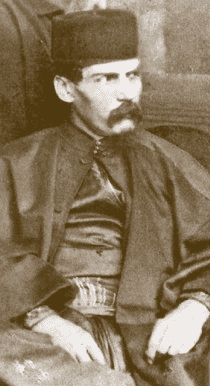 I discovered Steve and I share a fascination with Sir Richard Burton (1821-1890) when he put Burton on a list of "Good Things from Britain #5" in solidarity with the UK after the 7/7 terror bombings. Those of you who are not familiar with the life of this explorer, linguist, soldier, diplomat, travel writer, anthropologist, archaeologist, Orientalist, master swordsman, poet, raconteur, etc. will find a short bio and some other interesting things at this site. Another entertaining access to Burton is the 1990 movie Mountains of the Moon which is authentic to the spirit (if not every fact) of his explorations in search of the source of the Nile.
I have a very firm memory of a chance encounter I had at age 15 in the Frayser Branch of the Memphis Public Library with The Devil Drives, Fawn Brodie's estimable biography of Burton. The dust jacket bears the famous Leighton portrait of Burton showing the great scar on his cheek where the Somali spear went in. I picked up the book and have been enthralled ever since.
I have collected books by and about Burton for many years and they are often hard to come by. My primary purpose in putting up this post was to let fellow Burton-lovers know that The Narrative Press has put out a number of his travel writings in handsome trade paperback editions. I bought Goa, and the Blue Mountains from them recently.
It was to my great delight that I actually got to use one of my Burton books as a reference on a cultural resources project I managed years ago. Burton is best known for his explorations in Africa, India, and the Middle East. He only made one foray into America and his account of it, The City of the Saints centers around a trip he took to Salt Lake City in 1860. My project was a pipeline in Wyoming that went between the towns of Evanston and Casper. Its right of way cut a significant historical resource, the Oregon Trail, in several places. The Trail and its landmarks are still highly visible in Southwestern Wyoming.
Burton took a stagecoach on the Oregon Trail route to reach Salt Lake City. His account of that journey is perhaps the best contemporary description of the Trail. In his thorough way (which drove his readers nuts) he gave verbal descriptions of each stop, used a sextant to plot their locations, gave the distance and time it took to travel between each stop, what he ate, and on and on. Burton tells us, if you want to emigrate from Independence, MO to Oregon, what type of wagon to buy, its price, what type of draft animals to use, a list of supplies to take, their quantities, price, and unit of measure. All information hard to find anywhere else.
I'll ad a final sidebar to this story. I had to coordinate my evaluations of the effect of the pipeline on the Oregon Trail with a BLM historian. Her name was Kathy O'Neal. She was new on the job and very competent, practical and professional. She met and eventually married an archaeologist pal of mine, Mike Gear. After a few years, they left cultural resources work and decided to write some books of their own.
Apologies
Sorry for nonexistent blogging! Two reasons:
(1) Libby has broken four ribs, tripping on a dog- rucked rug and falling onto the corner of a brass- bound chest at the foot of the bed. Years of guiding in places like the Himalayas, climbing in the Tetons, kayaking around Baja, and her only injuries have been here-- breaking a shoulder in the garden a few years ago, and now this. And both were dog- related.
(2) Matt, in Baton Rouge, is taking in refugees from the storm.
I hope Reid and maybe John Carlson can take up a little of the slack until we are back on our feet.
Monday, August 29, 2005
Cannibalism in the Prehistoric Southwest
Steve's post below on PC Reburial alludes to a controversial subject - evidence of prehistoric cannibalism in Anasazi (Ancestral Pueblo) sites of the Southwest. I thought I'd say more about it as it's a subject I have followed since graduate school, when two colleagues of mine, Larry Nordby and Paul Nickens, excavated (Larry) and analyzed (Paul) site 5MTUMR2346 in southwestern Colorado that showed evidence of this. This site was less than a mile away from the four sites I wrote up in my thesis and we visited the site and discussed their research many times.
The floor of one of the rooms at 2346 was strewn with human bone and Paul's analysis of this indicated that at around AD 1100, thirty men, women and children were butchered and cooked. This collection was later reanalyzed in meticulous detail by Tim White, who reached the same conclusions, and published this book on it. This appeared in 1992 and was the first of a number of high profile studies on the subject.
These culminated in the publication of Christy & Jacqueline Turner's Man Corn in 1999 which took a synthetic review of possible instances of cannibalism at 75 sites in the Southwest. Their conclusion was that almost all of these were indeed provable as cannibalism and that the practice was not uncommon in prehistory here. This set off a storm of controversy and disagreement from other anthropologists who said they were misinterpreting the data, and Native Americans who believe the very idea is insulting to them and their ancestors. Some reasonably balanced accounts of both sides of this argument can be read in this article that originally appeared in The New Yorker as well as here and here and here.
Our grad school discussions about the findings at 5MTUMR2346 often speculated on the reason for cannibalism there. As I recall most centered around a "Donner Party" situation where people may have been driven to desperate measures by famine. The Turners reach a different (and even more controversial!) conclusion in Man Corn. They believe that it served as a form of punishment and social control. Individuals and whole villages that did not follow the dictates of Puebloan political authority were murdered, ritually butchered, cooked and eaten. The Turners believe that this behavior was learned from Mexico, where human sacrifice and ritual cannibalism were common among groups such as the Toltec and Aztec.
I can certainly understand how many Native Americans would be unhappy at the thought that their ancestors could have done such things, but looking at the amount of evidence marshalled by White, the Turners, and others, it's difficult to reach a different conclusion.
Pleistocene Sloth Poop

I just looked at the link to the Arizona Daily Star that Steve had in his last post that had this great picture of Dr. Paul Martin holding a Pleistocene Ground Sloth - "coprolite" is the proper term - and thought it deserved a post of its own. Such a priceless picture! This is real science! This is a man who has his "stuff" together!
Seeing it also reminded me of my days in graduate school. A colleague that I shared lab and office space with was doing studies of human coprolites from dry shelters in the Southwest for his master's thesis (theses on feces?). As found in the rock shelters the coprolites were firm and dry, like the one Dr. Martin is holding. For my friend to do his research to see what the prehistoric people were eating, what parasites they had, etc., he had to rehydrate them. You can imagine the smell. For a number of weeks there we had very few visitors. Actually, I found it imperative to do a lot of library research during that period.
Fear vs. "Re- Wilding"
Curious how the memes of "Re-wilding" and that of animal fear (scroll down and see Reid on sharks; I hope soon to post on Timothy Treadwell) seem to be multiplying on the news pages. For Re-wilding see this good commentary in Slate, and this article on Paul Martin from the Arizona Daily Star, showing him holding what is probably the same lump of sloth dung he once graciously placed in my hand. (How's that for an unlikely sentence?)
But the "rewilders" are going to have to deal with the attitudes of people who seem to think they can purchase absolute safety. Consider this NYT article on hysterical California billionaires and their terror over cougars who haven't done anything, and this slightly more tempered essay wondering how to deal with our situation , where predators come up against the edge of the suburbs.
The Californians are-- almost-- just plain silly, and seem prone to that syndrome peculiar to certain rich folks of thinking they can buy immortality. Most cougars-- I have lived in an area where they are common for over 25 years-- are no threat.
"Wildlife experts say that residents are overreacting to the presence of a stealthy animal that has been part of the landscape for as long as there has been a California. They say that mountain lions - also known as cougars - present an infinitesimal threat, especially if people avoid behavior like jogging alone at dawn or dusk close to the reservoir on Atherton's western border. (My emphasis).
Of course we do have one important cultural difference here-- we hunt them; though I have always been mildly skeptical of whether it actually changes the cats' attitudes, it makes people, even joggers or mothers with children, a bit less fearful. Unlike Californians, we can even carry unconcealed handguns without special permits. While jogging.
The second article seems saner, but it manages to lump "Timothy Treadwell, Assaulted by Bears" (apologies to the late Edward Gorey) with New Jersey suburban trashcan- raiding bears, skulking California cougars, and African lions that routinely dine on poor African farmers. Sorry, those are at least three and probably four different things.
First: treating grizzlies like teddy bears is.....let's be kind and say foolish. Most people have better survival instincts than Mr. Treadwell. I have no problem with the bears and probably would not have killed them. In his saner moments even Mr. Treadwell knew he was likely to attain his apotheosis as grizzly scat.
Black bears are garbage raiders. Deal with, meaning kill, real problem bears-- otherwise, get a life, or simply a better garbage can. Stop leaving bird seed on the ground. You are the same people who want the deer gone but hate hunters. Don't be such babies.
Cougars: real predators. But what is with the one destroyed by Park personnel in Colorado because it "looked at people"? Why not require all campers to stay on roads, and no climbing? Oh, right, they're already thinking about that in Yosemite...
Lions in Africa: deadly predators that have been eating us since before we were human. Ever have a lion look at you, even in a zoo? (I have worked in zoos). Ever see one after dark in Africa, gray in the edge of the headlights? Ever try to sleep as one worked the brand new electric fence twenty yards away, roaring for hours? A suburbanite in the Bay Area should not compare himself to a peasant in Africa whose life and livelihood is endangered by what is to him-- in fact not fancy-- a real "monster".
I support long- range Re- Wilding. I think the plains will never have a real population again-- no civilization has ever taken root on shortgrass plains or steppes, and it was a mistake-- an understandable one-- to try. Courageous men and women who have a prudent sense of what is dangerous and the attentiveness to live among dangerous animals may one day live lightly on the restored savannahs of North America. But they won't be the descendants of those who fear the cougar. And it is likely that they will fence the cats out of their yards the way I saw in Zimbabwe, not "confine them behind fences". It doesn't work that way.
PC Reburial?
i need to blur this story a bit to protect.... well, the guilty, but someone who told me this tale in confidence.
A few years a young woman, relative of someone we know, told us the following.
She had worked at [fill in the blank with any famous Southwestern site] and other places, and proudly bragged how at one site they had found an Anasazi- era "shaman's skull"-- her words-- filled with rattlesnake bones--!!-- and that they had turned it over to "the Indians" [which?] for instant reburial so no Anglo anthropologists would do any more "misinterpretations" [exact quote] like Christy Turner's of cannibalism. (Non- archaeologically- minded readers of this blog should know that Turner's work is meticulously documented and well- nigh irrefutable).
Makes one wonder what else has been reburied or destroyed to fit somebody's political agenda, on any side. "Truth is the first casualty", maybe especially when the wars are cultural. What can we do?
Thanks to Chas for persuading me to tell this tale.
Bernd Heinrich on Penguins
Vermont naturalist and prolific writer Bernd Heinrich, who knows a thing or two about birds and cold weather among other things, loved "March of the Penguins".
"As the movie continues, everything about these animals seems on the surface utterly different from human existence; and yet at the same time the closer one looks the more everything also seems familiar. Stepping back and viewing from the context of the vast diversity of millions of other organisms that evolved on the tree of life - grass, trees, tapeworms, hornets, jellyfish, tuna, green anoles and elephants - these animals marching across the screen are practically kissing cousins to us. Like many others who loved the movie, I admired the heroics of both the birds themselves and the intrepid camera crew that braved the inhumanly hostile environments of the Antarctic. But as a research biologist who has spent half a century studying the behavior and cognition of animals other than ourselves, I also admired the boldness of the filmmaker, Luc Jacquet, to face down the demon, if not the taboo, of anthropomorphizing his subjects".
He believes that, rather than potraying the birds as little humans, it reminds us what we share with other creatures.
"....the new breed of nature film will become increasingly mainstream because, as we learn more about ourselves from other animals and find out that we are more like them than supposed, we are now allowed to "relate" to them, and therefore to empathize".
And he contrasts thhis with ourculture's former anthropomorphism:
"Paradoxically, the cartoonish anthropomorphism of "Bambi," although it entertained the youngsters, blocked rather than promoted an understanding of animals. In "Bambi" we do not see other creatures. Instead, we are presented humans with antlers, and with our thought and speech".
I may have to see this movie after all!
Thursday, August 25, 2005
John Carlson On Penguins
Wildlife biologist John Carlson, last seen in a tux in Antarctica (go here for reference), offers some reasons why penguins are admirable, despite the fact they are not "cute:"
...I totally agree with the young lady concerning the nasty nature of penguins, but I also feel I must defend the little buggers too. Any wild animal I have ever dealt with has objected quite violently to being handled. Probably wouldn't survive very long if they didn't, so you can't be surprised or dismayed when it happens---No matter if they are cute or not.
If I can anthropomorphize a bit too: I would probably react similarly if some giant pulled me out of my living room, slapped a metal band on my arm, poured warm seawater down my throat and turned me upside down to "offload" my stomach to see what I had for breakfast, threw me in a bag and weighed me and then dropped me back in the living room (reminds me of the Larson cartoon with the male bear returning to the cave with an ear tag and a collar around his neck and trying to explain what happened to an obviously ticked off mama bear).
The young woman at the movie actually displayed as much ignorance as the Audubon folks and the audience by being surprised that the penguins reacted the way they did. She just got to live it and have her innocence taken away. I suspect that she hadn't had much experience with animals prior to heading south. I think she should have done the lecture and told people the truth...although I can really appreciate the standup routine too.

Anyway, in defense of the penguins -- they are the toughest animal I have worked with bar none. I have seen penguins with large chunks removed from their sides by leopard seals that apparently managed to survive. They beat on each other horrificly in defense of their territories and withstand some of the most brutal conditions on the surface of this earth. I am still in awe of their abilities to survive the demands that their lifestyle places on them. I suspect much of their rude behavior is a result of where they live: You don't mess with things that work in that environment. It is pretty unforgiving.
The Adelie penguin photo I have below pretty much sums up a penguin's life for me.
 >
Wednesday, August 24, 2005
The Tazi Girls
 The attraction of, and also the problem with "primitive" breeds of dogs is that they are intelligent. Interestingly, many pop boooks say the opposite; Oriental sighthounds, huskies, laikas are not neccessarily "tractable"-- they figure things out, and you must work with them. This makes many people think they are stupid. As someone who has trained spaniels, lurchers and -- is "trained" applicable?-- a dachshund, as well as dogs of the saluki/ tazi complex, I say "HAH!"
Their traits may be a result of their "growing up " to (nearly) adult or ''wolf'' behavior, rather than being stuck at some level of neoteny, as Raymond Coppinger has suggested. (I will blog more on this subject later if anyone is interested but I suspect a Google search of his name would turn up plenty).They tend to howl and yodel rather than bark, have only one estrus a year, dig dens, and form remarkably complex hierarchies with or without you. As Libby says, they are not beginner's dogs.
One thing they do that can be maddening or endearing is initiate original behavior. For reasons of peace and hierarchy the two female tazis-- Lashyn from Kiev, a South Kazakhstan "Semirichensky"- line tazi, suited for the biggest game and our fiercest dog, and Ataika from Almaty, our Turkmeni-strain sprite, smaller and sweeter but just as tough and arrogant-- spend the day largely indoors. Taik (pronounced "Tyke") can jump over the 8- foot backyard fence and would spend the day killing cats and risking death; Lash is jealous of her status, thinks she is my mistress and that only Libby ranks above, and dominates all the dogs but the Alpha male Plummer, yielding even to him only on food (Taik will submit but only if Lash is gentle about it; otherwise she will fight back hard).
Usually Lash sits to my left on the couch as I type, one paw touching me (Lib calls her "the jealous girlfriend"). This morning dawned cool and gray and windy and she wanted something else. She began to vocalize, making low "wuffs" and grumbles and yodels. She sat on the floor to my right, pawed me, got up, circled, and sat again. Taik murmured agreement from the couch. Every time I moved the mouse, she would catch my right hand with her paw. I said "do you want to go outside?" and walked to the back door. She sat down stubbornly. It was impossible to work.
Finally I went to the front door and both T- girls started racing around the house in ecstasy. "He got it, he finally got it!" I loaded them into the truck and took them for a run. They came back to the truck without hesitation-- often an issue-- and have been angels since.
Now-- I have seen countless dogs who, when you go to the door, know what is going on. I know many more that will even bring you their leashes when they want to go out .
But they had NEVER asked to go out. That is not the way we do it. They don't get a walk when I am at the computer. They have never before initiated a walk. Until this summer, Lash usually spent this time of day outside.
So how the hell did she figure out a way to demand one?
Above photo: T-Girls wrestling in freshly-cut tarragon: brindle Lashyn ("Peregrine"), and red Ataika, whose name means "Ruddy Shelduck". Most Kazakhs give tazis bird-related names.
Tuesday, August 23, 2005
Life is Dangerous - Deal With It
The title Biting Back: just because great white sharks are protected doesn't mean we should be on their menu of this LA Times op-ed almost says it all. It is symptomatic of the age we live in that an increasing proportion of our population believes that nature belongs in nature movies and we as individuals should never have to deal with its messy consequences. As I commented to Steve and Matt when I forwarded copies to them - it's as though we have a RIGHT to always be at the top of the food chain! I was appalled that the author of this piece, presumably a savvy "nature writer" published in Outside and Environmental History, could have taken this tone.
Read the article to get the facts that undermine its emotional argument: there have been 11 fatal shark attacks in California in the last 55 years. That's one every five years. Shall we compare those statistics with annual deaths due to car accidents, swimming pool drownings, home accidents and other risks we accept blithely each day? You know the answer and I'm not going through the exercise. Yet the author still feels entitled to say, " The urban beaches of Southern California are not the same as an oceanic 'wilderness' like the Farallon Islands. They are our backyard. We should not have to forfeit our right to security the minute we step off dry sand — especially because the scientific case for the great white shark's immediate endangerment becomes less convincing with each new sighting."
This "right to security" in nature? Where does it come from?
The article gives the story of the poor woman killed by a shark while swimming off Avila Beach in 2003. The lady was in the habit of putting on a black wetsuit and fins and swimming in the middle of a group of seals each morning. How a predator was to discern her from its normal food supply is beyond me. It's the moral equivalent of you or I grabbing a long steel rod and running to the top of the nearest tall hill in the middle of a thunderstorm. Not smart.
Sorry, but we all take risks as long as we're breathing. Know your environment, know what its risks are, accept them and do what you can to minimize them, as intelligent people do.
Of Pigs and Pit Bulls
How long can anyone sane continue to live in California? (Reid?)
It's not just the cost of living or the deficit or the smog or the crime or the massive illegal immigration-- one might put up with many of those things for the glories. It's the endless niggling laws, the superficial reverence for an environment that fewer and fewer people connect with, the...
Well, let's back up to those laws. The LA Times contained two stories today that may be of interest. While the problems-- non- native animals, animal rights, dangerous dogs, a state which thinks it can fix everything by regulating those who didn't "do it" (William S. Burroughs: "Every time some lunatic goes on a shooting spree they go out and take away the guns of everybody that didn't do it")-- the particular instances are completely Cailifornian.
First, non- native species in the Channel Islands. The story begins:
"Animal rights activists will get another chance to try to persuade a federal judge to halt what they consider the senseless slaughter of thousands of pigs on Santa Cruz Island.
"Recently rebuffed in their attempt to secure a temporary restraining order against the National Park Service, In Defense of Animals and two individual plaintiffs intend to ask Central District Judge Dickran Tevrizian Jr. on Sept. 26 to reconsider the case and grant an injunction against the feral pig eradication program".
The principal species that they are worried about are the Santa Cruz Island fox (not actually a species but a subspecies of the gray fox) and eight species of plants. If these are indeed endangered, I have no trouble with them removing the pigs by any reasonable means -- they are a fine game animal, though maybe for the taxpayers' sake and to annoy the Puritans they should allow year- round no limit hunting rather than employ "Pro Hunting, a New Zealand-based company, [with] a two-year contract to track down the pigs, using snipers, dogs and electronic collars".
Humans have introduced, aaccidentally or intentionally, many species-- goats, several species of deer which attain trophy proportions and are also fated to be eliminated-- in the Channel Islands, and eliminated others like the pygmy mammoth. The Park Service's most absurd move so far was to suggest shooting the island's Golden eagles, which they claimed were attracted there by the piglets but were now eating foxes, while denying most permits to falconers on the mainland (and of course letting Indian tribes strangle them without limits). I think the fetish of Pre- Columbianism is just that, and management (i.e. judicious killing) of the hooved immigrants would probably work better and be cheaper than a crew of Kiwi (why not Hawaiian, who would have at least as much experience, and are still American?) hotshots.
But the animal rights activists have managed to come up with an even dumber plan than the government's. " "Since there are probably not a lot of pigs left, I think the agency should give the contraceptive approach a chance; do the right thing and allow the remaining pigs to live out their lives". "
And then there are the poor pit bulls.
"Spurred by a recent rash of pit bull attacks on children in California, state lawmakers voted Monday to give local governments authority to require the spaying and neutering of specific dog breeds".
As usual "humane" groups, who the late dog trainer and philosopher Vicki Hearne said preferred animals to be either cute or victims, joined with the banners. Also, of course, not a few of these, like PETA, want an end to all domestication ("slavery"), though they may soft- pedal this fact to outsiders.
One congresswoman spoke sense." "The problem we have is not with our dogs but with our dog owners," said Assemblywoman Audra Strickland (R-Thousand Oaks). "There are a significant number of dog owners who abuse their dogs and condition them to fight and become vicious. Those people are the culprits.""
Exactly. To lose the brave genes that can go to make superior defense and schutzhund dogs because a few moral idiots (like the owners of the Presa Canarios that killed a young woman in San Francisco) will not be responsible is another kind of crime. What would happen to dogs like my Kazakh friends working tobets, who are certainly capable of killing armed adult humans in their Border Patrol work but will guard my friends' babies? If someone's dog kills an innocent, imprison him for murder and put his dog down. Don't ban breeds.
On the other hand, as long as proponents of bans are this dumb we may still stand a chance: " "It's time to get rid of these pit bulls," said Assemblyman Tim Leslie (R-Tahoe City). "I think we ought to string 'em all up, send them to some other state". "
In Germany animal rights group can now regulate the size of the wattles on pigeons.
A character in Cormac McCarthy's new novel, who asks an old sheriff if she can smoke, receives the laconic reply "its still America last time I looked".
Update: Lib looked at this and said:"They want to neuter both of them". Hmmmm....
Sacrificial Lambs
Have you ever wondered about the logistics of those burnt sacrifices in Classical and ancient Greece and Rome, or even in the Old Testament? Chas, hunter, professor, Pagan, and blogger, has...
On Falconry
My introduction to Steve's writing was from the falconry side of it, a popular article in Smithsonian, sometime in the mid-80s. I was surprised to know anyone wrote so well about the sport, then surprised again to discover he writes well about a lot of things. I'm sure various pigeon fanciers, gourmands, world travellers, writers, naturalists and fine-gun collectors have been equally surprised to see their favorite correspondent publishing on the weirdness of training hawks.
Steve doesn't need any more hobbies, but I bet he has them.
Sparking this post was Reid's comment in a recent email exchange, "You really have blogged very little on falconry, some on dogs, and not at all (that I recall) on coursing or pigeons or firearms. These are all subjects obviously where you have a tremendous fund of knowledge that you take for granted....Those are subjects that are the bread and butter of your books, the things that attracted readers like me and Matt."
Steve sent back, "Well, I just got one up on guns! Actually there will be more on hawks and dogs. I have been sort of saving this stuff for fall."
In fact the hawking and coursing time of year is not quite on us yet. When the hawks are up to molt (between late spring and early fall) we give them their due (food and care, etc.) but also take advantage of the extra time for other projects. In Steve's case, I gather that's quite a lot.
Steve then offered Reid another possible reason for the lack of falconry: "Matt and I are very odd falconers---we do weird things. So do many who we like, like the 'boyos' in Albuquerque. We are extremely naturalist-oriented as some but not all falconers are. None of us are mainstream, though Matt is very modern in some ways, and I very primitive."
To carry Steve's point a bit further, practicing "odd" falconry has some bearing on how and what you can write about it. It may be interesting to us, but also complicated when you consider the public forum: To non-falconers, we are ALL falconers. Some of the sub-distinctions we find significant are pretty arcane on the "outside." Few of us are comfortable presenting ourselves as general examples.
And then there are our peers. As Steve notes in A Rage for Falcons, falconry is "a great stirrer-up of passions." You need only to attend a gathering of hawkers, or to browse the Internet a bit to find ample proof. It is difficult to say enough to be meaningful without saying enough to be controversial.
Before I quit, the monikers "modern" and "primitive" falconry may need a bit more explaining: Steve flies a domestic-bred, hybrid falcon, which is hardly primitive. And I hunt small birds with various small hawks, something falconers have been doing forever. But Steve likes to fly his falcons at game directly off the fist (an ancient, eastern form of the sport) and at hares and rabbits (a heresy to Westerners, but traditional practice elsewhere). I tend to hunt non-traditional (read: low-rent) quarry like rails, starlings and sparrows. I fly a Harris' hawk ("the un-goshawk!") off a PVC pipe carry-pole and ply my trade mostly in undeveloped suburban plots. Thus, modern.


Left: "Primitive" Hybrid gyr 'Tuuli' on traditional screen perch, and Right: "Modern" Harris hawk 'Charlie' on PVC pipe carry-pole
Steve doesn't need any more hobbies, but I bet he has them.
Sparking this post was Reid's comment in a recent email exchange, "You really have blogged very little on falconry, some on dogs, and not at all (that I recall) on coursing or pigeons or firearms. These are all subjects obviously where you have a tremendous fund of knowledge that you take for granted....Those are subjects that are the bread and butter of your books, the things that attracted readers like me and Matt."
Steve sent back, "Well, I just got one up on guns! Actually there will be more on hawks and dogs. I have been sort of saving this stuff for fall."
In fact the hawking and coursing time of year is not quite on us yet. When the hawks are up to molt (between late spring and early fall) we give them their due (food and care, etc.) but also take advantage of the extra time for other projects. In Steve's case, I gather that's quite a lot.
Steve then offered Reid another possible reason for the lack of falconry: "Matt and I are very odd falconers---we do weird things. So do many who we like, like the 'boyos' in Albuquerque. We are extremely naturalist-oriented as some but not all falconers are. None of us are mainstream, though Matt is very modern in some ways, and I very primitive."
To carry Steve's point a bit further, practicing "odd" falconry has some bearing on how and what you can write about it. It may be interesting to us, but also complicated when you consider the public forum: To non-falconers, we are ALL falconers. Some of the sub-distinctions we find significant are pretty arcane on the "outside." Few of us are comfortable presenting ourselves as general examples.
And then there are our peers. As Steve notes in A Rage for Falcons, falconry is "a great stirrer-up of passions." You need only to attend a gathering of hawkers, or to browse the Internet a bit to find ample proof. It is difficult to say enough to be meaningful without saying enough to be controversial.
Before I quit, the monikers "modern" and "primitive" falconry may need a bit more explaining: Steve flies a domestic-bred, hybrid falcon, which is hardly primitive. And I hunt small birds with various small hawks, something falconers have been doing forever. But Steve likes to fly his falcons at game directly off the fist (an ancient, eastern form of the sport) and at hares and rabbits (a heresy to Westerners, but traditional practice elsewhere). I tend to hunt non-traditional (read: low-rent) quarry like rails, starlings and sparrows. I fly a Harris' hawk ("the un-goshawk!") off a PVC pipe carry-pole and ply my trade mostly in undeveloped suburban plots. Thus, modern.


The Pack
I mentioned the hounds in the last post but readers are asking how they are. During the summer the heat is bad for the muscular, greyhound-derived lurcher---tests by John Burchard have found that after a run in an outdoor temperature of 60 degrees F., the internal temperatures of greyhounds are in the dangerous range, as opposed to that of dogs in the saluki/tazi group (incidentally I prefer the more Cyrillicly phonetic "tasy" but I think I have lost the battle).
Basically you must throw such a dog in a pool to avoid death or damage, and my Plummer is too (pick one) valiant/dumb not to run. Lily the dachshund also overheats as she is small, close too the ground, and shaggy.
The tazis are not bothered. But the jacks in the summer are full of subcutaneous botflies and have enough problems without having to escape dogs. So I try to keep my hounds sane with once-or-twice-a-week runs early in the morning, up in th Pinon- Juniper woodland where the "quarry" is mostly cottontails that quickly go down holes without over-exerting themselves or the dogs.
Now is the time when we begin to get out and get in shape again---all of us. This is a photo of the pack last Sunday: spotted lurcher Plummer, red tazis Kyran and Ataika, brindle tazi Lashyn, and miniscule dachs Diamond Lil. And me, of course.
The Beauty of Weapons 1
Fall is in the air in the New Mexico highlands, and my hounds and hawk are restless, whining at the front door, or rowing wings in the quickening wind. You will be hearing more about them, I promise.
 But a natural transition from the fluted points of prehistory is the beauty humans-- all right, mostly men -- have bestowed on their hunting tools.
 I present you with photos of a rare and obscure English "Best" shotgun, a Griffiths, shaped and filed by hand to the tolerances of a particle of smoke, in Manchester in 1878. You can still buy a new London or Edinburgh or Birminghan Best, but it will take a couple of years and cost anywhere from forty to eighty thousand POUNDS. This one cost me less than $1500, including having the Damascus barrels re- finished by Chuck Webb at Briley.
 This black and white photo from the late Geoffrey Boothroyd's Shotguns and Gunsmiths shows the Damascus pattern more clearly. We believe it is of my gun!
You have to study old guns. My old friend the Albuquerque rare gun dealer Ron Peterson offered me this one, or a comparable one, of similar age, by the famous Westley Richards. We both agreed that this one had better details and balance, but someone relying on "names" would have gone with the other.
 It shoots light modern ammo as well as it did over 100 years ago, and I will open dove season with it. These things are made to last! I have handled a muzzle- loading gun made by Joseph Manton, the first maker of London Bests, that still worked; it dated from the 1790's. I am told some such still see action on the grouse moors of Scotland-- though I suspect only in good weather....
But a natural transition from the fluted points of prehistory is the beauty humans-- all right, mostly men -- have bestowed on their hunting tools.I present you with photos of a rare and obscure English "Best" shotgun, a Griffiths, shaped and filed by hand to the tolerances of a particle of smoke, in Manchester in 1878. You can still buy a new London or Edinburgh or Birminghan Best, but it will take a couple of years and cost anywhere from forty to eighty thousand POUNDS. This one cost me less than $1500, including having the Damascus barrels re- finished by Chuck Webb at Briley. This black and white photo from the late Geoffrey Boothroyd's Shotguns and Gunsmiths shows the Damascus pattern more clearly. We believe it is of my gun!You have to study old guns. My old friend the Albuquerque rare gun dealer Ron Peterson offered me this one, or a comparable one, of similar age, by the famous Westley Richards. We both agreed that this one had better details and balance, but someone relying on "names" would have gone with the other.
It shoots light modern ammo as well as it did over 100 years ago, and I will open dove season with it. These things are made to last! I have handled a muzzle- loading gun made by Joseph Manton, the first maker of London Bests, that still worked; it dated from the 1790's. I am told some such still see action on the grouse moors of Scotland-- though I suspect only in good weather....
Subscribe to:
Posts (Atom)