Lane Batot sent in this quote from "that clever 'Anonymous' person":
"Pedigree indicates what the animal is supposed to be; Conformation indicates what the animal appears to be; Function indicates what the animal actually is."
Showing posts with label Animal Breeding. Show all posts
Showing posts with label Animal Breeding. Show all posts
Thursday, November 10, 2016


Friday, September 02, 2016
Heinz Meng, 1925 - 2015: RIP
 |
| Heinz Meng in the 70s. |
Dr Heinz Meng of New Paltz NewYork, a long -time professor of Zoology at the State University there and the man who first bred falcons in captivity in the US (Not in the WORLD as many news reports chauvinistically state; Renz Waller bred several in Germany before the war, and Ronald Stevens and young John Morris actually bred a Saker- Peregrine hybrid clutch in Ireland in the sixties. But Waller and especially Stevens were gods of falconry, and Stevens had an entire huge estate in Ireland where he often let his falcons range free, and pioneered training methods and attitudes in his modest little Observations on Modern Falconry that were to change the ways of everybody from Harry McElroy to me.
While Heinz was a modest professesor in a state college who bred Peale's Pergirines in his backyard, making it look so easy that in a very short time, his friends Tom Cade and Jim Weaver, driven by the DDT crisis and the disappearance of the anatum- race Peregrine from its eastern eyries, cranked up what became the a kind of falconry Manhattan Project in their quonset huts at Cornell. This in turn would lead to the Peregrine Fund being founded by the late Frank Bond, future Republican gubernatorial candidate of New Mexico : Jim Weaver, born in Illinois and now a rancher in eastern New Mexico; Bob Berry, then of Philadelphia's Main Line and now of Wyoming, where he endowed the Berry Center for Biodiversity at U Wy Laramie, run by my friend Carlos Martinez del Rio, and Tom Cade, born dirt poor in there Depression in New Mexico's Bootheel, professor at Cornell and the only poor man among them. For the next (approximately- I would have to look it up) twenty years, hack teams would receive their precious hatch of "Cornell chickens" (a derisory term coined by, I believe, the birding writer Pete Dunne-- write to me, Pete!- and adapted with pride by those of us who worked the hack, including me) and nurse them to maturity, enduring everything from lightning storms to yellowjacket stings to rattlers to tourists to, even, slightly misinformed federal undercover agents. My partner, John Tobin, Vietnam vet, grad student, falconer, recently retired Massachusetts Game warden, and I survived all of the above, plus drunken races down the Mount Tom Alpine Slide, in which you would sometimes find trapped copperheads, which could flip into your lap...
All to be told, soon, and in the blog, but not here.What Heinz Meng did was deceptively simple: by his own knowledge and patience, he bred a threatened glamor species, a "charismatic" if not mega- faunal species that had captured the imagination of humans in many cultures for hundreds if not thousands of years. He was a scientist and so recorded his information in reproducible ways.The result was not just one revolution but several (think of the importance, and money, devoted to falcons in Arab cultures, for a hint; think of the blow to the egos of at least some traditional Arabs when they found the larger, braver "male" migrant falcons they were so proud of, that they had never seen nesting on their remote Central and Arctic Asian homes, were FEMALE!)
Meng's simple brilliant act of husbandry was to give the east back a relatively common Peregrine, if not precisely the one it started with; start entire industries, up to and including Robo- Falcons; extended to virtually every falconer's bird, including a new one, the Harris's hawk, possibly the most popular hawk in the world today*, and a rediscovered one, the "Alethe", better known as the Aplomado; make modern falconry possible (most European countries, unlike the States, do not allow any wild "take" at all); employ semi- unemployable types such as me and Helen Macdonald, at least on occasion, and give us stories to tell; and generate a truly amazing amount of myth and counter myth. And it all started in Heinz Meng's garage.
I only met Heinz once. Although most reports of his first successful breeding give the dates as 1971 or 1972, I am for various external reasons sure that the date was 1970, when my friend Mark, a long time falconer who met me that year, and Mike Conca, my oldest friend, who still lives in the hills of western Massachusetts, went to a very off-the-radar "meet" in central New York. Heinz was there with a young and very vocal Peale's falcon (the choice of that difficult sub-species makes his breeding more remarkable). Others present included that old bandit Victor Hardaswick, then a young bandit; then and forever he resembled a rather sinister version of Seinfeld's George. He was to become a celebrated breeder of falcons himself, and then the only breeder of Siberian goshawks in the U.S., but then he was a bandido from Bridgeport, as well as a second generation fighting cock fancier, the son of a great pouter pigeon breeder. His friend Fran Lynch, another bandit, was there, and a biologist who would later have an extremely savage Golden eagle, which nearly caught me, confiscated and sent to Martha's Vineyard, where it would live out its life in the household of Vineyard falconer Gus Ben-David, who is best known for flying Great horned owls (THAT falconer was alleged to have consorted with "escorts" at falconers' conventions, one of whom supposedly answered the phone in a motel with the news that "Bill can't come to the phone right now -- he's tied up.") In addition to the legal birds there, there were the first two "blonde" beach peregrines I'd ever seen up close, who were sitting on blocks on the lawn. Mark said "I'd sure like to have some lawn ornaments like that". Their owners too are long dead, so I'm not worried about repercussions.
Later they were flown successfully at bagged pheasants. They were two weeks out of the trap; that's how tame the Arctic birds are. I coveted them fiercely, and have still never flown one now that they are legal.
Later, Heinz flew his bird, and he would not come down. Victor killed a pigeon and threw it in the air to see if he would return. He didn't. He vanished behind the trees, still calling, and I don't think he ever came back. He might have been taken by a horned owl, an all too common end for birds left out overnight, especially in the days before electronic transmitters. It appalls, and on some level, blackly amuses me, to think that I saw one of the very first clutch of falcons bred in the United States fly away.
Autre temps, autre moeurs. Here's to you, Heinz, for starting a whole new world.
 |
| Dr. Meng more recently, with a Peale's |
Friday, June 12, 2015
Apache
Paul has his old NM Gos back, a bird who might have been his best. He has descendants, with Finnish genes, and if all goes well I may yet fly one.
Accipiter gentilis apache may or may or may not be a valid taxon, but Gila Goshawks are distinctive. First I ever saw was in the late 70's, when rancher John showed me one he had caugh and tamed after it had killed a number of his game fowl. The story is in Q- the - book.
Black, silver, garnet red...

Accipiter gentilis apache may or may or may not be a valid taxon, but Gila Goshawks are distinctive. First I ever saw was in the late 70's, when rancher John showed me one he had caugh and tamed after it had killed a number of his game fowl. The story is in Q- the - book.
Black, silver, garnet red...

Friday, October 24, 2014
Photoblogging: Kurdish Turkey II: Village Life
Hounds, houses, house partridge, sheep, field pigeons...


 Partridge, called "Keklik" are kept as pets and for calling their wild relatives, which they catch with fine nooses... demonstrated below


 These "swift" pigeons are bred for show in the west but fly free here. The one on the ground had just evaded a wild Peregrine and was feeding on the ground again.
 The Lebanons below are big enough to eat though also handsome. They are probably ancestor to the Carneau, a squabbing and show breed, in the west.


Saturday, April 19, 2014
Easter Doggage/ Impending Litter?
Riss and Aymoon:


If you think Aymoon seems a little goofy, consider this photo of him in action.
We already know that Rissy is a good girl.
Sunday, September 29, 2013
Trouble coming: APHIS
A few weeks ago the Sportsman's andAnimal Owners Alliance warned us that, despite the efforts and concerns expressed, literally for years, by small breeders, APHIS was coming. They listed these points of concern:
"Can hunting dog kennel owners sell pets?
Can breeders ship sight-unseen where relationships have been well established ?
Can litters be whelped inside the house?
Are rescues still exempt if they ship sight-unseen?
Can animals, other than rabbits, be shipped for preservation of the species?
Do the APHIS regulations take precedence over state license regulations?
How can we believe the answers from APHIS staff who do not understand the questions?
Does APHIS plan to offer any protection for newly licensed breeders so that kennel photos are not added to the ASPCA “puppy mill” data base and other sensationalized uses?
If you are reported to APHIS as needing a license, are investigators required to have a warrant to enter your premises?
Is everyone on the same premise required to be licensed if one person must be licensed?
"The rule is overly complicated, inconsistent, and certainly not easy to understand. The internet and chat groups are full of conversation about this rule with a number of interpretations and a wide variety of opinions being circulated. APHIS also posted another Question and Answer Fact Sheet with their explanations to some of the major concerns submitted during the rule making process. Again as last year, the Q&A contains many half, incomplete, or misleading answers. The reality is that the final interpretation of the rule and its definitions will be at the discretion of APHIS inspectors and staff."
Here are (a few of many) examples:
"The AWA Standards of Care for housing, facilities, exercise, cleaning, sanitization, employees, housekeeping, and pest control will not be revised.
"Living under USDA licensing is NOT an option for the average home-based retail seller. The average house cannot be converted to a USDA compliant facility. Federal standards for licensed facilities dictate sanitation measures not feasible in a normal home, surfaces that are impervious to moisture, ventilation, bio-hazard control, veterinary care, exercise, temperature controls, waste disposal systems, diurnal lighting, drainage systems, washrooms, perimeter fencing, as well as transportation standards for regulated animals.
"... IF you can give up a room in your house and convert it to be the moisture proof, sterile environment described above, AND gain approval from an APHIS inspector, you may be able to crate or pen animals in that room. This room would then be for either adults or puppies/kittens but not both. Under the USDA standards puppies and kittens under 4 months of age cannot be housed in the same primary enclosure with adults, other than the dam/queen or foster dam/queen. Since the remainder of your house does not meet the above requirements, allowing animals to roam freely would cause you to be in violation of the AWA. And unless your bedroom is coated in epoxy and has a floor drain, you won’t be doing any whelping there.
"A separate facility will be needed for females by two weeks prior to whelping. Even if you make one room in your house compliant with the AWA standards, females cannot be whelped in that room. That means an additional room will be required, plus one for each additional litter within the next 3.5 months.
"Any room in your home used for whelping or birthing must meet USDA standards – impervious to moisture – meaning tile floor and vinyl-coated walls.
"All surfaces touched by animals must be waterproof and sterilized every two weeks with your choice of live steam under pressure, 180 degree water and detergent with disinfectant, or a combination detergent/disinfectant product."
It has passed, without most of this being clarified. Lane Batot's friend Jill Porter, who has been fighting the act for a long time, wrote:
"It goes into effect in 60 days. It's 91 pages of convoluted and hard to understand new regulations for anyone breeding pet animals (dogs, cats, pocket pets, reptiles and much more.) The short of it is that even smaller home based breeders like me can no longer ship puppies without being USDA licensed. The requirements to be licensed will force us to not be able to raise dogs the way we do, as family members in our homes. Because of many other changes, it also has a horrible impact on our ability to make good genetic decisions for our breeding programs, and so much more. I am still in shock about this as is everyone who knows about it and understands what it is going to do. The reasoning was to control the huge volume breeders that sell sick puppies sight unseen over the internet, but in reality it will hurt the small, quality dog breeders who show and preserve the valuable genetics in each breed. Some of my friends have already announced they are closing down their breeding programs, since they have rare or less common breeds and can't function with the new regulations. (These are the good breeders who raise dogs in the home, do all health testing, are very active in their breed clubs and more.) It is going to be such a loss to see those breeds and bloodlines disappear. But hey, it's the government and animal rights groups in action. At least the big puppy mills will stay in business (and THAT is said with a HUGE amount of sarcasm) since they don't care if they have to keep dogs in cages to comply with regulations.
"This is a huge victory for the radical animal rights group the Humane Society of the United States (HSUS) who pushed for it To them all breeders are puppy mills and they want to see all breeding stopped forever. Their president said he wants to see domestic animals become extinct... They don't help shelter pets, they use their money for lawyers, pensions and lobbbying but their commercials make you THINK you are giving to save puppies and kittens in shelters. Check out www.humanewatch.org for more."
Text of the act, or most of it, should be here.
"Can hunting dog kennel owners sell pets?
Can breeders ship sight-unseen where relationships have been well established ?
Can litters be whelped inside the house?
Are rescues still exempt if they ship sight-unseen?
Can animals, other than rabbits, be shipped for preservation of the species?
Do the APHIS regulations take precedence over state license regulations?
How can we believe the answers from APHIS staff who do not understand the questions?
Does APHIS plan to offer any protection for newly licensed breeders so that kennel photos are not added to the ASPCA “puppy mill” data base and other sensationalized uses?
If you are reported to APHIS as needing a license, are investigators required to have a warrant to enter your premises?
Is everyone on the same premise required to be licensed if one person must be licensed?
"The rule is overly complicated, inconsistent, and certainly not easy to understand. The internet and chat groups are full of conversation about this rule with a number of interpretations and a wide variety of opinions being circulated. APHIS also posted another Question and Answer Fact Sheet with their explanations to some of the major concerns submitted during the rule making process. Again as last year, the Q&A contains many half, incomplete, or misleading answers. The reality is that the final interpretation of the rule and its definitions will be at the discretion of APHIS inspectors and staff."
Here are (a few of many) examples:
"The AWA Standards of Care for housing, facilities, exercise, cleaning, sanitization, employees, housekeeping, and pest control will not be revised.
"Living under USDA licensing is NOT an option for the average home-based retail seller. The average house cannot be converted to a USDA compliant facility. Federal standards for licensed facilities dictate sanitation measures not feasible in a normal home, surfaces that are impervious to moisture, ventilation, bio-hazard control, veterinary care, exercise, temperature controls, waste disposal systems, diurnal lighting, drainage systems, washrooms, perimeter fencing, as well as transportation standards for regulated animals.
"... IF you can give up a room in your house and convert it to be the moisture proof, sterile environment described above, AND gain approval from an APHIS inspector, you may be able to crate or pen animals in that room. This room would then be for either adults or puppies/kittens but not both. Under the USDA standards puppies and kittens under 4 months of age cannot be housed in the same primary enclosure with adults, other than the dam/queen or foster dam/queen. Since the remainder of your house does not meet the above requirements, allowing animals to roam freely would cause you to be in violation of the AWA. And unless your bedroom is coated in epoxy and has a floor drain, you won’t be doing any whelping there.
"A separate facility will be needed for females by two weeks prior to whelping. Even if you make one room in your house compliant with the AWA standards, females cannot be whelped in that room. That means an additional room will be required, plus one for each additional litter within the next 3.5 months.
"Any room in your home used for whelping or birthing must meet USDA standards – impervious to moisture – meaning tile floor and vinyl-coated walls.
"All surfaces touched by animals must be waterproof and sterilized every two weeks with your choice of live steam under pressure, 180 degree water and detergent with disinfectant, or a combination detergent/disinfectant product."
It has passed, without most of this being clarified. Lane Batot's friend Jill Porter, who has been fighting the act for a long time, wrote:
"It goes into effect in 60 days. It's 91 pages of convoluted and hard to understand new regulations for anyone breeding pet animals (dogs, cats, pocket pets, reptiles and much more.) The short of it is that even smaller home based breeders like me can no longer ship puppies without being USDA licensed. The requirements to be licensed will force us to not be able to raise dogs the way we do, as family members in our homes. Because of many other changes, it also has a horrible impact on our ability to make good genetic decisions for our breeding programs, and so much more. I am still in shock about this as is everyone who knows about it and understands what it is going to do. The reasoning was to control the huge volume breeders that sell sick puppies sight unseen over the internet, but in reality it will hurt the small, quality dog breeders who show and preserve the valuable genetics in each breed. Some of my friends have already announced they are closing down their breeding programs, since they have rare or less common breeds and can't function with the new regulations. (These are the good breeders who raise dogs in the home, do all health testing, are very active in their breed clubs and more.) It is going to be such a loss to see those breeds and bloodlines disappear. But hey, it's the government and animal rights groups in action. At least the big puppy mills will stay in business (and THAT is said with a HUGE amount of sarcasm) since they don't care if they have to keep dogs in cages to comply with regulations.
"This is a huge victory for the radical animal rights group the Humane Society of the United States (HSUS) who pushed for it To them all breeders are puppy mills and they want to see all breeding stopped forever. Their president said he wants to see domestic animals become extinct... They don't help shelter pets, they use their money for lawyers, pensions and lobbbying but their commercials make you THINK you are giving to save puppies and kittens in shelters. Check out www.humanewatch.org for more."
Text of the act, or most of it, should be here.
Sunday, September 08, 2013
More on Closed Registries
Population geneticist Federico Calboli is a frequent and outspoken commenter at Q. I sent him the material below even before I blogged it. Here, with his permission, are his thoughts. As he is not affiliated with any breeding organization his freedom from bias is clear. If you believe that simply picking from two healthy parents will guard against the defects revealed by the ever- shrinking gene pool, you should read this.
Sadly, most people who follow this blog already know these things, and those committed to the 19th century fallacies of "pure breeding" are standing around with fingers in their ears hollering "LALALALALALAI CAN'T HEARYOU!!!" Still, you never know who you might reach. Take it away, Federico! (Emphasis mine)
"Assuming one is trying to produce pedigree dogs that are healthy (i.e. health is the phenotype we select for), the advice [in post below] is sound.
"The elephant in the room (which is touched in the intro when landraces are mentioned) is that, no matter what, closed registry breeding will kill a breed, sooner or later. Later if the advice in the document is followed, but that's no silver bullet. Keeping dogs cost money (no matter how little, it's always more than 0). Even in the 'let's just breed for health' dreamscape, keeping the largest possible effective population would be quite costly. Who pays? This problem just by itself means that sooner or later genetic variability will be lost. In the best case scenario this is a slow whittling away, but there is never any putting back in a closed registry model.
"Hence why either you breed for function (dog X does job Y well enough, dog X is a breeder, end of), and 'breed' becomes a synonym with 'function', or you need something else. Hence why I recommend to reduce the number of breeds, merging similar one (say, all retrievers together, all sighthounds together) AND to have open registries. Merging breeds would increase genetic variability while keeping some guideline in terms of looks and function. Open registries (keeping note of all 'half bred' animals, and fully registering those with 3 out of 4 grandparent registered, or something like that) would guarantee gene flow after the first 'enrichment' through breed merging has happened.
"To cut it short, no matter how well managed, sooner or later closed registries will spell doom for a breed. Having said that, there is more to say about canine health, but that's for another email."
Sadly, most people who follow this blog already know these things, and those committed to the 19th century fallacies of "pure breeding" are standing around with fingers in their ears hollering "LALALALALALAI CAN'T HEARYOU!!!" Still, you never know who you might reach. Take it away, Federico! (Emphasis mine)
"Assuming one is trying to produce pedigree dogs that are healthy (i.e. health is the phenotype we select for), the advice [in post below] is sound.
"The elephant in the room (which is touched in the intro when landraces are mentioned) is that, no matter what, closed registry breeding will kill a breed, sooner or later. Later if the advice in the document is followed, but that's no silver bullet. Keeping dogs cost money (no matter how little, it's always more than 0). Even in the 'let's just breed for health' dreamscape, keeping the largest possible effective population would be quite costly. Who pays? This problem just by itself means that sooner or later genetic variability will be lost. In the best case scenario this is a slow whittling away, but there is never any putting back in a closed registry model.
"Hence why either you breed for function (dog X does job Y well enough, dog X is a breeder, end of), and 'breed' becomes a synonym with 'function', or you need something else. Hence why I recommend to reduce the number of breeds, merging similar one (say, all retrievers together, all sighthounds together) AND to have open registries. Merging breeds would increase genetic variability while keeping some guideline in terms of looks and function. Open registries (keeping note of all 'half bred' animals, and fully registering those with 3 out of 4 grandparent registered, or something like that) would guarantee gene flow after the first 'enrichment' through breed merging has happened.
"To cut it short, no matter how well managed, sooner or later closed registries will spell doom for a breed. Having said that, there is more to say about canine health, but that's for another email."
Saturday, September 07, 2013
Clear Thinking on Genetic Diversity
Every breeder of domestic animals with a closed studbook should read this, all of it. Most important is the section the writer, Jeffrey Bragg, calls Principles for the Breeder.
(MANY thanks to Daniela Imre)."The great majority of dog breeds have been bred within a completely closed studbook for sixty to a hundred years or longer, with little or no fresh genetic input throughout the entire period from breed foundation to the present. In most cases the stud book was opened for a year or two, a small number of founders, often closely related to one another, were registered, and the stud book was then closed. Thereafter, only dogs descended from the founders could be registered. And for those sixty to a hundred or more years, artificial selection, random drift, bottlenecking and other forms of attrition took their toll of whatever genetic diversity was present in the founder group. It is exactly as though a bank account had been established with a single initial deposit (the genetic diversity of the founders), with no further deposits permitted; meanwhile bank fees and direct debits (diversity losses from drift, selection, etc.) chiselled away at the balance. It is a sure and certain recipe for bankruptcy.
"Similarly, many individual bloodlines have been treated in exactly the same way, bred in relative genetic isolation from other bloodlines -- except that in this case additional deposits are at least allowed, in the form of bloodline outcrosses. Therefore each breeder probably ought to consider the desirability of locating and using a true outcross within his or her own breed (unrelated to one's own stock for at least ten to fifteen generations) at least once and to integrate the resulting progeny into one's kennel bloodline.
(Snip)
"If there is any possibility whatsoever to import unrelated stock from a breed's country of origin, one ought seriously to consider doing just that. This is mainly possible in the case of landrace breeds, in which an autochthonous regional population remains in the country of origin, independent of exported stock that may have become a registered breed in other countries. Examples of such situations would be the population of desert-bred coursing sighthounds in the Near East, relative to the Saluki breed in Europe and North America, or the relict populations of autochthonous arctic spitz-type sled dogs relative to the modern Siberian Husky, Alaskan Malamute, Samoyed, et al.
"It would be difficult to overestimate the genetic value of a single import animal, unrelated to the registered breed population for scores of generations but stemming from exactly the same fountainhead. This I would term the Holy Grail of the diversity breeder -- the ideal controlled-outcross situation in which an immediate significant increase in healthy genetic diversity may be obtained at little to no cost in terms of breed type and purpose. (That the Canadian Kennel Club rejected this option for the Siberian Husky in 1994 demonstrates, I believe, the true extent to which the umbrella all-breed registries represent an obstacle to genetic health and true breed welfare and improvement.)"
Are you listening, AKC? Saluki Club?
Oh right, all those "Holy Grail" dogs are... mongrels.
Thursday, August 29, 2013
Doggage
More relatives; Daniela's boys in part, Shunkar, showing the permanent damage the rattler did; thank God he did not lose an eye. Then, Monnie's new pups, from John B and Vladimir; sweet Kyra, Tigger's daughter, with her GSD protector Eden, and (the little red) feisty Aeris, Taika's neice and already a tiny tyrant who knows she was born to rule the world.


Kyra is already pointing pheasants

Really-- I hunt with Ataika as a bird dog, though nobody believes it!

Thursday, July 18, 2013
Once and future?
Passenger pigeons at the Denver Museum by Reid. They will be back, here at least. But why do those who would resurrect them plan on using Columba (Bandtail, now) genes for a template for such obvious Zenaida relatives?


Thursday, June 13, 2013
Tigger's Pups #1


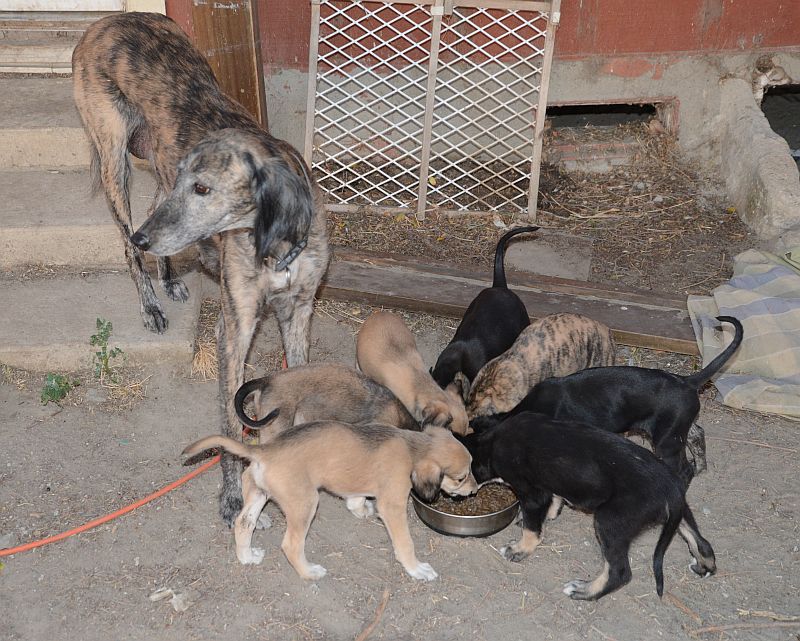
Courtesy of John Burchard, who bred them, and Daniela Imre, a co- "grandparent" of the human species: the wonderful rainbow litter of Tigger, bred here, and Prince. Multicolor, smooth and feathered, Kazakh & Arab; all progenitors hunters: the ultimate Silk Road US litter!
I am tempted by the little brindle girl and the feathered tri(s?), but health, poverty, and the desire to have a pup with Taika's genes say no.. as I say, tempted.
There will be more photos.
Saturday, May 18, 2013
Gratuitous Pigeon Photos
Handsome birds, "Lebanons". I saw their like in Turkey a few years ago. Anyone know where I can find a pair or two for less than $250? Stupid regs make all imported birds impossibly expensive for all but the rich, and cause hoarding and inbreeding depression in the tiny gene pools that exist in the US. I'm no fan of closed studbook pedigrees-- I cross out and back again, until I have the "good' phenotype with a wider genetic palette...


From my friend Warren, who has some of my "granddogs", I am getting some young of one of my favorite breeds, the wild, rugged old show bird called the English carrier. It no longer carries messages-- that job long ago taken over by its partial descendant, the racing homer, but is still a strong swift flier. It has too much character (is too odd/ ugly/ finicky) for modern tastes, but it was once known by the Scottish handle "King o' the Doo's" [doves]. Darwin bred ones that could win best in show today; there is a good illustration in his book on domestication, "Variations". Some of mine should come from the excellent pair in the first photo.


From my friend Warren, who has some of my "granddogs", I am getting some young of one of my favorite breeds, the wild, rugged old show bird called the English carrier. It no longer carries messages-- that job long ago taken over by its partial descendant, the racing homer, but is still a strong swift flier. It has too much character (is too odd/ ugly/ finicky) for modern tastes, but it was once known by the Scottish handle "King o' the Doo's" [doves]. Darwin bred ones that could win best in show today; there is a good illustration in his book on domestication, "Variations". Some of mine should come from the excellent pair in the first photo.


Sunday, April 28, 2013
Pigeons vs Humaniacs
Chris Landauer of Border Wars sent me a note a couple of weeks ago on the ARista's war on pigeon racing. Since then I have been roaming the Internet, too busy and too pissed off to to write a calm essay on the kind of people who would persecute old men, some of them who have made real connections to youngsters of different cultures, for being "racketeers" for betting on races. They claim it is cruel because some don't make it home (they don't know most ferals are more homer than not), and that some substandard birds are "culled" (and eaten), a practice and term that they seem to think unique to pigeon keepers....
It would of course be easy to sue the sport out of existence, of course; though the Queen of England and some wealthy Belgians fly birds, the old working class cartoon character Andy Capp on the other side of the channel and ancient ethnics like my late grandfather in the US are more typical, as are young blacks and city Hispanos. And given its nature as a HOMING sport, its targets are stationary, unable to go underground. Add irrational fears of diseases that pigeons don't even carry, the latest being bird flu...
And then I thought, to hell with reasoned arguments; better to go with my initial reaction. So here are some of the calmer parts of my reaction to Chris...
"God, Chris, I get so sick of it all.
" 'It's so crooool, but they are all old and they're going to die soon so we'll LET them'...
"And another human- animal hybrid culture, another meme, another selected association of unique genes goes back into the undifferentiated pond; another joy is taken from us, there is one less thing to distract the young from the all- flattening difference- ending locale- killing biophobic Almighty Screen. How many youths in how many places once took baskets of pigeons miles to 'toss' and raced them home, as I did? No more pigeons, hunting dogs, ferrets, horses but for the rich, ratting, snake catching. Oddly my grandson probably WILL do many of these, but will he be a social outcast for it? And WHERE will he do it?
"And me- my salukimorphs are wanted, and my hawks. But who will pick up my unique genetic stream and crosses when I am gone, my wild hawk- evading homers, my crossbred and reconstructed old Spanish pouter breeds? Eli is too young, and his parents still live in the city; US cities are banning them outright by name (Chicago, Bozeman) or just making it virtually impossible to keep or God help us FLY them.
"No answers but... Pigeon racing CRUEL? What absolute bullshit. The only beings that never suffer are-- DEAD."
A last thought: vegetarian and fine writer Sy Montgomery, who wrote beautifully about them in Birdology, knows better, and has more wise biophilia in her little finger than all of HSUS...
Photos from Scotland and Turkey, where pigeon culture still not only exists but thrives. The last pix including the cupboard loft are in the restaurant in Urfa where I used to eat lunch.


It would of course be easy to sue the sport out of existence, of course; though the Queen of England and some wealthy Belgians fly birds, the old working class cartoon character Andy Capp on the other side of the channel and ancient ethnics like my late grandfather in the US are more typical, as are young blacks and city Hispanos. And given its nature as a HOMING sport, its targets are stationary, unable to go underground. Add irrational fears of diseases that pigeons don't even carry, the latest being bird flu...
And then I thought, to hell with reasoned arguments; better to go with my initial reaction. So here are some of the calmer parts of my reaction to Chris...
"God, Chris, I get so sick of it all.
" 'It's so crooool, but they are all old and they're going to die soon so we'll LET them'...
"And another human- animal hybrid culture, another meme, another selected association of unique genes goes back into the undifferentiated pond; another joy is taken from us, there is one less thing to distract the young from the all- flattening difference- ending locale- killing biophobic Almighty Screen. How many youths in how many places once took baskets of pigeons miles to 'toss' and raced them home, as I did? No more pigeons, hunting dogs, ferrets, horses but for the rich, ratting, snake catching. Oddly my grandson probably WILL do many of these, but will he be a social outcast for it? And WHERE will he do it?
"And me- my salukimorphs are wanted, and my hawks. But who will pick up my unique genetic stream and crosses when I am gone, my wild hawk- evading homers, my crossbred and reconstructed old Spanish pouter breeds? Eli is too young, and his parents still live in the city; US cities are banning them outright by name (Chicago, Bozeman) or just making it virtually impossible to keep or God help us FLY them.
"No answers but... Pigeon racing CRUEL? What absolute bullshit. The only beings that never suffer are-- DEAD."
A last thought: vegetarian and fine writer Sy Montgomery, who wrote beautifully about them in Birdology, knows better, and has more wise biophilia in her little finger than all of HSUS...
Photos from Scotland and Turkey, where pigeon culture still not only exists but thrives. The last pix including the cupboard loft are in the restaurant in Urfa where I used to eat lunch.


Friday, February 08, 2013
Minor announcement, and one more interesting...
I was bemused to see I was just declared to be in the top ten percent of people searched for at LinkedIn. This is only remarkable because (1) there are twenty MILLION people in that network; (2) I have never done much with it-- I mean, I TWEET more; and (3) as my father used to say "if you're so famous how come you ain't rich?"
Here is their message you are supposed to put in FaceBook and such; I have to put it here, with unclothed code:
"Hurray! I have one of the top 10% most viewed @LinkedIn profiles for 2012. http://www.linkedin.com/pub/profile/17/a39/a3a"
More of interest I suspect: Ataika's daughter Riss (LaRISSa), up by Santa Fe with Shiri Hoshen, is in heat and Shiri hopes to breed her to Tavi. That 3/4 Almaty 1/4 St Petersbug cross (Lash born here, Tavi at Vladimir Beregovoy's in Virginia), is about my favorite possible in the US-- we chose pick of this litter as possibly our last tazi ; remember we are 63 and 66 and that Taika's mother and grandmother hit 20, and Taika isn't even mellow at 9! Will talk to any serious people. Remember they are primitives and you cannot browbeat them; they are smarter than most humans...


Here is their message you are supposed to put in FaceBook and such; I have to put it here, with unclothed code:
"Hurray! I have one of the top 10% most viewed @LinkedIn profiles for 2012. http://www.linkedin.com/pub/profile/17/a39/a3a"
More of interest I suspect: Ataika's daughter Riss (LaRISSa), up by Santa Fe with Shiri Hoshen, is in heat and Shiri hopes to breed her to Tavi. That 3/4 Almaty 1/4 St Petersbug cross (Lash born here, Tavi at Vladimir Beregovoy's in Virginia), is about my favorite possible in the US-- we chose pick of this litter as possibly our last tazi ; remember we are 63 and 66 and that Taika's mother and grandmother hit 20, and Taika isn't even mellow at 9! Will talk to any serious people. Remember they are primitives and you cannot browbeat them; they are smarter than most humans...


Subscribe to:
Posts (Atom)