Wednesday, July 06, 2011

New Bird

My first Harris, from Matt Mitchell. Something of a revelation as despite the fact he never saw a dog or a human other than Matt until he arrived here 40 minutes from his natal chamber, he is calm and considered. Intelligent bird! And I hope my "shotgun hawk", like my light 20 enabling my continuing pursuit(s)...

Re blogging: be patient please! A lot on my plate but a lot coming...

Money, Writing For...

What is it Dr Johnson said? Tom McIntyre wrote this week, in a note:

"Money, money, money, yes. It may not be able to buy you happiness but poverty sure as hell can't either. I would just like to have the time (which means the money) to write only what I want, not what I must, or rather only what I must because it is the "I" and no other concern making me do so."

Yup.

Friday, July 01, 2011

Q o' D

"The plural of anecdote is not data."

(Patrick Sweeney in G & A, attributing it to an engineering prof, though it is everywhere applicable...)

Thursday, June 30, 2011

Cat and Matt in the Big Easy

Another check-mark on my Blogger Meet-up Bucket List!  Cheers from New Orleans!
An unexpected and very welcome note from fellow blogger Cat Urbigkit, who was on her way to Louisiana:

"I'm about to head to New Orleans for a long weekend (attending the American Library Association convention) - I can't believe how hot it is there. . . .I can handle cold temps (add more layers), but as one brilliant teenager said about heat, 'there's only so naked you can get.'"
  
Well put! And true... We've been off the historical charts here, with real temps recently over 100 degrees and for days at a time.  Add that to our 85% humidity, and the heat indexes have been astounding.

At least Baton Rouge has a breeze.  Cramped old New Orleans in this kind of heat?  Forgetaboutit.

But I couldn't miss a chance to meet Cat in person. I've greatly enjoyed her posts and photos here at Querencia, and she has been wonderfully generous in sending her books for my kids.  Reading of her visit to Mongolia and her adventures with falconers on her own home range, she's almost a hawking buddy at this point.

Parking in the French Quarter, Step One: Find an open space, but be suspicious of open spaces.

Step Two:  Take photo of car beneath ambiguous "no parking" sign, since no one else seems to have risked the tow, and I might need to have evidence of the car tag and date.


Step Three: Email photo to myself in case over-zealous parking officer confiscates my phone, or it gets stolen.

Step Four: Then and only then, feed meter.

Cat and I met near the Cafe Du Monde, the Quarter's famous old dive where at least 80 tourists stood in line for bengniets and cafe au lait---in the heat.  We passed.

We walked instead through the covered French Market and found a shady bench beneath the live oaks in a park off Frenchmen Street.  A Cooper's hawk and a family of angry crows hopped around the branches above us as we talked of bad sheep and good lambs.

At lunchtime we left to eat at one of my favorite local spots, the Louisiana Pizza Kitchen, home of the world's only pie topped with shrimp and andoullie sausage etouffee.  There we talked at satisfying length about Steve (all good things), eagle falconry, our kids, writing, ranching, reading and local beers.  It was a pleasure.

Thank you, Cat, and come again!

Monday, June 27, 2011

"I smell a bird somewhere..."

My friend Daniel's new pup Bailey:

Daniel is blessed or cursed with pointers, falcons, double guns, good books, and even Spanish pouters, lives in wine country, hunts in Montana.

"This would be a man who has ruined his life for sport..."-- Tom McGuane of Russ Chatham, on his announcing he was going duck hunting AND trout fishing...

Sunday, June 26, 2011

Photo Blogging: Central Asian Textiles

Soviet war -era Afghan battle rug, supposedly of a real battle, obtained from an (American) artist who spent a good part of his youth there. Notice almost NMexican architecture and lack of un- Islamic humans despite tanks and helicopters; as always, click to embiggen:


Uzbek gun slip-- for, of all things, a Jungle carbine SMLE. Believe me, the only thing that fits, even to a perfectly- placed hole for the bolt handle...


Thanks to Michael Simon and Eric Wilcox.

UPDATE: found a pic of the old carbine with the Uzbek slip. Sold down the road like so many good guns, and too poor to afford "new" guns right now, but if anyone has one they no longer want (;-)...

On taking Kipling seriously

Kipling, perhaps because of his (perceived) politics, still "can't get no respect" from middlebrow critics and the kind of hacks who enjoy making up dismissive one- liners. He has fewer problems with actual readers-- he is never out of print-- or serious critics; in addition to the ones mentioned below, good recent essays on him have appeared from Christopher Hitchens, who hardly shares his politics real or imagined, and from John Derbyshire.

Still, it was nice to see a celebratory Kipling essay, "The Storyteller", in the formidable Robert Gottlieb's new Lives and Letters. They don't come more haut- lit than Gottlieb-- he was head editor of Knopf, Simon & Schuster, AND the NYRKR, not to mention a director of the New York ballet, is old enough to have known all the giants, and is uniquely qualified to review things in three or four fields in the arts.

On Kipling, Gottlieb quotes a letter from the always ambivalent, yet reluctantly admiring, Henry James " '... His talent I think quite diabolically great.' (James Joyce, too, as Norman Page points out in his invaluable A Kipling Companion, cited Kipling -- along with D'Annunzio and Tolstoy -- as one of the nineteenth century's 'greatest natural talents.') Alas, James didn't live to read those stories in which Kipling's talent was to be applied to material that James would certainly have found more congenial than talking locomotives -- in fact, on occasion, to semi- Jamesian donnees, as in 'Dayspring Mishandled'."

He continues: "James's ambivalence about Kipling is particularly worth noting because it presages the ambivalence of so much of the criticism and comment to come. No writer of the period -- except perhaps James himself -- has been so worried over, so condemned and reclaimed. Certainly no writer of the period has had so many remarkable explicators, among them T. S. Eliot, W. H. Auden, C. S. Lewis, George Orwell, Edmund Wilson, Lionel Trilling, Randell Jarrell, August Wilson, Kingsley Amis. And there is important work being done on Kipling today -- by dueling biographers and by outstanding critics like J.M.S. Tompkins and Craig Raine. Eliot was primarily concerned with reconsidering the poetry, but he shares with his fellow critics the urge to rescue Kipling -- or to place him, their efforts underlining the fact that, given his "diabolically great" talent, he has to be acknowledged and dealt with. However difficult a specimen he is to pin down, and however much one may dislike aspects of his mind and manner, he cannot be ignored."

The most interesting recent biographical work I have read is (India- born) Charles Allen's Kipling Sahib.

Friday, June 24, 2011

Whoops-- Lost and Found

My old friend Steve Grooms, author of two fine books on pheasants (here and here), as well as ones on wolves and cranes, called today. We probably haven't talked in over twenty years. After much catching up, he gave me an email for more-- but it keeps bouncing!

He has a good- gun- and book combo he is interested in placing, and I have offered to help. Can any of Q's readers put us in touch?

Update: all fixed and back in touch. Here is a youthful Grooms with his great spaniel Brandy, and his pheasant gun-- more to come...

Good News!

If given my many hints and more it IS news. I have just signed a contract for, not one, but two books with Globe Pequot Press!

The first, The Eagle's Shadow, is virtually done: a natural and cultural history of All Things Eagle, with over 100 already- acquired illos from petroglyphs and shamanistic religious objects to Kazakh stamps and advertising art; even a harrowing shot (in both senses of the word) of an eagle about to meet its doom in 50's Texas, taken over a shotgun, out the window of a diving Piper Cub. Evolution, religion, art, anthropology; enmity, amity, falconry; persecution and conservation.

The second is a "Sporting Library" a very opinionated -- that is, MY opinion-- bunch of wonderful reads on hunting and fishing, broadly defined, that I am in the process of putting together now. I could quote from the proposal but a recent letter of mine to a writer who is in it may be more succinct.

"As you said it will be a challenge to come up with around 100 best sporting themed books and authors, but I am neither limiting myself to literature per se nor God help us just traditional "hook and bullet"sources. I want science and art and history. Tom McGuane and Jim Harrison and Joe Hutto and maybe even Brautigan will be in it, sure. But I also plan books on paleolithic cave paitings, poetry about fish, stuff from Russia (Arseniev, Prishvin, Turgenev of course). The translation of Emperor Frederic II's book on falconry, and Cambridge poet Helen Macdonald's modern one, and The Goshawk (and more TH White). Out of Africa, Elspeth Huxley, Man Eaters of Tsavo. Caroline Gordon's novel and bird hunting stories about Aleck Maury, which McGuane loves, and Cross Creek. William Beebe's Pheasant Jungles. Geoffrey Household's literate thrillers with hunting themes. Bob Jones' fierce surreal Blood Sport, and Kerasote's gentle Blood Ties, and Blood Knot (English; one of last year's best books period, with some fish). William Humphrey's My Moby Dick about a trout, and Gavin Maxwell on harpooning sharks. Norman MacLean and Roderick Haig Brown. Brian Plummer's Rat Hunting Man, and Caroline Blackwood's fox- hunting women."

There is a lot out there and I am already having fun. Suggestions enthusiastically encouraged, as is forwarding to friends!

Wednesday, June 22, 2011

Radio

An interview with Guy de la Valdene, on The Fragrance of Grass, in which among many other things he says good things about writing by me, Joe Hutto, and Joel Vance, as well as his better- known hunting friends McGuane and Harrison. A cheerful reminder of why his book is so good...

PLF and John Huston

Leigh Fermor's one venture into movie writing was with my favorite (and most literary) director, John Huston, but apparently it was not a success (although there were still some good times enjoyed by the pre- PC group.

As the only available version of the movie is in Spanish, in Euro format, and subtitled in English, I wrote to fellow writer and falconer Tony Huston to see if there were any others available. He knew of none, and confirmed that the otherwise brilliant PLF never quite "got" screenwriting; he thinks his father rewrote it, though even that didn't save the film from the critics.

In gratitude for our efforts, Tom Sawford of the PLF Blog sent this splendid photo of Huston, Paddy, and Darryl Zanuck en route to Africa. Damn Leigh Fermor still looked the same at 90!


If any reader has a lead to any English version, we would love to see it.

Hal Herring on Colonel Cooper

As mentioned below. In his excellent Amazon review of To Ride, Shoot Straight, and Speak the Truth, Hal Herring writes:

"...Cooper is an authentic American voice, and the rare man who has read and written as much as he has studied weaponry, ethics, and war. He is opinionated- I never agreed with him about the wars in Central America, or about his rigid interpretations of morality. But it does not matter- Cooper's opinions are his own, and because of his powerful intellect, they are always worth reading, considering, questioning. He is a serious man, a serious writer, and a serious thinker. Reading him reminds one of Andre Malraux and other warrior scholars, who have lived big lives, witnessed history, and feel enough a part of it to offer their take on almost anything.

"Cooper is a hard--edged right winger of the old school, as far removed from these radio shock jocks like Limbaugh as you could ever get. In fact, the conservative movement in the US could use a good read of To Ride, Shoot Straight,and Speak the Truth. Maybe they would learn why the Republican party has collapsed, just by seeing what a real conservative is. At least it would make them read.

"To give an idea of Cooper's wide audience, I heard the Texas songwriter [and Q favorite] James McMurtry (Larry McMurty, Lonesome Dove, etc.'s son) talking about Cooper on the satellite radio not long ago, saying he was one of the only gunwriters who can truly write, and has something larger to say. That's high praise from a wordsmith and a half."

Of course, if you use the blog's search function using his name, you will find I could never convince the Colonel, even with photos, that eagles could kill wolves, and that Jonathan Hanson alleges that he should have perished in the Cretaceous extinction event...

Linkfest plus...

Good news announcement imminent (no, not the pending grandchild or as Mr P calls it "the Forthcoming Offspring")-- but I think I will wait until it is "on paper" so to speak. Somehow pixels are not quite as real...

Also other news: going to Wyoming in August, where Libby will cook for an old friend's daughter's wedding, and I will meet up with Cat, speak at her library, and drink martinis. That should feed blogging. Then, East in Sept mostly to see family but also hope to get with Sy & Dr Hypercube. More as I know more.

Meanwhile, too long since a link collection, with plenty accumulated. With no further ado:

Natural history: Walter Hingley sends note of 2500 year- old gyrfalcon nests, with 900 year- old feathers. I knew packrat nests in the southwest may date to the near Pleistocene but I believe this is the first bird nest so old.

From Matt: YouTubes of the first New World "forest falcon" I know of successfully trained in falconry, progressing from calling to bagged quarry to hunting. Ecologically and I suspect evolutionarily a fascinating bird: a genetic falcon or at least primitive falcon evolved in an Accipter's habitat to look like one, and with a primitive South American caracara's head!

(Matt: "I have actually heard the collared FF calling in the forest in Panama, but I never happened to see one. I did trap a barred FF in a mist net and it was the first wild trapped hawk I think I ever held. I told the biologist, "It looks just like a tiny goose hawk!" He chuckled and asked if I meant goshawk, which I knew was the word and the spelling but had never said it out loud or heard it spoken...

"...It obviously runs on foot a lot (did you see the grainy YouTube of the bird running after the falconer like some crazed armadillo?) so the flights would probably go in and out of cover like nothing we've ever seen before. It has gorgeous feet and a serious head with a strong, compressed beak.

"In attitude it definitely seems like an imprinted falcon, especially the imprinted aplos I've seen. Watching something that acts like a falcon but is built like a cooper's hawk is a little disconcerting. I was pleased to see also how attentive it was, how well it ate and how apparently comfortable it was in the relative open country. I'm sure I could catch some things with one around here.")

Asian animal memes; reader and dog relative Lane Bellman sends this informative forum on eagling, dogs, and other things Central Asian. They use some of my photos, but as they praise me and recommend Canat as a guide I am not complaining.

Pigeons beat Internet. I love my computer but also my Neolithic, ancient agri- city tech...

Guns n' stuff: Al Qaeda, NY mayor Bloomberg, and the Daily News all endorse the same gun control plan, based on a total lie or, charitably, ignorant misinterpretation. That would be a terrorist organization, a liberal mayor (if singularly illiberal person), and a conservative newspaper-- equal opportunity blame to go around here.

(Things are different in the west. Next post or soon I'll quote Hal Herring's review of a Colonel Jeff Cooper gun book. Herring is doubtless broadly on the left-- wrote a piece on wolves for High Country News recently-- but finds good true things to say about the old T rex).

From Chas: the Ninja Glock I too like the... serendipitously fortuitous typhoon app, and yes this IS a joke.

Cultural and other: the great sportswriter George Kimball has a website up. I contribute a small blurb to his neglected American at Large. Go there and buy the books of among other things our finest contemporary-- last?-- boxing writer. (And a strange common denominator-- at dinner in Mag last year I mentioned him and Daniela knew his NY sports reporting, while Vermont- raised Greg, Libby's boss, knew him from the Boston Herald!)

Could I be part Mongol or Turk?? I am certainly part Lombard. Too early for the ridiculously prolific Jingiz line, though...

Chad posts the truest readers' poster ever made. And Nagrom, sometime blacksmith and knife maker, writes the best essay on tools. (Nagrom also has a James Elroy Flecker quote in his header, and is the only person under 40 I know of who knows he exists-- well, Peculiar might. Anyone want to quote me his most famous lines?)

Last, some stuff from the WSJ re Buzkashi I don't have a link to, irresistible-- I am sure you could find the source. Me to blogfamily:

"...don't know if it is online yet but the Wall St Journal has a
piece on achieving fame via buzkashi in Afghanistan, with lots of local
color, vendors hawking opium and hash at bouts etc.

"But the real delight is the attempt of local (??!!) PETA to stop it. The
vice president or some such of the buzkashi society is quoted as saying
(paraphrasing here-- I read it at the Post office): “But we love our horses!
We think of them as WEAPONS.”

"They may be barbarians but you gotta love it."

Monday, June 20, 2011

Another Letter: Fran Hamerstrom

Or in her Beacon Hill accent and at her insistence, "Frahn".

She was a force of nature, a well- born Bostonian who defied convention and became Aldo Leopold's only female student, a biologist, a hunter, a writer, and a falconer. She and her beloved husband Frederick lived for as many years as I have been alive in a Victorian farmhouse in Wisconsin with few modern comforts, studying prairie chickens. She shot birds with a proper Yankee gun, a 16 gauge Parker, and trained an eagle. She also modeled and traveled to Europe and hunted with the pygmies in Africa and cooked a feral pigeon on Letterman to promote her cookbook ("Stephen, any publicity is good publicity"). After a little initial animosity -- is that Wilde?-- she became my friend. She NEVER suffered fools.

I recently found this card in my copy of the bird book she translated from the German (see link above) and wondered if she could be referring to Matt's well- known kestrels; click to enlarge:


I wrote to him:

"Note from Fran Hamerstrom on kestrels at the meet in 91.

"When she finally came in Feb 92 was when I was in Idaho meeting Lib for the 1st time, though I returned in time to drink with her at the Spur. She was 84 I think and on her way to Mexico. Re- tied my peregrine's knots, edited the ms on my desk, turned my thermostat up to about 80, used her revolver to shoot a stray dog that had been run over by an 18 wheeler to the horrified fascination of my house- watcher Sharon's kids, & told me I was "well off" because I had good boots & shotguns. I will not dispute.

"Drank Spanish brandy every night with the likes of the Dixon brothers (Wade called her "Miss Frahn"-- a fast learner), booted foot on the rail, all 5 feet nothing of her-- a long way from Louisburg Square on Beacon Hill where she was born or the mansion on Brush Hill Road in Milton, later my grammar school, where she grew up. But then so am I..."

Matt thought she had hunted with Jennifer Coulson and sent it on. He was right:

"Guilty as charged! Awh, that's awesome. I actually recognize her handwriting.
After the meet she sent me an autographed, inscribed copy of "Is She Coming Too?"
Wish I still had that. I bought another copy after Katrina, but it's no replacement.

"That was one of the kestrels that I bred, named Katie. She actually flew back into the car carrying one of the House Sparrows she caught."

Everyone knows that books are time machines, but notes like this are among my most priceless possessions.

Sunday, June 19, 2011

The Girls in Santa Fe

Much more in a little, but just downloaded this pic of The Girls looking rather formal and on their best behavior while staying at the Peculiar's last week midst the chaos.

They behaved well, were a great comfort, and went to the graveside, though Lashyn (left) remained rather nervous the entire time. (She has a bit of the personality and neuroses of Helper Dog, though she is smarter).

Bill Haast dead at 100...

The legendary reptile man Bill Haast died in Florida last week at 100.

According to the NYT:

"Mr. Haast was bitten at least 173 times by poisonous snakes, about 20 times almost fatally. It was all in a day’s work for probably the best-known snake handler in the country, a scientist-cum-showman who made enough money from milking toxic goo from slithery serpents to buy a cherry-red Rolls-Royce convertible.

"A secret of his success was the immunity he had built up by injecting himself every day for more than 60 years with a mix of venoms from 32 snake species. He suspected the inoculations might have explained his extraordinarily good health, but he was reluctant to make that claim, he said, until he reached 100."

Housman had his number-- and possibly inspired him.

There was a king reigned in the East:
There, when kings will sit to feast,
They get their fill before they think
With poisoned meat and poisoned drink.
He gathered all that springs to birth
From the many-venomed earth;
First a little, thence to more,
He sampled all her killing store;
And easy, smiling, seasoned sound,
Sate the king when healths went round.
They put arsenic in his meat
And stared aghast to watch him eat;
They poured strychnine in his cup
And shook to see him drink it up:
They shook, they stared as white's their shirt:
Them it was their poison hurt.
--I tell the tale that I heard told.
Mithridates, he died old.

Saturday, June 18, 2011

Fishing for words

I’m between book projects at the moment – something that only happens for a short time every few years. My next children’s book has been sent to the printer, and my next adult book is making its way through the review process of an academic press under the guidance of an acquisitions editor who is championing the project. Now it’s time for me to select what to work on next. The easy choice would be for me to go back to work on any number of partial manuscripts I’ve got sitting around, suffering from neglect. But I’m not doing that.

Like a wild trout lurking in the dark shadow of a cold stream, I’m detecting a new book project about to rise. Afraid to scare the elusive creature off, I’m moving slowly, reading pointed materials on the subject matter to spawn interest, delving out leaders of inspirational literature and engaging in writing exercises to sharpen my skills. I’m casting the fly line back and forth, back and forth, wooing that lurking wildness into the light.

I know it’s working, this taking things slow and letting the story rise on its own time. At first I had just a vague idea of subject matter, but that’s evolved to a rough outline in my mind, akin to that first glimpse of the full silhouette of the trout as it moves through the water. The book project has become a living being, accompanying me throughout the day. Stirred from the dark pool of back of my mind, the book has moved front and center, always with me, sharing space with all other tasks and thoughts. I’ve even started to dream about it. Soon it will emerge.

Husband Jim watches this book-fishing process with fascination, knowing that all this quiet and calm effort will soon erupt in a fury, as I begin marathon writing bouts to get the words from my head to paper, as the trout breaks the surface after my dancing fly gliding over the sparkling water. The fly rod melts away, replaced by my pen.

Wednesday, June 15, 2011

Seattle turf war


Jim and I had the pleasure of spending last weekend in Seattle, visiting our grandgirls and nephew. While exploring Pike's Place Market, we heard a ruckus above. A crow and gull were having a horrendous dispute, and I enjoyed spending a few minutes watching the crow dive-bombing the stubborn gull.

Belated Answer

Too busy! But re "digs him up again" in Mesabi below: the ref is from Ezra Pound in his pre- Modernist period; from "Sestina: Altaforte", his sketch of the warrior troubador Bertrans de Born. He prefaces the poem:

"Dante Alghieri put this man in hell for that he was a stirrer up of strife.

"Eccovi!

"Judge ye!

"Have I dug him up again?"

It then begins:
"Damn it all! All this our south stinks peace..."

proceeds through "...In hot summer I have great rejoicing/ When the tempests kill the earth's foul peace..."

and "There's no sound like to swords swords opposing..."

and ends with the bloody bard howling "Hell blot black for always the thought 'Peace!' "

NOT your regulation sensitive poet type...

Monday, June 13, 2011

PLF 2: Letters from Geoffrey Household

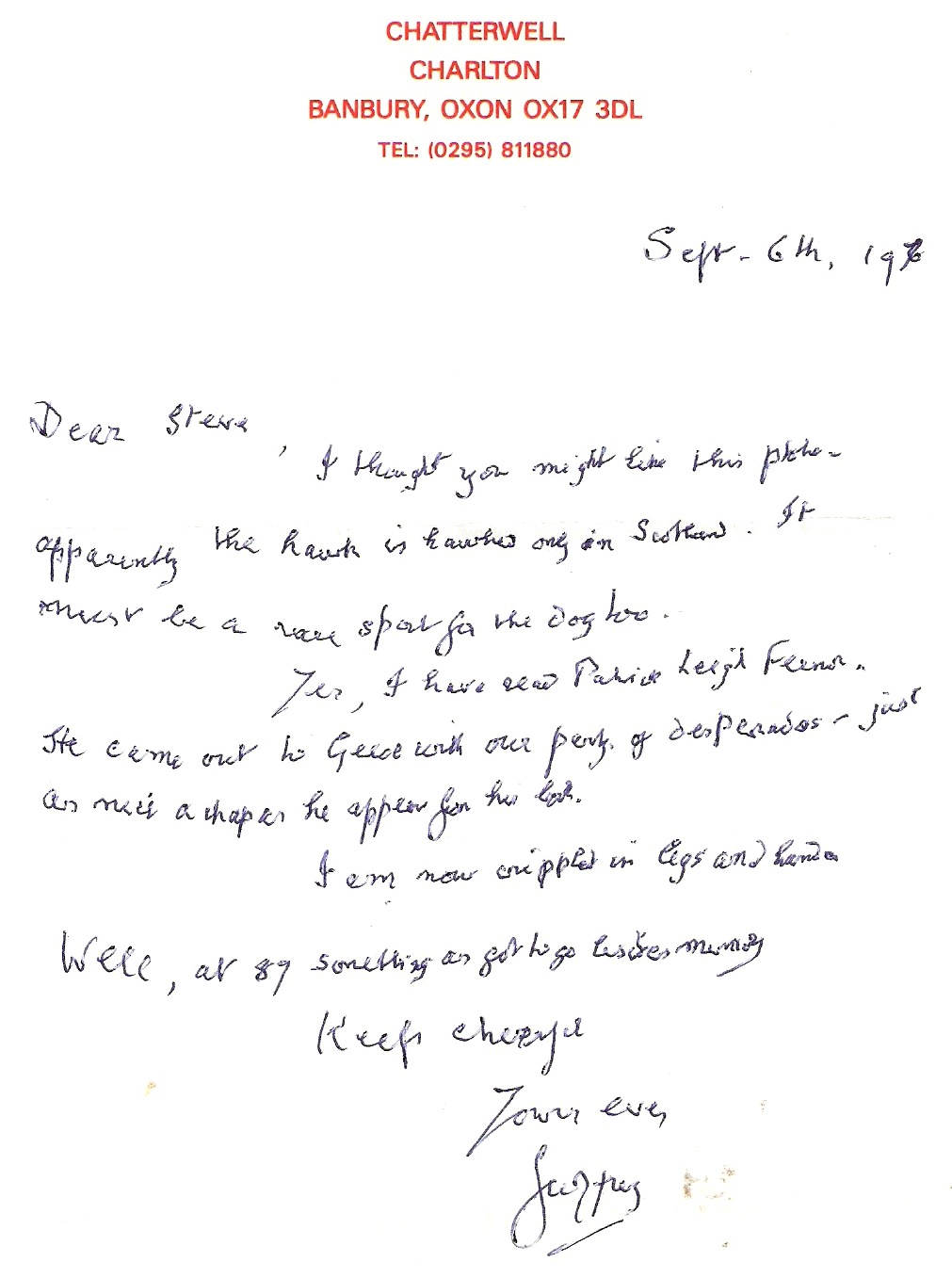
Sadly, I never corresponded with Patrick Leigh Fermor, but I did for many years with the adventurous old "suspense" story writer Geoffrey Household (as so many perceptive critics wrote, he was so much more than that, including a naturalist, a regionalist, and a chronicler of the same old lost Europe that Leigh Fermor also celebrated). Some of his best works are still or at least recently in print, though they were written from the thirties into the eighties: Rogue Male, in which an English big game hunter with a secret stalks a Hitler figure until he becomes the prey; 1965's Dance of the Dwarfs, a cryptozoological novel with several twists; and the one I read first, 1960's Watcher in the Shadows, still another tale of being stalked. Household's knowledge of nature and animals gave him an intuition and sympathy for prey that many writers of such novels lacked.*

I will write about Geoffrey's own work, but that must wait. Suffice to say that in the winter of 86-87, having been recently widowed, I wrote to him asking if he had known PLF, whose Woods & Water I had just finished. I figured with his background-- among other things, he had lived in Bucharest and Greece for many years before the war, and been in British Intelligence-- he might have. I just wanted to do something new-- walk across Europe, perhaps?

Geoffrey wrote back with enthusiasm; we had written to each other for some time, and I think he was worried for me. Of course, he HAD known "Paddy" during the war.

(I'll follow each letter with a blown- up text of the relevant part, as the handwriting of an 87- year- old- man can be as bad as that of a 61- year old with Parkinson's-- click twice and they are more legible than the originals!)


He apparently thought the matter over, then, perhaps forgetting his previous note, wrote what may have been his last letter to me in the fall before his death the next year at 88. His handwriting had deteriorated, but he could still command a phrase.


Desperados indeed. As David Pryce- Jones said this morning: "Could there be men like that again? In these thin days I doubt it..."

*Geoffrey's short story collections are not "suspense" and are much harder to find but worth the effort. Start with Sabres on the Sand or The Europe that Was.

UPDATE: In the introductory essay to the NYTBR ed of Rogue Male, linked above (click on "See Inside"), Virginia Nelson writes "...One can't help but wondering if his path crossed that of the notable English picaro Patrick Leigh Fermor..."

UPDATE 2: The wonderful Patrick Leigh Fermor blog is now on our blogroll (right). More to come I'm sure...

Friday, June 10, 2011

Patrick Leigh Fermor 1915- 2011 RIP

Too burnt on obit- writing to write a proper tribute to one of my (and Betsy Huntington's; she left me all my early first editions; and Q's) favorite writers and examples of a life well- lived. But readers and nomads everywhere should observe a silent moment: Patrick Leigh Fermor has died at 96 in England. He had recently returned from the island off Crete he had called home for many years, perhaps to be reunited at last with his late wife Joan. We must all hope that he finally completed his third book about his youthful walk, between the wars, from the Hook of Holland to "Constantinople"; the second volume,Between the Woods and the Water, may be my favorite travel book ever. I eagerly await Artemis Cooper's biography next year...

Good obits in the Telegraph, at England's Channel 4, and at The Guardian. More to come I'm sure...

Will attempt something later; for now here is an older post by me and here is one by Reid.


UPDATE: more good obits and memories: Max Hastings in the Daily mail; his biographer-to- be, Artemis Cooper, with a photo of his first love, Romanian princess Balasha Cantacuzene-- be still my heart!

Let's lift a glass to one who never hesitated-- see Cooper's opening tale-- to do so himself.

And a last note from another Guardian article, for those who are holding their breath about the existence or fate of the "Third Volume":

"Readers are still awaiting the promised third leg of Leigh Fermor's trip, despite the author's repeated promises to "pull my socks up and get on with it" and his 2007 declaration that he was learning to type so that he could complete it more quickly.

"Cooper, who visited him at his Greek home earlier this year, said that the writer had been working on corrections to a finished text. "A early draft of the third volume has existed for some time, and will be published in due course," she said.'

A Little Comic Relief

The Bodio side of the Frishman heritage, in part: guns & animals. I think several blogs attest there is a literary component as well...

Readings

On a hot dusty day, we buried Patty Adam in Fairview Cemetery on Cerrillos road in Santa Fe, with a small crowd of friends in attendance. The cemetery, on the National Historic Register, is odd, small, old, and dry, with 19th century tombstones and a general air of benign neglect-- think New Orleans with prairie dogs resident and dead grass instead of damp moss. Her neighbors, so to speak, include the fiery Polish-American writer Maia Wojciechowska (mother of our painter friend Oriana Rodman), and other local luminaries.

God knows what her friends we didn't know thought of our choice in readings. Patty had asked for a psalm and we all agreed on a "dog poem". I found a brilliant rather scary Ogden Nash that was more Housman than doggerel (sorry!), and we skipped over the more conventional sweetness of Psalm 23-- green pastures, fear no evil and all that-- for the tragic beauty of a selection from Psalm 103:

"For he knoweth our frame; he remembereth we are dust.

"As for man, his days are as grass; as a flower of the field, so he flourishes.

"For the wind passeth over it, and it is gone; and the place thereof shall know it no more."

(I actually read from her childhood friend Virginia Huntington's little leather- bound book of psalms; it is tempting to wonder whether another little girl might have seen it in China long ago).

Then, the Nash, particularly poignant when you have aging dogs too. One tends to think of Nash as silly but this one is not:

My little pup ten years ago
was arrogant and spry
Her backbone was a bended bow
for arrows in her eye
Her step was proud, her bark was loud,
her nose was in the sky,
But she was ten years older then,
And so by God, was I.

Small birds on stilts along the beach
rose up with piping cry.
And as they rose beyond her reach
I thought to see her fly.
If natural law refused her wings,
That law she would defy,
for she could do unheard of things
and so, at times, could I.

Ten years ago she split the air
to seize what she could spy;
now she bumps against a chair,
betrayed by milky eye!
She seems to pant,
time up, time up
My little dog must die,
And lie in dust with Hector's pup
So, presently must I.

Last, Libby read a sweet verse by Tolkien sent by Lily's breeder, Teddy Moritz in New Jersey:

I sit beside the fire and think
of all that I have seen,
Of meadow flowers and butterflies
in summers that have been;

Of yellow leaves and gossamer
in autumns that there were,
With morning mist and silver sun
and wind upon my hair.

I sit beside the fire and think
of how the world will be
When winter comes without a spring
that I shall ever see.

For there are still so many things
that I have never seen:
In every wood in every spring
there is a different green.

I sit beside the fire and think
of people long ago
And people who will see a world
that I shall never know.

But all the time I sit and think
of people long ago
I listen for returning feet
And voices at the door.

Monday, June 06, 2011

Climbing Heritage

As I mention in her mother's obit below, Libby was a second generation climber and a guide from the Rockies to the Himalayas. Her husband Harry, who died in a "backyard" fall in the Tetons after a far more frightening climb in China, was a serious one. Harry was father to my stepson, wilderness photo- blogger A Jackson Frishman, who was three when he died. As Jack (who also blogs on matters whimsical, scientific, and musical as "Peculiar") sometimes says, he inherited various things from all three of us.

His grandfather Ken Adam was also a famous climber, a pioneer of many routes in Yosemite, and one of only two people I have known who are on T- shirts, the other being Doug Peacock (Ken hanging from a rope in Yosemite; Peacock by R Crumb as the Monkey Wrench Gang's Hayduke). Though at first glance they make a strange pair, I suspect the old California Republican- but- green climber of "good" family and the feral bear biologist who once carried a spear he made in his garage to the Canadian Arctic would have found a lot of territory in common.

Patty's death and the recent reunion of Southwest Outward Bound, where Harry was Program Director, have brought a lot of emails, nostalgia, photos, and even people washing up on the dry shoes of Casa Q, and I thought I would share a few. My favorite without a doubt is this of Libby at 21, atop a California cliff near Donner Pass.


The scariest is this rather Mansoneque photo booth strip- how old are you if you remember these?-- of Harry and Libby in typical SOBS style ca 1972.


Addendum, Thurs 9 June: we found this lovely pic of Lib and Harry at their wedding in Kathmandu in December of 1972:


A more socially acceptable version than the "dirtbag" photo strip: Harry, Lib, and Jack at a summer SOBS gathering in Santa Fe-- same year as the one below it? Jack is about 2.


The infamous "Harry and the rats": Harry with a rat bounty in Szechuan the year before he died:


I don't have any climbing pix of Jack in the computer, and some fun adventurish ones-- with guns, butchering a sheep-- are perhaps off- topic (?-- will honor requests!) But I will leave you with the coming fourth generation: a pregnant Niki (Mrs Peculiar) last month, atop Mount Taylor on the edge of the Big Rez 100 miles away, at 11,300 feet above sea level. Happy climbing, little one!

Avian Drama, Home Version

In remote, dirt- road Magdalena, wildlife comes into town. Deer track through the central arroyo, followed by mountain lions. An adolescent lion got himself cornered and darted in the High school yard a couple of years ago; a bear went up an electric pole and was electrocuted the same year. Coyotes challenge the hounds from inside town limits before dawn and reduce them to a fury of howling.

But birds, even ones you don't think of as human commensals, can be even bolder, going about their lives in the artificial canyons and woodlands with little attention to humans. The following sequence yesterday begins with my shooting from my own front porch facing south and pointing just slightly west and to the right. Apologies for quality-- I was using a point- and- shoot that lags when you push the button, while trying to time myself to catch the falcon's rushes. All but the last will enlarge twice if clicked on-- it will go only once.

I was dozing over my book about 4 PM when I was roused by a mad chorus of raven croaks and kestrel "kleekleeklee!" alarm notes. I went out to see a raven standing in the street 100 feet away. Ravens don't do that.


He had evidently been poking his sinister beak into that little hole in the upper right corner of the storage shed across the street, where the falcon's eggs had hatched, and the female had caught him. She stooped at him again and again until she drove him to the ground, though he must easily have weighed three times as much, until he was squawking and ducking and trying to get under the hedge.


She hit him again and again, turning over at the end of each swing or hanging in the wind between strikes (click to enlarge-- she is at upper right).


Only my coming forward to try to take a closer photo finally gave the raven an opportunity to break away, while mother kestrel cursed impartially at me. The raven was not visiting today...

Gun Butts

Not art photography but: the Ithaca NID 16 gauge, my "Elmer Keith" gun, is back with an authentic 30's- era Art Deco "Rising Sun" butt pad- wouldn't have one without it.


And the perfect little 20 is also back from Beretta in NY courtesy of Andrew Campbell, with a leather- covered pad that makes it 3/4" longer, some invisible but necessary repair, and all screws aligned and indexed. Should be good for another lifetime of shooting. Thanks to Andrew and gunsmith Ed Anderson...

The Wierdest Clock in the World...

... stands in in Ulan Bataar, Mongolia in front of a bank. I know that is a coelacanth on top (why??) but what are those... tentacles? I can't read Mongolian, only (some) Russian, but I have a vague recollection of shooting a slide of a plaque with an inscription on it.

You can see why we have come to refer to it as the "Cthulhu Clock" Is it part of a plot by Baron von Ungern- Sternberg to open a door for the Great Old ones?

Why I prefer free hunting...

... to lure coursing: I don't like frustration!

Taigans, including Jutta Rubesam's red Taalai, in Germany, by her:

Katharine "Patty" Lucas Adam, 1917- 2011

Libby's mother, Patty Adam, died June 3, 2011, in Santa Fe, New Mexico. She was born on November 23, 1917, to American parents then living in Anking, China. (As many friends know and in one of the coincidences too weird for fiction,she was raised with Betsy's oldest sister, Jane Huntington; they were the first two "Anglo" babies born in the province. We found this out after we had been seeing each other for a while, when Patty dug up a photo of them together in a carriage at about a week; we put them together for the first time in about 70 years! I wll try to get that photo...)

From her obit: "After the death of her mother in 1925, she and her father moved to Berkeley, California. Patty attended the Berkeley public schools and graduated from the Dominican Convent in San Rafael in 1934. She attended the University of California at Berkeley, graduating in 1938 with a major in English, and then took a fifth year to earn a teaching credential. After graduation, she taught high school for a year in Dorris, California, a town with one box mill, three lumber companies, one grocery store, and seven saloons. She remembered it as a wonderful place because the teachers got to dance every dance!"

She married Kenneth Dunstan Adam, an engineer from the U.C. Class of 1940 and pioneer climber on Yosemite's big walls (Jackson is 3rd gen climber on his mother's side-- she climbed too-- and second on his blood father's), settled in Berkeley, and raised four children. An accomplished outdoorswoman and lifelong member of the Sierra Club, she spent many summers with her four children at Echo Lake in the Sierra Nevada, in a cabin accessible only by boat, with no electricity or telephone. In 1972, she went with her husband on a 500-mile hiking trek in Nepal that reached the Mt. Everest Base Camp and continued east to Darjeeling, India. She and Ken moved to Santa Fe, New Mexico, in 1973, where he continued an active outdoor life until he died in 2006. You had to earn Ken and Patty's respect but when you did you knew it meant something. As editor Allen Jones said to me earlier this week, that is an epitaph worth having.

Patty died, not unexpectedly, in Santa Fe Friday night, in her sleep, bedridden but still lucid and calm and good humored to the end-- Jack and his wife Niki had visited just hours before. We had visited last weekend and Lib again on Wednesday.

Please forgive slow bloggage. The past week and a half has been utter chaos-- the past four days alone have also included a vet trip for Lashyn (30 miles, diabetes, manageable by diet we hope), my semiannual Parkinson's checkup (excellent but in Alb, 100 miles away!), a blown tire (don't ask), and, still needing negotiation but looking to be a done deal if for yet unknown money, a two- book contract including a "Sportsman's Library" and the finished Eagle's Shadow, which may allow me to get a leg up on my other projects as well...

Lib is back from Santa Fe and I am getting ready to go up there (150 miles) for services, which include a (dog) poem read by me- ! Patty always loved the pups. I am slightly "Parkied" by stress and with seven confused-- disrupted routines, aaaargh!-- dogs. Yikes. But I finally have an afternoon to catch up on blogging; will get through & be back by the middle of the week or sooner, and checking mail from up north...

Monday, May 30, 2011

Dogs

Recent of ours, all but Irbis showing a little age, by Gail Goodman, and Cousin Nura in Scotland. Taik, Rissa, Kyran, Lash, Irb; two of Atai's niece Nura courtesy of Mark McBride.


Baby

If all works out, my next hawk and first Harris at Matt Mitchell's last week...

Hunting Eagles

If there is a common image of eagle falconry it is that of a fur- hatted Kazakh or Kyrgiz nomad on a short furry horse, hunting foxes or wolves; this has been reinforced by my own book, by the wonderful art of Vadim Gorbatov, and even by the BBC TV show referenced here a few weeks ago.


But like many good things, "eagling" has been invented several times, almost independently. In the twenties the legendary English setter breeder William Humphrey flew a female golden and is said to have taken over one hundred foxes in Wales with the help of his dogs, but he had no disciples. Freidrich Remmler flew eagles in Finland and Russia and even the US, but his only pupil was reclusive Dan McCarron (one of the best, who I hope will someday write a memoir), who knew him when he was a child. Also in the US, Charles Browning, fed up with eagles taking his gyrs, trained the legendary tiercel "Messiah" to hunt sage grouse from the soar.

Meanwhile, in England, Alan Gates accomplished the improbable feat of taking game with an eagle, breeding her, and then doing the same with her son. He was the first westerner recognized as a "berkutchi" by the Kazakhs.

(And for now, we will leave aside more exotic sorts like traditional Japanese eagling, or the kind from Africa, started perhaps by the late artist David Reid Henry and his crowned eagle and reaching its most baroque form in the "Brush War", when Rhodesian troopers flew eagles at night from half- tracks while carrying automatic weapons). I believe one crowned may still be used in Zimbabwe for monkey control...

But in Germany and Austria after the war a real shared tradition grew up, one that spread to eastern Europe and now features some of the best flights that exist. In Hunting Eagle: The Development of German and Austrian Eagle Falconry, Martin Hollinshead chronicles the little- known (at least in the west) invention and spread of this demanding but incomparably exciting form of falconry, which is now so advanced it is hard to believe that most of its history is post- 1960!

If not quite "present at the creation" Hollinshead was on the scene soon after, has flown eagles over there, and knows the principal actors and innovators. As a long- time advocate and practicioner of quality hawking for ground game (see other books on his site), he understands the prejudices eagle austringers had to overcome. As recently as ten years ago, I was still being assured by people who had never seen an eagle fly that they were clumsy, lazy, vicious, and incapable of stylish flights -- this despite the fact that I had seen such flights in Asia and America. Hollinshead's meticulous and informed account should dispel such pernicious myths for good. Not only does he document how mysteries of training and breeding eagles were solved, the second more or less for the first time; he also chronicles the rise of the great eagle festival in Opocno in the Czech Republic. Good eagles, as many have seen in videos, can take roe deer with the style and dash that a goshawk brings to hares, but also are agile enough to fly that quarry as well.

Eagle falconry continues to evolve. For a new interview of our friend Lauren, not only the first female berkutchi but the first westerner to train as a Kazakh eagler, see this post at Rebecca O'Connor's Operation Delta Duck. With new moves afoot to ban the use of eagles in falconry, let us hope the voices of such advocates as Dan McCarron, Al Gates, Martin Hollinshead and Lauren McGough are heard above the baying of the ignorant.

Sunday, May 29, 2011

Lambing season


Despite snow and rain storms, our lambing season has gone really well this year. Our ewes give birth out in the sagebrush and are not penned or sheltered. It's a natural way of doing things, and we hold off on lambing until mid-May so we've made it through the worst of the storms and the lambs can be born on green vegetation. We're about half-through now. I maintain it's easier to heat up a cold lamb than it is to cool down a hot lamb, so I prefer to lamb in cool weather. Lambs also grow better in cooler temperatures than when it's hot.

This lamb was born this morning in the snow. Mama ewe is just getting started getting the babe clean and dry, turning it into a beautiful white lamb, rather than the orangish creature she gave birth to.


We only have one bum lamb so far. Buck here was a twin who got separated from his mother. I looked for him for a day, and figured a predator must have taken him. But Buck finally managed to find another ewe who had her own lamb and didn't want another one. We picked him up and brought him to the house. He's been staying outside, but here he is lounging on the couch after a warm bottle, herding dog pup Hud unable to resist giving him some attention.