How long can anyone sane continue to live in California? (Reid?)
It's not just the cost of living or the deficit or the smog or the crime or the massive illegal immigration-- one might put up with many of those things for the glories. It's the endless niggling laws, the superficial reverence for an environment that fewer and fewer people connect with, the...
Well, let's back up to those laws. The LA Times contained two stories today that may be of interest. While the problems-- non- native animals, animal rights, dangerous dogs, a state which thinks it can fix everything by regulating those who didn't "do it" (William S. Burroughs: "Every time some lunatic goes on a shooting spree they go out and take away the guns of everybody that didn't do it")-- the particular instances are completely Cailifornian.
First, non- native species in the Channel Islands. The story begins:
"Animal rights activists will get another chance to try to persuade a federal judge to halt what they consider the senseless slaughter of thousands of pigs on Santa Cruz Island.
"Recently rebuffed in their attempt to secure a temporary restraining order against the National Park Service, In Defense of Animals and two individual plaintiffs intend to ask Central District Judge Dickran Tevrizian Jr. on Sept. 26 to reconsider the case and grant an injunction against the feral pig eradication program".
The principal species that they are worried about are the Santa Cruz Island fox (not actually a species but a subspecies of the gray fox) and eight species of plants. If these are indeed endangered, I have no trouble with them removing the pigs by any reasonable means -- they are a fine game animal, though maybe for the taxpayers' sake and to annoy the Puritans they should allow year- round no limit hunting rather than employ "Pro Hunting, a New Zealand-based company, [with] a two-year contract to track down the pigs, using snipers, dogs and electronic collars".
Humans have introduced, aaccidentally or intentionally, many species-- goats, several species of deer which attain trophy proportions and are also fated to be eliminated-- in the Channel Islands, and eliminated others like the pygmy mammoth. The Park Service's most absurd move so far was to suggest shooting the island's Golden eagles, which they claimed were attracted there by the piglets but were now eating foxes, while denying most permits to falconers on the mainland (and of course letting Indian tribes strangle them without limits). I think the fetish of Pre- Columbianism is just that, and management (i.e. judicious killing) of the hooved immigrants would probably work better and be cheaper than a crew of Kiwi (why not Hawaiian, who would have at least as much experience, and are still American?) hotshots.
But the animal rights activists have managed to come up with an even dumber plan than the government's. " "Since there are probably not a lot of pigs left, I think the agency should give the contraceptive approach a chance; do the right thing and allow the remaining pigs to live out their lives". "
And then there are the poor pit bulls.
"Spurred by a recent rash of pit bull attacks on children in California, state lawmakers voted Monday to give local governments authority to require the spaying and neutering of specific dog breeds".
As usual "humane" groups, who the late dog trainer and philosopher Vicki Hearne said preferred animals to be either cute or victims, joined with the banners. Also, of course, not a few of these, like PETA, want an end to all domestication ("slavery"), though they may soft- pedal this fact to outsiders.
One congresswoman spoke sense." "The problem we have is not with our dogs but with our dog owners," said Assemblywoman Audra Strickland (R-Thousand Oaks). "There are a significant number of dog owners who abuse their dogs and condition them to fight and become vicious. Those people are the culprits.""
Exactly. To lose the brave genes that can go to make superior defense and schutzhund dogs because a few moral idiots (like the owners of the Presa Canarios that killed a young woman in San Francisco) will not be responsible is another kind of crime. What would happen to dogs like my Kazakh friends working tobets, who are certainly capable of killing armed adult humans in their Border Patrol work but will guard my friends' babies? If someone's dog kills an innocent, imprison him for murder and put his dog down. Don't ban breeds.
On the other hand, as long as proponents of bans are this dumb we may still stand a chance: " "It's time to get rid of these pit bulls," said Assemblyman Tim Leslie (R-Tahoe City). "I think we ought to string 'em all up, send them to some other state". "
In Germany animal rights group can now regulate the size of the wattles on pigeons.
A character in Cormac McCarthy's new novel, who asks an old sheriff if she can smoke, receives the laconic reply "its still America last time I looked".
Update: Lib looked at this and said:"They want to neuter both of them". Hmmmm....
Tuesday, August 23, 2005


Sacrificial Lambs
Have you ever wondered about the logistics of those burnt sacrifices in Classical and ancient Greece and Rome, or even in the Old Testament? Chas, hunter, professor, Pagan, and blogger, has...
On Falconry
My introduction to Steve's writing was from the falconry side of it, a popular article in Smithsonian, sometime in the mid-80s. I was surprised to know anyone wrote so well about the sport, then surprised again to discover he writes well about a lot of things. I'm sure various pigeon fanciers, gourmands, world travellers, writers, naturalists and fine-gun collectors have been equally surprised to see their favorite correspondent publishing on the weirdness of training hawks.
Steve doesn't need any more hobbies, but I bet he has them.
Sparking this post was Reid's comment in a recent email exchange, "You really have blogged very little on falconry, some on dogs, and not at all (that I recall) on coursing or pigeons or firearms. These are all subjects obviously where you have a tremendous fund of knowledge that you take for granted....Those are subjects that are the bread and butter of your books, the things that attracted readers like me and Matt."
Steve sent back, "Well, I just got one up on guns! Actually there will be more on hawks and dogs. I have been sort of saving this stuff for fall."
In fact the hawking and coursing time of year is not quite on us yet. When the hawks are up to molt (between late spring and early fall) we give them their due (food and care, etc.) but also take advantage of the extra time for other projects. In Steve's case, I gather that's quite a lot.
Steve then offered Reid another possible reason for the lack of falconry: "Matt and I are very odd falconers---we do weird things. So do many who we like, like the 'boyos' in Albuquerque. We are extremely naturalist-oriented as some but not all falconers are. None of us are mainstream, though Matt is very modern in some ways, and I very primitive."
To carry Steve's point a bit further, practicing "odd" falconry has some bearing on how and what you can write about it. It may be interesting to us, but also complicated when you consider the public forum: To non-falconers, we are ALL falconers. Some of the sub-distinctions we find significant are pretty arcane on the "outside." Few of us are comfortable presenting ourselves as general examples.
And then there are our peers. As Steve notes in A Rage for Falcons, falconry is "a great stirrer-up of passions." You need only to attend a gathering of hawkers, or to browse the Internet a bit to find ample proof. It is difficult to say enough to be meaningful without saying enough to be controversial.
Before I quit, the monikers "modern" and "primitive" falconry may need a bit more explaining: Steve flies a domestic-bred, hybrid falcon, which is hardly primitive. And I hunt small birds with various small hawks, something falconers have been doing forever. But Steve likes to fly his falcons at game directly off the fist (an ancient, eastern form of the sport) and at hares and rabbits (a heresy to Westerners, but traditional practice elsewhere). I tend to hunt non-traditional (read: low-rent) quarry like rails, starlings and sparrows. I fly a Harris' hawk ("the un-goshawk!") off a PVC pipe carry-pole and ply my trade mostly in undeveloped suburban plots. Thus, modern.


Left: "Primitive" Hybrid gyr 'Tuuli' on traditional screen perch, and Right: "Modern" Harris hawk 'Charlie' on PVC pipe carry-pole
Steve doesn't need any more hobbies, but I bet he has them.
Sparking this post was Reid's comment in a recent email exchange, "You really have blogged very little on falconry, some on dogs, and not at all (that I recall) on coursing or pigeons or firearms. These are all subjects obviously where you have a tremendous fund of knowledge that you take for granted....Those are subjects that are the bread and butter of your books, the things that attracted readers like me and Matt."
Steve sent back, "Well, I just got one up on guns! Actually there will be more on hawks and dogs. I have been sort of saving this stuff for fall."
In fact the hawking and coursing time of year is not quite on us yet. When the hawks are up to molt (between late spring and early fall) we give them their due (food and care, etc.) but also take advantage of the extra time for other projects. In Steve's case, I gather that's quite a lot.
Steve then offered Reid another possible reason for the lack of falconry: "Matt and I are very odd falconers---we do weird things. So do many who we like, like the 'boyos' in Albuquerque. We are extremely naturalist-oriented as some but not all falconers are. None of us are mainstream, though Matt is very modern in some ways, and I very primitive."
To carry Steve's point a bit further, practicing "odd" falconry has some bearing on how and what you can write about it. It may be interesting to us, but also complicated when you consider the public forum: To non-falconers, we are ALL falconers. Some of the sub-distinctions we find significant are pretty arcane on the "outside." Few of us are comfortable presenting ourselves as general examples.
And then there are our peers. As Steve notes in A Rage for Falcons, falconry is "a great stirrer-up of passions." You need only to attend a gathering of hawkers, or to browse the Internet a bit to find ample proof. It is difficult to say enough to be meaningful without saying enough to be controversial.
Before I quit, the monikers "modern" and "primitive" falconry may need a bit more explaining: Steve flies a domestic-bred, hybrid falcon, which is hardly primitive. And I hunt small birds with various small hawks, something falconers have been doing forever. But Steve likes to fly his falcons at game directly off the fist (an ancient, eastern form of the sport) and at hares and rabbits (a heresy to Westerners, but traditional practice elsewhere). I tend to hunt non-traditional (read: low-rent) quarry like rails, starlings and sparrows. I fly a Harris' hawk ("the un-goshawk!") off a PVC pipe carry-pole and ply my trade mostly in undeveloped suburban plots. Thus, modern.


The Pack
I mentioned the hounds in the last post but readers are asking how they are. During the summer the heat is bad for the muscular, greyhound-derived lurcher---tests by John Burchard have found that after a run in an outdoor temperature of 60 degrees F., the internal temperatures of greyhounds are in the dangerous range, as opposed to that of dogs in the saluki/tazi group (incidentally I prefer the more Cyrillicly phonetic "tasy" but I think I have lost the battle).
Basically you must throw such a dog in a pool to avoid death or damage, and my Plummer is too (pick one) valiant/dumb not to run. Lily the dachshund also overheats as she is small, close too the ground, and shaggy.
The tazis are not bothered. But the jacks in the summer are full of subcutaneous botflies and have enough problems without having to escape dogs. So I try to keep my hounds sane with once-or-twice-a-week runs early in the morning, up in th Pinon- Juniper woodland where the "quarry" is mostly cottontails that quickly go down holes without over-exerting themselves or the dogs.
Now is the time when we begin to get out and get in shape again---all of us. This is a photo of the pack last Sunday: spotted lurcher Plummer, red tazis Kyran and Ataika, brindle tazi Lashyn, and miniscule dachs Diamond Lil. And me, of course.

Basically you must throw such a dog in a pool to avoid death or damage, and my Plummer is too (pick one) valiant/dumb not to run. Lily the dachshund also overheats as she is small, close too the ground, and shaggy.
The tazis are not bothered. But the jacks in the summer are full of subcutaneous botflies and have enough problems without having to escape dogs. So I try to keep my hounds sane with once-or-twice-a-week runs early in the morning, up in th Pinon- Juniper woodland where the "quarry" is mostly cottontails that quickly go down holes without over-exerting themselves or the dogs.
Now is the time when we begin to get out and get in shape again---all of us. This is a photo of the pack last Sunday: spotted lurcher Plummer, red tazis Kyran and Ataika, brindle tazi Lashyn, and miniscule dachs Diamond Lil. And me, of course.
The Beauty of Weapons 1
Fall is in the air in the New Mexico highlands, and my hounds and hawk are restless, whining at the front door, or rowing wings in the quickening wind. You will be hearing more about them, I promise.
 But a natural transition from the fluted points of prehistory is the beauty humans-- all right, mostly men -- have bestowed on their hunting tools.
 I present you with photos of a rare and obscure English "Best" shotgun, a Griffiths, shaped and filed by hand to the tolerances of a particle of smoke, in Manchester in 1878. You can still buy a new London or Edinburgh or Birminghan Best, but it will take a couple of years and cost anywhere from forty to eighty thousand POUNDS. This one cost me less than $1500, including having the Damascus barrels re- finished by Chuck Webb at Briley.
 This black and white photo from the late Geoffrey Boothroyd's Shotguns and Gunsmiths shows the Damascus pattern more clearly. We believe it is of my gun!
You have to study old guns. My old friend the Albuquerque rare gun dealer Ron Peterson offered me this one, or a comparable one, of similar age, by the famous Westley Richards. We both agreed that this one had better details and balance, but someone relying on "names" would have gone with the other.
 It shoots light modern ammo as well as it did over 100 years ago, and I will open dove season with it. These things are made to last! I have handled a muzzle- loading gun made by Joseph Manton, the first maker of London Bests, that still worked; it dated from the 1790's. I am told some such still see action on the grouse moors of Scotland-- though I suspect only in good weather....
But a natural transition from the fluted points of prehistory is the beauty humans-- all right, mostly men -- have bestowed on their hunting tools.I present you with photos of a rare and obscure English "Best" shotgun, a Griffiths, shaped and filed by hand to the tolerances of a particle of smoke, in Manchester in 1878. You can still buy a new London or Edinburgh or Birminghan Best, but it will take a couple of years and cost anywhere from forty to eighty thousand POUNDS. This one cost me less than $1500, including having the Damascus barrels re- finished by Chuck Webb at Briley. This black and white photo from the late Geoffrey Boothroyd's Shotguns and Gunsmiths shows the Damascus pattern more clearly. We believe it is of my gun!You have to study old guns. My old friend the Albuquerque rare gun dealer Ron Peterson offered me this one, or a comparable one, of similar age, by the famous Westley Richards. We both agreed that this one had better details and balance, but someone relying on "names" would have gone with the other.
It shoots light modern ammo as well as it did over 100 years ago, and I will open dove season with it. These things are made to last! I have handled a muzzle- loading gun made by Joseph Manton, the first maker of London Bests, that still worked; it dated from the 1790's. I am told some such still see action on the grouse moors of Scotland-- though I suspect only in good weather....
Yosemite Lawsuit
According to a story in the LA Times, a ten million dollar lawsuit by the parents of a climber killed in a rockslide may result in closing the park to all climbing.
"In its first century as a national park, Yosemite has seen 15 people killed by rock falls. Given the more than 3 million visitors each year to the valley, the park has a good safety record, said Kristi Kapetan, the assistant U.S. attorney defending the park in the Terbush suit.
"If the Terbush family prevails, it could prompt park officials to prohibit rock climbing and other dangerous sports, she said.
"I feel bad for the parents," Kapetan said. "But this would be like blaming Mother Nature. Like suing for an earthquake. We didn't do anything to cause a spontaneous rock fall." "
Ironically, the young climber came from a mountaineering family. They beleieve a leaking water tank caused the slip. I can only say that Libby, who lost her first husband in a climbing accident, feels like the park officials and climbers quoted in the article that climbing is "inherently dangerous", and that any lawsuit leading to banning climbing should be fought.
Also ironically, the suit has made allies of the often- at- odds climbers and rangers:
"Many of Yosemite's climbing regulars, often at odds with rangers, find common ground with park officials this time".
Ken Adam's ashes are doubtless in a tempest!
 (Left) No Fear: Libby in 1969 on a Sierra ridge.
"In its first century as a national park, Yosemite has seen 15 people killed by rock falls. Given the more than 3 million visitors each year to the valley, the park has a good safety record, said Kristi Kapetan, the assistant U.S. attorney defending the park in the Terbush suit.
"If the Terbush family prevails, it could prompt park officials to prohibit rock climbing and other dangerous sports, she said.
"I feel bad for the parents," Kapetan said. "But this would be like blaming Mother Nature. Like suing for an earthquake. We didn't do anything to cause a spontaneous rock fall." "
Ironically, the young climber came from a mountaineering family. They beleieve a leaking water tank caused the slip. I can only say that Libby, who lost her first husband in a climbing accident, feels like the park officials and climbers quoted in the article that climbing is "inherently dangerous", and that any lawsuit leading to banning climbing should be fought.
Also ironically, the suit has made allies of the often- at- odds climbers and rangers:
"Many of Yosemite's climbing regulars, often at odds with rangers, find common ground with park officials this time".
Ken Adam's ashes are doubtless in a tempest!
 (Left) No Fear: Libby in 1969 on a Sierra ridge.
Sunday, August 21, 2005
Pygmy Mammoths
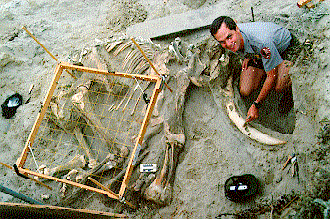
A little known but interesting aspect of Pleistocene megafauna was the species of pygmy mammoth (Mammuthus exilis) that inhabited the Northern Channel Islands of the California Coast. During the late Pleistocene when sea level was much lower than it is now, the four present northern islands (San Miguel, Santa Rosa, Santa Cruz, and Anacapa) were all part of a single large island geologists now call Santarosae. It is thought that Columbian mammoths (Mammuthus columbi) made their way to Santarosae about 20,000 years ago likely swimming (modern elephants are good swimmers!) the 5 miles or so from the mainland.
As sea level rose the mammoths were cut off from the mainland and the evolutionary response to decreasing food supplies and habitat was to select for smaller animals. The resulting pygmy species was about the size of a horse. You can see their size from the photo above, taken in an excavation conducted by Dr. Larry Agenbroad (see Steve's post below) for the National Park Service on Santa Rosa Island in the mid 1990s. This specimen was an adult male, with an estimated age in the 50s. He was so old he had bone spurs from arthritis on his feet. He was radiocarbon dated to about 12,800 years ago.
How the pygmy mammoths became extinct and exactly when is not yet firmly established. There is a theory that humans killed them off, as is surmised for the other North American mammoths and mastodons. Current research by Dr. John Johnson of the Santa Barbara Museum of Natural History at Arlington Springs on Santa Rosa Island has firmly established a human occupation out there as early as 13,000 years ago so it is likely their occupation of the islands overlapped. The SBMNH has documented 93 mammoth fossil locations on the islands so future work should help us answer that question.
Photo is courtesy of National Park Service - Channel Islands National Park
Some Pleistocene Links
For those interested, here is Larry Agenbroad's essay on how easy it would be to clone a mammoth, and why we should.
And here is a serious paper (fee required for more than an abstract) called "The catastrophic extinction of North American mammoths and mastodonts" by Gary Haynes, which will explain in detail why it was humans, not climate, that did in the elaphants.
Thanks to Reid for the paper versions.
Cast of mastodon tooth by paleoarchaeologist Laura Niven. Notice the breast-like shape of the cusps -- 'mastodont' = 'breast-tooth.' The teeth of elephants and mammoths have fine parallel ridges instead.
And here is a serious paper (fee required for more than an abstract) called "The catastrophic extinction of North American mammoths and mastodonts" by Gary Haynes, which will explain in detail why it was humans, not climate, that did in the elaphants.
Thanks to Reid for the paper versions.
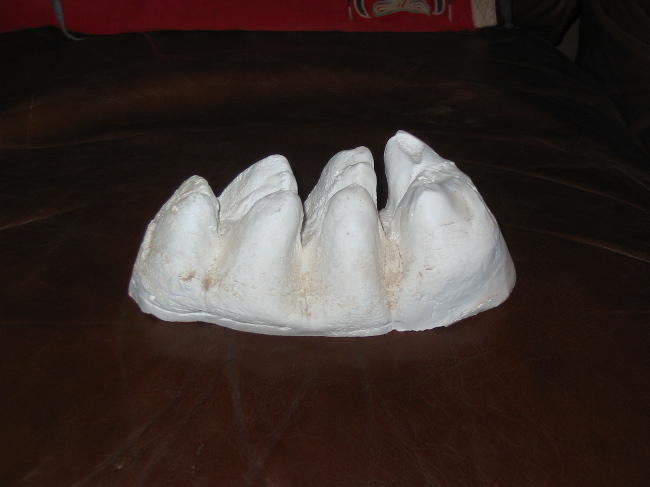
Cast of mastodon tooth by paleoarchaeologist Laura Niven. Notice the breast-like shape of the cusps -- 'mastodont' = 'breast-tooth.' The teeth of elephants and mammoths have fine parallel ridges instead.
Friday, August 19, 2005
Stirling
As I think about "Reviving the Pleistocene" and such notions it occurs that one source of images of such a world is in the novel Conquistador by S. M. Stirling. Mr. Stirling is a creator of alternate worlds, parrallel timelines and such, often done with just one step away from the world we know, all done with scentific and historical erudition and wit.
This one begins when a California game warden finds such things as caged condors with impossible DNA lines, not to mention a photograph of Aztec priests sacrificing their victims while wearing Grateful Dead T- shirts. It presents a gateway to a pre- Columbian type world, complete with recent introductions-- and, at the end, a suggestion of one like the savage Eden of 10,000 B. C.
Mr. Stirling often does sequels....
This one begins when a California game warden finds such things as caged condors with impossible DNA lines, not to mention a photograph of Aztec priests sacrificing their victims while wearing Grateful Dead T- shirts. It presents a gateway to a pre- Columbian type world, complete with recent introductions-- and, at the end, a suggestion of one like the savage Eden of 10,000 B. C.
Mr. Stirling often does sequels....
Pleistocene Revival: Update 1
There are a lot of stories about, and a lot of predictably silly reactions to, yesterday's proposal for "Re- Wilding" America. Here is a relatively sober one from New Scientist.
One from CNN yesterday-- no longer available-- contained some remarkable statements. The outrage from the stockman's association was predictable but sad-- I actually support public land grazing, but they will have to become a lot more innovative to survive.
But biologists should know better, and think before they shoot off their mouths. One compared the possible introductions to that of rabbits in Australia. Get a grip! Australia had no placental mammals, ever, before the introductions! We had lions, arguably conspecific with today's, no more than 12,000 years ago. Horses, fully conspecific. We may have had both longer than the modern Eurasian bears and wolves the same people are apparently worrying about. The other species-- camels, cheetahs, elephants etc are very like lost ones.
Second: time scale, anyone? I don't think anyone is arguing mass deportation from the plains. But if they continue their present loss of population over the next century the whole idea becomes more feasible. I was being SEMI- facetious about the Henrys, but they might form a containable test plot, especially for non- desert species. Their bisons stay in.
Third: some worry about the loss of --- African tourism!-- if the plains have lions and elephants. This is plain silly. Africa has a lot more than those two species. And if it loses tourism it may have more to do with AIDS, city crime in places like Nairobi, and despots and kleptocrats like Robert Mugabe than some plan to introduce animals to America. When I went to Zimbabwe in '96 there was plenty of tourism-- not so now.
Finally: just because an idea is conceived on the ranch of an egomaniacal, paranoid, Soviet Union- loving, Catholic- bashing, bad- neighbor- with- bad- fences billionaire like Ted Turner does not make it a bad idea. Really. I know at least one of the authors (Paul Martin) and he is above petty considerations.
See y'all next week.
One from CNN yesterday-- no longer available-- contained some remarkable statements. The outrage from the stockman's association was predictable but sad-- I actually support public land grazing, but they will have to become a lot more innovative to survive.
But biologists should know better, and think before they shoot off their mouths. One compared the possible introductions to that of rabbits in Australia. Get a grip! Australia had no placental mammals, ever, before the introductions! We had lions, arguably conspecific with today's, no more than 12,000 years ago. Horses, fully conspecific. We may have had both longer than the modern Eurasian bears and wolves the same people are apparently worrying about. The other species-- camels, cheetahs, elephants etc are very like lost ones.
Second: time scale, anyone? I don't think anyone is arguing mass deportation from the plains. But if they continue their present loss of population over the next century the whole idea becomes more feasible. I was being SEMI- facetious about the Henrys, but they might form a containable test plot, especially for non- desert species. Their bisons stay in.
Third: some worry about the loss of --- African tourism!-- if the plains have lions and elephants. This is plain silly. Africa has a lot more than those two species. And if it loses tourism it may have more to do with AIDS, city crime in places like Nairobi, and despots and kleptocrats like Robert Mugabe than some plan to introduce animals to America. When I went to Zimbabwe in '96 there was plenty of tourism-- not so now.
Finally: just because an idea is conceived on the ranch of an egomaniacal, paranoid, Soviet Union- loving, Catholic- bashing, bad- neighbor- with- bad- fences billionaire like Ted Turner does not make it a bad idea. Really. I know at least one of the authors (Paul Martin) and he is above petty considerations.
See y'all next week.
Thursday, August 18, 2005
Very Old Rock Art Blogging
1.jpg)
In light of Steve's post on Pleistocene Park and his suggestion that it start in Utah, I wanted to share this petroglyph of a mammoth from....Utah. This is the only North American rock art that I am familiar with that depicts extinct megafauna. The rock face where this image lies is in the Moab area.
I wish I had taken this picture myself, but I borrowed it from Ian Lange's Ice Age Mammals of North America a well-illustrated and informative book for the general reader.
American Pleistocene Park?
For several years I have been keeping track of Sergei Zimov's Siberian Pleistocene Park, where with the help of Universty of Alaska biologists he hopes to at least begin to bring back the Mammoth Steppe and, in the words of California beat poet Michael McClure, to "Revive the Pleistocene!"
Now from Peculiar comes the welcome news that an American group wants to try the same thing. The present scale is just plain nuts-- the whole great plains!-- and if the Buffalo Commons didn't fly then the same thing with lions and elephants is hardly more likely to gain acceptance. But now the meme is out there...
Personally I'd start more modestly, say for instance with the Henry Mountains in southern Utah-- public land, a huge montane wilderness, a sky island contained by desert, with no towns as large as-- even-- Magdalena nearby. And they already have bison and bighorn. See here and here for some info on the Henrys-- well worth knowing for their own sake.
Now from Peculiar comes the welcome news that an American group wants to try the same thing. The present scale is just plain nuts-- the whole great plains!-- and if the Buffalo Commons didn't fly then the same thing with lions and elephants is hardly more likely to gain acceptance. But now the meme is out there...
Personally I'd start more modestly, say for instance with the Henry Mountains in southern Utah-- public land, a huge montane wilderness, a sky island contained by desert, with no towns as large as-- even-- Magdalena nearby. And they already have bison and bighorn. See here and here for some info on the Henrys-- well worth knowing for their own sake.
Stranger in a Strange Land
Reading Wendell Berry's collected stories, That Distant Land, is like viewing a geologic record of American culture---or maybe its medical record from birth to an early death. Berry writes the history of fictional farming town Port William, Kentucky, from the 1880s forward. Whether his period representations are accurate, I don't have the credentials to know, but as a reader I am utterly enveloped and convinced. Berry's people share purpose and understanding with their animals; they share fate and responsibility and allegiance to their land. That these bonds break apart sometime after World War II and the subsequent marriage of corporations to politicians is Berry's signature theme. Reading him in a suburb, circa 2005, is an exquisitely sad experience.
My view of Berry's message is that we live among the broken pieces of a gift. In its original form, the gift was beautiful and complicated, unquestionably handmade from natural materials. Today it's merely the sum of its parts, some of which were lost in the breaking. My two girls break their toys as a matter of course; some of them I can fix and some aren't worth the effort. Berry's world, which is ours if we want it, is one immanently worth fixing.
A young woman from Steve Bodio country moved this summer to New Orleans. She is twenty-three and works nights selling cigarettes and alcohol for a national distributor. Business is good, and she plans to spend the money on medical school, enrolling this Fall at Tulane. I met her yesterday at my house, pursuing another of her interests, falconry.
Back home in New Mexico, her friends all flew hawks and ran sighthounds---Steve's kind of people, and mine. She grew to like that life and wants to stay with it, though the hunting here is so different as to be another sport entirely. We looked at books and pictures and trimmed my hawk's beak while she held him in her lap. Taking a small gamble, I made half a hawk trap (useless, as is) with the understanding that she bring it back to me complete.
How this young woman, so new here and to her future, wants to be a falconer is an interesting and maybe a hopeful thing. While I'm reading Berry again, it is impossible not to see the pieces and imagine how some might be joined.
UPDATE:

My view of Berry's message is that we live among the broken pieces of a gift. In its original form, the gift was beautiful and complicated, unquestionably handmade from natural materials. Today it's merely the sum of its parts, some of which were lost in the breaking. My two girls break their toys as a matter of course; some of them I can fix and some aren't worth the effort. Berry's world, which is ours if we want it, is one immanently worth fixing.
A young woman from Steve Bodio country moved this summer to New Orleans. She is twenty-three and works nights selling cigarettes and alcohol for a national distributor. Business is good, and she plans to spend the money on medical school, enrolling this Fall at Tulane. I met her yesterday at my house, pursuing another of her interests, falconry.
Back home in New Mexico, her friends all flew hawks and ran sighthounds---Steve's kind of people, and mine. She grew to like that life and wants to stay with it, though the hunting here is so different as to be another sport entirely. We looked at books and pictures and trimmed my hawk's beak while she held him in her lap. Taking a small gamble, I made half a hawk trap (useless, as is) with the understanding that she bring it back to me complete.
How this young woman, so new here and to her future, wants to be a falconer is an interesting and maybe a hopeful thing. While I'm reading Berry again, it is impossible not to see the pieces and imagine how some might be joined.
UPDATE:
Steve writes: "I am sending a photo of her friends with a lurcher pup I bred that you might add: modern folks looking to old traditions (well, one of them at least was actually raised in them, a 3rd generation lurcherman). They look dangerous, but the big guy on the right is a biologist and the one with the shades has a psychology degree, a security business, and is going to be a Border Patrol agent. They are not just 'my kind of people,' they're my friends."
(Note: The "PETA" t-shirt pictured actually says, "People for the Eating of Tasty Animals."
Wednesday, August 17, 2005
Great Game
A new article in the Moscow Times Online discusses what it calls the renewal of the Great Game in Central Asia, pitting a putative alliance of Russia and China against the interests of the U.S.
Maybe. I am known as an optimist about Central Asia's and Russia's intentions, and a pessimist about China's, so consider the source. But some internal evidence in the article seems to undermine its simple reading, and give more credence to the idea of Chinese pressure on the Stans (and even Russia), both economic and with an implied threat of worse-- not to mention, as in Tibet, Xinjiang, and the Russian Far East, an ongoing swamping by sheer numbers..
"China's inroads into this country take many forms, said Rashid Dyusembaev, editor of Kazakh Monitor, an independent English-language newspaper.
"For instance, he said, Chinese farmers are taking long-term leases on farmland. Also, he said, "China has the headwaters of the two main rivers that supply water to Kazakhstan and has been diverting the water channel and can hold the water hostage." "
Uh- huh. Without that water, the Wyoming- like steppes north of the Tian Shan turn into REAL desert.
Further, an observation from Sergei Pashevich, a Kazakh analyst and veteran of the Afghan war, who sounds more like my friends rather than someone anti- western:
"The Great Game, as I see it, won't be fought militarily," Pashevich said. "It will be fought economically, and it is there that China can win. We know that in Kazakhstan, and we are worried about China."

Above: Major Anna Plakhova of the Kazakh Border Patrol (standing beside horse). She is also a veterinarian and an equestrian instructor, not to mention the breeder of my dog Ataika.
Below: A "Tobet" named Zhendet in training with Anna: very scary, but safe if they tell him to be. (Click for larger views)

Maybe. I am known as an optimist about Central Asia's and Russia's intentions, and a pessimist about China's, so consider the source. But some internal evidence in the article seems to undermine its simple reading, and give more credence to the idea of Chinese pressure on the Stans (and even Russia), both economic and with an implied threat of worse-- not to mention, as in Tibet, Xinjiang, and the Russian Far East, an ongoing swamping by sheer numbers..
"China's inroads into this country take many forms, said Rashid Dyusembaev, editor of Kazakh Monitor, an independent English-language newspaper.
"For instance, he said, Chinese farmers are taking long-term leases on farmland. Also, he said, "China has the headwaters of the two main rivers that supply water to Kazakhstan and has been diverting the water channel and can hold the water hostage." "
Uh- huh. Without that water, the Wyoming- like steppes north of the Tian Shan turn into REAL desert.
Further, an observation from Sergei Pashevich, a Kazakh analyst and veteran of the Afghan war, who sounds more like my friends rather than someone anti- western:
"The Great Game, as I see it, won't be fought militarily," Pashevich said. "It will be fought economically, and it is there that China can win. We know that in Kazakhstan, and we are worried about China."

Above: Major Anna Plakhova of the Kazakh Border Patrol (standing beside horse). She is also a veterinarian and an equestrian instructor, not to mention the breeder of my dog Ataika.
Below: A "Tobet" named Zhendet in training with Anna: very scary, but safe if they tell him to be. (Click for larger views)

Poetry Time!
From Fred Turner's lyrical epic Genesis, a piece of satirical rather than lyrical writing worthy of Roy Campbell, on a journalist:
"Ah, Bill, you ask an ode of me, lest you
And all your brothers vanish like the dew;
Your virtues are not trumpet- tongued, and must
Be duly whistled ere they turn to dust.
First, a becoming modesty of style;
The aspirations of a crocodile;
A Shiite mullah's open- mindedness,
A moral backbone of boiled watercress;
All the prophetic vision of a sheep
(But not so witty, and not quite as deep);
A diction as unblemished by a thought
As is a baby's bottom by a wart;
You stand in the traditions of our art
As a blocked artery in a dying heart".
Soon to come from the Querencia : Kipling, guns, grizzlies (me); petroglyphs and cloning megafauna (Reid). Matt?
"Ah, Bill, you ask an ode of me, lest you
And all your brothers vanish like the dew;
Your virtues are not trumpet- tongued, and must
Be duly whistled ere they turn to dust.
First, a becoming modesty of style;
The aspirations of a crocodile;
A Shiite mullah's open- mindedness,
A moral backbone of boiled watercress;
All the prophetic vision of a sheep
(But not so witty, and not quite as deep);
A diction as unblemished by a thought
As is a baby's bottom by a wart;
You stand in the traditions of our art
As a blocked artery in a dying heart".
Soon to come from the Querencia : Kipling, guns, grizzlies (me); petroglyphs and cloning megafauna (Reid). Matt?
Clone Gay Sheep?
Contrarian evolutionary and economics blogger Steve Sailer has a lot in his archives on a biological-- but not necessarily genetic-- component or cause for male homosexuality. (He convincingly argues that biologically- anthropologically "Lesbians aren't gay"-- I can hardly wait to argue this one with my friends Kath and Athena when they come back from Greece). His new piece on twins with one straight and one gay member-- apparently from birth-- is fascinating, and also contains an irresistible sentence: "Gregory Cochran suggests that the best way to test the popular gay gene theory is to clone gay sheep".
Actually he is not kidding: "Although you hear a lot from propagandists about how common homosexuality is among animals, exclusive male homosexuality is quite rare. Rams are one of very few animals where a measurable percentage of males will ignore a female in heat who has been tied to a fence. It drives sheep ranchers crazy. They might have a superb specimen of a ram, a real Greg Louganis of the sheep world, that they want to mate with as many ewes as possible, but he doesn't have eyes for ewe -- just rams.
"Anyway, we've known how to clone sheep since Dolly back in the 1990s, so we could clone a bunch of gay rams and see how their clones turned out. If they are all gay, that suggests that there is a gay gene or genes. If not, that suggests the environment or random breakdowns play a role, such as Greg's [ Cochran's] gay germ theory or something else".
Actually he is not kidding: "Although you hear a lot from propagandists about how common homosexuality is among animals, exclusive male homosexuality is quite rare. Rams are one of very few animals where a measurable percentage of males will ignore a female in heat who has been tied to a fence. It drives sheep ranchers crazy. They might have a superb specimen of a ram, a real Greg Louganis of the sheep world, that they want to mate with as many ewes as possible, but he doesn't have eyes for ewe -- just rams.
"Anyway, we've known how to clone sheep since Dolly back in the 1990s, so we could clone a bunch of gay rams and see how their clones turned out. If they are all gay, that suggests that there is a gay gene or genes. If not, that suggests the environment or random breakdowns play a role, such as Greg's [ Cochran's] gay germ theory or something else".
Rock Art Blogging
Last May my wife Connie and I were lucky enough to take part in a tour of archaeological sites at Vandenberg Air Force Base here in Santa Barbara County, California. The tour was set up by Santa Barbara County Archaeological Society and guided by Larry Spanne, Chief of Cultural Resources at VAFB and I want to thank them both for the opportunity.
One site visited was the Honda Ridge Rock Art Site (CA-SBA-550) an exposed cliff face covered in pictographs painted in red pigment by the prehistoric Chumash who lived in the area for thousands of years.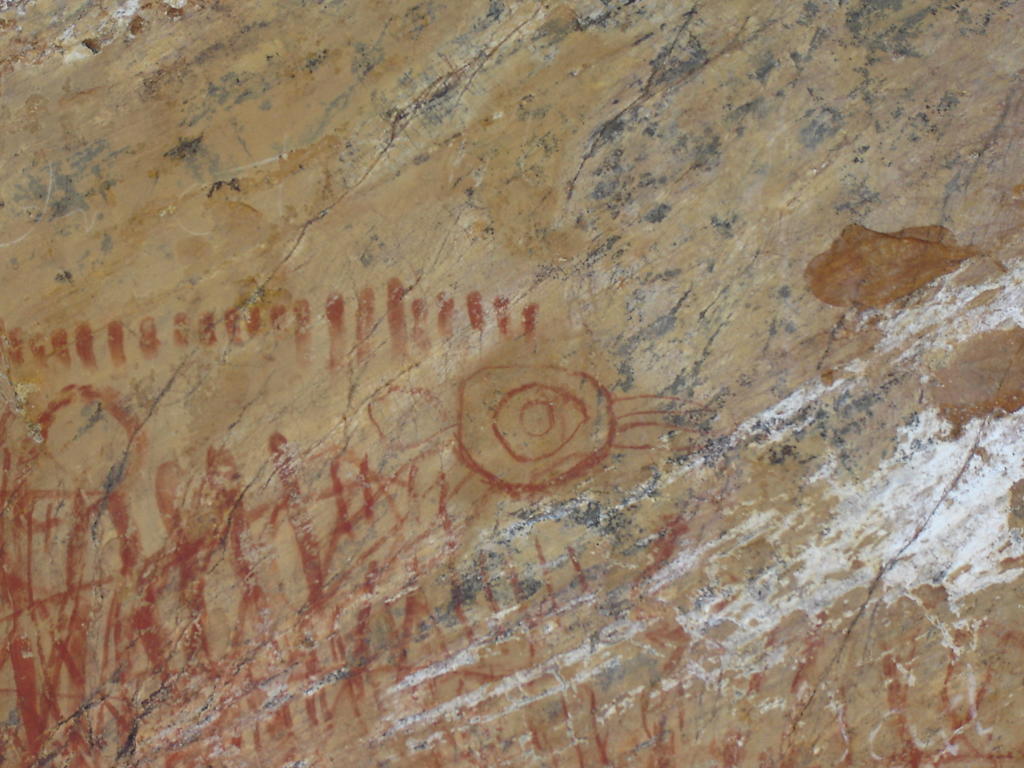
The image above is that of a raven's head, one of hundreds of figures painted on this panel. You can see the circle around his eye and his beak pointing to the right side. Standing under the panel looking south you can see Point Conception. It figured greatly in Chumash mythology and historically there was a shrine there named Humqaq'. This translates from Chumash as "The Raven Comes."
This second shot shows a general view of what the panel at Honda Ridge looks like, a south-facing, slick rock face covered with red painted images, more of which we will share with you in the future. Yours truly is the earnest photographer with his hat turned backwards.
This last shot is a study in contrasts - from the stone age to the space age - and explains why the resources at Honda Ridge have been protected from harm. In this view from the north side of Honda Ridge, you can see a large structure in the middle distance which is the gantry for one of the space launch complexes at VAFB. Military and commerical satellites are launched into polar orbits from these facilities. The fact that the VAFB area has restricted access has kept looters away and saved these magnificant cultural and natural resources for the future.
Prehistoric Passenger Pigeons 2
The genesis of my idea that passenger pigeons as Europeans knew them-- Aldo Leopold's "biological storm"-- were a post glacial phenomenon erupting into a new niche came to me as I discussed pre- Columbian America with our little Pigeon Forum-- what Dr. John Burchard calls "pigeons for polymaths".
I bounced some of the details off Tim Gallagher at Cornell in an email. Recently discovered material and info in brackets:
"What effect did the largest population of birds-- large birds at that!-- that ever existed on the continent have on, well, everything? Remember, they "darkened the skies" for days, and nested in dense colonies 65 kilometers long and several wide. Did their droppings have a major effect as fertilizer? [Yes-- first kill, then fertilize]. Did the tree limbs they broke hurt the trees? [Yes, sometimes killing them-- twenty- foot high canebreaks may have grown afterwards in the south ]. Did they spread seeds? Did they wander, or return to the same nest colonies?
What ate them? Are there fewer of it today? Frank Beebe suggests Peregrines and Goshawks in particular. [ I have also found a paper suggesting the now rare eastern burying beetle was affected. Re Peregrines-- if the PP population went up after Columbus, it may have accounted for the Peregrine's former high historical numbers in the eastern forest, an invasion of an uncharacteristic habitat from a bird more associated with seacoasts and cliffs ].
"HOW DID THEY GET STARTED?? Glacial sheets covered their former northern nesting grounds up to 12,000 years ago, and the vegetation in their wintering grounds in the American south and eastern Mexico was significantly different. Were they a southern species that boomed after the glaciers, perhaps helped by a fire- modified ecology introduced by humans?" [ I should add, bolstered by papers sent by Reid and others, that there really wasn't much PP habitat in North America in glacial times-- or in Mexico either. Tundra and tundra- steppe stretched as far south as Maryland- to- be, and boreal forest, with no pigeon food, south of that, while Mexico was wetter with much pinon- juniper where deserts are now ].
I'm not sure that it was just Europeans' effect on the landscape that boosted the pigeon numbers. I suspect North America was and is a sort of work- in- progress and almost inherently in flux, especially since the last glaciation. See Tim Flannery's The Eternal Frontier for more on this subject. And there were other species whose numbers and biomass defy belief-- bison and even more incredibly, grasshoppers-- see Jeffrey Lockwood's Locust .
I bounced some of the details off Tim Gallagher at Cornell in an email. Recently discovered material and info in brackets:
"What effect did the largest population of birds-- large birds at that!-- that ever existed on the continent have on, well, everything? Remember, they "darkened the skies" for days, and nested in dense colonies 65 kilometers long and several wide. Did their droppings have a major effect as fertilizer? [Yes-- first kill, then fertilize]. Did the tree limbs they broke hurt the trees? [Yes, sometimes killing them-- twenty- foot high canebreaks may have grown afterwards in the south ]. Did they spread seeds? Did they wander, or return to the same nest colonies?
What ate them? Are there fewer of it today? Frank Beebe suggests Peregrines and Goshawks in particular. [ I have also found a paper suggesting the now rare eastern burying beetle was affected. Re Peregrines-- if the PP population went up after Columbus, it may have accounted for the Peregrine's former high historical numbers in the eastern forest, an invasion of an uncharacteristic habitat from a bird more associated with seacoasts and cliffs ].
"HOW DID THEY GET STARTED?? Glacial sheets covered their former northern nesting grounds up to 12,000 years ago, and the vegetation in their wintering grounds in the American south and eastern Mexico was significantly different. Were they a southern species that boomed after the glaciers, perhaps helped by a fire- modified ecology introduced by humans?" [ I should add, bolstered by papers sent by Reid and others, that there really wasn't much PP habitat in North America in glacial times-- or in Mexico either. Tundra and tundra- steppe stretched as far south as Maryland- to- be, and boreal forest, with no pigeon food, south of that, while Mexico was wetter with much pinon- juniper where deserts are now ].
I'm not sure that it was just Europeans' effect on the landscape that boosted the pigeon numbers. I suspect North America was and is a sort of work- in- progress and almost inherently in flux, especially since the last glaciation. See Tim Flannery's The Eternal Frontier for more on this subject. And there were other species whose numbers and biomass defy belief-- bison and even more incredibly, grasshoppers-- see Jeffrey Lockwood's Locust .
REALLY ugly dog!
Several people have sent me various links to this... dog (it is alleged to be a dog). Myself, I think it is more akin to H. P. Lovecraft's witch familiar "Brown Jenkin".
Mole Martyr?
Sir Terence Clark in England sent me a story fom the UK Shooting Times that bears repeating here. There is no link to the story per se, but it is worth reprinting as a tale of what happens when law trumps common sense. What you need to know is that you cannot hunt a mammal with a dog, unless is a rat-- or a rabbit-- but not a hare. Got that?
"A Northumberland man could be the first person to fall foul of the new anti-hunting law. As I write, George Morrison, of West Woodburn, is under police investigation for hunting a mole.
"The offence is alleged to have happened when Mr Morrison flushed a mole from under a horse trailer. The hapless mammal made a sort of dash for the lawn. It was at this point that Mr Morrison committed the offence — it seems he wilfully called Chips, his terrier, to deal with the mole. Chips took up the hunt with unseemly enthusiasm and promptly killed the mole.
"Mr Morrison, who happens to have recently retired from Northumbria Police, after 30 years of distinguished service, immediately realised that he had committed an offence under the Hunting Act. If he had used the dog merely to flush the mole and then despatched the animal with a gun, then he might have kept on the right side of the law. However, it is unusual to catch moles on the surface, and no gun was to, hand. Besides, Mr Morrison is keen on keeping his lawn unblemished—one reason why he is not so keen on moles — and the prospect of blowing a crater in the sward with a 12-bore was unthinkable.
"An added absurdity is that Mr Morrison's actions would have been perfectly lawful if his quarry had been a rat or a rabbit.
"Being a time-served upholder of the law, Mr Morrison made no hesitation in turning himself in. He rang the police and an officer was duly sent to his home. On arrival, the officer informed Mr Morrison of his legal rights and proceeded to interview him. The bemused officer also examined the scene of the crime and collected the evidence (the ex-mole) in a sealed exhibit bag. Mr Morrison helpfully suggested that a post-mortem should be performed to establish the cause of death, and offered to hold Chips while a swab was taken for DNA.
"The officer did not take up this offer, but said he would be taking the deceased mole back to the station, where it would be placed in a freezer. Mr Morrison understands that a file on the incident will be sent to a Crown Prosecution Office (CPO), in Southern England, which is said to be collating all evidence of alleged illegal hunting. He is waiting to hear whether he
will be prosecuted.
"In considering the death of the mole, the CPO may wish to consider what public good will be served by bringing a prosecution. On the one hand, if they go ahead and prosecute Mr Morrison, it seems likely that the media will have a field day and the law will be widely derided and brought into disrepute. But, on the other hand, if they decline to prosecute Mr Morrison, then a precedent will be set, which may well be cited by subsequent transgressors. Either way, it seems highly likely that the Hunting Act is going to be made to look stupid".
LOOK?
"A Northumberland man could be the first person to fall foul of the new anti-hunting law. As I write, George Morrison, of West Woodburn, is under police investigation for hunting a mole.
"The offence is alleged to have happened when Mr Morrison flushed a mole from under a horse trailer. The hapless mammal made a sort of dash for the lawn. It was at this point that Mr Morrison committed the offence — it seems he wilfully called Chips, his terrier, to deal with the mole. Chips took up the hunt with unseemly enthusiasm and promptly killed the mole.
"Mr Morrison, who happens to have recently retired from Northumbria Police, after 30 years of distinguished service, immediately realised that he had committed an offence under the Hunting Act. If he had used the dog merely to flush the mole and then despatched the animal with a gun, then he might have kept on the right side of the law. However, it is unusual to catch moles on the surface, and no gun was to, hand. Besides, Mr Morrison is keen on keeping his lawn unblemished—one reason why he is not so keen on moles — and the prospect of blowing a crater in the sward with a 12-bore was unthinkable.
"An added absurdity is that Mr Morrison's actions would have been perfectly lawful if his quarry had been a rat or a rabbit.
"Being a time-served upholder of the law, Mr Morrison made no hesitation in turning himself in. He rang the police and an officer was duly sent to his home. On arrival, the officer informed Mr Morrison of his legal rights and proceeded to interview him. The bemused officer also examined the scene of the crime and collected the evidence (the ex-mole) in a sealed exhibit bag. Mr Morrison helpfully suggested that a post-mortem should be performed to establish the cause of death, and offered to hold Chips while a swab was taken for DNA.
"The officer did not take up this offer, but said he would be taking the deceased mole back to the station, where it would be placed in a freezer. Mr Morrison understands that a file on the incident will be sent to a Crown Prosecution Office (CPO), in Southern England, which is said to be collating all evidence of alleged illegal hunting. He is waiting to hear whether he
will be prosecuted.
"In considering the death of the mole, the CPO may wish to consider what public good will be served by bringing a prosecution. On the one hand, if they go ahead and prosecute Mr Morrison, it seems likely that the media will have a field day and the law will be widely derided and brought into disrepute. But, on the other hand, if they decline to prosecute Mr Morrison, then a precedent will be set, which may well be cited by subsequent transgressors. Either way, it seems highly likely that the Hunting Act is going to be made to look stupid".
LOOK?
Eco- Burial
I had to do a bit of thinking about this story on "ecologically correct" burial-- in, wouldn't you know it, Marin County. Some of the description is beyond parody:
"He was buried un-embalmed in a biodegradable pine coffin painted with daisies and rainbows, his soul marked by prairie grasses instead of a granite colossus.
"Here, where redwood forests and quivering wildflower meadows replace fountains and manicured lawns, graves are not merely graves. They are ecosystems in which "each person is replanted, becoming a little seed bank," said Tyler Cassity, a 35-year-old entrepreneur who reopened the long-moldering cemetery last fall.
"With Fernwood's debut, Mr. Cassity, who likened Mr. Odom's burial to the musical "Hair," became an impresario in a fledgling movement that originated in England".
And some people I normally respect are dismissive. Poet- essayist- undertaker (really!) Thomas Lynch -- I especially recommend The Undertaking -- is dismissive:
"It is not enough to be a corpse anymore," said Thomas Lynch, an author, poet and Michigan funeral director. "Now, you have to be a politically correct corpse."
But unease at the critics finally sets in. Another "Green" funeral service buries their bodies sans embalming, and what do they say? "Dr. Campbell, a small-town physician prone to quoting John Muir and Coleridge, opened the first of the United States' green burial grounds, the 350-acre Ramsey Creek Preserve in Westminster, S.C., in 1998. There, the departed are buried dust-to-dust-style without embalming - a practice called toxic, artificial and bizarre by critics - in biodegradable coffins or cremation urns that make impervious coffins and grave liners obsolete".
Right, I am not making this up-- bodies without such things as formaldehyde are "toxic".
Ed Abbey was hidden in the desert. When my 17 year- old spaniel Bart died we called a friend with a backhoe, and planted a rosebush above him, which still thrives. The Tibetans feed their dead to the vultures-- as Robinson Jeffers wrote in the poem "Vultures", imagining such a fate: "What a life after death/ What an enskyment". I think I'd prefer any of these, and a return of my elements to the whole shebang, than sequestration in a $5000 coffin.
"He was buried un-embalmed in a biodegradable pine coffin painted with daisies and rainbows, his soul marked by prairie grasses instead of a granite colossus.
"Here, where redwood forests and quivering wildflower meadows replace fountains and manicured lawns, graves are not merely graves. They are ecosystems in which "each person is replanted, becoming a little seed bank," said Tyler Cassity, a 35-year-old entrepreneur who reopened the long-moldering cemetery last fall.
"With Fernwood's debut, Mr. Cassity, who likened Mr. Odom's burial to the musical "Hair," became an impresario in a fledgling movement that originated in England".
And some people I normally respect are dismissive. Poet- essayist- undertaker (really!) Thomas Lynch -- I especially recommend The Undertaking -- is dismissive:
"It is not enough to be a corpse anymore," said Thomas Lynch, an author, poet and Michigan funeral director. "Now, you have to be a politically correct corpse."
But unease at the critics finally sets in. Another "Green" funeral service buries their bodies sans embalming, and what do they say? "Dr. Campbell, a small-town physician prone to quoting John Muir and Coleridge, opened the first of the United States' green burial grounds, the 350-acre Ramsey Creek Preserve in Westminster, S.C., in 1998. There, the departed are buried dust-to-dust-style without embalming - a practice called toxic, artificial and bizarre by critics - in biodegradable coffins or cremation urns that make impervious coffins and grave liners obsolete".
Right, I am not making this up-- bodies without such things as formaldehyde are "toxic".
Ed Abbey was hidden in the desert. When my 17 year- old spaniel Bart died we called a friend with a backhoe, and planted a rosebush above him, which still thrives. The Tibetans feed their dead to the vultures-- as Robinson Jeffers wrote in the poem "Vultures", imagining such a fate: "What a life after death/ What an enskyment". I think I'd prefer any of these, and a return of my elements to the whole shebang, than sequestration in a $5000 coffin.
Monday, August 15, 2005
Prehistoric Passenger Pigeons - A Mystery
Over the weekend I picked up a copy of 1491 by Charles Mann. This is a fascinating book for those interested in New World archaeology and natural history. Its basic message is that the environment encountered by Europeans at initial contact was not an edenic natural paradise but was an anthropogenic construct. In other words, the environment was "manufactured" by the Native Americans to suit their needs using a wide variety of practices. This is not a new concept, but Mann does us all a service by collecting information from a wide variety of individual research projects by archaeologists and biologists into an accessible compendium. Portions of this book first appeared in the Atlantic in 2002, an article many of us read and enjoyed. This book is dense with information and speculation and I'm sure will provide fodder for future posts by Steve and me.
One interesting topic addressed in 1491 is the mystery of the passenger pigeon. The natural history of the passenger pigeon is a particular interest of Steve's (page down to A Feathered Tempest) and discussion on this topic first put us in communication. Steve's treatment gives detailed data, but the condensed version is that in the Eighteenth and Nineteenth centuries in eastern North America, passenger pigeons flew in flocks of tens of millions, darkening the sun, crushing tree limbs, and wreaking havoc in the environment wherever they ventured. According to one expert estimate, in the first quarter of the Nineteenth century, one out of every four birds alive on this continent was a passenger pigeon.
The sad but well-known story is that these birds were relatively quickly hunted to extinction. The last passenger pigeon died in captivity in the Cincinnati Zoo in 1914.
Projecting these tremendous passenger pigeon populations backward into prehistory, one would assume that they would have provided a ready food source for Native Americans in their range - whereupon comes our mystery.
I attended a presentation at the Society for American Archaeology annual meeting last spring by Dr. Ed Jackson of U. of Southern Mississippi on passenger pigeon remains in prehistoric archeological sites in the eastern US. Jackson's conclusion was that there were actually quite few such remains, a surprising development. In this case it is not a matter of preservation, as these sites had plenty of other bird bones.
In 1491, Mann presents the same conclusions with data from different researchers who used a smaller sample size than Jackson. Mann believes that the Indians would have eaten pigeons if they were available in any quantity, and concludes that their populations in this period were small or more would be seen in archaeological deposits. Mann theorizes that as humans, deer, passenger pigeons, and other animals were all competitive consumers of mast (acorns & nuts) from eastern forests, when human populations fell due to introduced European diseases, the equation of mast consumers fell out of balance and pigeon populations boomed. Therefore, massive passenger pigeon flocks are a post-European settlement phenomenon.
I have seen enough examples in the archaeological record where plentiful food resources were completely ignored by prehistoric Indians (subject of a future post) to immediately leap to the conclusion that prehistoric pigeon populations were small. But it is a genuine mystery and a fascinating subject for future discussion and research.
One interesting topic addressed in 1491 is the mystery of the passenger pigeon. The natural history of the passenger pigeon is a particular interest of Steve's (page down to A Feathered Tempest) and discussion on this topic first put us in communication. Steve's treatment gives detailed data, but the condensed version is that in the Eighteenth and Nineteenth centuries in eastern North America, passenger pigeons flew in flocks of tens of millions, darkening the sun, crushing tree limbs, and wreaking havoc in the environment wherever they ventured. According to one expert estimate, in the first quarter of the Nineteenth century, one out of every four birds alive on this continent was a passenger pigeon.
The sad but well-known story is that these birds were relatively quickly hunted to extinction. The last passenger pigeon died in captivity in the Cincinnati Zoo in 1914.
Projecting these tremendous passenger pigeon populations backward into prehistory, one would assume that they would have provided a ready food source for Native Americans in their range - whereupon comes our mystery.
I attended a presentation at the Society for American Archaeology annual meeting last spring by Dr. Ed Jackson of U. of Southern Mississippi on passenger pigeon remains in prehistoric archeological sites in the eastern US. Jackson's conclusion was that there were actually quite few such remains, a surprising development. In this case it is not a matter of preservation, as these sites had plenty of other bird bones.
In 1491, Mann presents the same conclusions with data from different researchers who used a smaller sample size than Jackson. Mann believes that the Indians would have eaten pigeons if they were available in any quantity, and concludes that their populations in this period were small or more would be seen in archaeological deposits. Mann theorizes that as humans, deer, passenger pigeons, and other animals were all competitive consumers of mast (acorns & nuts) from eastern forests, when human populations fell due to introduced European diseases, the equation of mast consumers fell out of balance and pigeon populations boomed. Therefore, massive passenger pigeon flocks are a post-European settlement phenomenon.
I have seen enough examples in the archaeological record where plentiful food resources were completely ignored by prehistoric Indians (subject of a future post) to immediately leap to the conclusion that prehistoric pigeon populations were small. But it is a genuine mystery and a fascinating subject for future discussion and research.
Strange Ads and Evo- Crit
I assume the blogads track words in text--? I see that some promoting "creation science" are up right now--??? WHAT? Whatever this blog's sympathy to matters spiritual we are firmly reality based and have no truck with creationism or "Intelligent Design"-- I was educated as an evolution and populations biologist. To banish them, let us all chant "EVOLUTION EVOLUTION DARWIN DARWIN DARWIN!"
Then take yourself off to 2Blowhards for a long and fascinating post, with many links, to what might be called Evolutionary Literary Criticism, as practiced by such as Fred Turner and Denis Dutton. As always, plenty of other good stuff on Blowhards too.
Update: that's better-- Ugly Otters and archaeology...
Then take yourself off to 2Blowhards for a long and fascinating post, with many links, to what might be called Evolutionary Literary Criticism, as practiced by such as Fred Turner and Denis Dutton. As always, plenty of other good stuff on Blowhards too.
Update: that's better-- Ugly Otters and archaeology...
Urban Life
Reid Farmer's browsing of the L.A. Times finds this report of a lost South American reptile at large in the suburbs. The animal is believed to be a spectacled caiman, estimated at 6 to 8 feet and possibly 200 pounds, which must be a big one if the caiman I knew from Panama are any comparison.
From the story by Ashley Powers, Times Staff Writer:
Steve Bodio thinks this quote brings the story up to snuff as blog-fodder here:
Whether or not an escaped pet crocodilian qualifies as real nature, its present setting in a California city park makes it a surprising find. In other places, large reptiles are quite at home in the urban jungle.
Soon after moving to Louisiana, some local friends (two of them biologists) took me out in a canoe, loaded with beer and headlamps, for an evening of hands-on alligator "labwork" ten minutes from the French Quarter. We caught many by hand (small ones, naturally) and snared a few monsters with noose poles once the alcohol kicked in. I needn't say it was dumb, dumb, dumb. While three of us sat on the back of an exhausted leviathan we drug ashore, this began to dawn on us: Um, what next?
(No reptiles or people were injured in the events described above.)
From the story by Ashley Powers, Times Staff Writer:
"The reptile, which has a jaw like a steel trap, has been playing hide-and-seek in Machado Lake with its hunters, who are armed with just a few nets and a raw chicken....
"'One fellow said he was fishing and it came up on shore. He said he cast the line out and hooked it,' said Kevin Regan, assistant general manager for the Los Angeles Department of Parks and Recreation. 'Someone said kids were throwing tortillas at it, flour tortillas.'"
Steve Bodio thinks this quote brings the story up to snuff as blog-fodder here:
"'It's such an urban area, people just don't see [wildlife]...and they're like,I agree--not that nature is scary (though some of it is and should be!), but that people just don't see it where they don't expect it. For perhaps obvious reasons, we don't expect "real" nature to find us in the suburbs.
'Oh, nature!' It scares them,'"
Whether or not an escaped pet crocodilian qualifies as real nature, its present setting in a California city park makes it a surprising find. In other places, large reptiles are quite at home in the urban jungle.
Soon after moving to Louisiana, some local friends (two of them biologists) took me out in a canoe, loaded with beer and headlamps, for an evening of hands-on alligator "labwork" ten minutes from the French Quarter. We caught many by hand (small ones, naturally) and snared a few monsters with noose poles once the alcohol kicked in. I needn't say it was dumb, dumb, dumb. While three of us sat on the back of an exhausted leviathan we drug ashore, this began to dawn on us: Um, what next?
(No reptiles or people were injured in the events described above.)
Sunday, August 14, 2005
Poison Frogs...
... are one of Annie Davidson's passions, and cool evolution one of our Querencia's favorite subjects. Here is alink to a story on two widely separated groups of these beautiful, deadly, and inoffensive creatures. It seems that not only do they extract their toxins from their food, in this case ants; two unrelated groups have "learned" to do so.
"Because neither the frogs nor the ants from the two regions are closely related, the results indicate that the ability to utilize ants both as food and as the source of a defense weapon against danger developed independently in two diverse regions of the world".
"Because neither the frogs nor the ants from the two regions are closely related, the results indicate that the ability to utilize ants both as food and as the source of a defense weapon against danger developed independently in two diverse regions of the world".
Bookaholism 2
Reid sends this link from the LA times on in- house libraries.
"For the bibliophile, what to do with the books is life's central decorating issue, an ongoing discourse, a debate, and often an outright décor war, between aesthetics, the practicalities of storage and the consuming mindlessness of passion".
Some, who are not book lovers, have designers do their work.
"A Fallbrook-based business called Book Décor specializes in the sale of leather-bound books that "unlike drapes or carpeting appreciate in value and never wear out," selling them by the foot in quantities of up to 250. Lest any client be tempted to open and read one, they're printed in Danish".
Others are just crazy.
"But equally or more often, a book lover's chief ambition is less visual glory than containment — a pen to hold the 190-pound mastiff that you adore but know is capable of devouring you".
Look at this photo of one wall of one room in our four- room house and tell me which category we belong to. (Click on the photo to enlarge).
"For the bibliophile, what to do with the books is life's central decorating issue, an ongoing discourse, a debate, and often an outright décor war, between aesthetics, the practicalities of storage and the consuming mindlessness of passion".
Some, who are not book lovers, have designers do their work.
"A Fallbrook-based business called Book Décor specializes in the sale of leather-bound books that "unlike drapes or carpeting appreciate in value and never wear out," selling them by the foot in quantities of up to 250. Lest any client be tempted to open and read one, they're printed in Danish".
Others are just crazy.
"But equally or more often, a book lover's chief ambition is less visual glory than containment — a pen to hold the 190-pound mastiff that you adore but know is capable of devouring you".
Look at this photo of one wall of one room in our four- room house and tell me which category we belong to. (Click on the photo to enlarge).

Thursday, August 11, 2005
No Steenking Penguins, But What's Left?
...Matt, who is raising twin girls and trying not to screw that up, replies:
"I've been thinking to bring my girls (they're 4) to this flick [March]. It would be their first theater experience. But my folks, both regular film-goers and two of my most trusted movie critics, refused to recommend it even for kids. So I hesitated, and now with your input will look for another venue for my kids' debut.
"I have long since given up hope to find some popular entertainment to further the worldview I've been trying to instill in my girls. A feature-length documentary on real animals would seem to have a better chance than anything animated (which they adore), but after narration and editing and adding music, I don't guess there is much difference.
"Where are even the moderately realistic nature shows of my own youth? Our cable TV has a whole channel devoted to animal-related programming, and yet I can't remember seeing so much as flash of tooth or claw. An entire sequence of a predator's kill from start to finish? Not since the National Geographic Specials I watched as a kid myself.
"It's too much to ask of Hollywood to raise my children, I know it. But I also know that if I did not regularly drag home carcasses of dead animals and dissect them in view of my kids, they would have no direct evidence that:
(A) Meat comes from dead animals, right off the bone (and it tastes good!)
(B) All living things die
(C) Some animals kill other animals
(D) We are animals
"That the twins would not otherwise know the correct physical proportions of a rabbit or a bird almost goes without saying. As a witness to children's television, I can testify that the creatures representing small animals therein look imagined by artists two or three generations removed from any who've held real animals in hand. That might even be the case!"
"I've been thinking to bring my girls (they're 4) to this flick [March]. It would be their first theater experience. But my folks, both regular film-goers and two of my most trusted movie critics, refused to recommend it even for kids. So I hesitated, and now with your input will look for another venue for my kids' debut.
"I have long since given up hope to find some popular entertainment to further the worldview I've been trying to instill in my girls. A feature-length documentary on real animals would seem to have a better chance than anything animated (which they adore), but after narration and editing and adding music, I don't guess there is much difference.
"Where are even the moderately realistic nature shows of my own youth? Our cable TV has a whole channel devoted to animal-related programming, and yet I can't remember seeing so much as flash of tooth or claw. An entire sequence of a predator's kill from start to finish? Not since the National Geographic Specials I watched as a kid myself.
"It's too much to ask of Hollywood to raise my children, I know it. But I also know that if I did not regularly drag home carcasses of dead animals and dissect them in view of my kids, they would have no direct evidence that:
(A) Meat comes from dead animals, right off the bone (and it tastes good!)
(B) All living things die
(C) Some animals kill other animals
(D) We are animals
"That the twins would not otherwise know the correct physical proportions of a rabbit or a bird almost goes without saying. As a witness to children's television, I can testify that the creatures representing small animals therein look imagined by artists two or three generations removed from any who've held real animals in hand. That might even be the case!"
We don't need no steenking penguins!!
..so Reid writes to Matt and me:
"Have either of you seen 'March of the Penguins'? It is a big hit here - projected to make more money than Michael Moore's 'Farenheit 9/11' but as far as I can tell it is some magnificent footage of penguins with the most sentimental, lachrymose, maundering narrative with the worst possible anthropomorphic projections on the birds' behavior and emotions. We were at a party in Manhattan Beach over the weekend with a high proportion of sophisticated Westside LA types who just loved the movie - "The penguins just cry when their eggs break!" etc.
"Connie and I had to tell them a corrective story, and it occurred to me I ought to share it with you. I mean, you guys are falconers and pigeon raisers, etc., and know that birds aren't cute little kids in feather suits.
"Three or four weeks ago Connie and and I were in a theater here in Santa Barbara waiting to see 'War of the Worlds' (which I liked, by the way). The lights were still up and people were coming in to sit down. There were big posters for the local premiere of 'March' that was being used as a special fund-raiser for the local Audubon Society chapter. There were fliers and children's activity books for 'March' stacked in the lobby.
"Two twenty-something age couples sat behind us, obviously on a double date. They had picked up some of the fliers and started talking about 'March'. Turns out, one of the ladies said that she had spent a summer season in Antarctica doing penguin research. I assume she's a UCSB grad student. She was telling her friends that the Audubon Society had asked her to participate in the program they were going to have on stage for the fundraiser before the movie premiere. She said that she had declined because in good conscience she couldn't stand up in front of a crowd of people and say good things about penguins.
"The other girl said, "How can you say that - penguins are so cute!"
"The first girl just went off, (this is almost verbatim) "CUTE! You think penguins are CUTE! They're little BASTARDS! My shins were black and blue for SIX MONTHS from getting slapped by their wings! I have scars on my arms from their damn beaks! I'd pick them up and they'd SHIT all over me! Penguins are EVIL! And you know what else? They have rotten, stinky KRILL BREATH!...."
"And on and on for about five minutes worth of a stand-up comic quality rant. Connie and I and all around us just howled with laughter".
Now: this is even funnier than Reid realizes, because I know all about penguins. Libby's and my best man, John Carlson, a Montana nongame biologist, spent five seasons among the Adelie penguins of Antarctica, and while he may have a slightly higher opinion of them than the young woman overheard by Reid, he confirms everything from krill breath to black-and-blue shins.
He also packed a tux to Antarctica to wear among his penguins (which he did not do at our rather informal wedding).
I'm hoping for some feedback from John, and have asked.... stay tuned!
"Have either of you seen 'March of the Penguins'? It is a big hit here - projected to make more money than Michael Moore's 'Farenheit 9/11' but as far as I can tell it is some magnificent footage of penguins with the most sentimental, lachrymose, maundering narrative with the worst possible anthropomorphic projections on the birds' behavior and emotions. We were at a party in Manhattan Beach over the weekend with a high proportion of sophisticated Westside LA types who just loved the movie - "The penguins just cry when their eggs break!" etc.
"Connie and I had to tell them a corrective story, and it occurred to me I ought to share it with you. I mean, you guys are falconers and pigeon raisers, etc., and know that birds aren't cute little kids in feather suits.
"Three or four weeks ago Connie and and I were in a theater here in Santa Barbara waiting to see 'War of the Worlds' (which I liked, by the way). The lights were still up and people were coming in to sit down. There were big posters for the local premiere of 'March' that was being used as a special fund-raiser for the local Audubon Society chapter. There were fliers and children's activity books for 'March' stacked in the lobby.
"Two twenty-something age couples sat behind us, obviously on a double date. They had picked up some of the fliers and started talking about 'March'. Turns out, one of the ladies said that she had spent a summer season in Antarctica doing penguin research. I assume she's a UCSB grad student. She was telling her friends that the Audubon Society had asked her to participate in the program they were going to have on stage for the fundraiser before the movie premiere. She said that she had declined because in good conscience she couldn't stand up in front of a crowd of people and say good things about penguins.
"The other girl said, "How can you say that - penguins are so cute!"
"The first girl just went off, (this is almost verbatim) "CUTE! You think penguins are CUTE! They're little BASTARDS! My shins were black and blue for SIX MONTHS from getting slapped by their wings! I have scars on my arms from their damn beaks! I'd pick them up and they'd SHIT all over me! Penguins are EVIL! And you know what else? They have rotten, stinky KRILL BREATH!...."
"And on and on for about five minutes worth of a stand-up comic quality rant. Connie and I and all around us just howled with laughter".
Now: this is even funnier than Reid realizes, because I know all about penguins. Libby's and my best man, John Carlson, a Montana nongame biologist, spent five seasons among the Adelie penguins of Antarctica, and while he may have a slightly higher opinion of them than the young woman overheard by Reid, he confirms everything from krill breath to black-and-blue shins.
He also packed a tux to Antarctica to wear among his penguins (which he did not do at our rather informal wedding).
I'm hoping for some feedback from John, and have asked.... stay tuned!
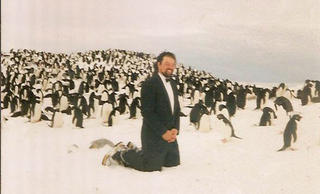
Update: an article from the LA Times suggests the scriptwriters were aware there were some anthropomorphism problems:
""Those guys [ National Geographic penguin experts ] were great," Roberts says. "I mean, they kept me toeing the line. I, of course, wanted more fable than fact, and they would send me these great messages saying 'tsk, tsk' when I strayed too far from the literal truth."
Reid doesn't think they suceeded. "“It really set my teeth on edge to hear my 23 year-old daughter (who saw it) say, "Penguins are people, too!" When we lived in the Sierras in Tehachapi she used to help her ex-boyfriend butcher deer and she knows better!”
Wednesday, August 10, 2005
Prehistoric Contact Between Polynesia and California?
I want to thank Steve for extending the invitation to guest-blog here. I have been a great fan of his since reading Querencia in 1994. I make my living as a professional archaeologist and I was delighted to find we have common interests in that field upon discovering this blog last month. Our resulting fun and stimulating exchanges of information led to my guest-blogging on archaeology and related subjects. There's a lot of interesting stuff going on that I'd like to share with you.
One of the most controversial new theories in North American archaeolgy in recent years was proposed this spring by archaeologist Terry Jones (Cal Poly - SLO) and linguist Kathryn Klar (UC - Berkeley). They believe that a method of canoe hull construction unique in North America to two prehistoric California Indian groups (Chumash and Gabrieleno) was not invented by them. This "sewn-plank" technology was also common in prehistoric Polynesia. Jones and Klar marshal evidence to support the proposition that Polynesians voyaged to California in the AD 500 - 700 time period and taught the concept to California Indians. This theory was first presented professionally in a symposium I attended at the annual meeting of the Society for American Archaeology last spring. A reasonable summary of their theory is presented here .
This is an intriguing though controversial theory with many arguments on both sides. A summary of some (by no means all!) of these arguments that have occurred to me and other professionals follows.
Pro:
Linguistics - I am not a linguist and cannot evaluate Klar's analysis, but it is a fact that the words in Chumash and Gabrieleno for planked canoe do not have their origins in those languages and are borrowed words from somewhere.
Polynesian Capability - It is an established fact that prehistoric Polynesians sailed to the New World and back based on the distribution of the sweet potato. They were fully capable of reaching North America.
Chronology - The earliest firm evidence of a North American planked canoe is a wood fragment from San Miguel Is. in the Santa Barbara Channel, radiocarbon dated to AD 625 - 700 (see Lynn Gamble's excellent 2002 American Antiquity article). This date correlates well with the Polynesian occupation of Hawaii, the only reasonable origin point of such a voyage.
Con:
Linguistics - The Polynesian source words that Klar posits as the origins of the Native American words translate as "useful tree" or "thing made of wood", not exact descriptions of a canoe. A "common sense" question occurring to me and others is why wasn't the source word the nearly universal Polynesian word for planked canoe - waka?
Technology Transfer - A Chumash seeing a Polynesian sailing canoe for the first time would be confronted with three pieces of new technology: sail, outrigger, and sewn plank hull. A "common sense" question would be why would he adopt the least obvious and most difficult to perform of the three, hull construction, and ignore the two most advantageous and easiest to implement, the sail and outrigger. It makes me scratch my head. I asked Jones this question and his answer was that during the Protohistoric period (AD 1542 - 1769) the Chumash saw numerous examples of Spanish ships with sails and never tried sails then either. I dunno.
Chronology - ANY direct evidence of planked canoe construction in California earlier than the current AD 600 - 700 dates would disprove the theory. This would predate the Polynesian settlement of Hawaii, a precondition for a North American voyage. The earliest planked canoe date cited above is subject to revision by new evidence. Gamble's 2002 article also cites a date from a "possible" plank fragment as early as ca. 300 BC. A 2000 MA thesis written by Suzan Rose (a former work colleague) at UNLV details indirect evidence of planked canoe construction at site CA-SBA-52, located about a mile from where I sit in Goleta, CA. Rose documents work areas in the site containing scatters of boring tools with distinctive wear patterns, asphaltum applicators, and other tools that Gamble's later article interpretes as typical of canoe construction workshops. Only at CA-SBA-52 these areas are securely radiocarbon dated to ca. 2000 BC. So the door is still open for this line of inquiry.
Klar and Jones deserve credit for originating this provocative theory challenging many assumptions about California prehistory. Science doesn't progress without people pushing at established paradigms.
Their peer-reviewed article on the theory will appear in the next issue of the flagship journal American Antiquity. I'm sure that the "fur will fly" in American Antiquity's Comments section in the coming months and I will report to you on what results!
One of the most controversial new theories in North American archaeolgy in recent years was proposed this spring by archaeologist Terry Jones (Cal Poly - SLO) and linguist Kathryn Klar (UC - Berkeley). They believe that a method of canoe hull construction unique in North America to two prehistoric California Indian groups (Chumash and Gabrieleno) was not invented by them. This "sewn-plank" technology was also common in prehistoric Polynesia. Jones and Klar marshal evidence to support the proposition that Polynesians voyaged to California in the AD 500 - 700 time period and taught the concept to California Indians. This theory was first presented professionally in a symposium I attended at the annual meeting of the Society for American Archaeology last spring. A reasonable summary of their theory is presented here .
This is an intriguing though controversial theory with many arguments on both sides. A summary of some (by no means all!) of these arguments that have occurred to me and other professionals follows.
Pro:
Linguistics - I am not a linguist and cannot evaluate Klar's analysis, but it is a fact that the words in Chumash and Gabrieleno for planked canoe do not have their origins in those languages and are borrowed words from somewhere.
Polynesian Capability - It is an established fact that prehistoric Polynesians sailed to the New World and back based on the distribution of the sweet potato. They were fully capable of reaching North America.
Chronology - The earliest firm evidence of a North American planked canoe is a wood fragment from San Miguel Is. in the Santa Barbara Channel, radiocarbon dated to AD 625 - 700 (see Lynn Gamble's excellent 2002 American Antiquity article). This date correlates well with the Polynesian occupation of Hawaii, the only reasonable origin point of such a voyage.
Con:
Linguistics - The Polynesian source words that Klar posits as the origins of the Native American words translate as "useful tree" or "thing made of wood", not exact descriptions of a canoe. A "common sense" question occurring to me and others is why wasn't the source word the nearly universal Polynesian word for planked canoe - waka?
Technology Transfer - A Chumash seeing a Polynesian sailing canoe for the first time would be confronted with three pieces of new technology: sail, outrigger, and sewn plank hull. A "common sense" question would be why would he adopt the least obvious and most difficult to perform of the three, hull construction, and ignore the two most advantageous and easiest to implement, the sail and outrigger. It makes me scratch my head. I asked Jones this question and his answer was that during the Protohistoric period (AD 1542 - 1769) the Chumash saw numerous examples of Spanish ships with sails and never tried sails then either. I dunno.
Chronology - ANY direct evidence of planked canoe construction in California earlier than the current AD 600 - 700 dates would disprove the theory. This would predate the Polynesian settlement of Hawaii, a precondition for a North American voyage. The earliest planked canoe date cited above is subject to revision by new evidence. Gamble's 2002 article also cites a date from a "possible" plank fragment as early as ca. 300 BC. A 2000 MA thesis written by Suzan Rose (a former work colleague) at UNLV details indirect evidence of planked canoe construction at site CA-SBA-52, located about a mile from where I sit in Goleta, CA. Rose documents work areas in the site containing scatters of boring tools with distinctive wear patterns, asphaltum applicators, and other tools that Gamble's later article interpretes as typical of canoe construction workshops. Only at CA-SBA-52 these areas are securely radiocarbon dated to ca. 2000 BC. So the door is still open for this line of inquiry.
Klar and Jones deserve credit for originating this provocative theory challenging many assumptions about California prehistory. Science doesn't progress without people pushing at established paradigms.
Their peer-reviewed article on the theory will appear in the next issue of the flagship journal American Antiquity. I'm sure that the "fur will fly" in American Antiquity's Comments section in the coming months and I will report to you on what results!
Tuesday, August 09, 2005
More Evo-- Guest Post
My friend Dr. John Burchard is a distinguished scientist, teacher, and researcher. His various interests include cichlid behavior, classical guitar, and falconry. He probably knows more about salukis and primitive sighthounds than anyone alive. He studied at Princeton, did postdoctoral work at the Max Planck Institute, worked under Konrad Lorenz,taught in Nigeria and worked for Aramco in Saudi Arabia. I thought this post, for another forum, was too good to pass up.
"In the 13th century St. Thomas Aquinas wrote, in effect, that it did not reflect
credit on the Church to contradict the findings of science.
"Science has advanced a bit since then.
"The facts of evolution are scarcely open to challenge by any halfway educated
person. The evidence was more than overwhelming 150 years ago, when the debate
raged; now it is infinitely more convincing and detailed. We are, of course,
constantly learning more about those details, and how they come about, but let
no one suppose that scientific arguments about the merits of one or another
detail of interpretation represent any serious challenge to the structure as a
whole. They do not.
"The history of life on this earth is known in very considerable detail, such
that the much-touted "gaps" present no real difficulty to understanding what
took place. It stands also beyond any reasonable doubt that the engine of all
those changes, and of the myriad strange and wonderful adaptations we see in
living forms all around us, is basically as Darwin described it: variation and
selection. That Darwin did not understand the laws of heredity made his
argument more difficult; but that difficulty was later removed by the
discoveries that led to the modern science of genetics. The contemporary furore
over "epigenetics" - by which we have learned that after all there is more to
heredity than just DNA - has no bearing on the correctness of Darwin's basic
principles, which are general and powerful and not at all dependent on any
particular details of the mechanism of inheritance. "Like begets like" is all
it takes, and epigenetics hasn't changed that.
"None of this, of course, interferes in any way with religious belief (as St.
Thomas also pointed out, indeed that was the main thrust of his argument),
unless we allow that belief to become conflated with all sorts of other things
which really have no place there.
"There is no necessary conflict between believing that "God created the universe"
and finding out all we can about how that universe works and how it has changed
over time. Evolution is a part of that story - a very important part. It is,
in fact, the fundamental principle on which most of our understanding of biology
and medicine, not to mention geology, is based. Our modern understanding of
everything from the classification of organisms to the movements of the
continents to the biochemistry of human disease rests on that foundation, and
would be unthinkable without it. Indeed, it is probably as close as we shall
ever come to a "seamless cloak" of knowledge - that thing so diligently sought,
and so rarely attained, in the heyday of mediaeval theology.
"It does not befit religious men to make statements which are demonstrably false,
or which reveal ignorance of elementary facts about the world in which we live.
That was not a good idea in the 13th century; and it is still not a good idea
today .
"Religion is about mystery, about things "surpassing human understanding." As
such it does not and indeed cannot conflict with science, because their subject
matter does not overlap.
"St. Thomas's point was, in a way, an intellectual version of "Render unto Caesar
that which is Caesar's, and unto God that which is God's." It's a pity that
such clarity has rather been lost in the so-called "debate" about evolution in
this country.
"A basic rule of debate is that in order to refute an argument, you must first
understand it. That principle, too, seems to be generally overlooked in this
context. Ignorance in this case is not bliss, nor does it redound especially to
the credit of those who display it in public".
"In the 13th century St. Thomas Aquinas wrote, in effect, that it did not reflect
credit on the Church to contradict the findings of science.
"Science has advanced a bit since then.
"The facts of evolution are scarcely open to challenge by any halfway educated
person. The evidence was more than overwhelming 150 years ago, when the debate
raged; now it is infinitely more convincing and detailed. We are, of course,
constantly learning more about those details, and how they come about, but let
no one suppose that scientific arguments about the merits of one or another
detail of interpretation represent any serious challenge to the structure as a
whole. They do not.
"The history of life on this earth is known in very considerable detail, such
that the much-touted "gaps" present no real difficulty to understanding what
took place. It stands also beyond any reasonable doubt that the engine of all
those changes, and of the myriad strange and wonderful adaptations we see in
living forms all around us, is basically as Darwin described it: variation and
selection. That Darwin did not understand the laws of heredity made his
argument more difficult; but that difficulty was later removed by the
discoveries that led to the modern science of genetics. The contemporary furore
over "epigenetics" - by which we have learned that after all there is more to
heredity than just DNA - has no bearing on the correctness of Darwin's basic
principles, which are general and powerful and not at all dependent on any
particular details of the mechanism of inheritance. "Like begets like" is all
it takes, and epigenetics hasn't changed that.
"None of this, of course, interferes in any way with religious belief (as St.
Thomas also pointed out, indeed that was the main thrust of his argument
unless we allow that belief to become conflated with all sorts of other things
which really have no place there.
"There is no necessary conflict between believing that "God created the universe"
and finding out all we can about how that universe works and how it has changed
over time. Evolution is a part of that story - a very important part. It is,
in fact, the fundamental principle on which most of our understanding of biology
and medicine, not to mention geology, is based. Our modern understanding of
everything from the classification of organisms to the movements of the
continents to the biochemistry of human disease rests on that foundation, and
would be unthinkable without it. Indeed, it is probably as close as we shall
ever come to a "seamless cloak" of knowledge - that thing so diligently sought,
and so rarely attained, in the heyday of mediaeval theology.
"It does not befit religious men to make statements which are demonstrably false,
or which reveal ignorance of elementary facts about the world in which we live.
That was not a good idea in the 13th century; and it is still not a good idea
today .
"Religion is about mystery, about things "surpassing human understanding." As
such it does not and indeed cannot conflict with science, because their subject
matter does not overlap.
"St. Thomas's point was, in a way, an intellectual version of "Render unto Caesar
that which is Caesar's, and unto God that which is God's." It's a pity that
such clarity has rather been lost in the so-called "debate" about evolution in
this country.
"A basic rule of debate is that in order to refute an argument, you must first
understand it. That principle, too, seems to be generally overlooked in this
context. Ignorance in this case is not bliss, nor does it redound especially to
the credit of those who display it in public".
More Evo
Steve Sailer has another irresistible post up about selection, Darwin, ignorance, etc. that should offend everyone from creationists to "Gouldian" Marxists. Sample (he is talking of the necessity of taking all your antibiotics):
"The good news is that there are no Creationists so dogmatic that they preach taking only two days worth of penicillin on the grounds that Darwin must have been wrong. Indeed, the logic of natural selection is widely recognized to be virtually tautological".
But of course RTWT.
"The good news is that there are no Creationists so dogmatic that they preach taking only two days worth of penicillin on the grounds that Darwin must have been wrong. Indeed, the logic of natural selection is widely recognized to be virtually tautological".
But of course RTWT.
Influences 2-- Reply to Matt
Matt said:
"You were a writer already into his own by the time I found that excerpt from "Rage" in the Smithsonian(?). But maybe you'd like to share some of your early unpublished work with us :-) and let us try to find the ghosts of Kipling and Hemingway in it? Maybe it's not there either".
By the time Rage was published (1984) I was already the veteran of quite a bit of the "New Sporting Writing"-- a term I just made up, and what probably got the book published-- and also of the various weeklies that had morphed from the anti- establishment papers of the Seventies. But let me back up.
You won't see any of my writing that is not in "my" style-- if there actually was any it has long since been thrown away. Some of my Seventies journalism does exist in dusty boxes here-- I even like some of it-- but it would require retyping off old newsprint and it's not all THAT good.
But the main reason you won't is that, while I vaguely felt I would "be a writer" I also thought I might equally "be a biologist" who wrote, and delayed my actual debut as I studied. I was interminably in school in the late Sixties- Seventies, studying both evo and populations biology and literature and writing, reading every Russian novelist ever translated, editing a scholarly journal of English Renaissance studies for credit because they didn't know what else to do with me, taking a one- on- one Shakespeare seminar, meanwhile staying alive by cutting wood and hunting, sometimes even poaching. Odd life.
During this time I discovered a bunch of young writers-- actually averaging about ten years older than I am-- who became an inspiration. Starting in the late Sixties, Sports Illustrated, under the remarkable editorship of a woman named Pat Ryan, a bunch of talented Bohemians and outdoorsmen began to merge the personal "New Journalism" of the time with their love of hunting and fishing, and nature. Thomas McGuane, Jim Harrison, William "Gatz" Hjortsberg, artist- writer Russell Chatham, Time- Life staffer Robert F. Jones, and others (including in other magazines, like Harper's and the Atlantic) suggested that you could be adventurous, intellectual, and have esthetic standards-- that you didn't have to be either a redneck (or as we said in the New England hills, "wood tick") or Henry James. Not that anyone had said that you did-- but for a young New England intellectual in the early Seventies it sometimes seemed so.
I began sending out stories to SI, to the new Gray's Sporting Journal-- a magazine that probably would not have existed without Pat Ryan's SI, and that featured many of the same writers-- and to various other mostly outdoor mags, which in the face of this competition at least temporarily raised their own standards. I also began to contribute pieces to the Cambridge Real Paper, including book reviews, a genre that I have practiced until recently for money. When an intelligent prof of mine-- who now lives in Santa Fe and also writes books-- questioned the sense of my putting myself through writing classes by writing for money, I realized he was right and quit on the spot.
My style was probably influenced by these people-- perhaps a bit too much by some for a short while-- but then it probably didn't show much, because after all they they had read the same people I had. And I like to think my subject matter was often broader, and still is. I got to know most of them, and all have been kind. Some became dear friends, like the late Robert F. "Bad Bob" Jones. Russell Chatham introduced me to Libby.
But in the innocence of autodidact youth I picked up a few bad habits then. Oddly, what some would say was the least sensible has always been of least import to me-- acting like money didn't matter. Betsy Huntington (who was born to privilege but blew through her inheritance long before she ever met me) used to say to me in exasperation about my literary idols, especially when I was contemplating a journey to some impossible place "My God, Stephen, don't you realize those people were richer than God?" (Not all were-- not Jim Harrison, at least by birth; not Bad Bob; not She Who Must Not Be Named. But most, including my predecessors as well as my contemporaries, were not people who would have to work hard, or at all, for a living.) I would as blithely reply in the same vein "God will provide", and God, magazines, or generous souls often have. In my fifties, with no regular income, my insouciance no longer seems quite as funny. But I still believe I have achieved much by jumping off cliffs while hoping that my wings worked.
But the other mistake I made was thinking that because my friends published in sporting mags that I could as easily get into literary ones, even if they were willing to blurb me or introduce me to agents. Literary ghettos are everywhere, and belonging to one is like being blackballed at a country club.
If you are ambitious you should know this: there are "proper" ways to become a literary/ midlist writer, and improper ones-- though I hope the Internet is subtly changing the paradigm.
Update: Chas Clifton writes in Hardscabble Creek on the subject of "ghettoization":
".... In a different sort of bitchfest, blogger Majikthise has all the links on Terry Prachett's denunciation of Rowling for not being a proper fantasy-genre writer. It really pisses [Pratchett and Neil Gaiman] off that such a huge commercial success isn't counted squarely as a coup for the fantasy genre.
"On the other hand, they really don't like the fact that a card carrying non-fanboy is kicking asses all over the best seller lists".
"There is a sign on the border of every ghetto: "Sal si puedes. Get out if you can." "
To be continued.
"You were a writer already into his own by the time I found that excerpt from "Rage" in the Smithsonian(?). But maybe you'd like to share some of your early unpublished work with us :-) and let us try to find the ghosts of Kipling and Hemingway in it? Maybe it's not there either".
By the time Rage was published (1984) I was already the veteran of quite a bit of the "New Sporting Writing"-- a term I just made up, and what probably got the book published-- and also of the various weeklies that had morphed from the anti- establishment papers of the Seventies. But let me back up.
You won't see any of my writing that is not in "my" style-- if there actually was any it has long since been thrown away. Some of my Seventies journalism does exist in dusty boxes here-- I even like some of it-- but it would require retyping off old newsprint and it's not all THAT good.
But the main reason you won't is that, while I vaguely felt I would "be a writer" I also thought I might equally "be a biologist" who wrote, and delayed my actual debut as I studied. I was interminably in school in the late Sixties- Seventies, studying both evo and populations biology and literature and writing, reading every Russian novelist ever translated, editing a scholarly journal of English Renaissance studies for credit because they didn't know what else to do with me, taking a one- on- one Shakespeare seminar, meanwhile staying alive by cutting wood and hunting, sometimes even poaching. Odd life.
During this time I discovered a bunch of young writers-- actually averaging about ten years older than I am-- who became an inspiration. Starting in the late Sixties, Sports Illustrated, under the remarkable editorship of a woman named Pat Ryan, a bunch of talented Bohemians and outdoorsmen began to merge the personal "New Journalism" of the time with their love of hunting and fishing, and nature. Thomas McGuane, Jim Harrison, William "Gatz" Hjortsberg, artist- writer Russell Chatham, Time- Life staffer Robert F. Jones, and others (including in other magazines, like Harper's and the Atlantic) suggested that you could be adventurous, intellectual, and have esthetic standards-- that you didn't have to be either a redneck (or as we said in the New England hills, "wood tick") or Henry James. Not that anyone had said that you did-- but for a young New England intellectual in the early Seventies it sometimes seemed so.
I began sending out stories to SI, to the new Gray's Sporting Journal-- a magazine that probably would not have existed without Pat Ryan's SI, and that featured many of the same writers-- and to various other mostly outdoor mags, which in the face of this competition at least temporarily raised their own standards. I also began to contribute pieces to the Cambridge Real Paper, including book reviews, a genre that I have practiced until recently for money. When an intelligent prof of mine-- who now lives in Santa Fe and also writes books-- questioned the sense of my putting myself through writing classes by writing for money, I realized he was right and quit on the spot.
My style was probably influenced by these people-- perhaps a bit too much by some for a short while-- but then it probably didn't show much, because after all they they had read the same people I had. And I like to think my subject matter was often broader, and still is. I got to know most of them, and all have been kind. Some became dear friends, like the late Robert F. "Bad Bob" Jones. Russell Chatham introduced me to Libby.
But in the innocence of autodidact youth I picked up a few bad habits then. Oddly, what some would say was the least sensible has always been of least import to me-- acting like money didn't matter. Betsy Huntington (who was born to privilege but blew through her inheritance long before she ever met me) used to say to me in exasperation about my literary idols, especially when I was contemplating a journey to some impossible place "My God, Stephen, don't you realize those people were richer than God?" (Not all were-- not Jim Harrison, at least by birth; not Bad Bob; not She Who Must Not Be Named. But most, including my predecessors as well as my contemporaries, were not people who would have to work hard, or at all, for a living.) I would as blithely reply in the same vein "God will provide", and God, magazines, or generous souls often have. In my fifties, with no regular income, my insouciance no longer seems quite as funny. But I still believe I have achieved much by jumping off cliffs while hoping that my wings worked.
But the other mistake I made was thinking that because my friends published in sporting mags that I could as easily get into literary ones, even if they were willing to blurb me or introduce me to agents. Literary ghettos are everywhere, and belonging to one is like being blackballed at a country club.
If you are ambitious you should know this: there are "proper" ways to become a literary/ midlist writer, and improper ones-- though I hope the Internet is subtly changing the paradigm.
Update: Chas Clifton writes in Hardscabble Creek on the subject of "ghettoization":
".... In a different sort of bitchfest, blogger Majikthise has all the links on Terry Prachett's denunciation of Rowling for not being a proper fantasy-genre writer. It really pisses [Pratchett and Neil Gaiman] off that such a huge commercial success isn't counted squarely as a coup for the fantasy genre.
"On the other hand, they really don't like the fact that a card carrying non-fanboy is kicking asses all over the best seller lists".
"There is a sign on the border of every ghetto: "Sal si puedes. Get out if you can." "
To be continued.
Sunday, August 07, 2005
Influences Part 1
The subject of influences and finding one's own voice is a big one, and I am going to have to think a lot about it. But let us make a start.
My mother started reading Kipling to me-- The Jungle Books-- when I was about three, and they may be the reason I started reading about then, along with Roger Tory Peterson's A Field Guide to the Birds. (I will pass over my baby pronunciation of such birds as "Pomarine Jaeger"-- that my mother did not laugh indicates she was and is a kind woman).
Given the watered- down pap kids are given today I should report that then-- 1953?-- I had little difficulty understanding the basic tales, nor nightmares from the tragedy and bloodshed, though of course I asked many questions. Subsequent knowledge of everything from the Raj to the Pribilof Islands has only deepened my respect and admiration for the man.
(Although I will go into more detail later on writers, I should point out that I don't just consider it nonsense that Kipling was merely a "racist" or imperialist or childrens' writer-- I consider him a protean genius. I own and have read everything he wrote and even have a book by his father. I have also read extensively in the critical literature-- luckily he attracts writers like Angus Wilson as biographers and critics, rather than theory types!)
Kipling once wrote a story about a group of Jane Austen devotees who cllesd themselves "Janeites". I am a "Kiplingite". But other than making me appreciate the music of words and giving me a taste for Asia I'm not sure where my first master comes in.
Next, Hemingway, who I discovered in my late teens/ early twenties? through the odd door of Islands in the Stream-- I was quite nautical at the time. I had "had" to read him in high school-- suddenly I saw his poetry, and read his invaluable advice. I also saw his love for nature, which led years later to my giving a paper on "Hemingway as Nature Writer" at the annual Hemingway Festival in Sanibel and to this amusing exchange (sickening name- dropping alert). Patrick Hemingway: "I never knew you knew so much about Dad's writing". SB: "Pat-- we never TALK about your Dad's writing!
You don't proceed or read on a neat timeline, so my devotion to the travel writers and SOME nature writers-- though I am usually identified as one, it would not be my most comfortable self- identification-- was ongoing, before and after this. Will Beebe, the scientist- adventurer- generalist, was a childhood favorite I can still read. In my teens I read Gavin Maxwell and thought "This is it!" He is the first writer mentioned here-- I read him before I "got" Hemingway-- whose life and ways became a big influence that I can see. He is another who is considered a nature writer but really isn't. For an introduction to him you could do worse than check out my intro to this edition of his Harpoon Venture, reprinted in Edge of the Wild.
Other important travel writer influences were to be Bruce Chatwin and the amazing women, Karen Blixen high among them. ( Though of course she was living, not "travelling"). Patrick Leigh Fermor, though really all one can do is stand in awe (and wish he would complete the third volume of his 1930's walk from Holland to Istanbul before he dies-- meanwhile see Between the Woods and the Water .)
And-- he may get a post to himself-- T. H. White, also started in my teens. I have as I said everything of Kipling's, everything-- in first edition!-- of Chatwin (fairly easy when you start by buying In Patagonia as a new book)-- and I collect White, thought there are some rarities of his I may never have.
Oddly, of these writers, Hemingway and Chatwin are stark though hardly minimalist, Leigh- Fermor ornate, and Maxwell, Kipling, White, and Blixen between the extremes somewhere. I figure I am "between" also, but beyond that observation, I can't really see the prose influences-- more the sensibility. Any thoughts, readers?
I admire English comic writers like Waugh but can see little influence. I like Chinese and Japanese Buddhist "mountain"- type poetry (though also Kipling, Ted Hughes, Robinson Jeffers, and Roy Campbell). And then there are a group of American males about ten years older than I who exerted a-- sometimes good, sometimes not so good-- influence over me and my prose style, less lasting than those above, in my twenties. More about the travel writers, and them, next time up. And after that, how one's own style develops-- if I can figure that out.
My mother started reading Kipling to me-- The Jungle Books-- when I was about three, and they may be the reason I started reading about then, along with Roger Tory Peterson's A Field Guide to the Birds. (I will pass over my baby pronunciation of such birds as "Pomarine Jaeger"-- that my mother did not laugh indicates she was and is a kind woman).
Given the watered- down pap kids are given today I should report that then-- 1953?-- I had little difficulty understanding the basic tales, nor nightmares from the tragedy and bloodshed, though of course I asked many questions. Subsequent knowledge of everything from the Raj to the Pribilof Islands has only deepened my respect and admiration for the man.
(Although I will go into more detail later on writers, I should point out that I don't just consider it nonsense that Kipling was merely a "racist" or imperialist or childrens' writer-- I consider him a protean genius. I own and have read everything he wrote and even have a book by his father. I have also read extensively in the critical literature-- luckily he attracts writers like Angus Wilson as biographers and critics, rather than theory types!)
Kipling once wrote a story about a group of Jane Austen devotees who cllesd themselves "Janeites". I am a "Kiplingite". But other than making me appreciate the music of words and giving me a taste for Asia I'm not sure where my first master comes in.
Next, Hemingway, who I discovered in my late teens/ early twenties? through the odd door of Islands in the Stream-- I was quite nautical at the time. I had "had" to read him in high school-- suddenly I saw his poetry, and read his invaluable advice. I also saw his love for nature, which led years later to my giving a paper on "Hemingway as Nature Writer" at the annual Hemingway Festival in Sanibel and to this amusing exchange (sickening name- dropping alert). Patrick Hemingway: "I never knew you knew so much about Dad's writing". SB: "Pat-- we never TALK about your Dad's writing!
You don't proceed or read on a neat timeline, so my devotion to the travel writers and SOME nature writers-- though I am usually identified as one, it would not be my most comfortable self- identification-- was ongoing, before and after this. Will Beebe, the scientist- adventurer- generalist, was a childhood favorite I can still read. In my teens I read Gavin Maxwell and thought "This is it!" He is the first writer mentioned here-- I read him before I "got" Hemingway-- whose life and ways became a big influence that I can see. He is another who is considered a nature writer but really isn't. For an introduction to him you could do worse than check out my intro to this edition of his Harpoon Venture, reprinted in Edge of the Wild.
Other important travel writer influences were to be Bruce Chatwin and the amazing women, Karen Blixen high among them. ( Though of course she was living, not "travelling"). Patrick Leigh Fermor, though really all one can do is stand in awe (and wish he would complete the third volume of his 1930's walk from Holland to Istanbul before he dies-- meanwhile see Between the Woods and the Water .)
And-- he may get a post to himself-- T. H. White, also started in my teens. I have as I said everything of Kipling's, everything-- in first edition!-- of Chatwin (fairly easy when you start by buying In Patagonia as a new book)-- and I collect White, thought there are some rarities of his I may never have.
Oddly, of these writers, Hemingway and Chatwin are stark though hardly minimalist, Leigh- Fermor ornate, and Maxwell, Kipling, White, and Blixen between the extremes somewhere. I figure I am "between" also, but beyond that observation, I can't really see the prose influences-- more the sensibility. Any thoughts, readers?
I admire English comic writers like Waugh but can see little influence. I like Chinese and Japanese Buddhist "mountain"- type poetry (though also Kipling, Ted Hughes, Robinson Jeffers, and Roy Campbell). And then there are a group of American males about ten years older than I who exerted a-- sometimes good, sometimes not so good-- influence over me and my prose style, less lasting than those above, in my twenties. More about the travel writers, and them, next time up. And after that, how one's own style develops-- if I can figure that out.
Kennewick win!
The Department of the Interior has reversed its position on the provenance of Kennewick, from siding with the Indians (i.e. that he could be identified with the present- day Umatillas-- or any other tribe) to siding with the scientists, a victory for reason. Money quote, from the Society for American Anthropology:
"The hearing brought several surprises. For starters, Mr. Hoffman testified that not only did the administration oppose the amendment [ the McCain amendment, which would allow present- day tribes to claim all pre- European remains in the U.S.--SB], but it also was changing its position on the Kennewick case. Prior to and during the case, the Department had sided with the tribal claimants of the remains, asserting that the Kennewick Man was both Native American and culturally affiliated with the tribes. Now the Department agrees with the court's finding that the remains are not Native American under NAGPRA. In addition, under questioning, Hoffman stated that the attorneys fees that the courts ordered the Department to pay to the lawyers who represented the scientists in the case were being paid out of the NAGPRA Grants Program.The outlook for the proposed amendment is now uncertain"
Reads more at the SAA website.. Thanks to Reid Farmer and Grayal Farr, who warns:"They will be back".
"The hearing brought several surprises. For starters, Mr. Hoffman testified that not only did the administration oppose the amendment [ the McCain amendment, which would allow present- day tribes to claim all pre- European remains in the U.S.--SB], but it also was changing its position on the Kennewick case. Prior to and during the case, the Department had sided with the tribal claimants of the remains, asserting that the Kennewick Man was both Native American and culturally affiliated with the tribes. Now the Department agrees with the court's finding that the remains are not Native American under NAGPRA. In addition, under questioning, Hoffman stated that the attorneys fees that the courts ordered the Department to pay to the lawyers who represented the scientists in the case were being paid out of the NAGPRA Grants Program.The outlook for the proposed amendment is now uncertain"
Reads more at the SAA website.. Thanks to Reid Farmer and Grayal Farr, who warns:"They will be back".
Bad news for the Sage Grouse
As all news seems to be. The magnificent Sage grouse (now considered to be composed of two species, the Sage, Centrocercus urophasianus, and the Gunnison, Centrocercus minimus) is the biggest grouse in North America and perhaps one of the ultimate quarries for dedicated falconers because it is so good in the air as well as large and strong. It is one of the few grouse that can be seen passing high in the air, like some sort of lumbering waterfowl or flapping B- 17 rather than a ground bird.
It is, (or they are) probably a "recent" species as such things go, one that split off from common stock with more conventional grouse species like the Blue grouse (Dendrogapus obscurus) during the Pleistocene glaciations. The polygamous males perform for the inspection of prospective mates on "leks" , communal display grounds, making an eerie hollow hooting sound and erecting plumes and tails until they look like dancing plains warriors.
I am not one for doom and gloom about species, but the Sage grouse is an unusually unlucky bird. It migrates over lage distances for a so- called sedentary species, needs riparian areas and insects for its chicks, and above all needs SAGE, a major part of its diet. The sage ecosystem has been broken up and turned into center- pivot agriculture throughout the Great Basin and the valleys of western Wyoming and Montana. Invasive cheatgrass, which has no value as a food plant, is spreading via fire throughout the sagbrush ecosystem.
Now comes more disturbing news from the Swarovski Birding e- bulletin:
"We again visit the beleaguered sage-grouse scene, now with warnings about West Nile Virus. Over the past few years, Greater Sage-Grouse have been found infected with West Nile Virus at a number of locations, including Wyoming, Montana, and Alberta. Ongoing studies have suggested that the species is highly susceptible to the disease. None has shown neutralizing antibodies, intimating that most sage-grouse do not survive WNV. Indeed, researchers have yet to find a Greater Sage-Grouse that has survived infection by WNV, a grave situation for a species already facing diminishing habitat. Even the smallest doses of the virus have killed sage-grouse during experimentation. There is also evidence that WNV, usually spread by mosquitoes, can spread directly between sage-grouse. A 2003 study found that sage-grouse survival had fallen by an average of 25 percent in two locations in the Wyoming portion of the Powder River Basin, as well as at another site in Wyoming and one in Alberta. Studies are ongoing".
Libby reminds me that irrigation can create better conditions for mosquitos as well. I am glad that I have had the privilege to see the males dance , courtesy of Matt Miller of the Nature Conservancy and Tom Cade and Kent Christopher of the North American Grouse Partnership. If anyone can turn the great bird around, these organizations are the ones-- check them out.
And, for a future post perhaps: the habitat of Sage grouse lies mostly within the "impact area" of that slumbering but uneasy dragon, the Yellowstone Supervolcano.....
Update: apparently thje WNV situation may not be as dire as first reported. In a North American Falconers Assocation email which I cannot quote in detail it because it is confidential, a veterinarian doubts that there is any confirmed bird- to- bird transmission. Which doesn't mean that these two spectacular grouse species do not continue to face all of the other problems mentioned above.
It is, (or they are) probably a "recent" species as such things go, one that split off from common stock with more conventional grouse species like the Blue grouse (Dendrogapus obscurus) during the Pleistocene glaciations. The polygamous males perform for the inspection of prospective mates on "leks" , communal display grounds, making an eerie hollow hooting sound and erecting plumes and tails until they look like dancing plains warriors.
I am not one for doom and gloom about species, but the Sage grouse is an unusually unlucky bird. It migrates over lage distances for a so- called sedentary species, needs riparian areas and insects for its chicks, and above all needs SAGE, a major part of its diet. The sage ecosystem has been broken up and turned into center- pivot agriculture throughout the Great Basin and the valleys of western Wyoming and Montana. Invasive cheatgrass, which has no value as a food plant, is spreading via fire throughout the sagbrush ecosystem.
Now comes more disturbing news from the Swarovski Birding e- bulletin:
"We again visit the beleaguered sage-grouse scene, now with warnings about West Nile Virus. Over the past few years, Greater Sage-Grouse have been found infected with West Nile Virus at a number of locations, including Wyoming, Montana, and Alberta. Ongoing studies have suggested that the species is highly susceptible to the disease. None has shown neutralizing antibodies, intimating that most sage-grouse do not survive WNV. Indeed, researchers have yet to find a Greater Sage-Grouse that has survived infection by WNV, a grave situation for a species already facing diminishing habitat. Even the smallest doses of the virus have killed sage-grouse during experimentation. There is also evidence that WNV, usually spread by mosquitoes, can spread directly between sage-grouse. A 2003 study found that sage-grouse survival had fallen by an average of 25 percent in two locations in the Wyoming portion of the Powder River Basin, as well as at another site in Wyoming and one in Alberta. Studies are ongoing".
Libby reminds me that irrigation can create better conditions for mosquitos as well. I am glad that I have had the privilege to see the males dance , courtesy of Matt Miller of the Nature Conservancy and Tom Cade and Kent Christopher of the North American Grouse Partnership. If anyone can turn the great bird around, these organizations are the ones-- check them out.
And, for a future post perhaps: the habitat of Sage grouse lies mostly within the "impact area" of that slumbering but uneasy dragon, the Yellowstone Supervolcano.....
Update: apparently thje WNV situation may not be as dire as first reported. In a North American Falconers Assocation email which I cannot quote in detail it because it is confidential, a veterinarian doubts that there is any confirmed bird- to- bird transmission. Which doesn't mean that these two spectacular grouse species do not continue to face all of the other problems mentioned above.
Ultmate in cluelessness?
At least, a leading candidate:
"The bureaucratic mind at work, from the WSJ Political Diary:
"Before deploying from Savannah, Georgia to Iraq by a chartered airliner, the troops of the 48th Brigade Combat Team, a National Guard unit, had to go through the same security checks as any other passengers. Lt. Col. John King, the unit's commander, told his 280 fellow soldiers that FAA anti-hijacking regulations require passengers to surrender pocket knives, nose hair scissors and cigarette lighters. 'If you have any of those things,' he said, almost apologetically, 'put them in this box now.' The troops were, however, allowed to keep hold of their assault rifles, body armour, helmets, pistols, bayonets and combat shotguns. " -- reported in the Air Finance Journal".
"Put down that assault rifle or I'll clip your nose hairs".
Via Samizdata.
"The bureaucratic mind at work, from the WSJ Political Diary:
"Before deploying from Savannah, Georgia to Iraq by a chartered airliner, the troops of the 48th Brigade Combat Team, a National Guard unit, had to go through the same security checks as any other passengers. Lt. Col. John King, the unit's commander, told his 280 fellow soldiers that FAA anti-hijacking regulations require passengers to surrender pocket knives, nose hair scissors and cigarette lighters. 'If you have any of those things,' he said, almost apologetically, 'put them in this box now.' The troops were, however, allowed to keep hold of their assault rifles, body armour, helmets, pistols, bayonets and combat shotguns. " -- reported in the Air Finance Journal".
"Put down that assault rifle or I'll clip your nose hairs".
Via Samizdata.
Hello from Africa
Alpha Enviros Jonathan and Roseann Hanson have been off- line because they are in Africa learning to be guides from the Maasai. Just got a note, which I quote:
"We drove two Land Cruisers all over the country. Roseann made other guides nearly drive off the road when they saw her. Then we went up into country where there WERE no other guides.
"We had many thrills and a few disasters, as expected here. Roseann saw a cheetah on her birthday. You'll want to hear about coursing hyraxes with Maasai Morani and their dogs".
I do.
"We drove two Land Cruisers all over the country. Roseann made other guides nearly drive off the road when they saw her. Then we went up into country where there WERE no other guides.
"We had many thrills and a few disasters, as expected here. Roseann saw a cheetah on her birthday. You'll want to hear about coursing hyraxes with Maasai Morani and their dogs".
I do.
Saturday, August 06, 2005
Fan (non)fiction
Matt here, and let me tell you how (and who): I'm a falconer and a reader with about equal enthusiasm for each pursuit, which explains my familiarity with Steve Bodio's work. I am a Bodio fan and have been since my first days as a falconer in the mid-80s. A couple years ago I stumbled into Steve's email address (on a blog, in fact) and sent him the first of a series of shameless fan mail. If you know Steve, you will expect he replied with grace and courtesy, and he did.
These days I work as a Web administrator for a university library system, which provides me a skill set to offer a hero-figure a little service in return. So we set up Steve's website and this blog, and that explains my involvement in the Bodiosphere.
I take this opportunity to post on Steve's blog with (I swear it!) reluctance. Or at least trepidation. But he invited, and like a vampire I am obliged to step inside.
My goal/ulterior motive for helping Steve create his blog is to get him posting about the writer's craft. I am a wanna-be writer and I eat this stuff up. Another hero, Hemingway, knew there were people like me, and he spoke to us---sometimes plainly in the middle of unrelated narrative. Wonderful! I hoped Steve would do the same, and sometimes he does.
To a recent post on the nature of book publishing, I offered the comment:
So Steve: Did you start writing by emulating your heroes? If so, when did you stop doing that and become Steve Bodio?
These days I work as a Web administrator for a university library system, which provides me a skill set to offer a hero-figure a little service in return. So we set up Steve's website and this blog, and that explains my involvement in the Bodiosphere.
I take this opportunity to post on Steve's blog with (I swear it!) reluctance. Or at least trepidation. But he invited, and like a vampire I am obliged to step inside.
My goal/ulterior motive for helping Steve create his blog is to get him posting about the writer's craft. I am a wanna-be writer and I eat this stuff up. Another hero, Hemingway, knew there were people like me, and he spoke to us---sometimes plainly in the middle of unrelated narrative. Wonderful! I hoped Steve would do the same, and sometimes he does.
To a recent post on the nature of book publishing, I offered the comment:
"...I see it as something like the creation of an elephant: low birthrate + long gestation + prolonged adolescence = one big, smart, long-lived, tough-skinned critter."To which my friend, writer and fellow falconer Rebecca O'Connor, replied:
"...we do the book writing thing because we can't help ourselves anyway. It's not like we WANT to wait around for it be published and permanent. We just can't stop ourselves. But...if you want to gestate elephants (which sounds VERY uncomfortable) who am I to tell you to stop. :-)"Having seen my wife gestate twins, I have no wish to break ground in that field! But I have to admit I want to write a permanent book. That's my goal, tho I see it as a distant one. My near-term objective is to write readable facsimiles of my heroes' prose---fan fiction, I guess, except not fiction...
So Steve: Did you start writing by emulating your heroes? If so, when did you stop doing that and become Steve Bodio?
(I'll hang up now and listen to your answer.)
Thursday, August 04, 2005
Cloned Dog and Afghan Intelligence
The Big Science News today is that Korean scientists have cloned a dog -- to be exact, a rather handsome Afghan.
This is all very interesting, but other than the anti- cloning tizzy that it has thrown Bay Area animal activists into-- I'll try to find a link-- one of the interesting aspects is how self- elected "experts" have weighed in on how dumb a choice the Afghan is.
Says one, shrink and pop dog author Stanley Coren: "The Afghan hound is not a particularly intelligent dog, but it is beautiful." He ranked the Afghan hound last among 119 breeds in temperament and trainability."Many people who opt for the cloning technique are more interested in fashionable looks," he said. "Whenever we breed dogs for looks and ignore behavior, we have suffered."
Actually I would agree with him that far-- but he may be picking the wrong breed for the wrong reason. The modern show Afghan may be a shadow of its Asian ancestors, but the primitive wolflike habits and physiologies of the Middle Eastern and Central Asian sighthounds, which I have hunted with for twenty five years, do not easily lend themselves to simple analysis. They are not robotic, while some "intelligent" breeds like Labs can be.
My friend Dr. John Burchard, who studied at the Max Planck Institute and under Konrad Lorenz, and who has worked with salukis and falcons for forty- plus years, put it this way today: "In general the dogs that score highest for obedience, and thus for "intelligence" in Coren's system, do worst at problem solving. The best problem solvers seem to be wolves -- and Basenjis, who score very low in Coren's scheme. Don't know if anybody's tried sighthounds on the problem solving tests ... but those of us who live with them can't help noticing certain things..."
(One of our sighthound group describes a cartoon in which a bespectacled scientist stands at the top of a cliff demanding that a recalcitrant Afghan "Jump!". Below the ground is littered with the corpses of Labs, collies, shepherds....)
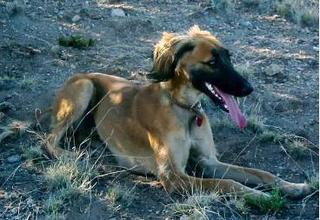 UPDATE: A few more comments from primitive dog aficionado friends-- both scientists incidentally. Vladimir Beregovoy wonders whether modern show and pet breeders who favor "placidity" would breed from what he calls "Houdinis " like my Kazakh female Ataika (left), who routinely escapes from 8- foot fenced enclosures though no bigger than a whippet.
And Dr. John Burchard adds re genetic depletion:"There is much talk of genetic diseases in purebred dogs.It seems the most serious one, ultimately fatal, is called "registration."
UPDATE: Here is what English PETA thinks, via Samizdata.
"Snuppy's birth announcement, published in today's issue of Nature, was greeted with scorn by some animal care activists, who decried the work as inhumane and wasteful, given the global glut of unwanted dogs.
"The cruelty and the body count outweighs any benefit that can be gained from this," said Mary Beth Sweetland, a vice president at People for the Ethical Treatment of Animals in Norfolk".
This is all very interesting, but other than the anti- cloning tizzy that it has thrown Bay Area animal activists into-- I'll try to find a link-- one of the interesting aspects is how self- elected "experts" have weighed in on how dumb a choice the Afghan is.
Says one, shrink and pop dog author Stanley Coren: "The Afghan hound is not a particularly intelligent dog, but it is beautiful." He ranked the Afghan hound last among 119 breeds in temperament and trainability."Many people who opt for the cloning technique are more interested in fashionable looks," he said. "Whenever we breed dogs for looks and ignore behavior, we have suffered."
Actually I would agree with him that far-- but he may be picking the wrong breed for the wrong reason. The modern show Afghan may be a shadow of its Asian ancestors, but the primitive wolflike habits and physiologies of the Middle Eastern and Central Asian sighthounds, which I have hunted with for twenty five years, do not easily lend themselves to simple analysis. They are not robotic, while some "intelligent" breeds like Labs can be.
My friend Dr. John Burchard, who studied at the Max Planck Institute and under Konrad Lorenz, and who has worked with salukis and falcons for forty- plus years, put it this way today: "In general the dogs that score highest for obedience, and thus for "intelligence" in Coren's system, do worst at problem solving. The best problem solvers seem to be wolves -- and Basenjis, who score very low in Coren's scheme. Don't know if anybody's tried sighthounds on the problem solving tests ... but those of us who live with them can't help noticing certain things..."
(One of our sighthound group describes a cartoon in which a bespectacled scientist stands at the top of a cliff demanding that a recalcitrant Afghan "Jump!". Below the ground is littered with the corpses of Labs, collies, shepherds....)
 UPDATE: A few more comments from primitive dog aficionado friends-- both scientists incidentally. Vladimir Beregovoy wonders whether modern show and pet breeders who favor "placidity" would breed from what he calls "Houdinis " like my Kazakh female Ataika (left), who routinely escapes from 8- foot fenced enclosures though no bigger than a whippet.
And Dr. John Burchard adds re genetic depletion:"There is much talk of genetic diseases in purebred dogs.It seems the most serious one, ultimately fatal, is called "registration."
UPDATE: Here is what English PETA thinks, via Samizdata.
"Snuppy's birth announcement, published in today's issue of Nature, was greeted with scorn by some animal care activists, who decried the work as inhumane and wasteful, given the global glut of unwanted dogs.
"The cruelty and the body count outweighs any benefit that can be gained from this," said Mary Beth Sweetland, a vice president at People for the Ethical Treatment of Animals in Norfolk".
Archaeology Blogging, First Americans and more...
Reid Farmer has been sending many good papers and emails-- so many in fact I have invited him to join the blog, which I hope he will next week. Meanwhile go here and here and here for some good early American stuff. (The last has a lot of links to other papers as well).
Most of this material relates to post- Clovis humans and "blitz" megafauna extinction, though as Reid points out there is nothing mutually exclusive about one population of humans coming down the coast while another, perhaps with a better big game toolkit, and definitely with dogs-- I'll have more on that later-- enters swiftly via the ice- free corridor.
One of the papers in the last link there is described with a remarkable line, though: "The authors of "Megafauna Extinction" posit that if early North American hunters focused merely on hunting relatively small animals such as rabbits and deer, accidental encounters with big megafauna like mammoths were common enough to result in megafaunal kills".
To which Matt Mullenix, who will also be posting here soon, replied: "Do you ever get the impression that lots of guys who speculate from scant evidence about the nature of Man The Hunter are not, in fact, hunting men themselves?
"Accidental encounters" with megafauna while hunting rabbits on the open plain? Please!
"Whilst I and my fellows enjoyed a day's bird hunting with our bolas, Grog here tripped upon a sleeping mammoth and had the poor beast lassoed before it could mount a commendable defense!
"All in a day's work, my boy!"
Also apropos here: the dean of high plains archaeology, George Frison (says Reid "Only archaeologist I ever knew who owned and operated his own backhoe) who IS a hunter and wrote the book on it, says: ".. too many investigators think they have analyzed hunting by declaring that prehistoric humans addressed their hunger simply by "leaving camp and killing an animal".
Most of this material relates to post- Clovis humans and "blitz" megafauna extinction, though as Reid points out there is nothing mutually exclusive about one population of humans coming down the coast while another, perhaps with a better big game toolkit, and definitely with dogs-- I'll have more on that later-- enters swiftly via the ice- free corridor.
One of the papers in the last link there is described with a remarkable line, though: "The authors of "Megafauna Extinction" posit that if early North American hunters focused merely on hunting relatively small animals such as rabbits and deer, accidental encounters with big megafauna like mammoths were common enough to result in megafaunal kills".
To which Matt Mullenix, who will also be posting here soon, replied: "Do you ever get the impression that lots of guys who speculate from scant evidence about the nature of Man The Hunter are not, in fact, hunting men themselves?
"Accidental encounters" with megafauna while hunting rabbits on the open plain? Please!
"Whilst I and my fellows enjoyed a day's bird hunting with our bolas, Grog here tripped upon a sleeping mammoth and had the poor beast lassoed before it could mount a commendable defense!
"All in a day's work, my boy!"
Also apropos here: the dean of high plains archaeology, George Frison (says Reid "Only archaeologist I ever knew who owned and operated his own backhoe) who IS a hunter and wrote the book on it, says: ".. too many investigators think they have analyzed hunting by declaring that prehistoric humans addressed their hunger simply by "leaving camp and killing an animal".
Tuesday, August 02, 2005
"Advice for Authors"
Michael Blowhard of 2Blowhards sent me to this excellent post by Seth Godin on the perils of "making a living" writing non- fiction. A couple of quotes?
"Please understand that book publishing is an organized hobby, not a business".
"There is no such thing as effective book promotion by a book publisher.
This isn't true, of course. Harry Potter gets promoted. So did Freakonomics. But out of the 75,000 titles published last year in the US alone, I figure 100 were effectively promoted by the publishers. This leaves a pretty big gap".
Read & weep. Or maybe not-- he has some intelligent things to say about the changing paradigm, including his conclusion:
"And the punchline, of course, is that if you do all these things, you won't need a publisher. And that's exactly when a publisher will want you! That's the sort of author publishers do the best with".
I'm still figuring it out-- I have only been doing it for 30 years.
"Please understand that book publishing is an organized hobby, not a business".
"There is no such thing as effective book promotion by a book publisher.
This isn't true, of course. Harry Potter gets promoted. So did Freakonomics. But out of the 75,000 titles published last year in the US alone, I figure 100 were effectively promoted by the publishers. This leaves a pretty big gap".
Read & weep. Or maybe not-- he has some intelligent things to say about the changing paradigm, including his conclusion:
"And the punchline, of course, is that if you do all these things, you won't need a publisher. And that's exactly when a publisher will want you! That's the sort of author publishers do the best with".
I'm still figuring it out-- I have only been doing it for 30 years.
On regional writing
A friend, a younger writer, asked my opinion on when one can be allowed, so to speak, to write about a place one was not born in. Here are his questions, and some thoughts of mine on the matter, those of a Bostonian who has lived in rural New Mexico for 25 or so years..
"Can you tell me: When did you feel comfortable writing
about New Mexico? How long do you have to be in a
place to feel right about writing about it? Do the
locals resent you? Did they at first?"
The thing of course is to be honest. Let us always go to unfashionable Hemingway.
It is NOT permissible to write in cliches about "the city different" and "the Land of Enchantment" if you are writing about New Mexico. The horrible ex- Michael Gruber version of "Robert Tanenbaum" in my review section has a lot of that. Clear Light. Native American Shamans. Hot Chiles. Santa Fe (Taos) Style.
It is permissible to write about the real Santa Fe. The best novel I know about it is-- believe it or not-- a sort of vampire novel written by a Santa Fe academic who was born in the deep South and raised as a Baptist--!!--Dreamer by Jack Butler.
(Nobody writes about Albuquerque, an absolutely fascinating town full of Asians of every description, gangs, restaurants, culture, high tech--- I digress).
Nobody owns anywhere. Though "one" should avoid making judgments/ conclusions about a new place-- OBSERVE. ASK. Then go with instinct if you are blessed with such. There is a LOT of horrible shite written about Montana, more than about New Mexico, partly I think because it is easier to go there and hang only with easterners/ coastal people.
To go on with my own experience: that-- to hang out with anyone other than locals-- was not possible for me when I got here, and I am hard on myself. I didn't do much of any NM writing for several years. When I first did, it was attacked all right-- by Easterners! New Mexicans came to my defense, and have ever after. Never heard a negative word from a New Mexican on any of my NM writing.
They like Cormac McCarthy too.
But not that rich sentimental commie John Nichols.
Keep it true, brother.
"Can you tell me: When did you feel comfortable writing
about New Mexico? How long do you have to be in a
place to feel right about writing about it? Do the
locals resent you? Did they at first?"
The thing of course is to be honest. Let us always go to unfashionable Hemingway.
It is NOT permissible to write in cliches about "the city different" and "the Land of Enchantment" if you are writing about New Mexico. The horrible ex- Michael Gruber version of "Robert Tanenbaum" in my review section has a lot of that. Clear Light. Native American Shamans. Hot Chiles. Santa Fe (Taos) Style.
It is permissible to write about the real Santa Fe. The best novel I know about it is-- believe it or not-- a sort of vampire novel written by a Santa Fe academic who was born in the deep South and raised as a Baptist--!!--Dreamer by Jack Butler.
(Nobody writes about Albuquerque, an absolutely fascinating town full of Asians of every description, gangs, restaurants, culture, high tech--- I digress).
Nobody owns anywhere. Though "one" should avoid making judgments/ conclusions about a new place-- OBSERVE. ASK. Then go with instinct if you are blessed with such. There is a LOT of horrible shite written about Montana, more than about New Mexico, partly I think because it is easier to go there and hang only with easterners/ coastal people.
To go on with my own experience: that-- to hang out with anyone other than locals-- was not possible for me when I got here, and I am hard on myself. I didn't do much of any NM writing for several years. When I first did, it was attacked all right-- by Easterners! New Mexicans came to my defense, and have ever after. Never heard a negative word from a New Mexican on any of my NM writing.
They like Cormac McCarthy too.
But not that rich sentimental commie John Nichols.
Keep it true, brother.
So that's how they do it..
Anyone who has ever been in the far north knows that its greatest curse is not cold but blood- sucking summer insects, in numbers that can drain a caribou or a human. So maybe it should come as no surprise that evolution has fitted some birds with their own built- in mosquito repellent.
"Hector Douglas, a University of Alaska Fairbanks researcher, said he made the discovery in the feathers of the crested auklet after applying a little scientific intuition and sacrificing some of his own blood....
"To test his theory, he went into the laboratory with a few auklet feathers. An analysis showed him the chemicals that make up the auklet's "odorant." Most are available commercially.
"He then tested their repellent properties using mosquitoes specially bred at a research lab in Florida for their aggressive tendencies. Douglas dabbed test samples on filter paper, attached that paper to his hand, then put it in a cage with hungry mosquitoes.
"It was clear the auklet samples kept mosquitoes away".
I'm wondering, given birds' vulnerability to arthropod- borne viruses, and their small size (which makes them easy to "drain") whether other such properties will bew found in other species
"Hector Douglas, a University of Alaska Fairbanks researcher, said he made the discovery in the feathers of the crested auklet after applying a little scientific intuition and sacrificing some of his own blood....
"To test his theory, he went into the laboratory with a few auklet feathers. An analysis showed him the chemicals that make up the auklet's "odorant." Most are available commercially.
"He then tested their repellent properties using mosquitoes specially bred at a research lab in Florida for their aggressive tendencies. Douglas dabbed test samples on filter paper, attached that paper to his hand, then put it in a cage with hungry mosquitoes.
"It was clear the auklet samples kept mosquitoes away".
I'm wondering, given birds' vulnerability to arthropod- borne viruses, and their small size (which makes them easy to "drain") whether other such properties will bew found in other species
"The blazon of expressed shapeliness.."
Some very nice lines on domestication from poet, critic, and philosopher Fred Turner, from his The New World: An Epic Poem (1985).
"We are the holy and dangerous beast who dared
to domesticate not only our plant and animal servants
but also ourselves: and not for usefulness only
but chiefly for beauty, the blazon of expressed shapeliness
and so the heroic hang of the Great Dane
the pretty baroque of the King Charles spaniel
the deathlike elegance of the Siamese cat, the fire
of the fighting fish, bulbous flash of the koi, pout
and delicate feather of pigeon and dove that Darwin
admired, crimson petals of rose and peony,
are only attendants on the sovereign differences given
to this clan of mutated monkeys, to itself by itself ".
"We are the holy and dangerous beast who dared
to domesticate not only our plant and animal servants
but also ourselves: and not for usefulness only
but chiefly for beauty, the blazon of expressed shapeliness
and so the heroic hang of the Great Dane
the pretty baroque of the King Charles spaniel
the deathlike elegance of the Siamese cat, the fire
of the fighting fish, bulbous flash of the koi, pout
and delicate feather of pigeon and dove that Darwin
admired, crimson petals of rose and peony,
are only attendants on the sovereign differences given
to this clan of mutated monkeys, to itself by itself ".
Subscribe to:
Posts (Atom)