Prairie Mary sent a review of Bill Buford's excellent new book Heat, which describes how a fancy New York editor (The New Yorker, Granta) decides to learn to be a Tuscan butcher under the influence of Mario Battali.
Italians and others from Catholic cultures (Battali blurbed the hilarious Bad Catholic's Guide to Good Living, which features a roadkill recipe alongside saint's days) seem to be utterly free of neo- puritan food prejudices. At Crunchy Con, Rod Dreher mentioned a wonderful- sounding Cuban beef dish, and I wrote for details, promising a trade. He replied in a recipe post:
"Steve Bodio asked me in the weekend cooking thread below to post the recipe for the Cuban fried beef I prepared last night. Happy to oblige. As Julie and I ate it last night, I said to her, "Is there any other dish that provides so much pure pleasure with so little effort?" The answer is, yes, there is: ripe tomatoes with kosher salt and a drizzling of olive oil (which I also had this weekend, thanks to my kind neighbor Laura bringing over tomatoes fresh from her garden). Still, you should make this; it's insanely delicious. I think the only reason Castro still rules Cuba is that a well-made vaca frita is the opiate of the people. I'm still pie-eyed from last night.
"What you do is the day before you're planning to eat the vaca frita, take 2 1/2 lbs. of flank steak, and let it simmer in a pot of salted water with a bay leaf or two for 90 minutes. When it's done, take it out and let the meat cool. Then, tear it into strips with your fingers. That done, you'll want to put the meat into a non-reactive bowl, and over that pour the juice of six limes and three lemons (at least), as well as three diced garlic cloves. Mix this together, and put it in the fridge to marinate overnight.
"The next day, cut an onion in half and slice the entire thing into thin strips. Then, remove the marinated beef from the bowl, and squeeze out all the marinade. Set the meat aside. In a deep saute pan or black-iron skillet, heat a half-cup of olive oil until fragrant, then put the beef in. Let it sizzle cheerfully for about eight minutes, stirring attentively, then put the onions in. Mix the meat and the onions well, and stir for about 10 to 15 more minutes, until the beef is crispy brown.
"Salt and pepper to taste, and squeeze a couple of lime wedges over the top before serving, if you like. The thing to serve with vaca frita is white rice. The thing to drink with it is cold lager. The thing to listen to while eating it is Jesus Alemany."
It is as good as he says. I replied with this:
"One of our favorites is Macedonian lamb stew, adapted froom Paula Wolfert. A few hours before you start cooking, put 3 cups of plain yogurt (real yogurt, not the kind with gelatin added to it) in a colander or seive that has been lined with three layers of cheesecloth. Sprinkle it with a few teaspoons of kosher salt and leave it to drain for a few hours -- it will become quite thick as the water drains out. Once it has thickened, add a few (or more as we do) tbsp. of finely chopped garlic and let it sit until you eat.
"Wash and dry 1-1/2 pounds of fresh spinach. Place it in a colander and sprinkle it with 1 tbsp kosher salt, making sure that the salt is dispersed throughout. let the spinach sit at room temperature for at least an hour. Salting it beforehand enables the spinach to maintain its bright green color when you later add it to the stew.
"Now you're ready to start cooking.
"Cut a lamb leg or shoulder into strips about 1" wide and 3" long, maybe 3/4" thick. Brown them in a large dutch oven or braising pan, and then cover with chicken broth. Simmer gently until tender. In another pan, saute 16-20 scallions cut into 3" lengths in a few tbsp of olive oil until they wilt; add a tbsp of paprika and some resh ground pepper and add this to the meat along with 1 tbsp or so of tomato paste. Let it simmer another ten minutes, then add the spinach. Cook until the spinach has collapsed.
"Serve this with the garlic yogurt on top, which really pulls the whole dish together!"
Usually we cook this in winter but this is making me hungry..
Care to reply, Roseann? Tag!
Update: Roseann responds here.
Saturday, June 24, 2006


Friday, June 23, 2006
"Entering Human Lives "
A friend, a serious writer and reader of this blog, is now working on some tales of her life as an Animal Control Officer ("dogcatcher") in a big city. Here is a tale of life at the sharp end. Take it away....
The early complaints about this case were about noise from barking dogs, a kind of complaint so common and so related to the state of the complainant (sad, angry, lonesome people are hypersensitive) that they tend to result in not much more than a door-hanger for the dog owner. This one was about a big old house along Powell in a place where the street was going to be rebuilt and widened. The houses would be torn down soon, so no one was maintaining them. This one appeared to be empty. I heard and saw no dogs. No one answered the door.
The complaints kept coming until one old man called up to say that there was a pack of chihuahuas running the streets at night and if we didn’t do something about them, he was going to start shooting them. A pack of chihuahuas sounded pretty ridiculous, but when people say they will begin to shoot, it’s past time for intervention. Actually, later I talked to an old Mexican guy who said that packs of chihuahuas were like land piranhas and could bring down a cow by taking bites out of its ankles until they severed the tendons so it fell over. Then, untroubled by any need to kill it, they ate it.
But I was so convinced that the designated house was empty that I couldn’t believe it was the source of the dogs. Finally I just went door-to-door looking for information but people were reluctant. A block away was a kind of hippie co-op food store and they finally told me that an old woman they called “the goat woman,” because she smelled so totally horrible, would sometimes come in and ask to use their phone. She carried with her a shopping bag full of restaurant scraps which she claimed was dog food. They pointed out that same decrepit abandoned house. I went back, and then went back again, and finally noticed that there was mail being delivered and letters put out for pickup. One is never supposed to touch mailboxes (a federal offense) but I got her name off the letters anyway. Helen. Then I wrote her a letter myself and put it in the box. (Also illegal if it doesn’t have a stamp on it.)
Next time I went back and knocked, the piece of cardboard covering the place where there had been a glass window in the door was pulled aside and there she was: the Goat Woman, wearing a bright red wig with a sweater tied over it by the arms and about six layers of clothes, most obviously a big nightgown. Behind her, ranged around a gloomy room six inches deep in dog shit, were the glittering eyes of the chihuahuas, dozens and dozens of them. All of them were named for politicians, which tells you something about Helen.
She said her life had been perfectly normal in this house until she had to have an operation for cancer. In those days there were only three chihuahuas and a friend promised to take care of them while she was in the hospital, but didn’t quite keep up with the messes. When Helen came back, she thought she’d just let it go a little longer until she felt better, and as the months dragged on, she got used to it. But as there began to be more and more dogs, she had worried about feeding them until she resourcefully hit on the idea of restaurant scraps. She was resistant to the idea of any new plan. She had a welfare worker and gave me the name. She claimed she had permission to live there.
I also went to the records to find out who owned the house and called that person, who turned out to be a widow on vacation in the Caribbean. Her lawyer was not pleasant. Helen had been given several eviction notices. Her welfare worker was a young man who hadn’t seen her for a long time. She regularly called in and told him she was doing fine. I told him what I saw and asked for his supervisor, whom I told my next call would be to a television station. Then back to Helen to pressure her to give up the dogs.
At last she handed them out the hole in the door, telling me the name of each. She claimed that one was named for a popular sports caster and that the dog would sit on the couch and watch when he came on the TV, which miraculously worked even though coated with what appeared to be cow patties, the kind out in a field where bugs have been making little holes in them. I doubted this practice on the part of the dog since the couch had rotted through until it was only springs.
The dogs all had diarrhea and all were wild, unsocialized. Most of them bit me and all of them shat on me. By now the police had been attracted and were sitting in their squad car laughing their heads off as I juggled dogs and tried to wrap them in my big tough law enforcement jacket to keep them from biting me. I was tempted to chuck one through their patrol car window.
My truck was filling up, so I called for a second truck. It was Renee and one whiff of the waves of head-clearing ammonia coming from the house was enough for her. “Do you know what diseases might be in there?” She said she’d hold the door of her truck for me while I brought the piranhas out. In the end there were 67 of them. More or less. Back in the shelter kennels they piled on top of each other, glassy-eyed with terror, so it was hard to count them.
Helen was crying and begged for just one dog to keep so she wouldn’t have to stay in the house all alone. But I went back to welfare and insisted they get her out of there TODAY, not tomorrow. The young man whined, “Well, if she’s lived in that mess this long, one more day isn’t going to kill her.” I pointed out that now she would be all alone, but he didn’t get it. Finally he found a place for her in an emergency shelter for abused women.
Somehow she got my phone number. Maybe I was rash enough to give it to her. Anyway, at ten o’clock she called me at home, frantic over money in her house, now unguarded. She hated the shelter (“These women are nuts!”) and was so hysterical (what a manipulator!) that I agreed to go. It was raining. It’s ALWAYS raining in Portland at night. I called the precinct and asked for cover -- “for WHAT?” they asked incredulously -- and packed up a hammer, nails, and my biggest flashlight. This was completely out of line -- I was in a very gray area indeed.
The young male officer refused to go into the house. “I’ll stand here and shine my light on you,” he generously offered from the doorway. I followed the instructions Helen had given me. There was a big pile of old purses in one corner downstairs. (in fact, there were boxes of old clothes everywhere.) In them, in no particular order were handfuls of envelopes, some with corners of checks sticking out: it was the mail she’d been receiving. I suspect it was some sort of maiI-order scam she was using to augment her welfare. Putting all the envelopes into one handbag, I went upstairs to get what she said were two mayonnaise jars of quarters.
The electricity, which had worked when she was there though there was dog excrement on the lightbulbs (how?), was now off so it was hard to tell what I walking on as I went up the stairs. I could hear water trickling someplace and scuttling -- either I’d missed a dog or two or there were rats. One bedroom door was hooked. Inside, as she had explained, was an ordinary clean room. On the bureau were the two mayonnaise jars of quarters.
The officer nicely held my swag while I nailed the door shut. He was trying to compose his report when I left to take Helen’s money to her. She was waiting for me and not particularly grateful. I was a little worried that she would accuse me of taking some of the money. Months later I saw her at a bus stop wearing a blue suit and a nice lady hat, all cleaned up and looking normal. I didn’t stop to visit.
The dogs were a different story. The shelter vet shook his head over them, but by now the media was onto the story and the politicians wanted a good face on the event. He picked out two animals that seemed healthy and we adopted them out to a lady in the country. Next day she brought them back by the scruff of their necks: they had killed every chicken she had. By this time we had realized that the dogs were so inbred that they were mostly blind and their innards were so deranged by their irregular food that they didn’t digest dog food. Euthanasia was the answer.
The point of this story is that animal control, like every other emergency responder and social regulator, is connected to every aspect of the households that are visited in response to complaints. Usually there are several factors in operation, assigned to different governmental bodies who may or may not be in sympathy with animal control. To be an effective agent in society, it’s as important to be a networker as to be a specialist.
It takes resources to RESIST pets. Dogs and cats know how to insert themselves into human households -- have known since the houses in question were caves. And once the family has major problems, animals are way down the list.
One complaint arrived in the form of a three-page single-spaced letter that itemized social offenses that ranged from letting kids run naked in the street to parking cars at the curb facing the wrong way. It was this last offense that the complainant really could not tolerate. When I went to the house, the teenager’s probation officer was just leaving, and when I left the public health nurse was just arriving. The fire department had been there the night before because of a mattress on fire -- now in the backyard, having been pushed out the window, and proving to have enough bounce left for bare-butted kids to enjoy. The fire was from a nodding drug addict, not her husband, the lady of the house was glad to announce. (The husband was in prison for something.) Her damned brother. This exhausted woman, the only responsible person in the house, stood in the doorway with a baby on her hip, hugely pregnant. They were hippies, they believed in the free life (their broken VW van, complete with daisies, was in pieces in the driveway), but somehow it had escaped control. Dogs and cats lolled here and there -- all mellow, none licensed or confined.
The woman was intelligent. I rather liked her. “Don’t you feel kinda like the soldiers in the fort being circled by Indians?” I asked her.
“Yah.”
I never could solve the problems. The household eventually just left.
But it wasn’t always the complainants who were the problem. In a very nice neighborhood I got a complaint about barking dogs. The family was Asian. “We don’t want trouble. We get rid of dog.”
I explained that it wasn’t necessary and made suggestions about how to keep the dog from barking. It wasn’t barking at me and seemed like a normal happy dog. The kids were very attached to it and held onto it tightly, crying, but the mother said, “We no want trouble. Dog goes.”
A few weeks later I got another complaint about the other end of the block, also about barking dogs. This time the owner was a woman who was defiant. “These are purebred collies, show dogs, and I will not be intimidated by that Nazi! My dogs are not the problem -- HE is the problem.” I talked to the people in the house on the other side of the collies and they agreed that the dogs were not a problem.
Complainants are always harder to deal with than offenders, maybe because they feel they are on the side of virtue. This man was Scandinaavian, not German as his neighbors thought, and he was a big tough guy who began a tirade as soon as he opened the door. In the middle of it his wife came halfway down the stairs in a blouse and slip, holding her skirt, desperate to stop him.
It was quite a story. She had divorced this man because of his unreasonable temper. She was a nursing supervisor. He was an artist -- I was invited in and looked at his work. Wonderful paintings of sailing ships, almost other-worldly in their suggestion of freedom and peace. Then he developed terminal cancer and she let him come back to the house so he could paint until he died. He was refusing pain killers so he could be clear-headed. But his wretched temper had turned on all the neighborhood dogs and kids. “I’m glad the dogs are being killed -- the kids should go next.”
“You don’t mean that,” I said.
“He does,” said his wife. And to him, “I should throw you out. I have to live here after you’re dead, you know.”
We talked quite a while. I doubt we reached any conclusion. She was late to work. But he must have turned his temper on something else because there were no more complaints about barking and I didn’t go back. From our point of view, the problem was solved.
I had no business trying to counsel these people. I could have gotten sucked into all kinds of accusations, to say nothing of being attacked on the scene. I should never even have gone into their house, but how can one keep from trying to offer human sympathy? Even if you are only the dog catcher.
One case comes back to my mind often. It was like a TV show. A woman had a big St. Bernard named Brandy that attacked people. She refused to tie it up. She said “they” would kill her if she had to tie it up. We insisted and threatened to impound the dog. So she tied it up and she was right: “they” killed her. Never did find out who “they” were.
In hospitals, I discovered years later when I did a chaplaincy as part of training for the ministry, there are “case conferences” where all the professionals involved in a specific patient’s care meet and try to get the big picture of what’s going on. The same is sometimes done with juvenile delinquents. The idea that one kind of agency can bring to bear a comprehensive approach that will resolve neighborhood problems is outmoded. In fact, I’d like to see some kind of neighborhood board that could address these problems of multiple anguish and aggravation. Some places have tried them with considerable success. But the simple machinery of getting people to meetings, compiling information, and enforcing recommendation is a huge burden on a community if there are more than a few dilemmas like these.
On the other hand, such a process can at least get people to realize what’s going on in their streets. Over and over I dealt with many wild events that no one even on the back of the block knew about. Probably one of the most memorable was a case of Wheeler’s. We picked up animals even in houses when the occupants were dead or arrested without anyone immediately available to care for them. When Wheeler got a 10-? on the radio, that’s what he expected. The police and coroner sometimes called us to help with bodies, even if no animal were involved, because our uniforms were wash-and-wear, but theirs were wool that had to be dry-cleaned.
In fact, the man of the household had freaked on drugs and gone berzerk with an axe. The woman and a couple of kids had escaped but the madman had chopped up a pekinese dog and a blonde toddler. Wheeler’s job was to help the coroner sort out and bag which little bits were child and which were dog. The child must have been holding the dog, maybe to protect it and maybe in hopes it could protect him.
Sometimes there are police cases that are too shocking to be put in the newspaper and that was the case this time. People who faced or adjoined the house knew something had happened, but not what. People on the back of the block never had a hint. All emergency responders see things that no one else realizes ever happen. Wheeler’s response was to be tough -- he was a survivor himself and a lively cynic.
My own response began to push me towards a wish to intervene or at least understand. I had a wicked appetite for knowing just what it was going through that insane man’s head, the toddler’s mind -- even what the dog was thinking. I couldn’t help wondering who “they,” the murderers of Brandy’s owner, really were. And I had a vivid fantasy of a pack of 69 Chihuahuas running in the moonlight through the night streets of Portland. I really wish I’d seen that just once.
The early complaints about this case were about noise from barking dogs, a kind of complaint so common and so related to the state of the complainant (sad, angry, lonesome people are hypersensitive) that they tend to result in not much more than a door-hanger for the dog owner. This one was about a big old house along Powell in a place where the street was going to be rebuilt and widened. The houses would be torn down soon, so no one was maintaining them. This one appeared to be empty. I heard and saw no dogs. No one answered the door.
The complaints kept coming until one old man called up to say that there was a pack of chihuahuas running the streets at night and if we didn’t do something about them, he was going to start shooting them. A pack of chihuahuas sounded pretty ridiculous, but when people say they will begin to shoot, it’s past time for intervention. Actually, later I talked to an old Mexican guy who said that packs of chihuahuas were like land piranhas and could bring down a cow by taking bites out of its ankles until they severed the tendons so it fell over. Then, untroubled by any need to kill it, they ate it.
But I was so convinced that the designated house was empty that I couldn’t believe it was the source of the dogs. Finally I just went door-to-door looking for information but people were reluctant. A block away was a kind of hippie co-op food store and they finally told me that an old woman they called “the goat woman,” because she smelled so totally horrible, would sometimes come in and ask to use their phone. She carried with her a shopping bag full of restaurant scraps which she claimed was dog food. They pointed out that same decrepit abandoned house. I went back, and then went back again, and finally noticed that there was mail being delivered and letters put out for pickup. One is never supposed to touch mailboxes (a federal offense) but I got her name off the letters anyway. Helen. Then I wrote her a letter myself and put it in the box. (Also illegal if it doesn’t have a stamp on it.)
Next time I went back and knocked, the piece of cardboard covering the place where there had been a glass window in the door was pulled aside and there she was: the Goat Woman, wearing a bright red wig with a sweater tied over it by the arms and about six layers of clothes, most obviously a big nightgown. Behind her, ranged around a gloomy room six inches deep in dog shit, were the glittering eyes of the chihuahuas, dozens and dozens of them. All of them were named for politicians, which tells you something about Helen.
She said her life had been perfectly normal in this house until she had to have an operation for cancer. In those days there were only three chihuahuas and a friend promised to take care of them while she was in the hospital, but didn’t quite keep up with the messes. When Helen came back, she thought she’d just let it go a little longer until she felt better, and as the months dragged on, she got used to it. But as there began to be more and more dogs, she had worried about feeding them until she resourcefully hit on the idea of restaurant scraps. She was resistant to the idea of any new plan. She had a welfare worker and gave me the name. She claimed she had permission to live there.
I also went to the records to find out who owned the house and called that person, who turned out to be a widow on vacation in the Caribbean. Her lawyer was not pleasant. Helen had been given several eviction notices. Her welfare worker was a young man who hadn’t seen her for a long time. She regularly called in and told him she was doing fine. I told him what I saw and asked for his supervisor, whom I told my next call would be to a television station. Then back to Helen to pressure her to give up the dogs.
At last she handed them out the hole in the door, telling me the name of each. She claimed that one was named for a popular sports caster and that the dog would sit on the couch and watch when he came on the TV, which miraculously worked even though coated with what appeared to be cow patties, the kind out in a field where bugs have been making little holes in them. I doubted this practice on the part of the dog since the couch had rotted through until it was only springs.
The dogs all had diarrhea and all were wild, unsocialized. Most of them bit me and all of them shat on me. By now the police had been attracted and were sitting in their squad car laughing their heads off as I juggled dogs and tried to wrap them in my big tough law enforcement jacket to keep them from biting me. I was tempted to chuck one through their patrol car window.
My truck was filling up, so I called for a second truck. It was Renee and one whiff of the waves of head-clearing ammonia coming from the house was enough for her. “Do you know what diseases might be in there?” She said she’d hold the door of her truck for me while I brought the piranhas out. In the end there were 67 of them. More or less. Back in the shelter kennels they piled on top of each other, glassy-eyed with terror, so it was hard to count them.
Helen was crying and begged for just one dog to keep so she wouldn’t have to stay in the house all alone. But I went back to welfare and insisted they get her out of there TODAY, not tomorrow. The young man whined, “Well, if she’s lived in that mess this long, one more day isn’t going to kill her.” I pointed out that now she would be all alone, but he didn’t get it. Finally he found a place for her in an emergency shelter for abused women.
Somehow she got my phone number. Maybe I was rash enough to give it to her. Anyway, at ten o’clock she called me at home, frantic over money in her house, now unguarded. She hated the shelter (“These women are nuts!”) and was so hysterical (what a manipulator!) that I agreed to go. It was raining. It’s ALWAYS raining in Portland at night. I called the precinct and asked for cover -- “for WHAT?” they asked incredulously -- and packed up a hammer, nails, and my biggest flashlight. This was completely out of line -- I was in a very gray area indeed.
The young male officer refused to go into the house. “I’ll stand here and shine my light on you,” he generously offered from the doorway. I followed the instructions Helen had given me. There was a big pile of old purses in one corner downstairs. (in fact, there were boxes of old clothes everywhere.) In them, in no particular order were handfuls of envelopes, some with corners of checks sticking out: it was the mail she’d been receiving. I suspect it was some sort of maiI-order scam she was using to augment her welfare. Putting all the envelopes into one handbag, I went upstairs to get what she said were two mayonnaise jars of quarters.
The electricity, which had worked when she was there though there was dog excrement on the lightbulbs (how?), was now off so it was hard to tell what I walking on as I went up the stairs. I could hear water trickling someplace and scuttling -- either I’d missed a dog or two or there were rats. One bedroom door was hooked. Inside, as she had explained, was an ordinary clean room. On the bureau were the two mayonnaise jars of quarters.
The officer nicely held my swag while I nailed the door shut. He was trying to compose his report when I left to take Helen’s money to her. She was waiting for me and not particularly grateful. I was a little worried that she would accuse me of taking some of the money. Months later I saw her at a bus stop wearing a blue suit and a nice lady hat, all cleaned up and looking normal. I didn’t stop to visit.
The dogs were a different story. The shelter vet shook his head over them, but by now the media was onto the story and the politicians wanted a good face on the event. He picked out two animals that seemed healthy and we adopted them out to a lady in the country. Next day she brought them back by the scruff of their necks: they had killed every chicken she had. By this time we had realized that the dogs were so inbred that they were mostly blind and their innards were so deranged by their irregular food that they didn’t digest dog food. Euthanasia was the answer.
The point of this story is that animal control, like every other emergency responder and social regulator, is connected to every aspect of the households that are visited in response to complaints. Usually there are several factors in operation, assigned to different governmental bodies who may or may not be in sympathy with animal control. To be an effective agent in society, it’s as important to be a networker as to be a specialist.
It takes resources to RESIST pets. Dogs and cats know how to insert themselves into human households -- have known since the houses in question were caves. And once the family has major problems, animals are way down the list.
One complaint arrived in the form of a three-page single-spaced letter that itemized social offenses that ranged from letting kids run naked in the street to parking cars at the curb facing the wrong way. It was this last offense that the complainant really could not tolerate. When I went to the house, the teenager’s probation officer was just leaving, and when I left the public health nurse was just arriving. The fire department had been there the night before because of a mattress on fire -- now in the backyard, having been pushed out the window, and proving to have enough bounce left for bare-butted kids to enjoy. The fire was from a nodding drug addict, not her husband, the lady of the house was glad to announce. (The husband was in prison for something.) Her damned brother. This exhausted woman, the only responsible person in the house, stood in the doorway with a baby on her hip, hugely pregnant. They were hippies, they believed in the free life (their broken VW van, complete with daisies, was in pieces in the driveway), but somehow it had escaped control. Dogs and cats lolled here and there -- all mellow, none licensed or confined.
The woman was intelligent. I rather liked her. “Don’t you feel kinda like the soldiers in the fort being circled by Indians?” I asked her.
“Yah.”
I never could solve the problems. The household eventually just left.
But it wasn’t always the complainants who were the problem. In a very nice neighborhood I got a complaint about barking dogs. The family was Asian. “We don’t want trouble. We get rid of dog.”
I explained that it wasn’t necessary and made suggestions about how to keep the dog from barking. It wasn’t barking at me and seemed like a normal happy dog. The kids were very attached to it and held onto it tightly, crying, but the mother said, “We no want trouble. Dog goes.”
A few weeks later I got another complaint about the other end of the block, also about barking dogs. This time the owner was a woman who was defiant. “These are purebred collies, show dogs, and I will not be intimidated by that Nazi! My dogs are not the problem -- HE is the problem.” I talked to the people in the house on the other side of the collies and they agreed that the dogs were not a problem.
Complainants are always harder to deal with than offenders, maybe because they feel they are on the side of virtue. This man was Scandinaavian, not German as his neighbors thought, and he was a big tough guy who began a tirade as soon as he opened the door. In the middle of it his wife came halfway down the stairs in a blouse and slip, holding her skirt, desperate to stop him.
It was quite a story. She had divorced this man because of his unreasonable temper. She was a nursing supervisor. He was an artist -- I was invited in and looked at his work. Wonderful paintings of sailing ships, almost other-worldly in their suggestion of freedom and peace. Then he developed terminal cancer and she let him come back to the house so he could paint until he died. He was refusing pain killers so he could be clear-headed. But his wretched temper had turned on all the neighborhood dogs and kids. “I’m glad the dogs are being killed -- the kids should go next.”
“You don’t mean that,” I said.
“He does,” said his wife. And to him, “I should throw you out. I have to live here after you’re dead, you know.”
We talked quite a while. I doubt we reached any conclusion. She was late to work. But he must have turned his temper on something else because there were no more complaints about barking and I didn’t go back. From our point of view, the problem was solved.
I had no business trying to counsel these people. I could have gotten sucked into all kinds of accusations, to say nothing of being attacked on the scene. I should never even have gone into their house, but how can one keep from trying to offer human sympathy? Even if you are only the dog catcher.
One case comes back to my mind often. It was like a TV show. A woman had a big St. Bernard named Brandy that attacked people. She refused to tie it up. She said “they” would kill her if she had to tie it up. We insisted and threatened to impound the dog. So she tied it up and she was right: “they” killed her. Never did find out who “they” were.
In hospitals, I discovered years later when I did a chaplaincy as part of training for the ministry, there are “case conferences” where all the professionals involved in a specific patient’s care meet and try to get the big picture of what’s going on. The same is sometimes done with juvenile delinquents. The idea that one kind of agency can bring to bear a comprehensive approach that will resolve neighborhood problems is outmoded. In fact, I’d like to see some kind of neighborhood board that could address these problems of multiple anguish and aggravation. Some places have tried them with considerable success. But the simple machinery of getting people to meetings, compiling information, and enforcing recommendation is a huge burden on a community if there are more than a few dilemmas like these.
On the other hand, such a process can at least get people to realize what’s going on in their streets. Over and over I dealt with many wild events that no one even on the back of the block knew about. Probably one of the most memorable was a case of Wheeler’s. We picked up animals even in houses when the occupants were dead or arrested without anyone immediately available to care for them. When Wheeler got a 10-? on the radio, that’s what he expected. The police and coroner sometimes called us to help with bodies, even if no animal were involved, because our uniforms were wash-and-wear, but theirs were wool that had to be dry-cleaned.
In fact, the man of the household had freaked on drugs and gone berzerk with an axe. The woman and a couple of kids had escaped but the madman had chopped up a pekinese dog and a blonde toddler. Wheeler’s job was to help the coroner sort out and bag which little bits were child and which were dog. The child must have been holding the dog, maybe to protect it and maybe in hopes it could protect him.
Sometimes there are police cases that are too shocking to be put in the newspaper and that was the case this time. People who faced or adjoined the house knew something had happened, but not what. People on the back of the block never had a hint. All emergency responders see things that no one else realizes ever happen. Wheeler’s response was to be tough -- he was a survivor himself and a lively cynic.
My own response began to push me towards a wish to intervene or at least understand. I had a wicked appetite for knowing just what it was going through that insane man’s head, the toddler’s mind -- even what the dog was thinking. I couldn’t help wondering who “they,” the murderers of Brandy’s owner, really were. And I had a vivid fantasy of a pack of 69 Chihuahuas running in the moonlight through the night streets of Portland. I really wish I’d seen that just once.
Working Like a Dog
A new trend in officedom seems to be bringing your pet to work. According to Ellen Wulfhorst of Reuters, several thousand US companies (possibly one in five) allow employees to keep animals at the office and/or telecommute in order to spend more time with their critters.
Call it a quirky, dot-com startup kind of idea, but I like it! And it's not just for unsupervised, overpaid whizkids... For a couple years at (highly supervised, cash-poor) Florida Game and Fish, there were no fewer than five active falconers on staff, and the sound of screaming eyas hawks and ringing bells could be heard on any of several floors at headquarters. How cool was it to bring my hawk to work, park her on a screen perch next to my boss's hawk, then head straight to the field at quitting time? Pretty cool.
My suspicion is that this happy, pet-to-work story suggests a great peril for the likes of Wayne Pacelle and the psycho-pet-castration set: Most of the people who support "humane" causes with hard-earned cash love their pets and like to spend time with them. Why is that a perilous thing for the AR movement? Because (as is so easily demonstrated) the movement's leaders have no special love of domesticated animals and can't even bring themselves to say the P-word in public. They want our pets to be "companion animals," but only until systematic spaying and neutering eliminate them from the planet.
My love for Rina, our slightly manic but sweet-natured whippet, is seen through AR-colored glasses as the patronizing love of a master for his favorite slave. How sad! How ignorant. How utterly incorrect.
The animal rightists and welfarists (increasingly indistinguishable) will only be able to conceal their goals from their chief supporters---normal, pet-loving Americans---for so long. It would be best for them to have fewer pet owners to contend with at that time, and so toward that end they toil tremendously now.
Friends, resist! Love your pets. And if you can, take them with you to work!
Call it a quirky, dot-com startup kind of idea, but I like it! And it's not just for unsupervised, overpaid whizkids... For a couple years at (highly supervised, cash-poor) Florida Game and Fish, there were no fewer than five active falconers on staff, and the sound of screaming eyas hawks and ringing bells could be heard on any of several floors at headquarters. How cool was it to bring my hawk to work, park her on a screen perch next to my boss's hawk, then head straight to the field at quitting time? Pretty cool.
My suspicion is that this happy, pet-to-work story suggests a great peril for the likes of Wayne Pacelle and the psycho-pet-castration set: Most of the people who support "humane" causes with hard-earned cash love their pets and like to spend time with them. Why is that a perilous thing for the AR movement? Because (as is so easily demonstrated) the movement's leaders have no special love of domesticated animals and can't even bring themselves to say the P-word in public. They want our pets to be "companion animals," but only until systematic spaying and neutering eliminate them from the planet.
My love for Rina, our slightly manic but sweet-natured whippet, is seen through AR-colored glasses as the patronizing love of a master for his favorite slave. How sad! How ignorant. How utterly incorrect.
The animal rightists and welfarists (increasingly indistinguishable) will only be able to conceal their goals from their chief supporters---normal, pet-loving Americans---for so long. It would be best for them to have fewer pet owners to contend with at that time, and so toward that end they toil tremendously now.
Friends, resist! Love your pets. And if you can, take them with you to work!
Thursday, June 22, 2006
Bull Market
 This was too cool a photo-opportunity to pass up. Think they could get a job on Wall Street?
An Artist on "Hands- On"
Blogger and wildlife artist Carel Brest van Kempen had alot to say in this old post about his attitudes to "hands- on" interaction with the biosphere (see Matt's post below).
"A spoiled child of the west, I grew up in an area as sparsely populated as any in the temperate zone. Fences were few and easy to climb. As a boy, I could get on a horse and ride for days in any direction save one without running into other humans. Like many of the kids in my home town, I was an avid naturalist. If a species interested me, I'd capture a young one and raise it as a pet. We took foxes, coyotes, squirrels, woodrats, and scores of bird and reptile species, and in the process learned more about those animals than any college course could have taught us. Many of us practiced falconry, and a number of us have continued that sport into adulthood. Through our hands-on wildlife studies, we gained insights into the natural world that are the privilege of few in the industrialized world. To this day, I'm as likely to try to catch a wild animal, or climb to its nest as to sit silently and study its behavior."
Another RTWT. And watch for a real review of his book. Right now suffice to say that it is a brilliantly- done collection that is the artistic equivalent of Darren Naish's blog, but with some invertebrates added. Carel is less interested in conventionally charismatic megafauna than he is in the lesser known inhabitants of earth and their interactions, from Aplomado falcons picking insects out of the air over a burning cane field to horseshoe bats scooping minnows from a brilliantly- reflected, inverted tropical sky, to a nighthawk hunting over a thoroughly urban summer night scene to...
Well, buy the book-- I did, even though I could not afford it. You might even learn how to get drunk on live palm grubs...
"A spoiled child of the west, I grew up in an area as sparsely populated as any in the temperate zone. Fences were few and easy to climb. As a boy, I could get on a horse and ride for days in any direction save one without running into other humans. Like many of the kids in my home town, I was an avid naturalist. If a species interested me, I'd capture a young one and raise it as a pet. We took foxes, coyotes, squirrels, woodrats, and scores of bird and reptile species, and in the process learned more about those animals than any college course could have taught us. Many of us practiced falconry, and a number of us have continued that sport into adulthood. Through our hands-on wildlife studies, we gained insights into the natural world that are the privilege of few in the industrialized world. To this day, I'm as likely to try to catch a wild animal, or climb to its nest as to sit silently and study its behavior."
Another RTWT. And watch for a real review of his book. Right now suffice to say that it is a brilliantly- done collection that is the artistic equivalent of Darren Naish's blog, but with some invertebrates added. Carel is less interested in conventionally charismatic megafauna than he is in the lesser known inhabitants of earth and their interactions, from Aplomado falcons picking insects out of the air over a burning cane field to horseshoe bats scooping minnows from a brilliantly- reflected, inverted tropical sky, to a nighthawk hunting over a thoroughly urban summer night scene to...
Well, buy the book-- I did, even though I could not afford it. You might even learn how to get drunk on live palm grubs...
Lemaitre
Father Georges Lemaitre, mathematician, physicist, and diocesan Roman Catholic priest, is generally considered to be the father of the cosmic "Big Bang "theory. This informative TCS article suggests that he had admirably sane attitudes about the relations between science and religion too-- sometimes ones unexpected by his colleagues.
"Back in the early 1930s, the Nobel Laureate Paul Michael Dirac had a chance to discuss the expanding universe with Lemaître. Dirac was an atheist, and yet later he recalled, "When I was talking with Lemaître about this subject and feeling stimulated by the grandeur of the picture that he has given us, I told him that I thought cosmology was the branch of science that lies closest to religion. However Lemaître did not agree with me. After thinking it over he suggested psychology as lying closest to religion."
"This is fascinating, not because Dirac was an atheist and feeling mystical stirrings when he contemplated the cosmos, but because Lemaitre was a priest -- and he did not."
RTWT!
"Back in the early 1930s, the Nobel Laureate Paul Michael Dirac had a chance to discuss the expanding universe with Lemaître. Dirac was an atheist, and yet later he recalled, "When I was talking with Lemaître about this subject and feeling stimulated by the grandeur of the picture that he has given us, I told him that I thought cosmology was the branch of science that lies closest to religion. However Lemaître did not agree with me. After thinking it over he suggested psychology as lying closest to religion."
"This is fascinating, not because Dirac was an atheist and feeling mystical stirrings when he contemplated the cosmos, but because Lemaitre was a priest -- and he did not."
RTWT!
Self- Pollination

Self pollination is not all that rare, but this newly discovered Chinese orchid appears to be an extreme case.
"The orchid produces no scent or nectar, and the researchers did not see a single instance of pollination by an insect or by wind.
"Instead, the pollen-bearing anther uncovers itself and rotates into a suitable position to insert into the stigma cavity, where fertilization takes place.
"This sexual relationship is so exclusive that flowers do not even transfer pollen to other flowers on the same plant, researchers found."
Kazakhs in Space
I often say "Kazakhstan is a player". More eveidence can be found here at the Moscow Times: "Kazakhs Put First Satellite In Space"-- may be behind a firewall but it is an AP report and you might Google it. In case not, some snips:
"Kazakhstan sent its first satellite into space Sunday in the country's first step toward fulfilling its ambitions to join the club of space-exploring nations.
"The KazSat 1 satellite, mounted on a Russian-built Proton-K rocket, soared into the pre-dawn skies above Baikonur Cosmodrome in the middle of the harsh Kazakh steppe, watched by Kazakh President Nursultan Nazarbayev and President Vladimir Putin."
(Snip)
"Kazakhstan had long ago leased the cosmodrome to Russia, but now Nazarbayev wants his nation to build its own space industry, the government's ambitions fueled by its economic success, pumped up by oil-dollars.
"Kazakhstan is planning space-exploration missions and has reached an agreement with Russia to be part of all its projects involving Baikonur, said Serik Turzhanov, who heads the country's space agency, Kazkosmos."
(Snip)
"Kazkosmos also intends to build a control center in the capital, Astana, to monitor launches from Baikonur and another center at the Sary Shagan missile test site that would monitor satellites that fly over Kazakh territory.
"The Kazakhs are also forming their own squad of cosmonauts, who have been training for a few years at Russia's cosmonaut-training center."
Kazakhstan is nobody's "satellite" (ouch!) As it is the freest , least Islamic, and most economically powerful Central Asian state, it is always interesting to watch its maneuvers...
"Kazakhstan sent its first satellite into space Sunday in the country's first step toward fulfilling its ambitions to join the club of space-exploring nations.
"The KazSat 1 satellite, mounted on a Russian-built Proton-K rocket, soared into the pre-dawn skies above Baikonur Cosmodrome in the middle of the harsh Kazakh steppe, watched by Kazakh President Nursultan Nazarbayev and President Vladimir Putin."
(Snip)
"Kazakhstan had long ago leased the cosmodrome to Russia, but now Nazarbayev wants his nation to build its own space industry, the government's ambitions fueled by its economic success, pumped up by oil-dollars.
"Kazakhstan is planning space-exploration missions and has reached an agreement with Russia to be part of all its projects involving Baikonur, said Serik Turzhanov, who heads the country's space agency, Kazkosmos."
(Snip)
"Kazkosmos also intends to build a control center in the capital, Astana, to monitor launches from Baikonur and another center at the Sary Shagan missile test site that would monitor satellites that fly over Kazakh territory.
"The Kazakhs are also forming their own squad of cosmonauts, who have been training for a few years at Russia's cosmonaut-training center."
Kazakhstan is nobody's "satellite" (ouch!) As it is the freest , least Islamic, and most economically powerful Central Asian state, it is always interesting to watch its maneuvers...
Condors and Lead
This NYT article tells of the (recurrent) problems with California condors acqiuring lead poisoning from carcasses.
"Wildlife officials laid traps for California condors to test for lead poisoning after many were spotted feeding on squirrels that had been shot."
"Even microscopic lead traces from ammunition can paralyze digestive systems in the endangered species and cause the birds to starve to death, park officials said."
I am sure this is a real problem, and I am also sure that some groups will immediately call for a ban on all hunting in southern California and Arizona-- and also that certain recalcitrant "hunters" will say, in effect, "Who needs the condor?"
At least one biologist on the case, Denise Louie, is more sensible: "We don't know who shot the rodents or why," Louie said. "If rodents have to be shot, maybe their carcasses can be buried to protect not only condors but other carrion eaters and raptors."
I can resolve the problem right here, for free. First, if you are hunting birds in Condor country, use non- toxic shot.
If there is really a problem with big- game bullets-- it is not clear to me-- there are now even non- toxic alternatives there. It might also be nice if Americans were allowed dogs to track wounded deer too, as in Eastern Europe and France, but I am not holding my breath about either hidebound Game departments or AR- ists getting behind that program!
If you MUST shoot varmints, a category that does not exist in my worldview (I hunt some "varmint" SPECIES, but consider them as valuable as all others); and won't eat them or feed them to other animals or otherwise use them respectfully, at least have enough courtesy to the other inhabitants of the wild to dispose of them harmlessly by burying them. If you don't want to put out a little effort perhaps you should stay home and watch TV.
"Wildlife officials laid traps for California condors to test for lead poisoning after many were spotted feeding on squirrels that had been shot."
"Even microscopic lead traces from ammunition can paralyze digestive systems in the endangered species and cause the birds to starve to death, park officials said."
I am sure this is a real problem, and I am also sure that some groups will immediately call for a ban on all hunting in southern California and Arizona-- and also that certain recalcitrant "hunters" will say, in effect, "Who needs the condor?"
At least one biologist on the case, Denise Louie, is more sensible: "We don't know who shot the rodents or why," Louie said. "If rodents have to be shot, maybe their carcasses can be buried to protect not only condors but other carrion eaters and raptors."
I can resolve the problem right here, for free. First, if you are hunting birds in Condor country, use non- toxic shot.
If there is really a problem with big- game bullets-- it is not clear to me-- there are now even non- toxic alternatives there. It might also be nice if Americans were allowed dogs to track wounded deer too, as in Eastern Europe and France, but I am not holding my breath about either hidebound Game departments or AR- ists getting behind that program!
If you MUST shoot varmints, a category that does not exist in my worldview (I hunt some "varmint" SPECIES, but consider them as valuable as all others); and won't eat them or feed them to other animals or otherwise use them respectfully, at least have enough courtesy to the other inhabitants of the wild to dispose of them harmlessly by burying them. If you don't want to put out a little effort perhaps you should stay home and watch TV.
Wednesday, June 21, 2006
Stolen Petroglyphs
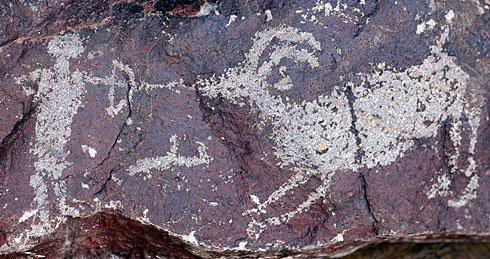 USA Today brings us the sad news that the 9th Circuit Court of Appeals has thrown out the convictions of a Reno man and a co-defendant who stole this beautiful petroglyph from the Humboldt-Toiyabe National Forest. Government prosecutors proved that the men took the boulders containing the petroglyph from USFS land, but the 9th Circuit threw out the Antiquities Act violation saying that the prosecutors failed to prove that the defendants knew or should have known that they were stealing something of archaeological value.
RTWT. As one of the commenters from the government said, this is an impossible standard of proof. "Essentially the government must prove the defendant knew this was an archaeological resource and knew the actual scientific benefit — which essentially says only archaeological scientists could be convicted in such a case."
The bedrock of protection for archaeological resources on public land in this country is the Antiquities Act of 1906 as amended by the Archaeological Resources Protection Act of 1979 (ARPA). The ARPA definition of resources is:
The term "archaeological resource" means any material remains of past human life or activities which are of archaeological interest, as determined under the uniform regulations promulgated pursuant to this Act. Such regulations containing such determination shall include, but not be limited to: pottery, basketry, bottles, weapons, weapon projectiles, tools, structures or portions of structures, pit houses, rock paintings, rock carvings, intaglios, graves, human skeletal materials, or any portion or piece of any of the foregoing items.
That sounds pretty plain to me, but often common sense and the law don't seem to intersect. The 9th Circuit is known for goofy rulings, after all, it's in California, but this is nonsense.
The only saving thing in this case is that the fellows are still guilty of stealing government property.
Kudos for Steve and the Q. Community
A nice note today from Patrick on his finding the Querencia blog. I think all of us can relate:
Finding this blog prompted Patrick to order a few Bodio titles, the first of which (On The Edge of The Wild) arrived recently. The "first nine pages" earn this praise:
"For the longest time I have felt a little like a polar bear at a road-side zoo -- pretty sure there must be others like me, but without much evidence of that reality. Now I see there are others out there with a similar bend in the brain -- not a lot of us, but more than one, and that's a pretty thrilling thing on this end.
"I know some professional environmental types, but I have to say most seem to know almost nothing about critters -- it's either an academic excercise or a romantic thing, or a legal construct (lots of lawyers!) or else it's just the fear-mongering tribe they chose out of college. For whatever reason, there is often not much real connection to things that snap or go squish under foot, or that fly up or bite back in the hedge. A dissapointment."
Finding this blog prompted Patrick to order a few Bodio titles, the first of which (On The Edge of The Wild) arrived recently. The "first nine pages" earn this praise:
"It's depressing to find smart sons of bitches who can really write and actually have something to say, 'cause basically you know you will never be able to keep up or say it half as well. On the other hand, it's exhilirating too -- new ideas and turns of the phrase that just pop in your brain. I feel like an apartment dog taking his first long walk though a zoo. Pretty grand this place!
"...It's more than the fact that Steve says it all very well (smooth, smooth); it's that he has something to say that really needs to be said and (as far as I know) has not been said before. I think it must help to be from the East and have gone West and stayed and really paid attention -- it is an expatriant journey every bit as clarifying as what deToqueville did (and certainly just as far geographically). It is an old observation that to write best about Somewhere it helps to be from Elsewhere -- Hemingway in Idaho and Florida writing about Paris, etc.
"Anyway, it is at some level depressing and inspiring to read something this well put together . Writing this good reminds me that done properly writing is more than typing -- it is craft."
More "Kids These Days"
A recent story from Yahoo news: Tech Creates Bubble for Kids
The jist:
Privacy and personal boundaries are important, nonetheless. Abandoning these values, a trend maybe in evidence now and perhaps to worsen, would affect everything in American life. Or maybe that sounds too much like Elvis's dad? I don't know. But I'm worried.
I gave a public falconry talk to a group in Ascension Parish last night. Forty-eight people showed up, about a third of them kids under the age of 15. It was wonderful to see.
I had already decided to revise my usual schpiel and speak mostly to the growing fact of raising kids without access to wild places and pet "critters." I told them about my great, patient parents and all those little animals I stashed under the bed---about being turned loose to walk in the woods after school; read what I wanted; get dirty.
And I admitted then that my own kids get precious little of that treatment and that mostly I keep them locked in the backyard for fear for their lives. I got a lot of sad nods, even here in the Sportsman's Paradise.
I made a point to let every kid mash on the hawk's feathers for a bit, despite the Danger of Natural Oils From Human Hands! and the risk (more real) of devastating personal lawsuit.
I met two great kids in particular, both girls: One about 12 years of age who keeps "two dogs, a cat, a turtle and some chickens my dad gave me" and had a wild bird feather collection---any of which could prompt prosecution under the Migratory Bird Treaty Act (I told her to keep collecting).
The other young lady came to me after the presentation, a very slim six or seven year old with Coke-bottle glasses and an earnest face. Her mother hovered in the background, hands clasped. I said, "Hi there. What can I do for you honey?"
In a very quiet voice she asked me, "Are Mississippi Kites more closely related to hawks or to falcons?"
YEAH!
The jist:
To baby boomers and other adults of a certain age, young people may seem rude, disrespectful and generally clueless about established social mores.
But to social scientists, the phenomenon is more complicated. Raised by parents who stressed individualism and informality, these young people grew up in a society that is more open and offers more choices than in their parents' youth, says child and adolescent psychologist Dave Verhaagen of Charlotte.
Unlike their parents, they have never known anything but a world dominated by technology. Even their social lives revolve around the Web, iPods and cellphones. So they dress down, talk loose and reveal their innermost thoughts online. "Put that all together and you've got a generation that doesn't have the same concept of privacy and personal boundaries as generations before," Verhaagen says.
Privacy and personal boundaries are important, nonetheless. Abandoning these values, a trend maybe in evidence now and perhaps to worsen, would affect everything in American life. Or maybe that sounds too much like Elvis's dad? I don't know. But I'm worried.
I gave a public falconry talk to a group in Ascension Parish last night. Forty-eight people showed up, about a third of them kids under the age of 15. It was wonderful to see.
I had already decided to revise my usual schpiel and speak mostly to the growing fact of raising kids without access to wild places and pet "critters." I told them about my great, patient parents and all those little animals I stashed under the bed---about being turned loose to walk in the woods after school; read what I wanted; get dirty.
And I admitted then that my own kids get precious little of that treatment and that mostly I keep them locked in the backyard for fear for their lives. I got a lot of sad nods, even here in the Sportsman's Paradise.
I made a point to let every kid mash on the hawk's feathers for a bit, despite the Danger of Natural Oils From Human Hands! and the risk (more real) of devastating personal lawsuit.
I met two great kids in particular, both girls: One about 12 years of age who keeps "two dogs, a cat, a turtle and some chickens my dad gave me" and had a wild bird feather collection---any of which could prompt prosecution under the Migratory Bird Treaty Act (I told her to keep collecting).
The other young lady came to me after the presentation, a very slim six or seven year old with Coke-bottle glasses and an earnest face. Her mother hovered in the background, hands clasped. I said, "Hi there. What can I do for you honey?"
In a very quiet voice she asked me, "Are Mississippi Kites more closely related to hawks or to falcons?"
YEAH!
Tuesday, June 20, 2006
Whole Foods in Hot Water
It's somewhat chic now to trash retail grocer Whole Foods. Whether it's about price or pretension, almost everyone I know has a gripe. Michael Pollan shared his beef in The Omnivore’s Dilemma, prompting this response from company execs. I've got a bone to pick with them, too, having lost to their expansionism the last good cottontail habitat inside my city limits.
But the truth is I trade there. The food is pricey and the atmosphere high falutin, but the quality is good as advertised. For several years, the quirky little outlet on Esplanade in New Orleans was a regular stop on my way home, Sunday mornings. Squeezed into existing space between giant live oaks and hundred-year old homes, the Eslpanade Whole Foods catered to a local crowd. The location had none of the brushed-steel-and-mahogany-veneer chic of the new super stores. It was clean, but plain; staffed by funky, pierced, granola munchers who smiled with good teeth and always got your change right. The coffee was excellent---probably shade grown by Costa Rican grad students---and surprisingly cheap.
Whole Foods closed that location when it opened a megastore in another neighborhood. Something had shifted. A sea change. The new outlet that sits on my bunny spot in Baton Rouge is a flagship-class giant, a bustling, upscale venue. A place to be seen.
The first time I entered the new store I thought, "Baton Rouge has people like this?" I hadn't seen that distinctive style of person since my last visit to downtown Houston: Shoppers with money, shoulder to shoulder. People who shop in heels.
You'd be challenged now to find a dredlock, or an easy-going kid behind the counter. The new workers are driven and clean cut, pushing the chanterelles and the mango smoothies at high volume. The pace of commerce is amazing. You can see five cash registers from any spot on the floor, all of them busy swiping cards.
So why do I think Whole Foods is in trouble? Because last week they stopped selling live lobsters and softshell crabs.
The move made the national news. You've probably heard about it, and if so you'll know the reason: After more than two years of study, Whole Foods concluded it is "not yet sufficiently satisfied that the process of selling live lobsters is in line with our commitment to humane treatment and quality of life for animals."
The task force helping Whole Foods determine what "humane treatment" and "quality of life" mean to lobsters includes some familiar names: Humane Society of the United States, PETA, Animal Welfare Institute, VIVA, Animal Rights International, and others. According to John Mackey, Whole Foods Co-founder and CEO, humane treatment "is an integral component of our standards for every species we sell, and lobster cannot be any different."
But what Mackey seems not to know is that pleasing the likes of HSUS will not end with kindness for crustaceans. Wayne Pacelle doesn't work that way. He starts small and with an obvious target---in this case, still-live animals awaiting a death by boiling in saltwater. Live lobsters have another trait that recommends them for action: They're considered a luxury food; lobsters are expensive to buy and messy to cook, an item easily dispensed from the American family menu.
Perhaps Whole Foods feels it has appeased the necessary demigods with this decision. It's a small price to pay---call it protection money---and a high-maintenance item that probably wasn't selling well anyway. Curiously, Whole Foods still offers "select raw and cooked frozen lobster products," which, presumably suffer the same fate they would otherwise in your kitchen, or worse: How else might one sell raw lobster meat without first chopping up a live lobster? I wonder when Pacelle, et al, will tie up that loose end?
To know Whole Foods as it was on Esplanade is to marvel that it sold meat at all. The clientele and staff could have passed for anyone's image of conscientious vegetarians. Somehow, seeing good meat carefully butchered and proudly displayed gave the place depth and substance---Whole Foods had hutzpah! Take away the meat, and all that's left is processed soy.
A note from me to John Mackey: When PETA is finally happy with your butcher shop, you'll be out of business.
But the truth is I trade there. The food is pricey and the atmosphere high falutin, but the quality is good as advertised. For several years, the quirky little outlet on Esplanade in New Orleans was a regular stop on my way home, Sunday mornings. Squeezed into existing space between giant live oaks and hundred-year old homes, the Eslpanade Whole Foods catered to a local crowd. The location had none of the brushed-steel-and-mahogany-veneer chic of the new super stores. It was clean, but plain; staffed by funky, pierced, granola munchers who smiled with good teeth and always got your change right. The coffee was excellent---probably shade grown by Costa Rican grad students---and surprisingly cheap.
Whole Foods closed that location when it opened a megastore in another neighborhood. Something had shifted. A sea change. The new outlet that sits on my bunny spot in Baton Rouge is a flagship-class giant, a bustling, upscale venue. A place to be seen.
The first time I entered the new store I thought, "Baton Rouge has people like this?" I hadn't seen that distinctive style of person since my last visit to downtown Houston: Shoppers with money, shoulder to shoulder. People who shop in heels.
You'd be challenged now to find a dredlock, or an easy-going kid behind the counter. The new workers are driven and clean cut, pushing the chanterelles and the mango smoothies at high volume. The pace of commerce is amazing. You can see five cash registers from any spot on the floor, all of them busy swiping cards.
So why do I think Whole Foods is in trouble? Because last week they stopped selling live lobsters and softshell crabs.
The move made the national news. You've probably heard about it, and if so you'll know the reason: After more than two years of study, Whole Foods concluded it is "not yet sufficiently satisfied that the process of selling live lobsters is in line with our commitment to humane treatment and quality of life for animals."
The task force helping Whole Foods determine what "humane treatment" and "quality of life" mean to lobsters includes some familiar names: Humane Society of the United States, PETA, Animal Welfare Institute, VIVA, Animal Rights International, and others. According to John Mackey, Whole Foods Co-founder and CEO, humane treatment "is an integral component of our standards for every species we sell, and lobster cannot be any different."
But what Mackey seems not to know is that pleasing the likes of HSUS will not end with kindness for crustaceans. Wayne Pacelle doesn't work that way. He starts small and with an obvious target---in this case, still-live animals awaiting a death by boiling in saltwater. Live lobsters have another trait that recommends them for action: They're considered a luxury food; lobsters are expensive to buy and messy to cook, an item easily dispensed from the American family menu.
Perhaps Whole Foods feels it has appeased the necessary demigods with this decision. It's a small price to pay---call it protection money---and a high-maintenance item that probably wasn't selling well anyway. Curiously, Whole Foods still offers "select raw and cooked frozen lobster products," which, presumably suffer the same fate they would otherwise in your kitchen, or worse: How else might one sell raw lobster meat without first chopping up a live lobster? I wonder when Pacelle, et al, will tie up that loose end?
To know Whole Foods as it was on Esplanade is to marvel that it sold meat at all. The clientele and staff could have passed for anyone's image of conscientious vegetarians. Somehow, seeing good meat carefully butchered and proudly displayed gave the place depth and substance---Whole Foods had hutzpah! Take away the meat, and all that's left is processed soy.
A note from me to John Mackey: When PETA is finally happy with your butcher shop, you'll be out of business.
Sunday, June 18, 2006
Father's Day with Guns and Puppies
"The kids", Peculiar and Mrs. Peculiar, came down from Santa Fe for Father's Day.
They played with puppies.
They played with puppies.

And shot targets, and played with more puppies.


Nikki shot for the first time-- a shotgun, a .22 rifle, and two decidedly non- wimpy handguns-- a Smith Mountain gun in .44, a Kimber .45 auto on a Commander- sized frame. She shot well and was not the slightest bit intimidated ("What recoil?")
We had fun.
Saturday, June 17, 2006
More Terrierman
Patrick Burns, whose exceptional blog we noted earlier and added to the Q. 'roll, has recently added us. We...are...pleased.
Burns has been "playing in the gutter" (that's old school lingo for updating his nav-bar), and his blog now offers a good post archive. I spent some time browsing this morning and see, to my amazement, he pretty much covers it all: A(nimal Rightists)-Z(ealots)
You can browse for natural history, terrier lore, hunters' ethics, and much else, but here's a sampler for the more humane among us:
The End of the Game?
Nannying Idiots Continue to Ignore Real Problems
The Red Flag of Lunacy
The Dysfunctional Terrier World
The Last Rat Pit in New York
Burns has been "playing in the gutter" (that's old school lingo for updating his nav-bar), and his blog now offers a good post archive. I spent some time browsing this morning and see, to my amazement, he pretty much covers it all: A(nimal Rightists)-Z(ealots)
You can browse for natural history, terrier lore, hunters' ethics, and much else, but here's a sampler for the more humane among us:
The End of the Game?
Nannying Idiots Continue to Ignore Real Problems
The Red Flag of Lunacy
The Dysfunctional Terrier World
The Last Rat Pit in New York
Friday, June 16, 2006
Prairiemary, Blackfeet and Fossil Legends
Mary Scriver e-mailed me a couple of weeks ago, telling me of a large and powerful mythic creature from Blackfoot legend known as a "water bull." Mary suggested that it might have its origins in tribal memories of mammoths from the Pleistocene and asked what I thought. I replied that was possible, but also to remember that extinct Pleistocene bison were much larger than the modern species and that could be a possibility, too.
I was able to refer Mary to an interesting book, Adrienne Mayor's Fossil Legends of the First Americans. I e-mailed her a reference from the book to baculites, marine cephalopod fossils, with surface fractal patterns. When these erode, the small pieces resemble four legged animals, and the Blackfeet (among others) invested them with the ability to summon bison herds. They are called iniskim, or buffalo calling stones. That immediately clicked with Mary, who has an immense fund of knowledge about iniskim, and has previously written a tourist brochure about them.
Mary has gotten a copy of Mayor's book, and has an initial post up about it at Prairiemary. She has such a depth and breadth of knowledge of Blackfeet culture, I know she will take Mayor's starting points on the interplay of fossils and Blackfeet religion and history and vastly expand them. I look forward to reading more about Mary's research.
I was able to refer Mary to an interesting book, Adrienne Mayor's Fossil Legends of the First Americans. I e-mailed her a reference from the book to baculites, marine cephalopod fossils, with surface fractal patterns. When these erode, the small pieces resemble four legged animals, and the Blackfeet (among others) invested them with the ability to summon bison herds. They are called iniskim, or buffalo calling stones. That immediately clicked with Mary, who has an immense fund of knowledge about iniskim, and has previously written a tourist brochure about them.
Mary has gotten a copy of Mayor's book, and has an initial post up about it at Prairiemary. She has such a depth and breadth of knowledge of Blackfeet culture, I know she will take Mayor's starting points on the interplay of fossils and Blackfeet religion and history and vastly expand them. I look forward to reading more about Mary's research.
Coso Rock Art Blogging
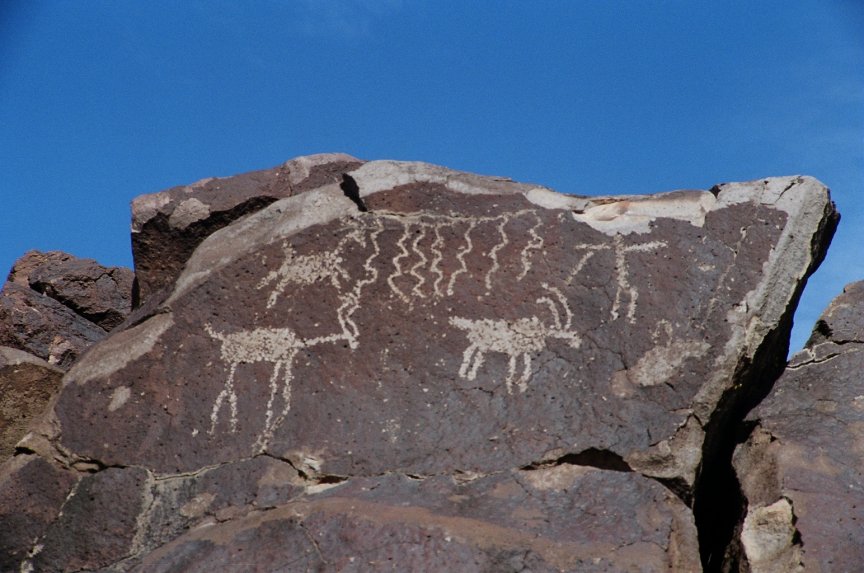
Bird Rock Art Blogging
 A prehistoric Chumash pictograph of a hummingbird. From CA-SBA-550 at Honda Ridge on Vandenberg AFB here in Santa Barbara County.
Thursday, June 15, 2006
A Close Call
This post has it's origins in an e-mail I sent to Steve, Libby, and Matt last Monday night. I have updated it, added some pictures that I took Tuesday evening, and included Libby's reply that tells a similar story.
I had a close call yesterday. In the afternoon I took the dogs hiking on the Jesusita Trail - the one I blogged about a few days ago. The dogs were off-leash which isn't an issue usually on this trail. There's no requirement for it and have never had a problem.
Early on the trail there is a stretch that is very narrow, cuts into the side of the hill, and has a vertical drop to the creek on the other side. When we got there we met a fellow coming down the trail who had the biggest male black lab I have ever seen, on leash. He said, "I'll hold him and you go on by."

When I got to her she was huddled on the small beach at the base of the bank, which was made of crumbled pieces of shale. She was obviously terrified and wet but I couldn't tell if she was injured. I grabbed her, hugged her and started feeling her legs. They seemed all right, and I started feeling along her ribs. No obvious problems, no yelps of pain. I looked up and could tell she had fallen at least ten, maybe twelve feet. [After revisiting the scene, it's really more like 18 - 20 feet]
I picked her up, and carried her back through the deep pool, to the shallows where Maggie was anxiously waiting. She had been too afraid to go in the deep water - she's not a good swimmer. Sadie seemed to calm some more when she saw Maggie. When I put her down, it didn't take her more than a minute to collect herself and start prancing around and looking at me with that, "Aren't we going back to the trail?" look.
She was exhausted and obviously a little sore last night, but seems to be okay. All I can figure is that the rotten shale beach had a lot of give, plus it was sloping at an angle from the base of the bank. So she hit an angled surface with a lot of give and then rolled into the water.
The fellow with the big lab, to give him credit, tied his dog to a tree and came splashing up the creek to help. He was upset, too. It wasn't his fault, or his dog's. My fault I didn't grab my dogs and let him come by us.
I woke at 2:30 this morning and couldn't get back to sleep, brooding about it. I got up and got Sadie out of her crate where she sleeps in the kitchen. We sat on the couch and she slept with her head in my lap for the rest of the night.
Sadie wasn't her usual energetic self this morning, but did seem okay other than that. I called our vet and tried to get her in for an exam today, but the soonest they would see her is tomorrow afternoon. I went by the house at lunch and she was her usual run and try to jump up on me (bad dog!) self. Connie thinks she's doing well enough that we don't need to take her to the vet.
I had a close call yesterday. In the afternoon I took the dogs hiking on the Jesusita Trail - the one I blogged about a few days ago. The dogs were off-leash which isn't an issue usually on this trail. There's no requirement for it and have never had a problem.
Early on the trail there is a stretch that is very narrow, cuts into the side of the hill, and has a vertical drop to the creek on the other side. When we got there we met a fellow coming down the trail who had the biggest male black lab I have ever seen, on leash. He said, "I'll hold him and you go on by."
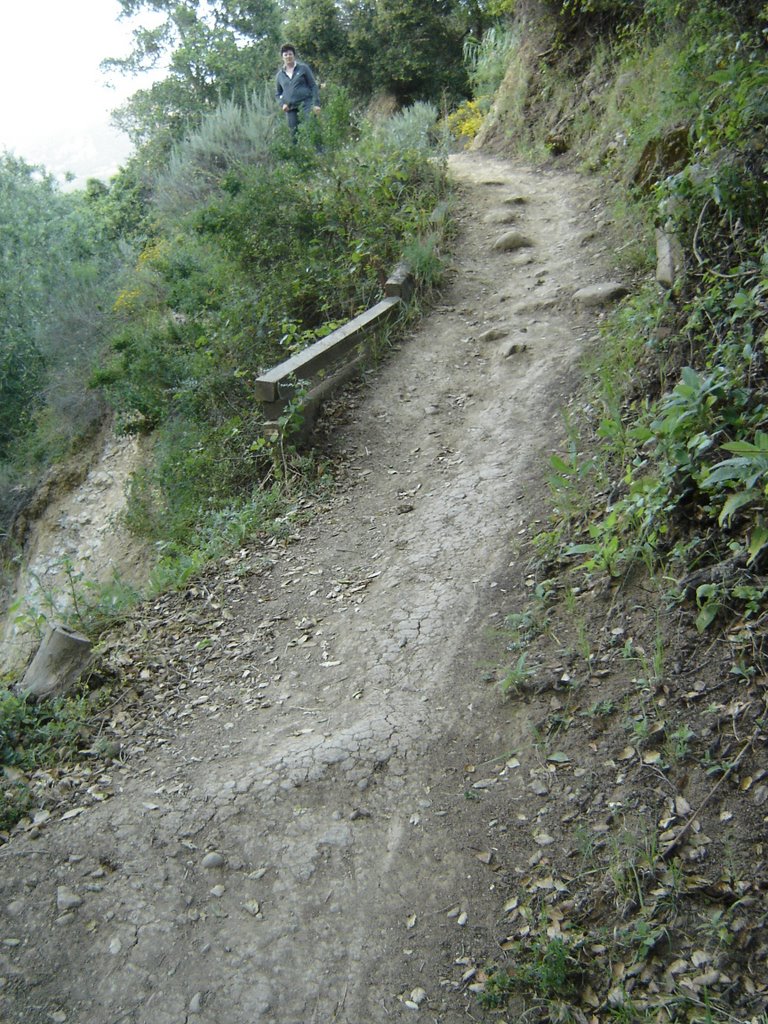 So we did. Maggie is usually very aggressive towards other dogs. She weighs almost 80 herself and was dwarfed by this guy. She wanted nothing to do with him, shot right by and Sadie followed. Then Sadie turned around and went back to the big lab. I turned to call her back and saw as the lab threatened her and she panicked, lost her footing and went over the side. [She went over about where the stump is in the lower left area of the picture]
I know it's a cliche, but she did look like she was falling in slow motion, falling on her side and spinning as her legs were still working frantically. It seemed to take forever for her to land. With the undercut of the bank I couldn't see her hit clearly.
I ran frantically down the trail to get to a point where the bank was low enough that I could scramble down to the creek bottom. Maggie ran ahead of me, every bit as traumatized as I was. I found later she scraped her legs sliding down the bank with me. There was a bend in the creek and I still couldn't see Sadie. I splashed up the creek, the last bit through a pool that was almost waist deep. When I got there I could hear her cry, but it wasn't a pain yelp, and sounded more like fear.
When I got to her she was huddled on the small beach at the base of the bank, which was made of crumbled pieces of shale. She was obviously terrified and wet but I couldn't tell if she was injured. I grabbed her, hugged her and started feeling her legs. They seemed all right, and I started feeling along her ribs. No obvious problems, no yelps of pain. I looked up and could tell she had fallen at least ten, maybe twelve feet. [After revisiting the scene, it's really more like 18 - 20 feet]
I picked her up, and carried her back through the deep pool, to the shallows where Maggie was anxiously waiting. She had been too afraid to go in the deep water - she's not a good swimmer. Sadie seemed to calm some more when she saw Maggie. When I put her down, it didn't take her more than a minute to collect herself and start prancing around and looking at me with that, "Aren't we going back to the trail?" look.
She was exhausted and obviously a little sore last night, but seems to be okay. All I can figure is that the rotten shale beach had a lot of give, plus it was sloping at an angle from the base of the bank. So she hit an angled surface with a lot of give and then rolled into the water.
The fellow with the big lab, to give him credit, tied his dog to a tree and came splashing up the creek to help. He was upset, too. It wasn't his fault, or his dog's. My fault I didn't grab my dogs and let him come by us.
I woke at 2:30 this morning and couldn't get back to sleep, brooding about it. I got up and got Sadie out of her crate where she sleeps in the kitchen. We sat on the couch and she slept with her head in my lap for the rest of the night.
Sadie wasn't her usual energetic self this morning, but did seem okay other than that. I called our vet and tried to get her in for an exam today, but the soonest they would see her is tomorrow afternoon. I went by the house at lunch and she was her usual run and try to jump up on me (bad dog!) self. Connie thinks she's doing well enough that we don't need to take her to the vet.
Here's Libby's reply.
Hi Reid --
I would take her into the vet anyway, just for your peace of mind to make
sure she is only bruised and rattled which is probably the case if she is
doing as well as she is. And go out and buy a big bottle of gin or whatever
for yourself.
One time when we were leading an Outward Bound course in the Escalante area,
we had a nightmare similar to yours. I think you know the area, at least a
bit. We started down Hall's Creek with the intention of crossing over the
Waterpocket Fold into the top of Stevens Canyon, and then coming out Coyote
Gulch. We had 18 students and four instructors, one of whom had a wonderful
dog named Shana. AS we entered Steve's Canyon from the top, we started
encountering a series of cliffs that required rappeling...some weren't too
high -- 50 - 75 feet; the problem was how to get Shana down. So we put her
into a nylon sleeping bag liner and lowered her down by rope, her owner Wick
at the bottom. We did that for three rappels and everything went fine, and
Shana, though a bit dubious, was co-operating. Finally we came to a cliff
that was slanted, not overhanging, but about 125 feet. We put Shana into the
bag liner and started lowering her...when she got about half way down, we
saw the knot starting to come undone, and Shana fell, in the liner, the rest
of the way, landing on a sand slope at the bottom. We were sure she was
dead. Wick got her out of the bag and she was hardly moving. We made camp
then and there, and got her as comfortable as we could -- she drank, but
didn't really want to eat. We nervously got up in the morning, and Shana
actually stood up and walked around. We rested another half day, and then
Wick alternately carried her and let her walk to the next camp. That night
she ate. The next day she was stiff but walked by herself most of the day,
and ate a good dinner. She lived another 6 years. We had to put her in the
bag again when we reached the Escalante River, which was in full flood -- we
were caught in the worst series of storms in 100 years on that trip, and we
had to do a Tyrolean Traverse across the river with all the students and
gear. Shana actually got into the bag liner again, shaking like a leaf --
before she got in she tried to swim the river but figured out that it would
be too much, so came back up and let us put her in the bag.
Our dogs make our hair turn white...
Libby
I did take Sadie to the vet and he gave her a clean bill of health. She's back to her normal energetic self.
Brown Eyes and a Taste for Steak
Heritability of food preference in children is the subject of a new study (in press with the Journal of Physiology & Behavior) by researchers with University College and Kings College, London.
Wire service reports can be found here and here and the original article by Fiona M. Breena, Robert Plominb and Jane Wardle can be viewed here.
The study is based on analysis of 214 food-preference questionnaires administered to mothers of twins (103 identical and 111 fraternal, all aged 4 or 5 years), the largest sample in comparable studies to date. Researchers grouped 77 distinct food items within four categories (meat and fish, vegetables, fruits, and deserts), and determined the extent of children's preferences for each. Comparing data on identical and fraternal twins allows researchers to tease apart the effects of genetics and environment; the purely genetic factors are statistically more likely to be shared by identical twins.
According to these findings, a child's taste for animal protein (meat and fish) is strongly inherited from his parents, while his particular taste for dessert (tho also somewhat inherited) is due more to environment. Liking of vegetables and fruits falls in between, with a taste for vegetables statistically more "hard-wired" than for fruits.
From the Discussion:
Matt (a parent of twin 5-year olds) observes: So meat-loving parents are most likely to pass on this trait to their kids, whatever else they might impart...like big feet. But how kids like their fruits and veggies is less pre-determined; and whether or not they will gorge on their father's Peanut M&Ms might depend most on whether or not they can reach them.
I'm kinda liking this train of thought. Here my kids' unpredictable performance at their greens is explained, and my hiding and hoarding of sweets is fully justified! And there's an added bonus in the notion that my own taste for meat---the flesh of once-living animals---is likely sewn into my genome and indivisible. It certainly feels that way.
Interestingly, my fraternal-twin daughters are notably different from each other in their taste for meat. One loves all kinds and generally cleans the meat first off her plate. The other is indifferent or worse about most meats and generally eats her salad first. This difference seems to be supported in the study findings, as my wife is also indifferent to most meats and eats little even of her favorite kinds.
What puzzles me most is that my Young Vegan is the one who loves to hunt.
Wire service reports can be found here and here and the original article by Fiona M. Breena, Robert Plominb and Jane Wardle can be viewed here.
The study is based on analysis of 214 food-preference questionnaires administered to mothers of twins (103 identical and 111 fraternal, all aged 4 or 5 years), the largest sample in comparable studies to date. Researchers grouped 77 distinct food items within four categories (meat and fish, vegetables, fruits, and deserts), and determined the extent of children's preferences for each. Comparing data on identical and fraternal twins allows researchers to tease apart the effects of genetics and environment; the purely genetic factors are statistically more likely to be shared by identical twins.
According to these findings, a child's taste for animal protein (meat and fish) is strongly inherited from his parents, while his particular taste for dessert (tho also somewhat inherited) is due more to environment. Liking of vegetables and fruits falls in between, with a taste for vegetables statistically more "hard-wired" than for fruits.
From the Discussion:
"...Using this approach, we found modest heritability estimates for liking for dessert foods, moderate heritability for fruits and vegetables, and high heritability for liking of protein foods (meat and fish)....Shared environment effects were strong for dessert foods, fruits and vegetables. This is consistent with evidence that in children, food acceptance is affected by what they see other people eating, what foods they are offered, and how parents control food intake in the home..."
Matt (a parent of twin 5-year olds) observes: So meat-loving parents are most likely to pass on this trait to their kids, whatever else they might impart...like big feet. But how kids like their fruits and veggies is less pre-determined; and whether or not they will gorge on their father's Peanut M&Ms might depend most on whether or not they can reach them.
I'm kinda liking this train of thought. Here my kids' unpredictable performance at their greens is explained, and my hiding and hoarding of sweets is fully justified! And there's an added bonus in the notion that my own taste for meat---the flesh of once-living animals---is likely sewn into my genome and indivisible. It certainly feels that way.
Interestingly, my fraternal-twin daughters are notably different from each other in their taste for meat. One loves all kinds and generally cleans the meat first off her plate. The other is indifferent or worse about most meats and generally eats her salad first. This difference seems to be supported in the study findings, as my wife is also indifferent to most meats and eats little even of her favorite kinds.
What puzzles me most is that my Young Vegan is the one who loves to hunt.
Wednesday, June 14, 2006
A Corporate-Sponsored, Televised, "Non-Fatal Hunting Tour" for Points, Cash Money and Valuable Prizes
"For far too long, hunters have looked forward to the day when we would eventually get our own professional sports league. Well, that time has arrived and we are extremely excited."
---Brett Hankins, a WHA Tour hunter
It's hard to choose which target to shoot first. Call it a bass tourney with guns, or paint-ball with live animals, or maybe The Bachelor in Realtree (tm) cammo, but what we've got here is your basic competitive deer darting.
I kid you not. David Farbman, a Michigan real estate developer and "Commissioner and CEO of The World Hunting Association," announced on Monday the inaugural season of "a new professional competitive world tour designed by hunters, for hunters."
According to the website, here's what we can expect to see:
The WHA will feature a series of major tournament events, oversight on a series of smaller events, and a highly interactive and informative website for members. WHA events will be broadcast through many outlets including Internet, television, Pay-per-view, On Demand, and others. WHA plans to become the standard for professional hunting competition and to grow and enhance the industry's image and presence.
During WHA Tour events, highly skilled hunters from around the world will compete, utilizing the WHA's patent-pending, respectful non-fatal tranquilizing technique that will allow for a thrilling tournament experience. This technique will expand the hunting fan base beyond passionate hunters to a broad-based mainstream audience, which will resonate well with the country's leading companies and brands.
You have to see the website's introductory "trailer" to enjoy the full effect----complete with square-jawed, commando-esque hunters menaced by fat, farm-reared deer; the lure of shiny convertibles; NFL cheerleader-grade spokesmodels and plenty of product placement.
But what is "non-fatal" hunting? Details promised soon, but until then:
"...for purposes of broadening viewership, the competition will be based on 'non-fatal' hunting...The WHA competition will focus on many of the same skills required in harvest hunting, including scents, positioning, scent elimination, stand strategies, gauging and playing the wind, and many other practices...The scoring system will reward competitors for their hunting skill. While the animals will not die, the hunt itself will be challenging and intense....To preserve ecology, the animals will be given certain vaccinations and will have blood work completed immediately by a licensed veterinarian; animals will be marked and not shot twice in a competition."
Sporting! But lest you think this is merely an ill-conceived and value-free ploy to sell ads to "prestigious hunting industry inaugural sponsors" and canned hunts to industry execs, note that the WHA stands "committed to supporting hunting-related charitable organizations worldwide."
Farbman, with subtle irony, outlines the need for this innovative new program: "Let's face it: our sport could use a 'shot in the arm.' The number of licensed hunters has been declining for years and many people view hunters and hunting in an inaccurate and unflattering way. It's time to improve that image and show the world the complexity, skill, and strategy that is the core of hunting."
Tuesday, June 13, 2006
Three quick links
I am writing two articles today (and one is for free, proving me a fool by Dr. Johnson's dictum), so time is limited. But I am taking a break, and you must see these.
First, as I said Larissa is going to London. Here is her account of her trip to set things up, which contains among other elegant and funny observations a perfect account of how the English use the adjective "brilliant".
Still in England, Darren tells us how the greater noctule bat
flies down migrant songbirds at night like a miniature falcon! I wonder if our own hoary and red bats (Lasiurus) do the same, as they are "big" migrants with narrow wings like noctules.
Finally, at 2Blowhards, Montana novelist Richard Wheeler pokes some holes in the (post?) modern literary novel and its pretensions, showing how, as raymond Chandler said, there are no genres, only good and bad writing.
Read The Whole Thing(s)!
First, as I said Larissa is going to London. Here is her account of her trip to set things up, which contains among other elegant and funny observations a perfect account of how the English use the adjective "brilliant".
Still in England, Darren tells us how the greater noctule bat
flies down migrant songbirds at night like a miniature falcon! I wonder if our own hoary and red bats (Lasiurus) do the same, as they are "big" migrants with narrow wings like noctules.
Finally, at 2Blowhards, Montana novelist Richard Wheeler pokes some holes in the (post?) modern literary novel and its pretensions, showing how, as raymond Chandler said, there are no genres, only good and bad writing.
Read The Whole Thing(s)!
Blog Family
Two essential additions to the blogroll: First, the writer and falconer Rebecca O'Connor, from Banning, CA, a longtime Q. reader and member of the Not-Technically-Extant-But-Devoted-And-Sincere-Nonetheless, Steve Bodio Fan Club.
And Patrick Burns (see Terrierman, below) whose own fan club just got a couple new members in Steve, Reid and myself.
Enjoy!
And Patrick Burns (see Terrierman, below) whose own fan club just got a couple new members in Steve, Reid and myself.
Enjoy!
Saturday, June 10, 2006
Terrierman
Paul Domski sent me to this wonderful blog. It is the best working dog blog I have yet seen, and is not just for fans of "earthdogs"; Patrick Burns writes gracefully and knowledgeably about dogs, nature, politics,and conservation. For instance, his post on genetics, inbreeding and closed studbooks should be required reading by not only every dog breeder but by every concerned dog buyer, and would in a just world utterly destroy the credibility of the AKC.
And on a lighter note, his most recent post is a celebration of the wolf, with a link to our cyber- friends the McGehees and their borzois in Idaho. Enjoy!
And on a lighter note, his most recent post is a celebration of the wolf, with a link to our cyber- friends the McGehees and their borzois in Idaho. Enjoy!
Guns for Food and Guns for Sport
In southern Europe, tiny shotgun bores have always been common. Descended from such oldies as the 9mm and 8mm Flobert rimfire cartridges, but now available in handily reloadable centerfire versions, they have always receieved scorn from american writers, as have their slightly larger brethren like the .410 and the 32- bore-- 'suitable only for rats" and the like.
I think that this is based on a misconception. A brochure for a reloading tool for the 8mm cartridge shows blinds, starling decoys, and doves. You don't use them for wingshooting, especially the millimetric bores-- you use them from blinds, over decoys, at ranges under 10 yards, to shoot small legal birds FOR FOOD.
(When I was in Provence years ago I bought a lot of French hunting mags-- still have them-- and was simulataneously amused and horrified to see the caption under a photo of a proud hunter who had just "killed the musician"-- a Song thrush. But I was also reminded of the scorn of a young cowboy at the Golden Spur one night, and his incomprehension that "Johnny UK" didn't want to shoot an elk here-- he wanted to shoot a quail!)
Recently Vito Accardi of Accardi Importers in California, sent me a trio of micro- bores to evalute for an article or two, and I am fascinated, especially by this tiny Falco side- by- side 9mm perched here, rather incongruously, on the skull of a buffalo.

For scale, here it is with a big Darne 10 bore:
Though I DO hunt elk-- perhaps some blogging on an elk rifle soon-- I can envision myself building a blind near town and setting out decoys for the abundant sparrows, starlings, and exotic doves. Because I am an eater and a cook. Polenta with meat sauce, risott' with small birds-- yum!
I love wingshooting too, but my paternal grandparents came from Italy, and loved their "uccellini"... "makes a nice sauce!"
I think that this is based on a misconception. A brochure for a reloading tool for the 8mm cartridge shows blinds, starling decoys, and doves. You don't use them for wingshooting, especially the millimetric bores-- you use them from blinds, over decoys, at ranges under 10 yards, to shoot small legal birds FOR FOOD.
(When I was in Provence years ago I bought a lot of French hunting mags-- still have them-- and was simulataneously amused and horrified to see the caption under a photo of a proud hunter who had just "killed the musician"-- a Song thrush. But I was also reminded of the scorn of a young cowboy at the Golden Spur one night, and his incomprehension that "Johnny UK" didn't want to shoot an elk here-- he wanted to shoot a quail!)
Recently Vito Accardi of Accardi Importers in California, sent me a trio of micro- bores to evalute for an article or two, and I am fascinated, especially by this tiny Falco side- by- side 9mm perched here, rather incongruously, on the skull of a buffalo.
For scale, here it is with a big Darne 10 bore:
Though I DO hunt elk-- perhaps some blogging on an elk rifle soon-- I can envision myself building a blind near town and setting out decoys for the abundant sparrows, starlings, and exotic doves. Because I am an eater and a cook. Polenta with meat sauce, risott' with small birds-- yum!
I love wingshooting too, but my paternal grandparents came from Italy, and loved their "uccellini"... "makes a nice sauce!"
"Sue Your Schools"
Is literacy a thing of the past?
"...for the first time in modern history less than half the adult population of the United States had read even a bit of poetry, fiction or drama in the entire year. While in 1982, almost 57 percent of Americans were ‘literary readers’—those who read literature on their own, not for school or work—that percentage had shrunk to less than 47 percent in 2002."
"...for the first time in modern history less than half the adult population of the United States had read even a bit of poetry, fiction or drama in the entire year. While in 1982, almost 57 percent of Americans were ‘literary readers’—those who read literature on their own, not for school or work—that percentage had shrunk to less than 47 percent in 2002."
Belated Da Vinci code link
Anthony Lane's New Yorker review-- scroll down-- was the (devastatingly) funniest, but Steve Sailer's might be the most perceptive (It's funny too). Some snips:
"...Brown, with all his talk of "the sacred feminine," is being intentionally hazy about what pagans have tended to mean by it: i.e., fertility goddesses. Now, you can see a bit of a problem for modern feminists in praising ancient conceptions of women as most sacred when barefoot and pregnant, but Dan Brown and his 60 million readers apparently can't.
"... hostility to paganism -- that's what the Protestants, Jews, and Muslims complained about ... that Catholicism wasn't hostile enough towards paganism. It's hardly a surprise that the Renaissance started in Catholic Italy. Or that the Reformation was a reaction to the High Renaissance in Rome. Here's a minor modern example: my younger son's otherwise perfectly sane Lutheran school refuses to hold a Halloween party because that's too pagan, so it holds a "Harvest Festival." To a Halloween-loving Catholic like me, that sounds like nuts, but it makes perfect sense to Lutherans.
(Snip)
"... the idea that the Catholic Church kept women down is pretty odd: What other monotheistic religion honored hundreds of women as saints? Made the Virgin Mary the second most revered person of all? What other religion made women writers like St. Theresa of Avila and St. Catherine of Siena part of the canon of religious literature? What other religion encouraged women to found and run giant hospitals? Protestantism? Judaism? Islam?"
RTWT.
"...Brown, with all his talk of "the sacred feminine," is being intentionally hazy about what pagans have tended to mean by it: i.e., fertility goddesses. Now, you can see a bit of a problem for modern feminists in praising ancient conceptions of women as most sacred when barefoot and pregnant, but Dan Brown and his 60 million readers apparently can't.
"... hostility to paganism -- that's what the Protestants, Jews, and Muslims complained about ... that Catholicism wasn't hostile enough towards paganism. It's hardly a surprise that the Renaissance started in Catholic Italy. Or that the Reformation was a reaction to the High Renaissance in Rome. Here's a minor modern example: my younger son's otherwise perfectly sane Lutheran school refuses to hold a Halloween party because that's too pagan, so it holds a "Harvest Festival." To a Halloween-loving Catholic like me, that sounds like nuts, but it makes perfect sense to Lutherans.
(Snip)
"... the idea that the Catholic Church kept women down is pretty odd: What other monotheistic religion honored hundreds of women as saints? Made the Virgin Mary the second most revered person of all? What other religion made women writers like St. Theresa of Avila and St. Catherine of Siena part of the canon of religious literature? What other religion encouraged women to found and run giant hospitals? Protestantism? Judaism? Islam?"
RTWT.
Just for fun
For sheer oddity it is hard to beat this story.
I also love the very casual last line: "Marriages between humans and other living beings are not uncommon in India. A tribal girl was married to a dog near Bhubaneshwar recently."
I also love the very casual last line: "Marriages between humans and other living beings are not uncommon in India. A tribal girl was married to a dog near Bhubaneshwar recently."
Evil Bastard Killer Eagles

Chicago, Chicago
Having banned handguns, homing pigeons, and foie gras, Chicago is now considering a ban on french fries.
Other things up for consideration are diapers for horses, uniforms for cabbies, and a law allowing only smokeless cigarettes.
On the fast food fat ban, Alderman Burke says he "... doesn't know enough about the subject to identify the specific oils he would target."
Hat tip Alphecca.
Other things up for consideration are diapers for horses, uniforms for cabbies, and a law allowing only smokeless cigarettes.
On the fast food fat ban, Alderman Burke says he "... doesn't know enough about the subject to identify the specific oils he would target."
Hat tip Alphecca.
Friday, June 09, 2006
More Goleta Birds
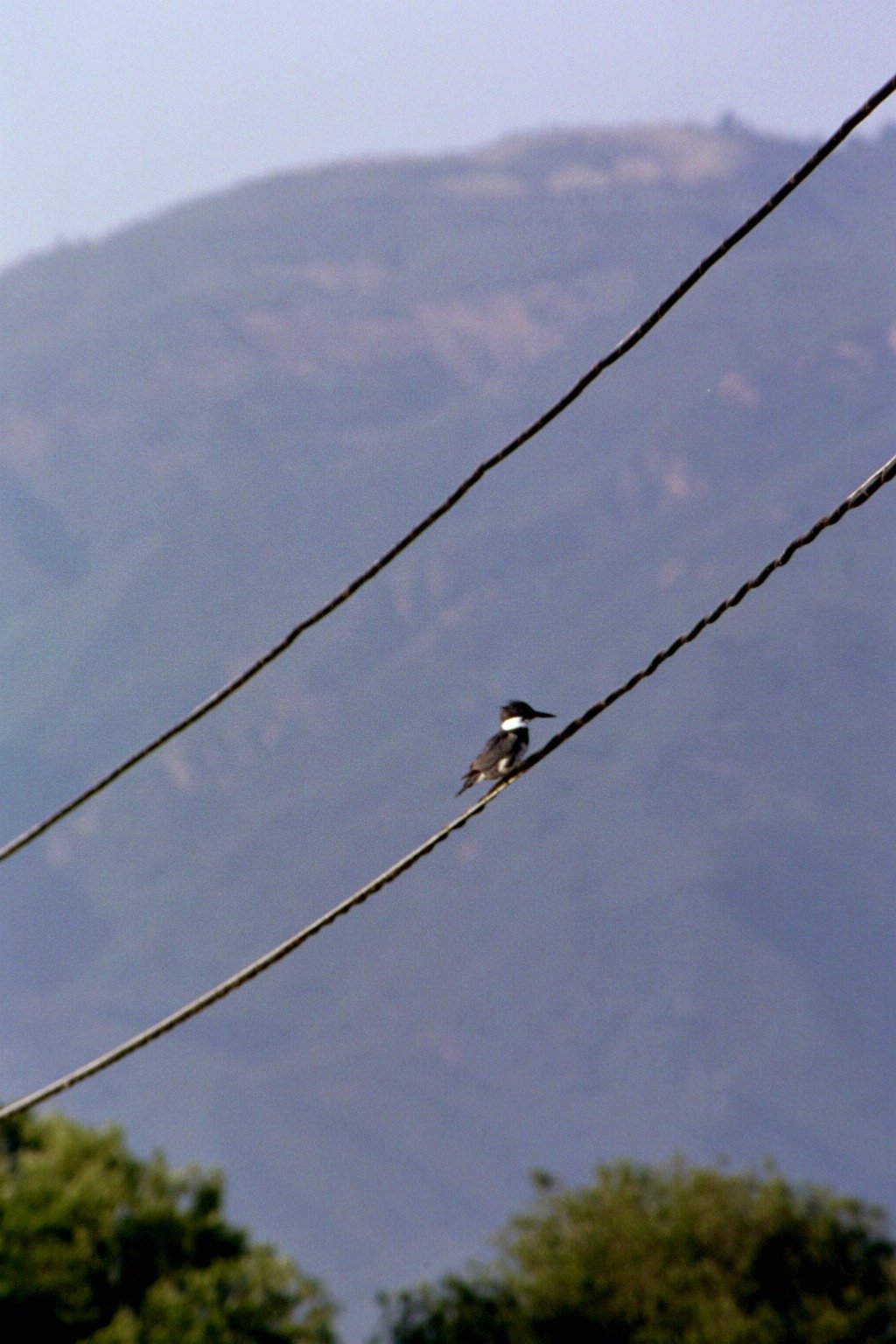 I found out inadvertantly last week that Blogger apparently limits the amount of "content" you can put in a single post. If you have a lot of pictures to show you have to break them into different posts, as I am doing here with more Atascadero Creek/Goleta Slough bird pictures.
As I said, it's a great place for birds. This Belted Kingfisher is perched on a powerline spanning the creek, giving him a great view of prospective meals.
 There are lots of Great Blue Herons and Snowy Egrets working the creek. In a eucalyptus grove just north of the creek, there is a heron rookery. It's active now, and here is the best view I could get of some nests.
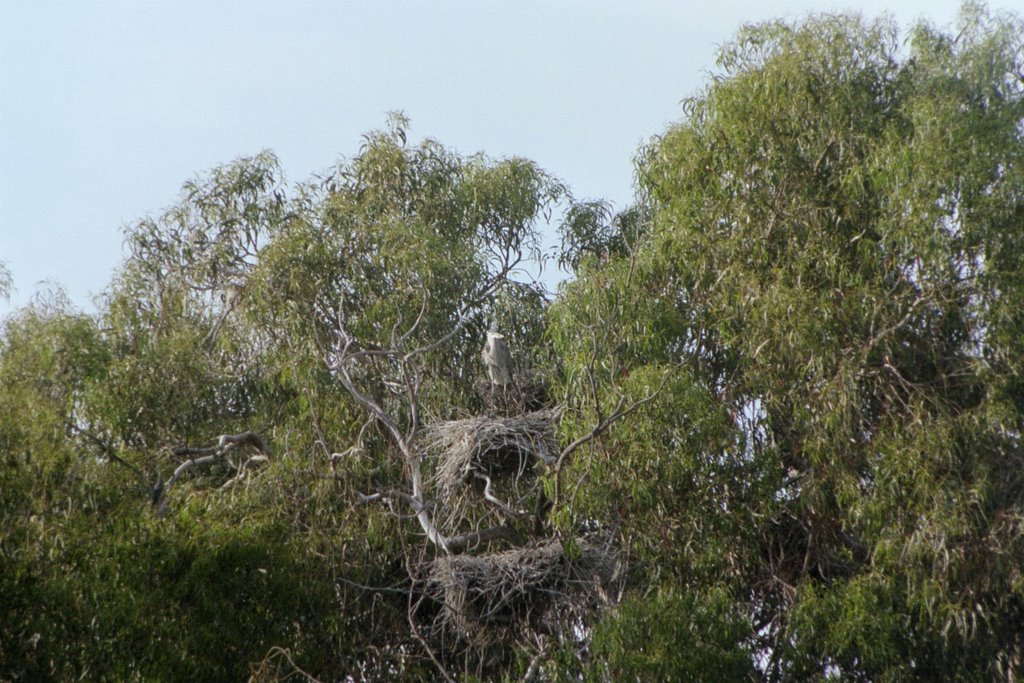 I find their shaggy stick bundle platform affairs of nests kind of cool. Herons have that same awkward ungainly gracefulness that pelicans have.
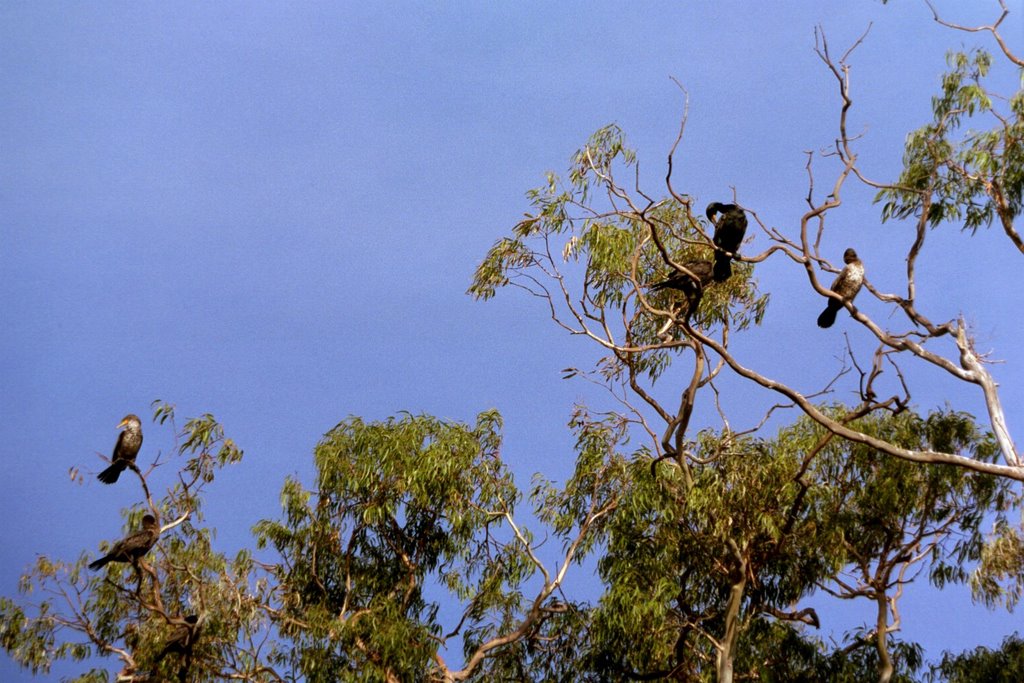 There are also lots of Double-crested Cormorants. They have such a primitive look with the snaky neck and narrow head that they have. I like the way they perch with a spread wing posture to sun themselves. Of course I couldn't catch any of them doing that for these pictures.
The eucalyptus they are perched in is in the middle of the parking lot for a very popular restaurant (I love their shrimp-filled chile rellenos!) that is adjacent to the slough.
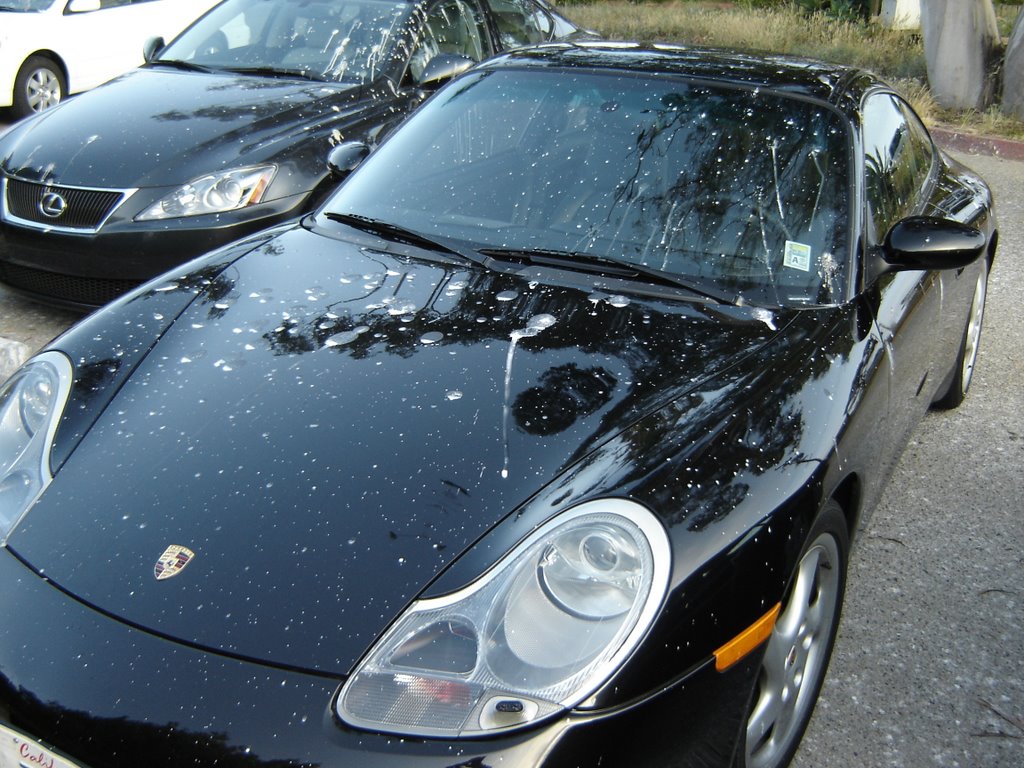 Never park your car under a tree where cormorants hang out. This will happen to you, even if you are driving a Porsche. Did I say it smells like fish?
Goleta Pelicans
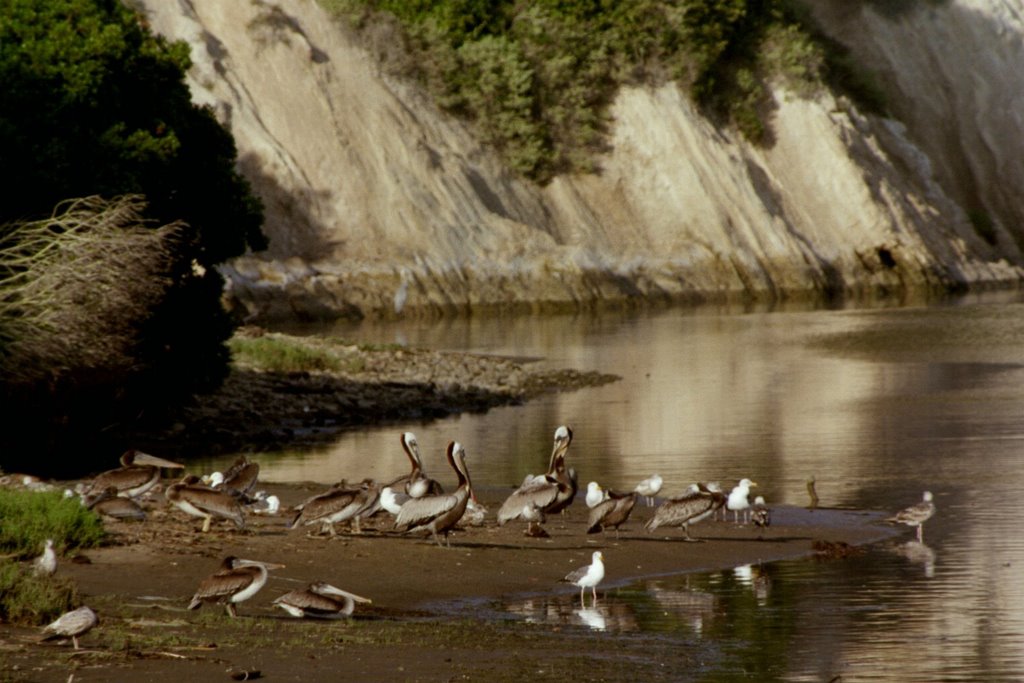 One of the things I enjoy most about living here is the birding. We go from the beach to 4,000 ft in the mountains in the space of five miles or less. We pack in a lot of habitat types in a small space which results in a large number of species.
This is my first opportunity to live on a coast and one of the birds I have come to know better and appreciate is the Brown Pelican (Pelecanus occidentalis). They are fairly plentiful here and have bounced back well from their population nadir after the DDT ban was enforced. Their populations are increasing - in fact there was a news report this week that said a group of nesters had recolonized Prince Island, an islet just off San Miguel Island. It was the first time Brown Pelicans had nested there since the late 1930s.
I love the way they glide in formation. With their heads tucked back and their bills dropped they look like pterodactyls.
 They have such an ungainly awkward grace about the way they move. I also really enjoy watching them dive. When they spot a fish from the air, they "fold-up" and drop like a rock to hit the fish.
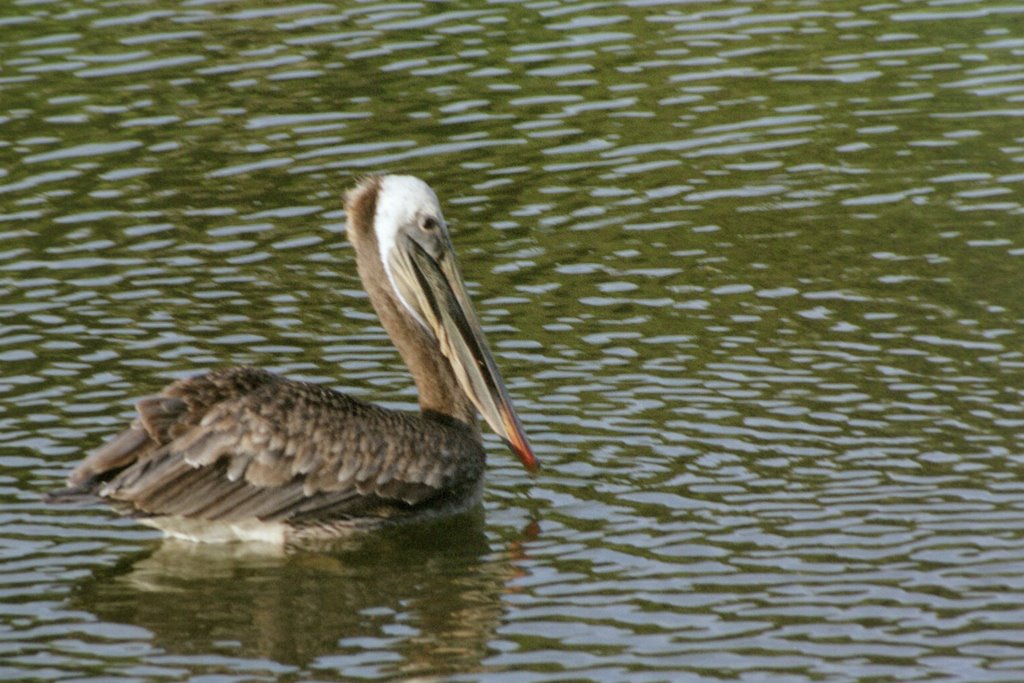 This one did it right in front of me just before I took his picture. A big splash. They are such big birds, often 50 inches long with a nearly eight foot wingspan.
They also have these strange things they do with their bills and pouches. I caught one in this picture.
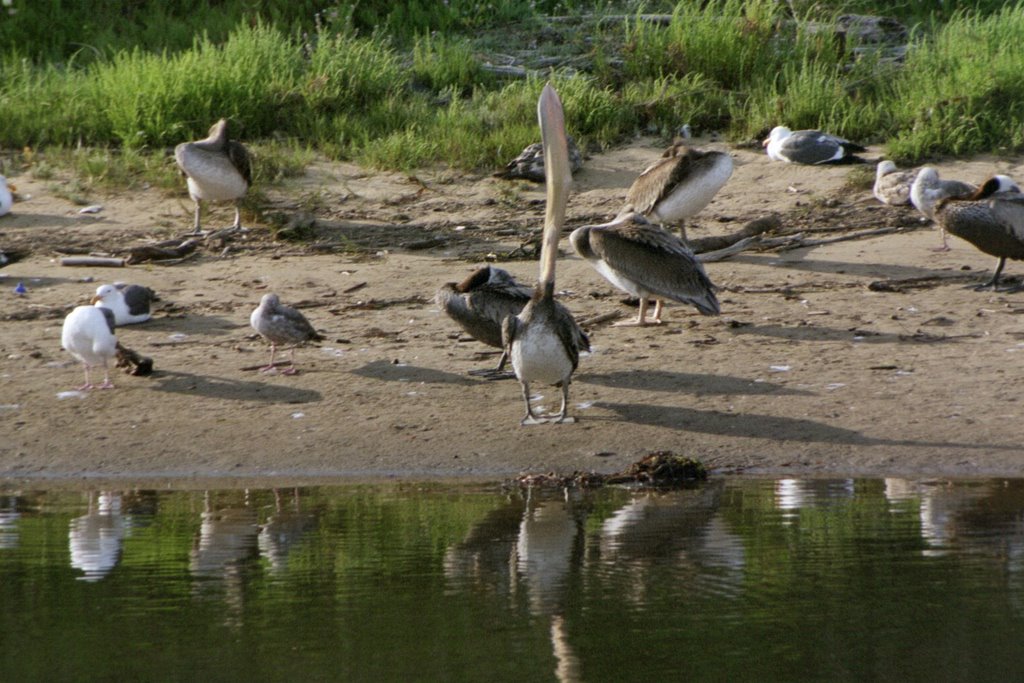 In his "Lives of North American Birds" Kenn Kaufmann speculates that these are stretching exercises to keep the pouch pliable. Whatever it's for, it sure looks strange.
I took these pictures last week at the confluence of Atascadero Creek and Goleta Slough, which is about 300 yards from where the Slough runs into the ocean. It was about an hour before sunset and the tide was rising. With the beach, tidewater creeks, and nearby brackish marshes, it is a happening place for all sorts of birds besides the pelicans.
I know I should be moving to and embracing digital photography, but my old "analog" stuff still takes good pictures. I took these with my old Canon FTb using a 100-500mm zoom.
Thursday, June 08, 2006
Lashyn's Pups!
Seven more pups, six female, arrived yesterday afternoon. Four are red, of which three look to have some brindle; one golden brindle girl a la Lash; and two creams, one a boy!
Lash has sisters that are cream with black muzzles, as these look to be.
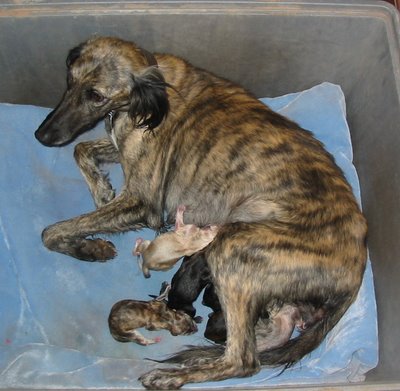
It took a while. Thought we were done after five, then the first cream. Thought we were done again, then the second-- an hour later.
We will probably keep the cream boy and the light brindle girl, who already has a bloggish name: Larissa. (By the way, congratulations to human Larissa who is going to London to study classical drama-- more on that later).
Everyone eating well and looking good.
More after I rest.
Lash has sisters that are cream with black muzzles, as these look to be.
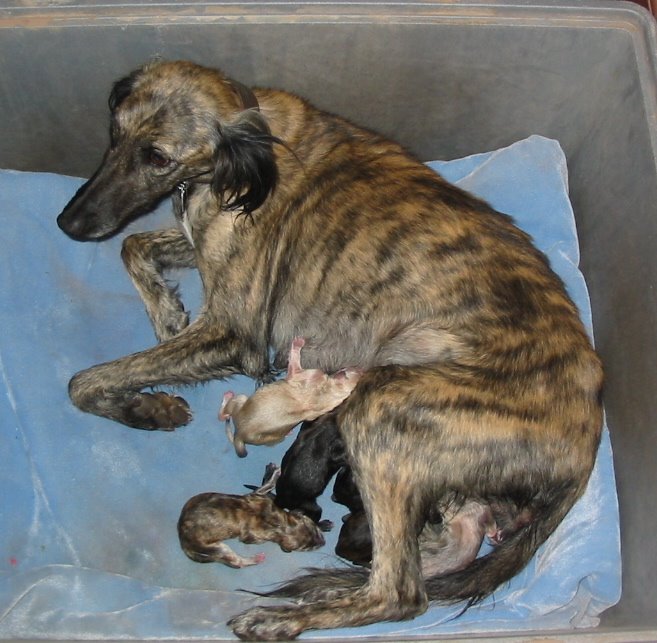
It took a while. Thought we were done after five, then the first cream. Thought we were done again, then the second-- an hour later.
We will probably keep the cream boy and the light brindle girl, who already has a bloggish name: Larissa. (By the way, congratulations to human Larissa who is going to London to study classical drama-- more on that later).
Everyone eating well and looking good.
More after I rest.
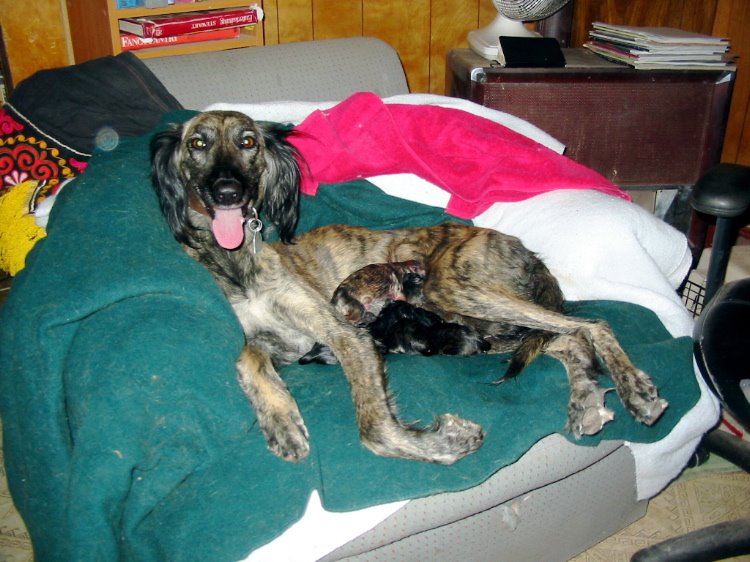
Why Are We So Strange?
We three have chattered away for a year on things that strike our fancies (some of them more fanciful than others). Evidently you share these interests, and we're glad for that. Maybe we're not so strange after all.
When Steve and Reid traded a couple early photos last week, I thought it might be fun to ask them how they came to love the things they do. I didn't want you to miss out on the visual aids, so I asked them to share those photos too: Young Men With Big Hair.
FROM STEVE: I am so weird I never thought about it--just followed my interests--until Betsy Huntington told me I was eccentric in my late twenties. I had always patterned myself after the great naturalist- adventurers from the Victorians to Will Beebe and Roy Chapman Andrews, and was puzzled that I couldn't get around the world as easily. Once after I mused on this she stared at me and said in her best patrician drawl; " Stephen-- don't you understand that they were all richer than GAWD?"
Until that moment it had never occurred to me.
Parenthetically; later, I met and befriended the late great Jesuit-explorer- naturalist- hunter Anderson Bakewell-- I should post on HIM some time, maybe including a pic of him in a fringed buckskin jacket with a woodland bison and his Rigby .416. Priests from orders like the Jesuits are supposed to take vows of poverty, but that didn't stop his using his Holland and Holland .470 double rifle that he had since he was a kid in trade to build a whole church in the Northwest Territories. He-- who had known the likes of Beebe and Andrews and Arthur Vernay-- was also richer than "Gawd".
Or as Betsy's friend Joan said: "A Bakewell? They are rahther GRAND. I
believe they own Missouri".
His great great- something aunt Lucy married Audubon.

STEVE ON HAIR: I never did anything but cut it less than I do now-- was wearing it like that since my teens, slightly pre- Doors, so Morrison was no model. But at the High School graduation party last Saturday, a now adult and married young Navajo who was drinking with us (local custom: parents & relatives stand around the bed of a pickup in the parking lot drinking beer and waving at the cruising cops from time to time)said: "When we were little kids-- when I was four-- [Ouch!] we used to call you "Little House on the Prairie". [ie, Michael Landon.]
Quips George Gonzalez the one- limbed mechanic: "Now he looks more like Albert Einstein!"
FROM REID: I knew when I was eight years old. Just before I started Third Grade, my father took a job as a salesman for a pharmaceutical company and we moved from my mother's home town of Jonesboro, AR to Louisville, KY. We lived in a suburb called Fern Creek which then was little more than a rural cross-roads. There were no children near my age living within walking distance of my house. After school and on weekends, I had no one to play with. My sister was six years younger so she couldn't really take that role.
I had lots of time on my own. I spent part of that with my dog, roaming the farm fields and wood-lots that surrounded our house. For most of the rest of it, I read. I had always enjoyed reading, so I read and read and read some more. My parents encouraged this, buying books and taking me to the library. The librarian wouldn't allow me to check out books that weren't from the children's section, and I had a proud moment when my mother told her I could check out any book in the library.
There was an illustrated children's version of The Iliad (librarian didn't want me to have it) that I checked out and rechecked for several months. I subscribed to the American Heritage Junior Library. I read most of the "All About" series. I read many of the "We Were There" historical novels. I read the Roy Chapman Andrews juveniles. I started reading science fiction: Robert Heinlein, Poul Anderson, and the Tom Corbett series. Other boys made plastic model airplanes and cars. I put together and painted plastic models of songbirds - do they still have those?
Finally my folks bought me "The Wonderful World of Archaeology" by Ronald Jessup. I was instantly hooked. The book is beautifully illustrated and I would moon over it for hours, trying to trace or copy pictures of artifacts and ruins. Near the end of the book, there is an illustration of a cross-section of a typical museum, showing the offices and research labs "behind" the exhibits. I picked out where my office was going to be.
I was on a trajectory to be different from my classmates because I rarely saw them socially outside of school. When I started talking at length about subjects that they knew or cared little about, it increased the effect. Back then when little boys were asked what they wanted to be when they grew up, they'd say a fireman, or a jet pilot, or an astronaut (popular in those early days of the space program). When I was asked, I said I was going to be an archaeologist. It always raised eyebrows.
My parents thought I would come to my senses, but I never did. It's right there as my career ambition in the write-up next to my senior picture in my high school annual.

REID ON HAIR: Like Steve, mine was just like it is now, just not cut as short. The part is in the same place and everything. You have to remember that of course long hair was fashionable, and up to the time period of the photo I was never able to have it. I had four years of a conservative private high school with a short hair rule, four years of ROTC drill at Tulane where I had to keep it short, and several months of active duty in the Army. As soon as I got out of the service, I grew it long and kept it that way for a couple of years. Then I decided it was too much bother, cut it off, and have kept it short since.
FROM MATT: I remember climbing up to the top of my dresser with the family's illustrated dictionary. This would be me, still in the single digits. I spent "hours" up there, according to Mom, perched with the book in my lap and doubtless thumbing up words like "bosom" and "posterior." I don't think I've been without a dictionary since, which can in no way explain my terrible speling.
Like all Army Brats, we moved around. I spent a pivotal pre-teen segment of my youth in Fairfax County, Virginia, while Dad worked at the Pentagon. Behind our house (then, but certainly not NOW) stood a wooded stretch just large enough to get lost in---which friends and I did at every opportunity. Ditto into the labyrinth of neighborhood storm drains, so cold in summertime and full of curious graffiti (our latter day pictographs?). I read recently via Richard Louv (author of Last Child in The Woods) that since my birth in 1970, the area within which American children now "explore" outside the home has shrunk 90%.
I aspired back then to entomology, a rare notion even in my B-list circle of friends. The Smithsonian Museum of Natural History had (still has, maybe) an Insect Zoo that became my office on regular weekend trips. Brother Philip (now a surgeon) spent his time at the Air and Space Museum, memorizing flight data.
One keen memory of my days at the bug zoo was being turned down for a summer job; doing something, presumably, with the collection, but probably too young for it at twelve. I cried. Out loud. I was inconsolable. It must have been an embarrassing moment for everyone there. But on the bright side, a kind curator sent me home with a box full of freshly dead stick insects----really big, nasty, tropical ones that were just starting to smell a bit. I kept them in the family fridge until one day they disappeared.
A couple years later, in the Republic of Panama, I picked up an orphaned screech owl [Otus asio choliba] and dropped the dream of being a bug doctor almost simultaneously. A necessary string of introductions---to vets and rehabbers---plugged me into a pipeline of future birds and to delusions of a life in falconry that have never fully dissipated. Boy, interrupted.
MATT ON HAIR: I'll let Mom take this one, "You had GORGEOUS hair. I mean, look at it. Michael Landon would flip over in envy. Probably still do. It is a Mullenix gene and you inherited heaps of it. It is amazing that Dad is 70 and still has a head full. Some day you will be so glad to have hair 'at your age' even though it seems a nuisance now I guess."
Did you get all that? The sense of loss and the rest of it? Sigh...
Here I am at 14, c.1984. I call this pic: "How Mom Remembers My Hair"

When Steve and Reid traded a couple early photos last week, I thought it might be fun to ask them how they came to love the things they do. I didn't want you to miss out on the visual aids, so I asked them to share those photos too: Young Men With Big Hair.
FROM STEVE: I am so weird I never thought about it--just followed my interests--until Betsy Huntington told me I was eccentric in my late twenties. I had always patterned myself after the great naturalist- adventurers from the Victorians to Will Beebe and Roy Chapman Andrews, and was puzzled that I couldn't get around the world as easily. Once after I mused on this she stared at me and said in her best patrician drawl; " Stephen-- don't you understand that they were all richer than GAWD?"
Until that moment it had never occurred to me.
Parenthetically; later, I met and befriended the late great Jesuit-explorer- naturalist- hunter Anderson Bakewell-- I should post on HIM some time, maybe including a pic of him in a fringed buckskin jacket with a woodland bison and his Rigby .416. Priests from orders like the Jesuits are supposed to take vows of poverty, but that didn't stop his using his Holland and Holland .470 double rifle that he had since he was a kid in trade to build a whole church in the Northwest Territories. He-- who had known the likes of Beebe and Andrews and Arthur Vernay-- was also richer than "Gawd".
Or as Betsy's friend Joan said: "A Bakewell? They are rahther GRAND. I
believe they own Missouri".
His great great- something aunt Lucy married Audubon.
STEVE ON HAIR: I never did anything but cut it less than I do now-- was wearing it like that since my teens, slightly pre- Doors, so Morrison was no model. But at the High School graduation party last Saturday, a now adult and married young Navajo who was drinking with us (local custom: parents & relatives stand around the bed of a pickup in the parking lot drinking beer and waving at the cruising cops from time to time)said: "When we were little kids-- when I was four-- [Ouch!] we used to call you "Little House on the Prairie". [ie, Michael Landon.]
Quips George Gonzalez the one- limbed mechanic: "Now he looks more like Albert Einstein!"
FROM REID: I knew when I was eight years old. Just before I started Third Grade, my father took a job as a salesman for a pharmaceutical company and we moved from my mother's home town of Jonesboro, AR to Louisville, KY. We lived in a suburb called Fern Creek which then was little more than a rural cross-roads. There were no children near my age living within walking distance of my house. After school and on weekends, I had no one to play with. My sister was six years younger so she couldn't really take that role.
I had lots of time on my own. I spent part of that with my dog, roaming the farm fields and wood-lots that surrounded our house. For most of the rest of it, I read. I had always enjoyed reading, so I read and read and read some more. My parents encouraged this, buying books and taking me to the library. The librarian wouldn't allow me to check out books that weren't from the children's section, and I had a proud moment when my mother told her I could check out any book in the library.
There was an illustrated children's version of The Iliad (librarian didn't want me to have it) that I checked out and rechecked for several months. I subscribed to the American Heritage Junior Library. I read most of the "All About" series. I read many of the "We Were There" historical novels. I read the Roy Chapman Andrews juveniles. I started reading science fiction: Robert Heinlein, Poul Anderson, and the Tom Corbett series. Other boys made plastic model airplanes and cars. I put together and painted plastic models of songbirds - do they still have those?
Finally my folks bought me "The Wonderful World of Archaeology" by Ronald Jessup. I was instantly hooked. The book is beautifully illustrated and I would moon over it for hours, trying to trace or copy pictures of artifacts and ruins. Near the end of the book, there is an illustration of a cross-section of a typical museum, showing the offices and research labs "behind" the exhibits. I picked out where my office was going to be.
I was on a trajectory to be different from my classmates because I rarely saw them socially outside of school. When I started talking at length about subjects that they knew or cared little about, it increased the effect. Back then when little boys were asked what they wanted to be when they grew up, they'd say a fireman, or a jet pilot, or an astronaut (popular in those early days of the space program). When I was asked, I said I was going to be an archaeologist. It always raised eyebrows.
My parents thought I would come to my senses, but I never did. It's right there as my career ambition in the write-up next to my senior picture in my high school annual.
REID ON HAIR: Like Steve, mine was just like it is now, just not cut as short. The part is in the same place and everything. You have to remember that of course long hair was fashionable, and up to the time period of the photo I was never able to have it. I had four years of a conservative private high school with a short hair rule, four years of ROTC drill at Tulane where I had to keep it short, and several months of active duty in the Army. As soon as I got out of the service, I grew it long and kept it that way for a couple of years. Then I decided it was too much bother, cut it off, and have kept it short since.
FROM MATT: I remember climbing up to the top of my dresser with the family's illustrated dictionary. This would be me, still in the single digits. I spent "hours" up there, according to Mom, perched with the book in my lap and doubtless thumbing up words like "bosom" and "posterior." I don't think I've been without a dictionary since, which can in no way explain my terrible speling.
Like all Army Brats, we moved around. I spent a pivotal pre-teen segment of my youth in Fairfax County, Virginia, while Dad worked at the Pentagon. Behind our house (then, but certainly not NOW) stood a wooded stretch just large enough to get lost in---which friends and I did at every opportunity. Ditto into the labyrinth of neighborhood storm drains, so cold in summertime and full of curious graffiti (our latter day pictographs?). I read recently via Richard Louv (author of Last Child in The Woods) that since my birth in 1970, the area within which American children now "explore" outside the home has shrunk 90%.
I aspired back then to entomology, a rare notion even in my B-list circle of friends. The Smithsonian Museum of Natural History had (still has, maybe) an Insect Zoo that became my office on regular weekend trips. Brother Philip (now a surgeon) spent his time at the Air and Space Museum, memorizing flight data.
One keen memory of my days at the bug zoo was being turned down for a summer job; doing something, presumably, with the collection, but probably too young for it at twelve. I cried. Out loud. I was inconsolable. It must have been an embarrassing moment for everyone there. But on the bright side, a kind curator sent me home with a box full of freshly dead stick insects----really big, nasty, tropical ones that were just starting to smell a bit. I kept them in the family fridge until one day they disappeared.
A couple years later, in the Republic of Panama, I picked up an orphaned screech owl [Otus asio choliba] and dropped the dream of being a bug doctor almost simultaneously. A necessary string of introductions---to vets and rehabbers---plugged me into a pipeline of future birds and to delusions of a life in falconry that have never fully dissipated. Boy, interrupted.
MATT ON HAIR: I'll let Mom take this one, "You had GORGEOUS hair. I mean, look at it. Michael Landon would flip over in envy. Probably still do. It is a Mullenix gene and you inherited heaps of it. It is amazing that Dad is 70 and still has a head full. Some day you will be so glad to have hair 'at your age' even though it seems a nuisance now I guess."
Did you get all that? The sense of loss and the rest of it? Sigh...
Here I am at 14, c.1984. I call this pic: "How Mom Remembers My Hair"
Tuesday, June 06, 2006
To Google or Not To Google (a note from Webmaster Q.)
In its First Anniversary Celebration Week, Querencia took a few minutes to tally up the revenue it generated via the Google ads over the past year. These ads come to you in the little box to the left (don't look; we've deleted them), which predictably/maddeningly mismatch the ads with our content. For example: We note the evil intents of Wayne Pacelle? Google gives us ads for HSUS. That sort of thing.
Anyway, it did not take long to tally up $0.00 and to discover that the only one making money on Google ads is Google. Outrageous fortunes, indeed!
Anyway, it did not take long to tally up $0.00 and to discover that the only one making money on Google ads is Google. Outrageous fortunes, indeed!
Monday, June 05, 2006
Bloggiversary!
Today is the first birthday of the Querencia blog. We will be posting relevant things through the week, including some scary photos of Skinny Men With Too Much Hair. You are warned!
As pups and work permit, there will also be posts forthcoming on micro- shotguns, Jesuit big- game hunters with snakes named after them, chemistry sets, and the usual zoology and AR follies. And did I mention PUPPIES?
As pups and work permit, there will also be posts forthcoming on micro- shotguns, Jesuit big- game hunters with snakes named after them, chemistry sets, and the usual zoology and AR follies. And did I mention PUPPIES?
Gator Mania
Los Angelenos love their 'gator tales! Reid noted this feature by LA Times writer Carol Williamson on the recent spate (if three be a spate) of fatal attacks on Floridians by the large reptiles. As the only one of us living within the range of the American Alligator [A. mississippiensis], I'll do the honors. The story begins:
Williamson writes a good story and hits all the talking points:
Steve B. concurs and notes with some wonder, "Three animals that common sense might tell you could be dangerous-- alligators, cougars, and wolves-- were all painted as virtual 'pacifists' in the 60's and 70's."
I can say, as a father of two media-chomping five-year-olds, that today's television and children's literature do not exactly put the teeth back into these predators. Apparently we prefer a kinder, gentler take on the facts of life (and death). Compare Barney the Friendly Lizard King to Kipling's take on the children's story----the one that opens with a wounded tiger chasing a human child.
Probably the difference between real and make-believe animals is inconsequential to most Americans. How many will ever hike through grizzly country? But here we have Florida, the Nation's Water Park and home to hundreds of thousands of giant, meat-eating reptiles. One doesn't need to monger fear or misrepresent the danger to suggest a little caution is OK.
During my stint with the Florida Fish and Wildlife Conservation Commission, I worked in the same office suite as the State's alligator program (aka lottery hunt) coordinator, Nick Wiley. I remember Nick as friendly, funny, smart and a player---one of maybe 5 guys in the agency with ambition. He moved on and up even during my short tenure there.
But what I remember best in Wiley's office was a wall-sized map of the state of Florida with all the occupied alligator habitat in red. I mentioned once that it looked like a hell of a lot of habitat to me. He said it is: Every body of water in the state was printed in red.
PEMBROKE PARK, Fla.---- Brian Wood is knee-deep in alligators, a beneficiary of the sudden statewide panic over a creature that has largely lived in peace with the humans who have increasingly invaded its habitat.
Wood's business of skinning and boning the slaughtered beasts has tripled in the last two weeks as freaked-out Floridians have been striking back at the predators after three fatal attacks on women.
Williamson writes a good story and hits all the talking points:
Though alligators are statistically less likely to kill a person than is the family dog, the state's Nuisance Alligator Program hotline has had 200 calls a day since the three incidents in mid-May.There's even a little gun-play...
[snip]
While the fear-induced run is a boost for his business, Hardwick professes to be "the No. 1 fan of alligators" and worries some are being labeled nuisances---and thus destined for destruction--- just for hanging around their own watery habitat. There are more than 1 million alligators in Florida, found in every one of its 67 counties.
Williamson takes this quote from University of Florida zoologist Kent Vliet: "People have a fairly instinctual and primal reaction to large reptiles dragging them into the water."Most worrisome, in the view of wildlife biologists and those charged with public safety, has been the spate of gun owners reaching for their pistols instead of the telephone.
"These are very primitive animals with very small brains, very thick skulls and very tough hides," Hardwick said. "The chances of someone being able to render one dead is slim."
Even veteran hunters such as Wood know the perils of projectiles bouncing off the gators' hard heads."If you hit the skull, I've had experience of it ricocheting into the top of my arm. They can move at the last second," said Wood of a coup de grace gone wrong.
Steve B. concurs and notes with some wonder, "Three animals that common sense might tell you could be dangerous-- alligators, cougars, and wolves-- were all painted as virtual 'pacifists' in the 60's and 70's."
I can say, as a father of two media-chomping five-year-olds, that today's television and children's literature do not exactly put the teeth back into these predators. Apparently we prefer a kinder, gentler take on the facts of life (and death). Compare Barney the Friendly Lizard King to Kipling's take on the children's story----the one that opens with a wounded tiger chasing a human child.
Probably the difference between real and make-believe animals is inconsequential to most Americans. How many will ever hike through grizzly country? But here we have Florida, the Nation's Water Park and home to hundreds of thousands of giant, meat-eating reptiles. One doesn't need to monger fear or misrepresent the danger to suggest a little caution is OK.
During my stint with the Florida Fish and Wildlife Conservation Commission, I worked in the same office suite as the State's alligator program (aka lottery hunt) coordinator, Nick Wiley. I remember Nick as friendly, funny, smart and a player---one of maybe 5 guys in the agency with ambition. He moved on and up even during my short tenure there.
But what I remember best in Wiley's office was a wall-sized map of the state of Florida with all the occupied alligator habitat in red. I mentioned once that it looked like a hell of a lot of habitat to me. He said it is: Every body of water in the state was printed in red.
Sunday, June 04, 2006
On the Trail
Last Sunday I took Sadie, our Aussie pup, and Maggie, our Lab, for a hike on the Jesusita Trail. The trail starts on the north outskirts of Santa Barbara, and winds its way up northward into the foothills of the Santa Ynez Mountains in the Los Padres National Forest.
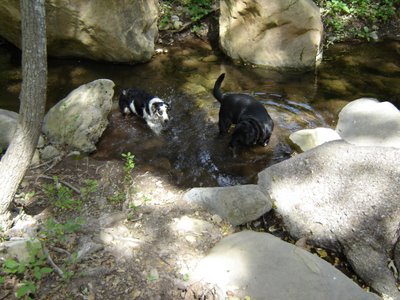 - it's there to keep dogs happy and cool on warm days.
 The trailhead is at about 500 ft. and though it doesn't go all the way to the top, it links with another trail that will take you to the crest here, which is at just under 4000 ft.
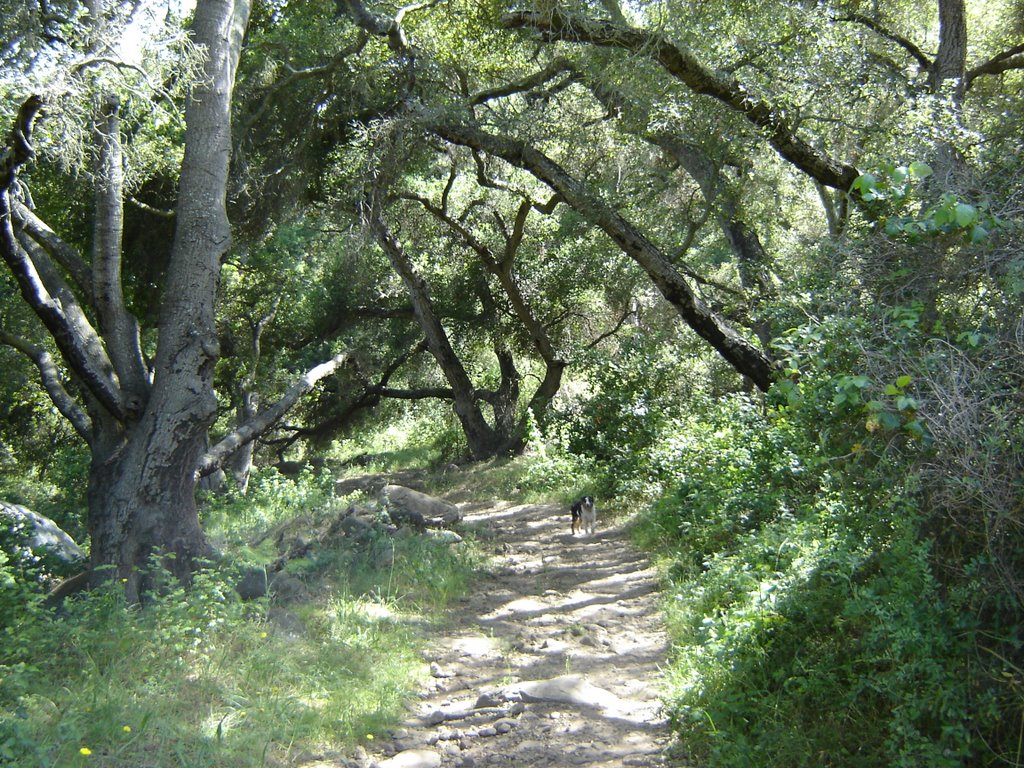 It makes its way through some pretty oak groves
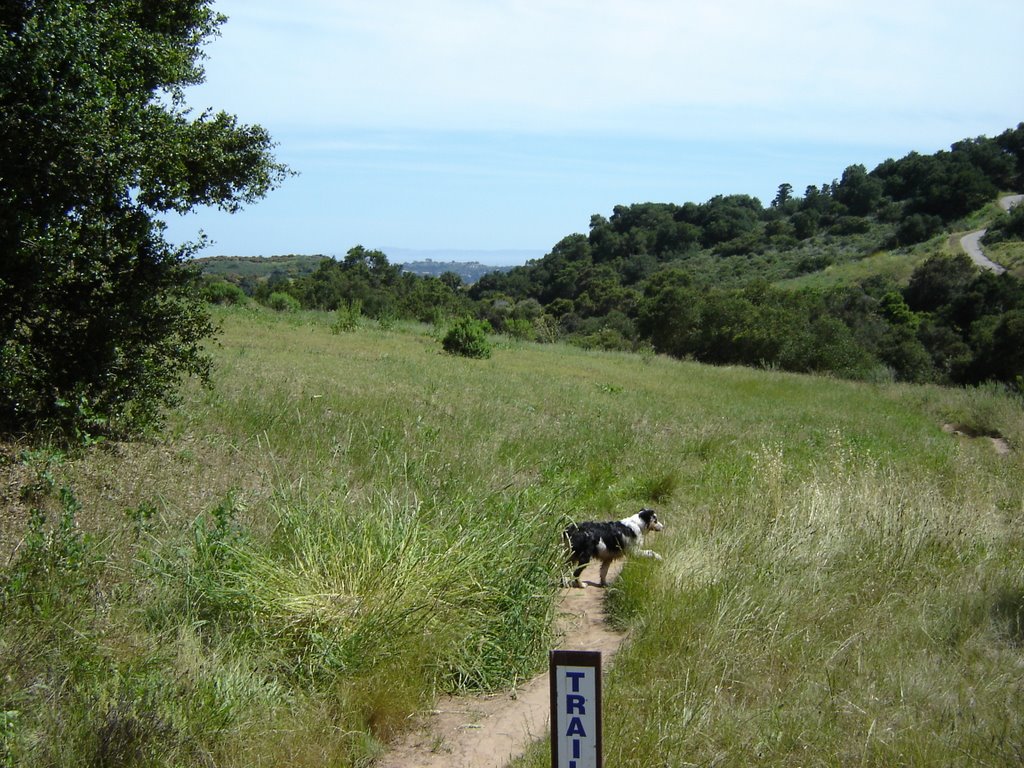 - and some open meadows. In all, it's a good trail if you keep out of the poison oak.
The view above is looking south. What appear to be mountains on the far horizon in this shot are actually hills on Santa Cruz Island, about 30 miles away as the crow flies and 25 miles out to sea. Another pleasant aspect of the Jesusita Trail is that it follows an unnamed tributary of San Roque Creek in its middle stretches.
 The creek is very pretty, but maybe best of all
 - it's there to keep dogs happy and cool on warm days.
Another unique blog
Check out The Indian Cowboy. He is a libertarian Hindu (that kind of Indian) primatologist from Texas who is studying for his doctorate in psychiatry. He is also a gun nut, and a conservationist. Gun pics and primate behavior and evolution!
Science and Animal Art
Via Darren, two wonderful sites of scientific, paleontological, and animal illustration.
Olduvai George features everything from prehistoric creatures to Cooper's hawks; Rigor Vitae features snapping turtles (most recently), the raptor- rich badlands of Wyoming, and more. Both sites seem fond of raptors-- but then isn't everybody?
Update: congratulations to Darren, who has just achieved his doctorate!
Olduvai George features everything from prehistoric creatures to Cooper's hawks; Rigor Vitae features snapping turtles (most recently), the raptor- rich badlands of Wyoming, and more. Both sites seem fond of raptors-- but then isn't everybody?
Update: congratulations to Darren, who has just achieved his doctorate!
They're Here!
The first Asian tazi pups in North America, Ataika's.
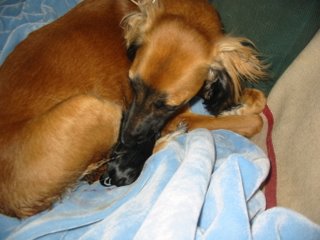

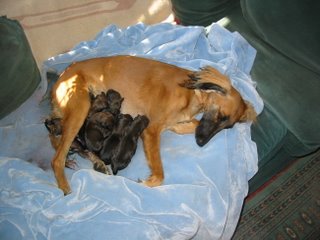
And Lashyn's should come in a few days...
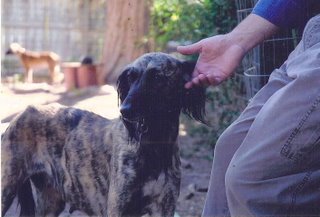
Blogging may be a bit intermittent!
And Lashyn's should come in a few days...
Blogging may be a bit intermittent!
Friday, June 02, 2006
Early Figs
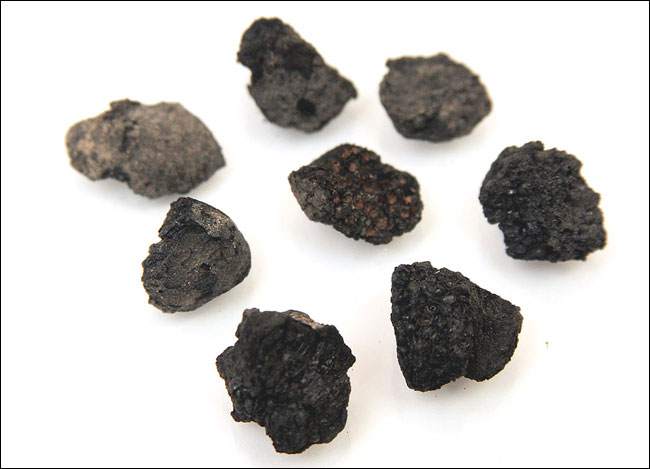
The NY Times reports the discovery of 11,400 year old remains of figs from a prehistoric site near the town of Jericho, in the West Bank. This is apparently the earliest known evidence of domesticated fruit.
Costly Signaling
I really like John Hawks Anthropology Weblog and urge all of you interested in those sorts of things to visit it often. Earlier this week, he commented on a journal article that tested a current anthropological theory on show-off behavior among hunter-gatherer peoples.
Traditional models of hunter-gatherer behavior used by cultural anthropologists and archaeologists have assumed that they use an optimizing hunting strategy. Hunters will use strategies that allow them to gain the most calories of meat for the least amount of effort. A new model, proposed in the early 1990s says that an optimizing strategy cannot always be assumed. Males in many cultures will often hunt "prestige" species - animals difficult to hunt or that have special cultural significance to their societies - to gain status with their fellow hunters and to impress the ladies. This behavior does not make economic sense, and the anthropologists had to invent a new nerdy piece of jargon to call it: costly signaling.
This was brought home to me by an article in American Antiquity (sorry only the abstract is available on line) by two California archaeologists last year, who argue that costly signaling explains some patterns seen in the Middle Archaic (4500 - 1000 BP) of the Great Basin.
Part of their argument rests on rock art, especially as seen at Coso, that I visited and posted on last fall. We know ethnographically that subsistence in the Great Basin was broadly based - it is a harsh environment and you can't be too picky. But the major hunting activity consisted of communal rabbit drives and antelope drives. Rock art in the midst of this area, however, doesn't portray this activity at all. It is obsessed with bighorn sheep.
Traditional models of hunter-gatherer behavior used by cultural anthropologists and archaeologists have assumed that they use an optimizing hunting strategy. Hunters will use strategies that allow them to gain the most calories of meat for the least amount of effort. A new model, proposed in the early 1990s says that an optimizing strategy cannot always be assumed. Males in many cultures will often hunt "prestige" species - animals difficult to hunt or that have special cultural significance to their societies - to gain status with their fellow hunters and to impress the ladies. This behavior does not make economic sense, and the anthropologists had to invent a new nerdy piece of jargon to call it: costly signaling.
This was brought home to me by an article in American Antiquity (sorry only the abstract is available on line) by two California archaeologists last year, who argue that costly signaling explains some patterns seen in the Middle Archaic (4500 - 1000 BP) of the Great Basin.
Part of their argument rests on rock art, especially as seen at Coso, that I visited and posted on last fall. We know ethnographically that subsistence in the Great Basin was broadly based - it is a harsh environment and you can't be too picky. But the major hunting activity consisted of communal rabbit drives and antelope drives. Rock art in the midst of this area, however, doesn't portray this activity at all. It is obsessed with bighorn sheep.
 There are thousands of images of sheep like on this face.
 And this one.
There are no rabbits, no antelope, and hardly any deer portrayed. The historic and ethnographic accounts barely mention sheep hunting - only that it was difficult and usually conducted using dogs. Sheep bone doesn't form a significant percentage of remains from archaeological sites in the area. Yet here are sheep in their thousands portrayed with hunters and bows and atlatls.
McGuire and Hildebrandt think this is an indication of bighorn sheep as a "prestige" species for these people.
Some of you hunters should comment on the role costly signaling plays in your behavior.
Boy Pirate
The pirate ship Whydah sank in a storm off the Massachusetts coast in 1717. When it was discovered by underwater archaeologists in 1984, it was the first authenticated wreck of a pirate ship ever found. The wreck has been the focus on an on-going research project since its discovery, with over 100,000 artifacts recovered that are preserved and studied in a dedicated museum in Provincetown.
This week an interesting story emerged about a member of the Whydah's crew. In November, 1716, the Whydah was preying on ships in the Caribbean and captured the sloop Bonetta. In a depostion filed by the Bonetta's captain, he said that the pirates held his ship for two weeks, stealing all the valuables, but finally setting them free. Among his passengers was a 9 year old boy named John King, who was accompanying his mother on the voyage. When the Bonetta was released, John King decided to stay with the pirates. In fact, the deposition says he threatened to kill himself if his mother or the Bonetta's crew tried to keep him aboard. Very striking.
As sometimes happens in archaeology, the reanalysis of material recovered years before has added a dimension to the John King story. Recently, a child's fibula (shinbone), a small silk stocking, and a child's shoe that were recovered from the Whydah 20 years ago, were identified as fitting with John King's age and social background. King's pirate adventure only lasted a few months.
Here's a link to the Expedition Whydah website.
This week an interesting story emerged about a member of the Whydah's crew. In November, 1716, the Whydah was preying on ships in the Caribbean and captured the sloop Bonetta. In a depostion filed by the Bonetta's captain, he said that the pirates held his ship for two weeks, stealing all the valuables, but finally setting them free. Among his passengers was a 9 year old boy named John King, who was accompanying his mother on the voyage. When the Bonetta was released, John King decided to stay with the pirates. In fact, the deposition says he threatened to kill himself if his mother or the Bonetta's crew tried to keep him aboard. Very striking.
As sometimes happens in archaeology, the reanalysis of material recovered years before has added a dimension to the John King story. Recently, a child's fibula (shinbone), a small silk stocking, and a child's shoe that were recovered from the Whydah 20 years ago, were identified as fitting with John King's age and social background. King's pirate adventure only lasted a few months.
Here's a link to the Expedition Whydah website.
Subscribe to:
Posts (Atom)