The Department of the Interior has reversed its position on the provenance of Kennewick, from siding with the Indians (i.e. that he could be identified with the present- day Umatillas-- or any other tribe) to siding with the scientists, a victory for reason. Money quote, from the Society for American Anthropology:
"The hearing brought several surprises. For starters, Mr. Hoffman testified that not only did the administration oppose the amendment [ the McCain amendment, which would allow present- day tribes to claim all pre- European remains in the U.S.--SB], but it also was changing its position on the Kennewick case. Prior to and during the case, the Department had sided with the tribal claimants of the remains, asserting that the Kennewick Man was both Native American and culturally affiliated with the tribes. Now the Department agrees with the court's finding that the remains are not Native American under NAGPRA. In addition, under questioning, Hoffman stated that the attorneys fees that the courts ordered the Department to pay to the lawyers who represented the scientists in the case were being paid out of the NAGPRA Grants Program.The outlook for the proposed amendment is now uncertain"
Reads more at the SAA website.. Thanks to Reid Farmer and Grayal Farr, who warns:"They will be back".
Sunday, August 07, 2005


Bad news for the Sage Grouse
As all news seems to be. The magnificent Sage grouse (now considered to be composed of two species, the Sage, Centrocercus urophasianus, and the Gunnison, Centrocercus minimus) is the biggest grouse in North America and perhaps one of the ultimate quarries for dedicated falconers because it is so good in the air as well as large and strong. It is one of the few grouse that can be seen passing high in the air, like some sort of lumbering waterfowl or flapping B- 17 rather than a ground bird.
It is, (or they are) probably a "recent" species as such things go, one that split off from common stock with more conventional grouse species like the Blue grouse (Dendrogapus obscurus) during the Pleistocene glaciations. The polygamous males perform for the inspection of prospective mates on "leks" , communal display grounds, making an eerie hollow hooting sound and erecting plumes and tails until they look like dancing plains warriors.
I am not one for doom and gloom about species, but the Sage grouse is an unusually unlucky bird. It migrates over lage distances for a so- called sedentary species, needs riparian areas and insects for its chicks, and above all needs SAGE, a major part of its diet. The sage ecosystem has been broken up and turned into center- pivot agriculture throughout the Great Basin and the valleys of western Wyoming and Montana. Invasive cheatgrass, which has no value as a food plant, is spreading via fire throughout the sagbrush ecosystem.
Now comes more disturbing news from the Swarovski Birding e- bulletin:
"We again visit the beleaguered sage-grouse scene, now with warnings about West Nile Virus. Over the past few years, Greater Sage-Grouse have been found infected with West Nile Virus at a number of locations, including Wyoming, Montana, and Alberta. Ongoing studies have suggested that the species is highly susceptible to the disease. None has shown neutralizing antibodies, intimating that most sage-grouse do not survive WNV. Indeed, researchers have yet to find a Greater Sage-Grouse that has survived infection by WNV, a grave situation for a species already facing diminishing habitat. Even the smallest doses of the virus have killed sage-grouse during experimentation. There is also evidence that WNV, usually spread by mosquitoes, can spread directly between sage-grouse. A 2003 study found that sage-grouse survival had fallen by an average of 25 percent in two locations in the Wyoming portion of the Powder River Basin, as well as at another site in Wyoming and one in Alberta. Studies are ongoing".
Libby reminds me that irrigation can create better conditions for mosquitos as well. I am glad that I have had the privilege to see the males dance , courtesy of Matt Miller of the Nature Conservancy and Tom Cade and Kent Christopher of the North American Grouse Partnership. If anyone can turn the great bird around, these organizations are the ones-- check them out.
And, for a future post perhaps: the habitat of Sage grouse lies mostly within the "impact area" of that slumbering but uneasy dragon, the Yellowstone Supervolcano.....
Update: apparently thje WNV situation may not be as dire as first reported. In a North American Falconers Assocation email which I cannot quote in detail it because it is confidential, a veterinarian doubts that there is any confirmed bird- to- bird transmission. Which doesn't mean that these two spectacular grouse species do not continue to face all of the other problems mentioned above.
It is, (or they are) probably a "recent" species as such things go, one that split off from common stock with more conventional grouse species like the Blue grouse (Dendrogapus obscurus) during the Pleistocene glaciations. The polygamous males perform for the inspection of prospective mates on "leks" , communal display grounds, making an eerie hollow hooting sound and erecting plumes and tails until they look like dancing plains warriors.
I am not one for doom and gloom about species, but the Sage grouse is an unusually unlucky bird. It migrates over lage distances for a so- called sedentary species, needs riparian areas and insects for its chicks, and above all needs SAGE, a major part of its diet. The sage ecosystem has been broken up and turned into center- pivot agriculture throughout the Great Basin and the valleys of western Wyoming and Montana. Invasive cheatgrass, which has no value as a food plant, is spreading via fire throughout the sagbrush ecosystem.
Now comes more disturbing news from the Swarovski Birding e- bulletin:
"We again visit the beleaguered sage-grouse scene, now with warnings about West Nile Virus. Over the past few years, Greater Sage-Grouse have been found infected with West Nile Virus at a number of locations, including Wyoming, Montana, and Alberta. Ongoing studies have suggested that the species is highly susceptible to the disease. None has shown neutralizing antibodies, intimating that most sage-grouse do not survive WNV. Indeed, researchers have yet to find a Greater Sage-Grouse that has survived infection by WNV, a grave situation for a species already facing diminishing habitat. Even the smallest doses of the virus have killed sage-grouse during experimentation. There is also evidence that WNV, usually spread by mosquitoes, can spread directly between sage-grouse. A 2003 study found that sage-grouse survival had fallen by an average of 25 percent in two locations in the Wyoming portion of the Powder River Basin, as well as at another site in Wyoming and one in Alberta. Studies are ongoing".
Libby reminds me that irrigation can create better conditions for mosquitos as well. I am glad that I have had the privilege to see the males dance , courtesy of Matt Miller of the Nature Conservancy and Tom Cade and Kent Christopher of the North American Grouse Partnership. If anyone can turn the great bird around, these organizations are the ones-- check them out.
And, for a future post perhaps: the habitat of Sage grouse lies mostly within the "impact area" of that slumbering but uneasy dragon, the Yellowstone Supervolcano.....
Update: apparently thje WNV situation may not be as dire as first reported. In a North American Falconers Assocation email which I cannot quote in detail it because it is confidential, a veterinarian doubts that there is any confirmed bird- to- bird transmission. Which doesn't mean that these two spectacular grouse species do not continue to face all of the other problems mentioned above.
Ultmate in cluelessness?
At least, a leading candidate:
"The bureaucratic mind at work, from the WSJ Political Diary:
"Before deploying from Savannah, Georgia to Iraq by a chartered airliner, the troops of the 48th Brigade Combat Team, a National Guard unit, had to go through the same security checks as any other passengers. Lt. Col. John King, the unit's commander, told his 280 fellow soldiers that FAA anti-hijacking regulations require passengers to surrender pocket knives, nose hair scissors and cigarette lighters. 'If you have any of those things,' he said, almost apologetically, 'put them in this box now.' The troops were, however, allowed to keep hold of their assault rifles, body armour, helmets, pistols, bayonets and combat shotguns. " -- reported in the Air Finance Journal".
"Put down that assault rifle or I'll clip your nose hairs".
Via Samizdata.
"The bureaucratic mind at work, from the WSJ Political Diary:
"Before deploying from Savannah, Georgia to Iraq by a chartered airliner, the troops of the 48th Brigade Combat Team, a National Guard unit, had to go through the same security checks as any other passengers. Lt. Col. John King, the unit's commander, told his 280 fellow soldiers that FAA anti-hijacking regulations require passengers to surrender pocket knives, nose hair scissors and cigarette lighters. 'If you have any of those things,' he said, almost apologetically, 'put them in this box now.' The troops were, however, allowed to keep hold of their assault rifles, body armour, helmets, pistols, bayonets and combat shotguns. " -- reported in the Air Finance Journal".
"Put down that assault rifle or I'll clip your nose hairs".
Via Samizdata.
Hello from Africa
Alpha Enviros Jonathan and Roseann Hanson have been off- line because they are in Africa learning to be guides from the Maasai. Just got a note, which I quote:
"We drove two Land Cruisers all over the country. Roseann made other guides nearly drive off the road when they saw her. Then we went up into country where there WERE no other guides.
"We had many thrills and a few disasters, as expected here. Roseann saw a cheetah on her birthday. You'll want to hear about coursing hyraxes with Maasai Morani and their dogs".
I do.
"We drove two Land Cruisers all over the country. Roseann made other guides nearly drive off the road when they saw her. Then we went up into country where there WERE no other guides.
"We had many thrills and a few disasters, as expected here. Roseann saw a cheetah on her birthday. You'll want to hear about coursing hyraxes with Maasai Morani and their dogs".
I do.
Saturday, August 06, 2005
Fan (non)fiction
Matt here, and let me tell you how (and who): I'm a falconer and a reader with about equal enthusiasm for each pursuit, which explains my familiarity with Steve Bodio's work. I am a Bodio fan and have been since my first days as a falconer in the mid-80s. A couple years ago I stumbled into Steve's email address (on a blog, in fact) and sent him the first of a series of shameless fan mail. If you know Steve, you will expect he replied with grace and courtesy, and he did.
These days I work as a Web administrator for a university library system, which provides me a skill set to offer a hero-figure a little service in return. So we set up Steve's website and this blog, and that explains my involvement in the Bodiosphere.
I take this opportunity to post on Steve's blog with (I swear it!) reluctance. Or at least trepidation. But he invited, and like a vampire I am obliged to step inside.
My goal/ulterior motive for helping Steve create his blog is to get him posting about the writer's craft. I am a wanna-be writer and I eat this stuff up. Another hero, Hemingway, knew there were people like me, and he spoke to us---sometimes plainly in the middle of unrelated narrative. Wonderful! I hoped Steve would do the same, and sometimes he does.
To a recent post on the nature of book publishing, I offered the comment:
So Steve: Did you start writing by emulating your heroes? If so, when did you stop doing that and become Steve Bodio?
These days I work as a Web administrator for a university library system, which provides me a skill set to offer a hero-figure a little service in return. So we set up Steve's website and this blog, and that explains my involvement in the Bodiosphere.
I take this opportunity to post on Steve's blog with (I swear it!) reluctance. Or at least trepidation. But he invited, and like a vampire I am obliged to step inside.
My goal/ulterior motive for helping Steve create his blog is to get him posting about the writer's craft. I am a wanna-be writer and I eat this stuff up. Another hero, Hemingway, knew there were people like me, and he spoke to us---sometimes plainly in the middle of unrelated narrative. Wonderful! I hoped Steve would do the same, and sometimes he does.
To a recent post on the nature of book publishing, I offered the comment:
"...I see it as something like the creation of an elephant: low birthrate + long gestation + prolonged adolescence = one big, smart, long-lived, tough-skinned critter."To which my friend, writer and fellow falconer Rebecca O'Connor, replied:
"...we do the book writing thing because we can't help ourselves anyway. It's not like we WANT to wait around for it be published and permanent. We just can't stop ourselves. But...if you want to gestate elephants (which sounds VERY uncomfortable) who am I to tell you to stop. :-)"Having seen my wife gestate twins, I have no wish to break ground in that field! But I have to admit I want to write a permanent book. That's my goal, tho I see it as a distant one. My near-term objective is to write readable facsimiles of my heroes' prose---fan fiction, I guess, except not fiction...
So Steve: Did you start writing by emulating your heroes? If so, when did you stop doing that and become Steve Bodio?
(I'll hang up now and listen to your answer.)
Thursday, August 04, 2005
Cloned Dog and Afghan Intelligence
The Big Science News today is that Korean scientists have cloned a dog -- to be exact, a rather handsome Afghan.
This is all very interesting, but other than the anti- cloning tizzy that it has thrown Bay Area animal activists into-- I'll try to find a link-- one of the interesting aspects is how self- elected "experts" have weighed in on how dumb a choice the Afghan is.
Says one, shrink and pop dog author Stanley Coren: "The Afghan hound is not a particularly intelligent dog, but it is beautiful." He ranked the Afghan hound last among 119 breeds in temperament and trainability."Many people who opt for the cloning technique are more interested in fashionable looks," he said. "Whenever we breed dogs for looks and ignore behavior, we have suffered."
Actually I would agree with him that far-- but he may be picking the wrong breed for the wrong reason. The modern show Afghan may be a shadow of its Asian ancestors, but the primitive wolflike habits and physiologies of the Middle Eastern and Central Asian sighthounds, which I have hunted with for twenty five years, do not easily lend themselves to simple analysis. They are not robotic, while some "intelligent" breeds like Labs can be.
My friend Dr. John Burchard, who studied at the Max Planck Institute and under Konrad Lorenz, and who has worked with salukis and falcons for forty- plus years, put it this way today: "In general the dogs that score highest for obedience, and thus for "intelligence" in Coren's system, do worst at problem solving. The best problem solvers seem to be wolves -- and Basenjis, who score very low in Coren's scheme. Don't know if anybody's tried sighthounds on the problem solving tests ... but those of us who live with them can't help noticing certain things..."
(One of our sighthound group describes a cartoon in which a bespectacled scientist stands at the top of a cliff demanding that a recalcitrant Afghan "Jump!". Below the ground is littered with the corpses of Labs, collies, shepherds....)
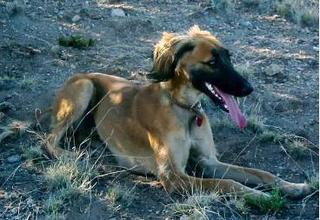 UPDATE: A few more comments from primitive dog aficionado friends-- both scientists incidentally. Vladimir Beregovoy wonders whether modern show and pet breeders who favor "placidity" would breed from what he calls "Houdinis " like my Kazakh female Ataika (left), who routinely escapes from 8- foot fenced enclosures though no bigger than a whippet.
And Dr. John Burchard adds re genetic depletion:"There is much talk of genetic diseases in purebred dogs.It seems the most serious one, ultimately fatal, is called "registration."
UPDATE: Here is what English PETA thinks, via Samizdata.
"Snuppy's birth announcement, published in today's issue of Nature, was greeted with scorn by some animal care activists, who decried the work as inhumane and wasteful, given the global glut of unwanted dogs.
"The cruelty and the body count outweighs any benefit that can be gained from this," said Mary Beth Sweetland, a vice president at People for the Ethical Treatment of Animals in Norfolk".
This is all very interesting, but other than the anti- cloning tizzy that it has thrown Bay Area animal activists into-- I'll try to find a link-- one of the interesting aspects is how self- elected "experts" have weighed in on how dumb a choice the Afghan is.
Says one, shrink and pop dog author Stanley Coren: "The Afghan hound is not a particularly intelligent dog, but it is beautiful." He ranked the Afghan hound last among 119 breeds in temperament and trainability."Many people who opt for the cloning technique are more interested in fashionable looks," he said. "Whenever we breed dogs for looks and ignore behavior, we have suffered."
Actually I would agree with him that far-- but he may be picking the wrong breed for the wrong reason. The modern show Afghan may be a shadow of its Asian ancestors, but the primitive wolflike habits and physiologies of the Middle Eastern and Central Asian sighthounds, which I have hunted with for twenty five years, do not easily lend themselves to simple analysis. They are not robotic, while some "intelligent" breeds like Labs can be.
My friend Dr. John Burchard, who studied at the Max Planck Institute and under Konrad Lorenz, and who has worked with salukis and falcons for forty- plus years, put it this way today: "In general the dogs that score highest for obedience, and thus for "intelligence" in Coren's system, do worst at problem solving. The best problem solvers seem to be wolves -- and Basenjis, who score very low in Coren's scheme. Don't know if anybody's tried sighthounds on the problem solving tests ... but those of us who live with them can't help noticing certain things..."
(One of our sighthound group describes a cartoon in which a bespectacled scientist stands at the top of a cliff demanding that a recalcitrant Afghan "Jump!". Below the ground is littered with the corpses of Labs, collies, shepherds....)
 UPDATE: A few more comments from primitive dog aficionado friends-- both scientists incidentally. Vladimir Beregovoy wonders whether modern show and pet breeders who favor "placidity" would breed from what he calls "Houdinis " like my Kazakh female Ataika (left), who routinely escapes from 8- foot fenced enclosures though no bigger than a whippet.
And Dr. John Burchard adds re genetic depletion:"There is much talk of genetic diseases in purebred dogs.It seems the most serious one, ultimately fatal, is called "registration."
UPDATE: Here is what English PETA thinks, via Samizdata.
"Snuppy's birth announcement, published in today's issue of Nature, was greeted with scorn by some animal care activists, who decried the work as inhumane and wasteful, given the global glut of unwanted dogs.
"The cruelty and the body count outweighs any benefit that can be gained from this," said Mary Beth Sweetland, a vice president at People for the Ethical Treatment of Animals in Norfolk".
Archaeology Blogging, First Americans and more...
Reid Farmer has been sending many good papers and emails-- so many in fact I have invited him to join the blog, which I hope he will next week. Meanwhile go here and here and here for some good early American stuff. (The last has a lot of links to other papers as well).
Most of this material relates to post- Clovis humans and "blitz" megafauna extinction, though as Reid points out there is nothing mutually exclusive about one population of humans coming down the coast while another, perhaps with a better big game toolkit, and definitely with dogs-- I'll have more on that later-- enters swiftly via the ice- free corridor.
One of the papers in the last link there is described with a remarkable line, though: "The authors of "Megafauna Extinction" posit that if early North American hunters focused merely on hunting relatively small animals such as rabbits and deer, accidental encounters with big megafauna like mammoths were common enough to result in megafaunal kills".
To which Matt Mullenix, who will also be posting here soon, replied: "Do you ever get the impression that lots of guys who speculate from scant evidence about the nature of Man The Hunter are not, in fact, hunting men themselves?
"Accidental encounters" with megafauna while hunting rabbits on the open plain? Please!
"Whilst I and my fellows enjoyed a day's bird hunting with our bolas, Grog here tripped upon a sleeping mammoth and had the poor beast lassoed before it could mount a commendable defense!
"All in a day's work, my boy!"
Also apropos here: the dean of high plains archaeology, George Frison (says Reid "Only archaeologist I ever knew who owned and operated his own backhoe) who IS a hunter and wrote the book on it, says: ".. too many investigators think they have analyzed hunting by declaring that prehistoric humans addressed their hunger simply by "leaving camp and killing an animal".
Most of this material relates to post- Clovis humans and "blitz" megafauna extinction, though as Reid points out there is nothing mutually exclusive about one population of humans coming down the coast while another, perhaps with a better big game toolkit, and definitely with dogs-- I'll have more on that later-- enters swiftly via the ice- free corridor.
One of the papers in the last link there is described with a remarkable line, though: "The authors of "Megafauna Extinction" posit that if early North American hunters focused merely on hunting relatively small animals such as rabbits and deer, accidental encounters with big megafauna like mammoths were common enough to result in megafaunal kills".
To which Matt Mullenix, who will also be posting here soon, replied: "Do you ever get the impression that lots of guys who speculate from scant evidence about the nature of Man The Hunter are not, in fact, hunting men themselves?
"Accidental encounters" with megafauna while hunting rabbits on the open plain? Please!
"Whilst I and my fellows enjoyed a day's bird hunting with our bolas, Grog here tripped upon a sleeping mammoth and had the poor beast lassoed before it could mount a commendable defense!
"All in a day's work, my boy!"
Also apropos here: the dean of high plains archaeology, George Frison (says Reid "Only archaeologist I ever knew who owned and operated his own backhoe) who IS a hunter and wrote the book on it, says: ".. too many investigators think they have analyzed hunting by declaring that prehistoric humans addressed their hunger simply by "leaving camp and killing an animal".
Tuesday, August 02, 2005
"Advice for Authors"
Michael Blowhard of 2Blowhards sent me to this excellent post by Seth Godin on the perils of "making a living" writing non- fiction. A couple of quotes?
"Please understand that book publishing is an organized hobby, not a business".
"There is no such thing as effective book promotion by a book publisher.
This isn't true, of course. Harry Potter gets promoted. So did Freakonomics. But out of the 75,000 titles published last year in the US alone, I figure 100 were effectively promoted by the publishers. This leaves a pretty big gap".
Read & weep. Or maybe not-- he has some intelligent things to say about the changing paradigm, including his conclusion:
"And the punchline, of course, is that if you do all these things, you won't need a publisher. And that's exactly when a publisher will want you! That's the sort of author publishers do the best with".
I'm still figuring it out-- I have only been doing it for 30 years.
"Please understand that book publishing is an organized hobby, not a business".
"There is no such thing as effective book promotion by a book publisher.
This isn't true, of course. Harry Potter gets promoted. So did Freakonomics. But out of the 75,000 titles published last year in the US alone, I figure 100 were effectively promoted by the publishers. This leaves a pretty big gap".
Read & weep. Or maybe not-- he has some intelligent things to say about the changing paradigm, including his conclusion:
"And the punchline, of course, is that if you do all these things, you won't need a publisher. And that's exactly when a publisher will want you! That's the sort of author publishers do the best with".
I'm still figuring it out-- I have only been doing it for 30 years.
On regional writing
A friend, a younger writer, asked my opinion on when one can be allowed, so to speak, to write about a place one was not born in. Here are his questions, and some thoughts of mine on the matter, those of a Bostonian who has lived in rural New Mexico for 25 or so years..
"Can you tell me: When did you feel comfortable writing
about New Mexico? How long do you have to be in a
place to feel right about writing about it? Do the
locals resent you? Did they at first?"
The thing of course is to be honest. Let us always go to unfashionable Hemingway.
It is NOT permissible to write in cliches about "the city different" and "the Land of Enchantment" if you are writing about New Mexico. The horrible ex- Michael Gruber version of "Robert Tanenbaum" in my review section has a lot of that. Clear Light. Native American Shamans. Hot Chiles. Santa Fe (Taos) Style.
It is permissible to write about the real Santa Fe. The best novel I know about it is-- believe it or not-- a sort of vampire novel written by a Santa Fe academic who was born in the deep South and raised as a Baptist--!!--Dreamer by Jack Butler.
(Nobody writes about Albuquerque, an absolutely fascinating town full of Asians of every description, gangs, restaurants, culture, high tech--- I digress).
Nobody owns anywhere. Though "one" should avoid making judgments/ conclusions about a new place-- OBSERVE. ASK. Then go with instinct if you are blessed with such. There is a LOT of horrible shite written about Montana, more than about New Mexico, partly I think because it is easier to go there and hang only with easterners/ coastal people.
To go on with my own experience: that-- to hang out with anyone other than locals-- was not possible for me when I got here, and I am hard on myself. I didn't do much of any NM writing for several years. When I first did, it was attacked all right-- by Easterners! New Mexicans came to my defense, and have ever after. Never heard a negative word from a New Mexican on any of my NM writing.
They like Cormac McCarthy too.
But not that rich sentimental commie John Nichols.
Keep it true, brother.
"Can you tell me: When did you feel comfortable writing
about New Mexico? How long do you have to be in a
place to feel right about writing about it? Do the
locals resent you? Did they at first?"
The thing of course is to be honest. Let us always go to unfashionable Hemingway.
It is NOT permissible to write in cliches about "the city different" and "the Land of Enchantment" if you are writing about New Mexico. The horrible ex- Michael Gruber version of "Robert Tanenbaum" in my review section has a lot of that. Clear Light. Native American Shamans. Hot Chiles. Santa Fe (Taos) Style.
It is permissible to write about the real Santa Fe. The best novel I know about it is-- believe it or not-- a sort of vampire novel written by a Santa Fe academic who was born in the deep South and raised as a Baptist--!!--Dreamer by Jack Butler.
(Nobody writes about Albuquerque, an absolutely fascinating town full of Asians of every description, gangs, restaurants, culture, high tech--- I digress).
Nobody owns anywhere. Though "one" should avoid making judgments/ conclusions about a new place-- OBSERVE. ASK. Then go with instinct if you are blessed with such. There is a LOT of horrible shite written about Montana, more than about New Mexico, partly I think because it is easier to go there and hang only with easterners/ coastal people.
To go on with my own experience: that-- to hang out with anyone other than locals-- was not possible for me when I got here, and I am hard on myself. I didn't do much of any NM writing for several years. When I first did, it was attacked all right-- by Easterners! New Mexicans came to my defense, and have ever after. Never heard a negative word from a New Mexican on any of my NM writing.
They like Cormac McCarthy too.
But not that rich sentimental commie John Nichols.
Keep it true, brother.
So that's how they do it..
Anyone who has ever been in the far north knows that its greatest curse is not cold but blood- sucking summer insects, in numbers that can drain a caribou or a human. So maybe it should come as no surprise that evolution has fitted some birds with their own built- in mosquito repellent.
"Hector Douglas, a University of Alaska Fairbanks researcher, said he made the discovery in the feathers of the crested auklet after applying a little scientific intuition and sacrificing some of his own blood....
"To test his theory, he went into the laboratory with a few auklet feathers. An analysis showed him the chemicals that make up the auklet's "odorant." Most are available commercially.
"He then tested their repellent properties using mosquitoes specially bred at a research lab in Florida for their aggressive tendencies. Douglas dabbed test samples on filter paper, attached that paper to his hand, then put it in a cage with hungry mosquitoes.
"It was clear the auklet samples kept mosquitoes away".
I'm wondering, given birds' vulnerability to arthropod- borne viruses, and their small size (which makes them easy to "drain") whether other such properties will bew found in other species
"Hector Douglas, a University of Alaska Fairbanks researcher, said he made the discovery in the feathers of the crested auklet after applying a little scientific intuition and sacrificing some of his own blood....
"To test his theory, he went into the laboratory with a few auklet feathers. An analysis showed him the chemicals that make up the auklet's "odorant." Most are available commercially.
"He then tested their repellent properties using mosquitoes specially bred at a research lab in Florida for their aggressive tendencies. Douglas dabbed test samples on filter paper, attached that paper to his hand, then put it in a cage with hungry mosquitoes.
"It was clear the auklet samples kept mosquitoes away".
I'm wondering, given birds' vulnerability to arthropod- borne viruses, and their small size (which makes them easy to "drain") whether other such properties will bew found in other species
"The blazon of expressed shapeliness.."
Some very nice lines on domestication from poet, critic, and philosopher Fred Turner, from his The New World: An Epic Poem (1985).
"We are the holy and dangerous beast who dared
to domesticate not only our plant and animal servants
but also ourselves: and not for usefulness only
but chiefly for beauty, the blazon of expressed shapeliness
and so the heroic hang of the Great Dane
the pretty baroque of the King Charles spaniel
the deathlike elegance of the Siamese cat, the fire
of the fighting fish, bulbous flash of the koi, pout
and delicate feather of pigeon and dove that Darwin
admired, crimson petals of rose and peony,
are only attendants on the sovereign differences given
to this clan of mutated monkeys, to itself by itself ".
"We are the holy and dangerous beast who dared
to domesticate not only our plant and animal servants
but also ourselves: and not for usefulness only
but chiefly for beauty, the blazon of expressed shapeliness
and so the heroic hang of the Great Dane
the pretty baroque of the King Charles spaniel
the deathlike elegance of the Siamese cat, the fire
of the fighting fish, bulbous flash of the koi, pout
and delicate feather of pigeon and dove that Darwin
admired, crimson petals of rose and peony,
are only attendants on the sovereign differences given
to this clan of mutated monkeys, to itself by itself ".
Sunday, July 31, 2005
Some Travel Writing
The Brits-- and those who have totally embraced their internal (imperial?) Brit-- have a certain sardonic yet deadpan style I admire. First, the late great master Norman Lewis, from his 1951 A Dragon Apparent, about a totally- vanished Indochina:
"These Chams were aboriginal Malayo- Polynesians, the only group of that race to have accepted the civilization of Indian colonizers in the remote past. They made a great impression on Marco Polo, but judging from the account of the Dominican, Gilbert de San Antonio, who visited them in the sixteenth century, there was a nightmarish element in their civilization.It was brilliant but psychopathic, like that of the Aztecs... Stone age beliefs, like grim Easter- Island faces, were always there in the background. On certain days, San Antonio says, they sacrificed over six thousand people, and their gall was collected and sent to the king, who bathed in it to gain immortality.
"...The metaphysical appetite of South- East Asia is insatiable and its tolerance absolute. The modern Chams find no difficulty worshipping the Hindu Trinity,the linga, the bull of Siva, a pythoness, Allah-- who is believed to have been an eleventh century Cham king-- plus Mohammed and a number of uncomprehended words taken from the Muslim invocations and regarded as the names of deities, each with its special function.They are inclined to give their children such names as Dog, Cat, Rat to distract them from the attentions of evil spirits. For this reason there were several Cham kings named excrement".
Next, American Paul Theroux, who has read the masters.
"I bought four oranges at the station, made a note of a sign advertising horoscopes that read MARRY YOUR DAUGHTERS BY SPENDING RS. 12 ONLY, shouted at a little man who was bullying a beggar, and read my handbook's entry for Nagpur (so called because it is on the River Nag:
"Among the inhabitants are many aborigines known as Gonds. Of these hill tribes [sic] have black skins, flat noses and thick lips. A cloth around their waist is their chief garment The religious belief varies from village to village. Nearly all worship the cholera and smallpox deities, and there are traces of serpent worship"
This passage was so reminiscent of Norman Lewis (except for, possibly, the shouting) that I searched for it in his A Goddess in the Stones before finding it pasted into my commonplace book for 11 June '98, apparently from a (?) NYTBR.
(If you are intrigued enough to check out Lewis I suggest you start with this volume, which contains his early Indochina volume mentioned above, his recent Indian "Goddess", and a book about Burma. They are my favorites, though he wrote MANY others on subjects and locations from Spain to Sicily. Come to think of it, better read the Sicilian ones too, at least...)
"These Chams were aboriginal Malayo- Polynesians, the only group of that race to have accepted the civilization of Indian colonizers in the remote past. They made a great impression on Marco Polo, but judging from the account of the Dominican, Gilbert de San Antonio, who visited them in the sixteenth century, there was a nightmarish element in their civilization.It was brilliant but psychopathic, like that of the Aztecs... Stone age beliefs, like grim Easter- Island faces, were always there in the background. On certain days, San Antonio says, they sacrificed over six thousand people, and their gall was collected and sent to the king, who bathed in it to gain immortality.
"...The metaphysical appetite of South- East Asia is insatiable and its tolerance absolute. The modern Chams find no difficulty worshipping the Hindu Trinity,the linga, the bull of Siva, a pythoness, Allah-- who is believed to have been an eleventh century Cham king-- plus Mohammed and a number of uncomprehended words taken from the Muslim invocations and regarded as the names of deities, each with its special function.They are inclined to give their children such names as Dog, Cat, Rat to distract them from the attentions of evil spirits. For this reason there were several Cham kings named excrement".
Next, American Paul Theroux, who has read the masters.
"I bought four oranges at the station, made a note of a sign advertising horoscopes that read MARRY YOUR DAUGHTERS BY SPENDING RS. 12 ONLY, shouted at a little man who was bullying a beggar, and read my handbook's entry for Nagpur (so called because it is on the River Nag:
"Among the inhabitants are many aborigines known as Gonds. Of these hill tribes [sic] have black skins, flat noses and thick lips. A cloth around their waist is their chief garment The religious belief varies from village to village. Nearly all worship the cholera and smallpox deities, and there are traces of serpent worship"
This passage was so reminiscent of Norman Lewis (except for, possibly, the shouting) that I searched for it in his A Goddess in the Stones before finding it pasted into my commonplace book for 11 June '98, apparently from a (?) NYTBR.
(If you are intrigued enough to check out Lewis I suggest you start with this volume, which contains his early Indochina volume mentioned above, his recent Indian "Goddess", and a book about Burma. They are my favorites, though he wrote MANY others on subjects and locations from Spain to Sicily. Come to think of it, better read the Sicilian ones too, at least...)
Doom and Gloom
Here's a good one for falconers, hound- hunters, and, well, everyone:
"Des chiens, d'oyseaux, d'armes, d'amours,
Pour une joye, cent doleurs".
Gace de la Vigne
("In hounds, hawks, arms, and love, for every joy a hundred sorrows")
"Des chiens, d'oyseaux, d'armes, d'amours,
Pour une joye, cent doleurs".
Gace de la Vigne
("In hounds, hawks, arms, and love, for every joy a hundred sorrows")
Are all non- native species bad?
Ron Bailey doesn't think they necessarily are. He also deplores the fact that you aren't supposed to talk about it.
" "That kind of information is dangerous," scolded Jodi Cassell. Cassell, who works with the California Sea Grant Extension program, was speaking at a symposium on "Alien Species in Coastal Waters: What Are the Real Ecological and Social Costs?" at the February American Association for the Advancement of Science meeting in Washington, D.C. She wasn't alone in her alarm. "We have members of the press here," warned a member of the audience. "I am very concerned that they might think that his view is the dominant view."
"The target of this shushing was Mark Sagoff, a philosopher from the University of Maryland who has worked with Maryland's Sea Grant program to determine how the Chesapeake Bay's unique ecology defines a sense of place. Sagoff's sin? He'd had the temerity to point out the benefits that the much-loathed zebra mussels had brought to the Great Lakes.
" "There has been a striking difference in water clarity improving dramatically in Lake Erie, sometimes six to four times what it was before the arrival of the zebra mussels," according to the U.S. Geological Survey's Nonindigenous Aquatic Species Database. "With this increase in water clarity, more light is able to penetrate deeper allowing for an increase in macrophytes (aquatic plants). Some of these macrophyte beds have not been seen for many decades due to changing conditions of the lake mostly due to pollution. The macrophyte beds that have returned are providing cover and acting as nurseries for some species of fish." What's more, zebra mussels provide food and habitat for all sorts of native fish and ducks".
Bailey is provocative, though he hardly has the last word. For a more detailed examination of the state of the art, check out Out of Eden by Alan Burdick, a good and even- handed book about the ecology of biological invasions. (On the cover is an unquestionably bad invader, the brown tree snake that wiped out Guam's birds).
" "That kind of information is dangerous," scolded Jodi Cassell. Cassell, who works with the California Sea Grant Extension program, was speaking at a symposium on "Alien Species in Coastal Waters: What Are the Real Ecological and Social Costs?" at the February American Association for the Advancement of Science meeting in Washington, D.C. She wasn't alone in her alarm. "We have members of the press here," warned a member of the audience. "I am very concerned that they might think that his view is the dominant view."
"The target of this shushing was Mark Sagoff, a philosopher from the University of Maryland who has worked with Maryland's Sea Grant program to determine how the Chesapeake Bay's unique ecology defines a sense of place. Sagoff's sin? He'd had the temerity to point out the benefits that the much-loathed zebra mussels had brought to the Great Lakes.
" "There has been a striking difference in water clarity improving dramatically in Lake Erie, sometimes six to four times what it was before the arrival of the zebra mussels," according to the U.S. Geological Survey's Nonindigenous Aquatic Species Database. "With this increase in water clarity, more light is able to penetrate deeper allowing for an increase in macrophytes (aquatic plants). Some of these macrophyte beds have not been seen for many decades due to changing conditions of the lake mostly due to pollution. The macrophyte beds that have returned are providing cover and acting as nurseries for some species of fish." What's more, zebra mussels provide food and habitat for all sorts of native fish and ducks".
Bailey is provocative, though he hardly has the last word. For a more detailed examination of the state of the art, check out Out of Eden by Alan Burdick, a good and even- handed book about the ecology of biological invasions. (On the cover is an unquestionably bad invader, the brown tree snake that wiped out Guam's birds).
The Limits of Reason
Steve Sailer has an interesting post on the limits of reason, or why some intelligent people can embrace both Darwin AND religion, contra the brilliant but smug Richard Dawkins.
Writing Life 2: "Long Tails"
Scott Esposito at Conversational Reading has an examination of the publishing world's current obsession with what we might call Big Safe Books, and why it is not the best or only business model.
"I suppose that all this reflects the dominant business-model in commercial publishing right now: Put all your eggs in one basket. Publishers seem to prefer to have one megaseller that saves them from 10 bad investments instead of 10 modest-sellers and 1 bad invesement that doesn't hurt that much. This strikes me as bad business sense, a system that produces books and marketing that are out of whack with what most readers want".
Read. The. Whole. Thing!
"I suppose that all this reflects the dominant business-model in commercial publishing right now: Put all your eggs in one basket. Publishers seem to prefer to have one megaseller that saves them from 10 bad investments instead of 10 modest-sellers and 1 bad invesement that doesn't hurt that much. This strikes me as bad business sense, a system that produces books and marketing that are out of whack with what most readers want".
Read. The. Whole. Thing!
Writing Life #1
It has been a rough week-- we lost Libby's father Ken (see "Ken Adam" below) and a good friend, Bill Smiley, this week, so blogging has taken a back seat. But we are home now and things are returning to as close to normal as they ever get here at Casa Querencia.
In that spirit: first, Annie Davidson sends word that the results on this year's Bulwer-Lytton contest-- the one in which writers attempt to construct first sentences of imaginary novels at least as bad as those of the legendary author of The Last Days of Pompeii-- "It was a dark and stormy night"-- are up. She also sent this relevant entry separately:
"Inside his cardboard box, Greg heated a dented can of Spaghetti-O's over a small fire made from discarded newspapers, then cracked open his last can of shoplifted generic beer to celebrate the 10th anniversary of his embarkation on a career as a freelance writer".
(Lawrence Person,
Austin, TX)
In that spirit: first, Annie Davidson sends word that the results on this year's Bulwer-Lytton contest-- the one in which writers attempt to construct first sentences of imaginary novels at least as bad as those of the legendary author of The Last Days of Pompeii-- "It was a dark and stormy night"-- are up. She also sent this relevant entry separately:
"Inside his cardboard box, Greg heated a dented can of Spaghetti-O's over a small fire made from discarded newspapers, then cracked open his last can of shoplifted generic beer to celebrate the 10th anniversary of his embarkation on a career as a freelance writer".
(Lawrence Person,
Austin, TX)
Wednesday, July 27, 2005
Ken Adam R.I.P.-- and a few thoughts on Yosemite
Ken Adam, my father- in- law, died yesterday at 87, at home, surrounded by his loving family. He had a long and adventurous life. Among his achievements were many pioneering climbs in Yosemite.
To quote from Steve Roper's A Climber's Guide to Yosemite: " Although as long ago as 1886 Hutchings, in reporting the relatively easy ascent of Grizzly Peak, claimed that the last `unclimbed summit' of Yosemite had been ascended, nevertheless the Cathedral Spires, the Church Spires, the Church Tower, the Arrowhead, Split Pinnacle, Pulpit Rock, Watkins Pinnacles, and the Lost Arrow still stood forth without even an attempt ever having been recorded against them. In addition to these summits, there was a field, practically unexplored, of route finding on faces, aretes, gullies, and chimneys. Among these may be mentioned Washington Column, Royal Arches, Panorama Cliff, Glacier Point, Yosemite Point Couloir, Cathedral Chimney, and the arete of the Lower Brother. Ropes, pitons, and trained experience in their use were the keys to these ascents, which were later to become so popular. Climbers, profiting by the achievements of their predecessors, added still more ascents to the growing list of Yosemite Routes . . . "
Roper continues:
"During the eight years between the 1933 trip and the entry of this country into World War II, about forty first ascents were made. The most active climbers of this period were Kenneth Adam, David Brower, Jules Eichorn, Morgan Harris Richard Leonard, L. Bruce Meyer, and Harvey Voge.
Now the climbers of Yosemite, Ken's heirs, are under seige. In the crowded park, they receive no special privileges, and cannot spend more than seven days there in the summer. But they have some excellent arguments against the park's one- size- fits- all rules.
“Seven nights are barely enough for climbers to get their bearings in Yosemite, much less to climb the big routes that draw them here in the first place. Although climbing conditions can be good in April and in the early fall, the weather is less predictable than in the summer; witness the deaths of two climbers -- and the rescue of five others -- on El Capitan last October. So playing by the seven-night rule is a little like an Olympic athlete agreeing to experiment with his chosen event only seven times a year. So nobody does, which makes things difficult for the rangers”.
Aaron Young, a climber, staes the wishes of the climbers succinctly: "We're trying to say we should be grandfathered in," Young says. "We've been here this many years; we should be allowed to stay all summer. Even people in the Ahwahnee Hotel have a one-week limit, but what is a tourist going to do for more than a week? There's only so many waterfalls, so many stores to go in, but climbers have a 7-mile stretch on either side of just solid rock."
We have strange ideas of privilege in this society. Too often we grant it to those who haven't earned it, and deny it to those who have. I think I know whose side Ken would be on.
To quote from Steve Roper's A Climber's Guide to Yosemite: " Although as long ago as 1886 Hutchings, in reporting the relatively easy ascent of Grizzly Peak, claimed that the last `unclimbed summit' of Yosemite had been ascended, nevertheless the Cathedral Spires, the Church Spires, the Church Tower, the Arrowhead, Split Pinnacle, Pulpit Rock, Watkins Pinnacles, and the Lost Arrow still stood forth without even an attempt ever having been recorded against them. In addition to these summits, there was a field, practically unexplored, of route finding on faces, aretes, gullies, and chimneys. Among these may be mentioned Washington Column, Royal Arches, Panorama Cliff, Glacier Point, Yosemite Point Couloir, Cathedral Chimney, and the arete of the Lower Brother. Ropes, pitons, and trained experience in their use were the keys to these ascents, which were later to become so popular. Climbers, profiting by the achievements of their predecessors, added still more ascents to the growing list of Yosemite Routes . . . "
Roper continues:
"During the eight years between the 1933 trip and the entry of this country into World War II, about forty first ascents were made. The most active climbers of this period were Kenneth Adam, David Brower, Jules Eichorn, Morgan Harris Richard Leonard, L. Bruce Meyer, and Harvey Voge.
Now the climbers of Yosemite, Ken's heirs, are under seige. In the crowded park, they receive no special privileges, and cannot spend more than seven days there in the summer. But they have some excellent arguments against the park's one- size- fits- all rules.
“Seven nights are barely enough for climbers to get their bearings in Yosemite, much less to climb the big routes that draw them here in the first place. Although climbing conditions can be good in April and in the early fall, the weather is less predictable than in the summer; witness the deaths of two climbers -- and the rescue of five others -- on El Capitan last October. So playing by the seven-night rule is a little like an Olympic athlete agreeing to experiment with his chosen event only seven times a year. So nobody does, which makes things difficult for the rangers”.
Aaron Young, a climber, staes the wishes of the climbers succinctly: "We're trying to say we should be grandfathered in," Young says. "We've been here this many years; we should be allowed to stay all summer. Even people in the Ahwahnee Hotel have a one-week limit, but what is a tourist going to do for more than a week? There's only so many waterfalls, so many stores to go in, but climbers have a 7-mile stretch on either side of just solid rock."
We have strange ideas of privilege in this society. Too often we grant it to those who haven't earned it, and deny it to those who have. I think I know whose side Ken would be on.
Tuesday, July 26, 2005
Oh all right...
... something cool. This is a photo of two aboriginal hunters with matchlock rifles and a Laika dog in the Tunguskaya region of Siberia in 1926, part of a great archive compilied by Russian census takers in 1926 (you can "back" into the larger archive). As my friend Vladimir Beregovoy, who sent this to me, wrote:" These pictures were taken at a very last time of relatively free life in Russia, 1926- 27. Communist government was just about to start turning life upside down there. They conducted population census in the North and Siberia. Members of the crew had a keen interest beyond their government's duty and took a lot of pictures, the last pictures from Communist- free Siberia".
"Spleen" by Beaudelaire
I’m like the King of some damp, rainy clime,
Grown impotent and old before my time,
Who scorns the bows and scrapings of his teachers
And bores himself with hounds and all such creatures.
Naught can amuse him, falcon, steed or chase:
No, not the mortal plight of his whole race
Dying before his balcony. The tune,
Sung to this tyrant by his pet buffoon,
Irks him. His couch seems far more like a grave.
Even the girls, for whom all kings seem brave,
Can think no toilet up, nor shameless rig,
To draw a smirk from this funereal prig.
The sage who makes him gold, could never find
The baser element that rots his mind.
Even those blood-baths the old Romans knew
And later thugs have imitated too,
Can’t warm this skeleton to deeds of slaughter,
Whose only blood is Lethe’s cold, green water.
—Charles Baudelaire (translated by Roy Campbell)
Grown impotent and old before my time,
Who scorns the bows and scrapings of his teachers
And bores himself with hounds and all such creatures.
Naught can amuse him, falcon, steed or chase:
No, not the mortal plight of his whole race
Dying before his balcony. The tune,
Sung to this tyrant by his pet buffoon,
Irks him. His couch seems far more like a grave.
Even the girls, for whom all kings seem brave,
Can think no toilet up, nor shameless rig,
To draw a smirk from this funereal prig.
The sage who makes him gold, could never find
The baser element that rots his mind.
Even those blood-baths the old Romans knew
And later thugs have imitated too,
Can’t warm this skeleton to deeds of slaughter,
Whose only blood is Lethe’s cold, green water.
—Charles Baudelaire (translated by Roy Campbell)
Human Nature
I promise to snap out of this mood sooner than later, but I believe in celebrating the bracing effects of gloom as well as the good things. In that spirit, a quote from Rose Nunez at No Credentials: "What history really teaches is that people are indeed nasty; that Hobbes was righter than Rousseau, and the William Golding's vision of childhood is truer than Dr. Spock's".
China in Zimbabwe
An article in the NYT on the new bonds being forged with China by Zimbabwe's megalomaniacal dictator Robert Mugabe contains many things to give us pause. Remember those farms confiscated from white farmers that were supposed to go to the "people"? Well, "...China won a contract last year to farm 386 square miles of land seized from white commercial farmers during the land-confiscation program begun by Mr. Mugabe in 2000"
And even better: " Atop the list is a plan for China to train Zimbabweans in managing prisons.
"They have a fairly advanced prison system," Zimbabwe's justice minister, Patrick Chinamasa, told reporters. "We would also want to tap into that expertise."
And even better: " Atop the list is a plan for China to train Zimbabweans in managing prisons.
"They have a fairly advanced prison system," Zimbabwe's justice minister, Patrick Chinamasa, told reporters. "We would also want to tap into that expertise."
Sunday, July 24, 2005
Durians
From the Oxford Companion to Food, a bit of doggerel from Horticulture. It helps to know that Alfred Russell Wallace was extremely fond of the stinking fruit.
The durian--neither Wallace or Darwin agreed on it.
Darwin said 'may your worst enemies be forced to feed on it'.
Wallace cried 'it's delicious'.
Darwin replied 'I'm suspicious,
For the flavor is scented
Like papaya fermented
After a fruit- eating bat has pee'd on it'.
The durian--neither Wallace or Darwin agreed on it.
Darwin said 'may your worst enemies be forced to feed on it'.
Wallace cried 'it's delicious'.
Darwin replied 'I'm suspicious,
For the flavor is scented
Like papaya fermented
After a fruit- eating bat has pee'd on it'.
Atlantis??
Frankly, if this were any lesser journal than Nature I'd be VERY skeptical. But....
"In a recent paper in Geology, Marc-Andre Gutscher of the European Institute for Marine Studies in Plouzané gives details of one candidate for the lost city: the submerged island of Spartel, west of the Straits of Gibraltar.
"The top of this isle lies some 60 metres beneath the surface in the Gulf of Cadiz, having plunged beneath the waves at the end of the most recent ice age as melting glaciers caused the sea level to rise.
"Geological evidence has shown that a large earthquake and a tsunami hit this island some 12,000 years ago, at roughly the location and time indicated in Plato's writings".
"In a recent paper in Geology, Marc-Andre Gutscher of the European Institute for Marine Studies in Plouzané gives details of one candidate for the lost city: the submerged island of Spartel, west of the Straits of Gibraltar.
"The top of this isle lies some 60 metres beneath the surface in the Gulf of Cadiz, having plunged beneath the waves at the end of the most recent ice age as melting glaciers caused the sea level to rise.
"Geological evidence has shown that a large earthquake and a tsunami hit this island some 12,000 years ago, at roughly the location and time indicated in Plato's writings".
Rich Writers?
And while we are on doom and gloom-- where does the idea that writers are rich come from? 2Blowhards sent me to Conversational Reading's post on Writing and Money that has some true and funny things to say on the subject.
"They had their names on the cover of a book, thus they were wealthy.
"Even more strangely, this idea persists right up to this day, when I know much better than to expect that even 1% of all published authors can scrape together any kind of a living off their work. Of course, as Dan Green points out, the idea of the wealthy novelist is complete bunk. In fact, poverty is such a fact of a writer's life that it's hardly even worth noting".
For any readers who do not know me: in the current state of writing, I make so little I could not exist in a more expensive environment than Magdalena, and even here, we need Libby's job and drive vehicles more than ten years old (one is almost 20).
And it's universal. I know all of TWO rich writers who weren't born that way.
"They had their names on the cover of a book, thus they were wealthy.
"Even more strangely, this idea persists right up to this day, when I know much better than to expect that even 1% of all published authors can scrape together any kind of a living off their work. Of course, as Dan Green points out, the idea of the wealthy novelist is complete bunk. In fact, poverty is such a fact of a writer's life that it's hardly even worth noting".
For any readers who do not know me: in the current state of writing, I make so little I could not exist in a more expensive environment than Magdalena, and even here, we need Libby's job and drive vehicles more than ten years old (one is almost 20).
And it's universal. I know all of TWO rich writers who weren't born that way.
Pessimism and gloom
The indispensible Derbyshire found this quote from Macaulay on Dr. Johnson that perfectly describes the pessimistic cast of mind, which I think he and I (often) share, and cheerfully offers it up for our inspection:
"A deep melancholy took possession of him, and gave a dark tinge to all his views of human nature and of human destiny. Such wretchedness as he endured has driven many men to shoot themselves or drown themselves. But he was under no temptation to commit suicide. He was sick of life; but he was afraid of death; and he shuddered at every sight or sound which reminded him of the inevitable hour. In religion he found but little comfort during his long and frequent fits of dejection, for his religion partook of his own character. The light from heaven shone on him indeed, but not in a direct line, or with its own pure splendour. The rays had to struggle through a disturbing medium; they reached him refracted, dulled and discoloured by the thick gloom which had settled on his soul, and, though they might be sufficiently clear to guide him, were too dim to cheer him."
"A deep melancholy took possession of him, and gave a dark tinge to all his views of human nature and of human destiny. Such wretchedness as he endured has driven many men to shoot themselves or drown themselves. But he was under no temptation to commit suicide. He was sick of life; but he was afraid of death; and he shuddered at every sight or sound which reminded him of the inevitable hour. In religion he found but little comfort during his long and frequent fits of dejection, for his religion partook of his own character. The light from heaven shone on him indeed, but not in a direct line, or with its own pure splendour. The rays had to struggle through a disturbing medium; they reached him refracted, dulled and discoloured by the thick gloom which had settled on his soul, and, though they might be sufficiently clear to guide him, were too dim to cheer him."
Killer 'Pillar
A caterpillar from the forests of Hawaii that eats land snails. Libby wishes we had some in our garden, where the escargots have run rampant this year.
Hawaii is full of strange and unique creatures-- see here. One can only wonder it was like before humans came-- and no, the aboriginal Hawaiians were no better than the rest of us, and killed off more species than the Europeans.
Hawaii is full of strange and unique creatures-- see here. One can only wonder it was like before humans came-- and no, the aboriginal Hawaiians were no better than the rest of us, and killed off more species than the Europeans.
Mongolian Freedom
More from the always thoughtful Nabetz at New Mongols. I have made extensive excerpts, but as the Professor says you should Read The Whole Thing. (Actually you should read the whole blog). I really like Nabetz' undogmatic take on private property-- perhaps a Mongolian heritage. I know I have seldom felt as free as when riding on the plains there-- it makes even my wide- open home seem closed in by comparison.
"One of the singular impressions I have of Mongolia is the ability to simply walk anywhere and everywhere and not encounter that most ubiquitous of American institutions, the fence. This creates a number of interesting scenes: cows meandering through Erdenet's downtown streets being one of the most distinctive. But more than that, it creates a very open society charactarized by community, liberality, and shared effort.
"...there are legitimate objections to land-privatization in Mongolia (or anywhere else) . To wit, there are (to simplify grossly) three: First, it goes against traditional Mongolian notions of land use. Second, it would create instability in the livelihoods the well over half of Mongolia's population that derives its subsistance from nomadic herding. Third, it would go a long way toward destroying an ancient, thriving, and irreplacable culture.
"Let's face it. It's easy to be dogmatic when facing such issues. But when you have a tie to the land, it's anything but philosophical. It's intensely visceral. For a man's land is inseperable from his land, his soil, his hearth. And for the Mongolian nomad, that land, that soil, that hearth, is the entire steppe as it billows and rolls under the the eternal blue sky.
"The beauty of blogging is that it's always a work in process. Just like my view on land-privatization in Mongolia. What makes Mongolia so beautiful in many regards is the fact that the land is for all intents and purposes communal (where the word communal carries no political baggage). Quite literally, it's possible to walk or ride from one end of Mongolia to the other without a fence getting in one's way. The kind of life and view on life that this creates (or was created by it) is breathtakingly unique. The only thing I can think of to parallel this phenomenon in my own experience is that of the American Indian or the cowboys and cattle-drivers in bygone American epochs (I grew up in Montana). I suppose there are snatches of such open space in other places throughout the earth--northern Canada, Alaska, Siberia, both poles. But there's no place quite like Mongolia where the wide open steppe and taiga and desert is so tied up with a living and widespread culture. The world, not least the Mongolians, would lose something of incalculable worth--their very historic identity--were their country to go the way of all flesh and chop its land into little parcels and hedge them about with barbed wire fences.
"In the final analysis, an ownership society and with it land-privatization is apparently the only way forward for Mongolia. But at the cost of the culture? Of the land? Of this generation of Mongolians? They know and we know that there is a choice to be made. Unfortunately, there's no easy decision. We can only hope for the best as Mongolia plots its course for the future".
"One of the singular impressions I have of Mongolia is the ability to simply walk anywhere and everywhere and not encounter that most ubiquitous of American institutions, the fence. This creates a number of interesting scenes: cows meandering through Erdenet's downtown streets being one of the most distinctive. But more than that, it creates a very open society charactarized by community, liberality, and shared effort.
"...there are legitimate objections to land-privatization in Mongolia (or anywhere else) . To wit, there are (to simplify grossly) three: First, it goes against traditional Mongolian notions of land use. Second, it would create instability in the livelihoods the well over half of Mongolia's population that derives its subsistance from nomadic herding. Third, it would go a long way toward destroying an ancient, thriving, and irreplacable culture.
"Let's face it. It's easy to be dogmatic when facing such issues. But when you have a tie to the land, it's anything but philosophical. It's intensely visceral. For a man's land is inseperable from his land, his soil, his hearth. And for the Mongolian nomad, that land, that soil, that hearth, is the entire steppe as it billows and rolls under the the eternal blue sky.
"The beauty of blogging is that it's always a work in process. Just like my view on land-privatization in Mongolia. What makes Mongolia so beautiful in many regards is the fact that the land is for all intents and purposes communal (where the word communal carries no political baggage). Quite literally, it's possible to walk or ride from one end of Mongolia to the other without a fence getting in one's way. The kind of life and view on life that this creates (or was created by it) is breathtakingly unique. The only thing I can think of to parallel this phenomenon in my own experience is that of the American Indian or the cowboys and cattle-drivers in bygone American epochs (I grew up in Montana). I suppose there are snatches of such open space in other places throughout the earth--northern Canada, Alaska, Siberia, both poles. But there's no place quite like Mongolia where the wide open steppe and taiga and desert is so tied up with a living and widespread culture. The world, not least the Mongolians, would lose something of incalculable worth--their very historic identity--were their country to go the way of all flesh and chop its land into little parcels and hedge them about with barbed wire fences.
"In the final analysis, an ownership society and with it land-privatization is apparently the only way forward for Mongolia. But at the cost of the culture? Of the land? Of this generation of Mongolians? They know and we know that there is a choice to be made. Unfortunately, there's no easy decision. We can only hope for the best as Mongolia plots its course for the future".
Naadam Wussies
In the spring, on the steppes outside Ulaan Bataar in Mongolia, thousands of people gather to witness a wild 20- mile childrens' horse race.
Now U.N. bureaucrats want to force the kids to wear helmets. Nabetz of New Mongols, a Mongolian- American blogger (?-- he grew up in Montana, but has relatives in Mongolia) so good he goes instantly to the blogroll, has many pungent things to say, and I'll quote him at length:
"Naadam, one of the world's oldest games festivals, recently ended for this year. One western journalist, Oliver August of The Times (London), finds something to complain about. The children jockeys don't wear helmets. Here's a bit from his article, "It's the world's longest race, and child welfare is last - as always" (um, by the way, why is this article called "news"; shouldn't it be "opinion"):
".... Unicef, the international children’s agency, has now called on the Mongolian Government to make helmets mandatory. “We have strong reservations with regards to the racing because it poses a threat to the health of the children,” a spokesman said".
(Nabetz):" "There's a lot I could say. But has this guy ever been on a horse? Does he know that nomad kids start riding before they can walk? They're practically born on horses. But Oliver August knows better than they. And so do does UNICEF. They want helmets for the racers. This is only a 20 miles race and lasts only a few minutes--but a infinitesimal fraction of the time and miles that the kids have and will spend on horseback as part of the family livelihood. Does UNICEF want kids to wear helmets when they're herding the family sheep, too? When they're riding out on the steppe to visit friends? What about the kids who ride camels? They might fall further, no? Should they have to wear a safety harness, too?"
[ I might add: how do they think the kids GOT there?--SB]
(Nabetz): "This is the way it should be. The Mongolians just recently got out from under a system in which people's lives were controlled down to what you did, what you read, what you thought, how long you lived. It was a system called communism. It's over now, and now the Mongolians are living freely and easily as they did since time out of memory. If this horse-mounted culture wants to start wearing helmets, it's up to them. It's their country.
"The story ends with what must be a sad ending for the meddling "child welfare" people, but it's a beautiful ending for the proud Mongolians and freedom loving people everywhere:
"The thought of government intervention is anathema to most nomads. Property rights are unknown on the grasslands, as are fences or signs on the few roads. The Government is absent from their lives and always has been" ".
Now U.N. bureaucrats want to force the kids to wear helmets. Nabetz of New Mongols, a Mongolian- American blogger (?-- he grew up in Montana, but has relatives in Mongolia) so good he goes instantly to the blogroll, has many pungent things to say, and I'll quote him at length:
"Naadam, one of the world's oldest games festivals, recently ended for this year. One western journalist, Oliver August of The Times (London), finds something to complain about. The children jockeys don't wear helmets. Here's a bit from his article, "It's the world's longest race, and child welfare is last - as always" (um, by the way, why is this article called "news"; shouldn't it be "opinion"):
".... Unicef, the international children’s agency, has now called on the Mongolian Government to make helmets mandatory. “We have strong reservations with regards to the racing because it poses a threat to the health of the children,” a spokesman said".
(Nabetz):" "There's a lot I could say. But has this guy ever been on a horse? Does he know that nomad kids start riding before they can walk? They're practically born on horses. But Oliver August knows better than they. And so do does UNICEF. They want helmets for the racers. This is only a 20 miles race and lasts only a few minutes--but a infinitesimal fraction of the time and miles that the kids have and will spend on horseback as part of the family livelihood. Does UNICEF want kids to wear helmets when they're herding the family sheep, too? When they're riding out on the steppe to visit friends? What about the kids who ride camels? They might fall further, no? Should they have to wear a safety harness, too?"
[ I might add: how do they think the kids GOT there?--SB]
(Nabetz): "This is the way it should be. The Mongolians just recently got out from under a system in which people's lives were controlled down to what you did, what you read, what you thought, how long you lived. It was a system called communism. It's over now, and now the Mongolians are living freely and easily as they did since time out of memory. If this horse-mounted culture wants to start wearing helmets, it's up to them. It's their country.
"The story ends with what must be a sad ending for the meddling "child welfare" people, but it's a beautiful ending for the proud Mongolians and freedom loving people everywhere:
"The thought of government intervention is anathema to most nomads. Property rights are unknown on the grasslands, as are fences or signs on the few roads. The Government is absent from their lives and always has been" ".
Saturday, July 23, 2005
New World Founding Fathers (and Mothers)
This highly technical genetic paper, from the excellent Public Library of Science online, seems to suggest that the entire "native" population of the New World may decend from only seventy or eighty people!
Of course that doesnt mean that there weren't others who may have left no descendants, as Matt Mullenix has suggested...
I'd be curious what Reid Farmer (or any other archaeologists out there ) think.
Of course that doesnt mean that there weren't others who may have left no descendants, as Matt Mullenix has suggested...
I'd be curious what Reid Farmer (or any other archaeologists out there ) think.
"Because of the morals of the maids"...
Davidson's book also sent me to my battered copy of David Arora's Mushrooms Demystified -- the one book you must have if you want to hunt mushrooms-- for this anecdote by the Victorian memoirist Gwen Raverat about the smelly, phallic, stinkhorn mushroom. ("Aunt Etty" was Darwin's daughter!)
"In our native woods there grows a kind of a toadstool, called in the vernacular The Stinkhorn, though in Latin it bears a grosser name [Phallus-- SB]. This name is justified, for the fungus can be hunted by scent alone; and this was Aunt Etty's greatest invention: armed with a basket and a pointed stick, and wearing special hunting cloak and gloves, she would sniff her way around the wood, pausing here and there, her nostrils twitching, when she caught a whiff of her prey; then at last, with a deadly pounce, she would fall upon her victim, and then poke his putrid carcass into her basket. At the end of the day's sport, the catch was brought back and burnt in the deepest secrecy on the drawing room fire, with the door locked, because of the morals of the maids".
Don't know if it's as catchy as Derbyshire's (and Nabokov's) favorite H. G. Wells quote "On account of the flies", but I like it...
"In our native woods there grows a kind of a toadstool, called in the vernacular The Stinkhorn, though in Latin it bears a grosser name [Phallus-- SB]. This name is justified, for the fungus can be hunted by scent alone; and this was Aunt Etty's greatest invention: armed with a basket and a pointed stick, and wearing special hunting cloak and gloves, she would sniff her way around the wood, pausing here and there, her nostrils twitching, when she caught a whiff of her prey; then at last, with a deadly pounce, she would fall upon her victim, and then poke his putrid carcass into her basket. At the end of the day's sport, the catch was brought back and burnt in the deepest secrecy on the drawing room fire, with the door locked, because of the morals of the maids".
Don't know if it's as catchy as Derbyshire's (and Nabokov's) favorite H. G. Wells quote "On account of the flies", but I like it...
Cordyceps
I have been slowly reading Alan Davidson's The Oxford Companion to Food, a delightful, encyclopedic, opinionated, (and sometimes wrongheaded) book, and came across what I believe is the single weirdest food I have ever heard about. To quote Davidson:
".....the only English name for fungi of the genus Cordyceps. These grow, oddly, on live insects or worms.One of them, C. robertsi, is eaten in China and Tibet, where it has mysterious names such as the Chinese tung chong ha cho, meaning 'winter worm summer grass' (sometimes shortened to tung chong cho, which translates even more puzzlingly as 'winter worm grass').
"The explanation of these names is that during the winter the fungus grows only inside its host. In the summer, however, it produces an exterior growth. So what appeared to be, and was, a live worm or larval insect can change into something which looks like and is a kind of plant.Tibetans believe that this is a real metamorphosis, and that the 'insect- plant' can move around as they hunt for it; but what has happened is that the fungus first consumes the nutrients provided by its host and only then, having thus killed it, sends up the brown stalk which is what can be seen above ground....
"The dried stalks, because they are hard to find, are expensive. In China they have a reputation as a restorative and aphrodisiac, and it is therefore customary to eat them in a rich chicken broth in the late evening".
".....the only English name for fungi of the genus Cordyceps. These grow, oddly, on live insects or worms.One of them, C. robertsi, is eaten in China and Tibet, where it has mysterious names such as the Chinese tung chong ha cho, meaning 'winter worm summer grass' (sometimes shortened to tung chong cho, which translates even more puzzlingly as 'winter worm grass').
"The explanation of these names is that during the winter the fungus grows only inside its host. In the summer, however, it produces an exterior growth. So what appeared to be, and was, a live worm or larval insect can change into something which looks like and is a kind of plant.Tibetans believe that this is a real metamorphosis, and that the 'insect- plant' can move around as they hunt for it; but what has happened is that the fungus first consumes the nutrients provided by its host and only then, having thus killed it, sends up the brown stalk which is what can be seen above ground....
"The dried stalks, because they are hard to find, are expensive. In China they have a reputation as a restorative and aphrodisiac, and it is therefore customary to eat them in a rich chicken broth in the late evening".
Friday, July 22, 2005
Operas
Enough doom and gloom! I'll try to get some book and bio- blogging up this weekend, circumstances permitting-- but meanwhile, here is a cheerful excerpt from Peculiar on the production of Turandot at the Santa Fe Opera (though come to think of it, it is also about scary Chinese).
"Turandot last night was awesome! It helped that we arrived in leisurely and luxuriant fashion, enjoying a tailgate meal of rice and squid and ginger beer beneath the aforementioned Miltonian atmosphere. Jack wore her lovely chinoiserie gown, with green and purple eye makeup that made her look like a sorceress in a Kung-Fu movie, or possibly a cuttlefish (I find both attractive): an apt outfit for an odd, out-of-control opera production. Most newspapers who have reviewed this Turandot have done nothing but complain and whine about the lurid staging, but they just don't want to have fun. One does not go to Turandot for subtle, understated realism; lurid is the whole essence of both plot and music.
"The first act staging must have been a real joy for the props guys: there were six or seven severed heads on stakes around the stage, each with individual facial features and clearly in several stages of decomposition. The costumes were pretty far out, in eye-watering colors, a sort of Manchurian tyranny cum space barbarian aesthetic. It all made me think of John Derbyshire's description of a Brittany Spears concert: "The sort of entertainment provided by the gaudier kind of Oriental despot for the enjoyment of the coarser kind of barbarian conqueror."
"Hallucinatory though it was, the production did achieve a real creepiness, an undeniable and horrifying sense of just how twisted Peking had become through Turandot's murderous virginity. Timur, Calaf and Liu seemed very isolated and far from home in their subtler, more elegant costumes: unnerved strangers speaking sense (well, Timur and Liu anyway) amidst a hideous culture obsessed with ritual torture. "We'll embroider your skin with our knives."
"The Chinese aren't all bad, of course. Ping, Pang and Pong were really excellent, singing with vim and wearing hats with long feathers that I will covet for the rest of my life. Their numbers added genuine comic relief while adding a measure of creepiness at the same time: "Well, let's go enjoy another torture." Their nostalgia for pre-Turandot China was serendipitously present in the vocally lethargic Emperor, who came across as though he very much wished he were emperor of absolutely anywhere else. I couldn't help but imagine him thinking, "Beheading my daughter's suitors sounded like a corking idea when she brought it up, and the first eight or ten were sure a lot of fun, but they keep coming, the heads are taking over the palace, they sing in the night... Whatever's to be done?!"
"It was a loony production, but Jack and I loved it, and Odious would have too. The two leads were excellent singers, really belting out the Wagnerian bits; Liu's voice was tender and lovely and sympathetic and really made Calaf look like an ass; Timur was perfect. My only gripe was the somewhat ponderous choreography, which often required Calaf to belt out his money notes facing 180 degrees away from the character he was addressing. But overall, well, the opera's wonderfully bonkers to begin with, and I am not at all disappointed to have seen an equally bonkers production".
"Turandot last night was awesome! It helped that we arrived in leisurely and luxuriant fashion, enjoying a tailgate meal of rice and squid and ginger beer beneath the aforementioned Miltonian atmosphere. Jack wore her lovely chinoiserie gown, with green and purple eye makeup that made her look like a sorceress in a Kung-Fu movie, or possibly a cuttlefish (I find both attractive): an apt outfit for an odd, out-of-control opera production. Most newspapers who have reviewed this Turandot have done nothing but complain and whine about the lurid staging, but they just don't want to have fun. One does not go to Turandot for subtle, understated realism; lurid is the whole essence of both plot and music.
"The first act staging must have been a real joy for the props guys: there were six or seven severed heads on stakes around the stage, each with individual facial features and clearly in several stages of decomposition. The costumes were pretty far out, in eye-watering colors, a sort of Manchurian tyranny cum space barbarian aesthetic. It all made me think of John Derbyshire's description of a Brittany Spears concert: "The sort of entertainment provided by the gaudier kind of Oriental despot for the enjoyment of the coarser kind of barbarian conqueror."
"Hallucinatory though it was, the production did achieve a real creepiness, an undeniable and horrifying sense of just how twisted Peking had become through Turandot's murderous virginity. Timur, Calaf and Liu seemed very isolated and far from home in their subtler, more elegant costumes: unnerved strangers speaking sense (well, Timur and Liu anyway) amidst a hideous culture obsessed with ritual torture. "We'll embroider your skin with our knives."
"The Chinese aren't all bad, of course. Ping, Pang and Pong were really excellent, singing with vim and wearing hats with long feathers that I will covet for the rest of my life. Their numbers added genuine comic relief while adding a measure of creepiness at the same time: "Well, let's go enjoy another torture." Their nostalgia for pre-Turandot China was serendipitously present in the vocally lethargic Emperor, who came across as though he very much wished he were emperor of absolutely anywhere else. I couldn't help but imagine him thinking, "Beheading my daughter's suitors sounded like a corking idea when she brought it up, and the first eight or ten were sure a lot of fun, but they keep coming, the heads are taking over the palace, they sing in the night... Whatever's to be done?!"
"It was a loony production, but Jack and I loved it, and Odious would have too. The two leads were excellent singers, really belting out the Wagnerian bits; Liu's voice was tender and lovely and sympathetic and really made Calaf look like an ass; Timur was perfect. My only gripe was the somewhat ponderous choreography, which often required Calaf to belt out his money notes facing 180 degrees away from the character he was addressing. But overall, well, the opera's wonderfully bonkers to begin with, and I am not at all disappointed to have seen an equally bonkers production".
More China
The Max Boot piece in the LA Times I refer to below has a lot more to say about China's current doctrine. He quotes from a Chinese study on "Unresticted Warfare" published by the Peoples' Liberation Army in 1998.
" "Unrestricted Warfare" recognizes that it is practically impossible to challenge the U.S. on its own terms. No one else can afford to build mega-expensive weapons systems like the F-35 Joint Strike Fighter, which will cost more than $200 billion to develop. "The way to extricate oneself from this predicament," the authors write, "is to develop a different approach."
"Their different approaches include financial warfare (subverting banking systems and stock markets), drug warfare (attacking the fabric of society by flooding it with illicit drugs), psychological and media warfare (manipulating perceptions to break down enemy will), international law warfare (blocking enemy actions using multinational organizations), resource warfare (seizing control of vital natural resources), even ecological warfare (creating man-made earthquakes or other natural disasters).
Cols. Qiao and Wang write approvingly of Al Qaeda, Colombian drug lords and computer hackers who operate outside the "bandwidths understood by the American military." They envision a scenario in which a "network attack against the enemy" — clearly a red, white and blue enemy — would be carried out "so that the civilian electricity network, traffic dispatching network, financial transaction network, telephone communications network and mass media network are completely paralyzed," leading to "social panic, street riots and a political crisis." Only then would conventional military force be deployed "until the enemy is forced to sign a dishonorable peace treaty." "
I feel a bit like Cassandra, or Cato shouting "Cartago delenda est", but, like the people I have traveled among in Asia, I fear the dragon the most; as does Boot, I see connections, and I don't think I am merely paranoid.
"The bid by the state-owned China National Offshore Oil Co., to acquire Unocal? Resource warfare. Attempts by China's spy apparatus to infiltrate U.S. high-tech firms and defense contractors? Technological warfare. China siding against the U.S. in the U.N. Security Council over the invasion of Iraq? International law warfare. Gen. Zhu's threat to nuke the U.S.? Media warfare".
In light of this, I have to find the Cato institute's Jerry Taylor and his approach a bit-- Pollyanna- ish? "Economic liberalization has had a lot to do with that - the emergence of capitalism and free trade has eroded the government's power and is likely to continue to do so in the future. Encouraging wealth creation and engagement in world markets will do more to encourage civil society in China than economic isolation, stagnation, and saber-rattling".
Yeah, right. Rope.
Update: also see this John Derbyshire essay. He has lived in China, speaks Chinese, and is married to a woman who grew up there.
" "Unrestricted Warfare" recognizes that it is practically impossible to challenge the U.S. on its own terms. No one else can afford to build mega-expensive weapons systems like the F-35 Joint Strike Fighter, which will cost more than $200 billion to develop. "The way to extricate oneself from this predicament," the authors write, "is to develop a different approach."
"Their different approaches include financial warfare (subverting banking systems and stock markets), drug warfare (attacking the fabric of society by flooding it with illicit drugs), psychological and media warfare (manipulating perceptions to break down enemy will), international law warfare (blocking enemy actions using multinational organizations), resource warfare (seizing control of vital natural resources), even ecological warfare (creating man-made earthquakes or other natural disasters).
Cols. Qiao and Wang write approvingly of Al Qaeda, Colombian drug lords and computer hackers who operate outside the "bandwidths understood by the American military." They envision a scenario in which a "network attack against the enemy" — clearly a red, white and blue enemy — would be carried out "so that the civilian electricity network, traffic dispatching network, financial transaction network, telephone communications network and mass media network are completely paralyzed," leading to "social panic, street riots and a political crisis." Only then would conventional military force be deployed "until the enemy is forced to sign a dishonorable peace treaty." "
I feel a bit like Cassandra, or Cato shouting "Cartago delenda est", but, like the people I have traveled among in Asia, I fear the dragon the most; as does Boot, I see connections, and I don't think I am merely paranoid.
"The bid by the state-owned China National Offshore Oil Co., to acquire Unocal? Resource warfare. Attempts by China's spy apparatus to infiltrate U.S. high-tech firms and defense contractors? Technological warfare. China siding against the U.S. in the U.N. Security Council over the invasion of Iraq? International law warfare. Gen. Zhu's threat to nuke the U.S.? Media warfare".
In light of this, I have to find the Cato institute's Jerry Taylor and his approach a bit-- Pollyanna- ish? "Economic liberalization has had a lot to do with that - the emergence of capitalism and free trade has eroded the government's power and is likely to continue to do so in the future. Encouraging wealth creation and engagement in world markets will do more to encourage civil society in China than economic isolation, stagnation, and saber-rattling".
Yeah, right. Rope.
Update: also see this John Derbyshire essay. He has lived in China, speaks Chinese, and is married to a woman who grew up there.
Unocal 2
I seem to be a lonely voice of doubt on the Unocal deal (for those who haven't seen my earlier post, the attempt by China to buy one of our big oil companies, supported by the Wall Street Journal, The New Yorker, the Cato Institute, and just about everyone else.
Maybe now that a major Chinese general has threatened to nuke us hundreds of times in a first strike (and gotten less press for it than Tancredo got for his ill- considered remarks on nuking Mecca in retaliation) people will reconsider, but somehow I doubt it.
Meanwhile Cynthia Anderson, an alert reader of the Albuquerque Journal, brings up a point in a letter dated 16 July that I have been unable to find mention of anywhere else.
"Currently China's mines produce over half the world supply of rare earth elements (65 percent) with the US (Molycorp [a subsidiary of Unocal-- SB]) being second (24 percent).
"If the Chinese purchase of Unocal goes through and includes Molycorp, then it appears that China will have control of nearly 90 percent of the rare earth supplies in the world".
The defense and high tech implications alone are scary.
Selling the rope...
Maybe now that a major Chinese general has threatened to nuke us hundreds of times in a first strike (and gotten less press for it than Tancredo got for his ill- considered remarks on nuking Mecca in retaliation) people will reconsider, but somehow I doubt it.
Meanwhile Cynthia Anderson, an alert reader of the Albuquerque Journal, brings up a point in a letter dated 16 July that I have been unable to find mention of anywhere else.
"Currently China's mines produce over half the world supply of rare earth elements (65 percent) with the US (Molycorp [a subsidiary of Unocal-- SB]) being second (24 percent).
"If the Chinese purchase of Unocal goes through and includes Molycorp, then it appears that China will have control of nearly 90 percent of the rare earth supplies in the world".
The defense and high tech implications alone are scary.
Selling the rope...
Eagles 2
Blogging time has been limited-- illness in the family-- but I'll try to get some stuff up, with a little commentary at least-- my "hold" box is full of material.
Reid Farmer, who I hope will be doing some guest blogging on pre- Columbian archaeology, sent this LA Times story on eagles. Now NON- Indians want rights to feathers, and are suing to have them. Actually, they may even have a point, though as things stand they are simply putting more pressure on a bird already threatened by Indian poachers. One non- Indian defendant, Raymond Hardman, actually tried to get a legal permit, and was refused because of his origins.
"Hardman is angry at being prosecuted because, he said, some Native Americans trap, trade and sell eagle feathers. They don't get caught, he said, because police never check permits".
And why is this? "Hardman said police should check Native Americans' permits, but Native American practitioners consider that idea offensive.
"It's the same as having to have a permit to carry a cross," said Ron Rader, a powwow dancer in Sacramento whose regalia includes the wings and wing feathers of several golden eagles."
(Actually, it's not. Hell, I'm of Catholic backgound, but I don't have a legal right to have a cross made of, say, ivory billed woodpecker bones...)
But that is a side issue-- everyone should be treated the same. And maybe if they gave out more falconry permits, subject of course to careful observation of populations, you would have a renewable source of feathers lasting over the eagles' thirty- year- plus lifespan (eagles molt their feathers every year) for both Indian and "Neo- Indian" practicioners alike.
Reid Farmer, who I hope will be doing some guest blogging on pre- Columbian archaeology, sent this LA Times story on eagles. Now NON- Indians want rights to feathers, and are suing to have them. Actually, they may even have a point, though as things stand they are simply putting more pressure on a bird already threatened by Indian poachers. One non- Indian defendant, Raymond Hardman, actually tried to get a legal permit, and was refused because of his origins.
"Hardman is angry at being prosecuted because, he said, some Native Americans trap, trade and sell eagle feathers. They don't get caught, he said, because police never check permits".
And why is this? "Hardman said police should check Native Americans' permits, but Native American practitioners consider that idea offensive.
"It's the same as having to have a permit to carry a cross," said Ron Rader, a powwow dancer in Sacramento whose regalia includes the wings and wing feathers of several golden eagles."
(Actually, it's not. Hell, I'm of Catholic backgound, but I don't have a legal right to have a cross made of, say, ivory billed woodpecker bones...)
But that is a side issue-- everyone should be treated the same. And maybe if they gave out more falconry permits, subject of course to careful observation of populations, you would have a renewable source of feathers lasting over the eagles' thirty- year- plus lifespan (eagles molt their feathers every year) for both Indian and "Neo- Indian" practicioners alike.
Friday, July 15, 2005
Pibgorn
Are Libby and I the only people in the world who read Pibgorn? It is a comic, or perhaps more properly a series of graphic novels in daily installments , about the adventures of its eponymous heroine, a fairy; her friend and rival Drusilla, a succubus; and the half- willing object of their affections, Geoff, an Episcopalian. What may sound silly is perhaps the best daily comic I have ever seen, swooping from humor to whimsy to theological speculation to sheer terror in moments. It is beautifully and adventurously drawn, hyper- literate, extremely sexy (rather too strong for a newspaper I suspect) and occasionally profound.
I am hoping that artist Brooke McEldowney is eventually able to publish these stories as books, so I can once again have access to my favorite yet-- the one with the haunted piano, the Regency vampires, Drusilla recapping the Marlene Deitrich Blue Angel role in a MIG, and the scariest scene I have ever seen in a comic.
McEldowney fans may also want to check out his (slightly) more conventional comic 9 Chickweed Lane, which currently deals with the life and adventures of a young dancer in New York, her true love, her other suitors, and her flamboyantly gay but large dancing partner and protector. It is as inventive in black and white as Pibgorn is in color.
I am hoping that artist Brooke McEldowney is eventually able to publish these stories as books, so I can once again have access to my favorite yet-- the one with the haunted piano, the Regency vampires, Drusilla recapping the Marlene Deitrich Blue Angel role in a MIG, and the scariest scene I have ever seen in a comic.
McEldowney fans may also want to check out his (slightly) more conventional comic 9 Chickweed Lane, which currently deals with the life and adventures of a young dancer in New York, her true love, her other suitors, and her flamboyantly gay but large dancing partner and protector. It is as inventive in black and white as Pibgorn is in color.
Raptor Education Foundation
The REF is a delightfully politically INcorrect conservation foundation based in Denver and dedicated to the birds of prey we all love, founded by artist, entrepreneur, and raptorphile Peter (Petro Aleksandrovich) Reshetniak. I am currently working with them on several projects-- click on their link to the book Fidget's Freedom to see the illustrations by our friend Vadim Gorbatov, and to see photos of us all after a raptor- themed show at the Gerald Peters Gallery in Santa Fe featuring Tony Angell, Lars Jonsson, and Tom Quinn.
There are an abundance of other delights at REF too. Especially cool are the T- Shirts featuring bald eagles (see Graphic blogs) with slogans defending our borders and attacking targets as various as Senator Byrd, Ward Churchill (read Peter's hilarious letter to the chancellor at Boulder), AND Creationism. Not what you expect from your average enviro site...
There are an abundance of other delights at REF too. Especially cool are the T- Shirts featuring bald eagles (see Graphic blogs) with slogans defending our borders and attacking targets as various as Senator Byrd, Ward Churchill (read Peter's hilarious letter to the chancellor at Boulder), AND Creationism. Not what you expect from your average enviro site...
Disturbing Situation
Should Indian tribes be allowed to do as they wish with eagles? Ted Williams gives many reasons why not. Their justifications are religious; their reasons sometimes financial, their methods crude to say the least. "In New Mexico one member of the Jemez Pueblo claimed that he and his fellow tribal members had killed 60 to 90 eagles during the winter of 1995-96 and that he had caught six at once by setting traps around a dead cow. He explained that the best way to dispatch a trapped eagle is to sit on it, get it to bite a stick, then ram your thumb down its throat so it can't breathe. They jump around for 10 or 15 minutes, he said".
What, you think all Indians hold beliefs like the ones in that Chief Seattle speech? Sorry, that's a fake too-- the creation of a TV screenwriter.
Falconers, who revere eagles without strangling them, can only take one from the wild with special federal permission, and then only in areas where they are preying on livestock.
I was sent to this story by my friends at the Raptor Education Foundation, about which more above.
What, you think all Indians hold beliefs like the ones in that Chief Seattle speech? Sorry, that's a fake too-- the creation of a TV screenwriter.
Falconers, who revere eagles without strangling them, can only take one from the wild with special federal permission, and then only in areas where they are preying on livestock.
I was sent to this story by my friends at the Raptor Education Foundation, about which more above.
Thursday, July 14, 2005
Good Quote #2
Marcus Aurelius, from Rick Brookhiser at NRO: "Either an all-seeing Providence, or iron destiny, or an uncontrollable storm. Whichever it is, why should you do anything other than what is right?"
Revolting "Meat"
I was afraid something like this was going to happen...
The University of Maryland reports that "meat" will soon be growing in a lab near you. "In a paper in the June 29 issue of Tissue Engineering, a team of scientists, including University of Maryland doctoral student Jason Matheny, propose two new techniques of tissue engineering that may one day lead to affordable production of in vitro - lab grown -- meat for human consumption. It is the first peer-reviewed discussion of the prospects for industrial production of cultured meat." They go on to tout its health benefits and other perceived advantages, then describe the processes : " Matheny's team developed ideas for two techniques that have potential for large scale meat production. One is to grow the cells in large flat sheets on thin membranes. The sheets of meat would be grown and stretched, then removed from the membranes and stacked on top of one another to increase thickness. The other method would be to grow the muscle cells on small three-dimensional beads that stretch with small changes in temperature. The mature cells could then be harvested and turned into a processed meat, like nuggets or hamburgers. "The challenge is getting the texture right," says Matheny. "We have to figure out how to 'exercise' the muscle cells. For the right texture, you have to stretch the tissue, like a live animal would." "
Yum.
I don't know where to begin. The esthetics are of course utterly revolting; the likelihood of achieving anything as unimportant as, say, good taste seems vanishingly unlikely. What might be called the spiritual effects-- especially to those of us who treasure such primitivisms as hunting and locally- based, small- scale, healthy agriculture-- are even worse. If such practices become common and cheap the last remaining connections between us and our ecosystem will be severed.
But of course, such sentiments are barbaric. The inventors are already appealing to people who are afraid of food AND the animal rights lobby: "...cultured meat could appeal to people concerned about food safety, the environment, and animal welfare.."
Yeah, that's just what the the world needs more of -- food weenie PETA ninnies.
The University of Maryland reports that "meat" will soon be growing in a lab near you. "In a paper in the June 29 issue of Tissue Engineering, a team of scientists, including University of Maryland doctoral student Jason Matheny, propose two new techniques of tissue engineering that may one day lead to affordable production of in vitro - lab grown -- meat for human consumption. It is the first peer-reviewed discussion of the prospects for industrial production of cultured meat." They go on to tout its health benefits and other perceived advantages, then describe the processes : " Matheny's team developed ideas for two techniques that have potential for large scale meat production. One is to grow the cells in large flat sheets on thin membranes. The sheets of meat would be grown and stretched, then removed from the membranes and stacked on top of one another to increase thickness. The other method would be to grow the muscle cells on small three-dimensional beads that stretch with small changes in temperature. The mature cells could then be harvested and turned into a processed meat, like nuggets or hamburgers. "The challenge is getting the texture right," says Matheny. "We have to figure out how to 'exercise' the muscle cells. For the right texture, you have to stretch the tissue, like a live animal would." "
Yum.
I don't know where to begin. The esthetics are of course utterly revolting; the likelihood of achieving anything as unimportant as, say, good taste seems vanishingly unlikely. What might be called the spiritual effects-- especially to those of us who treasure such primitivisms as hunting and locally- based, small- scale, healthy agriculture-- are even worse. If such practices become common and cheap the last remaining connections between us and our ecosystem will be severed.
But of course, such sentiments are barbaric. The inventors are already appealing to people who are afraid of food AND the animal rights lobby: "...cultured meat could appeal to people concerned about food safety, the environment, and animal welfare.."
Yeah, that's just what the the world needs more of -- food weenie PETA ninnies.
Monkeynomics
A fascinating NYT article describes the ongoing experiments conducted by economist Keith Chen, who has taught monkeys to use marshmallows as money.
Many kinds of "economic" behavior soon appeared, including, amazingly, prostitution (and a pragmatic followup) : "During the chaos in the monkey cage, Chen saw something out of the corner of his eye that he would later try to play down but in his heart of hearts he knew to be true. What he witnessed was probably the first observed exchange of money for sex in the history of monkeykind. (Further proof that the monkeys truly understood money: the monkey who was paid for sex immediately traded the token in for a grape.)"
Many kinds of "economic" behavior soon appeared, including, amazingly, prostitution (and a pragmatic followup) : "During the chaos in the monkey cage, Chen saw something out of the corner of his eye that he would later try to play down but in his heart of hearts he knew to be true. What he witnessed was probably the first observed exchange of money for sex in the history of monkeykind. (Further proof that the monkeys truly understood money: the monkey who was paid for sex immediately traded the token in for a grape.)"
Uzbek Wedding Costume
While we are in a Central Asian mood (when are we not, says my editor) here is a fine Uzbek wedding costume sent to me by my son. He and his bride plan to wear something similar to their wedding reception this fall, which will also feature a groom's cake in the form of a sheep's head. We are all a little peculiar around here.

Babelfishing for Taigans
Are you familiar with the translation program Babel Fish ? It may work sometimes, but usually the effect is surreal.
Background: a friend in Finland informed me that I was being accused on a site in Kirgyzstan of trying to take taigans out of the country illegally-- maybe a confusion with my actual ongoing tazi project in nearby Kazakhstan. Wanting to see what was going on, and with inadequate Russian, I "Babelfished" the forum entry. What came up was this:
"To husbands Bodio urgently is required...
"Itself Of kurmankulov, is created impression, no longer rad of this popularity by dilute and with great care guarded by it species. Only in the recent three months in its office were saved about two thousand (!) letters from the most different corners of planet. We obtain at random one. "dear mister almaz..." this family couple from THE USA on the surname Bodio places in the reputation of our compatriot about the fact that the in summer present years of miss and mister will arrive to Bishkek "for the purpose to acquire one tayganchika".
"Otherwise as triumphal the procession of kyrgyzskoy borzoi in the countries peace you will not name. According to the chapter of public fund, even now confirmed their arrival for the acquaintance tayganom as by species representatives 34 (!) the states of Europe and South America, CIS, and also USA. Accretion is planned to the autumn, when in Bishkek THE III national canine exhibition starts. But the thus far American and German specialized publications excitedly issue form into a snuff article and historical information about our taygane.
"Control, if you please, the binding".
I actually do know Almaz Kurmankulov, but as to the rest....??!!
To be continued, if I ever unravel it-- I have some friends who speak good Russian on the case. meanwhile, control that binding!
Background: a friend in Finland informed me that I was being accused on a site in Kirgyzstan of trying to take taigans out of the country illegally-- maybe a confusion with my actual ongoing tazi project in nearby Kazakhstan. Wanting to see what was going on, and with inadequate Russian, I "Babelfished" the forum entry. What came up was this:
"To husbands Bodio urgently is required...
"Itself Of kurmankulov, is created impression, no longer rad of this popularity by dilute and with great care guarded by it species. Only in the recent three months in its office were saved about two thousand (!) letters from the most different corners of planet. We obtain at random one. "dear mister almaz..." this family couple from THE USA on the surname Bodio places in the reputation of our compatriot about the fact that the in summer present years of miss and mister will arrive to Bishkek "for the purpose to acquire one tayganchika".
"Otherwise as triumphal the procession of kyrgyzskoy borzoi in the countries peace you will not name. According to the chapter of public fund, even now confirmed their arrival for the acquaintance tayganom as by species representatives 34 (!) the states of Europe and South America, CIS, and also USA. Accretion is planned to the autumn, when in Bishkek THE III national canine exhibition starts. But the thus far American and German specialized publications excitedly issue form into a snuff article and historical information about our taygane.
"Control, if you please, the binding".
I actually do know Almaz Kurmankulov, but as to the rest....??!!
To be continued, if I ever unravel it-- I have some friends who speak good Russian on the case. meanwhile, control that binding!
Saturday, July 09, 2005
"Refugees with Laptops"
... is the phrase Chas at Nature Blog used when he e-mailed me that he and Mary (and their dogs, cat, etc.) had been evacuated from their house by the Forest Service at the approach of the Mason Fire. It is already VERY close-- they could lose their house. Chas is fireblogging, with pics, but it's no joke. Send good thoughts, prayers, support, & encouragement.
Update-- Chas is back blogging, and all-- humans, dogs, cat, and house-- are well. Go to Nature Blog for the whole story and an amazing shot of the fire's aftermath.
Update-- Chas is back blogging, and all-- humans, dogs, cat, and house-- are well. Go to Nature Blog for the whole story and an amazing shot of the fire's aftermath.
Forgive my language but..
.. or, Good Things from Britain #5. Andrew Stuttaford of NRO sent me to this hilarious and touching site with these words: "Here’s one American’s gesture in the wake of the horror in London. It’s oddly moving, very nostalgic, rather nice, and a terrific read, but, not for people troubled by the f word".
You've got that right. But it is a fascinating digest of all that is English, high and low. Warning: in adition to the F word, it has over 900 comments, and is irresistible.
My additions:
Captain Sir Richard Francis and Isabel Burton FUCK YEAH!
Flashman FUCK YEAH!
The Two Fat Ladies, ESPECIALLY Clarissa who defends such unpopular traditional British liberties as fox hunting and coursing-- may they rise again! FUCK YEAH!
Coursing FUCK YEAH!
T H White and The Sword in the Stone FUCK YEAH!
John Buchan FUCK YEAH!
Best London shotguns-- Purdey, Boss, Holland and Holland, Evans-- FUCK YEAH!
The Pitt Rivers Museum at Oxford FUCK YEAH!
The Sladmore Galley FUCK YEAH!
Ted Hughes, Philip Larkin (I know they have been done) and Roy Campbell who hasn't FUCK YEAH!
The Mitfords FUCK YEAH!
Evelyn Waugh FUCK YEAH!
Mallory and Irvine FUCK YEAH!
Shipton and Tilman FUCK YEAH!
English lurchers, especially ones bred by David Hancock FUCK YEAH
D. Brian Plummer FUCK YEAH!
Jack Russell terriers FUCK YEAH!
Twitchers FUCK YEAH!
Darwin's heirs: Matt Ridley, Richard Dawkins, William Hamilton, Jonathan Kingdon FUCK YEAH!
Reginald Farrer and all the other plant explorers FUCK YEAH!
Colonel Richard Meinertzhagen FUCK YEAH!
Shackleton FUCK YEAH!
Bruce Chatwin and Redmond O'Hanlon FUCK YEAH!
That'll do until I think of more...
You've got that right. But it is a fascinating digest of all that is English, high and low. Warning: in adition to the F word, it has over 900 comments, and is irresistible.
My additions:
Captain Sir Richard Francis and Isabel Burton FUCK YEAH!
Flashman FUCK YEAH!
The Two Fat Ladies, ESPECIALLY Clarissa who defends such unpopular traditional British liberties as fox hunting and coursing-- may they rise again! FUCK YEAH!
Coursing FUCK YEAH!
T H White and The Sword in the Stone FUCK YEAH!
John Buchan FUCK YEAH!
Best London shotguns-- Purdey, Boss, Holland and Holland, Evans-- FUCK YEAH!
The Pitt Rivers Museum at Oxford FUCK YEAH!
The Sladmore Galley FUCK YEAH!
Ted Hughes, Philip Larkin (I know they have been done) and Roy Campbell who hasn't FUCK YEAH!
The Mitfords FUCK YEAH!
Evelyn Waugh FUCK YEAH!
Mallory and Irvine FUCK YEAH!
Shipton and Tilman FUCK YEAH!
English lurchers, especially ones bred by David Hancock FUCK YEAH
D. Brian Plummer FUCK YEAH!
Jack Russell terriers FUCK YEAH!
Twitchers FUCK YEAH!
Darwin's heirs: Matt Ridley, Richard Dawkins, William Hamilton, Jonathan Kingdon FUCK YEAH!
Reginald Farrer and all the other plant explorers FUCK YEAH!
Colonel Richard Meinertzhagen FUCK YEAH!
Shackleton FUCK YEAH!
Bruce Chatwin and Redmond O'Hanlon FUCK YEAH!
That'll do until I think of more...
Friday, July 08, 2005
Good Things from Britain 4
The Alpha Environmentalist couldn't make the comment link work, which is just as well,as he gets his own guest post.
He says: "I couldn't make your "comments" link work, but:
. . . the best beer. Sorry, Germany, but England's breadth of
choices makes her the top beer country. Not to mention having (still)
the best places to drink it. I remember the owner of the White Dog
Pub outside Hastings apologizing to us as he descibed the building:
"Unfortunately it's not all original. The west room burnt down in the
sixteenth century and had to be rebuilt."
"Others: While England's major auto manufacturing industry entered its
La Brea stage two decades ago, the little cottage makers--TVR,
Morgan, Ariel, etc.--seem to thrive, and produce some of the most
interesting vehicles on the planet.
"Bespoke clothing, lurchers, Harrier jets . . . all is not lost".

He says: "I couldn't make your "comments" link work, but:
. . . the best beer. Sorry, Germany, but England's breadth of
choices makes her the top beer country. Not to mention having (still)
the best places to drink it. I remember the owner of the White Dog
Pub outside Hastings apologizing to us as he descibed the building:
"Unfortunately it's not all original. The west room burnt down in the
sixteenth century and had to be rebuilt."
"Others: While England's major auto manufacturing industry entered its
La Brea stage two decades ago, the little cottage makers--TVR,
Morgan, Ariel, etc.--seem to thrive, and produce some of the most
interesting vehicles on the planet.
"Bespoke clothing, lurchers, Harrier jets . . . all is not lost".
Steve's lurcher 'Plummer,' relaxed...
Honor in Animals
From Shelley on Tazi List comes this fascinating Time article on play and fairness in dogs and other social animals. "...Thanks to Bekoff and other researchers, ethologists are also starting to accept the once radical idea that some animals--primarily the social ones such as dogs, chimps, hyenas, monkeys, dolphins, birds and even rats--possess not just raw emotions but also subtler and more sophisticated mental states, including envy, empathy, altruism and a sense of fairness. "They have the ingredients we use for morality," says Frans de Waal, a professor of primate behavior at Emory University in Atlanta, referring to the monkeys and chimps he studies".
"Pull down thy vanity, it is not man
Made courage, or made order, or made grace,
Pull down thy vanity..."
(Which is also one of the very few late Ezra Pound lines worth quoting).
"Pull down thy vanity, it is not man
Made courage, or made order, or made grace,
Pull down thy vanity..."
(Which is also one of the very few late Ezra Pound lines worth quoting).
Subscribe to:
Posts (Atom)