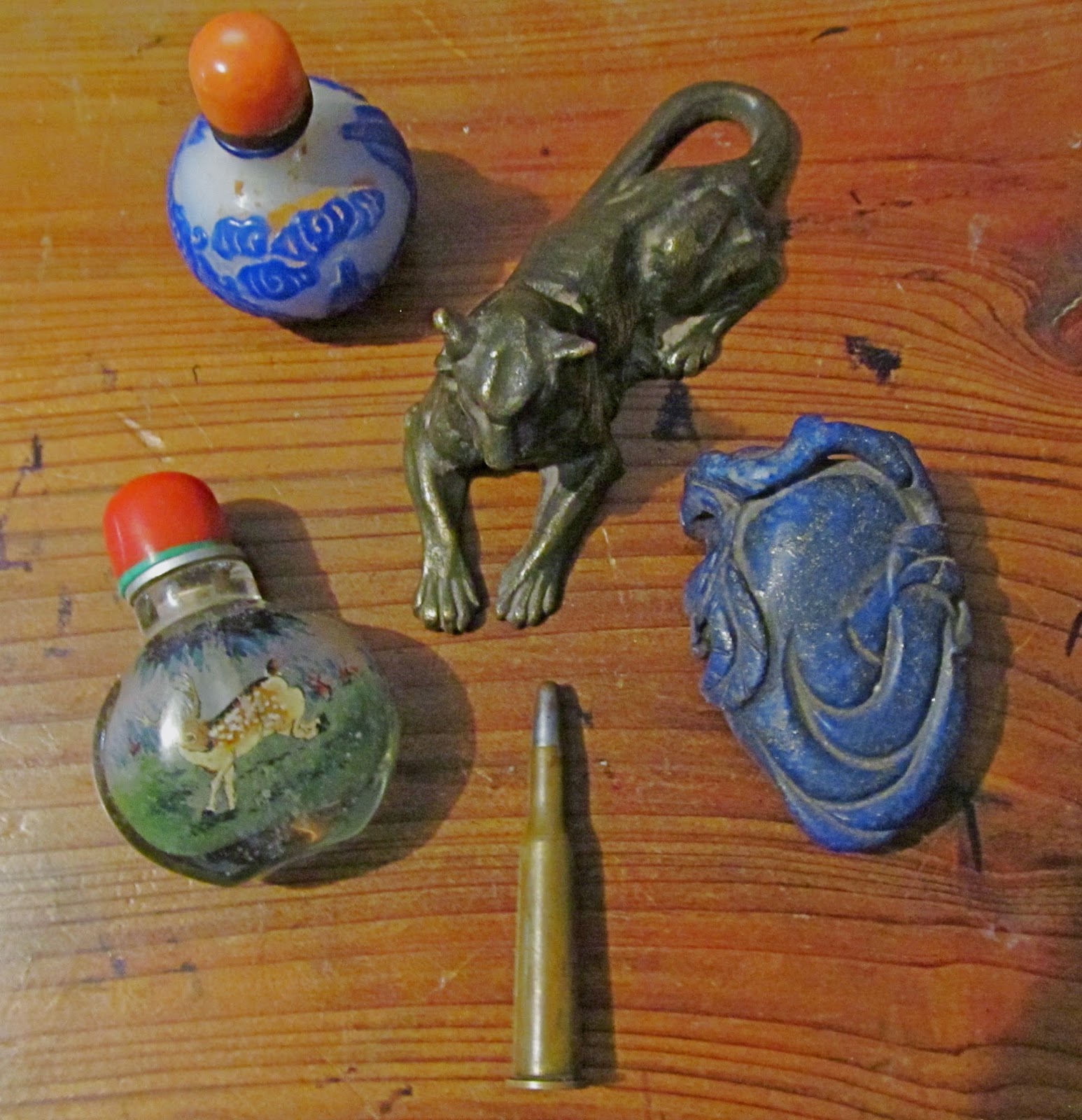
A collage of sorts. Explain, improvise, interpret, or even deconstruct.
UPDATE. Everyone in comments had the idea. The elements: books on China by the American Museum's Roy Chapman Andrews, "Indiana Jones", before he ever got to "outer" Mongolia and its fossils, and his China host, missionary, ornithologist and big game hunter Harry Caldwell. Caldwell hunted almost entirely with Savage 99's in .250 Savage ("250- 3000" for its hitherto unmatched velocity) and .22 Hi- Power, the obsolete cartridge shown here-- he used the 250 on the local elk and shot many tigers, at least one a maneater, with it. Perhaps only the easy confidence of a man of God let him get away with that.
Other objects include Mongolian snuff bottles-- snuff is still popular there, as it was back then, and a little animalier bronze of a tiger by Tiffany. Photo of me with eaglers including the late R Suleiman in Olgii on first Mongolia trip, 1997.
"Stuff is eaten by dogs, broken by family and friends, sanded down by the wind, frozen by the mountains, lost by the prairie, burnt off by the sun, washed away by the rain. So you are left with dogs, family, friends, sun, rain, wind, prairie and mountains. What more do you want?" Federico Calboli
Showing posts with label China. Show all posts
Tuesday, September 23, 2014
Thursday, October 25, 2012
Rifle quiz
Pure fun for scholars of guns and readers of travel and adventure tales: how many things can you find in common on these little carbines? Oh, I will add one invisible addition for the bolt:
The first question is for tecchies; the second for readers and travelers: how many books and writers and scientists and... whatever-- can you list that mention or who used either?
Sunday, July 01, 2012
Historical Huntingtonia
Since Jane died last week the Weiners, Huntingtons and I have been unearthing some seriously old stuff. I am replacing my useless scanner soon so take this as a preview; the pic of the family Huntington in China in the thirties is really of decent quality, for instance.
Below: Virginia Haist Huntington at high school graduation, 1907, and with her kids about 1977. (The old one courtesy of David Weiner). Then Bishop D T Huntington in his Episcopal robes in China, and with the whole family.
You think Virginia was old? She married an older guy. "Trum" died almost exactly when I was born, and was born in 1865. He was in then- Peking for the Boxer Rebellion.
Below: Virginia Haist Huntington at high school graduation, 1907, and with her kids about 1977. (The old one courtesy of David Weiner). Then Bishop D T Huntington in his Episcopal robes in China, and with the whole family.
You think Virginia was old? She married an older guy. "Trum" died almost exactly when I was born, and was born in 1865. He was in then- Peking for the Boxer Rebellion.
Friday, June 15, 2012
Silk Road Trilogy Project
An innovative approach to publishing and natural for Q fans, on so many levels: The Silk Road Trilogy translation project on Kickstarter!
Central Asia, the Silk Road, falcons and horses, China, literature, cyber- publishing; what's not to love? Please consider pledging a bit to make this happen- time is short! Russian Life's blog will report on progress. Casa Q pitched in a hundred and may try for more...
Tuesday, November 29, 2011
Links, Pix, & Assorted Phenomena...
Lauren's Aquiling is up and running again and, at least until her book on her year among the Kazakhs is out, the best place for exotic falconry and adventure tales...

There is some pretty funny and often grotesque animal photography up at Nature Wants to Eat You. HT Annie Davidson, who also sent this video of a walking octopus.
Tim Gallagher, who recently completed a book on his harrowing expedition to the heart of the Narcotraficante strongholds of the Sierra Madre in search of the (almost?) extinct Imperial woodpecker, wrote the short version here, and added a link to the only videos of this largest of all woodpeckers...
Dr Joseph Rock explored the remotest parts of central Asia and southwestern China for the National Geographic in the twenties and thirties. Teddy Roosevelt's big- game hunting sons thought Minya Konka in "his" territory near the border of Szechuan and Tibet-- he wrote about in in 1930-- was higher than Everest. A couple more Americans laid siege to it in 1935 (they were also hunters, armed with a Springfield .30- 06 and two "heavy" SMLE's) and found it was formidable but not quite that high. Yvon Chouinard, Al Read, Kim Schmitz, Rick Ridgeway, and Harry Frishman (Peculiar's biological dad) made another attempt on it in 1980, not long before Harry was killed in a climb in his "backyard" Tetons, but they ran into disaster. Bruce Chatwin allegedly caught the legendary "bat fungus" that did in his AIDS- compromised body in a cave in the vicinity, which is also home to the Naxi people and their still- living goshawk falconry. (Chatwin also put Rock's book, and Emperor Frederic II's falconry text de Arte Venandi cum Avibus, into his posthumous story "The Estate of Maximilian Tod").
Obviously there is a book there, and eventually I hope to go, with Lib and Peculiar. Meanwhile I suspect the greatest single source of useful material is at the Arnold Arboretum near Boston, where Rock's archives reside, full of treasures like this photo:

("Horned Rifles" too!)
There is some pretty funny and often grotesque animal photography up at Nature Wants to Eat You. HT Annie Davidson, who also sent this video of a walking octopus.
Tim Gallagher, who recently completed a book on his harrowing expedition to the heart of the Narcotraficante strongholds of the Sierra Madre in search of the (almost?) extinct Imperial woodpecker, wrote the short version here, and added a link to the only videos of this largest of all woodpeckers...
Dr Joseph Rock explored the remotest parts of central Asia and southwestern China for the National Geographic in the twenties and thirties. Teddy Roosevelt's big- game hunting sons thought Minya Konka in "his" territory near the border of Szechuan and Tibet-- he wrote about in in 1930-- was higher than Everest. A couple more Americans laid siege to it in 1935 (they were also hunters, armed with a Springfield .30- 06 and two "heavy" SMLE's) and found it was formidable but not quite that high. Yvon Chouinard, Al Read, Kim Schmitz, Rick Ridgeway, and Harry Frishman (Peculiar's biological dad) made another attempt on it in 1980, not long before Harry was killed in a climb in his "backyard" Tetons, but they ran into disaster. Bruce Chatwin allegedly caught the legendary "bat fungus" that did in his AIDS- compromised body in a cave in the vicinity, which is also home to the Naxi people and their still- living goshawk falconry. (Chatwin also put Rock's book, and Emperor Frederic II's falconry text de Arte Venandi cum Avibus, into his posthumous story "The Estate of Maximilian Tod").
Obviously there is a book there, and eventually I hope to go, with Lib and Peculiar. Meanwhile I suspect the greatest single source of useful material is at the Arnold Arboretum near Boston, where Rock's archives reside, full of treasures like this photo:

("Horned Rifles" too!)
Sunday, March 06, 2011
Illustrated Gun (and Asian Hawk Art)
As part of my downsizing/ upgrading I bought my scrimshaw grips a new gun (1911 .45 of course), a Kimber Ultra Carry II with night sights. Mel at Ron Peterson's threw in an ingenious holster that can be used right or left side, cross or regular draw, with no alterations.

The design is based on a drawing I did, a composite from these (life- sized) Japanese goshawk screens (click on them to enlarge-- they should go up twice), with a pose from one and Siberian "North- of- the Waste White" plumage from another.


Japanese falconry probably ultimately derives from the Chinese. Jess at Desert Windhounds sent me these 18th century images of such a gos and a gyr by Castiglione, the Jesuit painter at the Chinese court, who combined western and Chinese techniques. (He did tazis too-- I'll get to them...)


Update: Jess sent me another image. This gos wears a rooster feather on its tail to make it more visible in cover, as the ones flown by the Naxi in southwestern China still do.

The design is based on a drawing I did, a composite from these (life- sized) Japanese goshawk screens (click on them to enlarge-- they should go up twice), with a pose from one and Siberian "North- of- the Waste White" plumage from another.


Japanese falconry probably ultimately derives from the Chinese. Jess at Desert Windhounds sent me these 18th century images of such a gos and a gyr by Castiglione, the Jesuit painter at the Chinese court, who combined western and Chinese techniques. (He did tazis too-- I'll get to them...)


Update: Jess sent me another image. This gos wears a rooster feather on its tail to make it more visible in cover, as the ones flown by the Naxi in southwestern China still do.
Xigou
Sir Terence Clark has just returned from China. He writes:
"I was in Shaanxi Province of China in October 2010 with the Xigou (pronounced See-gow) hunters, one of whom had previously asked me whether I thought his hound was a Saluki. After examining a whole range of these hounds, I can only say that superficially they look very like desert bred Salukis of the kind that you find elsewhere in the northern range of Turkey and Iran."
Terence thinks they came to Central Asia from the west, from Persia and Arabia. I rather think they went the other way; I'm not sure the evidence is in yet to prove either of our theories. What is for certain is that they have been in both places a long time! Tomb images and other art places them firmly in western China by AD 700-- see "Prince Xangui's Tomb" where the dog has the local roman nose, about which more in a moment. Terence continues:
"...the Chinese Xigou are quite varied in their appearance. Some have a distinctly banana-shaped nose, but this would seem to go back at least to the 7th century, if the tomb painting of Prince Zhanghuai is accurate. Others have a normal Saluki nose. Some have a roached back, but others a straight topline. Some are very broad across the chest so that the elbows seem to stick out, but most have a normal Saluki front. Most have quite thick ear fringes but only skimpy feathering on the tail, like the Tazys of Central Asia. A few have rather rounded front feet but most have a good long, well-arched Saluki foot. The colours are mainly solid black, white, red with black mask and fringes, grey and dark brindle. I did not see any particoloureds, grizzles or smooths, though I was told a smooth variety existed."
Here is a typical young black pup of the local type. Blacks are rare in the Arab countries but appear sporadically from Turkey east and are apparently common in China.
Some pretty saluki- type dogs:
The nose:
Which contrary to some saluki people has been around a long time. Remember the Prince's tomb, and look at that profile:

Another:
A Xian figurine also ca 700:
Terence also got to go hunting. "Hunting was a free for all! I saw as many as six or eight run at the same time and the hare, smaller but similar to the European hare, does not have much chance to escape on the flat, sparsely covered cultivated fields."
Hungry cultures are not as "sporting" as ones at play...
Tuesday, March 01, 2011
"Horned Rifles"
Central Asia is full of archaic survivals, which include old technologies (should that be "technologies" with quotes, to include animal memes like hawking and various "old ways"-- thanks Liz Thomas!-- with dogs and other animals as well as actual "tech"?)
China controls guns but Tibetans actually still hunt with matchlocks (and tazi- like dogs though the pix have vanished).
17th century snaphaunce patent flintlocks were common in Siberia in 1865 when Cherkassov wrote his "Notes of a Siberian Hunter"-- he called them "primitive" and gave these illustrations.


But they are still in use in Mongolia today! Here is Kent Madin of Boojum Expeditions shooting one of Cherkassov's designs ca 1996 (photo by A Jackson Frishman-- Peculiar); and one I brought back that looks like his other drawing.


Cat saw this nice one for sale in the shop at the Natural History Museum in Ulan Bataar. I would have bought it-- must go back... (Not just for flintlock scholarship of course). Enlarge and you will see it is the same design as mine but finished much better.

And horn-style bipods go on everything from matchlocks to Mosin Nagants. Here are some from explorer Leonard Clark. Maybe I should also retrofit an old Mosin.

Incidentally I should add re costs: my flintlock, shootable but for missing trigger, cost me only $50 in 2000, with all tools (below)-- this in a touristy shop in Ulan Bataar. Such guns are still made by village blacksmiths using forges that burn dung for fuel.
China controls guns but Tibetans actually still hunt with matchlocks (and tazi- like dogs though the pix have vanished).
17th century snaphaunce patent flintlocks were common in Siberia in 1865 when Cherkassov wrote his "Notes of a Siberian Hunter"-- he called them "primitive" and gave these illustrations.


But they are still in use in Mongolia today! Here is Kent Madin of Boojum Expeditions shooting one of Cherkassov's designs ca 1996 (photo by A Jackson Frishman-- Peculiar); and one I brought back that looks like his other drawing.


Cat saw this nice one for sale in the shop at the Natural History Museum in Ulan Bataar. I would have bought it-- must go back... (Not just for flintlock scholarship of course). Enlarge and you will see it is the same design as mine but finished much better.

And horn-style bipods go on everything from matchlocks to Mosin Nagants. Here are some from explorer Leonard Clark. Maybe I should also retrofit an old Mosin.

Incidentally I should add re costs: my flintlock, shootable but for missing trigger, cost me only $50 in 2000, with all tools (below)-- this in a touristy shop in Ulan Bataar. Such guns are still made by village blacksmiths using forges that burn dung for fuel.
Monday, November 08, 2010
Old Eastern Salukis, Volume--??
Wednesday, September 22, 2010
Chinese Tazis Continued
When I wrote about old tazis in Asia recently one commenter sneered and asked if I thought Chinese "sheepheads" were ancient too, meaning the roman- nosed tazis of northwestern China (colloquially, "thin dogs"). I replied with this image from Prince Xanghui's 8th Century tomb.
Here is a recent photo of a similar hound, a male "xigou".
.jpg)
The nose is unusual, and not universal even there- perhaps what geneticists call a "founder effect" where its original presence in a small population dominates. More Chinese dogs here.
And see this 2007 post for more wonderful images going back to 450 AD. Tazis are Asian.
Here is a recent photo of a similar hound, a male "xigou".
.jpg)
The nose is unusual, and not universal even there- perhaps what geneticists call a "founder effect" where its original presence in a small population dominates. More Chinese dogs here.
And see this 2007 post for more wonderful images going back to 450 AD. Tazis are Asian.
Tuesday, August 10, 2010
John Vaillant's The Tiger
Here it is, Q- Philes-- John Vaillant's The Tiger: a True Story of Vengeance and Survival is finally out this week. It is better than good-- my favorite book of the year so far, and a likely classic in my rare favorite genre, that which documents (to use a book title) "the edge of the wild", that interface where humans and "nature" are not artificially separated but in conflict or cooperation, acting on each other.
Tiger is a non- fiction book that reads like a novel, set in "Primorye", the Russian Far East-- not "Siberia", despite its desperately cold winters-- but rather a huge block to the east and south of Siberia, a rugged place of mixed deciduous forests, few roads, a flora and fauna mixing the temperate and the subtropical (like leopards and tigers), inhabited by a never- prosperous populace now eking out their lives by such expedients as beekeeping and subsistence poaching.
Its protagonists are a single huge tiger, a ragged bunch of drunken poachers, and a patrol of anti- poaching rangers dedicated to protecting tigers over a huge area, with no money and inadequate tools. The beginning, as an unnamed hunter and his dog approach a dark cabin on a freezing evening, is a masterpiece of tension and quiet terror; the ending is utterly cinematic but real (the book is based on over 200 interviews). In between, Vaillant skilfully cuts from one "protagonist" to another, building an almost unbearable tension even as he dramatizes the serious issue of Asian poaching.
He manages to evoke sympathy for a man- killing tiger that outdoes any in Corbett (at one point he drags a mattress out under the shelter of a spruce to await his next victim in comfort; waits for another IN HIS BED; toward the end,`a la Kipling’s "Letting In the Jungle", he appears to be contemplating the elimination of a village), but also for destitute subsistence poachers tempted by the Han Empire’s eternal appetite for animal parts, and above all for the underpaid, overworked, and threatened Russian rangers, who use SKS’s in 7.62 X 39 (on brown bear, moose, and sadly tiger if they must) because they are the BEST rifles available! (Regular readers will recall previous posts on my love/ hate for this working man's rifle and cartridge-- more later, but I would never use it for such animals if I didn't have to!) On the other hand, a scene where a poacher pulls the trigger on an ancient Mosin and, instead of the firing pin falling, in the words of James McMurtry it "didn't, quite...", doesn't end well; perhaps the rangers are doing the best they can.
(In fact, my only extremely minor quibble with the book is re firearms: if you know a bit it can be momentarily confusing; if you don't, though, you won't even notice. But a poacher's badly- handloaded 16 gauge single- shot shotgun is not a "rifle", and using a thing like that to try to poach an Amur tiger is the exact kind of drunken Russian foolery that is likely to bring on Nemesis, on wheels, with no brakes...)
But really, a quibble-- this is an amazing book, one to stand with Arseniev and Corbett, its worthy predecessors. Annie Proulx sent me an early galley, asking that I return it as soon as I finished, and I was so blown away I asked-- well, demanded!-- another copy from the press, to quote to my friends until the real thing came out months later. On the Amazon site she says:
"The Tiger is the sort of book I very much like and rarely find. Humans are hard-wired to fear tigers, so this book will attract intense interest. In addition to tiger lore and scalding adventure, Vaillant shows us Russia’s far east and its inhabitants, their sometimes desperate lives interwoven with the economics of poaching and the politics of wildlife conservation... This is a book not only for adventure buffs, but for all of us interested in wildlife habitat preservation.”
Another good writer, Sy Montgomery's friend Liz Thomas, adds:
"In it are chilling accounts of human encounters with tigers—but these encounters, however fearsome, convincingly demonstrate the role that these enormous cats continue to play in the natural world. Equally compelling are the people of Primorye, those who of necessity must hunt the tigers, and those who would preserve them. To call this book a page-turner is an understatement."
I rarely quote other writers in praise of a book I like-- as anyone who knows me knows, I am secure in my opinions (!) But in this case, I think this book is so good I want to remind readers that writers I respect and who like MY writing-- "friends of Q"-- are as over the top about The Tiger as I am. Run don't walk...
Tiger is a non- fiction book that reads like a novel, set in "Primorye", the Russian Far East-- not "Siberia", despite its desperately cold winters-- but rather a huge block to the east and south of Siberia, a rugged place of mixed deciduous forests, few roads, a flora and fauna mixing the temperate and the subtropical (like leopards and tigers), inhabited by a never- prosperous populace now eking out their lives by such expedients as beekeeping and subsistence poaching.
Its protagonists are a single huge tiger, a ragged bunch of drunken poachers, and a patrol of anti- poaching rangers dedicated to protecting tigers over a huge area, with no money and inadequate tools. The beginning, as an unnamed hunter and his dog approach a dark cabin on a freezing evening, is a masterpiece of tension and quiet terror; the ending is utterly cinematic but real (the book is based on over 200 interviews). In between, Vaillant skilfully cuts from one "protagonist" to another, building an almost unbearable tension even as he dramatizes the serious issue of Asian poaching.
He manages to evoke sympathy for a man- killing tiger that outdoes any in Corbett (at one point he drags a mattress out under the shelter of a spruce to await his next victim in comfort; waits for another IN HIS BED; toward the end,`a la Kipling’s "Letting In the Jungle", he appears to be contemplating the elimination of a village), but also for destitute subsistence poachers tempted by the Han Empire’s eternal appetite for animal parts, and above all for the underpaid, overworked, and threatened Russian rangers, who use SKS’s in 7.62 X 39 (on brown bear, moose, and sadly tiger if they must) because they are the BEST rifles available! (Regular readers will recall previous posts on my love/ hate for this working man's rifle and cartridge-- more later, but I would never use it for such animals if I didn't have to!) On the other hand, a scene where a poacher pulls the trigger on an ancient Mosin and, instead of the firing pin falling, in the words of James McMurtry it "didn't, quite...", doesn't end well; perhaps the rangers are doing the best they can.
(In fact, my only extremely minor quibble with the book is re firearms: if you know a bit it can be momentarily confusing; if you don't, though, you won't even notice. But a poacher's badly- handloaded 16 gauge single- shot shotgun is not a "rifle", and using a thing like that to try to poach an Amur tiger is the exact kind of drunken Russian foolery that is likely to bring on Nemesis, on wheels, with no brakes...)
But really, a quibble-- this is an amazing book, one to stand with Arseniev and Corbett, its worthy predecessors. Annie Proulx sent me an early galley, asking that I return it as soon as I finished, and I was so blown away I asked-- well, demanded!-- another copy from the press, to quote to my friends until the real thing came out months later. On the Amazon site she says:
"The Tiger is the sort of book I very much like and rarely find. Humans are hard-wired to fear tigers, so this book will attract intense interest. In addition to tiger lore and scalding adventure, Vaillant shows us Russia’s far east and its inhabitants, their sometimes desperate lives interwoven with the economics of poaching and the politics of wildlife conservation... This is a book not only for adventure buffs, but for all of us interested in wildlife habitat preservation.”
Another good writer, Sy Montgomery's friend Liz Thomas, adds:
"In it are chilling accounts of human encounters with tigers—but these encounters, however fearsome, convincingly demonstrate the role that these enormous cats continue to play in the natural world. Equally compelling are the people of Primorye, those who of necessity must hunt the tigers, and those who would preserve them. To call this book a page-turner is an understatement."
I rarely quote other writers in praise of a book I like-- as anyone who knows me knows, I am secure in my opinions (!) But in this case, I think this book is so good I want to remind readers that writers I respect and who like MY writing-- "friends of Q"-- are as over the top about The Tiger as I am. Run don't walk...
Monday, November 23, 2009
For Central Asia fanatics only
From Sir Terence Clark: a photo of Chini Bagh, the old British consulate in Kashgar, home at one time to Eric and Diana Shipton (who both wrote excellent books set there) and George Macartney, way station to Paul Nazaroff as he fled the Bolsheviks, famed in story and still standing, a monument to climbers and diplomats, spies and fugitives...
Terence tells me it is a museum now. I am vaguely surprised that the Chinese are that kind to such an imperial remnant.
Sunday, November 30, 2008
Pigeons Plus
Or, from pigeons to eagles to art.
The whole thread started when artist Graeme Boyd of my pigeon discussion group emailed us this video of Chinese pigeons being flown with whistles.
Everyone knows that this is an interest of mine. I even have a collection, sent to me by a German scholar who taught in Beijing and whom we showed around Ulan Bataar.

When I played the video, I discovered that the Englishman narrating was my friend Al Gates, legendary Berkutchi and the only person ever to hunt with one eagle and then breed her and hunt with her son.
Of course I immediately e- mailed to see if he had anything else new going on. He did, of course, and I'll post that above.
Meanwhile, as though in synchronicity, new pigeon and eagle material just kept coming in. There was this Life Magazine image from Chas:
I think I'll add this older one of a pigeon with a camera, from the Spy Museum via Annie H:
The whole thread started when artist Graeme Boyd of my pigeon discussion group emailed us this video of Chinese pigeons being flown with whistles.
Everyone knows that this is an interest of mine. I even have a collection, sent to me by a German scholar who taught in Beijing and whom we showed around Ulan Bataar.

When I played the video, I discovered that the Englishman narrating was my friend Al Gates, legendary Berkutchi and the only person ever to hunt with one eagle and then breed her and hunt with her son.
Of course I immediately e- mailed to see if he had anything else new going on. He did, of course, and I'll post that above.
Meanwhile, as though in synchronicity, new pigeon and eagle material just kept coming in. There was this Life Magazine image from Chas:
I think I'll add this older one of a pigeon with a camera, from the Spy Museum via Annie H:
And this video-- actually narration over stills, but good stills and mostly accurate info (though eagles do NOT take months to train) here, sent by the tazi group. After about 2:50 our old friend Aralbai comes in. Cat rode with him and his son this past fall (see the various "Cat's Mongolia" posts) but here he and his son are in '98:
Perhaps this is the place to say that sad word from Mongolia has come in: Manai, who I hunted with in '98 and 2000, and who is on the cover of Eagle Dreams (you can see the book down in the sidebar) has just died. He was younger than me. I have no details yet, and will give him a proper remembrance when I know more.
Subscribe to:
Posts (Atom)


.jpg)