Prairie Mary sends this link to a story suggesting another complication in the unfolding Bird Flu story: some people may be more susceptible to H5N1, genetically.
"Of the 205 reported cases of human infections since late 2003, many have involved blood relatives, such as father and children, mothers and daughters. Of the total infections, 113 people died in nine countries.
" "There have been family clusters. So there has to be certainly a genetic aspect to it," Robert Webster of the St Jude Children's Research Hospital told a bird flu conference organized by the Lancet medical journal in Singapore."
This is not actually all that surprising-- if genetic susceptibility were not a factor in survival, pandemics would long since have wiped out the human species.
Sunday, May 07, 2006


More from the Pandemic Report
I couldn't find a way to fit this into my previous post, but those who've been reading here and elsewhere about the USDA's National Animal Identification System will see why this section of the flu report caught my eye:
You can check out the NAIS website and call your state Dept.s of Wildlife and Agriculture to learn what "guidance," "encouraged reporting" and "increased surveillance" means for you and your backyard animals.
Educating Bird Owners
We will expand our multilevel outreach and education campaign called “Biosecurity for the Birds” to provide disease and biosecurity information to poultry producers, especially those with “backyard" production. The program provides guidance to bird owners and producers on preventing introduction of disease and mitigating spread of disease should it be introduced, and encourages producers to report sickbirds, there by increasing surveillance opportunities for avian influenza.
You can check out the NAIS website and call your state Dept.s of Wildlife and Agriculture to learn what "guidance," "encouraged reporting" and "increased surveillance" means for you and your backyard animals.
Saturday, May 06, 2006
The Next Big Thing
Eighty miles inland and west of the epicenter, Baton Rouge took little abuse from Hurricane Katrina. The storm’s worst effects were felt in waves of people, hundreds of thousands chased, bussed, boated or airlifted from New Orleans and into our laps.
Our emergency was mainly of supply and demand. Demand came first for food, fuel and medical supplies; soon after for clothes, bedding, shelter and cash. Within two weeks, city services buckled and traffic swelled, straining an infrastructure designed for half as many people. Lines were long and tempers short. Rumors of running gunfights in the streets brought panic and confusion. A month later, as FEMA trailers popped up in the cow pastures, a low-grade fever gripped the capitol city: compassion fatigue.
Hurricane Rita rolled through at about that time. It flooded Southwest Louisiana then took out trees in Baton Rouge, tore off roofs and turned out the lights.
Living in Louisiana is like that. I don’t mean to be flippant: Tropical cyclones are serious events, and our last two prompted a vast exodus of long-time residents. Thousands of Louisiana natives have had enough of her.
But bad as it is, once it was worse. Consider a place with monster storms plus waves of malaria, encephalitis, leprosy and yellow fever. That was our state well into the twentieth century.
Hurricanes are terrible but also predictable and passing events. Recovery is in large part a matter of money, materials and manpower. The federal response to Katrina and Rita has been infamously criticized, but note that these are the kinds of disaster our government handles best. Government stumbles to address disasters more difficult to predict, like terrorist attack, or to contain, like pandemic flu.
Last week the White House released its guidelines to preparing for worldwide deadly illness. Given the inescapably sketchy nature of the threat, the report is predictably vague and like most over-vetted government documents, penned in language not quite fit for human consumption. A sample from the overview:
The language is clearer on this point:
Unfortunately, the report’s specifics are not much more specific than its overview. The section concerning “individuals and families” (i.e., what we can do for ourselves) comes perilously close to the duct tape and blue tarp solutions we received after 9-11.
But first some throat-clearing:
At last some recommendations:
And for eating, be sure to:
When the 1918 pandemic killed an estimated half-million Americans, 40% of our citizenry lived and worked on farms (US Census Bureau), places by nature thinly populated and (back then) fairly self-sufficient. An equal percentage of Americans lived in cities, which, unsurprisingly, became the foci of influenza: San Francisco, Boston, Chicago, Philadelphia, New York.
Today more than 75% of us live in urban areas (and less than 2% on family farms). Not only will this likely speed the spread of a virulent influenza, it will reduce our ability to cope with its effects long term. We are farther from the sources of our food and clothing, both in physical distance and in the cultural knowledge required to produce it. We are wholly dependent on complex mechanical systems to provide our clean water and power.
Considering the space available in most urban living units, and the months of disrupted services that may accompany a deadly pandemic, how much nonperishable food will we be able to stockpile as suggested by the Department of Homeland Security?
The vulnerability of urban life is no revelation; it’s well known and easily demonstrated in times of crisis. Ironically, rural life as we have it today is not much safer because it is not much more self-sufficient. Increasingly, urban people populate our rural landscapes; we simply move to the country and bring our dependence on others with us.
But that process is not complete. A community I know along Bayou Lafourche, about an hour south of Baton Rouge on Highway 1, is not yet a suburb of anyplace in particular. It’s just a sleepy little bend in the river about three houses deep. Most of the homes boast substantial kitchen gardens, equal in size to the house lot and some of them plowed by small vintage tractors. The locals work, farm and hunt near home, buy groceries at the corner and breakfast at the diner. My friend Kenneth lives there, and while the storm knocked out his power for weeks, it did little to disrupt his daily routine. In fact he drove up once a week to check on us.
As we sit and wait for the next big thing---bird flu, terror attack, or tropical storm---we might consider that the worst damage to the health and resiliency of the nation has already been done.
Our emergency was mainly of supply and demand. Demand came first for food, fuel and medical supplies; soon after for clothes, bedding, shelter and cash. Within two weeks, city services buckled and traffic swelled, straining an infrastructure designed for half as many people. Lines were long and tempers short. Rumors of running gunfights in the streets brought panic and confusion. A month later, as FEMA trailers popped up in the cow pastures, a low-grade fever gripped the capitol city: compassion fatigue.
Hurricane Rita rolled through at about that time. It flooded Southwest Louisiana then took out trees in Baton Rouge, tore off roofs and turned out the lights.
Living in Louisiana is like that. I don’t mean to be flippant: Tropical cyclones are serious events, and our last two prompted a vast exodus of long-time residents. Thousands of Louisiana natives have had enough of her.
But bad as it is, once it was worse. Consider a place with monster storms plus waves of malaria, encephalitis, leprosy and yellow fever. That was our state well into the twentieth century.
Hurricanes are terrible but also predictable and passing events. Recovery is in large part a matter of money, materials and manpower. The federal response to Katrina and Rita has been infamously criticized, but note that these are the kinds of disaster our government handles best. Government stumbles to address disasters more difficult to predict, like terrorist attack, or to contain, like pandemic flu.
Last week the White House released its guidelines to preparing for worldwide deadly illness. Given the inescapably sketchy nature of the threat, the report is predictably vague and like most over-vetted government documents, penned in language not quite fit for human consumption. A sample from the overview:
Chapters 2 and 3 (U.S. Government Planning and Response) describe the unique threat posed by a pandemic that would spread across the globe over a period of many months; the specific and coordinated actions to be taken by the Federal Government as well as its capabilities and limitations in responding to thesustained and distributed burden of a pandemic; and the central importance of comprehensive preparation at the State, local, and community levels to address medical and non-medical impacts with available resources.
The language is clearer on this point:
The center of gravity of the pandemic response . . . will be in communities. The distributed nature of a pandemic, as well as the sheer burden of disease across the Nation over a period of months or longer, means that the Federal Government’s support to any particular State, Tribal Nation, or community will be limited in comparison to the aid it mobilizes for disasters such as earthquakes or hurricanes, which strike a more confined geographic area over a shorter period of time. Local communities will have to address the medical and non-medical effects of the pandemic with available resources.
Unfortunately, the report’s specifics are not much more specific than its overview. The section concerning “individuals and families” (i.e., what we can do for ourselves) comes perilously close to the duct tape and blue tarp solutions we received after 9-11.
But first some throat-clearing:
It is difficult to predict when the next influenza pandemic will occur or how severe it will be. The effects of a pandemic can be lessened if preparations are made ahead of time. When a pandemic starts, every one around the world could be at risk. The United States has been working closely with other countries and the World Health Organization (WHO) to strengthen systems to detect outbreaks of
influenza that might cause a pandemic. A pandemic would touch every aspect of society, and so every aspect of society must begin to prepare. State, tribal, and local governments are developing, improving, and testing their plans for an influenza pandemic. Businesses, schools, universities, and other community organizations are preparing plans as well.
As you begin your individual or family planning, you may want to review your State’s planning efforts and those of your local public health and emergency preparedness officials. Many of the State plans and other planning information can be found at http://www.pandemicflu.gov.
The Department of Health and Human Services (HHS) and other Federal agencies are providing funding, advice, and other support to
your State. The Federal Government will provide up-to-date information and guidance to the public if an influenza pandemic unfolds. For reliable, accurate, and timely information, visit the Federal Government’s official website at www.pandemicflu.gov. The benefits of preparation will be many. States and communities will be better prepared for any disaster. Preparation will bring peace of mind and the confidence that we are ready to fight an influenza pandemic.
At last some recommendations:
- Plan for the possible reduction or loss of income if you are unable to work or your place of employment is closed. &
- Plan home learning activities and exercises. Have materials, such as books, on hand. Also plan recreational activities that your children can do at home.
And for eating, be sure to:
Stock a supply of water and food. During a pandemic you may not be able to get to a store. Even if you can get to a store, it may be out of supplies. Public waterworks services may also be interrupted.
Stocking supplies can be useful in other types of emergencies, such as power outages and disasters. Store foods that are nonperishable (will keep for a long time) and don’t require refrigeration; are easy to prepare in case you are unable to cook; require little or no water, so you can conserve water for drinking.
When the 1918 pandemic killed an estimated half-million Americans, 40% of our citizenry lived and worked on farms (US Census Bureau), places by nature thinly populated and (back then) fairly self-sufficient. An equal percentage of Americans lived in cities, which, unsurprisingly, became the foci of influenza: San Francisco, Boston, Chicago, Philadelphia, New York.
Today more than 75% of us live in urban areas (and less than 2% on family farms). Not only will this likely speed the spread of a virulent influenza, it will reduce our ability to cope with its effects long term. We are farther from the sources of our food and clothing, both in physical distance and in the cultural knowledge required to produce it. We are wholly dependent on complex mechanical systems to provide our clean water and power.
Considering the space available in most urban living units, and the months of disrupted services that may accompany a deadly pandemic, how much nonperishable food will we be able to stockpile as suggested by the Department of Homeland Security?
The vulnerability of urban life is no revelation; it’s well known and easily demonstrated in times of crisis. Ironically, rural life as we have it today is not much safer because it is not much more self-sufficient. Increasingly, urban people populate our rural landscapes; we simply move to the country and bring our dependence on others with us.
But that process is not complete. A community I know along Bayou Lafourche, about an hour south of Baton Rouge on Highway 1, is not yet a suburb of anyplace in particular. It’s just a sleepy little bend in the river about three houses deep. Most of the homes boast substantial kitchen gardens, equal in size to the house lot and some of them plowed by small vintage tractors. The locals work, farm and hunt near home, buy groceries at the corner and breakfast at the diner. My friend Kenneth lives there, and while the storm knocked out his power for weeks, it did little to disrupt his daily routine. In fact he drove up once a week to check on us.
As we sit and wait for the next big thing---bird flu, terror attack, or tropical storm---we might consider that the worst damage to the health and resiliency of the nation has already been done.
Evil Foie Gras
From the NYT courtesy of of Margory Cohen:
"Fresh from a victory in Chicago, where the City Council voted last week to ban the sale of foie gras, animal rights activists have set their sights on Philadelphia, where they are collecting signatures on a petition to ban the delicacy there. Their influence on Whole Foods Market has led a foie gras producer to file a lawsuit against the natural-food grocery chain.
"Events like these have spurred the foie gras industry, which estimates its sales were $20 million last year, to organize and to take on its opponents. In the lawsuit, Sonoma Foie Gras is charging Whole Foods with "intentional interference with contract." According to the complaint, filed in January, Whole Foods told Grimaud Farms last fall to stop processing and distributing Sonoma's ducks and foie gras or the grocer would no longer do business with the company. Grimaud, which sells ducks to Whole Foods, will terminate its contract with Sonoma at the end of this month.
(Snip)
"If Sonoma loses the suit, it could hasten the disappearance of foie gras in California. In 2004 California passed a law banning the production and sale of foie gras by 2012.
"I hope I'm retired by 2012," said Thomas Keller, owner of the French Laundry in the Napa Valley and Per Se in Manhattan, who believes the government should not tell people what to eat. "If force-feeding a duck is
cruel, then packing chickens in a cage is cruel, and then the veal and the beef. We are all going to be vegetarians soon if they have their way. We should probably start converting now."
I should add that I am a bit conflicted. I'm not a big fan of force- feeding ducks, though I understand that AR activists (surprise!) exaggerate its horrors. But I love foie gras, and on purely libertarian grounds...
I like Charlie Trotter's stance. "Charlie Trotter, who stopped serving foie gras in his eponymous restaurant
five years ago because he did not like what he had seen on several foie gras farms, said he is not an animal rights activist but is opposed to interference from the government.
"When I took foie gras off the menu I was not trying to make a political statement," he said. "I am certainly not gleeful about this. I am very much a libertarian." And he added: "I don't think government should tell people not to smoke in restaurants." " YES!
According to an LAT piece sent by Reid he has been more outspoken than that in the past: "According to an earlier article in the Chicago Tribune, Trotter refused to sign an anti-foie gras pledge promoted by Farm Sanctuary, saying "These people are idiots. Understand my position: I have nothing to do with a group like that. I think they're pathetic…. " "
Chicago chef Rick Tramonto points to exactly what is wrong. He "...finds nothing funny in the current situation. "Unfortunately, the public is the loser," he says. "If [animal rights groups are] going to dictate what we're going to eat, what's next? That's the problem that I have. I wish I could say that the people have spoken, but I don't really think the people had anything to do with this.""
He remains guardedly optimistic: ""What are they going to do? Are we going to see them leading chefs away in handcuffs?...My integrity is my integrity and I won't break any laws, but the thing's absurd."
Meanwhile, according to the NYT : "Legislation to ban the production or the production and sale of foie gras
has been introduced but not passed in six other states, including New York, where it has been withdrawn."
So far....
"Fresh from a victory in Chicago, where the City Council voted last week to ban the sale of foie gras, animal rights activists have set their sights on Philadelphia, where they are collecting signatures on a petition to ban the delicacy there. Their influence on Whole Foods Market has led a foie gras producer to file a lawsuit against the natural-food grocery chain.
"Events like these have spurred the foie gras industry, which estimates its sales were $20 million last year, to organize and to take on its opponents. In the lawsuit, Sonoma Foie Gras is charging Whole Foods with "intentional interference with contract." According to the complaint, filed in January, Whole Foods told Grimaud Farms last fall to stop processing and distributing Sonoma's ducks and foie gras or the grocer would no longer do business with the company. Grimaud, which sells ducks to Whole Foods, will terminate its contract with Sonoma at the end of this month.
(Snip)
"If Sonoma loses the suit, it could hasten the disappearance of foie gras in California. In 2004 California passed a law banning the production and sale of foie gras by 2012.
"I hope I'm retired by 2012," said Thomas Keller, owner of the French Laundry in the Napa Valley and Per Se in Manhattan, who believes the government should not tell people what to eat. "If force-feeding a duck is
cruel, then packing chickens in a cage is cruel, and then the veal and the beef. We are all going to be vegetarians soon if they have their way. We should probably start converting now."
I should add that I am a bit conflicted. I'm not a big fan of force- feeding ducks, though I understand that AR activists (surprise!) exaggerate its horrors. But I love foie gras, and on purely libertarian grounds...
I like Charlie Trotter's stance. "Charlie Trotter, who stopped serving foie gras in his eponymous restaurant
five years ago because he did not like what he had seen on several foie gras farms, said he is not an animal rights activist but is opposed to interference from the government.
"When I took foie gras off the menu I was not trying to make a political statement," he said. "I am certainly not gleeful about this. I am very much a libertarian." And he added: "I don't think government should tell people not to smoke in restaurants." " YES!
According to an LAT piece sent by Reid he has been more outspoken than that in the past: "According to an earlier article in the Chicago Tribune, Trotter refused to sign an anti-foie gras pledge promoted by Farm Sanctuary, saying "These people are idiots. Understand my position: I have nothing to do with a group like that. I think they're pathetic…. " "
Chicago chef Rick Tramonto points to exactly what is wrong. He "...finds nothing funny in the current situation. "Unfortunately, the public is the loser," he says. "If [animal rights groups are] going to dictate what we're going to eat, what's next? That's the problem that I have. I wish I could say that the people have spoken, but I don't really think the people had anything to do with this.""
He remains guardedly optimistic: ""What are they going to do? Are we going to see them leading chefs away in handcuffs?...My integrity is my integrity and I won't break any laws, but the thing's absurd."
Meanwhile, according to the NYT : "Legislation to ban the production or the production and sale of foie gras
has been introduced but not passed in six other states, including New York, where it has been withdrawn."
So far....
Jaguars
Reid sent this story on collaring border jaguars.
"A team of government scientists has voted to capture one of a handful of jaguars known to live in the United States, drawing protests from environmental groups.
"In 2002 and 2003, two jaguars died after being captured in Sonora, Mexico for radio-collaring. That's two out of the three research-based jaguar captures ever made in Sonora."
I asked a friend who has been involved in border conservation issues for years (as has her husband, what her take was, and she helped clarify my thoughts a bit.
She says: "It's a complex issue, for sure. With this population, every individual lost is a tragedy.
"But more at issue is the fact that NM Game and Fish is the pushy-dominant gov rep in the jaguar conservation team, and along with USFWS have been pushing for radio/GPS collars - some think to pander to ranchers who just want to prove that the jags are eating cows. Well OF COURSE they're eating young ungulates. That's what they DO. And I have a half-baked theory, too, that the jags up here are moving into territories (or testing territories) that are opened up in areas where ranchers are culling cougars. Every single area where we have frequent jags there are very active lion hunting groups or ranchers. If you open a territory, they will come. . .
"Anyway, my opinion is that the money associated with GPS collars and the tracking program should be better spent buying habitat in Mexico, where ranchers are still shooting jags on sight. The jags up here are outliers. I don't think we'll have permanent populations here, given too many damn people, except maybe out in the Baboquivaris and Tumacacoris, and Gray Ranch. Pretty small areas, in the scope of things. I can't fathom what the gobberment folks want the data for if not for helping backwards ranchers prove the cats 1) eat cows and 2) don't belong here."
I should add that these people are generally SUPPORTERS of ranching-- just not stupidity or gummint bailouts for such.
She adds:
"Here's a link to the Northern Jaguar Project, the US group fundraising the 2 million needed to buy the biggest ranch surrounding the preserve. Diana Hadley and Peter Warshall are on the board. I like them a lot.
"The site is as wild as it gets in North America - just on our doorstep. [ie just south of the border-- SB] Truly astonishing. The ultimate cauldron of neotropical-tropical mix: jaguars, ocelots, military macaws, black hawks (highest density of breeding pairs possibly in NA) and river otters, cougars, and plants of unbelievable diversity."
"A team of government scientists has voted to capture one of a handful of jaguars known to live in the United States, drawing protests from environmental groups.
"The scientists want to follow the jaguar's movements, along river corridors or through mountain ranges, to help authorities figure out which areas most need protection in the name of the species.
"The decision still needs to be approved by game agencies in Arizona and New Mexico, meaning it could take until the end of the year before one is collard, Arizona Game and Fish officials said.
"At least three environmental groups have protested the idea."
I find myself in a bit of a quandary here. I am a supporter of science and don't much like two of the three protesting groups. But jaguars are still vanishingly rare on the border. And..."In 2002 and 2003, two jaguars died after being captured in Sonora, Mexico for radio-collaring. That's two out of the three research-based jaguar captures ever made in Sonora."
I asked a friend who has been involved in border conservation issues for years (as has her husband, what her take was, and she helped clarify my thoughts a bit.
She says: "It's a complex issue, for sure. With this population, every individual lost is a tragedy.
"But more at issue is the fact that NM Game and Fish is the pushy-dominant gov rep in the jaguar conservation team, and along with USFWS have been pushing for radio/GPS collars - some think to pander to ranchers who just want to prove that the jags are eating cows. Well OF COURSE they're eating young ungulates. That's what they DO. And I have a half-baked theory, too, that the jags up here are moving into territories (or testing territories) that are opened up in areas where ranchers are culling cougars. Every single area where we have frequent jags there are very active lion hunting groups or ranchers. If you open a territory, they will come. . .
"Anyway, my opinion is that the money associated with GPS collars and the tracking program should be better spent buying habitat in Mexico, where ranchers are still shooting jags on sight. The jags up here are outliers. I don't think we'll have permanent populations here, given too many damn people, except maybe out in the Baboquivaris and Tumacacoris, and Gray Ranch. Pretty small areas, in the scope of things. I can't fathom what the gobberment folks want the data for if not for helping backwards ranchers prove the cats 1) eat cows and 2) don't belong here."
I should add that these people are generally SUPPORTERS of ranching-- just not stupidity or gummint bailouts for such.
She adds:
"Here's a link to the Northern Jaguar Project, the US group fundraising the 2 million needed to buy the biggest ranch surrounding the preserve. Diana Hadley and Peter Warshall are on the board. I like them a lot.
"The site is as wild as it gets in North America - just on our doorstep. [ie just south of the border-- SB] Truly astonishing. The ultimate cauldron of neotropical-tropical mix: jaguars, ocelots, military macaws, black hawks (highest density of breeding pairs possibly in NA) and river otters, cougars, and plants of unbelievable diversity."
Can Starlings Speak?
This NYT story suggests that the way Starlings process and arrange sounds may illuminate the origins of speech.
Some prominent linguists, including Noam Chomsky, disagree (and Chomsky's linguistics make a lot more sense than his politics). But a defender of the experiments dismisses Chomsky.
"Chomsky may find this trivial, but that is a bit like saying apes use tools, but only the trivial kind that lack the sophistication of a tri-square or a laser level," he said."
John Hawks has more to say on his Anthropology Blog, here andhere.
Some prominent linguists, including Noam Chomsky, disagree (and Chomsky's linguistics make a lot more sense than his politics). But a defender of the experiments dismisses Chomsky.
"Chomsky may find this trivial, but that is a bit like saying apes use tools, but only the trivial kind that lack the sophistication of a tri-square or a laser level," he said."
John Hawks has more to say on his Anthropology Blog, here andhere.
"Grolar"
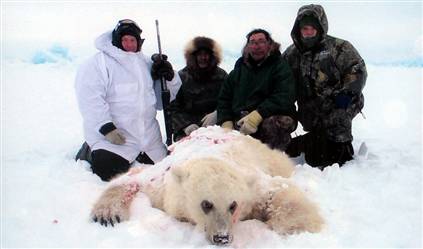
A hybrid between a grizzly and a polar bear has been shot in Canada-- species that have been separated for more than 200,000 years. Nervous about warming in the arctic yet?
""Everybody thought it was a polar bear, and then they started looking more and more and they seen [sic] other features that resembled some of a grizzly as well."
"The bear had thick, creamy white fur, typical of polar bears, but its long claws, humped back and shallow face, as well as brown patches around its eyes, nose, back and on one foot are grizzly traits."
Of course bureaucrats will be bureaucrats. "If it is found to be a grizzly bear, Martell, whose hunting licence only allowed him to shoot polar bears, may be charged with shooting the wrong animal, officials said."From the Sydney Morning Herald of all places!
Genghis and other amusements..
While I try to get "things" done-- not just fun things, either-- O & P have been digging up things to delight their readers. Peculiar tells us how certain parts of Mt. St. Helens have been growing four to five feet a day!
Meanwhile, Odious has encountered a song about Genghis Khan's genetic legacy:
When Darwin wrote of fitness, he meant to reproduce.
Y chromosomes bear witness that Genghis could seduce.
And then, of course, survival of offspring is the thing.
Reminding every rival, it's good to be the king!
CHORUS:
You hear them hooves a' drummin'; the Mongols on a raid.
It's Genghis Khan a' comin' and he's looking to get laid.
Now Genghis was a leader whose armies conquered all,
And even greater breeder as genes today recall.
With every new encounter as he rode into town,
If female, he would mount her, in hay or eider down.
Meanwhile, Odious has encountered a song about Genghis Khan's genetic legacy:
When Darwin wrote of fitness, he meant to reproduce.
Y chromosomes bear witness that Genghis could seduce.
And then, of course, survival of offspring is the thing.
Reminding every rival, it's good to be the king!
CHORUS:
You hear them hooves a' drummin'; the Mongols on a raid.
It's Genghis Khan a' comin' and he's looking to get laid.
Now Genghis was a leader whose armies conquered all,
And even greater breeder as genes today recall.
With every new encounter as he rode into town,
If female, he would mount her, in hay or eider down.
Wednesday, May 03, 2006
Loved to Death
The LA Times also brings the sad report today that the fabulous Peruvian archeological site, Machu Picchu, is showing signs of wear from the thousands of tourists who come to visit it each year. Visits are up since the end of the Sendero Luminoso rebellion. There's not much you can do to prevent this unless you come up with a scheme to reduce visitation.
The most extreme example of this that I can think of is the cave of Lascaux in France, filled with beautiful Paleolithic art. When it became apparent that allowing visitors in the cave was destroying the art, the French government closed it down and built a replica cave so that tourists could at least get the feel of what viewing the art was like. Access to the real Lascaux is tightly controlled.
I attended a lecture recently by David Lewis-Williams, an expert on Paleolithic rock art and author of The Mind in the Cave. He told the story of a researcher (unnamed) who had been granted a 20-minute visit inside Lascaux by the French authorities. When the lights went on and the fellow saw the beautiful paintings he was so overcome by emotion that he spent 10 minutes blubbering tears before he could pull himself together and start the work he needed to do. But, as Lewis-Williams said, "the French being the French," he still only got 20 minutes!
The most extreme example of this that I can think of is the cave of Lascaux in France, filled with beautiful Paleolithic art. When it became apparent that allowing visitors in the cave was destroying the art, the French government closed it down and built a replica cave so that tourists could at least get the feel of what viewing the art was like. Access to the real Lascaux is tightly controlled.
I attended a lecture recently by David Lewis-Williams, an expert on Paleolithic rock art and author of The Mind in the Cave. He told the story of a researcher (unnamed) who had been granted a 20-minute visit inside Lascaux by the French authorities. When the lights went on and the fellow saw the beautiful paintings he was so overcome by emotion that he spent 10 minutes blubbering tears before he could pull himself together and start the work he needed to do. But, as Lewis-Williams said, "the French being the French," he still only got 20 minutes!
Communication with the Future
I found this piece in the LA Times on the burial of radioactive waste in a salt mine in New Mexico fascinating from an anthropological point of view. How do we warn people 100,000 years from now that what is buried in the mine is dangerous? They obviously won't speak our language and what are the chances they will be able to translate our writing? If they do understand what we are trying to tell them will they believe it - or think we are trying to lure them away from a buried treasure?
Interesting questions and interesting that we really are trying to think ahead.
Interesting questions and interesting that we really are trying to think ahead.
Sunday, April 30, 2006
Porumbeii

Palomas, palombe, palumbus..... a Romanian pigeon site. Because Romanian IS a Romance language.
Someone told me this was "Portuguese". I went to it and more or less understood a lot, having French and some Latin, Spanish, Italian. But it looked... weird. Then I saw the "ro" in the url....
The "Carunculat"-- the pigeon in the home page-- looks just like my Spanish Barbs. How old are the Mediterranean- Latin connections?
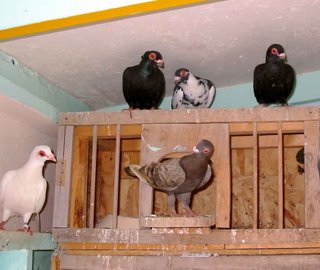
Perhaps Peculiar can tell us a bit about the language...
Iraq Iran
Re Rod Dreher's Crunchy Con, a remark from Alan Dershowitz: "History may well conclude that America and Britain fought the wrong preventive war against a country that posed no real threat, and that fighting that wrong war stopped them fighting the right preventive war against a country that did pose a danger to world peace."
Just wonderin'...
Just wonderin'...
New Chernobyl?
David Satter wonders if another Chernobyl is possible in Russia, given their technology and a persistent culture of secrecy and unaccountability.
Of course, in a fascinating book, Mary Mycio argues that Chernobyl's effects were more complex and less simplistically devastating than the pop press or Greenpeace might have it (the area is now a vast wildlife sanctuary for rare species among other things!) But I still can't help thinking it is a bit like the old George Leonard Herter chestnut: "Being eaten alive by hyenas is less painful than you would think".
Of course, in a fascinating book, Mary Mycio argues that Chernobyl's effects were more complex and less simplistically devastating than the pop press or Greenpeace might have it (the area is now a vast wildlife sanctuary for rare species among other things!) But I still can't help thinking it is a bit like the old George Leonard Herter chestnut: "Being eaten alive by hyenas is less painful than you would think".
Puppy Numbers

Mothers-to-Be
How many pups will our Girls have? Steve and Val Kaeppler, fellow NM breeders, found a database based on 2080 saluki litters.
1 pup: 89 litters
2 pups: 104
3 pups: 136
4 pups:197
5 pups:314
6 pups: 419
7 pups358
8 pups: 266
9 pups: 123
10 pups 51
11 pups: 18
12 pups: 4
13 pups: 1
Lash had six lurcher pups so I think this looks pretty rational. Also means a few slots are still open!
It occurrs to me that this is a very doggy day's posting. In the winter when we want to be hunting all the time I post on & think about writing etc-- now, when I am either writing or in the garden, I dream of fall. Go figure!
Redtail
Rebecca has a savage, lovely pic up, a wild redatail with a grosbeak right outside her window. "I try to replay it in my head and realize that even though I was looking, I experienced the moment rather than seeing it, too primal of an instant to do anything but react. I only saw red and know I'll never forget that limited vision of her tail, an unexpected meteor, then a smattering of red across my view. Perhaps there is nothing more to see than the tail, human eyes are too weak to take much more in, the mind filling in the blanks with blood. I think I understand those auburn feathers in a way I didn't before. As the jarring cries of grosbeak in her feet confirmed that neither of us saw her coming, I know I understood my own weakness. She's a better predator than I'll ever be; exquisite and terrifying."
Real Dogs
Is there still a place for real dogs in our world? Yvonne McGehee contemplates the prospects. She is a borzoi breeder who lives in Idaho, still running the dogs the in the way that they shoould be run, and found, on a visit to Hungary, a single dog with the old fire:
"... my beliefs collided with reality in a garden in Hungary. This gold dog will never be able to do what she was born for; never, not even once. She will hope and hope until hope fades and her body grows too old to do what she once so desperately wanted.
"Meanwhile, the yaks lay contentedly on the ground, inert and happily so. These dogs who so resemble blankets are happy in their garden. They have no desire to use even the full extent of it; happy to lay nearest to the gate back to their kennel. They have no hunter's body, and they have no hunter's heart and mind. They have no desire, no mental desire and no physical desire, to move those heavy round limbs ending with heavy round feet, in anything resembling a sighthound's way. They are suitable, the best fit for their situation. They are perfect here, in this tame place, with their domesticity, with their show-ring-selected bodies and minds. They are the products of static selection, based on static appearance and on somebody's ideas of what must be the right thing for this breed to look like. The plush silky coat is gone, replaced by yak hair; the muscles, cut with definition and tendons hard as cables, are gone, a bland flat smoothness taking the place of sharp-cut convexity; the bladed tapering limbs, ending in feet so fine you can see the veins feeding them and the tendons working them and the details of the joints, these are all gone, exchanged for hairy round balls. Hair on the head and extremeties fine like a mouse's; this, from an early breed description, is gone. And the behavior is gone as well. The hunter's attentiveness, living all in their eyes and ears, alert scanners of the horizon; gone.
"They have evolved. Under static selection, where hunting is an aberration, where trips to the dog show are the only outing they will have, they are the output of evolution toward a domestic dog who resembles a borzoi. They are facsimiles. They are happy here, eating their commercial foods, sleeping their undisturbed sleep, living through entire lives in this garden. They do not suffer frustration and disappointment. They will never grow bored and restless, they will never crave to be on the other side of this fence, to go, to run as hard as their muscles and bones and lungs can manage, to hunt, to feel the fast warm fur in predatory teeth. Their hearts do not long to stretch out lightlimbs over large empty spaces. The borzoi as I have tried to understand it, as I have striven to breed it, is completely missplaced here. And here is all there is; this is what the world will be, ever more crowded, ever more restricted, ever more domesticated. It is the gold girl who suffers here.
"It is the gold girl who is the borzoi, the only borzoi, in the garden."
"... my beliefs collided with reality in a garden in Hungary. This gold dog will never be able to do what she was born for; never, not even once. She will hope and hope until hope fades and her body grows too old to do what she once so desperately wanted.
"Meanwhile, the yaks lay contentedly on the ground, inert and happily so. These dogs who so resemble blankets are happy in their garden. They have no desire to use even the full extent of it; happy to lay nearest to the gate back to their kennel. They have no hunter's body, and they have no hunter's heart and mind. They have no desire, no mental desire and no physical desire, to move those heavy round limbs ending with heavy round feet, in anything resembling a sighthound's way. They are suitable, the best fit for their situation. They are perfect here, in this tame place, with their domesticity, with their show-ring-selected bodies and minds. They are the products of static selection, based on static appearance and on somebody's ideas of what must be the right thing for this breed to look like. The plush silky coat is gone, replaced by yak hair; the muscles, cut with definition and tendons hard as cables, are gone, a bland flat smoothness taking the place of sharp-cut convexity; the bladed tapering limbs, ending in feet so fine you can see the veins feeding them and the tendons working them and the details of the joints, these are all gone, exchanged for hairy round balls. Hair on the head and extremeties fine like a mouse's; this, from an early breed description, is gone. And the behavior is gone as well. The hunter's attentiveness, living all in their eyes and ears, alert scanners of the horizon; gone.
"They have evolved. Under static selection, where hunting is an aberration, where trips to the dog show are the only outing they will have, they are the output of evolution toward a domestic dog who resembles a borzoi. They are facsimiles. They are happy here, eating their commercial foods, sleeping their undisturbed sleep, living through entire lives in this garden. They do not suffer frustration and disappointment. They will never grow bored and restless, they will never crave to be on the other side of this fence, to go, to run as hard as their muscles and bones and lungs can manage, to hunt, to feel the fast warm fur in predatory teeth. Their hearts do not long to stretch out lightlimbs over large empty spaces. The borzoi as I have tried to understand it, as I have striven to breed it, is completely missplaced here. And here is all there is; this is what the world will be, ever more crowded, ever more restricted, ever more domesticated. It is the gold girl who suffers here.
"It is the gold girl who is the borzoi, the only borzoi, in the garden."
Plus ca Change
Tom McIntyre found this NYT essay by Verlyn Klinkenborg comparing the blogosphere to the paleo- alternative media described by Catholic populist and controversialist Hilaire Belloc in the early Twentieth century.
Update: have found it is now behind the Times' subscription firewall. Still worth looking for if you subscribe.
Update: have found it is now behind the Times' subscription firewall. Still worth looking for if you subscribe.
The Writer's Life
Prairie Mary gives us one of the best essays I have seen on the unglamorous side of the writer's life, that is, life as we know it, here.
"My income puts me four dollars over the poverty line, but this is a choice -- as school teachers these days say in a blaming voice as though that explained everything. I knew I would never get even the first book written unless I escaped Portland and deadhead salary work. I saw poverty as a kind of freedom, a purity, a simplification. So I retired a little too soon.
(snip)
"The first book is written and sold but it turns out there will be no money for a year and then it will be a modest amount. The fact is that our culture no longer values writing. Our media has gone digital video and may not return. Everyone writes -- not very well -- but the publishing houses have crashed. Indeed, the newspapers and magazines are crashing. Writers are as unemployed as Detroit assembly line workers. Rolling poverty."
And yet, finally, this is not at all a depressing essay.
"It was like coming into an inheritance to return to this dry, windy, pop. 300 village. Now I’m wealthy in time, materials, ideas, security, sunlight... But that only increases the necessity of simplification, discipline, awareness. While this lasts. Across the street the little house of one of my neighbors has been emptied over the past week or so. She is in a nursing home. The very large family cleared out what they wanted, then held a “garage” sale. We wait to see who buys the little house. It is not grand enough to attract a Hummer driver, thank... um... Buddha."
RTWT-- you know.
"My income puts me four dollars over the poverty line, but this is a choice -- as school teachers these days say in a blaming voice as though that explained everything. I knew I would never get even the first book written unless I escaped Portland and deadhead salary work. I saw poverty as a kind of freedom, a purity, a simplification. So I retired a little too soon.
(snip)
"The first book is written and sold but it turns out there will be no money for a year and then it will be a modest amount. The fact is that our culture no longer values writing. Our media has gone digital video and may not return. Everyone writes -- not very well -- but the publishing houses have crashed. Indeed, the newspapers and magazines are crashing. Writers are as unemployed as Detroit assembly line workers. Rolling poverty."
And yet, finally, this is not at all a depressing essay.
"It was like coming into an inheritance to return to this dry, windy, pop. 300 village. Now I’m wealthy in time, materials, ideas, security, sunlight... But that only increases the necessity of simplification, discipline, awareness. While this lasts. Across the street the little house of one of my neighbors has been emptied over the past week or so. She is in a nursing home. The very large family cleared out what they wanted, then held a “garage” sale. We wait to see who buys the little house. It is not grand enough to attract a Hummer driver, thank... um... Buddha."
RTWT-- you know.
Gun Stuff
A wonderful not- quite- new gun blog: Dave Petzal's "Gun Nut". Dave is possibly the most literate gun editor I ever (many years ago) worked with, funny, irreverent, and he knows everything-- argue with him at your peril.
He is also refershingly anti EVERY idiot. I quote a recent post:
"Let’s look at the Bush bashing first. I bash Bush because:
* President-bashing is an American tradition that goes back to the beginning of our republic. Abraham Lincoln took a worse lacing from the press than any chief executive in our history.
* Bush talks funny.
* Look at his record
"Why, after reading The New York Times, would I bash Bush? Does reading it make you victim to some kind of thought-control process? Since I also bash Hillary every chance I get, is this also caused by The Times ?
"Why would I prefer Al Gore, or that curious object, John Kerry? Does pointing out W’s many and horrific shortcomings automatically make me a supporter of those two goons?
"I’ve been an NRA member since 1964 and a Benefactor Member since 1979, and I’ve been reading The American Rifleman since the 1950s. If we didn’t have the NRA, I would be writing about things other than guns because we wouldn’t have guns, but does all this mean I have to agree with every single thing the NRA says and does?
"And President Bush is always free to bash me if he so chooses."
A post I have been meaning to link to for a long time is this old one of Tam's: Why Guns?, in which the Queen of Snark gives us some thoughts on why a person might, practical reasons aside, wish to own guns:
"What do you find so fascinating about those rusty old things?" indeed. What's not fascinating about them? You can heat the cosmoline out of the stock, but the history is soaked in for good. You can own it, you can hold it, you can learn from it, you can shoot it, and then you can pass it and its story on to the next generation, having added your own small chapter. Until they make a time machine, I'll just have to keep using the time machines I already have."
Finally, a video link courtesy of Brad Lord- Leutwyler. Starts like a conventional maiden-in- menace horror movie, but with a twist...
He is also refershingly anti EVERY idiot. I quote a recent post:
"Let’s look at the Bush bashing first. I bash Bush because:
* President-bashing is an American tradition that goes back to the beginning of our republic. Abraham Lincoln took a worse lacing from the press than any chief executive in our history.
* Bush talks funny.
* Look at his record
"Why, after reading The New York Times, would I bash Bush? Does reading it make you victim to some kind of thought-control process? Since I also bash Hillary every chance I get, is this also caused by The Times ?
"Why would I prefer Al Gore, or that curious object, John Kerry? Does pointing out W’s many and horrific shortcomings automatically make me a supporter of those two goons?
"I’ve been an NRA member since 1964 and a Benefactor Member since 1979, and I’ve been reading The American Rifleman since the 1950s. If we didn’t have the NRA, I would be writing about things other than guns because we wouldn’t have guns, but does all this mean I have to agree with every single thing the NRA says and does?
"And President Bush is always free to bash me if he so chooses."
A post I have been meaning to link to for a long time is this old one of Tam's: Why Guns?, in which the Queen of Snark gives us some thoughts on why a person might, practical reasons aside, wish to own guns:
"What do you find so fascinating about those rusty old things?" indeed. What's not fascinating about them? You can heat the cosmoline out of the stock, but the history is soaked in for good. You can own it, you can hold it, you can learn from it, you can shoot it, and then you can pass it and its story on to the next generation, having added your own small chapter. Until they make a time machine, I'll just have to keep using the time machines I already have."
Finally, a video link courtesy of Brad Lord- Leutwyler. Starts like a conventional maiden-in- menace horror movie, but with a twist...
AR Follies 2: Albuquerque
Meanwhile, close to home, Albuquerque residents soon can choose between having all their dogs neutered and microchipped or owning them under even MORE restrictive rules.
I am not remotely exaggerating. The original "simple, fair" regs promoted by Albuquerque mayor Marty Chavez were " that all dogs and cats be spayed or neutered, provides the service for free or people who cannot afford it, requires dogs and cats to be micro- chipped, and provides an exception for bona fide breeders " [ whatever they may be-- State decides of course-- SB] (City councilman Don Harris, Albuquerque Journal 29 April.) This is bad enough for any minor breeder with its $150 fee for intact animals, and NOBODY microchips my dogs and birds!
But the reaction to this is not the status quo ante; it is a bill so mind- boggling it could have been written by Wayne Pacelle. From the same source:
"On Monday, the City Council will vote on a very different animal ordinance, Sally Mayer's Humane And Ethical Rules and Treatment (HEART) Ordinance. The ordinance contains the spay, neuter and microchip provisions. However, they are a small component of a proposal that is as breathtakingly radical as it is totalitarian....
"The ordinance would create unlimited liability for the city. It states that "the City has the responsibility to ptotect animals in the City." The courts do not impose that duty on the city with respect to people (unless they are in the city's custody). If passed, whenever pigeons are killed, animal rights activists may have a cuase of action against the city....
"The proposal equates animals and people in many respects - referring to animals "incarcerated" at the animal shelter, referring to "foster care" for animals and providing a "safe haven" for animals dropped off at animal shelters....
"Any person holding a permit - for instance, breeders - would have to have a background check, an inspection of his or her home and be subjected to warrantless follow-up searches by the city. City officials can look through paperwork that the owner must maintain for three years until after the animal dies. Every dog or cat owner must provide the city with the names of two other people who will take care of their animals in the event the owners cannot...
"Purebred aimal breeders must pay a fee of $150 per intact animal per year, and get a permit for every litter before the puppies or kittens are born...
"The ordinance equates animal abuse with domestic violence by requiring that all violoations of the lengthly law would constitute a petty misdemeanor requiring a court appearance....
"The HEART ordinance, once understood, conjures up a National Lampoon style skit of a team of Animal Control Police coming into your home without a warrant and arresting you for mistreating your bunny. It is not funny, however, becasue that is actually what the ordinance would allow."
I most certainly have a personal interest here. Three of my intact lurcher pups are in working homes in Albuquerque, and one of my forthcoming tazis is going there. (The tazis have taken most of my income and energy for the last five years and are genetic gold, the only Asian saluki-type dogs in North America, the only ones of that stock whose ancestors have never stopped hunting, and a likely source of genes for working salukis as well as a distinct population of their own). I have given all these dogs away for expenses in order to place them well, and intend to breed them all. I certainly couldn't afford such fees or, probably, survive a hostile inspection with my 120- year- old house and dusty yard. (I'm sure they would be especially fair to a falconer and hunter).
But forget me. Where, O hunters and purebred dog fans, do you think your dogs will come from? Will there be any? If there are, will they cost $5000 apiece?
If this bill passes there will be pressure on all New Mexican towns to do likewise. And I, who have lived in this town for 26 years, will be considering northeastern Montana, as I am too poor to afford my own ranch...
Update: Wayne Pacelle personally challenges governor and presidential hopeful Bill Richardson on cockfighting. It's a lose- lose situation for Richardson-- a Hispanic hot button issue (pro- cockfihghting) and a national loser.
I am not remotely exaggerating. The original "simple, fair" regs promoted by Albuquerque mayor Marty Chavez were " that all dogs and cats be spayed or neutered, provides the service for free or people who cannot afford it, requires dogs and cats to be micro- chipped, and provides an exception for bona fide breeders " [ whatever they may be-- State decides of course-- SB] (City councilman Don Harris, Albuquerque Journal 29 April.) This is bad enough for any minor breeder with its $150 fee for intact animals, and NOBODY microchips my dogs and birds!
But the reaction to this is not the status quo ante; it is a bill so mind- boggling it could have been written by Wayne Pacelle. From the same source:
"On Monday, the City Council will vote on a very different animal ordinance, Sally Mayer's Humane And Ethical Rules and Treatment (HEART) Ordinance. The ordinance contains the spay, neuter and microchip provisions. However, they are a small component of a proposal that is as breathtakingly radical as it is totalitarian....
"The ordinance would create unlimited liability for the city. It states that "the City has the responsibility to ptotect animals in the City." The courts do not impose that duty on the city with respect to people (unless they are in the city's custody). If passed, whenever pigeons are killed, animal rights activists may have a cuase of action against the city....
"The proposal equates animals and people in many respects - referring to animals "incarcerated" at the animal shelter, referring to "foster care" for animals and providing a "safe haven" for animals dropped off at animal shelters....
"Any person holding a permit - for instance, breeders - would have to have a background check, an inspection of his or her home and be subjected to warrantless follow-up searches by the city. City officials can look through paperwork that the owner must maintain for three years until after the animal dies. Every dog or cat owner must provide the city with the names of two other people who will take care of their animals in the event the owners cannot...
"Purebred aimal breeders must pay a fee of $150 per intact animal per year, and get a permit for every litter before the puppies or kittens are born...
"The ordinance equates animal abuse with domestic violence by requiring that all violoations of the lengthly law would constitute a petty misdemeanor requiring a court appearance....
"The HEART ordinance, once understood, conjures up a National Lampoon style skit of a team of Animal Control Police coming into your home without a warrant and arresting you for mistreating your bunny. It is not funny, however, becasue that is actually what the ordinance would allow."
I most certainly have a personal interest here. Three of my intact lurcher pups are in working homes in Albuquerque, and one of my forthcoming tazis is going there. (The tazis have taken most of my income and energy for the last five years and are genetic gold, the only Asian saluki-type dogs in North America, the only ones of that stock whose ancestors have never stopped hunting, and a likely source of genes for working salukis as well as a distinct population of their own). I have given all these dogs away for expenses in order to place them well, and intend to breed them all. I certainly couldn't afford such fees or, probably, survive a hostile inspection with my 120- year- old house and dusty yard. (I'm sure they would be especially fair to a falconer and hunter).
But forget me. Where, O hunters and purebred dog fans, do you think your dogs will come from? Will there be any? If there are, will they cost $5000 apiece?
If this bill passes there will be pressure on all New Mexican towns to do likewise. And I, who have lived in this town for 26 years, will be considering northeastern Montana, as I am too poor to afford my own ranch...
Update: Wayne Pacelle personally challenges governor and presidential hopeful Bill Richardson on cockfighting. It's a lose- lose situation for Richardson-- a Hispanic hot button issue (pro- cockfihghting) and a national loser.
A R Follies...
.. to use a slightly different meaning of the word.
I have been neglecting the blog for other work, but the PC minions of Animail Rites never sleep. In Solano County, California, activists have managed to enact a ban on open field coursing-- chasing hares with dogs-- in advance of the threatened legisaltion. A typical informed comment from a ban supporter:
"Who wants to live next door to a dog that has been trained and encouraged to chase and kill small animals. Cats are small, squirrels are small, children are small." (Emphasis mine).
The reasoned response of a lover of real dogs:
"My own dogs have hunted, and this is what they do in the off time, they sleep with the cats."
A realistic warning:
"This ordinance is a step toward the supporters' stated goal of outlawing all hunting in the United States."
And the result?
"... all five members of the board voted to ban open field coursing, even one supervisor who is also a hunter... The Solano County ordinance makes open field coursing a misdemeanorpunishable by a thousand dollar fine and up to six months in jail."
Hat tip Margory Cohen. Any hunter who votes for this is, charitably, BLIND.
Meanwhile, in Delaware, a bill was inroduced to outlaw greyhound racing (which doesn't exist in Delaware!) Ricka Smith, who sent this, said "The way this bill is written, even lure coursing could be construed as "racing" and animals would be confiscated by the state ..."
The bill, luckily, failed. But why would the ARistas promote a bill where no racing exists? Because they can then say, "well, it has already been outlawed in..."
Meanwhile, back in California, as the ban creeps forward, it has been amended to make it even worse. From Margory again:
"Assembly Bill 2110 was recently amended and the new language will affect certain AKC sanctioned events. The bill will prohibit "live lure coursing," which is now defined as "a competition in which dogs are, by the use of
rabbits, hares, or foxes, assessed as to skill in hunting live rabbits, hares, or foxes." AB 2110 will effectively outlaw Beagle Field Trials, Basset Hound Field Trials and Dachshund Field Trials within the state of
California.
"The original intent of AB 2110 was to outlaw "live lure coursing," defined as "any activity in which a dog is left untethered and allowed to track and pursue any rabbit, hare, or fox and that results in the injury or death of
the rabbit, hare, or fox." In AKC sanctioned events dogs trail the scent of an animal, but they do not kill the animal.
"As amended, AB 2110 threatens the rights of Beagle, Bassett Hound, and Dachshund breeders and owners to prove the merits of their dogs as true working hounds, capable of performing tasks for which these breeds were originally developed. Individuals dedicated to continuing and refining the innate abilities of these scenthound breeds deserve the right to continue their pursuits, which in no way threaten the native rabbits tracked only by scent.
"AB 2110 now eliminates that right and should be vigorously opposed by everyone committed to purebred dogs and working field trails, regardless of their personal breed."
People like the Solano congressman or many falconers I know keep thinking THEIR sport is exempt. It's not.
I have been neglecting the blog for other work, but the PC minions of Animail Rites never sleep. In Solano County, California, activists have managed to enact a ban on open field coursing-- chasing hares with dogs-- in advance of the threatened legisaltion. A typical informed comment from a ban supporter:
"Who wants to live next door to a dog that has been trained and encouraged to chase and kill small animals. Cats are small, squirrels are small, children are small." (Emphasis mine).
The reasoned response of a lover of real dogs:
"My own dogs have hunted, and this is what they do in the off time, they sleep with the cats."
A realistic warning:
"This ordinance is a step toward the supporters' stated goal of outlawing all hunting in the United States."
And the result?
"... all five members of the board voted to ban open field coursing, even one supervisor who is also a hunter... The Solano County ordinance makes open field coursing a misdemeanorpunishable by a thousand dollar fine and up to six months in jail."
Hat tip Margory Cohen. Any hunter who votes for this is, charitably, BLIND.
Meanwhile, in Delaware, a bill was inroduced to outlaw greyhound racing (which doesn't exist in Delaware!) Ricka Smith, who sent this, said "The way this bill is written, even lure coursing could be construed as "racing" and animals would be confiscated by the state ..."
The bill, luckily, failed. But why would the ARistas promote a bill where no racing exists? Because they can then say, "well, it has already been outlawed in..."
Meanwhile, back in California, as the ban creeps forward, it has been amended to make it even worse. From Margory again:
"Assembly Bill 2110 was recently amended and the new language will affect certain AKC sanctioned events. The bill will prohibit "live lure coursing," which is now defined as "a competition in which dogs are, by the use of
rabbits, hares, or foxes, assessed as to skill in hunting live rabbits, hares, or foxes." AB 2110 will effectively outlaw Beagle Field Trials, Basset Hound Field Trials and Dachshund Field Trials within the state of
California.
"The original intent of AB 2110 was to outlaw "live lure coursing," defined as "any activity in which a dog is left untethered and allowed to track and pursue any rabbit, hare, or fox and that results in the injury or death of
the rabbit, hare, or fox." In AKC sanctioned events dogs trail the scent of an animal, but they do not kill the animal.
"As amended, AB 2110 threatens the rights of Beagle, Bassett Hound, and Dachshund breeders and owners to prove the merits of their dogs as true working hounds, capable of performing tasks for which these breeds were originally developed. Individuals dedicated to continuing and refining the innate abilities of these scenthound breeds deserve the right to continue their pursuits, which in no way threaten the native rabbits tracked only by scent.
"AB 2110 now eliminates that right and should be vigorously opposed by everyone committed to purebred dogs and working field trails, regardless of their personal breed."
People like the Solano congressman or many falconers I know keep thinking THEIR sport is exempt. It's not.
Hume's Folly
My friend Timothy Hume, artist and breeder of flying pigeons and Welsh ponies, who lives on Saltspring Isalnd in British Columbia, has a new project.
Welsh mountain ponies trace their ancestorship back through Hackneys to the Darley Arabian, one of the four foundation studs of the modern Thoroughbred.
Welsh mountain ponies trace their ancestorship back through Hackneys to the Darley Arabian, one of the four foundation studs of the modern Thoroughbred.


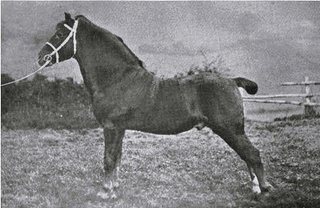
One of the latest scions of this line is Phantom Orchid.
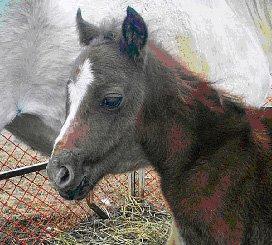
He is named, for obvious reasons, for this rare British Columbia flower.

Timothy has produced a limited edition print to support the ongoing efforts to preserve the breed. He says: "[This is a] Limited edition hand- cut, hand- printed serigraph by Timothy Hume.
"You can help this restoration project by purchasing one of these unique prints.
"All money raised from the sale of these rare prints from my private collection will be put into the preservation of the Islander bloodline.
"I am asking $250.00.
"Please contact me if you want to help: artangel@telus.net
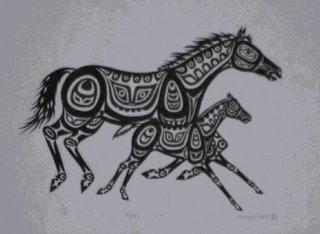
("Hume's Folly" is Timothy's title for his project.)
Friday, April 28, 2006
Digesting Good Literature
Our friend Anne Hocker and her friend Richard Louv (author of Last Child in The Woods) forwarded this quote today, a Querencia gem: Mark Twain* on writing, travel, animals and...good eats?
* from Roughing It
"In Syria, once, at the head-waters of the Jordan, a camel took charge of my overcoat while the tents were being pitched, and examined it with a critical eye, all over, with as much interest as if he had an idea of getting one made like it; and then, after he was done figuring on it as an article of apparel, he began to contemplate it as an article of diet. He put his foot on it, and lifted one of the sleeves out with his teeth, and chewed and chewed at it, gradually taking it in, and all the while opening and closing his eyes in a kind of religious ecstasy, as if he had never tasted anything as good as an overcoat before, in his life. Then he smacked his lips once or twice, and reached after the other sleeve. Next he tried the velvet collar, and smiled a smile of such contentment that it was plain to see that he regarded that as the daintiest thing about an overcoat. The tails went next, along with some percussion caps and cough candy, and some fig-paste from Constantinople. And then my newspaper correspondence dropped out, and he took a chance in that -- manuscript letters written for the home papers. But he was treading on dangerous ground, now. He began to come across solid wisdom in those documents that was rather weighty on his stomach; and occasionally he would take a joke that would shake him up till it loosened his teeth; it was getting to be perilous times with him, but he held his grip with good courage and hopefully, till at last he began to stumble on statements that not even a camel could swallow with impunity. He began to gag and gasp, and his eyes to stand out, and his forelegs to spread, and in about a quarter of a minute he fell over as stiff as a carpenter's work-bench, and died a death of indescribable agony. I went and pulled the manuscript out of his mouth, and found that the sensitive creature had choked to death on one of the mildest and gentlest statements of fact that I ever laid before a trusting public."
* from Roughing It
Tuesday, April 18, 2006
Real Life in Kamchatka
Just got this remarkable photo from Vladimir Beregovoy of a Kamchatkan feeding some very polite dogs slices of seal meat.

Valdimir says "Steve and Libby, I just received this wonderful picture taken in Kamchatka. Local people feed their dogs. The picture is highly recommended for animal rightists."
The photo is by Arthur Chubarkin, a noted Russian traveler. His friend wrote to Vladimir: "In the picture are his dogs of his sled dog team, which he takes to the North Pole. He participated in may expeditions, including circumpolar international ones. In the picture, a Chukcha national is feeding his dogs-- he is a caretaker there".
Valdimir says "Steve and Libby, I just received this wonderful picture taken in Kamchatka. Local people feed their dogs. The picture is highly recommended for animal rightists."
The photo is by Arthur Chubarkin, a noted Russian traveler. His friend wrote to Vladimir: "In the picture are his dogs of his sled dog team, which he takes to the North Pole. He participated in may expeditions, including circumpolar international ones. In the picture, a Chukcha national is feeding his dogs-- he is a caretaker there".
Sunday, April 16, 2006
"New" Blog
My ferocious old friend David Zincavage has had a blog for a while and I didn't even know it! Let me introduce you to Never Yet Melted.
Culinary Institute Grads
Also at O & P: Odious does not like Culinary Institute graduates.
A sample: "I can only imagine the life of these graduates before they found their calling. Lying on the couch in their parents' basement, dreaming of a land of Cocaigne with rivers of Mountain Dew and Cheeto-trees, inhabited entirely by girls -- gone wild! And as they lift one orange-powdered finger to check out the blocked soft-core pr0n channel for a breast or maybe an elbow, there it is: Destiny. An ad telling them that they too can have a career, be respected, even worshipped. In two years, they shall be one of the elite, a fire-breathing no-holds-barred chef de cuisine with a tall hat and a knife almost large enough to compensate for Nature's cruellest jest."
RTWT!
A sample: "I can only imagine the life of these graduates before they found their calling. Lying on the couch in their parents' basement, dreaming of a land of Cocaigne with rivers of Mountain Dew and Cheeto-trees, inhabited entirely by girls -- gone wild! And as they lift one orange-powdered finger to check out the blocked soft-core pr0n channel for a breast or maybe an elbow, there it is: Destiny. An ad telling them that they too can have a career, be respected, even worshipped. In two years, they shall be one of the elite, a fire-breathing no-holds-barred chef de cuisine with a tall hat and a knife almost large enough to compensate for Nature's cruellest jest."
RTWT!
Bang!
Inspired by seeing "V for Vendetta" (conclusion : fun but not serious) Peculiar found this post by John Zmirak, proprietor of European Reactionary from Queens and author of the hilarious "The Bad Catholic's Guide to Good Living", doubtless the only book blurbed by both chef Mario Batalli and Catholic priests that contains a roadkill recipe. Zmirak suggests how Catholics might celebrate Guy Fawkes' Day:
"While this day is not part of the Church's liturgical calendar, there's no reason we can't enjoy it—albeit giving the holiday a bit of a twist. Why not get the baking enthusiasts in your family (i.e. the girls) to make a House of Parliament out of gingerbread? Find pictures of these exquisite gothic buildings on the Internet, and make the best copy you can, lovingly adding details with icing, perhaps even forming a tiny King James I out of marzipan. Unveil it at the outset of tonight's family dinner-or at a gathering of friends. As dinner unfolds, tell the story of Guy Fawkes and his friends—then for dessert take the gingerbread parliament outside, stuff it with M-80 fireworks, and blow it all to hell."
I can't help thinking this might remind Mr. P. of his childhood, when his mother would make elaborate gingerbread houses at christmas, win prizes with them, and then give them to young P. and his friends on New Year's Day to destroy by any means they chose...
"While this day is not part of the Church's liturgical calendar, there's no reason we can't enjoy it—albeit giving the holiday a bit of a twist. Why not get the baking enthusiasts in your family (i.e. the girls) to make a House of Parliament out of gingerbread? Find pictures of these exquisite gothic buildings on the Internet, and make the best copy you can, lovingly adding details with icing, perhaps even forming a tiny King James I out of marzipan. Unveil it at the outset of tonight's family dinner-or at a gathering of friends. As dinner unfolds, tell the story of Guy Fawkes and his friends—then for dessert take the gingerbread parliament outside, stuff it with M-80 fireworks, and blow it all to hell."
I can't help thinking this might remind Mr. P. of his childhood, when his mother would make elaborate gingerbread houses at christmas, win prizes with them, and then give them to young P. and his friends on New Year's Day to destroy by any means they chose...
Dog Confiscators and Castrators..
.. come to New Mexico.
"AT A GLANCE
. Key points of [ Albuquerque ] Mayor Martin Chavez's ordinance:
. Pet owners must have their animals spayed or neutered and microchipped
by Dec. 31, 2007.
. Penalties would start at $100 for the first offense, $250 for the second
and $500 for the third and subsequent offenses."
Courtesy John Burchard.
"AT A GLANCE
. Key points of [ Albuquerque ] Mayor Martin Chavez's ordinance:
. Pet owners must have their animals spayed or neutered and microchipped
by Dec. 31, 2007.
. Penalties would start at $100 for the first offense, $250 for the second
and $500 for the third and subsequent offenses."
Courtesy John Burchard.
One for the Good Guys
Lousiana legislators do the right thing. "With little debate, the Senate voted 39-0 Monday for a bill that would prohibit police from confiscating firearms of law-abiding citizens in times of emergencies or disasters."
New Creature, "I" D, and more
Also from Tom, a great new transitional critter between sea and land animals. Tom's comment is worth reprinting too: "Thank God, literally, we Catholics don't have to fool around with Fundamentalist Creationism crap. Anecdote: A friend of mine's sister is a nun and the principal of a Catholic girl's high school. When she found a biology teacher trying to inject Creationism next to Evolution, she fired his ass without blinking. Even "Intelligent Design" is anything but. How is it that people can't see that there is absolutely no contradiction between the mechanism of Evolution and belief? "
Apropos of that subject ("intelligent" design), a link from John Hawks' excellent anthropology blog sent me to this profile of biologist and filmmaker Randy Olson, whose forthcoming "Flock of Dodos" sounds both scientifically sound and hilarious. He wants scientists to use humor and plain speech to defend themselves and evolutionary ideas: "....when he watches the advocates of intelligent design at work, he sees pleasant people who speak plainly, convincingly and with humor. When scientists he knows talk about evolution, they can be dour, pompous and disagreeable, even with one another. His film challenges them to get off their collective high horse and make their case to ordinary people with — if they can muster it — a smile. "
Apropos of that subject ("intelligent" design), a link from John Hawks' excellent anthropology blog sent me to this profile of biologist and filmmaker Randy Olson, whose forthcoming "Flock of Dodos" sounds both scientifically sound and hilarious. He wants scientists to use humor and plain speech to defend themselves and evolutionary ideas: "....when he watches the advocates of intelligent design at work, he sees pleasant people who speak plainly, convincingly and with humor. When scientists he knows talk about evolution, they can be dour, pompous and disagreeable, even with one another. His film challenges them to get off their collective high horse and make their case to ordinary people with — if they can muster it — a smile. "
Food Notes
Even when I am busy friends keep me supplied with links, somehow especially FOOD links. Reid sent me this link to a pretty good LA Times review of Michael Pollan's The Omnivore's Dillema. But I'm not sure the reviewer "gets" hunting-- not as much being down on it as simply uncomprehending. "Pollan sets off on a quest for the foraged meal. Among other things, he needs to get a gun license, learn to shoot, hunt for chanterelles and pan for salt in San Francisco Bay. No sooner has he hit the Berkeley Hills than he drops his entire tone and point of view. He meets an Italian who makes salami, and the book starts reading like bad Castaneda. Moreover, it's hard to believe that a writer with Pollan's gimlet eye can consider a meal that involves hunting in a private forest, crossing California in an SUV and the use of ATVs and GPS technology as living off the land" Huh? He explicitly explains his heightened perceptions-- feelings all hunters know, which is what I assume the writer means by "bad Casteneda" (and what could "good Casteneda" be?!. And while all non- subsistence hunting in today's world has some aspects of artificiality, how else would a Berkeley English prof who has never hunted start?
Reid also sent this one to a review of Julia Childs' lifelong love affair with France and French cooking. France may be in a decline, but any civilized person must be thankful for its food, wine, and shotguns!
Finally, from Tom McIntyre, a restaurant review with recipes from the New York Times. Chef David Chang of Momofuku has a refreshing attitude: "Momofuku's pro-meat attitude goes even deeper than that. The menu warns off vegetarians, and Mr. Chang, 28, said: "It's hard to order anything here that doesn't have meat in some form or other; we just try not to make anything vegetarian. We're just doing the food we like, and we like meat. We don't make a vegetarian broth, because we don't want to, and we don't make vegetarian versions of things because they just don't taste as good as the versions we do make." "
Reid also sent this one to a review of Julia Childs' lifelong love affair with France and French cooking. France may be in a decline, but any civilized person must be thankful for its food, wine, and shotguns!
Finally, from Tom McIntyre, a restaurant review with recipes from the New York Times. Chef David Chang of Momofuku has a refreshing attitude: "Momofuku's pro-meat attitude goes even deeper than that. The menu warns off vegetarians, and Mr. Chang, 28, said: "It's hard to order anything here that doesn't have meat in some form or other; we just try not to make anything vegetarian. We're just doing the food we like, and we like meat. We don't make a vegetarian broth, because we don't want to, and we don't make vegetarian versions of things because they just don't taste as good as the versions we do make." "
Garden Blogging

We have just planted our first "crops"-- various greens and lettuces, and one artichoke to replace one that failed to make it over the winter. And our apples are blooming. Newcomers often complain to us that they can't get things to grow. As usual, Kipling has something to say to them.
"Our England is a garden, and such gardens are not made
By singing :- "Oh, how beautiful!"and sitting in the shade... "
In this case we-- actually mostly Libby, built the soil itself. The back yard looked like this (first photo, not second, which is a later if not finished stage):

Lib basically dug huge pits and filled them with a mix of horse manure, aged pigeon manure, and compost, with perlite to lighten it. (That big white cube is a sack of perlite). She calls the process "making giant flowerpots". You can't just put in seeds and expect things to grow. The work is backbreaking, but the results are spectacular.

MATT: Steve and Libby's rich garden in the desert will make our small effort an amusing counterpoint. But we've at least dug a bed this year to augment the annual Garden Pot. It is amazing, really, what a little pot in the backyard will do for you.


(The Crop: Early Girls, Better Boys, Romas, eggplant & bell pepper)
Monday, April 10, 2006
New Group Against NAIS
I received this press release today from the Farm and Ranch Freedom Alliance, a new organization seeking to stop the USDA's National Animal Identification System and to act further---after this disaster is averted---on behalf of small farmers and private ranchers.
To see the need and for a taste of the NAIS-brand of government service, note this snippet from the press release:
To see the need and for a taste of the NAIS-brand of government service, note this snippet from the press release:
"...NAIS poses a serious threat to all farmers, ranchers, livestock owners, and companion-animal owners, whether they are organic or conventional, small or large, involved with animals for business or for pleasure. Across the country, every person with even one horse, cow, chicken, pig, goat, sheep, exotic animal or virtually any other livestock animal on their premises, will be required to register their homes and property into a database and subject their property and animals to government surveillance."Is it just me, or did we all suddenly move to China?
Friday, April 07, 2006
Summer of the Puppies?
Libby here. It appears that this summer is going to be the "summer of the puppies". We definitely wanted Ataika and Kyran to mate, which they did; Ataika's heat must have triggered Lashyn to cycle also. Steve heard a commotion in the yard yesterday and went out to find Lashyn and Kyran "tied", as they say. The thought of two simultaneous litters of puppies in a four room house has us laughing rather hysterically. At least it will be summer so we can have them outside much of the time. With our luck this will be an exceptionally rainy summer after months of no moisture at all...let's see...with the 5 dogs we have now plus 15 puppies that would be 80 dog feet covered with mud. Our poor livers may disintegrate before it's over.
And here are a few pics of the oblivious parents- to- be.

And here are a few pics of the oblivious parents- to- be.
Proud Lashyn

Well- Aged Meat
Reid and Roseann sent me to this wonderful tale of a unique dinner, recorded by two of my paleontological heroes, Bjorn Kurten and Dale Guthrie.
Here is Kurten:
"The meat in its abdomen had spoiled before the bison was completely frozen. But in the neck area small pieces of meat were found attached to the skull. The lions had left so little there that it had frozen through while the meat was still fresh. When it thawed it gave off an unmistakable beef aroma, not unpleasantly mixed with a faint smell of the earth in which it was found, with a touch of mushroom. About a dozen of us gathered .... on April 6, 1984, to partake of Bison priscus stew. The taste was delicious, and none of us suffered any ill effects from the meal."
Thursday, April 06, 2006
Prehistoric Dentistry
About the time Kennewick Man was paddling around Washington, people in Pakistan were having their cavities filled.
Wednesday, April 05, 2006
Doug Owsley on Kennewick Man
Connie and I heard Doug Owsley of the Smithsonian Institution give the after-dinner address at the Society for California Archaeology awards banquet last Friday night in Ventura. He spoke on his work on the taphonomy of the Kennewick Man find, something I posted on in February.
It was an interesting and amazingly well-illustrated talk. Not having followed the scientific aspects of the find that closely in the past, it was a useful corrective to misconceptions that had crept into my thinking. The fact that many accounts of Kennewick Man talked of the remains eroding out of the bank of the Columbia River had led me to believe that some of the bones were still in situ in the bank. In reality, the skeleton was out of context as a scatter of bones along the beach. Also, I was not aware of how fragmented the remains were. For example, the cranium was in 11 pieces, so there was a lot of reconstruction to do.
The February press release said that Owsley had established that the burial was intentional, was an "extended" burial (straight out, flat on his back), was parallel to the river, and that the head was pointed upstream. Owsley explained how he came to those conclusions. Those of us who live in arid or semi-arid climates know that calcium carbonate collects in layers in our soils. It's commonly known as caliche. Any hard material such as stone or bone that is buried within one of these caliche layers collects calcium carbonate deposits on its underside. When this phenomenon occurs over long periods of time, grains of sediment actually become cemented to the underside of the buried material.
The Kennewick bones had a consistent pattern of cemented sediment on their undersides. Owsley was able to trace the attitude of each bone's location as it was buried. This was consistent with the pattern of an extended burial. The pattern showed that the cranium was not lying flat, but had been propped up with something under it. This coupled with the fact that the bones showed no sign of perimortem disturbance or animal scavenging led him to conclude the burial was intentional.
Owsley was able to determine the body's position relative to the river by patterns of "corrasion" - wear by water-bourne sediment - on the bone. Bones on the left side of the body showed consistent patterns of corrasion, more than on the right side, indicating that this was the side of the body that eroded out of the bank first. Geological reconstruction of the river channel has shown that when the body was buried the Columbia was 400 yards away.
As I said, this phase of Owsley's work has focused on taphonomy, how the body came to be buried and preserved. There are multiple continuing studies on other aspects of the find, and he talked somewhat off the cuff as to where these are going.
Much has been made of the projectile point imbedded in Kennewick Man's hip bone. CT scans have shown that it was a healed wound and told us more about the point. It is apparently a stemmed serrated dart point. The point entered the body at an angle of 77 degrees, sliced off part of the edge of the hipbone before imbedding itself. This first impact apparently broke off the tip of the point, and that and the bone fragment came loose in the wound. Owsley believes the amount of force necessary to do this and the steep angle of entry indicate it was done by an atlatl dart. A thrusting spear could not have done that amount of damage at that angle.
The base of the point was broken in a fracture showing a twisting application of force. After he was impaled by the dart, Kennewick Man (or one of his companions) yanked and twisted (ouch!) the shaft of the dart until the point broke off and the shaft came free. You can imagine the wound.
Owsley believes that Kennewick Man was somewhere between 35 and 40 years old when he died. He was extremely muscular in the upper body and the humeri were very bowed. Use was very heavy on the right side. A comparison photograph of the heads of the humeri showed an astonishing size difference on that side. He also spent extended periods of time squatting or kneeling, as revealed by the pattern of arthritis in the knees. Owsley admitted he was only speculating, but in his opinion, Kennewick Man, "...looked like a guy who had spent a lot of time in a canoe."
The teeth showed extreme wear, so much so that Owsley believes it is more than can be accounted for by diet. The wear is probably from some task activity such as chewing hides to soften them. Christy Turner and a team of specialists are working on detailed studies of the teeth. More will come later on the teeth.
I speculated in my earlier post as to whether DNA samples had been procured. I found out from another source since then that an attempt had been made several years ago, but that it had failed. Owsley said that the attempt was made using a rib fragment, not the best choice. More attempts will be made in the future using root pulp from the tooth sockets, the preferred site these days.
Finally Owsley reiterated others' opinions that Kennewick does not look like modern Native Americans. He looks more like modern Ainu or Polynesians - but doesn't look closely like them either. Owsley has looked at the other extant Paleoindian skeletons and believes that they are all distinct from modern Native Americans, who don't appear until 7 - 8,000 BP. There also don't appear to be transitional forms, where the populations can be seen gradually changing into modern Native American types. This appears to be a sharp break.
This talk served to tell us how much more we will be learning about Kennewick Man and how much more we need to learn about Paleoindians.
It was an interesting and amazingly well-illustrated talk. Not having followed the scientific aspects of the find that closely in the past, it was a useful corrective to misconceptions that had crept into my thinking. The fact that many accounts of Kennewick Man talked of the remains eroding out of the bank of the Columbia River had led me to believe that some of the bones were still in situ in the bank. In reality, the skeleton was out of context as a scatter of bones along the beach. Also, I was not aware of how fragmented the remains were. For example, the cranium was in 11 pieces, so there was a lot of reconstruction to do.
The February press release said that Owsley had established that the burial was intentional, was an "extended" burial (straight out, flat on his back), was parallel to the river, and that the head was pointed upstream. Owsley explained how he came to those conclusions. Those of us who live in arid or semi-arid climates know that calcium carbonate collects in layers in our soils. It's commonly known as caliche. Any hard material such as stone or bone that is buried within one of these caliche layers collects calcium carbonate deposits on its underside. When this phenomenon occurs over long periods of time, grains of sediment actually become cemented to the underside of the buried material.
The Kennewick bones had a consistent pattern of cemented sediment on their undersides. Owsley was able to trace the attitude of each bone's location as it was buried. This was consistent with the pattern of an extended burial. The pattern showed that the cranium was not lying flat, but had been propped up with something under it. This coupled with the fact that the bones showed no sign of perimortem disturbance or animal scavenging led him to conclude the burial was intentional.
Owsley was able to determine the body's position relative to the river by patterns of "corrasion" - wear by water-bourne sediment - on the bone. Bones on the left side of the body showed consistent patterns of corrasion, more than on the right side, indicating that this was the side of the body that eroded out of the bank first. Geological reconstruction of the river channel has shown that when the body was buried the Columbia was 400 yards away.
As I said, this phase of Owsley's work has focused on taphonomy, how the body came to be buried and preserved. There are multiple continuing studies on other aspects of the find, and he talked somewhat off the cuff as to where these are going.
Much has been made of the projectile point imbedded in Kennewick Man's hip bone. CT scans have shown that it was a healed wound and told us more about the point. It is apparently a stemmed serrated dart point. The point entered the body at an angle of 77 degrees, sliced off part of the edge of the hipbone before imbedding itself. This first impact apparently broke off the tip of the point, and that and the bone fragment came loose in the wound. Owsley believes the amount of force necessary to do this and the steep angle of entry indicate it was done by an atlatl dart. A thrusting spear could not have done that amount of damage at that angle.
The base of the point was broken in a fracture showing a twisting application of force. After he was impaled by the dart, Kennewick Man (or one of his companions) yanked and twisted (ouch!) the shaft of the dart until the point broke off and the shaft came free. You can imagine the wound.
Owsley believes that Kennewick Man was somewhere between 35 and 40 years old when he died. He was extremely muscular in the upper body and the humeri were very bowed. Use was very heavy on the right side. A comparison photograph of the heads of the humeri showed an astonishing size difference on that side. He also spent extended periods of time squatting or kneeling, as revealed by the pattern of arthritis in the knees. Owsley admitted he was only speculating, but in his opinion, Kennewick Man, "...looked like a guy who had spent a lot of time in a canoe."
The teeth showed extreme wear, so much so that Owsley believes it is more than can be accounted for by diet. The wear is probably from some task activity such as chewing hides to soften them. Christy Turner and a team of specialists are working on detailed studies of the teeth. More will come later on the teeth.
I speculated in my earlier post as to whether DNA samples had been procured. I found out from another source since then that an attempt had been made several years ago, but that it had failed. Owsley said that the attempt was made using a rib fragment, not the best choice. More attempts will be made in the future using root pulp from the tooth sockets, the preferred site these days.
Finally Owsley reiterated others' opinions that Kennewick does not look like modern Native Americans. He looks more like modern Ainu or Polynesians - but doesn't look closely like them either. Owsley has looked at the other extant Paleoindian skeletons and believes that they are all distinct from modern Native Americans, who don't appear until 7 - 8,000 BP. There also don't appear to be transitional forms, where the populations can be seen gradually changing into modern Native American types. This appears to be a sharp break.
This talk served to tell us how much more we will be learning about Kennewick Man and how much more we need to learn about Paleoindians.
Total Eclipse
I better blog this before Steve does. One of our favorites, Pluvialis (aka Helen Macdonald), treats us yet again with a sample of her casual brilliance. She is back from a visit to catch the total eclipse in Turkey. No need to go there yourself; just read the whole thing.
"There I am, sitting on the beach in the underworld, with the standing dead. It is cold, and a loose wind blows through the darkness. But then, from the lower edge of the blank, black disk of the dead sun, bursts a perfect point of brilliance. It leaps and burns. It’s unthinkably fierce, unbearably bright, something (I blush to say it, but here it comes) like a word. And thus begins the world again. Instantly."
Sunday, April 02, 2006
Lurchers
I picked up my falcon Tuuli yesterday from my friend Bodie, who had taken fifteen hares with him and his lurchers, including one of our pups, in a season that started in late January when I realized that I would not be able to fly him at all this year.
We met in Albuquerque at a gathering of lurchermen and, well, bloggers-- Peculiar; Mrs. Peculiar; Bodie, Nate (who also has one of our pups), and Terence Wright ditto. Terence was kind enough to give me a photo of our grand- dog "Gobi"-- the black female on the left-- with him and his older classic lurcher "Percy" on the left. I am delighted to report that the pups in this tazi- lurcher litter are prodigies. Gobi has taken several hares single- hand and, once, two in a day with the hawks assistance

We met in Albuquerque at a gathering of lurchermen and, well, bloggers-- Peculiar; Mrs. Peculiar; Bodie, Nate (who also has one of our pups), and Terence Wright ditto. Terence was kind enough to give me a photo of our grand- dog "Gobi"-- the black female on the left-- with him and his older classic lurcher "Percy" on the left. I am delighted to report that the pups in this tazi- lurcher litter are prodigies. Gobi has taken several hares single- hand and, once, two in a day with the hawks assistance
"Mammoth" discovery
Ivory-billed woodpecker rediscoverer Tim Gallagher has a sense of humor, even if his skeptics don't. For april Fool's Day he sent me this:

Pacelle speaks
Reader and borzoi breeder Rey McGehee finds some attributed wisdom from H$U$ prez Wayne Pacelle.
"The life of an ant and the life of my child should be accorded equal respect."
-- Wayne Pacelle, Associated Press, Jan. 15, 1989
And again, lest you think he spoke without thinking of the implications:
The life of an ant and that of my child should be granted equal consideration."
-- Wayne Pacelle, in Inhumane Society, 1990
Not my child. Not my DOG.
"The life of an ant and the life of my child should be accorded equal respect."
-- Wayne Pacelle, Associated Press, Jan. 15, 1989
And again, lest you think he spoke without thinking of the implications:
The life of an ant and that of my child should be granted equal consideration."
-- Wayne Pacelle, in Inhumane Society, 1990
Not my child. Not my DOG.
Growing "Meat"
Artificial meat-- or more acurrately "test tube meat" -- rears its ugly head again. I suspect if this ever becomes a reality it will give AR people another club to beat us with. And can you imagine the esthetics? Notice they couldn't bring themselves to actually EAT it.
"Creatures"
From the unique blog Laputan Logic (which I should blogroll) comes this group of-- sculptures?-- that move across the beaches of holland. I don't know what to call them but I think they are wonderful.
Thursday, March 30, 2006
Canine Forensics
The Society for California Archaeology is holding their annual meeting in Ventura this week. In conjunction with that, Connie and I attended a presentation last night from the Institute for Canine Forensics. This group trains and promotes the use of dogs to locate dead humans both of recent and long-buried vintage. It is an outgrowth of the use of dogs by search-and-rescue teams.
Two members of the Institute and their dogs (both Border collies) gave a talk and demonstration of how the dogs are trained, the types of projects they have done, and their potential to help archaeologists in their research. It was interesting and entertaining. At the beginning of the talk, the dogs were taken out of the room, and some "targets" set around the seating area: human teeth, dirt fill from around a human burial, lumps of cement, and pig teeth.
The dogs are trained to "signal" by taking a down or sit position when they encounter the scent they are trained for. After the talk, the dogs were allowed to search the room and signalled at the human teeth, ignoring the pig teeth and cement. They hesitated at the fill dirt that was sitting in an open bag on the floor. The handlers said that when the dogs get a visual with the scent, they sometimes doubt themselves, as though they are thinking "This is too easy to be real."
The handlers freely admit that the dogs have problems picking up scent in hot and dry conditions or when areas are waterlogged. They also have trouble in heavy clay soils or when burials are very deep. But it appears they can be of value. Please look at their website for descriptions of projects they have worked on.
One interesting project they discussed was the excavation of the Donner Party Camp at Alder Creek here in California. You may recall that I posted on this controversial project in January. The archaeologists who conducted the excavation there reported that though they recovered large amounts of bone they found no direct evidence of cannibalism, something surprising to most who know the history of the Donner Party.
The handlers from the Institute were invited by the archaeologists to visit the Alder Creek site while it was under investigation. In the talk last night, they said that their dogs signalled all over the meadow where the site is located. They said the dogs' reactions seemed to indicate that the scent was scattered and diffuse, not concentrated as they get over a burial. The dogs reacted most strongly to the hearth areas that were excavated.
I found this very interesting. Perhaps cannibalism did take place at Alder Creek, and the bone was smashed into such small pieces that the archaeologists couldn't identify it. The ladies from the Institute seemed quite unaware that their dogs' reactions contradict the archaeologists' conclusions.
Two members of the Institute and their dogs (both Border collies) gave a talk and demonstration of how the dogs are trained, the types of projects they have done, and their potential to help archaeologists in their research. It was interesting and entertaining. At the beginning of the talk, the dogs were taken out of the room, and some "targets" set around the seating area: human teeth, dirt fill from around a human burial, lumps of cement, and pig teeth.
The dogs are trained to "signal" by taking a down or sit position when they encounter the scent they are trained for. After the talk, the dogs were allowed to search the room and signalled at the human teeth, ignoring the pig teeth and cement. They hesitated at the fill dirt that was sitting in an open bag on the floor. The handlers said that when the dogs get a visual with the scent, they sometimes doubt themselves, as though they are thinking "This is too easy to be real."
The handlers freely admit that the dogs have problems picking up scent in hot and dry conditions or when areas are waterlogged. They also have trouble in heavy clay soils or when burials are very deep. But it appears they can be of value. Please look at their website for descriptions of projects they have worked on.
One interesting project they discussed was the excavation of the Donner Party Camp at Alder Creek here in California. You may recall that I posted on this controversial project in January. The archaeologists who conducted the excavation there reported that though they recovered large amounts of bone they found no direct evidence of cannibalism, something surprising to most who know the history of the Donner Party.
The handlers from the Institute were invited by the archaeologists to visit the Alder Creek site while it was under investigation. In the talk last night, they said that their dogs signalled all over the meadow where the site is located. They said the dogs' reactions seemed to indicate that the scent was scattered and diffuse, not concentrated as they get over a burial. The dogs reacted most strongly to the hearth areas that were excavated.
I found this very interesting. Perhaps cannibalism did take place at Alder Creek, and the bone was smashed into such small pieces that the archaeologists couldn't identify it. The ladies from the Institute seemed quite unaware that their dogs' reactions contradict the archaeologists' conclusions.
Designer Grits
Just so we can be ethnically diverse here, I have to put up this companion post to Steve's on risotto from earlier this week. He gets to honor his Italian heritage - I get to honor my Southern redneck Scots-Irish heritage. This LA Times article says that grits are starting to move into high-end cuisine to take their rightful place alongside potates, polenta and risotto. But not your everyday off-the-shelf grits: special old-school stone-ground varieties that take two hours to cook.
Though I say I celebrate my Southern heritage by talking about grits, it is of course truly an inheritance from our Native American antecedents along with its first cousin, hominy. Hominy is another wonderful over-looked food waiting for its day in the sun. People who say they don't like hominy have likely never tried that delicious Southwestern hominy-based stew, posole, one that I know Steve and I both like.
Grits were a staple in my family when I was growing up in Arkansas and Tennessee. We still eat them a lot and one of my great accomplishments as a parent has been passing on the love of grits to our kids.
Though I say I celebrate my Southern heritage by talking about grits, it is of course truly an inheritance from our Native American antecedents along with its first cousin, hominy. Hominy is another wonderful over-looked food waiting for its day in the sun. People who say they don't like hominy have likely never tried that delicious Southwestern hominy-based stew, posole, one that I know Steve and I both like.
Grits were a staple in my family when I was growing up in Arkansas and Tennessee. We still eat them a lot and one of my great accomplishments as a parent has been passing on the love of grits to our kids.
Aussie Speak
A young lady who works in my office is Australian, a transfer from our Melbourne office. She is a geologist; very bright, capable and funny. It is interesting to talk to her about her impressions of this strange country she finds herself in. Of course, the fact that her experiences here are mostly in California ups the "strange" quotient, but that can't be helped.
Last week she was sitting in our break room leafing through an office furniture catalog.
"What are you looking for in that 'wish-book'?" I asked her.
She looked at me quizzically, "A wish-book?"
"It's a Southern slang name for a catalog. You page through the catalog, point at things, and say, 'I wish I had that.'"
"Oh. Well, where I grew up we always called them 'dogalogs' - I never knew why."
Then her eyes widened, "Oh! Dogalog - catalog! Of course!"
Last week she was sitting in our break room leafing through an office furniture catalog.
"What are you looking for in that 'wish-book'?" I asked her.
She looked at me quizzically, "A wish-book?"
"It's a Southern slang name for a catalog. You page through the catalog, point at things, and say, 'I wish I had that.'"
"Oh. Well, where I grew up we always called them 'dogalogs' - I never knew why."
Then her eyes widened, "Oh! Dogalog - catalog! Of course!"
Wednesday, March 29, 2006
How To Interest A Big Publisher
Society is not breaking down. Society is broken.
I caught this bit at Yahoo news, about a college student who spent his spring break in Wal-Mart (or should we spell that, W@L-M*RT?). Skyler Bartels haunted the fluorescent interior for 41 hours in a row, watching movies, playing video games, eating from the snack bar and stealing naps in the garden department. He planned to write an article about his experience but decided against that when he failed to meet his goal of a full-week's stay. The greeters were getting wise to him, and Bartels had to leave before he was thrown out.
But was the project really a failure? Read on:
In a spasm of sheer meanness, I sent this story to Steve. I told him he was going about this writer-thing all wrong. No need to actually WRITE. All you have to do is hang out a few days at Wally World. Steve comes back, "You blog it, Matt. If I have to do it I'll shoot myself."
Maybe we should file this under Doom and Gloom.
I caught this bit at Yahoo news, about a college student who spent his spring break in Wal-Mart (or should we spell that, W@L-M*RT?). Skyler Bartels haunted the fluorescent interior for 41 hours in a row, watching movies, playing video games, eating from the snack bar and stealing naps in the garden department. He planned to write an article about his experience but decided against that when he failed to meet his goal of a full-week's stay. The greeters were getting wise to him, and Bartels had to leave before he was thrown out.
But was the project really a failure? Read on:
The Des Moines Register...called to ask him about the experience. Once the story ran, TV networks began calling.
[Bartels] also talked with a book agent, has been contacted by New Line Cinema about a movie concept and did a radio interview with National Public Radio.
Bartels told The Associated Press he has decided the stunt wasn't such a failure after all.
"I'm incredibly happy with the press coverage," he said. "It would be kind of silly not to accept it with open arms."
In a spasm of sheer meanness, I sent this story to Steve. I told him he was going about this writer-thing all wrong. No need to actually WRITE. All you have to do is hang out a few days at Wally World. Steve comes back, "You blog it, Matt. If I have to do it I'll shoot myself."
Maybe we should file this under Doom and Gloom.
Sunday, March 26, 2006
Girls With Guns
The incomparable Tam, queen of snark and Mistress of Coal Creek Armory, deconstructs a breathless and idiotic piece on female shooters.
"Why is it that when some bright spark in the marketing department at Apple, Cannondale, or Pontiac notices that slightly more than 50% of the planet's population is setters rather than pointers, it gets two column inches on page 24 of the WSJ, but when their counterpart at Remington or Smith & Wesson does likewise, it calls for a panting TeeWee news spot from ABC? Build a Saturn that has room to stow a purse in the front passenger compartment, and nobody notices. Make a SIG small enough to fit in that purse, and shoulders get dislocated in newsrooms across America as folks reach for dusty tomes by Freud. Weird."
RTWT!
Update: the link doesn't seem to be working. Go to View From the Porch and scroll down...
"Why is it that when some bright spark in the marketing department at Apple, Cannondale, or Pontiac notices that slightly more than 50% of the planet's population is setters rather than pointers, it gets two column inches on page 24 of the WSJ, but when their counterpart at Remington or Smith & Wesson does likewise, it calls for a panting TeeWee news spot from ABC? Build a Saturn that has room to stow a purse in the front passenger compartment, and nobody notices. Make a SIG small enough to fit in that purse, and shoulders get dislocated in newsrooms across America as folks reach for dusty tomes by Freud. Weird."
RTWT!
Update: the link doesn't seem to be working. Go to View From the Porch and scroll down...
Risotto and Rice Fetishism
Reid sent this LAT food column on risotto (which I still call "risott' " in the mountain dialect of my grandparents) for my comment. What did I think?
Well, you'd certainly get a good dish if you followed the cook's advice. But he sure takes it solemnly (not at all the same as seriously).
I never knew there were separate names for every step, like adding butter, and I have been making it for almost 50 years....
I think I said the same thing in an essay in here using fewer words.
He needed a special inspiration to think of making it?! (Maybe because he seems to see it as such a ... BIG THING?) We make some variety two or three times a week.
And finally, drop the rice fetishism and the rare- rice mystique. Arborio is nice, but you can make it with any of the shorter high- starch rices from supermarket medium- grain to (even) sushi- type--- just avoid long- grain types like Basmati. My grandparents used ordinary medium- grain and it worked then, as it does now.
Cooking technique is important, but there is a difference between the kitchen and Church-- or even an art gallery. I prefer Bourdain's playful, even raunchy attitude to food to hushed worship...
Well, you'd certainly get a good dish if you followed the cook's advice. But he sure takes it solemnly (not at all the same as seriously).
I never knew there were separate names for every step, like adding butter, and I have been making it for almost 50 years....
I think I said the same thing in an essay in here using fewer words.
He needed a special inspiration to think of making it?! (Maybe because he seems to see it as such a ... BIG THING?) We make some variety two or three times a week.
And finally, drop the rice fetishism and the rare- rice mystique. Arborio is nice, but you can make it with any of the shorter high- starch rices from supermarket medium- grain to (even) sushi- type--- just avoid long- grain types like Basmati. My grandparents used ordinary medium- grain and it worked then, as it does now.
Cooking technique is important, but there is a difference between the kitchen and Church-- or even an art gallery. I prefer Bourdain's playful, even raunchy attitude to food to hushed worship...
Scarier than Flu..
I share Pluvialis's mixture of dread and fascination with various high- tech military innovations. Here is uber- blogger Glenn Reynolds over at TCS with some terrifying new info on biowar bugs.
And, on a slightly (perhaps) lighter note: insect cyborgs.
And, on a slightly (perhaps) lighter note: insect cyborgs.
Subscribe to:
Posts (Atom)