
Showing posts with label Double Guns. Show all posts
Showing posts with label Double Guns. Show all posts
Friday, January 19, 2018
Why I like the "Plain Gun".
The seriously flawed first edition of Good Guns, rife with errors and badly illustrated by me, i(s a ...perhaps justifiably... rare book. But it does contain a line drawing of the Platonic ideal of a boxlock gun, and despite the pernicious French influence, as seen in the exaggeratedly curved"shadbelly" stock, it looks a lot like "Plain Gun" (a Weston from Brighton).
 Getting the images of gun and illo in the same focus even after Libby outlined the latter ( I CAN'T) but you get the idea...


Tuesday, September 13, 2016
Convergent Evo -in Double Guns!
I had no idea, when I started measuring these, just how close they would be. They are of different origin and design. One is an LC Smith so- called Featherweight 12 from †he 1920,s, built and designed in New England and New York. One is a typical 12 bore British game gun (though proofed for American loads and with a metric barrel- length- Frederic Scot twas always odder then his kinsmen), built to Best or near Best standards in Birmingham. And one is the only grade 7 Manufrance Robust I have ever seen, a 16, with an Ideal- style fore-end ( better seen than described), skip- line checkering, a reel- up "Brettel automatique" sling, a swamped rib, fine scroll engraving, and a horn buttplate. AllI know is that it was made before the War.
I'll spare you every detail, but I weighed the barrels, the fore-end, and the stock and action of each on my hawk scales, in ounces rather than grams. Each unit varied a bit, but in the end they all converged. I should add that I left the slip - on pad on the Elsie, as she always wears it, and it helped the convergence.
The barrels varied most, from 44.7 (lightest) in the Scott to 51.6 in the French gun. (They were all almost the same length-- 28" in the LC, 70 cm for the other two (about 27 1/2). In the end, the FRENCH gun was lightest, at 6.43 pounds, despite its barrels. The Scott was next, at 6.51, and the LC heaviest, at all of 6.6.
That is not a lot of difference. All the makers knew what they were doing.
I have put more photos of the French gun, as it is most unusual! Thanks to Kirby Hoyt of Vintage doubles for that, and to my friend Gerry Cox for the Scott. That is the Turner .410, my other near "Best" shotgun, peeping out on the left.


I'll spare you every detail, but I weighed the barrels, the fore-end, and the stock and action of each on my hawk scales, in ounces rather than grams. Each unit varied a bit, but in the end they all converged. I should add that I left the slip - on pad on the Elsie, as she always wears it, and it helped the convergence.
The barrels varied most, from 44.7 (lightest) in the Scott to 51.6 in the French gun. (They were all almost the same length-- 28" in the LC, 70 cm for the other two (about 27 1/2). In the end, the FRENCH gun was lightest, at 6.43 pounds, despite its barrels. The Scott was next, at 6.51, and the LC heaviest, at all of 6.6.
That is not a lot of difference. All the makers knew what they were doing.
I have put more photos of the French gun, as it is most unusual! Thanks to Kirby Hoyt of Vintage doubles for that, and to my friend Gerry Cox for the Scott. That is the Turner .410, my other near "Best" shotgun, peeping out on the left.


Saturday, July 16, 2016
Fine Shotguns: A Review
Subtitled The History, Science, and Art of the Finest Shotguns from Around the World,
John Taylor's big- format paperback from Skyhorse is both more
ambitious and far more difficult a task than it might appear to be, and
for the most part he has succeeded splendidly. No, that's not fair; he
HAS succeeded; that is to say, I have minor disagreements with him, of
opinion not fact; I might emphasize a few things he doesn't; and I
would recommend this book to anyone who is beginning to untangle the
mysteries of shotguns, without reservations. At the moment, it is the
best "Freshman course" on fine doubles around, especially if you are an
American, and I suspect it will be the standard for some time to come.
What rivals does it have? Johnny Barsness's Shotguns for Hunting is a great book, and I wouldn't be without it. It is the best and most general book on what shotguns are, how they work, and how to use each kind for the proper game that exists, but it is about ALL shotguns, as its title suggests, while Fine Shotguns is about what Libby calls the pretty ones: double guns, both side by side and over and under. Only a few repeaters are so much as mentioned - the Ithaca 37, its predecessor the Remington 17, and the legendary Winchester Model 12, a gun that the late Geoffrey Boothroyd, "James Bond's Armourer", once wrote me was more esthetic in his eyes than the far more expensive Model 21 double, the favorite shotgun of Hemingway and O'Connor, thereby committing a sacrilege in the eyes of many Americans. But my father, an artist AND a hunter, sold his Model 21 and kept his 16 gauge Model 12 and his Browning Sweet 16. .John Barsness says: "...my favorite Chukar gun these days is the 6 1/4 pound 16- gauge Model 12 pump I bought from Steve Bodio a few seasons ago....This little 16 is also my favorite early season sharptail and Prairie chicken gun", and adds (not in the book) that it handles "like a Purdey"." It doesn't, actually, but this is the kind of superlative the old Winchesters tend to attract.
UPDATE: here are my father's favorites in an old ad display from Shooting Sportsman online, courtesy of Daniel Riviera:

I must tell you a few more things this book is NOT, to tell you what its virtues are, as almost all my other modern gun books, good ones, often by friends, fall into certain categories. It is not a specialized monograph, not a book on just Purdeys or just Bosses or just Parkers or LC Smiths or "British Boxlocks" (Diggory Hadoke) or "Spanish Bests" (Terry Wieland). Nor is at detailed look at a kind of technical aspect of guncraft, like Vic Venters' book of that name, or any of Steven Dodd Hughes' books. It is not even a buyer's manual. telling you how to pick a good British gun for yourself for a reasonable price -- reasonable price by today's standards -- like Terry's Vintage British Shotguns or Diggory's Vintage Guns for the Modern Shot. It is certainly not a textbook for the obsessed, showing tiny details of vintage gun construction, like Braden and Adams' Lock, Stock, and Barrel. I have every one of these books and again would not be without them. And not ONE , except possibly Barsness's, would be of the slightest use to a beginner. They all automatically assume a level of knowledge that most people simply don't have, so they start collecting shotguns and making expensive mistakes.
I started my shotgun training in the late 60s and early 70s. I had mentors -- the late Callanan brothers of Cambridge, Massachusetts -- and read Gun Digest and O'Connor and Keith. They taught me a lot, but only the Callanans were reliable oracles. Betsy Huntington later said that we should have bought a Purdey and a Boss back then and been done with it. Instead, we traded through perhaps a hundred guns, gaining our education but losing a lot of money.
Very few books that came along in those years were worth the price. Don Zutz, a quirky Michiganer, wrote two books that were more right than wrong. A Missouri school teacher, Michael McIntosh, before he became a white-bearded eminence, wrote a modest book called The Best Double Guns Ever Made in America. I eventually tried my hand at it myself (too soon), producing Good Guns and Good Guns Again. Zutz's books and mine were full of mistakes; McIntosh seems to have survived the ravages of time better. This book is in their spirit, but is better and more accurate than any of them.
Fine Shotguns briefly defines what a high-grade shotgun is, then covers America's best doubles; Britain's finest, with a heavy emphasis on London guns; the Continent, not counting Spain and Italy, which have their own section; such arcana as hammerguns, smallbores, and pairs. He then lays out all the parts, pieces, and features of a shotgun -- stocks, fit, checkering, barrels, finishing; tells you why a bespoke shotgun is special; he tells you how to shoot a fine shotgun and what kind of ammo to use, the good implication being that you WILL shoot your shotgun. He talks about care and gunsmithing. And finally, he deals with that fraught subject, shopping for one.
Necessarily, such a book will be broad, but perhaps a bit shallow. If it wasn't, it would be six inches thick, cost $500, and no one would buy it. Instead, Skyhorse has given us a 240 page, high- quality paperback, printed in China, for $35, which probably would have saved me five figures had I had it around in 1975. Buy it.

What rivals does it have? Johnny Barsness's Shotguns for Hunting is a great book, and I wouldn't be without it. It is the best and most general book on what shotguns are, how they work, and how to use each kind for the proper game that exists, but it is about ALL shotguns, as its title suggests, while Fine Shotguns is about what Libby calls the pretty ones: double guns, both side by side and over and under. Only a few repeaters are so much as mentioned - the Ithaca 37, its predecessor the Remington 17, and the legendary Winchester Model 12, a gun that the late Geoffrey Boothroyd, "James Bond's Armourer", once wrote me was more esthetic in his eyes than the far more expensive Model 21 double, the favorite shotgun of Hemingway and O'Connor, thereby committing a sacrilege in the eyes of many Americans. But my father, an artist AND a hunter, sold his Model 21 and kept his 16 gauge Model 12 and his Browning Sweet 16. .John Barsness says: "...my favorite Chukar gun these days is the 6 1/4 pound 16- gauge Model 12 pump I bought from Steve Bodio a few seasons ago....This little 16 is also my favorite early season sharptail and Prairie chicken gun", and adds (not in the book) that it handles "like a Purdey"." It doesn't, actually, but this is the kind of superlative the old Winchesters tend to attract.
UPDATE: here are my father's favorites in an old ad display from Shooting Sportsman online, courtesy of Daniel Riviera:

I must tell you a few more things this book is NOT, to tell you what its virtues are, as almost all my other modern gun books, good ones, often by friends, fall into certain categories. It is not a specialized monograph, not a book on just Purdeys or just Bosses or just Parkers or LC Smiths or "British Boxlocks" (Diggory Hadoke) or "Spanish Bests" (Terry Wieland). Nor is at detailed look at a kind of technical aspect of guncraft, like Vic Venters' book of that name, or any of Steven Dodd Hughes' books. It is not even a buyer's manual. telling you how to pick a good British gun for yourself for a reasonable price -- reasonable price by today's standards -- like Terry's Vintage British Shotguns or Diggory's Vintage Guns for the Modern Shot. It is certainly not a textbook for the obsessed, showing tiny details of vintage gun construction, like Braden and Adams' Lock, Stock, and Barrel. I have every one of these books and again would not be without them. And not ONE , except possibly Barsness's, would be of the slightest use to a beginner. They all automatically assume a level of knowledge that most people simply don't have, so they start collecting shotguns and making expensive mistakes.
I started my shotgun training in the late 60s and early 70s. I had mentors -- the late Callanan brothers of Cambridge, Massachusetts -- and read Gun Digest and O'Connor and Keith. They taught me a lot, but only the Callanans were reliable oracles. Betsy Huntington later said that we should have bought a Purdey and a Boss back then and been done with it. Instead, we traded through perhaps a hundred guns, gaining our education but losing a lot of money.
Very few books that came along in those years were worth the price. Don Zutz, a quirky Michiganer, wrote two books that were more right than wrong. A Missouri school teacher, Michael McIntosh, before he became a white-bearded eminence, wrote a modest book called The Best Double Guns Ever Made in America. I eventually tried my hand at it myself (too soon), producing Good Guns and Good Guns Again. Zutz's books and mine were full of mistakes; McIntosh seems to have survived the ravages of time better. This book is in their spirit, but is better and more accurate than any of them.
Fine Shotguns briefly defines what a high-grade shotgun is, then covers America's best doubles; Britain's finest, with a heavy emphasis on London guns; the Continent, not counting Spain and Italy, which have their own section; such arcana as hammerguns, smallbores, and pairs. He then lays out all the parts, pieces, and features of a shotgun -- stocks, fit, checkering, barrels, finishing; tells you why a bespoke shotgun is special; he tells you how to shoot a fine shotgun and what kind of ammo to use, the good implication being that you WILL shoot your shotgun. He talks about care and gunsmithing. And finally, he deals with that fraught subject, shopping for one.
Necessarily, such a book will be broad, but perhaps a bit shallow. If it wasn't, it would be six inches thick, cost $500, and no one would buy it. Instead, Skyhorse has given us a 240 page, high- quality paperback, printed in China, for $35, which probably would have saved me five figures had I had it around in 1975. Buy it.

Friday, April 08, 2016
A few Images
Some images to hold you--we are heading up to to Santa Fe to see Pluvialis! (Perhaps better known today in our crowd as RockStar Helen, to her embarrassment..). We'll be back Sunday. Reid may report on their dinner in Denver later... he and Connie, Anne "Anyushka" Price and Chas and Mary attending...
And the countdown begins--this is post #3995...
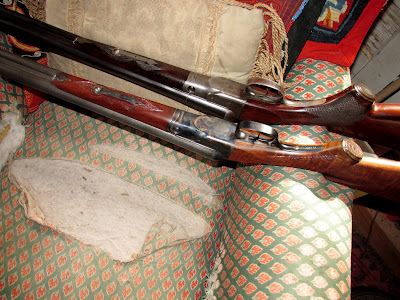
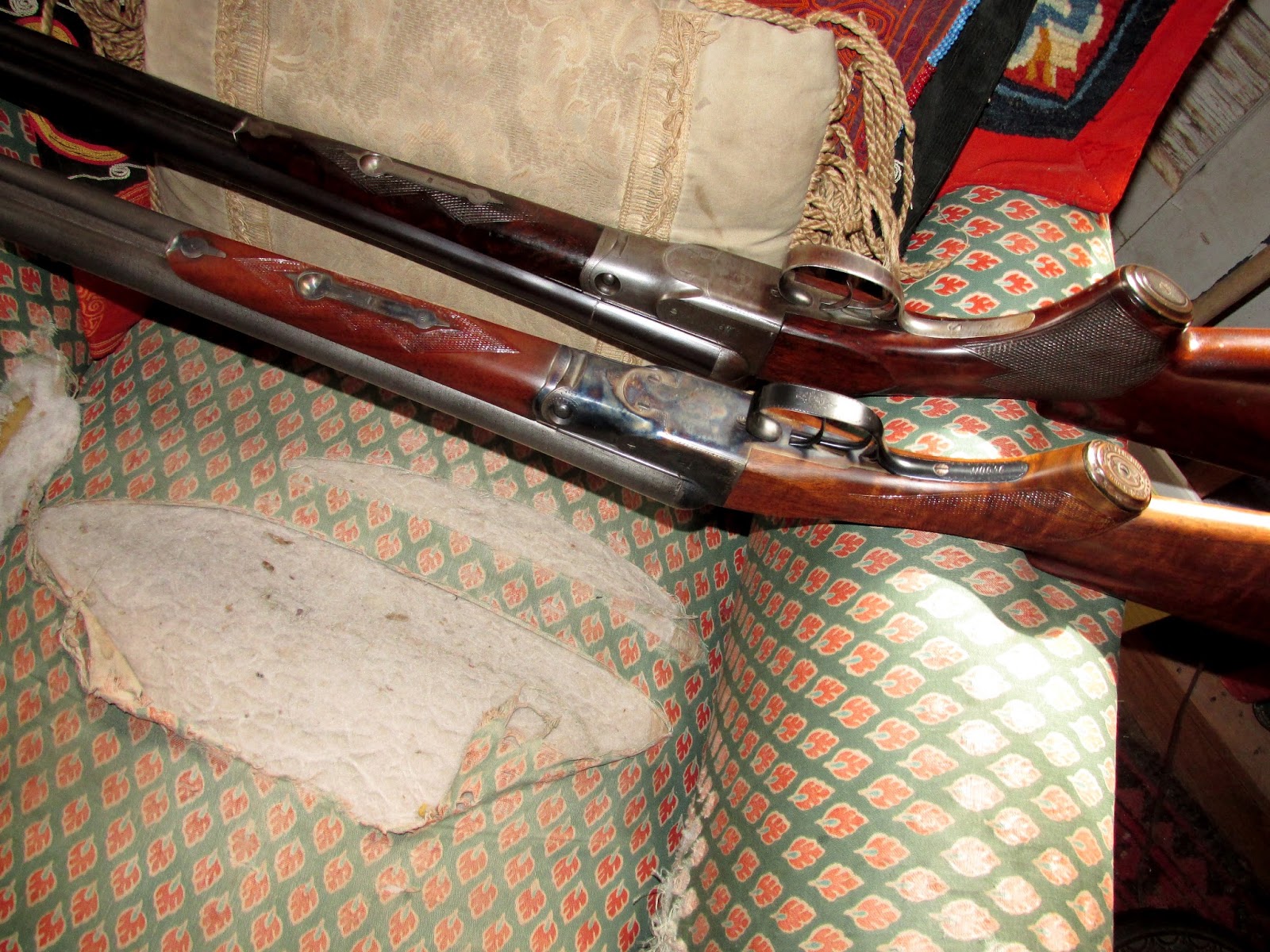
Parkers: the exquisite Damascus is a del Grego restoration, unfortunately with its firing pin noses filed down on the hammers, as in Larry del Grego's day, most Americans thought that Damsacus was unsafe. It is probably best not to know how many gorgeous guns bit the dust in the fifties and sixties (or as one fool in an early Gun Digest suggested, were THROWN INTO PONDS)...
Both guns are equipped with 30" barrels, heavier on the sleeved gun, which is also on a heavier frame, one used for 10 gauges. It seems to have been rebuilt as a Pigeon gun; its tight pistol grip and amazinglyeven patterns at 45 measured yards, even with a light game load of an ounce of 7 1/2s, suggests this.The Damascus gun is only a little lighter -- both are under 8 pounds -- but they have very different sight pictures. The sleeved gun was made in 1890, and I believe the Damascus was made in 1905.
The sleeved gun also has the most amazing sight bead I've ever seen with parallel gold and ivory bands.


John checkers the Darne "Nameless":
 Rosanne's drawing of the lovely but annoying (she refuses to learn to tolerate hats, a real fault in a desert town) Esme.

And the countdown begins--this is post #3995...
Parkers: the exquisite Damascus is a del Grego restoration, unfortunately with its firing pin noses filed down on the hammers, as in Larry del Grego's day, most Americans thought that Damsacus was unsafe. It is probably best not to know how many gorgeous guns bit the dust in the fifties and sixties (or as one fool in an early Gun Digest suggested, were THROWN INTO PONDS)...
Both guns are equipped with 30" barrels, heavier on the sleeved gun, which is also on a heavier frame, one used for 10 gauges. It seems to have been rebuilt as a Pigeon gun; its tight pistol grip and amazinglyeven patterns at 45 measured yards, even with a light game load of an ounce of 7 1/2s, suggests this.The Damascus gun is only a little lighter -- both are under 8 pounds -- but they have very different sight pictures. The sleeved gun was made in 1890, and I believe the Damascus was made in 1905.
The sleeved gun also has the most amazing sight bead I've ever seen with parallel gold and ivory bands.


Monday, November 16, 2015
The LC 16: what it IS
The "weird gun" is finished. A 16 bore wildfowl gun that weighs close to 8 pounds, with 30" Damascus barrels and full chokes, it appears distinctly pre - modern. Which it literally is- an early grade 2 LC Smith from about 1904.
But it was not unique in its day. So many of us use English guns as our standard, but there are others. In his The American Shotgun in 1910, Charles Askins Sr. wrote: "Thirty inch barrels in a sixteen bore with the stock cut on finer lines makes an especially elegant looking weapon. Should the arm weigh over six and a half pounds, or be intended for trap and duck shooting, then try the thirty-two inch barrels." This gun follows his formula: his old ornate Flues model Ithaca 16, later owned and written about by Elmer Keith and sold this year for more than $8000.
 My gun, though it has extractors and double triggers, is obviously built to the same standards.

But it was not unique in its day. So many of us use English guns as our standard, but there are others. In his The American Shotgun in 1910, Charles Askins Sr. wrote: "Thirty inch barrels in a sixteen bore with the stock cut on finer lines makes an especially elegant looking weapon. Should the arm weigh over six and a half pounds, or be intended for trap and duck shooting, then try the thirty-two inch barrels." This gun follows his formula: his old ornate Flues model Ithaca 16, later owned and written about by Elmer Keith and sold this year for more than $8000.


Saturday, November 14, 2015
Old & very old guns
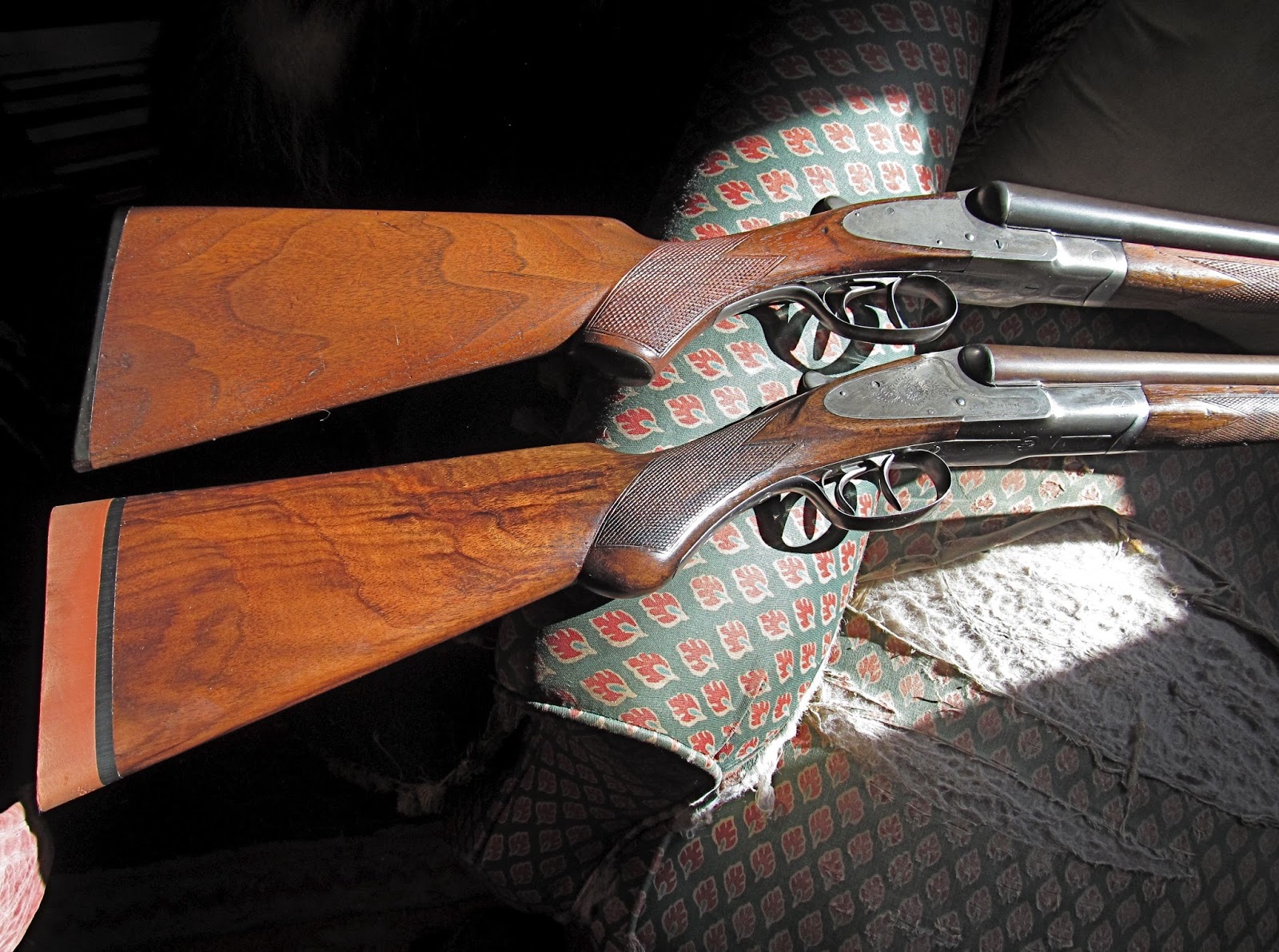
Latest restorations. More text later. But the 12 "featherweight" handles like a Best Brit gun, while the "Askins- Keith special" 16 is almost 8 pounds and has 30" barrels and tight chokes. The prairies were not bucolic England...
To see the details like Damascus, click to enlarge...


To see the details like Damascus, click to enlarge...


Tuesday, October 06, 2015
Italian Design
Italian gun design, like Spanish, has looked to England, albeit with more decorative engraving and gaudier wood. Now, things are changing, some radically, some more subtly.
For the radical, see Benelli's re- imagining of the over and under. I cannot warm to this angular- lined gun, but you should not bet against Benelli. Years ago, it brought out autoloaders that cost more than any others but the obscure Cosmi, which I thought was an unlikely direction to follow. But when T. McGuane bought a Black eagle, followed by Pat and Carol Hemingway after they had their gun collection stolen, I knew that people were paying attention.
 I like the mechanical inventiveness- I am less than pleased with the angularity...
Which is not the problem with the Mark Newsom- designed, limited edition Beretta 486, a $25,000 gun that may be the ultimate refinement of the round action. Newsom had not designed a gun before; as far as I know he didn't even shoot. This one is odd, but I see no reason it wouldn't work..


Still, if your taste is more traditional, how about their "Parrallelo"? This one reminds me of the unsuccessful but mourned Ruger round action a few years ago. Maybe Beretta's slightly higher price, around $5000, will allow it to find a permanent niche.
 My own preference is a little 28 bore, the least expensive (though hardly cheap) of these new guns. The F.A.I.R. Iside looks not unlike the Beretta, but its innovative boxlock action is forged in one piece, with integral tangs, which may be what brings its price down to an almost affordable $3000.


For the radical, see Benelli's re- imagining of the over and under. I cannot warm to this angular- lined gun, but you should not bet against Benelli. Years ago, it brought out autoloaders that cost more than any others but the obscure Cosmi, which I thought was an unlikely direction to follow. But when T. McGuane bought a Black eagle, followed by Pat and Carol Hemingway after they had their gun collection stolen, I knew that people were paying attention.

Which is not the problem with the Mark Newsom- designed, limited edition Beretta 486, a $25,000 gun that may be the ultimate refinement of the round action. Newsom had not designed a gun before; as far as I know he didn't even shoot. This one is odd, but I see no reason it wouldn't work..


Still, if your taste is more traditional, how about their "Parrallelo"? This one reminds me of the unsuccessful but mourned Ruger round action a few years ago. Maybe Beretta's slightly higher price, around $5000, will allow it to find a permanent niche.


Sunday, August 30, 2015
"A simple linear gesture.."
LC Smith Field Grade Featherweight-- an honest Yankee double, finished. Nothing has cleaner lines. This 6 1/4 pound, 28" 12 bore from, probably, the twenties, is a perfcctly balanced gun.


Wednesday, April 15, 2015
Unique action
France has always gone its own merry way in design-- in cars, think of the Citroen; in guns-- well, more seem unique than those of any other country (can "more" and "unique" coexist this way in a sentence?)
The first that comes to mind is the sliding breech Darne. I have had many. Carlos Martinez del Rio owns my last, a 30's 16 bore, and I may yet get another.

 And what about a Manufrance Ideal with lunette trigger guards?
 Or the rotating breech Darne, with an opening mechanism a bit like some artillery guns or punt guns but on a light game action? (I have only seen pictures, this one from a Raymond Caranta article in an old Gun Digest, on the collection of Christian Ducros, the only postmodern gunmaker).
 Recently Djamel, who runs the brilliant French gun and sport blog La Chasse et les Armes Fines, sent me the best yet, a combination of antique and what must have been cutting- edge modern: a hammer rotating breech Darne!


The first that comes to mind is the sliding breech Darne. I have had many. Carlos Martinez del Rio owns my last, a 30's 16 bore, and I may yet get another.
Friday, March 27, 2015

Saturday, December 27, 2014
Stephen Grant hammer 16...
... at present. Next we will focus on the barrels. I think it was made in 1868. Right or double click to enlarge.

Sunday, November 30, 2014
Beautiful guns plus
I very nearly used Libby's not unkind but perhaps too accurate term "gun porn", but quailed at putting it in the title, fearing just what search engines might send people here. The Stephen Grant 16 is all cleaned up-- mechanicals by John Besse, wood by me-- safe to shoot, and pretty-- now I must decide what else if anything to do to bring it back to life. One set of numbers suggests it was made in 1868, but given its signs of being a converted pinfire, I must wonder if that was when it was converted. But the fine scroll is a mostly 1870 (and later) characteristic.
It really is a BEST gun though-- airy balance right on the hinge pin. Adding removable Briley Titanium tubes in 28 wouldn't get it to 6 pounds!
Here it is with its fellow 16's-- a square- backed Browning from FN in its first year of production, a 30's Belgian guild gun made for Stoeger in the 30's and sold at Abercrombie to my friend Gerry, or rather his grandfather, when he was 13, Soon afterwards, his mother took it over and shot enough Yankee grouse with it to shoot it loose. Look how much deeper a typical Anson and Deeley action is than that of a back action sidelock.

.JPG)
It really is a BEST gun though-- airy balance right on the hinge pin. Adding removable Briley Titanium tubes in 28 wouldn't get it to 6 pounds!
Here it is with its fellow 16's-- a square- backed Browning from FN in its first year of production, a 30's Belgian guild gun made for Stoeger in the 30's and sold at Abercrombie to my friend Gerry, or rather his grandfather, when he was 13, Soon afterwards, his mother took it over and shot enough Yankee grouse with it to shoot it loose. Look how much deeper a typical Anson and Deeley action is than that of a back action sidelock.
And with its sister English gun, my amazing 4 pound Thomas Turner .410. Recently the Field has published an article suggesting Turner was one of only six provincial makers who made their own actions. If this is true it makes this rare long- stocked .410 even more unusual. I already knew they were specialist makers of lightweight guns, not just .410's.
Friday, November 28, 2014
Quote
On "Best" guns, from the delightful Westley Richards Blog:
"...the very best work is still done by men with files and chisels and, by definition, best work is what a best gun is about. When asked about the difference between making guns and making best guns, Tom Wilkes made the observation ‘it all comes down to time and control of the tool, doesn’t it’?"
"...the very best work is still done by men with files and chisels and, by definition, best work is what a best gun is about. When asked about the difference between making guns and making best guns, Tom Wilkes made the observation ‘it all comes down to time and control of the tool, doesn’t it’?"
Monday, November 10, 2014


Wednesday, August 06, 2014
English guns, big and small
I am tempted to agree with Bob Braden and Cyril Adams, authors of Lock, Stock, and Barrel; for SHOTguns, at least side - by - side doubles, you really can't beat the English. The new ones' prices are barking mad, far more than my house; for the Best London ones, easily three times as much as my house, and they can't keep up with the demand. I can't imagine who buys them- I have known exactly one person who has bought new London guns, though more than a few who have owned older examples.
Because for the rest of us, a little scholarship goes a long way. Consider this Thomas Turner boxlock .410, which is an expensive gun by my humble standards now, but not unaffordable, and was almost cheap when I bought it. Or this flawless (though it needs a stock refinish, and I would like to get the Damascus figure in the barrels to show more) ten bore by Williams and Powell, which weighs twice as much as the little one, and cost less. Yet both are harmonious and graceful. There are few ugly English guns, especially ones made before WW II, and no two are quite alike unless built as pairs.
And that brings to mind another maxim from Braden and Adams: how many still- functional English guns 100 years old and more exist-- ones that need no repairs to shoot.


Because for the rest of us, a little scholarship goes a long way. Consider this Thomas Turner boxlock .410, which is an expensive gun by my humble standards now, but not unaffordable, and was almost cheap when I bought it. Or this flawless (though it needs a stock refinish, and I would like to get the Damascus figure in the barrels to show more) ten bore by Williams and Powell, which weighs twice as much as the little one, and cost less. Yet both are harmonious and graceful. There are few ugly English guns, especially ones made before WW II, and no two are quite alike unless built as pairs.
And that brings to mind another maxim from Braden and Adams: how many still- functional English guns 100 years old and more exist-- ones that need no repairs to shoot.
Thursday, June 12, 2014
Shooting Smallbores
... and WHY smallbores. No time for deep analysis today-- an eagerly awaited guest, last minute prep for the new tiercel including expanded housing, gunsmithery, cooking. But it would come as no surprise to most readers that I am down to using two smallbores: my all- time favorite English .410 (sold away years ago, fortuitously regained thanks to Tom Quinn and Libby), and a total surprise, suggested to me by Mel Merritt at Ron Peterson's, a sidelock Spanish 28 made for the US market in 1959. In the first photo, Jessica Abberley shoots the .410 and smashes her targets as husband Piet Ditmars of Dunhill Ranch runs the machine. Double or right click for a bigger image.
That this is the first time she ever shot a side- by- side, two triggers, or a .410 makes her ability even more amazing. But I shoot well with it too, better than almost any gun I have ever owned, and I am not a natural with a shotgun despite my having shot one since I was eight.
Below that are the guns-- more on them later. Meanwhile, see Steve Hughes' column in the July/ August Shooting Sportsman, where he examines Ben Williams' 28 bore Holloway and Naughton, a gun amazingly like my Turner .410 in everything but name and gauge.


That this is the first time she ever shot a side- by- side, two triggers, or a .410 makes her ability even more amazing. But I shoot well with it too, better than almost any gun I have ever owned, and I am not a natural with a shotgun despite my having shot one since I was eight.
Below that are the guns-- more on them later. Meanwhile, see Steve Hughes' column in the July/ August Shooting Sportsman, where he examines Ben Williams' 28 bore Holloway and Naughton, a gun amazingly like my Turner .410 in everything but name and gauge.
Saturday, March 22, 2014
A little more info?
For those who do not follow regularly-- a couple of e- mailers wondered about the post below.
The shotgun below is a Best quality London- style Birmingham sidelock 12 bore, with a three figure serial number, built by Frederick "Frank" Scott between the end of the Great War and the end of his firm in 1918. He probably made less than a thousand guns, unlike his famous uncle William.
Many guns of this style have been made in England and Spain. Today the Spanish are expensive and the Brits cost more than my house. I got this one last year mostly by trading, turning over a boxlock nearly as fine, with the same dimensions, that I had owned for a long time. But its cost even without trade was about that of a good American semi- custom rifle, ie affordable by anyone who saves a bit. Let us say, low 4 figures as opposed to the latest Holland and Holland Royal on similar patents I saw for sale last week, at eighty seven thousand pounds. (This one cost 50 when it was made!) And still today, less than any contemporary Spanish sidelock.
Check the Internet ads of people like Kirby at Vintage, Diggory Haddoke, Champlin, and Woodcock Hill, where they give plenty of detail. If you are in New Mexico, go to Ron Peterson's, where I got this gun and have bought and sold a scary amount more. Read Steve Hughes and Haddoke and Terry Weiland and Vic Venters. Look at lots of guns; then, trust your instincts. Don't be put off by things like sleeving that is well done; even less by good Damascus. You will pay much less if you avoid "names"-- this was the first FRED Scott I ever saw.
Below, the Scott, with my English .410 to contrast, and his 1910 catalog, from Abby Cornell's fabulous reprint series..


The shotgun below is a Best quality London- style Birmingham sidelock 12 bore, with a three figure serial number, built by Frederick "Frank" Scott between the end of the Great War and the end of his firm in 1918. He probably made less than a thousand guns, unlike his famous uncle William.
Many guns of this style have been made in England and Spain. Today the Spanish are expensive and the Brits cost more than my house. I got this one last year mostly by trading, turning over a boxlock nearly as fine, with the same dimensions, that I had owned for a long time. But its cost even without trade was about that of a good American semi- custom rifle, ie affordable by anyone who saves a bit. Let us say, low 4 figures as opposed to the latest Holland and Holland Royal on similar patents I saw for sale last week, at eighty seven thousand pounds. (This one cost 50 when it was made!) And still today, less than any contemporary Spanish sidelock.
Check the Internet ads of people like Kirby at Vintage, Diggory Haddoke, Champlin, and Woodcock Hill, where they give plenty of detail. If you are in New Mexico, go to Ron Peterson's, where I got this gun and have bought and sold a scary amount more. Read Steve Hughes and Haddoke and Terry Weiland and Vic Venters. Look at lots of guns; then, trust your instincts. Don't be put off by things like sleeving that is well done; even less by good Damascus. You will pay much less if you avoid "names"-- this was the first FRED Scott I ever saw.
Below, the Scott, with my English .410 to contrast, and his 1910 catalog, from Abby Cornell's fabulous reprint series..
Subscribe to:
Posts (Atom)